


ISO 603-7:1999
(Main)Bonded abrasive products - Dimensions - Part 7: Grinding wheels for manually guided grinding
Bonded abrasive products - Dimensions - Part 7: Grinding wheels for manually guided grinding
Produits abrasifs agglomérés — Dimensions — Partie 7: Meules pour meulage à guidage manuel
La présente partie de l'ISO 603 spécifie les dimensions nominales, en millimètres, des meules de- Type 1: Meule plate- Type 5: Meule à un embrèvement- Type 6: Meule boisseau droit- Type 35: Meule lapidaire collée ou serrée- Type 36: Meule lapidaire à écrous noyés- Type 37: Meule cylindre à écrous noyésCes produits abrasifs agglomérés sont utilisés pour le meulage de pièces de surfaces quelconques. La pièce travaillée est guidée manuellement, la meule est fixe.
General Information
Relations
Overview
ISO 603-7:1999, "Bonded abrasive products - Dimensions - Part 7: Grinding wheels for manually guided grinding," specifies nominal dimensions (in millimetres) and designation rules for grinding wheels intended for manually guided grinding operations. The standard covers a range of wheel types (straight, recessed, cup, disc and cylinder styles) and describes how to identify and mark these bonded abrasive products for safe and consistent use where the workpiece is guided by hand and the wheel is fixed.
Key topics and technical requirements
- Wheel types and dimensions: Defines nominal dimensions for Type 1 (straight), Type 5 (recessed on one side), Type 6 (straight cup), Type 35 (cemented or clamped disc), Type 36 (disc with inserted nuts) and Type 37 (cylinder with inserted nuts). Dimensions are given in millimetres and illustrated with figures and tables.
- Designation: Prescribes the complete designation format including type, dimensions, abrasive nature, grain size, grade, structure, bond type and maximum operating speed (example format provided in the standard).
- Tolerances and run-out: Limit deviations and run-out tolerances are to follow ISO 13942 (referenced).
- Balancing: Static balancing requirements and testing are referenced to ISO 6103.
- Marking and general requirements: Marking and general product requirements are covered by ISO 525; manufacturers are expected to provide marking consistent with that standard.
- Manufacturer specifications: Detailed product specifications (e.g., manufacturing tolerances beyond the dimensional tables) are left to the manufacturer’s discretion, within referenced normative requirements.
Practical applications
ISO 603-7 is used to ensure compatibility, safety and interchangeability of grinding wheels used in off-hand/manual grinding operations. Typical applications include:
- Hand-held grinding and finishing of metal and other materials
- Regrinding and surface treatment where the operator guides the workpiece manually
- Selection and procurement of bonded abrasive products for workshops, maintenance, fabrication and toolrooms
Who uses this standard
- Abrasive product manufacturers and designers - for product dimensioning, marking and catalogue specifications
- Quality control and compliance teams - to verify tolerances, balancing and marking
- Procurement and distributors - for unambiguous product ordering and designation
- Machine shops, maintenance departments and safety officers - to ensure correct wheel selection and safe maximum operating speeds
Related standards
- ISO 525:1999 - Bonded abrasive products - General requirements
- ISO 6103:1999 - Static balancing of grinding wheels - Testing
- ISO 13942 - Limit deviations and run-out tolerances
- Other parts of ISO 603 series (Parts 1–16) and ISO 8486 (grain size determination)
Keywords: ISO 603-7, bonded abrasive products, grinding wheels, manually guided grinding, dimensions, tolerances, balancing, marking.
Standards Content (Sample)
ISO
INTERNATIONAL
603-7
STANDARD
First edition
1999-07-15
Bonded abrasive products —
Dimensions —
Part 7:
Grinding wheels for manually guided grinding
Produits abrasifs agglomérés — Dimensions —
Partie 7: Meules pour meulage à guidage manuel
A
Reference number
Contents Page
1 Scope .1
2 Normative references .1
3 Dimensions.2
3.1 Type 1: Straight grinding wheel .2
3.2 Type 5: Wheel recessed on one side .3
3.3 Type 6: Straight cup wheel .3
3.4 Type 35: Cemented or clamped disc wheel .4
3.5 Type 36:Disc wheel with inserted nuts.4
3.6 Type 37: Cylinder wheels with inserted nuts.5
4 Designation .5
5 Specifications.6
5.1 Tolerances.6
5.2 Balancing.6
5.3 Marking .6
Bibliography.7
© ISO 1999
All rights reserved. Unless otherwise specified, no part of this publication may be reproduced or utilized in any form or by any means, electronic
or mechanical, including photocopying and microfilm, without permission in writing from the publisher.
International Organization for Standardization
Case postale 56 • CH-1211 Genève 20 • Switzerland
Internet iso@iso.ch
Printed in Switzerland
ii
© ISO
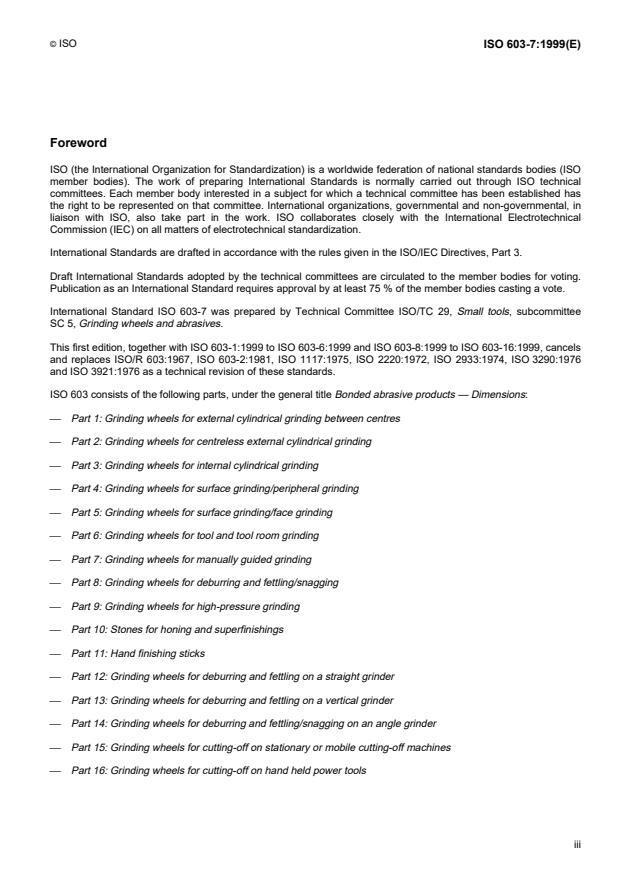
Foreword
ISO (the International Organization for Standardization) is a worldwide federation of national standards bodies (ISO
member bodies). The work of preparing International Standards is normally carried out through ISO technical
committees. Each member body interested in a subject for which a technical committee has been established has
the right to be represented on that committee. International organizations, governmental and non-governmental, in
liaison with ISO, also take part in the work. ISO collaborates closely with the International Electrotechnical
Commission (IEC) on all matters of electrotechnical standardization.
International Standards are drafted in accordance with the rules given in the ISO/IEC Directives, Part 3.
Draft International Standards adopted by the technical committees are circulated to the member bodies for voting.
Publication as an International Standard requires approval by at least 75 % of the member bodies casting a vote.
International Standard ISO 603-7 was prepared by Technical Committee ISO/TC 29, Small tools, subcommittee
SC 5, Grinding wheels and abrasives.
This first edition, together with ISO 603-1:1999 to ISO 603-6:1999 and ISO 603-8:1999 to ISO 603-16:1999, cancels
and replaces ISO/R 603:1967, ISO 603-2:1981, ISO 1117:1975, ISO 2220:1972, ISO 2933:1974, ISO 3290:1976
and ISO 3921:1976 as a technical revision of these standards.
ISO 603 consists of the following parts, under the general title Bonded abrasive products — Dimensions:
Part 1: Grinding wheels for external cylindrical grinding between centres
Part 2: Grinding wheels for centreless external cylindrical grinding
Part 3: Grinding wheels for internal cylindrical grinding
Part 4: Grinding wheels for surface grinding/peripheral grinding
Part 5: Grinding wheels for surface grinding/face grinding
Part 6: Grinding wheels for tool and tool room grinding
Part 7: Grinding wheels for manually guided grinding
Part 8: Grinding wheels for deburring and fettling/snagging
Part 9: Grinding wheels for high-pressure grinding
Part 10: Stones for honing and superfinishings
Part 11: Hand finishing sticks
Part 12: Grinding wheels for deburring and fettling on a straight grinder
Part 13: Grinding wheels for deburring and fettling on a vertical grinder
Part 14: Grinding wheels for deburring and fettling/snagging on an angle grinder
Part 15: Grinding wheels for cutting-off on stationary or mobile c
...
NORME ISO
INTERNATIONALE 603-7
Première édition
1999-07-15
Produits abrasifs agglomérés —
Dimensions —
Partie 7:
Meules pour meulage à guidage manuel
Bonded abrasive products — Dimensions —
Part 7: Grinding wheels for manually guided grinding
A
Numéro de référence
Sommaire Page
1 Domaine d’application .1
2 Références normatives .1
3 Dimensions.2
3.1 Type 1: Meule plate.2
3.2 Type 5: Meule à un embrèvement .3
3.3 Type 6: Meule boisseau droit .3
3.4 Type 35: Meule lapidaire collée ou serrée.4
3.5 Type 36: Meule lapidaire à écrous noyés .4
3.6 Type 37: Meule cylindre à écrous noyés .5
4 Désignation .5
5 Spécifications.6
5.1 Tolérances.6
5.2 Équilibrage .6
5.3 Marquage.6
Bibliographie.7
© ISO 1999
Droits de reproduction réservés. Sauf prescription différente, aucune partie de cette publication ne peut être reproduite ni utilisée sous quelque
forme que ce soit et par aucun procédé, électronique ou mécanique, y compris la photocopie et les microfilms, sans l'accord écrit de l'éditeur.
Organisation internationale de normalisation
Case postale 56 • CH-1211 Genève 20 • Suisse
Internet iso@iso.ch
Imprimé en Suisse
ii
© ISO
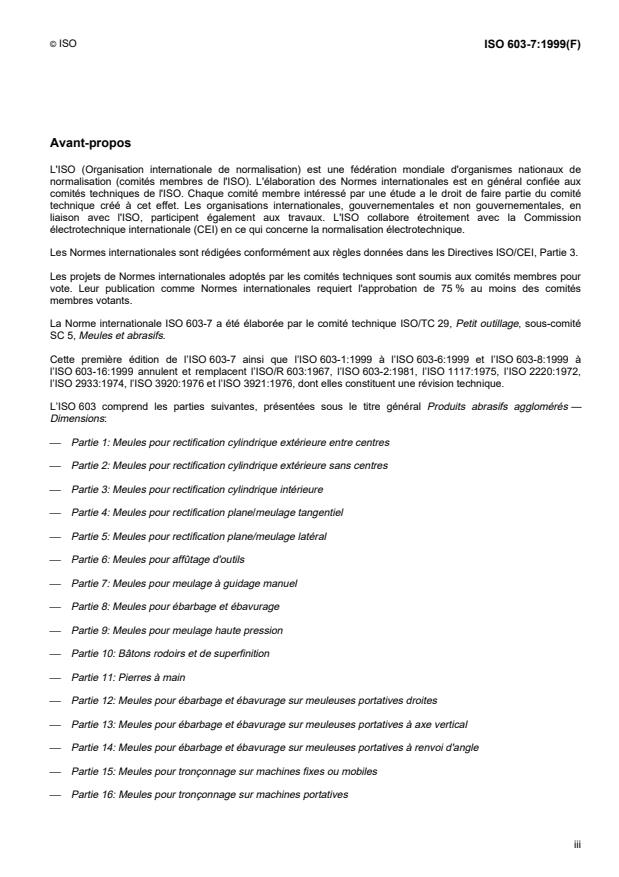
Avant-propos
L'ISO (Organisation internationale de normalisation) est une fédération mondiale d'organismes nationaux de
normalisation (comités membres de l'ISO). L'élaboration des Normes internationales est en général confiée aux
comités techniques de l'ISO. Chaque comité membre intéressé par une étude a le droit de faire partie du comité
technique créé à cet effet. Les organisations internationales, gouvernementales et non gouvernementales, en
liaison avec l'ISO, participent également aux travaux. L'ISO collabore étroitement avec la Commission
électrotechnique internationale (CEI) en ce qui concerne la normalisation électrotechnique.
Les Normes internationales sont rédigées conformément aux règles données dans les Directives ISO/CEI, Partie 3.
Les projets de Normes internationales adoptés par les comités techniques sont soumis aux comités membres pour
vote. Leur publication comme Normes internationales requiert l'approbation de 75 % au moins des comités
membres votants.
La Norme internationale ISO 603-7 a été élaborée par le comité technique ISO/TC 29, Petit outillage, sous-comité
SC 5, Meules et abrasifs.
Cette première édition de l’ISO 603-7 ainsi que l’ISO 603-1:1999 à l’ISO 603-6:1999 et l’ISO 603-8:1999 à
l’ISO 603-16:1999 annulent et remplacent l’ISO/R 603:1967, l’ISO 603-2:1981, l’ISO 1117:1975, l’ISO 2220:1972,
l’ISO 2933:1974, l’ISO 3920:1976 et l’ISO 3921:1976, dont elles constituent une révision technique.
L’ISO 603 comprend les parties suivantes, présentées sous le titre général Produits abrasifs agglomérés —
Dimensions:
Partie 1: Meules pour rectification cylindrique extérieure entre centres
Partie 2: Meules pour rectification cylindrique extérieure sans centres
Partie 3: Meules pour rectification cylindrique intérieure
Partie 4: Meules pour rectification plane/meulage tangentiel
Partie 5: Meules pour rectification plane/meulage latéral
Partie 6: Meules pour affûtage d'outils
Partie 7: Meules pour meulage à guidage manuel
Partie 8: Meules pour ébarbage et ébavurage
Partie 9: Meules pour meulage haute pression
Partie 10: Bâtons rodoirs et de superfinition
Partie 11: Pierres à main
Partie 12: Meules pour ébarbage et ébavurage sur meuleuses portatives droites
Partie 13: Meules pour ébarbage et ébavurage sur meuleuses portatives à axe vertical
Partie 14: Meules pour ébarbage et ébavurage sur meuleuses portatives à renvoi d'angle
Partie 15: Meules pour tronçonnage sur machines fixes ou mobiles
Partie 16: Meules pour tronçonnage sur machines portatives
iii
-----------------
...
Frequently Asked Questions
ISO 603-7:1999 is a standard published by the International Organization for Standardization (ISO). Its full title is "Bonded abrasive products - Dimensions - Part 7: Grinding wheels for manually guided grinding". This standard covers: La présente partie de l'ISO 603 spécifie les dimensions nominales, en millimètres, des meules de- Type 1: Meule plate- Type 5: Meule à un embrèvement- Type 6: Meule boisseau droit- Type 35: Meule lapidaire collée ou serrée- Type 36: Meule lapidaire à écrous noyés- Type 37: Meule cylindre à écrous noyésCes produits abrasifs agglomérés sont utilisés pour le meulage de pièces de surfaces quelconques. La pièce travaillée est guidée manuellement, la meule est fixe.
La présente partie de l'ISO 603 spécifie les dimensions nominales, en millimètres, des meules de- Type 1: Meule plate- Type 5: Meule à un embrèvement- Type 6: Meule boisseau droit- Type 35: Meule lapidaire collée ou serrée- Type 36: Meule lapidaire à écrous noyés- Type 37: Meule cylindre à écrous noyésCes produits abrasifs agglomérés sont utilisés pour le meulage de pièces de surfaces quelconques. La pièce travaillée est guidée manuellement, la meule est fixe.
ISO 603-7:1999 is classified under the following ICS (International Classification for Standards) categories: 25.100.70 - Abrasives. The ICS classification helps identify the subject area and facilitates finding related standards.
ISO 603-7:1999 has the following relationships with other standards: It is inter standard links to ISO 603-7:1999/Cor 1:1999, ISO 603-2:1981, ISO 3920:1976, ISO 2220:1972, ISO/R 603:1967, ISO 1117:1975, ISO 3921:1976, ISO 2933:1974; is excused to ISO 603-7:1999/Cor 1:1999. Understanding these relationships helps ensure you are using the most current and applicable version of the standard.
You can purchase ISO 603-7:1999 directly from iTeh Standards. The document is available in PDF format and is delivered instantly after payment. Add the standard to your cart and complete the secure checkout process. iTeh Standards is an authorized distributor of ISO standards.
Questions, Comments and Discussion
Ask us and Technical Secretary will try to provide an answer. You can facilitate discussion about the standard in here.
Loading comments...