

ISO/FDIS 27468
(Main)Nuclear criticality safety — Evaluation of systems containing PWR uranium oxide fuels — Burnup credit
- Abstract
ISO 27468:2011 establishes an evaluation methodology for nuclear criticality safety with burnup credit. It identifies important parameters and specifies requirements, recommendations, and precautions to be taken into account in the evaluations. It also highlights the main important technical fields to ensure that the fuel composition or history considered in calculations provides a bounding value of the effective neutron multiplication factor, keff. ISO 27468:2011 is applicable to transport, storage, disposal or reprocessing units implying irradiated fissile material from pressurized water reactor (PWR) fuels that initially contain uranium oxide (UOX). Fuels irradiated in other reactors (e.g. boiling water reactors) and fuels that initially contain mixed uranium-plutonium oxide are not covered in ISO 27468:2011. ISO 27468:2011 does not specify requirements related to overall criticality safety evaluation or eventual implementation of burnup credit.
- Status
- Not Published
- Technical Committee
- ISO/TC 85/SC 5 - Nuclear installations, processes and technologies
- Drafting Committee
- ISO/TC 85/SC 5/WG 8 - Nuclear criticality safety
- Current Stage
- 5020 - FDIS ballot initiated: 2 months. Proof sent to secretariat
- Start Date
- 19-Aug-2026
- Completion Date
- 19-Aug-2026
Buy Documents
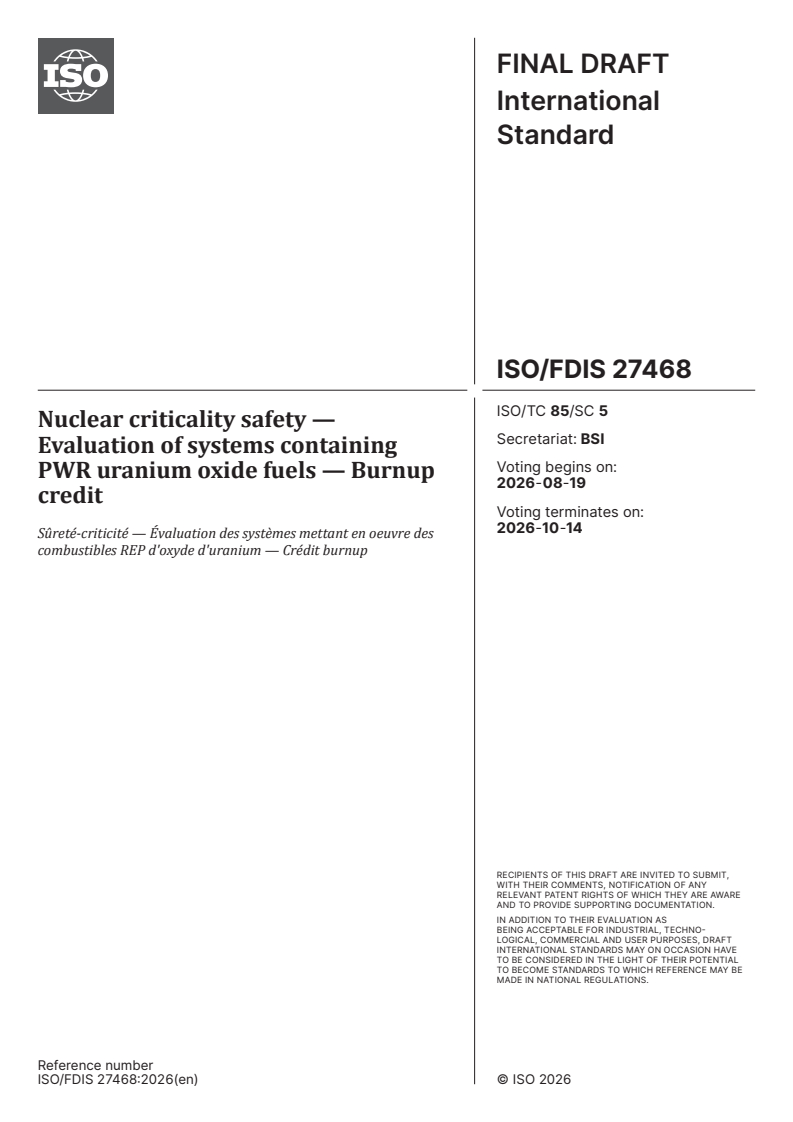

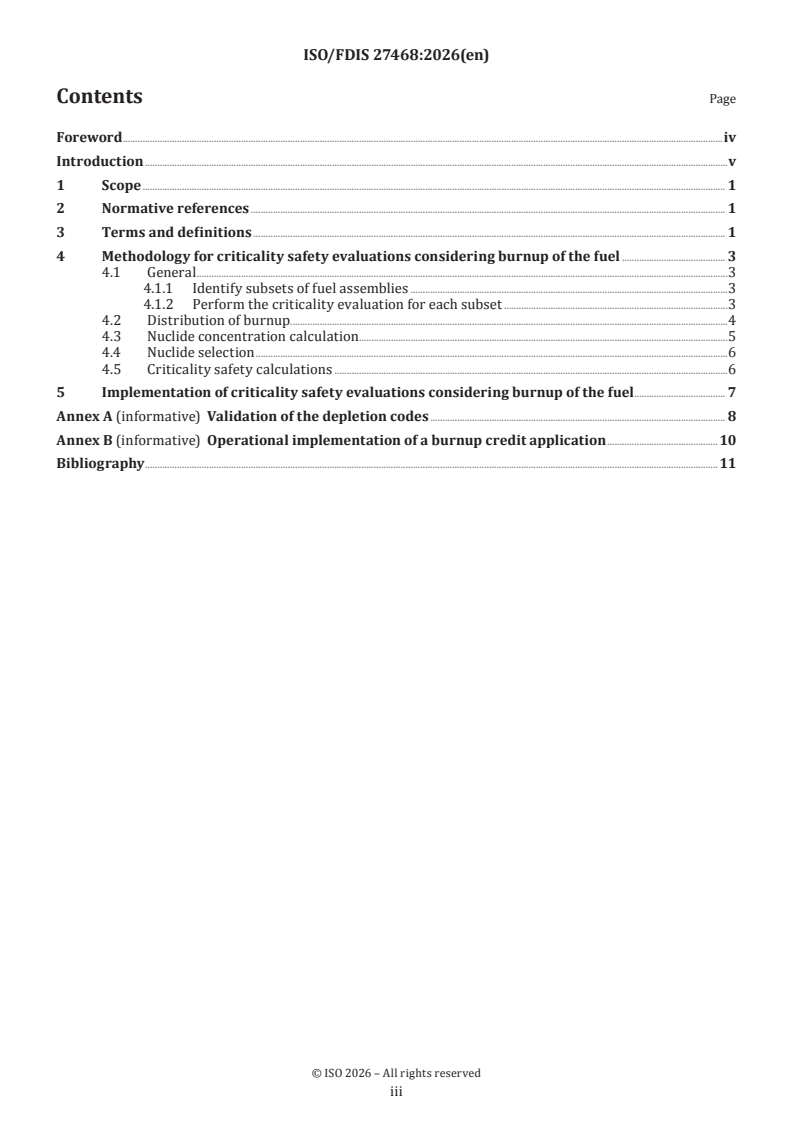

ISO/FDIS 27468 - Nuclear criticality safety — Evaluation of systems containing PWR uranium oxide fuels — Burnup credit
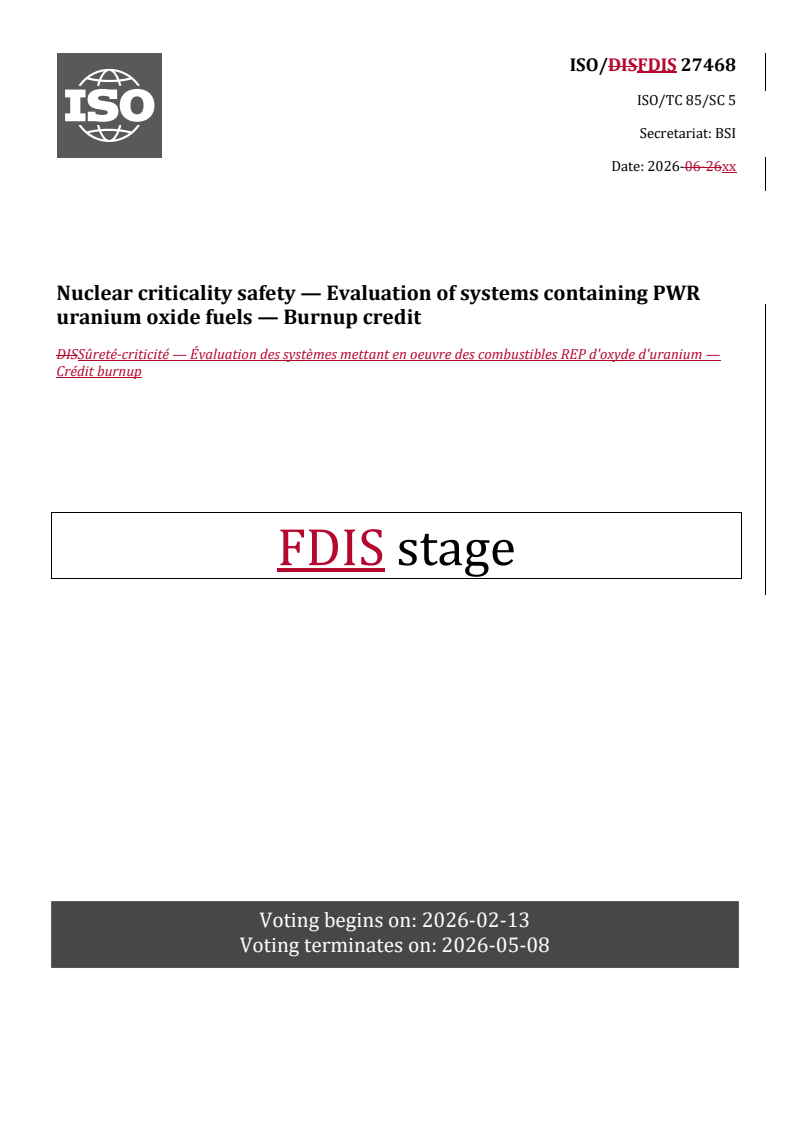
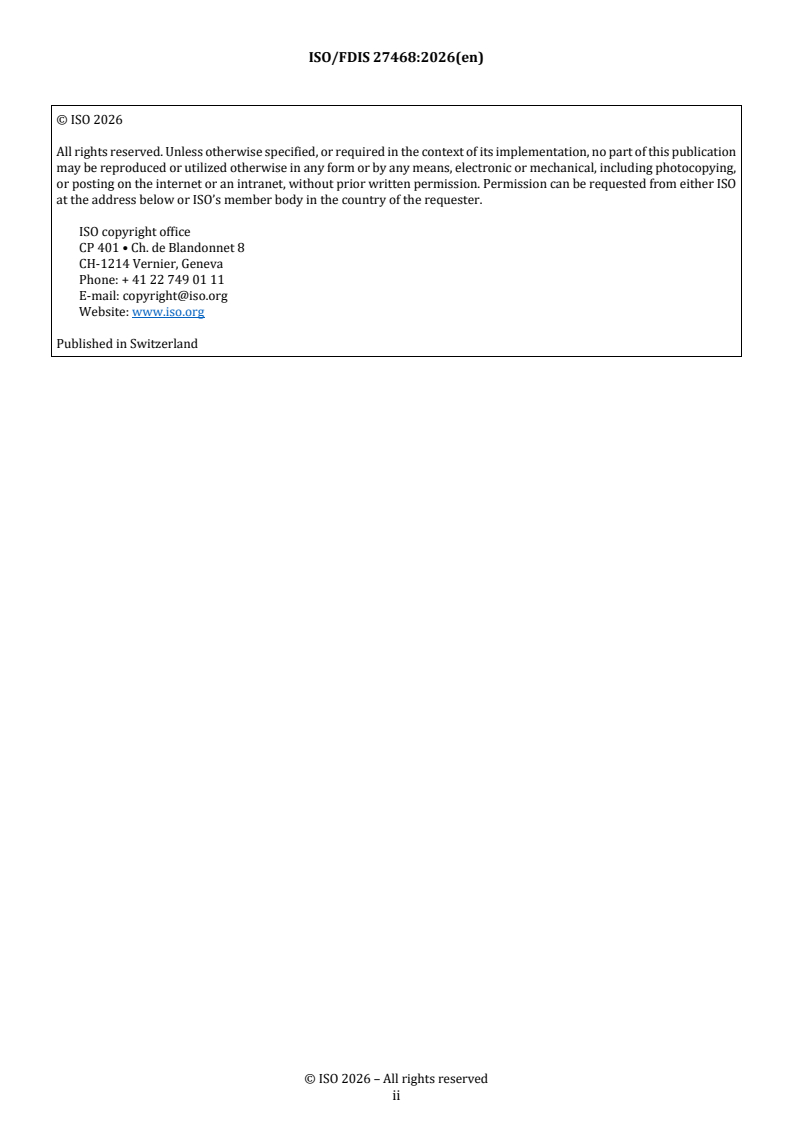
REDLINE ISO/FDIS 27468 - Nuclear criticality safety — Evaluation of systems containing PWR uranium oxide fuels — Burnup credit

ISO/FDIS 27468 - Sûreté-criticité — Évaluation des systèmes mettant en oeuvre des combustibles REP d'oxyde d'uranium — Crédit burnup
ISO/FDIS 27468 is an ISO standard for nuclear criticality safety evaluations that use burnup credit for systems containing PWR uranium oxide fuels. It specifies a methodology for estimating the reactivity of irradiated fuel so the effective neutron multiplication factor, keff, is bounded for transport, storage, disposal and reprocessing applications.
What does ISO/FDIS 27468 specify?
ISO/FDIS 27468 specifies how to evaluate nuclear criticality safety with burnup credit for irradiated fissile material from pressurized water reactor (PWR) fuels that initially contain uranium oxide (UOX). It organizes the subject into scope, normative references, terms and definitions, a methodology clause, an implementation clause, and two informative annexes.
The standard applies to fuel that was initially made from enriched uranium oxide. Uranium may originate from natural uranium or recycled uranium. It does not cover fuels irradiated in other reactors or fuels that initially contain mixed uranium-plutonium oxide.
| Annex | What it covers |
|---|---|
| A | Validation of the depletion codes |
| B | Operational implementation of a burnup credit application |
What are the key requirements of ISO/FDIS 27468?
ISO/FDIS 27468 sets out the main steps and checks needed to make a burnup credit evaluation conservative and traceable. The practical aim is to support a keff calculation that remains bounding for the real fuel history and operating case.
1) Work on defined subsets of fuel assemblies
The standard says the population of fuel assemblies may be divided into subsets based on type, initial composition, burnup, cooling time and irradiation conditions. That matters because different fuel histories can lead to different nuclide inventories and different reactivity.
2) Use a justified burnup distribution
Clause 4.2 requires the burnup distribution to be evaluated because axial and radial or horizontal gradients can affect keff. The evaluator shall justify any division into regions or zones and shall choose an axial burnup profile that is conservative, including the effect of partially inserted control or absorber rods.
In practice, this means the burnup shape cannot be assumed casually. If a flat profile is used, the selected burnup value has to bound the end effect.
3) Calculate nuclide concentrations from validated depletion methods
Clause 4.3 requires the irradiated-fuel nuclide concentrations to be calculated from the fresh fuel characteristics, the irradiation parameters, the cooling time and validation of the depletion method. The irradiation parameters that can harden the neutron spectrum, such as boron concentration, coolant temperature and density, burnable absorbers, rod insertion, and nearby MOX or poisoned fuels, must be considered.
This matters because the depletion calculation determines what nuclides remain in the fuel, and those nuclides drive the burnup credit result. The document also requires the assumptions and options used in the depletion calculation to be evaluated and documented.
4) Select nuclides carefully
Clause 4.4 says actinides and fission products included in the keff evaluation shall be selected case by case. Nuclides with significant positive contribution to keff should be accounted for unless omission is justified, and only nuclides with stable concentration over the time frame of interest should be used as neutron absorbers.
In practice, the analyst must justify both inclusion and omission. The document also requires each accounted nuclide to be plausible for the normal and fault conditions of the application.
5) Apply criticality safety principles and account for burnup-specific effects
Clause 4.5 requires the basic principles and limitations of ISO 1709:2018 and ISO 14943:2004 to be applied. It also highlights burnup-specific effects such as fuel geometry changes, biases and uncertainties in cross-sections, convergence issues for loosely coupled systems in Monte Carlo calculations, and mixtures with other fissile materials.
This means burnup credit is not just a depletion calculation. The final keff calculation must also reflect geometry, data uncertainty and system interactions.
6) Support the calculation with validation and operational checks
Clause 5 requires specific evaluations and verifications for on-site operations and storage involving irradiated fuel. Annex A and Annex B give practical guidance for code validation and for checking that the real fuel history and burnup shape stay within the assessed domain.
What terms does ISO/FDIS 27468 define?
- Actinide - an element with atomic number from 90 to 103.
- Axial burnup profile - the burnup distribution along the length of a fuel assembly.
- Burnup - the average energy released during irradiation, divided by the initial mass of actinides in the fuel region.
- Burnup credit - the difference between keff for fresh fuel and irradiated fuel, determined through a structured evaluation process.
- Cooling time - the time after reactor shutdown during which decay changes nuclide concentrations.
- Depletion calculation - a calculation used to determine individual nuclide concentrations at the end of irradiation.
- Code validation - documented confirmation that a computer code predicts the intended process or system, usually by comparison with benchmark results.
- Loosely coupled system - a system with separated high-importance regions and low-neutron-importance regions.
Who uses ISO/FDIS 27468?
ISO/FDIS 27468 is used by nuclear criticality safety specialists, fuel-cycle engineers, transport and storage package designers, and teams involved in reprocessing or disposal of irradiated PWR UOX fuel. It is also relevant to assessors and reviewers who need to check burnup credit calculations, depletion-code validation and operational controls.
What changed in ISO/FDIS 27468 from the previous edition?
ISO/FDIS 27468 is the second edition and cancels and replaces ISO 27468:2011. The foreword states that the main change is the addition of a practical, less conservative approach alongside the bounding approach used previously, together with editorial changes.
Which standards are used with ISO/FDIS 27468?
- ISO 1709:2018 - provides the basic principles and limitations for criticality safety in storing, handling and processing fissile materials.
- ISO 14943:2004 - provides administrative criteria related to nuclear criticality safety.
What does the ISO/FDIS 27468 document contain?
ISO/FDIS 27468 contains a step-by-step methodology in Clause 4 for burnup distributions, depletion calculations, nuclide selection and criticality calculations. It also contains Clause 5 on implementation for operations and storage. Annex A describes two validation approaches for depletion codes - one based on post-irradiation examination benchmarks and one based on a global validation approach - and Annex B gives practical checks for applying burnup credit in operations.
Relations
- Effective Date
- 08-Nov-2025
Buy Documents
ISO/FDIS 27468 - Nuclear criticality safety — Evaluation of systems containing PWR uranium oxide fuels — Burnup credit
REDLINE ISO/FDIS 27468 - Nuclear criticality safety — Evaluation of systems containing PWR uranium oxide fuels — Burnup credit
ISO/FDIS 27468 - Sûreté-criticité — Évaluation des systèmes mettant en oeuvre des combustibles REP d'oxyde d'uranium — Crédit burnup
Get Certified
Connect with accredited certification bodies for this standard

DNV
DNV is an independent assurance and risk management provider.

Lloyd's Register
Lloyd's Register is a global professional services organisation specialising in engineering and technology.
DNV Energy Systems
Energy and renewable energy certification.
Sponsored listings
Frequently Asked Questions
ISO/FDIS 27468 is a draft published by the International Organization for Standardization (ISO). Its full title is "Nuclear criticality safety — Evaluation of systems containing PWR uranium oxide fuels — Burnup credit". This standard covers: ISO 27468:2011 establishes an evaluation methodology for nuclear criticality safety with burnup credit. It identifies important parameters and specifies requirements, recommendations, and precautions to be taken into account in the evaluations. It also highlights the main important technical fields to ensure that the fuel composition or history considered in calculations provides a bounding value of the effective neutron multiplication factor, keff. ISO 27468:2011 is applicable to transport, storage, disposal or reprocessing units implying irradiated fissile material from pressurized water reactor (PWR) fuels that initially contain uranium oxide (UOX). Fuels irradiated in other reactors (e.g. boiling water reactors) and fuels that initially contain mixed uranium-plutonium oxide are not covered in ISO 27468:2011. ISO 27468:2011 does not specify requirements related to overall criticality safety evaluation or eventual implementation of burnup credit.
ISO 27468:2011 establishes an evaluation methodology for nuclear criticality safety with burnup credit. It identifies important parameters and specifies requirements, recommendations, and precautions to be taken into account in the evaluations. It also highlights the main important technical fields to ensure that the fuel composition or history considered in calculations provides a bounding value of the effective neutron multiplication factor, keff. ISO 27468:2011 is applicable to transport, storage, disposal or reprocessing units implying irradiated fissile material from pressurized water reactor (PWR) fuels that initially contain uranium oxide (UOX). Fuels irradiated in other reactors (e.g. boiling water reactors) and fuels that initially contain mixed uranium-plutonium oxide are not covered in ISO 27468:2011. ISO 27468:2011 does not specify requirements related to overall criticality safety evaluation or eventual implementation of burnup credit.
ISO/FDIS 27468 is classified under the following ICS (International Classification for Standards) categories: 27.120.30 - Fissile materials and nuclear fuel technology. The ICS classification helps identify the subject area and facilitates finding related standards.
ISO/FDIS 27468 has the following relationships with other standards: It is inter standard links to ISO 27468:2011. Understanding these relationships helps ensure you are using the most current and applicable version of the standard.
ISO/FDIS 27468 is available in PDF format for immediate download after purchase. The document can be added to your cart and obtained through the secure checkout process. Digital delivery ensures instant access to the complete standard document.
Standards Content (Sample)
FINAL DRAFT
International
Standard
ISO/TC 85/SC 5
Nuclear criticality safety —
Secretariat: BSI
Evaluation of systems containing
Voting begins on:
PWR uranium oxide fuels — Burnup
2026-08-19
credit
Voting terminates on:
2026-10-14
Sûreté-criticité — Évaluation des systèmes mettant en oeuvre des
combustibles REP d'oxyde d'uranium — Crédit burnup
RECIPIENTS OF THIS DRAFT ARE INVITED TO SUBMIT,
WITH THEIR COMMENTS, NOTIFICATION OF ANY
RELEVANT PATENT RIGHTS OF WHICH THEY ARE AWARE
AND TO PROVIDE SUPPOR TING DOCUMENTATION.
IN ADDITION TO THEIR EVALUATION AS
BEING ACCEPTABLE FOR INDUSTRIAL, TECHNO
LOGICAL, COMMERCIAL AND USER PURPOSES, DRAFT
INTERNATIONAL STANDARDS MAY ON OCCASION HAVE
TO BE CONSIDERED IN THE LIGHT OF THEIR POTENTIAL
TO BECOME STAN DARDS TO WHICH REFERENCE MAY BE
MADE IN NATIONAL REGULATIONS.
Reference number
FINAL DRAFT
International
Standard
ISO/TC 85/SC 5
Nuclear criticality safety —
Secretariat: BSI
Evaluation of systems containing
Voting begins on:
PWR uranium oxide fuels — Burnup
credit
Voting terminates on:
Sûreté-criticité — Évaluation des systèmes mettant en oeuvre des
combustibles REP d'oxyde d'uranium — Crédit burnup
RECIPIENTS OF THIS DRAFT ARE INVITED TO SUBMIT,
WITH THEIR COMMENTS, NOTIFICATION OF ANY
RELEVANT PATENT RIGHTS OF WHICH THEY ARE AWARE
AND TO PROVIDE SUPPOR TING DOCUMENTATION.
© ISO 2026
IN ADDITION TO THEIR EVALUATION AS
All rights reserved. Unless otherwise specified, or required in the context of its implementation, no part of this publication may
BEING ACCEPTABLE FOR INDUSTRIAL, TECHNO
LOGICAL, COMMERCIAL AND USER PURPOSES, DRAFT
be reproduced or utilized otherwise in any form or by any means, electronic or mechanical, including photocopying, or posting on
INTERNATIONAL STANDARDS MAY ON OCCASION HAVE
the internet or an intranet, without prior written permission. Permission can be requested from either ISO at the address below
TO BE CONSIDERED IN THE LIGHT OF THEIR POTENTIAL
or ISO’s member body in the country of the requester.
TO BECOME STAN DARDS TO WHICH REFERENCE MAY BE
MADE IN NATIONAL REGULATIONS.
ISO copyright office
CP 401 • Ch. de Blandonnet 8
CH-1214 Vernier, Geneva
Phone: +41 22 749 01 11
Email: copyright@iso.org
Website: www.iso.org
Published in Switzerland Reference number
ii
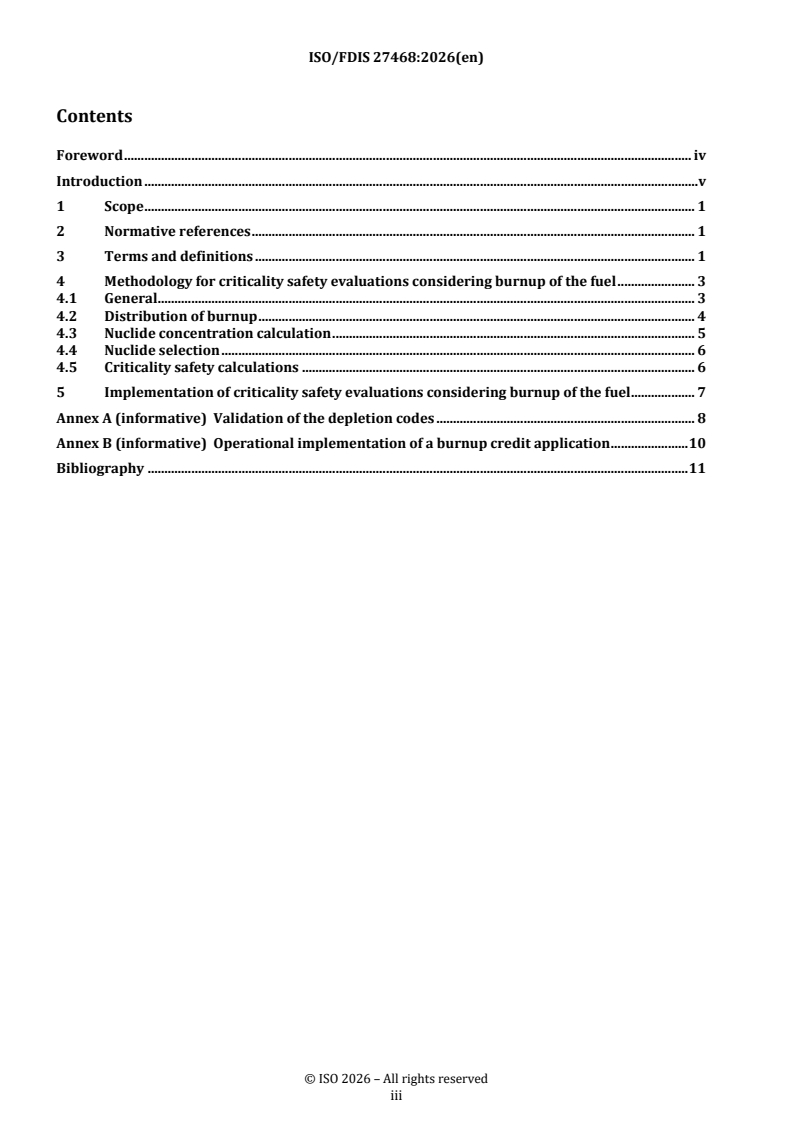
Contents Page
Foreword .iv
Introduction .v
1 Scope . 1
2 Normative references . 1
3 Terms and definitions . 1
4 Methodology for criticality safety evaluations considering burnup of the fuel . 3
4.1 General .3
4.1.1 Identify subsets of fuel assemblies .3
4.1.2 Perform the criticality evaluation for each subset .3
4.2 Distribution of burnup . .4
4.3 Nuclide concentration calculation.5
4.4 Nuclide selection .6
4.5 Criticality safety calculations .6
5 Implementation of criticality safety evaluations considering burnup of the fuel . 7
Annex A (informative) Validation of the depletion codes . 8
Annex B (informative) Operational implementation of a burnup credit application .10
Bibliography .11
iii
Foreword
ISO (the International Organization for Standardization) is a worldwide federation of national standards
bodies (ISO member bodies). The work of preparing International Standards is normally carried out through
ISO technical committees. Each member body interested in a subject for which a technical committee
has been established has the right to be represented on that committee. International organizations,
governmental and non-governmental, in liaison with ISO, also take part in the work. ISO collaborates closely
with the International Electrotechnical Commission (IEC) on all matters of electrotechnical standardization.
The procedures used to develop this document and those intended for its further maintenance are described
in the ISO/IEC Directives, Part 1. In particular, the different approval criteria needed for the different types
of ISO documents should be noted. This document was drafted in accordance with the editorial rules of the
ISO/IEC Directives, Part 2 (see www.iso.org/directives).
ISO draws attention to the possibility that the implementation of this document may involve the use of (a)
patent(s). ISO takes no position concerning the evidence, validity or applicability of any claimed patent
rights in respect thereof. As of the date of publication of this document, ISO had not received notice of (a)
patent(s) which may be required to implement this document. However, implementers are cautioned that
this may not represent the latest information, which may be obtained from the patent database available at
www.iso.org/patents. ISO shall not be held responsible for identifying any or all such patent rights.
Any trade name used in this document is information given for the convenience of users and does not
constitute an endorsement.
For an explanation of the voluntary nature of standards, the meaning of ISO specific terms and expressions
related to conformity assessment, as well as information about ISO's adherence to the World Trade
Organization (WTO) principles in the Technical Barriers to Trade (TBT), see www.iso.org/iso/foreword.html.
This document was prepared by Technical Committee ISO/TC 85, Nuclear energy, nuclear technologies, and
radiological protection, Subcommittee SC 5, Nuclear fuel cycle.
This second edition cancels and replaces the first edition (ISO 27468:2011), which has been technically
revised.
The main changes are as follows:
— a practical (less conservative) approach is added to the bounding approach used in the previous version;
— a number of editorial changes were made.
Any feedback or questions on this document should be directed to the user’s national standards body. A
complete listing of these bodies can be found at www.iso.org/members.html.
iv
Introduction
For many years, criticality evaluations involving irradiated uranium oxide (UO ) fuels in a pressurized water
x
reactor (PWR) considered the fuel as un-irradiated. Information on and consideration of the fuel properties
after irradiation could usually have resulted in considerable criticality safety margins.
The use of PWR UOX fuel with increased enrichment of U motivates evaluation of burnup credit in existing
and new applications for storage, reprocessing or transport of irradiated fuel. A more realistic estimation of
the actual effective neutron multiplication factor, k , of a system involving irradiated fuel is possible with
eff
methods available to nuclear criticality safety specialists. Thus, the maximum estimated k value during
eff
normal conditions and incidents can be reduced compared with the assumption of un-irradiated fuel.
Moreover, the safe use of burnup credit can reduce the overall risk (fewer cask moves, etc.).
Therefore, for the safe use of the burnup credit, this document highlights the need to consider new
parameters in addition to those that need evaluation for un-irradiated fuel. It presents the various issues
that should be addressed to support evaluations of burnup credit for systems with PWR fuels that are
initially containing uranium oxides and then irradiated in a PWR.
This document identifies both a bounding approach and a more realistic practical approach in terms of k
eff
calculation. Other approaches may be used (e.g. calculation of the average configuration with k criteria
eff
covering credible variations/bias/uncertainties) especially if there are additional mechanisms to control
the degree of sub-criticality (e.g. use of boron, gadolinium or dry transport).
Overall criticality safety evaluation and eventual implementation of burnup credit are not covered by this
document. However, the burnup credit evaluation in this document should support use of burnup credit in
the overall criticality safety evaluation and an eventual implementation of burnup credit.
v
FINAL DRAFT International Standard ISO/FDIS 27468:2026(en)
Nuclear criticality safety — Evaluation of systems containing
PWR uranium oxide fuels — Burnup credit
1 Scope
This document establishes an evaluation methodology for nuclear criticality safety with burnup credit. It
identifies important parameters and specifies requirements, recommendations, and precautions to be taken
into account in the evaluations. It also highlights the main important technical fields to ensure that the
fuel composition or history considered in calculations provides a bounding value of the effective neutron
multiplication factor, k . A more practical approach is also presented.
eff
This document is applicable to transport, storage, disposal or reprocessing units using irradiated fissile
material from pressurized water reactor (PWR) fuels that initially contain enriched uranium oxide (UO ).
x
Uranium could originate either from natural uranium or recycled uranium.
Fuels irradiated in other reactors (e.g. boiling water reactors) and fuels that initially contain mixed uranium-
plutonium oxide are not covered in this document.
This document does not specify requirements related to overall criticality safety evaluation or eventual
implementation of burnup credit.
2 Normative references
The following documents are referred to in the text in such a way that some or all of their content constitutes
requirements of this document. For dated references, only the edition cited applies. For undated references,
the latest edition of the referenced document (including any amendments) applies.
ISO 1709, Nuclear energy — Fissile materials — Principles of criticality safety in storing, handling and processing
ISO 14943, Nuclear fuel technology — Administrative criteria related to nuclear criticality safety
3 Terms and definitions
For the purposes of this document, the following terms and definitions apply.
ISO and IEC maintain terminology databases for use in standardization at the following addresses:
— ISO Online browsing platform: available at https:// www .iso .org/ obp
— IEC Electropedia: available at https:// www .electropedia .org/
3.1
actinide
element with atomic number in the range from 90 to 103
3.2
axial burnup profile
axial distribution of the burnup (3.4) in the fuel assembly
Note 1 to entry: The axial distribution can be inferred from calculations or measurements (by in-core detectors or
detectors outside of reactor cores).
Note 2 to entry: The axial distribution of the burnup (3.4) is caused by axial neutron leakage, axial variations in the
fuel enrichment, moderator temperature rise through the core, non-full length burnable absorber (3.3) and insertion of
control and absorber rods.
3.3
burnable absorber
neutron absorbing nuclide added to the fuel assembly to control reactor reactivity and power distribution
Note 1 to entry: As the reactor operation progresses, the amount of neutron absorbing material is depleted, or
‘‘burned’’. Then, if the presence of burnable absorbers (fixed or removable) is considered in a criticality safety
evaluation, the most reactive condition may not be for the fresh fuel.
3.4
burnup
average energy released by a defined region of the fuel during its irradiation divided by the mass of actinide
(3.1) in that region prior to irradiation
Note 1 to entry: This region could be a complete fuel assembly or some part of the assembly.
Note 2 to entry: In that context of UO fuel (where the only actinide (3.1) prior to irradiation is uranium), units
x
commonly used are expressed in megawatt day per metric tonne of initial uranium (MWd/t) or gigawatt day per
metric tonne of initial uranium (GWd/t).
3.5
burnup credit
difference between k of fresh fuel and irradiated fuel for an evaluated system as determined by the use of
eff
a structured evaluation process
3.6
cooling time
time after the reactor is no longer producing power during which radioactive decay results in changes in the
fuel nuclide concentrations
3.7
depletion calculation
calculation performed to determine the concentrations of individual nuclides in the fuel at the end of
irradiation in a reactor
Note 1 to entry: Other fuel properties can usually be determined by depletion calculations (e.g. flux-weighted
macroscopic cross-sections or lattice cell k ).
∞
Note 2 to entry: Radioactive decay between reactor irradiation periods and after final shutdown is usually included in
the same calculation procedure.
3.8
end effect
impact on k of the less irradiated parts of the fuel assembly (upper and lower ends of the assembly)
eff
Note 1 to entry: The end effect is commonly defined as the difference between the k for the two following systems:
eff
— a system containing irradiated fuel assemblies having a constant fuel composition corresponding to the average
burnup and irradiation energy spectrum of the fuel,
— the same system containing irradiated fuel assemblies having an axially varying fuel composition corresponding
to the axial burnup profile (3.2).
3.9
fission product
nuclide produced from nuclear fission
Note 1 to entry: After nuclear fission, two or more fission products are produced together with neutrons and radiations
(gamma, etc.). The fission products can be a direct result of the fissions or can be created after the decay of (or neutron
absorption by) other fission products. Often only a selection of fission products is accounted for as neutron absorbers
in burnup credit, but consideration of nearly all fission products is required to accurately simulate fuel irradiation
during reactor operation.
3.10
loosely coupled system
system in which two or more regions with high “local” values of neutron importance are separated by
regions with low neutron importance
Note 1 to entry: Convergence problems can occur when a Monte Carlo method is used for the k calculation of such
eff
systems where neutron interaction between the highly fissile regions is weak. Deterministic transport and diffusion
methods are less affected by these convergence problems.
3.11
nuclide concentration
atom density expressed as atoms per unit volume such as atoms per cubic centimetre
3.12
validation
documented determination that the combination of models, methods and data as embodied in a computer
code methodology and applied by a specific user is a predictable representation of the process or system for
which it is intended
Note 1 to entry: This documented determination is accomplished by comparing code results to benchmark
experimental results to estimate the code bias, the uncertainty in the bias, and areas of applicability of the calculation
method.
4 Methodology for criticality safety evaluations considering burnup of the fuel
WARNING — The application of this clause requires evaluators to know the initial composition of
each fuel type and its history of irradiation.
4.1 General
4.1.1 Identify subsets of fuel assemblies
The entire set of fuel assemblies subject to a criticality evaluation may be divided into subsets (or groups).
These subsets may be based on the characteristics of the fuel assemblies, such as type (e.g. 15X15, 16X16,
17X17), initial composition, burnup, cooling time and irradiation conditions.
4.1.2 Perform the criticality evaluation for each subset
The approach identified in this document consists of the main following steps, for a given application (e.g. a
given transport, storage, reprocessing and disposal) and for a given subset:
— to choose and justify a burnup distribution to model in the fuel assemblies (see 4.2);
— to calculate the irradiated fuel nuclide concentrations for each burnup assessed, with considerations for
the cooling time (see 4.3);
— to select the nuclides to be included in the evaluation of k for the application (see 4.4);
eff
— to perform the criticality calculations of the evaluated application (see 4.5).
The validation of the calculation tools shall be justified and documented. Such validation should be
performed for each calculation tool used in the evaluation. The validation may alternatively consist of a
global validation of the resulting k (see Clause A.2).
eff
4.2 Distribution of burnup
4.2.1 The burnup distribution of the selected irradiated fuel assemblies shall be evaluated because of its
[1] [2] [3] [4] [5] [6] [7]
impact on k (see References , , , , , , and ). The axial and radial/horizontal burnup gradients,
eff
due to the neutron flux distribution
...
ISO/DISFDIS 27468
ISO/TC 85/SC 5
Secretariat: BSI
Date: 2026-06-26xx
Nuclear criticality safety — Evaluation of systems containing PWR
uranium oxide fuels — Burnup credit
DISSûreté-criticité — Évaluation des systèmes mettant en oeuvre des combustibles REP d'oxyde d'uranium —
Crédit burnup
FDIS stage
Voting begins on: 2026-02-13
Voting terminates on: 2026-05-08
All rights reserved. Unless otherwise specified, or required in the context of its implementation, no part of this publication
may be reproduced or utilized otherwise in any form or by any means, electronic or mechanical, including photocopying,
or posting on the internet or an intranet, without prior written permission. Permission can be requested from either ISO
at the address below or ISO’s member body in the country of the requester.
ISO copyright office
CP 401 • Ch. de Blandonnet 8
CH-1214 Vernier, Geneva
Phone: + 41 22 749 01 11
E-mail: copyright@iso.org
Website: www.iso.org
Published in Switzerland
ii
Contents
Foreword . iv
Introduction . v
1 Scope . 1
2 Normative references . 1
3 Terms and definitions . 1
4 Methodology for criticality safety evaluations considering burnup of the fuel . 3
4.1 General . 3
4.2 Distribution of burnup . 4
4.3 Nuclide concentration calculation . 5
4.4 Nuclide selection . 6
4.5 Criticality safety calculations . 6
5 Implementation of criticality safety evaluations considering burnup of the fuel . 7
Annex A (informative) Validation of the depletion codes . 8
Annex B (informative) Operational implementation of a burnup credit application . 10
Bibliography . 11
iii
Foreword
ISO (the International Organization for Standardization) is a worldwide federation of national standards
bodies (ISO member bodies). The work of preparing International Standards is normally carried out through
ISO technical committees. Each member body interested in a subject for which a technical committee has been
established has the right to be represented on that committee. International organizations, governmental and
non-governmental, in liaison with ISO, also take part in the work. ISO collaborates closely with the
International Electrotechnical Commission (IEC) on all matters of electrotechnical standardization.
The procedures used to develop this document and those intended for its further maintenance are described
in the ISO/IEC Directives, Part 1. In particular, the different approval criteria needed for the different types of
ISO documents should be noted. This document was drafted in accordance with the editorial rules of the
ISO/IEC Directives, Part 2 (see www.iso.org/directives).
ISO draws attention to the possibility that the implementation of this document may involve the use of (a)
patent(s). ISO takes no position concerning the evidence, validity or applicability of any claimed patent rights
in respect thereof. As of the date of publication of this document, ISO had not received notice of (a) patent(s)
which may be required to implement this document. However, implementers are cautioned that this may not
represent the latest information, which may be obtained from the patent database available at
www.iso.org/patents. ISO shall not be held responsible for identifying any or all such patent rights.
Any trade name used in this document is information given for the convenience of users and does not
constitute an endorsement.
For an explanation of the voluntary nature of standards, the meaning of ISO specific terms and expressions
related to conformity assessment, as well as information about ISO's adherence to the World Trade
Organization (WTO) principles in the Technical Barriers to Trade (TB TTBT), see
www.iso.org/iso/foreword.html.
This document was prepared by Technical Committee ISO/TC 85, Nuclear energy, nuclear technologies, and
radiological protection, Subcommittee SC 5, Nuclear fuel cycle.
This second edition cancels and replaces the first edition (ISO 27468:2011), which has been technically
revised.
The main changes are as follows:
— Aa practical (less conservative) approach is added to the bounding approach used in the previous version;
— Aa number of editorial changes were made.
Any feedback or questions on this document should be directed to the user’s national standards body. A
complete listing of these bodies can be found at www.iso.org/members.html.
iv
Introduction
For many years, criticality evaluations involving irradiated uranium oxide (UOXUO ) fuels in a pressurized
x
water reactor (PWR) considered the fuel as un-irradiated. Information on and consideration of the fuel
properties after irradiation could usually have resulted in considerable criticality safety margins.
The use of PWR UOX fuel with increased enrichment of U motivates evaluation of burnup credit in existing
and new applications for storage, reprocessing or transport of irradiated fuel. A more realistic estimation of
the actual effective neutron multiplication factor, k , of a system involving irradiated fuel is possible with
eff
methods available to nuclear criticality safety specialists. Thus, the maximum estimated k value during
eff
normal conditions and incidents can be reduced compared with the assumption of un-irradiated fuel.
Moreover, the safe use of burnup credit can reduce the overall risk (fewer cask moves, etc.).
Therefore, for the safe use of the burnup credit, this document highlights the need to consider new parameters
in addition to those that need evaluation for un-irradiated fuel. It presents the various issues that should be
addressed to support evaluations of burnup credit for systems with PWR fuels that are initially containing
uranium oxides and then irradiated in a PWR.
This document identifies both a bounding approach and a more realistic practical approach in terms of k
eff
calculation. Other approaches may be used (e.g. calculation of the average configuration with k criteria
eff
covering credible variations/bias/uncertainties) especially if there are additional mechanisms to control the
degree of sub-criticality (e.g. use of boron, gadolinium or dry transport).
Overall criticality safety evaluation and eventual implementation of burnup credit are not covered by this
document. However, the burnup credit evaluation in this document should support use of burnup credit in the
overall criticality safety evaluation and an eventual implementation of burnup credit.
v
Nuclear criticality safety — Evaluation of systems containing PWR
uranium oxide fuels — Burnup credit
1 Scope
This document establishes an evaluation methodology for nuclear criticality safety with burnup credit. It
identifies important parameters and specifies requirements, recommendations, and precautions to be taken
into account in the evaluations. It also highlights the main important technical fields to ensure that the fuel
composition or history considered in calculations provides a bounding value of the effective neutron
multiplication factor, k . A more practical approach is also presented.
eff
This document is applicable to transport, storage, disposal or reprocessing units using irradiated fissile
material from pressurized water reactor (PWR) fuels that initially contain enriched uranium oxide (UOXUO ).
x
Uranium could originate either from natural uranium or recycled uranium.
Fuels irradiated in other reactors (e.g. boiling water reactors) and fuels that initially contain mixed uranium-
plutonium oxide are not covered in this document.
This document does not specify requirements related to overall criticality safety evaluation or eventual
implementation of burnup credit.
2 Normative references
The following documents are referred to in the text in such a way that some or all of their content constitutes
requirements of this document. For dated references, only the edition cited applies. For undated references,
the latest edition of the referenced document (including any amendments) applies.
ISO 1709:2018, Nuclear energy — Fissile materials — Principles of criticality safety in storing, handling and
processing
ISO 14943:2004, Nuclear fuel technology — Administrative criteria related to nuclear criticality safety
3 Terms and definitions
For the purposes of this document, the following terms and definitions apply.
ISO and IEC maintain terminology databases for use in standardization at the following addresses:
— ISO Online browsing platform: available at https://www.iso.org/obp
— IEC Electropedia: available at https://www.electropedia.org/
3.1
actinide
element with atomic number in the range from 90 to 103
3.2
axial burnup profile
axial distribution of the burnup (3.4(3.4)) in the fuel assembly
Note 1 to entry: The axial distribution can be inferred from calculations or measurements (by in-core detectors or
detectors outside of reactor cores)).
Note 2 to entry: The axial distribution of the burnup (3.4(3.4)) is caused by axial neutron leakage, axial variations in the
fuel enrichment, moderator temperature rise through the core, non-full length burnable absorber (3.3(3.3)) and insertion
of control and absorber rods.
3.3
burnable absorber
neutron absorbing nuclide added to the fuel assembly to control reactor reactivity and power distribution
Note 1 to entry: As the reactor operation progresses, the amount of neutron absorbing material is depleted, or ‘‘burned’’.
Then, if the presence of burnable absorbers (fixed or removable) is considered in a criticality safety evaluation, the most
reactive condition may not be for the fresh fuel.
3.4
burnup
average energy released by a defined region of the fuel during its irradiation divided by the mass of actinide
(3.1actinides (3.1)) in that region prior to irradiation
Note 1 to entry: This region could be a complete fuel assembly or some part of the assembly.
Note 2 to entry: In that context of UOXUO fuel (where the only actinide (3.1) prior to irradiation is uranium), units
x
commonly used are expressed in megawatt day per metric tonne of initial uranium (MWd/t) or gigawatt day per metric
tonne of initial uranium (GWd/t).
3.5
burnup credit
difference between k of fresh fuel and irradiated fuel for an evaluated system as determined by the use of a
eff
structured evaluation process
3.6
cooling time
time after the reactor is no longer producing power during which radioactive decay results in changes in the
fuel nuclide concentrations
3.7
depletion calculation
calculation performed to determine the concentrations of individual nuclides in the fuel at the end of
irradiation in a reactor
Note 1 to entry: Other fuel properties can usually be determined by depletion calculations (e.g. flux-weighted
macroscopic cross-sections or lattice cell k∞).
Note 2 to entry: Radioactive decay between reactor irradiation periods and after final shutdown is usually included in
the same calculation procedure.
3.8
end effect
impact on k of the less irradiated parts of the fuel assembly (upper and lower ends of the assembly)
eff
Note 1 to entry: The end effect is commonly defined as the difference between the k for the two following systems:
eff
— a system containing irradiated fuel assemblies having a constant fuel composition corresponding to the average
burnup and irradiation energy spectrum of the fuel,
— the same system containing irradiated fuel assemblies having an axially varying fuel composition corresponding to
the axial burnup profile (3.2(3.2).).
3.9
fission product
nuclide produced from nuclear fission
Note 1 to entry: After nuclear fission, two or more fission products are produced together with neutrons and radiations
(gamma, etc.). The fission products can be a direct result of the fissions or can be created after the decay of (or neutron
absorption by) other fission products. Often only a selection of fission products is accounted for as neutron absorbers in
burnup credit, but consideration of nearly all fission products is required to accurately simulate fuel irradiation during
reactor operation.
3.10
loosely coupled system
system in which two or more regions with high “local” values of neutron importance are separated by regions
with low neutron importance
Note 1 to entry: Convergence problems can occur when a Monte Carlo method is used for the k calculation of such
eff
systems where neutron interaction between the highly fissile regions is weak. Deterministic transport and diffusion
methods are less affected by these convergence problems.
3.11
nuclide concentration
atom density expressed as atoms per unit volume such as atoms per cubic centimetre
3.12
code validation
documented determination that the combination of models, methods and data as embodied in a computer
code methodology and applied by a specific user is a predictable representation of the process or system for
which it is intended
Note 1 to entry: This documented determination is accomplished by comparing code results to benchmark experimental
results to estimate the code bias, the uncertainty in the bias, and areas of applicability of the calculation method.
4 Methodology for criticality safety evaluations considering burnup of the fuel
WARNING — The application of this clause requires evaluators to know the initial composition of each
fuel type and its history of irradiation.
4.1 General
4.1.1 Identify subsets of fuel assemblies
The entire set of fuel assemblies subject to a criticality evaluation may be divided into subsets (or groups).
These subsets may be based on the characteristics of the fuel assemblies, such as type (e.g. 15X15, 16X16,
17X17), initial composition, burnup, cooling time and irradiation conditions.
4.1.2 Perform the criticality evaluation for each subset
The approach identified in this document consists of the main following steps, for a given application (e.g. a
given transport, storage, reprocessing, and disposal) and for a given subset:
— to choose and justify a burnup distribution to model in the fuel assemblies (see 4.2);
— to calculate the irradiated fuel nuclide concentrations for each burnup assessed, with considerations for
the cooling time (see 4.3);
— to select the nuclides to be included in the evaluation of k for the application (see 4.4);
eff
— to perform the criticality calculations of the evaluated application (see 4.5).
The validation of the calculation tools shall be justified and documented. Such validation should be performed
for each calculation tool used in the evaluation. The validation may alternatively consist of a global validation
of the resulting k (see Clause A.2).
eff
4.2 Distribution of burnup
4.2.1 The burnup distribution of the selected irradiated fuel assemblies shall be evaluated because of its
[1] [2] [3] [4] [5] [6] [7]
impact on k (see References , , , , , , and ). The axial and radial/horizontal burnup gradients,
eff
due to the neutron flux distribution during the irradiation, are mainly related to
— neutron leakage at the top and the bottom of the fuel assembly,
— neutron absorption within partially inserted control rods at the top of the fuel assembly,
— the moderator density change from the bottom to the top of the core,
— radial leakage/absorption/moderation of the neutrons, which depend on the environment of the
assembly, on its position in the reactor during irradiation and on the presence of burnable absorbers
and/or guide tubes, and
— irradiation history.
WARNING — The axial burnup distribution is not sufficient to determine the axial variation of the
composition of the irradiated fuel: the neutron spectrum of the irradiation flux also varies axially and
has an impact on the fuel nuclide concentrations that are determined from the depletion calculation .
Guidelines on the effect on fuel nuclides concentration of the fuel depletion parameters are given in
4.3.
4.2.2 The selected irradiated fuel assemblies may be divided into regions or zones in which the burnup is
assumed to be uniform. The division into such regions or zones shall be justified for each application and may
be different to what is usually used in
...
PROJET FINAL
Norme
internationale
ISO/TC 85/SC 5
Sûreté-criticité — Évaluation
Secrétariat: BSI
des systèmes mettant en oeuvre
Début de vote:
des combustibles REP d'oxyde
2026-08-19
d'uranium — Crédit burnup
Vote clos le:
2026-10-14
Nuclear criticality safety — Evaluation of systems containing
PWR uranium oxide fuels — Burnup credit
LES DESTINATAIRES DU PRÉSENT PROJET SONT
INVITÉS À PRÉSENTER, AVEC LEURS OBSERVATIONS,
NOTIFICATION DES DROITS DE PROPRIÉTÉ DONT ILS
AURAIENT ÉVENTUELLEMENT CONNAISSANCE ET À
FOURNIR UNE DOCUMENTATION EXPLICATIVE.
OUTRE LE FAIT D’ÊTRE EXAMINÉS POUR
ÉTABLIR S’ILS SONT ACCEPTABLES À DES FINS
INDUSTRIELLES, TECHNOLOGIQUES ET COM-MERCIALES,
AINSI QUE DU POINT DE VUE DES UTILISATEURS, LES
PROJETS DE NORMES
INTERNATIONALES DOIVENT PARFOIS ÊTRE CONSIDÉRÉS
DU POINT DE VUE DE LEUR POSSI BILITÉ DE DEVENIR DES
NORMES POUVANT
SERVIR DE RÉFÉRENCE DANS LA RÉGLEMENTATION
NATIONALE.
Numéro de référence
PROJET FINAL
Norme
internationale
ISO/TC 85/SC 5
Sûreté-criticité — Évaluation
Secrétariat: BSI
des systèmes mettant en oeuvre
Début de vote:
des combustibles REP d'oxyde
2026-08-19
d'uranium — Crédit burnup
Vote clos le:
2026-10-14
Nuclear criticality safety — Evaluation of systems containing
PWR uranium oxide fuels — Burnup credit
LES DESTINATAIRES DU PRÉSENT PROJET SONT
INVITÉS À PRÉSENTER, AVEC LEURS OBSERVATIONS,
NOTIFICATION DES DROITS DE PROPRIÉTÉ DONT ILS
AURAIENT ÉVENTUELLEMENT CONNAISSANCE ET À
FOURNIR UNE DOCUMENTATION EXPLICATIVE.
DOCUMENT PROTÉGÉ PAR COPYRIGHT
OUTRE LE FAIT D’ÊTRE EXAMINÉS POUR
ÉTABLIR S’ILS SONT ACCEPTABLES À DES FINS
© ISO 2026 INDUSTRIELLES, TECHNOLOGIQUES ET COM-MERCIALES,
AINSI QUE DU POINT DE VUE DES UTILISATEURS, LES
Tous droits réservés. Sauf prescription différente ou nécessité dans le contexte de sa mise en œuvre, aucune partie de cette
PROJETS DE NORMES
INTERNATIONALES DOIVENT PARFOIS ÊTRE CONSIDÉRÉS
publication ne peut être reproduite ni utilisée sous quelque forme que ce soit et par aucun procédé, électronique ou mécanique,
DU POINT DE VUE DE LEUR POSSI BILITÉ DE DEVENIR DES
y compris la photocopie, ou la diffusion sur l’internet ou sur un intranet, sans autorisation écrite préalable. Une autorisation peut
NORMES POUVANT
être demandée à l’ISO à l’adresse ci-après ou au comité membre de l’ISO dans le pays du demandeur.
SERVIR DE RÉFÉRENCE DANS LA RÉGLEMENTATION
NATIONALE.
ISO copyright office
Case postale 401 • Ch. de Blandonnet 8
CH-1214 Vernier, Genève
Tél.: +41 22 749 01 11
E-mail: copyright@iso.org
Web: www.iso.org
Publié en Suisse Numéro de référence
ii
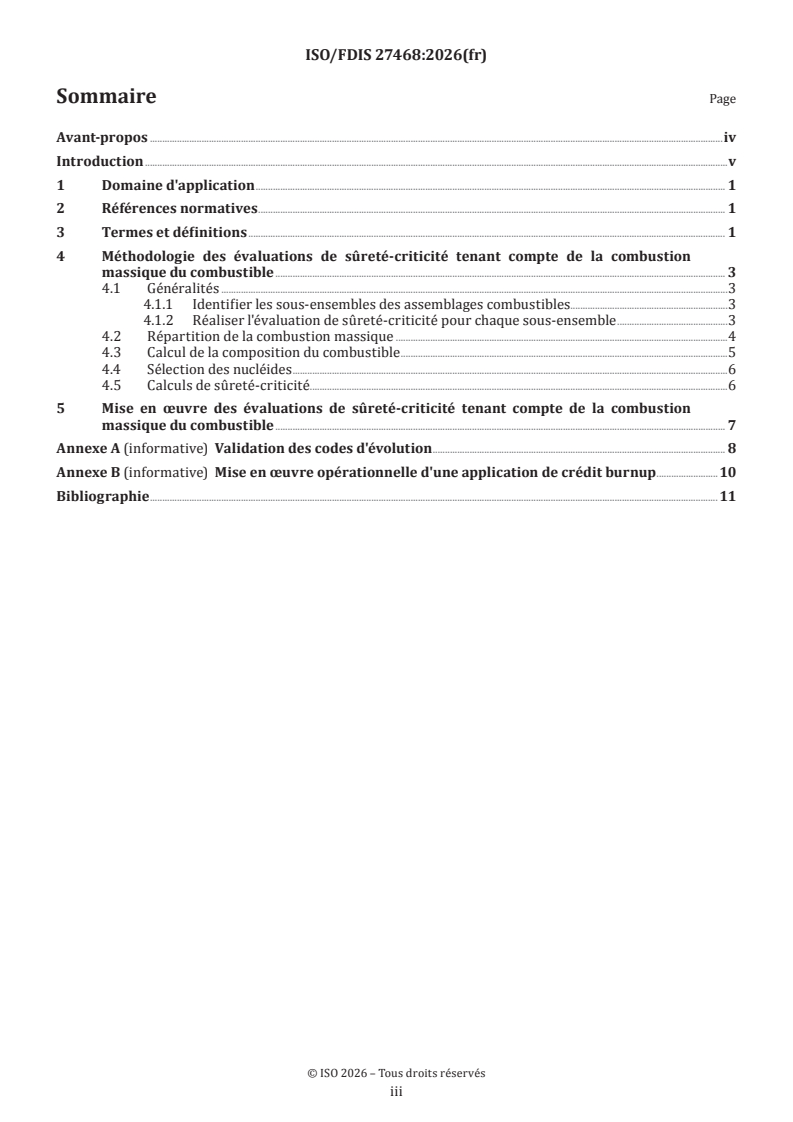
Sommaire Page
Avant-propos .iv
Introduction .v
1 Domaine d'application . 1
2 Références normatives . 1
3 Termes et définitions . 1
4 Méthodologie des évaluations de sûreté-criticité tenant compte de la combustion
massique du combustible . 3
4.1 Généralités .3
4.1.1 Identifier les sous-ensembles des assemblages combustibles.3
4.1.2 Réaliser l'évaluation de sûreté-criticité pour chaque sous-ensemble .3
4.2 Répartition de la combustion massique .4
4.3 Calcul de la composition du combustible .5
4.4 Sélection des nucléides .6
4.5 Calculs de sûreté-criticité.6
5 Mise en œuvre des évaluations de sûreté-criticité tenant compte de la combustion
massique du combustible . 7
Annexe A (informative) Validation des codes d'évolution . 8
Annexe B (informative) Mise en œuvre opérationnelle d'une application de crédit burnup .10
Bibliographie .11
iii
Avant-propos
L'ISO (Organisation internationale de normalisation) est une fédération mondiale d'organismes nationaux
de normalisation (comités membres de l'ISO). L'élaboration des Normes internationales est en général
confiée aux comités techniques de l'ISO. Chaque comité membre intéressé par une étude a le droit de faire
partie du comité technique créé à cet effet. Les organisations internationales, gouvernementales et non
gouvernementales, en liaison avec l'ISO participent également aux travaux. L'ISO collabore étroitement avec
la Commission électrotechnique internationale (IEC) en ce qui concerne la normalisation électrotechnique.
Les procédures utilisées pour élaborer le présent document et celles destinées à sa mise à jour sont
décrites dans les Directives ISO/IEC, Partie 1. Il convient, en particulier, de prendre note des différents
critères d'approbation requis pour les différents types de documents ISO. Le présent document
a été rédigé conformément aux règles de rédaction données dans les Directives ISO/IEC, Partie 2
(voir www.iso.org/directives).
L'ISO attire l'attention sur le fait que la mise en application du présent document peut entraîner l'utilisation
d'un ou de plusieurs brevets. L'ISO ne prend pas position quant à la preuve, à la validité et à l'applicabilité
de tout droit de propriété revendiqué à cet égard. À la date de publication du présent document, l'ISO
n'avait pas reçu notification qu'un ou plusieurs brevets pouvaient être nécessaires à sa mise en application.
Toutefois, il y a lieu d'avertir les responsables de la mise en application du présent document que des
informations plus récentes sont susceptibles de figurer dans la base de données de brevets, disponible à
l'adresse www.iso.org/brevets. L'ISO ne saurait être tenue pour responsable de ne pas avoir identifié tout ou
partie de tels droits de brevet.
Les appellations commerciales éventuellement mentionnées dans le présent document sont données pour
information, par souci de commodité, à l’intention des utilisateurs et ne sauraient constituer un engagement.
Pour une explication de la nature volontaire des normes, la signification des termes et expressions
spécifiques de l'ISO liés à l'évaluation de la conformité, ou pour toute information au sujet de l'adhésion de
l'ISO aux principes de l'Organisation mondiale du commerce (OMC) concernant les obstacles techniques au
commerce (OTC), voir www.iso.org/avant-propos.
Le présent document a été élaboré par le comité technique ISO/TC 85, Énergie nucléaire, technologies
nucléaires, et radioprotection, sous-comité SC 5, Cycle du combustible nucléaire.
Cette deuxième édition annule et remplace la première édition (ISO 27468:2011), qui a fait l'objet d'une
révision technique.
Les principales modifications sont les suivantes:
— une approche pratique (moins conservative) est ajoutée à l'approche limitative utilisée dans la version
précédente;
— un certain nombre de modifications rédactionnelles ont été apportées.
Il convient que l'utilisateur adresse tout retour d'information ou toute question concernant le présent
document à l'organisme national de normalisation de son pays. Une liste exhaustive desdits organismes se
trouve à l'adresse www.iso.org/fr/members.html.
iv
Introduction
Dans les études de criticité de systèmes mettant en œuvre des combustibles à base d'oxyde d'uranium (UO )
x
irradié dans les réacteurs à eau sous pression (REP), le combustible a été considéré pendant des années
comme non irradié. Cependant, la caractérisation et la prise en compte des propriétés du combustible après
irradiation pourraient généralement conduire à dégager des marges de sûreté-criticité.
L'utilisation de combustibles REP UOX de plus en plus enrichis en U motive la prise en compte du crédit
burnup dans les applications, existantes et nouvelles, d'entreposage, de traitement ou de transport de
combustible irradié. Il s'agit de réaliser une évaluation plus réaliste du facteur de multiplication effectif
des neutrons, k , d'un système contenant du combustible irradié en appliquant les méthodes mises
eff
à la disposition des spécialistes en sûreté-criticité. La valeur maximale de k en conditions normales et
eff
incidentelles peut ainsi être réduite par rapport à l'hypothèse d'un combustible non irradié.
En outre, la prise en compte du crédit burnup peut améliorer la sûreté globale (moins de déplacements du
colis de transport, etc.).
En conséquence, le présent document souligne la nécessité de considérer de nouveaux paramètres, qui
s'ajoutent à ceux devant être évalués pour un combustible non irradié, afin de garantir la prise en compte
de façon sûre du crédit burnup. Il présente les différents points qu'il convient d'aborder dans les études avec
prise en compte du crédit burnup pour les systèmes utilisant des combustibles contenant initialement des
oxydes d'uranium et qui sont ensuite irradiés dans un REP.
Le présent document établit à la fois une approche conduisant à définir un calcul conservatif de k et
eff
une approche pratique plus réaliste pour le calcul de k . D'autres approches de prise en compte du crédit
eff
burnup peuvent également être envisagées (par exemple calculer une configuration avec des hypothèses
d'irradiation du combustible moyennes puis appliquer, sur les résultats de k obtenus, des pénalisations
eff
couvrant les variations/biais/incertitudes de ces hypothèses), notamment s'il existe un mode de contrôle de
la sûreté-criticité complémentaire (par exemple utilisation de bore, de gadolinium ou transport à sec).
L'évaluation globale de la sûreté-criticité et les conditions de mise en œuvre opérationnelle du crédit burnup
ne sont pas couvertes par le présent document. L'étude du crédit burnup telle que présentée dans le présent
document est néanmoins indispensable pour l'évaluation globale de la sûreté-criticité et pour la mise en
œuvre opérationnelle du crédit burnup.
v
PROJET FINAL Norme internationale ISO/FDIS 27468:2026(fr)
Sûreté-criticité — Évaluation des systèmes mettant en oeuvre
des combustibles REP d'oxyde d'uranium — Crédit burnup
1 Domaine d'application
Le présent document établit une méthodologie d'évaluation de sûreté-criticité faisant intervenir le crédit
burnup. Elle identifie les paramètres importants et spécifie des exigences, des recommandations et les
précautions à prendre en compte dans les évaluations. Elle met également en évidence les principaux
aspects techniques permettant d'assurer que la composition ou l'historique du combustible pris en compte
dans les calculs conduit à une valeur conservative du facteur de multiplication effectif des neutrons, k . Une
eff
approche plus pratique est également présentée.
Le présent document est applicable au transport, à l'entreposage, au stockage et au traitement de matière
fissile irradiée provenant du combustible des réacteurs à eau sous pression (REP) à base d'oxyde d'uranium
enrichi (UO). L'uranium peut provenir d'uranium naturel ou d'uranium recyclé.
Les combustibles irradiés dans d'autres types de réacteurs (par exemple à eau bouillante) et les combustibles
à base d'oxyde mixte d'uranium et de plutonium ne sont pas couverts par le présent document.
Le présent document ne spécifie pas d'exigences relatives à l'évaluation globale de la sûreté-criticité ou à la
mise en œuvre opérationnelle du crédit burnup.
2 Références normatives
Les documents suivants cités dans le texte constituent, pour tout ou partie de leur contenu, des exigences du
présent document. Pour les références datées, seule l'édition citée s'applique. Pour les références non datées,
la dernière édition du document de référence s'applique (y compris les éventuels amendements).
ISO 1709, Énergie nucléaire — Matières fissiles — Principes de sûreté-criticité lors des opérations d'entreposage,
de manutention et de mise en oeuvre du procédé
ISO 14943, Technologie du combustible nucléaire - Critères administratifs concernant la sûreté-criticité nucléaire
3 Termes et définitions
Pour les besoins du présent document, les termes et définitions suivants s'appliquent.
L'ISO et l'IEC tiennent à jour des bases de données terminologiques destinées à être utilisées en normalisation,
consultables aux adresses suivantes:
— ISO Online browsing platform: disponible à l'adresse https:// www .iso .org/ obp;
— IEC Electropedia: disponible à l'adresse https:// www .electropedia .org/
3.1
actinide
élément dont le numéro atomique est compris entre 90 et 103
3.2
profil axial de combustion massique
répartition axiale de la combustion massique (3.4) dans l'assemblage combustible
Note 1 à l'article: La répartition axiale peut être déduite de calculs ou de mesurages (au moyen de détecteurs placés à
l'intérieur ou à l'extérieur des cœurs de réacteurs).
Note 2 à l'article: La répartition axiale de la combustion massique (3.4) est causée par les fuites axiales des neutrons,
les variations axiales d'enrichissement du combustible, l'augmentation de température du modérateur à travers le
cœur, la présence d'absorbeurs consommables (3.3) de hauteur partielle et l'insertion des barres de commande et
d'absorbeur.
3.3
absorbeur consommable
nucléide absorbant les neutrons, ajouté au combustible de l'assemblage pour contrôler la réactivité du
réacteur et la distribution de puissance
Note 1 à l'article: Au fur et à mesure de l'exploitation du réacteur, le matériau absorbant les neutrons s'appauvrit ou est
«consommé». En conséquence, si la présence d'absorbeurs consommables fixes ou mobiles est prise en compte dans
l'analyse de sûreté-criticité, la condition la plus réactive peut ne pas être celle du combustible neuf.
3.4
combustion massique
burnup
taux de combustion
énergie moyenne libérée dans une région définie du combustible au cours de son irradiation, divisée par la
masse d'actinides (3.1) dans cette région avant irradiation
Note 1 à l'article: Cette région peut être un assemblage combustible complet ou une partie de l'assemblage.
Note 2 à l'article: Dans ce contexte de combustible UO (où le seul actinide (3.1) avant irradiation est l'uranium), les
x
unités généralement utilisées sont le mégawatt-jour par tonne d'uranium initial (MWj/t) ou le gigawatt-jour par tonne
d'uranium initial (GWj/t).
3.5
crédit burnup
différence entre les valeurs de k d'un combustible frais et d'un combustible irradié pour un système évalué,
eff
déterminée à l'aide d'un processus d'évaluation structuré
3.6
temps de refroidissement
période suivant l'arrêt de la production de puissance du réacteur, au cours de laquelle la décroissance
radioactive engendre des variations dans la composition du combustible
3.7
calcul d'évolution
calcul visant à définir la concentration des différents nucléides dans le combustible à l'issue de son irradiation
en réacteur
Note 1 à l'article: D'autres propriétés du combustible peuvent habituellement être déterminées par des calculs
d'évolution (par exemple les sections efficaces macroscopiques pondérées par le flux neutronique ou le k de la cellule).
∞
Note 2 à l'article: La décroissance radioactive entre les cycles d'irradiation en réacteur et après le déchargement du
combustible est généralement traitée par la même procédure de calcul.
3.8
effet d'extrémité
impact sur le k des parties les moins irradiées de l'assemblage combustible (extrémités supérieure et
eff
inférieure de l'assemblage)
Note 1 à l'article: L'effet d'extrémité (en anglais, end effect) est couramment défini comme étant la différence entre les
valeurs du k des deux systèmes suivants:
eff
— un système contenant des assemblages combustibles irradiés ayant une composition de combustible uniforme,
correspondant à la combustion massique moyenne et au spectre énergétique moyen d'irradiation du combustible;
— le même système contenant des assemblages combustibles irradiés ayant une composition de combustible à
variation axiale, correspondant au profil axial de combustion massique (3.2).
3.9
produit de fission
nucléide produit par fission nucléaire
Note 1 à l'article: Après une fission nucléaire, deux ou plusieurs produits de fission sont produits, ainsi que des
neutrons et d'autres rayonnements (gamma, etc.). Les produits de fission peuvent être le résultat direct des fissions
ou être créés par décroissance d'autres produits de fission ou par absorption de neutrons sur d'autres produits de
fission. Généralement, seuls certains produits de fission sont pris en compte dans les études faisant intervenir le
crédit burnup, mais il est nécessaire de prendre en compte pratiquement tous les produits de fission pour simuler avec
exactitude l'irradiation du combustible en réacteur.
3.10
système faiblement couplé
système dans lequel deux zones ou plus présentant des valeurs “locales” élevées d'importance neutronique
sont séparées par des zones de faible importance neutronique
Note 1 à l'article: Des problèmes de convergence peuvent survenir en cas de recours à une méthode de Monte-Carlo
pour calculer la valeur de k de tels systèmes dans lesquels les interactions neutroniques entre les zones les plus
eff
réactives sont faibles. Les méthodes déterministes de transport et de diffusion sont moins affectées par ces problèmes
de convergence.
3.11
concentration de nucléides
densité atomique exprimée en atomes par unité de volume, par exemple en atomes par centimètre cube
3.12
validation
détermination documentée que la combinaison de modèles, méthodes et données nucléaires implémentées
dans un code de calcul et appliquée par un utilisateur donné représente de façon reproductible le processus
ou le système pour lequel il est conçu
Note 1 à l'article: Cette détermination documentée est obtenue en comparant les résultats du code à des résultats
expérimentaux de référence (benchmarks), pour estimer le biais de calcul, l'incertitude du biais et les domaines
d'applicabilité de la méthode de calcul.
4 Méthodologie des évaluations de sûreté-criticité tenant compte de la combustion
massique du combustible
AVERTISSEMENT — Pour pouvoir appliquer le présent article, il est nécessaire de connaître la
composition initiale de chaque combustible et son historique d'irradiation.
4.1 Généralités
4.1.1 Identifier les sous-ensembles des assemblages combustibles
L'ensemble complet des assemblages combustibles soumis à une évaluation de sûreté-criticité peut être
divisé en sous-ensembles (ou groupes). Ces sous-ensembles peuvent être fondés sur les caractéristiques des
assemblages combustibles, telles que le type (par exemple, 15X15, 16X16, 17X17), la composition initiale, la
combustion massique, le temps de refroidissement et les conditions d'irradiation.
4.1.2 Réaliser l'évaluation de sûreté-criticité pour chaque sous-ensemble
L'approche définie dans le présent document comprend les principales étapes suivantes, pour une application
donnée (par exemple un transport, un entreposage, un traitement, un stockage) et pour un sous-ensemble
donné de combustibles irradiés:
— choisir et justifier la répartition de la combustion massique à modéliser dans les assemblages combustibles
(voir 4.2);
— calculer la composition de combustible irradié pour chaque valeur de combustion massique retenue, en
tenant compte du temps de refroidissement (voir 4.3);
— sélectionner les nucléides à inclure dans l'évaluation de la valeur de k de l'application concernée
eff
(voir 4.4);
— réaliser les calculs de sûreté-criticité de l'application étudiée (voir 4.5).
La validation des outils de calcul doit être justifiée et documentée. Il convient de procéder à une telle
validation pour chaque outil de calcul utilisé lors de l'évaluation. La validation peut également consister en
une validation globale du k résultant (voir l'Article A.2).
eff
4.2 Répartition de la combustion massique
4.2.1 La répartition de la combustion massique des assemblages combustibles irradiés choisis doit être
évaluée en raiso
...