

ISO/ASTM 52966
(Main)Additive manufacturing — Qualification principles — Framework for categorizing resources and process capabilities
- Abstract
This document specifies a standardized level framework for the implementation of additive manufacturing to support temporary self-sufficient systems. It defines principles and criteria, from a resource perspective (personnel, training, infrastructure, materials, etc.) and provides guidance for categorizing additive manufacturing processes into different levels to support self-sufficient systems (ships, small islands, oil rigs, etc.). Support can be established through onboard and onshore operation. This covers the complete part cycle from design (if applicable), manufacturing, to a finished part that meets requirements. It aims to provide clarity and consistency for non-AM experts dealing with logistical support of self-sufficient systems. This document is applicable to industries, military institutions, research institutions, and regulatory bodies involved in additive manufacturing, facilitating interoperability and harmonization of practices across different stakeholders.
- Status
- Not Published
- Technical Committee
- ISO/TC 261 - Additive manufacturing
- Drafting Committee
- ISO/TC 261 - Additive manufacturing
- Current Stage
- 6000 - International Standard under publication
- Start Date
- 09-Oct-2026
- Completion Date
- 31-Oct-2026
Buy Documents

ISO/ASTM FDIS 52966 - Additive manufacturing — Qualification principles — Framework for categorizing resources and process capabilities
REDLINE ISO/ASTM FDIS 52966 - Additive manufacturing — Qualification principles — Framework for categorizing resources and process capabilities

ISO/ASTM FDIS 52966 - Fabrication additive — Principes de qualification — Cadre pour la catégorisation des ressources et capacités de traitement
ISO/ASTM 52966 is an International Standard that sets a framework for categorizing additive manufacturing (AM) resources and process capabilities in temporary self-sufficient systems. It is written for organizations that need to plan AM support for ships, oil rigs, remote sites, and similar settings, with a focus on clear logistics, coordination, and capability levels rather than on design rules for a specific part.
What does ISO/ASTM 52966 specify?
ISO/ASTM 52966 specifies principles and criteria for a standardized AM level framework, together with guidance for classifying AM processes and technologies into four levels. It covers the full part cycle where applicable, from design through manufacturing to a finished part that meets requirements, and it supports both onboard and onshore operation.
The document is organized into five clauses plus two informative annexes:
- Clause 1 - Scope
- Clause 2 - Normative references
- Clause 3 - Terms and definitions
- Clause 4 - Principle
- Clause 5 - Framework implementation requirements
- Annex A - Integrating additive manufacturing into organizational structures
- Annex B - Practical examples of the AM level framework application in a Navy context
| Annex | What it covers |
|---|---|
| Annex A | A six-phase approach for integrating AM into organizational structures, including the funnel-sieve method |
| Annex B | Practical Navy examples for Levels 1 to 4, with typical uses, equipment, training, and outcomes |
What are the key requirements of ISO/ASTM 52966?
ISO/ASTM 52966 sets out a progressive AM level system in Clause 4 and turns it into practical implementation considerations in Clause 5 and Table 1. The main idea is cumulative capability: a higher level shall be able to replicate or encompass the capabilities and processes of the level below it.
The four AM levels build on each other
- Level 1 - Basic prototyping: suitable for basic operations, prototyping, and non-critical parts. In practice, this is the entry point for simple repairs and low-risk items.
- Level 2 - Intermediate production: suitable for functional prototypes and moderately complex parts, and it includes the Level 1 requirements. In practice, it supports more useful parts and may include post-processing.
- Level 3 - Advanced AM capabilities: for complex, functional parts with higher durability and precision, and it includes Level 2. In practice, the facility must meet the requirements for industrial AM processes and sites in ISO/ASTM 52920.
- Level 4 - Certified manufacturing: for critical and regulated applications, and it includes Level 3. In practice, the site must be certified for industrial AM processes and sites, and it must have quality assurance capabilities.
Clause 5 and Table 1 tie the level to real-world resources
ISO/ASTM 52966 uses Table 1 to show how each level relates to resource constraints, application focus, machine requirements, facilities, quality assurance, qualification, record keeping, data integrity, materials, and safety. The table marks items as mandatory (M) or optional (O), so users can see what must be addressed and what should be reviewed against their own situation.
In practice, that means the standard is not only about the machine. It also asks the user to consider personnel, training, consumables, engineering support, utilities, installation space, quality inspection, and post-processing.
Capability, not just equipment, determines the level
ISO/ASTM 52966 links each level to the surrounding support needed for reliable production. Level 1 is based on limited resources and basic personnel training; Level 2 adds industrial-grade systems and more qualified staff; Level 3 adds specialized facilities, industrial AM process requirements, and more advanced qualifications; Level 4 adds certification, stronger quality assurance, and certified personnel.
This matters because two sites with similar machines may not belong to the same level if their training, QA, or facility controls are different.
Data handling and traceability are part of the framework
ISO/ASTM 52966 includes data integrity as a mandatory consideration across the levels. It calls for secure exchange of information, protection of intellectual property and sensitive data, secure transfer channels, segmentation practices, and security audits.
It also asks for record keeping, including training and certification records, and retention of completed manufacturing plans. In practice, this supports traceability, troubleshooting, and later review of how a part was made.
Materials and safety are level-dependent controls
ISO/ASTM 52966 requires materials to be suitable for the intended level and to be checked for compatibility with the equipment so the build cycle is not interrupted. It also requires safety measures based on the material safety data sheet, with additional personnel protection equipment where needed.
For a buyer or operator, this means the standard expects the material choice, handling, and workplace protection to match the risk of the application, not just the printer type.
Annexes show how to implement the framework
Annex A presents a six-phase way to integrate AM into an organization, from user-needs analysis to continuous evaluation and optimization. Annex B gives Navy examples that show how the four levels can support readiness, reduce dependency on external supply chains, and match different ship or shore scenarios.
What terms does ISO/ASTM 52966 define?
- Temporarily self-sufficient system - A system that can operate independently for defined periods and meet its own needs and tasks without external support.
- Additive manufacturing level framework - A structured approach and set of principles for implementing and operating AM within an organization.
- AM (additive manufacturing) - The manufacturing method used throughout the document to create parts by additive processes rather than by subtractive machining.
- AM Coordinator - The role responsible for coordinating AM activities at the appropriate level and, depending on the level, holding the relevant qualifications.
- Environmental Health and Safety (EHS) - The site function that addresses health and safety controls for AM operations and materials.
- Quality assurance - The system of checks and documented controls used to ensure that parts produced at the level are reliable and consistent.
Who uses ISO/ASTM 52966?
ISO/ASTM 52966 is used by industries, military institutions, research institutions, and regulatory bodies involved in AM. It is especially relevant to people planning logistics support for temporary self-sufficient systems, including ships, oil rigs, small islands, remote research stations, and similar operating environments.
In practice, the standard helps engineering teams, AM operators, quality managers, procurement staff, and regulators discuss capability levels in a common way. It is also useful where different systems need to share parts, expertise, or support across organizational or national boundaries.
Which standards are used with ISO/ASTM 52966?
ISO/ASTM 52966 refers to these normative and companion standards:
- ISO/ASTM 52900 - Gives the general principles, fundamentals, and vocabulary used by the document.
- ISO/ASTM 52901 - Adds requirements for purchased AM parts.
- ISO/ASTM 52904 - Covers metal powder bed fusion process characteristics and performance for critical applications.
- ISO/ASTM 52920 - Sets requirements for industrial AM processes and production sites.
- ISO/ASTM 52926 (all parts) - Provides qualification principles for metal AM.
- ISO/ASTM/TS 52930 - Covers installation, operation, and performance qualification of PBF-LB equipment.
- ISO/ASTM 52935 - Covers qualification of coordination personnel.
- ISO/ASTM 52942 - Covers qualifying machine operators of laser metal powder bed fusion machines and equipment used in aerospace applications.
What does the ISO/ASTM 52966 document contain?
ISO/ASTM 52966 contains a clause on the core principle of a four-level AM framework, followed by a clause that turns the framework into implementation requirements. Table 1 is the main practical reference, because it compares the levels across resource constraints, applications, machine requirements, facilities, quality assurance, qualification, record keeping, data integrity, materials, materials-selection guidance, and safety.
Annex A gives an organizational implementation approach, including user-needs analysis, structural analysis, defining levels, creating AM concepts, implementation and testing, and evaluation and optimization. It also explains the funnel-sieve method for assigning AM orders to the right level.
Annex B gives Navy examples for Levels 1 to 4 and shows how the framework applies to non-critical parts, functional components, advanced shore-based capability, and certified mission-critical parts.
Relations
- Effective Date
- 12-Feb-2026
Buy Documents
ISO/ASTM FDIS 52966 - Additive manufacturing — Qualification principles — Framework for categorizing resources and process capabilities
REDLINE ISO/ASTM FDIS 52966 - Additive manufacturing — Qualification principles — Framework for categorizing resources and process capabilities
ISO/ASTM FDIS 52966 - Fabrication additive — Principes de qualification — Cadre pour la catégorisation des ressources et capacités de traitement
Get Certified
Connect with accredited certification bodies for this standard

DVS-ZERT GmbH
German welding certification society.
CARES (UK Certification Authority for Reinforcing Steels)
UK certification for reinforcing steels and construction.
EWF/IIW (European/International Welding Federation)
International welding personnel certification.
Sponsored listings
Frequently Asked Questions
ISO/ASTM 52966 is a draft published by the International Organization for Standardization (ISO). Its full title is "Additive manufacturing — Qualification principles — Framework for categorizing resources and process capabilities". This standard covers: This document specifies a standardized level framework for the implementation of additive manufacturing to support temporary self-sufficient systems. It defines principles and criteria, from a resource perspective (personnel, training, infrastructure, materials, etc.) and provides guidance for categorizing additive manufacturing processes into different levels to support self-sufficient systems (ships, small islands, oil rigs, etc.). Support can be established through onboard and onshore operation. This covers the complete part cycle from design (if applicable), manufacturing, to a finished part that meets requirements. It aims to provide clarity and consistency for non-AM experts dealing with logistical support of self-sufficient systems. This document is applicable to industries, military institutions, research institutions, and regulatory bodies involved in additive manufacturing, facilitating interoperability and harmonization of practices across different stakeholders.
This document specifies a standardized level framework for the implementation of additive manufacturing to support temporary self-sufficient systems. It defines principles and criteria, from a resource perspective (personnel, training, infrastructure, materials, etc.) and provides guidance for categorizing additive manufacturing processes into different levels to support self-sufficient systems (ships, small islands, oil rigs, etc.). Support can be established through onboard and onshore operation. This covers the complete part cycle from design (if applicable), manufacturing, to a finished part that meets requirements. It aims to provide clarity and consistency for non-AM experts dealing with logistical support of self-sufficient systems. This document is applicable to industries, military institutions, research institutions, and regulatory bodies involved in additive manufacturing, facilitating interoperability and harmonization of practices across different stakeholders.
ISO/ASTM 52966 is classified under the following ICS (International Classification for Standards) categories: 25.030 - Additive manufacturing. The ICS classification helps identify the subject area and facilitates finding related standards.
ISO/ASTM 52966 has the following relationships with other standards: It is inter standard links to FprEN ISO/ASTM 52966. Understanding these relationships helps ensure you are using the most current and applicable version of the standard.
ISO/ASTM 52966 is available in PDF format for immediate download after purchase. The document can be added to your cart and obtained through the secure checkout process. Digital delivery ensures instant access to the complete standard document.
Standards Content (Sample)
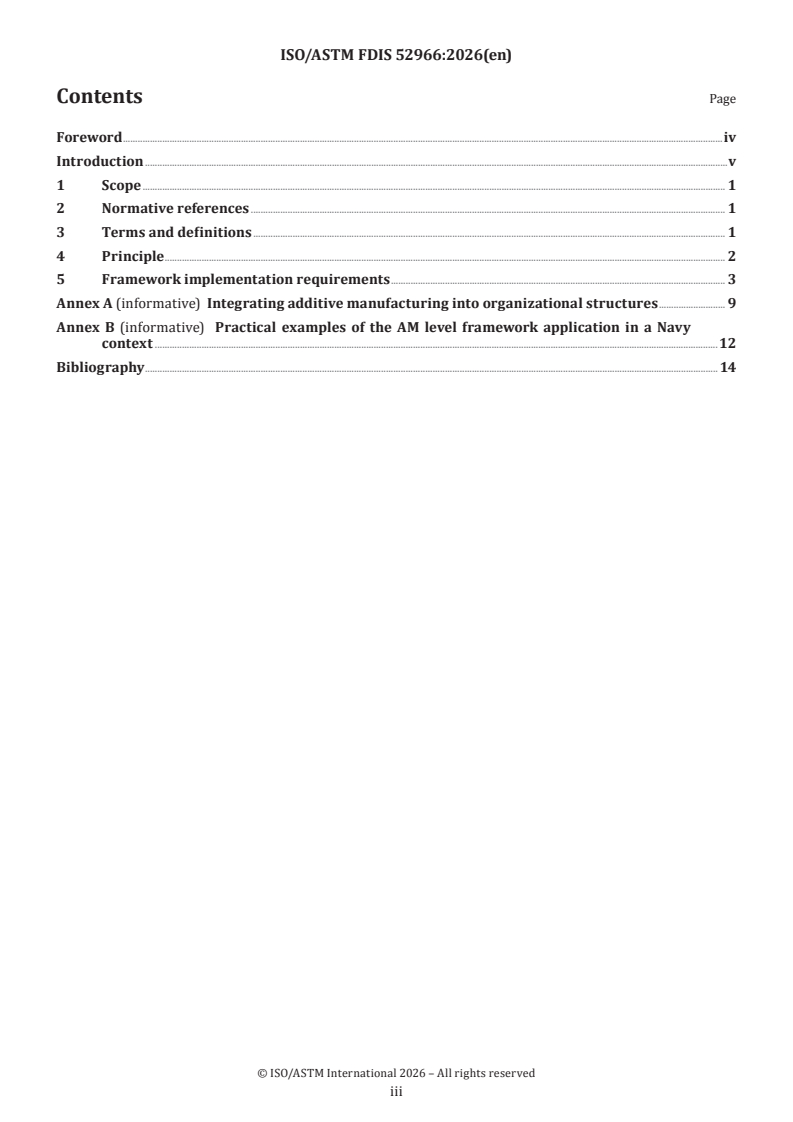
FINAL DRAFT
International
Standard
ISO/ASTM
FDIS
ISO/TC 261
Additive manufacturing —
Secretariat: DIN
Qualification principles —
Voting begins on:
Framework for categorizing
2026-08-13
resources and process capabilities
Voting terminates on:
2026-10-08
Fabrication additive — Principes de qualification — Cadre de
catégorisation des ressources et capacités du procédé
RECIPIENTS OF THIS DRAFT ARE INVITED TO SUBMIT,
WITH THEIR COMMENTS, NOTIFICATION OF ANY
RELEVANT PATENT RIGHTS OF WHICH THEY ARE AWARE
AND TO PROVIDE SUPPOR TING DOCUMENTATION.
IN ADDITION TO THEIR EVALUATION AS
BEING ACCEPTABLE FOR INDUSTRIAL, TECHNO
ISO/CEN PARALLEL PROCESSING LOGICAL, COMMERCIAL AND USER PURPOSES, DRAFT
INTERNATIONAL STANDARDS MAY ON OCCASION HAVE
TO BE CONSIDERED IN THE LIGHT OF THEIR POTENTIAL
TO BECOME STAN DARDS TO WHICH REFERENCE MAY BE
MADE IN NATIONAL REGULATIONS.
Reference number
ISO/ASTM FDIS 52966:2026(en) © ISO/ASTM International 2026
FINAL DRAFT
ISO/ASTM FDIS 52966:2026(en)
International
Standard
ISO/ASTM
FDIS
ISO/TC 261
Additive manufacturing —
Secretariat: DIN
Qualification principles —
Voting begins on:
Framework for categorizing
resources and process capabilities
Voting terminates on:
Fabrication additive — Principes de qualification — Cadre de
catégorisation des ressources et capacités du procédé
RECIPIENTS OF THIS DRAFT ARE INVITED TO SUBMIT,
WITH THEIR COMMENTS, NOTIFICATION OF ANY
RELEVANT PATENT RIGHTS OF WHICH THEY ARE AWARE
© ISO/ASTM International 2026
AND TO PROVIDE SUPPOR TING DOCUMENTATION.
All rights reserved. Unless otherwise specified, or required in the context of its implementation, no part of this publication may
IN ADDITION TO THEIR EVALUATION AS
be reproduced or utilized otherwise in any form or by any means, electronic or mechanical, including photocopying, or posting on
BEING ACCEPTABLE FOR INDUSTRIAL, TECHNO
ISO/CEN PARALLEL PROCESSING
LOGICAL, COMMERCIAL AND USER PURPOSES, DRAFT
the internet or an intranet, without prior written permission. Permission can be requested from either ISO at the address below
INTERNATIONAL STANDARDS MAY ON OCCASION HAVE
or ISO’s member body in the country of the requester. In the United States, such requests should be sent to ASTM International.
TO BE CONSIDERED IN THE LIGHT OF THEIR POTENTIAL
ISO copyright office ASTM International TO BECOME STAN DARDS TO WHICH REFERENCE MAY BE
MADE IN NATIONAL REGULATIONS.
CP 401 • Ch. de Blandonnet 8 100 Barr Harbor Drive, PO Box C700
CH-1214 Vernier, Geneva West Conshohocken, PA 19428-2959, USA
Phone: +41 22 749 01 11 Phone: +610 832 9634
Fax: +610 832 9635
Email: copyright@iso.org Email: khooper@astm.org
Website: www.iso.org Website: www.astm.org
Published in Switzerland Reference number
ISO/ASTM FDIS 52966:2026(en) © ISO/ASTM International 2026
© ISO/ASTM International 2026 – All rights reserved
ii
ISO/ASTM FDIS 52966:2026(en)
Contents Page
Foreword .iv
Introduction .v
1 Scope . 1
2 Normative references . 1
3 Terms and definitions . 1
4 Principle . 2
5 Framework implementation requirements . 3
Annex A (informative) Integrating additive manufacturing into organizational structures . 9
Annex B (informative) Practical examples of the AM level framework application in a Navy
context .12
Bibliography . 14
© ISO/ASTM International 2026 – All rights reserved
iii
ISO/ASTM FDIS 52966:2026(en)
Foreword
ISO (the International Organization for Standardization) is a worldwide federation of national standards
bodies (ISO member bodies). The work of preparing International Standards is normally carried out through
ISO technical committees. Each member body interested in a subject for which a technical committee
has been established has the right to be represented on that committee. International organizations,
governmental and non-governmental, in liaison with ISO, also take part in the work. ISO collaborates closely
with the International Electrotechnical Commission (IEC) on all matters of electrotechnical standardization.
The procedures used to develop this document and those intended for its further maintenance are described
in the ISO/IEC Directives, Part 1. In particular, the different approval criteria needed for the different types
of ISO document should be noted. This document was drafted in accordance with the editorial rules of the
ISO/IEC Directives, Part 2 (see www.iso.org/directives).
ISO draws attention to the possibility that the implementation of this document may involve the use of (a)
patent(s). ISO takes no position concerning the evidence, validity or applicability of any claimed patent
rights in respect thereof. As of the date of publication of this document, ISO had not received notice of (a)
patent(s) which may be required to implement this document. However, implementers are cautioned that
this may not represent the latest information, which may be obtained from the patent database available at
www.iso.org/patents. ISO shall not be held responsible for identifying any or all such patent rights.
Any trade name used in this document is information given for the convenience of users and does not
constitute an endorsement.
For an explanation of the voluntary nature of standards, the meaning of ISO specific terms and expressions
related to conformity assessment, as well as information about ISO's adherence to the World Trade
Organization (WTO) principles in the Technical Barriers to Trade (TBT), see www.iso.org/iso/foreword.html.
This document was prepared by Technical Committee ISO/TC 261, Additive manufacturing, in cooperation
with ASTM Committee F42, Additive Manufacturing Technologies, on the basis of a partnership agreement
between ISO and ASTM International with the aim to create a common set of ISO/ASTM standards on
additive manufacturing, in collaboration with the European Committee for Standardization (CEN) Technical
Committee CEN/TC 438, Additive manufacturing, in accordance with the Agreement on technical cooperation
between ISO and CEN (Vienna Agreement).
Any feedback or questions on this document should be directed to the user’s national standards body. A
complete listing of these bodies can be found atwww.iso.org/members.html.
© ISO/ASTM International 2026 – All rights reserved
iv
ISO/ASTM FDIS 52966:2026(en)
Introduction
The introduction of additive manufacturing (AM) in the production of parts to support temporary self-
sufficient systems (e.g. oil rigs, ships, forward operating bases) has opened new possibilities. However,
the limited resources (e.g. space, equipment, utilities, personnel and training) within these systems
pose challenges for the implementation of AM. Due to these limitations, it is not realistic to have the AM
equipment, and staff to respond to all possible needs at the same AM service site at every self sufficient
system. Rather, it is necessary to optimise the set-up of the AM service site in order to correspond to the
most frequent and critical needs of each self sufficient system. However, this optimisation will mean that
there could be situations when the local AM service site cannot respond to the actual need at the time
of need. Still, it would be possible for capabilities of different self sufficient systems to complement each
other, thus forming a framework enabling higher levels combined self-sufficiency, operational readiness
and resilience. To enable such a framework to work efficiently it is necessary to specify and categorize
the available resources and process capabilities of each AM service site, thus providing a clear structure
for coordination of capabilities. This international standard establishes a system for categorization of AM
resources and processes capabilities thus providing clarity and consistency for planning and logistical
support of self-sufficient systems.
In addition to the requirements for AM in self-sufficient systems, this standard also facilitates support
between different frameworks. For example: ships equipped with Level 2 AM capabilities can support those
with Level 1 AM, or ships with no AM capabilities, or even from different shipping companies, and from
different nationalities.
By implementing this standardized framework, collaboration and assistance between different systems
become easier, enabling the exchange of resources, expertise, and parts productions.
This normative approach addresses the allocation problem, where to put AM capabilities depending on
the available resources on site, not by focusing on quality or cost minimization, but rather by prioritizing
availability, speed, and the reduction of time back online and mean time to repair. The framework can be
resilience-optimized to meet the unique needs of isolated operating systems and to support them remotely
with optimized logistics. The AM integration process is dynamic, evolving through iterative phases of
analysis, structuring, and implementation. This ensures that the AM framework becomes increasingly
adaptable over time, supporting the broader adoption and effective utilization of AM technologies in
challenging environments.
In addition to its primary function of enabling AM in self-sufficient systems, the standardized framework
brings forth a multitude of advantages, prominently among them being the enhancement of supply chain
resilience. These benefits extend to both civilian and military domains, underlining the framework's
significance.
In summary, the standardized framework not only facilitates AM but also fosters a cohesive AM ecosystem.
It does so by promoting interoperability, collaboration, and efficiency across diverse self-sufficient systems,
thereby contributing significantly to overall supply chain resilience, particularly in times of uncertainty or
crisis.
© ISO/ASTM International 2026 – All rights reserved
v
FINAL DRAFT International Standard ISO/ASTM FDIS 52966:2026(en)
Additive manufacturing — Qualification principles —
Framework for categorizing resources and process
capabilities
1 Scope
This document specifies a standardized level framework for the implementation of additive manufacturing
to support temporary self-sufficient systems. It defines principles and criteria, from a resource perspective
(personnel, training, infrastructure, materials, etc.) and provides guidance for categorizing additive
manufacturing processes into different levels to support self-sufficient systems (ships, small islands, oil rigs,
etc.). Support can be established through onboard and onshore operation. This covers the complete part
cycle from design (if applicable), manufacturing, to a finished part that meets requirements.
It aims to provide clarity and consistency for non-AM-experts dealing with logistical support of self-
sufficient systems.
This document is applicable to industries, military institutions, research institutions, and regulatory bodies
involved in additive manufacturing, facilitating interoperability and harmonization of practices across
different stakeholders.
2 Normative references
The following documents are referred to in the text in such a way that some or all of their content constitutes
requirements of this document. For dated references, only the edition cited applies. For undated references,
the latest edition of the referenced document (including any amendments) applies.
ISO/ASTM 52900, Additive manufacturing — General principles — Fundamentals and vocabulary
ISO/ASTM 52901, Additive manufacturing — General principles — Requirements for purchased AM parts
ISO/ASTM 52904, Additive manufacturing of metals — Process characteristics and performance — Metal
powder bed fusion process to meet critical applications
ISO/ASTM 52920, Additive manufacturing — Qualification principles — Requirements for industrial additive
manufacturing processes and production sites
ISO/ASTM 52926 (all parts), Additive manufacturing of metals — Qualification principles
ISO/ASTM/TS 52930, Additive manufacturing — Qualification principles — Installation, operation and
performance (IQ/OQ/PQ) of PBF-LB equipment
ISO/ASTM 52935, Additive manufacturing of metals — Qualification principles — Qualification of coordination
personnel
ISO/ASTM 52942, Additive manufacturing — Qualification principles — Qualifying machine operators of laser
metal powder bed fusion machines and equipment used in aerospace applications
3 Terms and definitions
For the purposes of this document, the terms and definitions given in ISO/ASTM 52900, as well as the
following apply.
© ISO/ASTM International 2026 – All rights reserved
ISO/ASTM FDIS 52966:2026(en)
ISO and IEC maintain terminology databases for use in standardization at the following addresses:
— IEC Electropedia: available at http:// www .electropedia .org/
— ISO Online browsing platform: available at http:// www .iso .org/ obp
3.1
temporarily self-sufficient system
system capable of independent operation for defined periods, meeting their own needs and tasks without
external support.
Note 1 to entry: Additive machines and supporting equipment implemented in this type of system are expected to be
capable of performing a build cycle in the working environment of the system, such as while in motion on a ship, while
in orbit on a space station, and therefore must be secured to resist environmental influence such as swell, movements
and others as required in Table 1.
Note 2 to entry: Examples are a ship, an oil rig, small island, international space station, a mobile spare parts
manufacturing unit…
3.2
additive manufacturing level framework
additive manufacturing level framework
structured approach and set of principles that guide the implementation and operation of additive
manufacturing within an organization
4 Principle
The AM level framework for the implementation for systems and personnel operating in temporarily self-
sufficient systems categorizes AM capabilities into four progressive levels.
Level n+1 shall be able to replicate or encompass the capabilities and processes available at level n.
— Level 1 additive manufacturing - Basic prototyping: AM equipment is suitable for basic operations,
prototyping and non-critical parts. Operators shall have sufficient training for the available AM
equipment. Minimal auxiliary equipment is sufficient for fulfilling the needs for small-scale AM machines.
— Level 2 additive manufacturing – Intermediate production: Industrial-grade AM systems are suitable
for creating functional prototypes and moderately complex parts. Operators shall receive training,
corresponding to the requirements for executing the processes and handling the equipment.
NOTE This can include post-processing operations and part finalization.
Requirements for level 2 shall include the requirements for level 1.
— Level 3 additive manufacturing – Advanced AM capabilities: AM facilities with a high specialization,
capable of producing complex and functional parts that meet higher durability and precision standards.
The facility shall fulfil the requirements for industrial additive manufacturing processes and sites as
specified in ISO/ASTM 52920. Operators shall have training for the available equipment, corresponding
to, or equivalent to qualification requirements in ISO/ASTM 52926 standard series. Corresponding
qualifications are required for all available post processing and auxiliary equipment.
Requirements for level 3 shall include the requirements for level 2.
— Level 4 additive manufacturing – Certified manufacturing: Certified manufacturing facilities with
a focus on producing parts that meet stringent standards for critical and regulated applications. The
facility shall be certified to fulfil the requirements for industrial additive manufacturing processes and
sites as specified in ISO/ASTM 52920. The site shall have quality assurance capabilities for the available
processes. Operators shall be certified for the available equipment, corresponding to, or equivalent
to qualification requirements in ISO/ASTM 52926 standard series. Corresponding qualification and
certification is required for available post processing, quality assurance and auxiliary equipment.
Requirements for level 4 shall include the requirements for level 3.
© ISO/ASTM International 2026 – All rights reserved
ISO/ASTM FDIS 52966:2026(en)
A principal feature and requirement of this additive manufacturing level framework is that capabilities
and processes available at a lower level can be replicated or encompassed at higher levels, allowing for a
cumulative progression of skills and technological applications.
For example, a temporary self-sufficient system which has Level 1 equipment integrated in a Level 2 AM
system (e.g. AM container with industrial grade MEX machine) is classified as Level 2 AM system.
5 Framework implementation requirements
This clause describes the framework implementation requirements that are required for each level (as
described in Clause 4). These requirements are outlined in Table 1. The content of this list is not intended
to be a complete list of all the conditions but should be seen as examples and suggestions of items for
consideration in the implementation of the framework. Each user may have additional requirements based
on their circumstances.
Requirements marked with a “M” are mandatory unless the user has a specific reason why the requirement
is not applicable to their situation. Requirements marked with an “O” are optional, but the user should
review and determine what is applicable to them.
Annex A describes how additive manufacturing can be successfully integrated into organizational
structures. Practical examples of the AM level framework application in a navy context are given in Annex B.
© ISO/ASTM International 2026 – All rights reserved
ISO/ASTM FDIS 52966:2026(en)
© ISO/ASTM International 2026 – All rights reserved
Table 1 — Key considerations for framework implementation by level
Key considerations Level 1 Level 2 Level 3 Level 4
Resource constraints (M) Very limited to no access to: Limited access to: Potentially limited access to: Full access to:
— digital databases (stored model — part specific post process (post — full spectrum of AM processes; — certified production environments
and production files); machining); fulfilling the requirements of ISO/
ASTM 52901, ISO/ASTM 52904, ISO/
— post-processing, e.g. machining,
ASTM 52920, ISO/ASTM TS 52930,
— consumables; — finalization step of AM process heat treatment;
(support removal and hardening); or equivalent;
— trained personnel (operator and — qualified personnel (operator, AM
basic designer only); — quality assurance; Coordinator Level 1 to 3); — no integration restrictions;
— part specific post process (post — trained personnel (operator and AM — engineering/design resources; — any AM equipment required;
machining); coordinator level 1);
— expertise in reverse engineering — trained personnel (operator, AM
— finalization step of AM process — Environmental health and safety and advanced materials coordinator Level 1 to 3);
(support removal and hardening); (EHS) resources; compatibility shall be developed
to support Level 3 operations — full spectrum of post-processing
— Environmental health and safety — manufacturing network (e.g. effectively; equipment;
(EHS) resources; possibly temporary);
— optimization of the logistics — no limitations on engineering/
chain to ensure efficient material design resources;
— engineering resources; — equipment resources, utilities (e.g.
availability for temporary self-
ventilation, power and air) and
installation space; sufficient systems. — Regulatory conforming quality
— facility resources, utilities (e.g.
control equipment as applicable;
ventilation, power and air) and
installation space; — quality inspection and quality
assurance. — optimization of the logistics for the
— quality inspection. efficient distribution of certified
components, benefiting temporary
— post processing equipment; self-sufficient systems and shore-
based facilities.
No access to:
— quality assurance.
Application focus (M) — primary focus on low risk — extends to producing complex — extends to comprehensive — encompasses certified
components production for parts and functional prototypes production capabilities at shore- manufacturing of critical
integration into self-sufficient for various applications at the self- based facilities and, in exceptional components and applications with
systems (e.g. land, sea and space); sufficient system (e.g. land, sea and cases, advanced self-sufficient industry compliance at shore-based
space) or at a shore based facility in systems. facilities.
— applications are foundational and close support;
serve as proof of concept for more
advanced levels. — intermediate design capabilities for
complex components and functional
prototypes.
AM machine requirements — simple user friendly additive — industrial-grade additive — dedicated AM centres/ facilities — high end AM machines,
(M) manufacturing equipment with manufacturing systems with with necessary equipment and corresponding to industrial
basic capabilities. capabilities for functional capabilities. requirements for production
prototypes and temporary repeatability and reliability with
replacement parts. advanced capabilities.
ISO/ASTM FDIS 52966:2026(en)
© ISO/ASTM International 2026 – All rights reserved
Table 1 (continued)
Key considerations Level 1 Level 2 Level 3 Level 4
Facilities (M) — temperature controlled area if —
...
ISO/ASTM FDIS 52966:2026(en)
ISO/TC 261
Secretariat: DIN
Date: 2026-06-11xx
Additive manufacturing — Qualification principles — Framework for
categorizing resources and process capabilities
Fabrication additive — Principes de qualification — Cadre de catégorisation des ressources et capacités du
procédé
FDIS stage
TThhiis drs draafftt i is s susubbmmiitttteed d ttoo aa ppaarraallellel l vvoottee i inn IISSOO,, CCEEN.N.
ISO/ASTM FDIS 52966:2026(en)
© ISO/ASTM International 2026
All rights reserved. Unless otherwise specified, or required in the context of its implementation, no part of this publication
may be reproduced or utilized otherwise in any form or by any means, electronic or mechanical, including photocopying,
or posting on the internet or an intranet, without prior written permission. Permission can be requested from either ISO
at the address below or ISO’s member body in the country of the requester.
ISO copyright office
CP 401 • Ch. de Blandonnet 8
CH-1214 Vernier, Geneva
Phone: + 41 22 749 01 11
E-mail: copyright@iso.org
Website: www.iso.org
Published in Switzerland
© ISO/ASTM 2026 – All rights reserved
ii
ISO/ASTM FDIS 52966:2026(en)
Contents
Foreword . iv
Introduction . v
1 Scope . 1
2 Normative references . 1
3 Terms and definitions . 1
4 Principle . 2
5 Framework implementation requirements . 3
Annex A (informative) Integrating additive manufacturing into organizational structures . 11
Annex B (informative) Practical examples of the AM level framework application in a Navy
context . 14
Bibliography . 16
© ISO/ASTM 2026 – All rights reserved
iii
ISO/ASTM FDIS 52966:2026(en)
Foreword
ISO (the International Organization for Standardization) is a worldwide federation of national standards
bodies (ISO member bodies). The work of preparing International Standards is normally carried out through
ISO technical committees. Each member body interested in a subject for which a technical committee has been
established has the right to be represented on that committee. International organizations, governmental and
non-governmental, in liaison with ISO, also take part in the work. ISO collaborates closely with the
International Electrotechnical Commission (IEC) on all matters of electrotechnical standardization.
The procedures used to develop this document and those intended for its further maintenance are described
in the ISO/IEC Directives, Part 1. In particular, the different approval criteria needed for the different types of
ISO document should be noted. This document was drafted in accordance with the editorial rules of the
ISO/IEC Directives, Part 2 (see www.iso.org/directives).
ISO draws attention to the possibility that the implementation of this document may involve the use of (a)
patent(s). ISO takes no position concerning the evidence, validity or applicability of any claimed patent rights
in respect thereof. As of the date of publication of this document, ISO had not received notice of (a) patent(s)
which may be required to implement this document. However, implementers are cautioned that this may not
represent the latest information, which may be obtained from the patent database available at
www.iso.org/patents. ISO shall not be held responsible for identifying any or all such patent rights.
Any trade name used in this document is information given for the convenience of users and does not
constitute an endorsement.
For an explanation of the voluntary nature of standards, the meaning of ISO specific terms and expressions
related to conformity assessment, as well as information about ISO's adherence to the World Trade
Organization (WTO) principles in the Technical Barriers to Trade (TBT), see www.iso.org/iso/foreword.html.
This document was prepared by Technical Committee ISO/TC 261, Additive manufacturing, in cooperation
with ASTM Committee F42, Additive Manufacturing Technologies, on the basis of a partnership agreement
between ISO and ASTM International with the aim to create a common set of ISO/ASTM standards on additive
manufacturing, in collaboration with the European Committee for Standardization (CEN) Technical
Committee CEN/TC 438, Additive manufacturing, in accordance with the Agreement on technical cooperation
between ISO and CEN (Vienna Agreement).
Any feedback or questions on this document should be directed to the user’s national standards body. A
complete listing of these bodies can be found atwww.iso.org/members.html.
© ISO/ASTM 2026 – All rights reserved
iv
ISO/ASTM FDIS 52966:2026(en)
Introduction
The introduction of additive manufacturing (AM) in the production of parts to support temporary self-
sufficient systems (e.g. oil rigs, ships, forward operating bases) has opened new possibilities. However, the
limited resources (e.g. space, equipment, utilities, personnel, and training…)) within these systems pose
challenges for the implementation of AM. Due to these limitations, it is not realistic to have the AM equipment,
and staff to respond to all possible needs at the same AM service site at every self sufficient system. Rather, it
is necessary to optimise the set-up of the AM service site in order to correspond to the most frequent and
critical needs of each self sufficient system. However, this optimisation will mean that there could be situations
when the local AM service site cannot respond to the actual need at the time of need. Still, it would be possible
for capabilities of different self sufficient systems to complement each other, thus forming a framework
enabling higher levels combined self-sufficiency, operational readiness and resilience. To enable such a
framework to work efficiently it is necessary to specify and categorize the available resources and process
capabilities of each AM service site, thus providing a clear structure for coordination of capabilities. This
international standard establishes a system for categorization of AM resources and processes capabilities thus
providing clarity and consistency for planning and logistical support of self-sufficient systems.
In addition to the requirements for AM in self-sufficient systems, this standard also facilitates support between
different frameworks. For example: ships equipped with Level 2 AM capabilities can support those with Level
1 AM, or ships with no AM capabilities, or even from different shipping companies, and from different
nationalities.
By implementing this standardized framework, collaboration and assistance between different systems
become easier, enabling the exchange of resources, expertise, and parts productions.
This normative approach addresses the allocation problem, where to put AM capabilities depending on the
available resources on site, not by focusing on quality or cost minimization, but rather by prioritizing
availability, speed, and the reduction of time back online and mean time to repair. The framework can be
resilience-optimized to meet the unique needs of isolated operating systems and to support them remotely
with optimized logistics. The AM integration process is dynamic, evolving through iterative phases of analysis,
structuring, and implementation. This ensures that the AM framework becomes increasingly adaptable over
time, supporting the broader adoption and effective utilization of AM technologies in challenging
environments.
In addition to its primary function of enabling AM in self-sufficient systems, the standardized framework
brings forth a multitude of advantages, prominently among them being the enhancement of supply chain
resilience. These benefits extend to both civilian and military domains, underlining the framework's
significance.
In summary, the standardized framework not only facilitates AM but also fosters a cohesive AM ecosystem. It
does so by promoting interoperability, collaboration, and efficiency across diverse self-sufficient systems,
thereby contributing significantly to overall supply chain resilience, particularly in times of uncertainty or
crisis.
© ISO/ASTM 2026 – All rights reserved
v
ISO/ASTM FDIS 52966:2026(en)
Additive manufacturing — Qualification principles — Framework for
categorizing resources and process capabilities
1 Scope
This document specifies a standardized level framework for the implementation of additive manufacturing to
support temporary self-sufficient systems. It defines principles and criteria, from a resource perspective
(personnel, training, infrastructure, materials, etc.) and provides guidance for categorizing additive
manufacturing processes into different levels to support self-sufficient systems (ships, small islands, oil rigs,
etc.). Support can be established through onboard and onshore operation. This covers the complete part cycle
from design (if applicable), manufacturing, to a finished part that meets requirements.
It aims to provide clarity and consistency for non-AM-experts dealing with logistical support of self-sufficient
systems.
This document is applicable to industries, military institutions, research institutions, and regulatory bodies
involved in additive manufacturing, facilitating interoperability and harmonization of practices across
different stakeholders.
2 Normative references
The following documents are referred to in the text in such a way that some or all of their content constitutes
requirements of this document. For dated references, only the edition cited applies. For undated references,
the latest edition of the referenced document (including any amendments) applies.
ISO/ASTM 52900, Additive manufacturing — General principles — Fundamentals and vocabulary
ISO/ASTM 52901, Additive manufacturing — General principles — Requirements for purchased AM parts
ISO/ASTM 52904, Additive manufacturing of metals — Process characteristics and performance — Metal
powder bed fusion process to meet critical applications
ISO/ASTM 52920, Additive manufacturing — Qualification principles — Requirements for industrial additive
manufacturing processes and production sites
ISO/ASTM 52926 (all parts), Additive manufacturing of metals — Qualification principles
ISO/ASTM/TS 52930, Additive manufacturing — Qualification principles — Installation, operation and
performance (IQ/OQ/PQ) of PBF-LB equipment
ISO/ASTM 52935, Additive manufacturing of metals — Qualification principles — Qualification of coordination
personnel
ISO/ASTM 52942, Additive manufacturing — Qualification principles — Qualifying machine operators of laser
metal powder bed fusion machines and equipment used in aerospace applications
3 Terms and definitions
For the purposes of this document, the terms and definitions given in ISO/ASTM 52900, as well as the
following apply.
ISO and IEC maintain terminologicalterminology databases for use in standardization at the following
addresses:
© ISO/ASTM 2026 – All rights reserved
ISO/ASTM FDIS 52966:2026(en)
— — IEC Electropedia: available at http://www.electropedia.org/
— — ISO Online browsing platform: available at http://www.iso.org/obp
3.1 3.1
temporarily self-sufficient system
system capable of independent operation for defined periods, meeting their own needs and tasks without
external support.
Note 1 to entry: Additive Machinesmachines and supporting equipment implemented in this type of system are expected
to be capable of performing a build cycle in the working environment of the system, such as while in motion on a ship,
while in orbit on a space station, and therefore must be secured to resist environmental influence such as swell,
movements and others as required in Table 1table 1.
Note 2 to entry: Examples are a ship, an oil rig, small island, international space station, a mobile spare parts
manufacturing unit…
3.2 3.2
additive manufacturing level framework
additive manufacturing level framework
structured approach and set of principles that guide the implementation and operation of additive
manufacturing within an organization
4 Principle
The AM level framework for the implementation for systems and personnel operating in temporarily self-
sufficient systems categorizes AM capabilities into four progressive levels.
Level n+1 shall be able to replicate or encompass the capabilities and processes available at level n.
— — Level 1 additive manufacturing - Basic prototyping: AM equipment is suitable for basic operations,
prototyping and non-critical parts. Operators shall have sufficient training for the available AM equipment.
Minimal auxiliary equipment is sufficient for fulfilling the needs for small-scale AM machines.
— — Level 2 additive manufacturing – Intermediate production: Industrial-grade AM systems are
suitable for creating functional prototypes and moderately complex parts. Operators shall receive training,
corresponding to the requirements for executing the processes and handling the equipment.
NOTE This maycan include post-processing operations and part finalization.
Requirements for level 2 shall include the requirements for level 1.
— — Level 3 additive manufacturing – Advanced AM capabilities: AM facilities with a high
specialization, capable of producing complex and functional parts that meet higher durability and
precision standards. The facility shall fulfil the requirements for industrial additive manufacturing
processes and sites as specified in ISO/ASTM 52920. Operators shall have training for the available
equipment, corresponding to, or equivalent to qualification requirements in ISO/ASTM 52926 standard
series. Corresponding qualifications are required for all available post processing and auxiliary
equipment.
Requirements for level 3 shall include the requirements for level 2.
— — Level 4 additive manufacturing – Certified manufacturing: Certified manufacturing facilities with
a focus on producing parts that meet stringent standards for critical and regulated applications. The
facility shall be certified to fulfil the requirements for industrial additive manufacturing processes and
sites as specified in ISO/ASTM 52920. The site shall have quality assurance capabilities for the available
© ISO/ASTM 2026 – All rights reserved
ISO/ASTM FDIS 52966:2026(en)
processes. Operators shall be certified for the available equipment, corresponding to, or equivalent to
qualification requirements in ISO/ASTM 52926 standard series. Corresponding qualification and
certification is required for available post processing, quality assurance and auxiliary equipment.
Requirements for level 4 shall include the requirements for level 3.
A principal feature and requirement of this additive manufacturing level framework is that capabilities and
processes available at a lower level can be replicated or encompassed at higher levels, allowing for a
cumulative progression of skills and technological applications.
For example, a temporary self-sufficient system which has Level 1 equipment integrated in a Level 2 AM
system (e.g. AM container with industrial grade MEX machine) is classified as Level 2 AM system.
5 Framework implementation requirements
This clause describes the framework implementation requirements that are required for each level (as
described in Clause 4Clause 4).). These requirements are outlined in Table 1Table 1. The content of this list is
not intended to be a complete list of all the conditions but should be seen as examples and suggestions of items
for consideration in the implementation of the framework. Each user may have additional requirements based
on their circumstances.
Requirements marked with a “M” are mandatory unless the user has a specific reason why the requirement is
not applicable to their situation. Requirements marked with an “O” are optional, but the user should review
and determine what is applicable to them.
Annex AAnnex A describes how additive manufacturing can be successfully integrated into organizational
structures. Practical examples of the AM level framework application in a navy context are given in
Annex BAnnex B.
© ISO/ASTM 2026 – All rights reserved
ISO/ASTM FDIS 52966:2026(en)
Table 1 — Key considerations for framework implementation by level
Key Level 1 Level 2 Level 3 Level 4
Considerationsconsi
derations
Resource constraints (M) Very limited to no access to: Limited access to: Potentially limited access to: Full access to:
— — digital databases (stored — — part specific post process — — full spectrum of AM — — certified production
model and production files); (post machining); processes; environments fulfilling the
requirements forof ISO/ASTM
— — consumables; — — finalization step of AM — — post-processing, e.g. 52901, ISO/ASTM 52904,
process (support removal, and machining, heat treatment; ISO/ASTM 52920, ISO/ASTM TS
52930, or equivalent;
— — trained personnel hardening);
(operator and basic designer — — qualified personnel
only); — — quality assurance; (operator, AM Coordinator — — no integration restrictions;
Level 1 to 3);
— — part specific post process — — trained personnel (operator — — any AM equipment
(post machining); and AM Coordinatorcoordinator — — engineering / /design required;
level 1); resources;
— — trained personnel
— — finalization step of AM
process (support removal, and — — Environmental Healthhealth — — expertise in reverse (operator, AM coordinator Level
hardening); and Safetysafety (EHS) resources; engineering and advanced 1 to 3);
materials compatibility shall be
— — Environmental Healthhealth — — manufacturing network developed to support Level 3 — — full spectrum of post-
operations effectively; processing equipment;
and Safetysafety (EHS) (e.g. possibly temporary);
resources;
— — equipment resources (, — — optimization of the logistics — — no limitations on
— — engineering resources; utilities (e.g. ventilation, power, chain to ensure efficient engineering / design resources;
material availability for
and air, etc.)) and installation
space; temporary self-sufficient — — Regulatory conforming
— — facility resources (, utilities
(e.g. ventilation, power, and air, systems. quality control equipment as
etc.)) and installation space; — — quality inspection and applicable;
quality assurance.
— — quality inspection. — — optimization of the logistics
for the efficient distribution of
certified components, benefiting
— — post processing
equipment; temporary self-sufficient
© ISO/ASTM 2026 – All rights reserved
ISO/ASTM FDIS 52966:2026(en)
Key Level 1 Level 2 Level 3 Level 4
Considerationsconsi
derations
No access to: systems and shore-based
facilities.
— — quality assurance.
— — primary focus on low risk — — extends to producing — — extends to comprehensive — — encompasses certified
Application focus (M)
components production for complex parts and functional production capabilities at shore- manufacturing of critical
integration into self-sufficient prototypes for various based facilities and, in components and applications
systems (e.g. land, sea, and applications at the self-sufficient exceptional cases, advanced with industry compliance at
space, etc.);); system (e.g. land, sea, and space, self-sufficient systems. shore-based facilities.
etc.)) or at a shore based facility
— — applications are in close support;
foundational and serve as proof
of concept for more advanced — — intermediate design
levels. capabilities for complex
components and functional
prototypes.
— — simple user friendly — — industrial-grade additive — — dedicated AM centres/ — — high end AM machines,
AM machine requirements
additive manufacturing manufacturing systems with facilities with necessary corresponding to industrial
(M)
equipment with basic capabilities for functional equipment and capabilities. requirements for production
capabilities. prototypes and temporary repeatability and reliability with
replacement parts. advanced capabilities.
— — temperature controlled — — temperature and humidity — — a dedicated AM centre or — — a qualified AM centre or
Facilities (M)
area if possible; controlled as required; facility facility with specialized
equipment corresponding to
— — area with proper — — area with proper ventilation ISO/ASTM 52920 or equal.
ventilation based on materials shall be fulfilled to ensure a safe
used. working environment.
— — AM shall be possible in — — implementable in self- — — implementable in self- — — none.
Versatility (O)
every self-sufficient system that sufficient systems with fewer sufficient systems regarding
considers using AM. restrictions regarding installation requirements and
installation requirements and
environmental influences (e.g.
© ISO/ASTM 2026 – All rights reserved
ISO/ASTM FDIS 52966:2026(en)
Key Level 1 Level 2 Level 3 Level 4
Considerationsconsi
derations
swell, and humidity) such as environmental influences.
auxiliary ships and oil rigs. Typically, on shore locations.
— — basic quality assurance — — enhanced quality assurance — — documented quality — — enhanced quality assurance
Quality Assurance (M)
processes shall be established processes shall be established to assurance processes shall be processes shall be established to
to ensure the reliability of ensure the reliability of established to ensure the ensure the reliability of
components produced at this components produced at this r
...
PROJET FINAL
Norme
internationale
ISO/ASTM
FDIS
ISO/TC 261
Fabrication additive — Principes
Secrétariat: DIN
de qualification — Cadre pour la
Début de vote:
catégorisation des ressources et
2026-08-13
capacités de traitement
Vote clos le:
2026-10-08
Additive manufacturing — Qualification principles —
Framework for categorizing resources and process capabilities
LES DESTINATAIRES DU PRÉSENT PROJET SONT
INVITÉS À PRÉSENTER, AVEC LEURS OBSERVATIONS,
NOTIFICATION DES DROITS DE PROPRIÉTÉ DONT ILS
AURAIENT ÉVENTUELLEMENT CONNAISSANCE ET À
FOURNIR UNE DOCUMENTATION EXPLICATIVE.
OUTRE LE FAIT D’ÊTRE EXAMINÉS POUR
ÉTABLIR S’ILS SONT ACCEPTABLES À DES FINS
INDUSTRIELLES, TECHNOLOGIQUES ET COM-MERCIALES,
AINSI QUE DU POINT DE VUE DES UTILISATEURS, LES
PROJETS DE NORMES
TRAITEMENT PARALLÈLE ISO/CEN
INTERNATIONALES DOIVENT PARFOIS ÊTRE CONSIDÉRÉS
DU POINT DE VUE DE LEUR POSSI BILITÉ DE DEVENIR DES
NORMES POUVANT
SERVIR DE RÉFÉRENCE DANS LA RÉGLEMENTATION
NATIONALE.
Numéro de référence
ISO/ASTM FDIS 52966:2026(fr) © ISO/ASTM International 2026
PROJET FINAL
ISO/ASTM FDIS 52966:2026(fr)
Norme
internationale
ISO/ASTM
FDIS
ISO/TC 261
Fabrication additive — Principes
Secrétariat: DIN
de qualification — Cadre pour la
Début de vote:
catégorisation des ressources et
2026-08-13
capacités de traitement
Vote clos le:
2026-10-08
Additive manufacturing — Qualification principles —
Framework for categorizing resources and process capabilities
LES DESTINATAIRES DU PRÉSENT PROJET SONT
INVITÉS À PRÉSENTER, AVEC LEURS OBSERVATIONS,
NOTIFICATION DES DROITS DE PROPRIÉTÉ DONT ILS
DOCUMENT PROTÉGÉ PAR COPYRIGHT
AURAIENT ÉVENTUELLEMENT CONNAISSANCE ET À
FOURNIR UNE DOCUMENTATION EXPLICATIVE.
© ISO/ASTM International 2026
OUTRE LE FAIT D’ÊTRE EXAMINÉS POUR
ÉTABLIR S’ILS SONT ACCEPTABLES À DES FINS
Tous droits réservés. Sauf prescription différente ou nécessité dans le contexte de sa mise en œuvre, aucune partie de cette
INDUSTRIELLES, TECHNOLOGIQUES ET COM-MERCIALES,
publication ne peut être reproduite ni utilisée sous quelque forme que ce soit et par aucun procédé, électronique ou mécanique,
AINSI QUE DU POINT DE VUE DES UTILISATEURS, LES
y compris la photocopie, ou la diffusion sur l’internet ou un intranet, sans autorisation écrite soit de l’ISO à l’adresse ci-après,
PROJETS DE NORMES
TRAITEMENT PARALLÈLE ISO/CEN
INTERNATIONALES DOIVENT PARFOIS ÊTRE CONSIDÉRÉS
soit d’un organisme membre de l’ISO dans le pays du demandeur. Aux États-Unis, les demandes doivent être adressées à ASTM
DU POINT DE VUE DE LEUR POSSI BILITÉ DE DEVENIR DES
International.
NORMES POUVANT
ISO copyright office ASTM International SERVIR DE RÉFÉRENCE DANS LA RÉGLEMENTATION
NATIONALE.
Case postale 401 • Ch. de Blandonnet 8 100 Barr Harbor Drive, PO Box C700
CH-1214 Vernier, Genève West Conshohocken, PA 19428-2959, USA
Tél.: +41 22 749 01 11 Tél.: +610 832 9634
Fax: +610 832 9635
E-mail: copyright@iso.org E-mail: khooper@astm.org
Web: www.iso.org Web: www.astm.org
Publié en Suisse Numéro de référence
ISO/ASTM FDIS 52966:2026(fr) © ISO/ASTM International 2026
© ISO/ASTM International 2026 – Tous droits réservés
ii
ISO/ASTM FDIS 52966:2026(fr)
Sommaire Page
Avant-propos .iv
Introduction .v
1 Domaine d’application . 1
2 Références normatives . 1
3 Termes et définitions . 1
4 Principe. 2
5 Exigences de mise en œuvre du cadre . 3
Annexe A (informative) Intégration de la fabrication additive à des structures
organisationnelles . 9
Annexe B (informative) Exemples pratiques de l’application du cadre de FA dans le contexte de
la marine.12
Bibliographie . 14
© ISO/ASTM International 2026 – Tous droits réservés
iii
ISO/ASTM FDIS 52966:2026(fr)
Avant-propos
L'ISO (Organisation internationale de normalisation) est une fédération mondiale d'organismes nationaux
de normalisation (comités membres de l'ISO). L'élaboration des Normes internationales est en général
confiée aux comités techniques de l'ISO. Chaque comité membre intéressé par une étude a le droit de faire
partie du comité technique créé à cet effet. Les organisations internationales, gouvernementales et non
gouvernementales, en liaison avec l'ISO participent également aux travaux. L'ISO collabore étroitement avec
la Commission électrotechnique internationale (IEC) en ce qui concerne la normalisation électrotechnique.
Les procédures utilisées pour élaborer le présent document et celles destinées à sa mise à jour sont
décrites dans les Directives ISO/IEC, Partie 1. Il convient, en particulier, de prendre note des différents
critères d'approbation requis pour les différents types de documents ISO. Le présent document a
été rédigé conformément aux règles de rédaction données dans les Directives ISO/IEC, Partie 2 (voir
www.iso.org/directives).
L'ISO attire l'attention sur le fait que la mise en application du présent document peut entraîner l'utilisation
d'un ou de plusieurs brevets. L'ISO ne prend pas position quant à la preuve, à la validité et à l'applicabilité de
tout droit de brevet revendiqué à cet égard. À la date de publication du présent document, l'ISO n'avait pas
reçu notification qu'un ou plusieurs brevets pouvaient être nécessaires à sa mise en application. Toutefois,
il y a lieu d'avertir les responsables de la mise en application du présent document que des informations
plus récentes sont susceptibles de figurer dans la base de données de brevets, disponible à l'adresse
www.iso.org/brevets. L'ISO ne saurait être tenue pour responsable de ne pas avoir identifié tout ou partie de
tels droits de brevet.
Les appellations commerciales éventuellement mentionnées dans le présent document sont données pour
information, par souci de commodité, à l’intention des utilisateurs et ne sauraient constituer un engagement.
Pour une explication de la nature volontaire des normes, la signification des termes et expressions
spécifiques de l'ISO liés à l'évaluation de la conformité, ou pour toute information au sujet de l'adhésion de
l'ISO aux principes de l’Organisation mondiale du commerce (OMC) concernant les obstacles techniques au
commerce (OTC), voir www.iso.org/iso/fr/avant-propos.html.
Le présent document a été élaboré par le comité technique ISO/TC 261, Fabrication additive, en coopération
avec le comité ASTM F42, Technologies de fabrication additive, dans le cadre d'un accord de partenariat entre
l'ISO et ASTM International dans le but de créer un ensemble commun de normes ISO/ASTM sur la fabrication
additive, et en collaboration avec le comité technique CEN/TC 438, Fabrication additive, du Comité européen
de normalisation (CEN) conformément à l'Accord de coopération technique entre l'ISO et le CEN (Accord de
Vienne).
Il convient que l’utilisateur adresse tout retour d’information ou toute question concernant le présent
document à l’organisme national de normalisation de son pays. Une liste exhaustive desdits organismes se
trouve à l’adresse www.iso.org/fr/members.html.
© ISO/ASTM International 2026 – Tous droits réservés
iv
ISO/ASTM FDIS 52966:2026(fr)
Introduction
L’introduction de la fabrication additive (FA) dans la production de pièces pour appuyer des systèmes
temporairement autosuffisants (par exemple, plateformes pétrolières, navires, bases opérationnelles
avancées) a ouvert de nouvelles possibilités. Néanmoins, les ressources limitées (par exemple, espace,
équipements, réseaux, personnel et formation) au sein de ces systèmes représentent un défi pour la
mise en œuvre de la FA. En raison de ces limitations, il n'est pas réaliste d'avoir l'équipement de FA et le
personnel pour répondre à tous les besoins potentiels sur le même site de service de FA de chaque système
autosuffisant. Il est plutôt nécessaire d'optimiser l'installation du site de service de FA afin de correspondre
aux besoins les plus fréquents et critiques de chaque système autosuffisant. Cependant, cette optimisation
signifiera qu'il pourrait y avoir des situations au cours desquelles le site de service de FA local ne peut pas
répondre au besoin réel au moment de nécessité.
Pourtant, il serait possible pour des capacités de différents systèmes autosuffisants de se compléter entre
elles, formant ainsi un cadre permettant des niveaux plus élevés combinés d'autosuffisance, de préparation
opérationnelle et de résilience. Pour permettre à un tel cadre de fonctionner efficacement, il est nécessaire
de spécifier et de catégoriser les ressources disponibles et les capacités de traitement de chaque site
de service de FA, fournissant ainsi une structure claire pour la coordination des capacités. La présente
norme internationale établit un système pour la catégorisation des ressources et des capacités de procédé
de FA fournissant ainsi clarté et cohérence pour la planification et le support logistique des systèmes
autosuffisants.
En complément aux exigences pour la FA dans les systèmes autosuffisants, la présente norme facilite
également le support entre différents cadres. Par exemple: les navires équipés de capacités de FA de Niveau 2
peuvent apporter un support à ceux de Niveau 1 de FA, ou bien à des navires n'ayant aucune capacité de FA
ou même à des compagnies maritimes différentes et de différentes nationalités.
En mettant en œuvre ce cadre normalisé, la collaboration et l’assistance entre différents systèmes deviennent
plus simples, permettant l’échange de ressources, d’expertise et de productions de pièces.
Cette approche normative aborde le problème de l’affectation, et de la répartition des capacités de FA selon
les ressources disponibles sur place, sans se focaliser sur la qualité ou la réduction des coûts, mais plutôt en
privilégiant la disponibilité, la vitesse et la réduction du temps de rétablissement et du temps moyen entre
défaillances. Le cadre peut être optimisé en matière de résilience afin de répondre aux besoins uniques
des systèmes opérationnels isolés et de pouvoir les supporter à distance grâce à une logistique améliorée.
Le procédé d’intégration de la FA est dynamique, évoluant au travers de phases itératives d’analyse, de
structuration et de mise en œuvre. Cela garantit la flexibilité toujours plus importante du cadre de FA au
cours du temps, en soutenant l’adoption élargie et une utilisation efficace des technologies de FA dans des
environnements difficiles.
En plus de sa fonction principale de permettre la FA dans des systèmes autosuffisants, le cadre normalisé
permet de profiter d’une multitude d’avantages, dont le plus important est l’amélioration de la résilience
de la chaîne d’approvisionnement. Ces avantages s’appliquent aux domaines civils et militaires, soulignant
l’importance du cadre.
Pour résumer, le cadre normalisé non seulement facilite la FA, mais favorise également un écosystème de
FA cohésif. Il y parvient en promouvant l’interopérabilité, la collaboration et l’efficacité au sein de divers
systèmes autosuffisants, contribuant ainsi fortement à la résilience globale de la chaîne d’approvisionnement,
en particulier en période d’incertitude ou de crise.
© ISO/ASTM International 2026 – Tous droits réservés
v
PROJET FINAL Norme internationale ISO/ASTM FDIS 52966:2026(fr)
Fabrication additive — Principes de qualification — Cadre
pour la catégorisation des ressources et capacités de
traitement
1 Domaine d’application
Le présent document spécifie un cadre de niveau normalisé pour la mise en œuvre de la fabrication additive
afin de supporter des systèmes temporairement autosuffisants. Il définit des principes et critères, d’un
point de vue des ressources (personnel, formation, infrastructure, matériaux, etc.), et fournit des lignes
directrices pour catégoriser les procédés de fabrication additive en différents niveaux pour supporter des
systèmes autosuffisants (navires, petites îles, plateformes pétrolières, etc.). Le support peut être établi par
le biais d’une opération intégrée ou terrestre. Cela couvre le cycle de pièce complet de la conception (le cas
échéant) et la fabrication, jusqu’à une pièce finie qui satisfait aux exigences.
Il a pour objectif d’assurer clarté et cohérence pour les non experts en FA traitant du support logistique des
systèmes autosuffisants.
Le présent document s’applique aux industries, institutions militaires, instituts de recherche et organismes
de réglementation concernés par la fabrication additive, facilitant l’interopérabilité et l’harmonisation des
pratiques au sein des différentes parties prenantes.
2 Références normatives
Les documents suivants sont cités dans le texte de sorte qu’ils constituent, pour tout ou partie de leur
contenu, des exigences du présent document. Pour les références datées, seule l’édition citée s’applique. Pour
les références non datées, la dernière édition de la publication à laquelle il est fait référence s'applique (y
compris tous les amendements).
ISO/ASTM 52900, Fabrication additive — Principes généraux — Fondamentaux et vocabulaire
ISO/ASTM 52901, Fabrication additive — Principes généraux — Exigences pour l’achat de pièces
ISO/ASTM 52904, Fabrication additive de métaux — Caractéristiques et performances du procédé — Procédé
de fusion sur lit de poudre métallique en vue de répondre aux applications critiques
ISO/ASTM 52920, Fabrication additive — Principes de qualification — Exigences pour les procédés et les sites
industriels de production en fabrication additive
ISO/ASTM 52926 (toutes les parties), Fabrication additive de métaux — Principes de qualification
ISO/ASTM/TS 52930, Fabrication additive — Principes de qualification — Installation, fonctionnement et
performances (IQ/OQ/PQ) de l'équipement de PBF-LB
ISO/ASTM 52935, Fabrication additive des métaux — Principes de qualification — Qualification du personnel
de coordination
ISO/ASTM 52942, Fabrication additive — Principes de qualification — Qualification des opérateurs machine
des machines à fusion laser sur lit de poudre et équipements utilisés dans les applications aérospatiales
3 Termes et définitions
Pour les besoins du présent document, les termes et définitions donnés dans l’ISO/ASTM 52900 ainsi que les
suivants s’appliquent.
© ISO/ASTM International 2026 – Tous droits réservés
ISO/ASTM FDIS 52966:2026(fr)
L'ISO et l'IEC tiennent à jour des bases de données terminologiques destinées à être utilisées en normalisation,
consultables aux adresses suivantes:
— IEC Electropedia: disponible à l’adresse http:// www .electropedia .org/
— ISO Online browsing platform: disponible à l’adresse http:// www .iso .org/ obp
3.1
système temporairement autosuffisant
système en mesure de fonctionner indépendamment pendant des périodes définies, de manière à répondre à
leurs propres besoins et tâches sans support externe
Note 1 à l'article: Les machines additives et l'équipement de support mis en place dans ce type de système sont
censés être capables de réaliser un cycle de fabrication dans l'environnement de travail du système, par exemple en
mouvement sur un navire, en orbite sur une station spatiale, et doivent ainsi être sécurisées pour résister à l'influence
environnementale telle que la houle, les mouvements ou autre comme requis au Tableau 1.
Note 2 à l'article: Des exemples sont un navire, une plateforme pétrolière, une petite île, une station spatiale
internationale, une unité de fabrication de pièces détachées mobiles, etc.
3.2
cadre de niveau de fabrication additive
approche et ensemble de principes structurés qui guident la mise en œuvre et l’opération de la fabrication
additive au sein d’une organisation
4 Principe
Le cadre de niveau de FA pour la mise en œuvre de systèmes et du personnel d’exploitation dans des systèmes
temporairement autosuffisants catégorise les capacités de FA en quatre niveaux progressifs.
Le niveau n+1 doit être capable de répliquer ou d'inclure les capacités et les procédés au niveau n.
— Fabrication additive de niveau 1 – Prototypage de base: l’équipement de FA est adapté pour les
opérations de base, le prototypage et les pièces non critiques. Les opérateurs doivent avoir une formation
suffisante pour l'équipement de FA disponible. Un équipement auxiliaire minimum est suffisant pour
répondre aux besoins de machines de FA de petite taille.
— Fabrication additive de niveau 2 – Production intermédiaire: Systèmes de FA de qualité industrielle,
sont adaptés à la création de prototypes fonctionnels et de pièces à complexité modérée. Les opérateurs
doivent suivre une formation correspondant aux exigences pour l'exécution des procédés et la
manipulation de l'équipement.
NOTE Cela peut inclure des opérations de post-traitement et de finalisation de la pièce.
Les exigences pour le niveau 2 doivent inclure les exigences pour le niveau 1.
— Fabrication additive de niveau 3 – Capacités de FA avancées: installations de FA de haute spécialisation,
en mesure de produire des pièces complexes et fonctionnelles qui respectent des normes de durabilité et
de précision plus strictes. L'installation doit être certifiée comme répondant aux exigences des procédés
et sites de fabrication additive comme spécifié dans l'ISO/ASTM 52920. Les opérateurs doivent être
formés pour l'équipement disponible, correspondant aux ou équivalent aux exigences de la série de
normes ISO/ASTM 52926. Les qualifications correspondantes sont requises pour tout l'équipement de
post-traitement et auxiliaire disponible.
Les exigences pour le niveau 3 doivent inclure les exigences pour le niveau 2.
— Fabrication additive de niveau 4 – Fabrication certifiée: installations de fabrication certifiées qui se
concentrent sur la production de pièces qui respectent des normes rigoureuses pour des applications
critiques et réglementées. L'installation doit être certifiée pour répondre aux exigences des procédés et
des sites de fabrication additive industrielle comme spécifié dans l'ISO/ASTM 52920. Le site doit avoir
des capacités d'assurance qualité pour les procédés disponibles. Les opérateurs doivent être certifiés
pour l'équipement disponible, correspondant aux ou équivalent aux exigences de qualification de la série
© ISO/ASTM International 2026 – Tous droits réservés
ISO/ASTM FDIS 52966:2026(fr)
de normes ISO/ASTM 52926. La qualification et la certification correspondantes sont requises pour le
post-traitement, l'assurance qualité et l'équipement auxiliaire disponibles.
Les exigences pour le niveau 4 doivent inclure les exigences pour le niveau 3.
Une des principales caractéristiques et exigences de ce cadre de niveau de fabrication additive réside dans
le fait que les capacités et procédés disponibles à un niveau inférieur peuvent être répliqués ou inclus aux
niveaux supérieurs, autorisant une progression cumulative des compétences et applications technologiques.
Par exemple, un système temporairement autosuffisant disposant d’un équipement de niveau 1 intégré dans
un système de FA de niveau 2 (par exemple, conteneur de FA avec machine MEX de qualité industrielle) est
classé comme système de FA de niveau 2.
5 Exigences de mise en œuvre du cadre
Le présent article décrit les exigences de mise en œuvre du cadre requises pour chaque niveau (comme
décrit à l'Article 4). Ces exigences sont indiquées dans le Tableau 1. Le contenu de cette liste n'est pas destiné
à être une liste complète de toutes les conditions, mais il convient de le considérer comme des exemples et
des suggestions d'éléments à prendre en considération dans la mise en œuvre du cadre. Chaque utilisateur
peut avoir des exigences supplémentaires en fonction de ses particularités.
Les exigences marquées d’un «M» sont obligatoires à moins que l’utilisateur ait une raison spécifique pour ne
pas appliquer l’exigence à sa situation. Les exigences marquées d’un «O» sont optionnelles, mais il convient
que l’utilisateur examine et détermine les exigences qui lui sont applicables.
L’Annexe A décrit la manière dont la fabrication additive peut être intégrée avec succès à des structures
organisationnelles. Des exemples pratiques de l’application du cadre de niveau de FA dans le contexte de la
marine sont donnés à l’Annexe B.
© ISO/ASTM International 2026 – Tous droits réservés
ISO/ASTM FDIS 52966:2026(fr)
© ISO/ASTM International 2026 – Tous droits réservés
Tableau 1 — Considérations clés pour la mise en œuvre du cadre par niveau
Considérations clés Niveau 1 Niveau 2 Niveau 3 Niveau 4
Contraintes de ressources (M) Accès très limité ou aucun accès aux Accès limité aux éléments suivants: Accès potentiellement limité aux élé- Accès total aux éléments suivants:
éléments suivants: ments suivants:
— post-procédé spécifique à une — environnements de production
— bases de données numériques pièce (post-usinage); — spectre complet de procédés de certifiés répondant aux
(fichiers de modèle et de FA; exigences de l'ISO/ASTM 52901,
production enregistrés); l'ISO/ASTM 52904, l’ISO/
— étape de finalisation d’un
procédé de FA (retrait du — post-traitement, par exemple ASTM 52920, l’ISO/
— consommables; support et durcissement); usinage, traitement thermique; ASTM TS 52930 ou équivalent;
— personnel formé (opérateur et — assurance qualité; — personnel qualifié (opérateur, — intégration complète;
concepteur de base uniquement); coordinateur de FA de niveau 1
— personnel formé (opérateur et à 3); — tout équipement de FA requis;
— post-procédé spécifique à une coordinateur de FA de niveau 1);
pièce (post-usinage); — ressources d’ingénierie/de — personnel formé (opérateur,
— ressources environnement, conception; coordinateur de FA de niveau 1
à 3);
— étape de finalisation d’un santé, sécurité (HSE);
procédé de FA (retrait du — une expertise en rétro-ingénierie
support et durcissement); et en compatibilité des matériaux — gamme complète d'équipement
— réseau de fabrication (par
avancés doit être développée de post-traitement
exemple, éventuellement
— ressources environnement, santé temporaire); afin de supporter efficacement
et sécurité (EHS); les opérations de niveau 3; — ressources d’ingénierie/de
— ressources en équipements conception illimitées;
— ressources d’ingénierie; (installations (par exemple, — optimisation de la chaîne
ventilation, alimentation, air, logistique pour assurer une — équipement d’assurance qualité
disponibilité efficace en
— ressources d'installation etc.) et espace d’installation); conforme à la règlementation, le
matériaux pour les systèmes
(utilités, par exemple, cas échéant;
temporairement autosuffisants.
ventilation, alimentation, air, — inspection de la qualité et
etc.) et espace d’installation; assurance qualité. — optimisation de la logistique
pour la distribution efficace de
composants certifiés, favorisant
— inspection de la qualité;
les systèmes temporairement
autosuffisants et les installations
— équipement de post-traitement
à terre.
Aucun accès aux éléments suivants:
— assurance qualité.
Axé sur l’application (M) — accent mis sur la production — s’étend à la production de pièces — s’étend aux capacités de — inclut la fabrication certifiée
de composants à faible risque et de prototypes fonctionnels production globales au niveau de composants critiques et les
pour intégration à des systèmes complexes pour différentes des installations à terre et, applications avec conformité
autosuffisants (par exemple, applications au niveau du dans des cas exceptionnels, des industrielle au niveau des
terre, mer et espace); système autosuffisant (par systèmes autosuffisants avancés. installations à terre.
exemple, terre, mer et espace),
— les applications sont ou au niveau d’une installation à
fondamentales et servent de terre en soutien rapproché;
preuve de concept pour les
niveaux plus avancés. — capacité de conception
intermédiaire pour des
composants et prototypes
fonctionnels complexes.
ISO/ASTM FDIS 52966:2026(fr)
© ISO/ASTM International 2026 – Tous droits réservés
Tableau 1 (suite)
Considérations clés Niveau 1 Niveau 2 Niveau 3 Niveau 4
Exigences des machines de FA (M) — équipement simple et intuitif — systèmes de fabrication additive — centres/installations de FA — machines de FA pointe,
de fabrication additive avec de qualité industrielle avec dédié(e)s avec équipements et correspondant aux exigences
capacités de base. capacités pour des prototypes capacités nécessaires. industrielles pour la répétabilité
fonctionnels et des pièces de de la production avec des
rechange temporaires. capacités avancées.
Installations (M) — zone contrôlée en température si — température et humidité — un centre ou une installation de — un centre ou une installation
possible; contrôlées, le cas échéant; FA dédié(e). de FA qualifié(e) avec des
équipements spécialisés
— zone avec ventilation adaptée en — la zone avec une ventilation correspondant à l'ISO/
ASTM 52920 ou équivalent.
fonction des matériaux utilisés. adaptée doit être satisfaite pour
assurer un environnement de
travail sûr.
Polyvalence (O) — la FA doit être possible dans — réalisable dans les systèmes — réalisable dans les systèmes — aucune.
chaque système autosuffisant autosuffisants avec moins de autosuffisants en ce qui concerne
qui envisage d’utiliser la FA. restrictions en ce qui concerne les exigences d’installation et les
les exigences d’installation et les influen
...