

ISO/TS 21085:2026
(Main)Biotechnology — General requirements for the measurement of ultra-low concentration samples of target nucleic acid sequence
- Abstract
This document specifies requirements and considerations for handling, measuring, and storing samples with ultra-low concentration of target nucleic acid sequences, i.e., concentrations corresponding to copy numbers. This document is applicable to nucleic acid detection methods (qPCR, dPCR, isothermal amplification, and NGS).
- Status
- Published
- Publication Date
- 02-Aug-2026
- Technical Committee
- ISO/TC 276 - Biotechnology
- Drafting Committee
- ISO/TC 276 - Biotechnology
- Current Stage
- 6060 - International Standard published
- Start Date
- 03-Aug-2026
- Due Date
- 08-Dec-2026
- Completion Date
- 03-Aug-2026
ISO/TS 21085:2026 is an ISO Technical Specification for biotechnology that sets general requirements and considerations for handling, measuring, and storing samples with ultra-low concentration of a target nucleic acid sequence. It is written for users of qPCR, dPCR, isothermal amplification, and NGS who need to work with copy-number-level samples. In practice, it helps laboratories control contamination, adsorption, sample preparation, validation, and reporting when results are strongly affected by very small numbers of molecules.
What does ISO/TS 21085:2026 specify?
ISO/TS 21085:2026 specifies how to handle, measure, validate, verify, and report ultra-low concentration samples of target nucleic acid sequence, meaning samples whose concentration is expressed in copy numbers rather than mass. The document applies to nucleic acid detection methods including qPCR, dPCR, isothermal amplification, and NGS.
The document is organized into seven clauses:
- Scope
- Normative references
- Terms and definitions
- Principle
- Requirements
- Validation and verification for ultra-low concentration sample of target nucleic acid sequence
- Reporting
It also includes four informative annexes that give worked examples and supporting protocols.
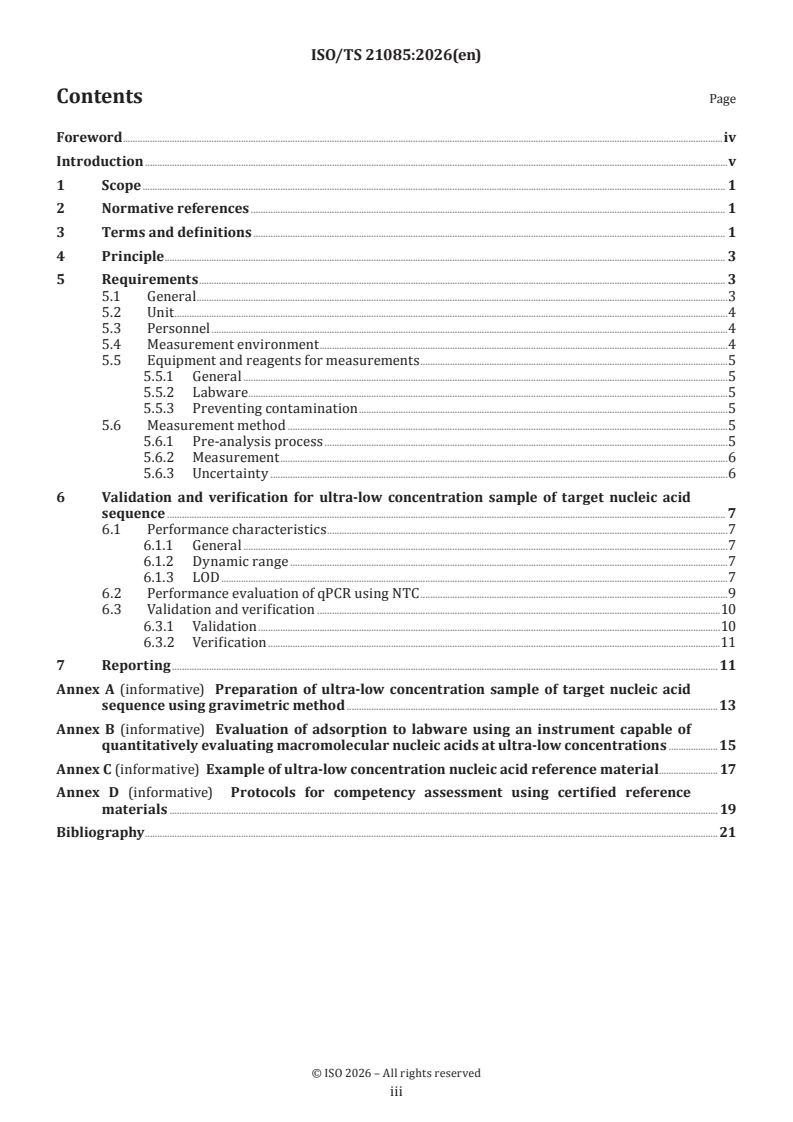
| Annex | What it covers |
|---|---|
| Annex A | Preparation of ultra-low concentration sample of target nucleic acid sequence using gravimetric method |
| Annex B | Evaluation of adsorption to labware using an instrument capable of quantitatively evaluating macromolecular nucleic acids at ultra-low concentrations |
| Annex C | Example of ultra-low concentration nucleic acid reference material |
| Annex D | Protocols for competency assessment using certified reference materials |
What are the key requirements of ISO/TS 21085:2026?
ISO/TS 21085:2026 focuses on the practical controls needed when a sample contains only a few copies of the target sequence. The main message is that contamination, adsorption, personnel competence, and sample preparation steps can dominate the result at this level, so they must be controlled and documented.
Units and how results are expressed
ISO/TS 21085:2026 says the target amount should be expressed with copy-based units such as copy number, copies/well, or copy number concentration, not mass-based units. That matters because at ultra-low levels, mass does not describe the measurable target well enough for method control or comparison.
Personnel competence and training
ISO/TS 21085:2026 requires a training plan for personnel and competence indicators for the work. It also points to confirmatory testing with uniform samples and protocols, preferably using reference materials with assigned concentrations. In practice, laboratories need evidence that staff can handle, store, and measure these samples consistently.
Measurement environment and contamination control
ISO/TS 21085:2026 requires steps to minimize contamination, with pre-PCR and post-PCR work separated spatially or temporally. After PCR, samples should be discarded without opening the tube or seal unless POST-PCR methods are being used in a separate area. This is important because even trace contamination can change the measurement outcome at ultra-low concentration.
Equipment, reagents, and labware
ISO/TS 21085:2026 requires nuclease-free labware and low-adsorption materials for nucleic acids. For samples with low matrix-derived nucleic acids, adsorption to polypropylene and silica is a specific concern, and Annex B gives an example of how to check labware adsorption. Reagents used repeatedly, such as primers, probes, master mixes, H2O, and TE, should be handled separately from target samples, clearly identified, and aliquoted where needed.
Sample preparation and measurement methods
ISO/TS 21085:2026 says sample preparation should be kept as simple as possible because each step can add loss or variation. For RNA targets, reverse transcription conditions must be documented, and the extraction and reverse transcription steps can be evaluated separately from the later amplification steps. The document also says qPCR, dPCR, isothermal amplification, and NGS all need performance evaluation suitable for ultra-low concentration use.
Validation, verification, and performance characteristics
ISO/TS 21085:2026 requires performance characteristics to be fit for intended use, including sensitivity, precision, LOD, LOQ, range, uncertainty, and robustness where relevant. For qualitative analysis, the detectable range and LOD are important; for quantitative analysis, the quantifiable range and a calibration curve based on suitable reference materials are needed. For qPCR, the document emphasizes checking performance with NTC because non-specific amplification can look similar to true low-level target signal.
LOD and method-specific guidance
ISO/TS 21085:2026 says the LOD must be evaluated for the user’s own conditions, not taken only from a manufacturer’s value. For qPCR, the document points to a POD-based approach; for dPCR, it gives signal-to-noise and POD-based approaches, and says the LOD should be determined for each amplicon. For isothermal amplification, the qPCR approach is used, and for NGS the LOD is linked to a read count equivalent to one copy.
Reporting
ISO/TS 21085:2026 requires reporting in line with ISO 20395 and says the report should include the method used, sample identifiers, reagents, instrument details and settings, validation and verification plans, data analysis, results with units and uncertainty, deviations, unusual observations, and the test date. That gives another laboratory enough detail to assess the result independently.
What terms does ISO/TS 21085:2026 define?
- Ultra-low concentration sample - A target nucleic acid sequence sample containing 3 copies/μL to 100 copies/μL.
- Copy number - The number of molecules containing a specific nucleic acid sequence.
- Copy number concentration - The number of molecules containing a specific nucleic acid sequence in a defined volume.
- NTC - Negative nucleic acid target control; a known negative control used to show that samples without the target sequence give negative results.
- LOD - Limit of detection; the measured quantity value linked to the risk of false absence claims.
- POD - Probability of detection; the proportion of positive outcomes at a given analyte level.
- Validation - Confirmation by objective evidence that requirements for a specific intended use are met.
- Verification - Confirmation by objective evidence that specified requirements are met.
Who uses ISO/TS 21085:2026?
ISO/TS 21085:2026 is used by biotechnology laboratories, medical laboratories, microbiology labs, food testing laboratories, environmental testing groups, and forensic or research users that handle copy-number-level nucleic acid samples. It is also relevant to quality managers, method developers, and technical staff responsible for training, contamination control, instrument qualification, and reporting.
In practice, these users apply it when they prepare ultra-low concentration samples, choose labware and reagents, evaluate adsorption or contamination risk, validate qPCR or dPCR methods, or document results for independent review.
Which standards are used with ISO/TS 21085:2026?
ISO/TS 21085:2026 normatively references ISO 20395, which supports performance evaluation and reporting for nucleic acid quantification methods. It is also linked in the text to several related standards and documents that support specific topics:
- ISO 24276 - source for the NTC definition used in the terms section.
- ISO 9000 - source for the validation and verification definitions.
- ISO/IEC Guide 99 - source for precision, repeatability, intermediate precision, reproducibility, and measurement uncertainty definitions.
- ISO 16140-4 - source for POD terminology.
- ISO 23033 - source for robustness terminology.
- ISO 16577 - source for the test sample definition.
- ISO 11781 - cited in LOD examples for qPCR.
- ISO 20070 - cited for primary containers.
- ISO 21571 - cited for nucleic acid extraction.
- MIQE and dMIQE guidelines - cited in Annex D for reporting and performance details for qPCR and dPCR.
What does the ISO/TS 21085:2026 document contain?
ISO/TS 21085:2026 contains a principle section that distinguishes two sample patterns: samples where both matrix-derived nucleic acids and the target are ultra-low, and samples where the target is ultra-low but matrix-derived nucleic acids are high. It then builds requirements around that distinction, because adsorption risk and contamination risk are different in the two cases.
The annexes provide practical support material rather than additional requirements. Annex A gives a gravimetric dilution approach for preparing ultra-low concentration samples. Annex B gives an adsorption evaluation procedure for labware using repeated transfers and quantitative nucleic acid measurement. Annex C shows an example route for producing ultra-low concentration reference material with low variability using a single-cell approach. Annex D gives a competency assessment protocol using certified reference materials, including a qPCR example with defined acceptance criteria and calibration-curve evaluation.
Frequently Asked Questions
ISO/TS 21085:2026 is a technical specification published by the International Organization for Standardization (ISO). Its full title is "Biotechnology — General requirements for the measurement of ultra-low concentration samples of target nucleic acid sequence". This standard covers: This document specifies requirements and considerations for handling, measuring, and storing samples with ultra-low concentration of target nucleic acid sequences, i.e., concentrations corresponding to copy numbers. This document is applicable to nucleic acid detection methods (qPCR, dPCR, isothermal amplification, and NGS).
This document specifies requirements and considerations for handling, measuring, and storing samples with ultra-low concentration of target nucleic acid sequences, i.e., concentrations corresponding to copy numbers. This document is applicable to nucleic acid detection methods (qPCR, dPCR, isothermal amplification, and NGS).
ISO/TS 21085:2026 is classified under the following ICS (International Classification for Standards) categories: 07.080 - Biology. Botany. Zoology. The ICS classification helps identify the subject area and facilitates finding related standards.
ISO/TS 21085:2026 is available in PDF format for immediate download after purchase. The document can be added to your cart and obtained through the secure checkout process. Digital delivery ensures instant access to the complete standard document.
Standards Content (Sample)
Technical
Specification
ISO/TS 21085
First edition
Biotechnology — General
2026-08
requirements for the measurement
of ultra-low concentration samples
of target nucleic acid sequence
Biotechnologie — Exigences générales relatives au mesurage
des échantillons à très faible concentration de séquence d'acide
nucléide cible
Reference number
© ISO 2026
All rights reserved. Unless otherwise specified, or required in the context of its implementation, no part of this publication may
be reproduced or utilized otherwise in any form or by any means, electronic or mechanical, including photocopying, or posting on
the internet or an intranet, without prior written permission. Permission can be requested from either ISO at the address below
or ISO’s member body in the country of the requester.
ISO copyright office
CP 401 • Ch. de Blandonnet 8
CH-1214 Vernier, Geneva
Phone: +41 22 749 01 11
Email: copyright@iso.org
Website: www.iso.org
Published in Switzerland
ii
Contents Page
Foreword .iv
Introduction .v
1 Scope . 1
2 Normative references . 1
3 Terms and definitions . 1
4 Principle . 3
5 Requirements . 3
5.1 General .3
5.2 Unit .4
5.3 Personnel .4
5.4 Measurement environment .4
5.5 Equipment and reagents for measurements .5
5.5.1 General .5
5.5.2 Labware .5
5.5.3 Preventing contamination .5
5.6 Measurement method .5
5.6.1 Pre-analysis process .5
5.6.2 Measurement .6
5.6.3 Uncertainty .6
6 Validation and verification for ultra-low concentration sample of target nucleic acid
sequence . 7
6.1 Performance characteristics .7
6.1.1 General .7
6.1.2 Dynamic range .7
6.1.3 LOD .7
6.2 Performance evaluation of qPCR using NTC .9
6.3 Validation and verification .10
6.3.1 Validation .10
6.3.2 Verification .11
7 Reporting .11
Annex A (informative) Preparation of ultra-low concentration sample of target nucleic acid
sequence using gravimetric method .13
Annex B (informative) Evaluation of adsorption to labware using an instrument capable of
quantitatively evaluating macromolecular nucleic acids at ultra-low concentrations .15
Annex C (informative) Example of ultra-low concentration nucleic acid reference material . 17
Annex D (informative) Protocols for competency assessment using certified reference
materials . 19
Bibliography .21
iii
Foreword
ISO (the International Organization for Standardization) is a worldwide federation of national standards
bodies (ISO member bodies). The work of preparing International Standards is normally carried out through
ISO technical committees. Each member body interested in a subject for which a technical committee
has been established has the right to be represented on that committee. International organizations,
governmental and non-governmental, in liaison with ISO, also take part in the work. ISO collaborates closely
with the International Electrotechnical Commission (IEC) on all matters of electrotechnical standardization.
The procedures used to develop this document and those intended for its further maintenance are described
in the ISO/IEC Directives, Part 1. In particular, the different approval criteria needed for the different types
of ISO document should be noted. This document was drafted in accordance with the editorial rules of the
ISO/IEC Directives, Part 2 (see www.iso.org/directives).
ISO draws attention to the possibility that the implementation of this document may involve the use of (a)
patent(s). ISO takes no position concerning the evidence, validity or applicability of any claimed patent
rights in respect thereof. As of the date of publication of this document, ISO had not received notice of (a)
patent(s) which may be required to implement this document. However, implementers are cautioned that
this may not represent the latest information, which may be obtained from the patent database available at
www.iso.org/patents. ISO shall not be held responsible for identifying any or all such patent rights.
Any trade name used in this document is information given for the convenience of users and does not
constitute an endorsement.
For an explanation of the voluntary nature of standards, the meaning of ISO specific terms and expressions
related to conformity assessment, as well as information about ISO's adherence to the World Trade
Organization (WTO) principles in the Technical Barriers to Trade (TBT), see www.iso.org/iso/foreword.html.
This document was prepared by Technical Committee ISO/TC 276, Biotechnology, Subcommittee SC 1,
Analytical Methods.
Any feedback or questions on this document should be directed to the user’s national standards body. A
complete listing of these bodies can be found at www.iso.org/members.html.
iv
Introduction
When measuring ultra-low concentration of nucleic acid samples, the measurements often exhibit significant
variation. This large variation is primarily caused by the Poisson distribution and other contributing
factors. In addition, the ultra-low concentration makes the samples highly susceptible to issues such as
adsorption and contamination. This document summarizes the key considerations and requirements for
handling, measurement including both qualification and quantification analysis, and storage of ultra-low
concentration sample of target nucleic acids sequence.
Analytical methods based on polymerase chain reaction (PCR) are theoretically capable of detecting the
presence of one molecule of nucleic acid in the reaction solution, making it possible to amplify and measure
the ultra-low concentration target nucleic acid sequence. These methods are used not only in the field of
biotechnology, but also in many other areas such as medicine, food, and the environment. However, it is
difficult to stably handle, measure, and store ultra-low concentration target nucleic acid sequences. For
example, nucleic acids readily adsorb to polypropylene (PP) materials, which is widely used as a base
material for labware, so target nucleic acid sequences stored in such containers are easily removed from
the sample/reaction solution during storage or experiment and become undetectable. Similarly, if a sample
before PCR and a sample after PCR are handled in the same place for the same target nucleic acid sequence,
contamination can occur, and the measurement result will change. Furthermore, when the target nucleic
acid sequence is present at ultra-low concentrations, the distribution of nucleic acid molecules becomes
non-uniform. These phenomena can occur even in samples of general concentrations, but the effects of
adsorption and contamination can be relatively small and negligible at higher concentrations. However,
since measurement results on ultra-low concentration samples can be impacted significantly, there are
special considerations to be taken into account when handing with such samples.
This document provides specific requirements to improve data reliability and obtain accurate measurement
results when working with ultra-low concentrations of target nucleic acid sequence. Biotechnology and
bioscience industry data with higher measurement confidence will enable data interoperability, improved
product quality, reduced risks and costs and facilitate international trade.
v
Technical Specification ISO/TS 21085:2026(en)
Biotechnology — General requirements for the measurement
of ultra-low concentration samples of target nucleic acid
sequence
1 Scope
This document specifies requirements and considerations for handling, measuring, and storing samples
with ultra-low concentration of target nucleic acid sequences, i.e., concentrations corresponding to copy
numbers.
This document is applicable to nucleic acid detection methods (qPCR, dPCR, isothermal amplification, and
NGS).
2 Normative references
The following documents are referred to in the text in such a way that some or all of their content constitutes
requirements of this document. For dated references, only the edition cited applies. For undated references,
the latest edition of the referenced document (including any amendments) applies.
ISO 20395, Biotechnology — Requirements for evaluating the performance of quantification methods for nucleic
acid target sequences — qPCR and dPCR
3 Terms and definitions
For the purposes of this document, the following terms and definitions apply.
ISO and IEC maintain terminological databases for use in standardization at the following addresses:
— ISO Online browsing platform: available at https:// www .iso .org/ obp
— IEC Electropedia: available at https:// www .electropedia .org/
3.1
ultra-low concentration sample
[10]
sample containing 3 copies/μL to 100 copies/μL of target nucleic acid
sequences
Note 1 to entry: Ultra-low concentration sample of target nucleic acid sequence includes synthetized nucleic acid
solution diluted with TE buffer.
3.2
copy number
number of molecules (copies) containing a specific nucleic acid sequence
[SOURCE: ISO 20395:2019, 3.6]
3.3
copy number concentration
number of molecules (copies) containing a specific nucleic acid sequence in a defined volume
[SOURCE: ISO 20395:2019, 3.7]
3.4
negative nucleic acid target control
NTC
reference nucleic acid, or nucleic acid extracted from a certified reference material, or known negative
sample not containing the sequence under study
Note 1 to entry: This control demonstrates that the results of analyses of test samples not containing the target
sequence will be negative.
[SOURCE: ISO 24276:2006, 3.4.2; modified — DNA replaced by nucleic acid.]
3.5
limit of detection
LOD
measured quantity value, obtained by a given measurement procedure, for which the probability of falsely
claiming the absence of a component in a material is β, given a probability α of falsely claiming its presence
[SOURCE: ISO 20395:2019, 3.14]
3.6
probability of detection
POD
proportion of positive analytical outcomes for a qualitative method for a given matrix at a given analyte
level or concentration
Note 1 to entry: For qualitative methods, POD represents the probability of detection.
[SOURCE: ISO 16140-4:2020, 3.9]
3.7
validation
confirmation, through the provision of objective evidence, that the requirements for a specific intended use
or application have been fulfilled
[SOURCE: ISO 9000:2015, 3.8.13, modified — Notes to entry deleted.]
3.8
verification
confirmation, through the provision of objective evidence, that specified requirements have been fulfilled
[SOURCE: ISO 9000:2015, 3.8.12, modified — Notes to entry deleted.]
3.9
precision
closeness of agreement between indications or measured quantity values obtained by replicate
measurements on the same or similar objects under specified conditions
[SOURCE: ISO/IEC Guide 99:2007, 2.15, modified — Notes to entry deleted.]
3.10
repeatability
measurement precision under a set of repeatability conditions of measurement
[SOURCE: ISO/IEC Guide 99:2007, 2.21]
3.11
intermediate precision
measurement precision under a set of intermediate precision conditions of measurement
[SOURCE: ISO/IEC Guide 99:2007, 2.23, modified — Note to entry deleted.]
3.12
reproducibility
measurement precision under reproducibility conditions of measurement
[SOURCE: ISO/IEC Guide 99:2007, 2.25, modified — Note to entry deleted.]
3.13
measurement uncertainty
non-negative parameter characterizing the dispersion of the quantity values being attributed to a
measurand, based on the information used
[SOURCE: ISO/IEC Guide 99:2007, 2.26, modified — Notes to entry deleted.]
3.14
robustness
measure of a test method's capacity to remain unaffected by small, but deliberate variations in method
parameters and provides an indication of its reliability during normal usage
[SOURCE: ISO 23033:2021 3.44]
3.15
test sample
sample prepared for testing or analysis, the whole quantity or part of it being used for testing or analysis at
one time
[SOURCE: ISO 16577:2016, 3.210]
4 Principle
In this document, the following two patterns are assumed for the ultra-low concentration sample of target
nucleic acid sequence.
a) Samples with ultra-low concentrations of both the matrix-derived nucleic acids and the target nucleic
acid sequence.
EXAMPLE 1 Environmental DNA, NA derived from highly processed food, samples in forensic science, fossil,
series of standard for the validation and the verification without carrier NA.
b) Samples with an ultra-low concentration of the target of nucleic acid sequence and a high concentration
of matrix-derived nucleic acids.
EXAMPLE 2 GMO, samples in medical laboratory, microbiology.
When considering the sample specified in 4 a), the effects of the adsorption can be significant, while the effect
of the adsorption can be negligible for the sample specified in 4 b). Variation due to Poisson distribution and
other factors can affect both samples.
5 Requirements
5.1 General
There are several points to consider for the measurement of ultra-low concentration samples of target
nucleic acid sequence compared to the measurement for those of general concentrations. In addition, since
the impact of contamination is relatively greater in ultra-low concentration nucleic acid measurements than
in general-concentration nucleic acid measurements, efforts to prevent contamination shall be implemented
according to the purpose of the measurement. Examples of specific points to consider are described in the
relevant subclauses.
5.2 Unit
Mass (g, ng, etc.) or mass concentration (g/mL, ng/μL, etc.) is usually used as a unit to indicate the amount
of nucleic acid sample, however the amount of the target nucleic acid sequence contained in an ultra-low
concentration sample of target nucleic acid sequence is not appropriately expressed as a mass.
In order to clearly indicate the amount of the target nucleic acid sequence contained, units focusing on the
number of target nucleic acid sequence molecules shall be used, for example, copy number (copies), copy
number per well (copies/well), copy number concentration (copies/μL, copies/mL).
NOTE Spectrophotometric methods primarily measure the mass or mass concentration of nucleic acids, but are
not applied to measure single molecules. Methods that detect single molecules are better suited to quantify ultra-low
concentration sample of target nucleic acid sequence.
5.3 Personnel
Personnel supervising the measurement of ultra-low concentration sample of target nucleic acid sequence
require additional competence beyond that required for measurements in the normal concentration range.
Since the measurement of ultra-low concentration sample of target nucleic acid sequence requires special
knowledge and skills, a training plan for personnel shall be developed.
Indicators for evaluating the competence of personnel shall be established. Confirmatory testing using
uniform samples and protocols should be performed to evaluate the competence of personnel. The samples
used should be reference materials with assigned concentrations, preferably certified reference materials.
An example of confirmation test method using reference materials is given in Annex D.
Personnel shall be trained according to the type of work to be performed to acquire the necessary and
sufficient knowledge on handling, storing, and measuring ultra-low concentration sample of target nucleic
acid sequence.
The educational program can include, but is not limited to the following knowledge:
— Knowledge of statistics: Poisson distribution;
— Metrological knowledge;
— Knowledge of dispensing methods;
— Knowledge of reference materials;
— Knowledge of physical properties of materials and samples;
— Knowledge of physical properties of nucleic acids: adsorption, limit of detection (LOD), probability of
detection (POD), etc;
— Content of related standards.
NOTE Further general guidance can be found in References [5], [6].
5.4 Measurement environment
Sample contamination with nucleic acids from extraneous sources can occur. When handling ultra-low
concentration sample of target nucleic acid sequence, even very small amounts of contaminants, especially
those with the same or similar sequences as the target, can significantly affect the measurement results.
Therefore, steps shall be taken to minimise contamination in the ultra-low concentration sample of target
nucleic acid sequence.
Incompatible operations should be separated spatially or temporally. In particular, it is required to handle
pre-PCR and post-PCR samples in different areas or compartments.
After the PCR is completed, the samples shall be discarded without opening the tube lid or removing the plate
seal, except when performing the POST-PCR methods. When performing the POST-PCR methods including
electrophoresis, restriction enzyme treatment, cloning, POST-PCR sequencing (e.g. NGS), or analysis of
reaction products by other methods, the sample shall be opened in a different area or compartments.
If an accident such as leakage occurs during/after the PCR reaction, cleaning and decontamination shall be
performed.
NOTE Cleaning with an approximate 5 % sodium hypochlorite solution can be effective.
5.5 Equipment and reagents for measurements
5.5.1 General
The equipment and reagents for the measurement shall be selected with consideration for measuring the
ultra-low concentration sample of nucleic acid sequences. Labware shall be nuclease-free and with low
adsorption for nucleic acids.
5.5.2 Labware
In relation to the sample described in 4a):
Labware, such as tube and micropipette tips, that directly contact with nucleic acid samples should be
selected in consideration of adsorption. Since nucleic acids are adsorbed especially to polypropylene and
silica, when handling the sample contains ultra-low concentration sample of target nucleic acid sequence
and matrix NA, they can be lost due to adsorption on the labware. An example of the verification method is
shown in Annex B. It should also be evaluated that eluates from the labware surface do not affect the results.
Since the presence of a large amount of nucleic acids other than the target nucleic acid sequence can reduce
adsorption of the target nucleic acid sequence to the labware, carrier nucleic acids may be used as needed.
[2]
NOTE Detailed information on containers, such as tubes, can be found in ISO 20070 .
5.5.3 Preventing contamination
In relation to both samples described in 4a) and 4b):
It is required to develop a measurement environment that reduces the risk of contamination of nuclease.
Equipment shall be cleaned regularly to prevent contamination of nuclease. When handling RNA, reagents
shall be RNase free.
Reagents expected to be used more than once, for example primers, probes, master mixes, H O and TE shall
be handled in a different area/time from the sample containing the target nucleic acid because they can easily
become contaminated. It is recommended to aliquot these reagents to reduce introduction of contaminants.
Reagents shall be stored with clear identification, for example the name and date of preparation.
The use of a master mix containing Uracil-DNA Glycosylase (UNG) and dUTP can be helpful in PCR to prevent
contamination due to carryover.
5.6 Measurement method
5.6.1 Pre-analysis process
During sample preparation, the target nucleic acid sequence can be also degraded and adsorbed. The sample
shall be handled with the same attention to contamination as when preparing reagents (5.5).
In an ultra-low concentration sample of target nucleic acid sequence, it is difficult to prepare the sample to
the desired concentration or number of molecules. This is generally attributed to the significant influence
[16]
of the Poisson distribution, although other factors can also play a role. Therefore, the number of steps for
sample preparation should be minimized.
An example of sample preparation using the gravimetric method is shown in Annex A.
The nucleic acid extraction method should be selected in a manner that has minimal impact on the
subsequent measurement process. In the performance evaluation of the extraction process, the use of a
reference material with a known concentration allows a recovery test to be performed.
[3]
NOTE ISO 21571 can be referred .
When the measurement target is RNA, reverse transcription reaction is required. Since the efficiency of the
reverse transcription reaction affects the measurement results, the conditions of the reverse transcription
reaction shall be documented. If detailed optimization is performed, the method of optimization shall also
be documented. The reverse transcription efficiency can also be evaluated by adding the reference materials
to the same matrix as the sample and performing the reverse transcription reaction process.
The extraction and reverse transcription reaction steps can be evaluated separately from the subsequent
sample preparation and PCR performance evaluation. Performance evaluation should be made on samples
that are close to the actual sample.
5.6.2 Measurement
5.6.2.1 General
Examples of methods for measuring ultra-low concentration sample of target nucleic acid sequence include
qPCR, dPCR, isothermal amplification, and NGS. Each method shall be evaluated for sufficient performance
and validity to measure ultra-low concentration sample of target nucleic acid sequence.
When preparing a concentration series of a sample, the number of molecules in the aliquots used to prepare
the concentration series is significantly affected by various factors. The influence of these factors on the
preparation of the desired concentration series shall be considered to select a suitable number of replicate
measurements.
5.6.2.2 qPCR
When measuring ultra-low concentration sample of target nucleic acid sequence using qPCR, the C value
q
obtained as a result of the measurement is expected to be high. To ensure that the C value is correct, the
q
performance evaluation and validation shall be performed. The methods of performance evaluation and
validation are described in 6.2. A reference material including an in-house sample and a spiked sample, with
known concentration of the same sequence as the target nucleic acid sequence shall be used for performance
evaluation and validation. When in-house or spiked samples are used, they shall be validated.
5.6.2.3 dPCR
When measuring ultra-low concentration sample of target nucleic acid sequence using dPCR, the quantifiable
concentration range (dynamic range) shall be identified using an ultra-low concentration standard. Normally,
dPCR measures a sample stock solution at an ultra-low concentration, and if it is within the quantifiable
concentration range, the measured value at that time can be adopted. A reference material with the same
sequence as the target nucleic acid sequence should be used for performance evaluation and validation.
When in house sample or spiked sample are used instead, they should be validated.
5.6.3 Uncertainty
Measurement uncertainty associated with the result can have contributions from uncertainties in counting
the target nucleic acid molecules and from determination of the amount of sample analysed (usually the
sample volume). The uncertainty of the measured concentration of target nucleic acid should be given. In
addition, the examination uncertainty for proper identification of the target nucleic acid sequence should be
given.
6 Validation and verification for ultra-low concentration sample of target nucleic
acid sequence
6.1 Performance characteristics
6.1.1 General
For measurements at ultra-low concentration sample of target nucleic acid sequence, both quantitative and
qualitative analyses shall be evaluated for performance and validation for the intended use.
In qualitative analysis, the detectable range shall be determined. Determination of the detectable range
requires the use of appropriate reference materials and the determination of dynamic range and LOD.
In quantitative analysis, the quantifiable range shall be determined. Determination of the quantifiable range
requires the determination of a confidence interval for quantifiability by creating a calibration curve using
appropriate reference materials.
6.1.2 Dynamic range
When using either qualitative analysis in qPCR or quantitative analysis in qPCR/dPCR, the possible
qualitative/quantitative range shall be determined using a concentration series of test samples prepared
from a reference material to which a concentration value is assigned. The reference materials used in this
process should be certified reference materials.
For qualitative analysis,
...