

ISO 23511:2026
(Main)Biotechnology — General requirements and considerations for cell line identification and cross-contamination testing
- Abstract
This document specifies general principles, detection strategies and analytical methods for cell line identification of mammalian cells in the field of biotechnology. This document also specifies general requirements and key considerations for method selection, quality control parameters, data analysis and reporting in cell line identification. This document is applicable to routine cell line cross-contamination testing in the fields of basic research, translational medicine studies and cell therapeutic product manufacturing. This document is also applicable to cell line identity confirmation to prevent cell misidentification in academic and industrial laboratories, cell banks and manufacturing sites. This document is primarily applicable to mammalian cells.
- Status
- Published
- Publication Date
- 27-Jul-2026
- Technical Committee
- ISO/TC 276 - Biotechnology
- Drafting Committee
- ISO/TC 276 - Biotechnology
- Current Stage
- 6060 - International Standard published
- Start Date
- 28-Jul-2026
- Due Date
- 20-Jun-2026
- Completion Date
- 28-Jul-2026

ISO 23511:2026 is an International Standard from ISO for cell line identification and cross-contamination testing in biotechnology. It sets general principles, detection strategies, analytical methods, quality control, data analysis and reporting for mammalian cell lines. The standard is intended for routine testing in research, translational medicine, cell therapeutic product manufacturing, laboratories, cell banks and manufacturing sites.
What does ISO 23511:2026 specify?
ISO 23511:2026 specifies how to identify mammalian cell lines and how to test for cell line cross-contamination. It also gives general requirements for method selection, quality control, data analysis and reporting, so users can choose a suitable approach and document results in a way that can be reviewed independently.
The document is organized into clauses 1 to 9 plus one informative annex:
- Clause 1 - Scope
- Clause 2 - Normative references
- Clause 3 - Terms and definitions
- Clause 4 - Principles of cell line authentication
- Clause 5 - Application scenarios of cell line authentication
- Clause 6 - Detection method for cell line identification and cellular cross-contamination
- Clause 7 - Method selection for different purposes
- Clause 8 - Quality control
- Clause 9 - Report
- Annex A - Detection methods for cell line identification and cell line cross-contamination
Annex A is an overview annex that compares the main methods, their strengths and limitations. That helps a laboratory decide which test fits the cell type, the contamination risk and the decision it needs to make.
What are the key requirements of ISO 23511:2026?
ISO 23511:2026 requires cell line authentication to be treated as a combination of tests, not a single check. Clause 4.1 says genomic analysis is combined with phenotypic and functional information, such as identity, species verification, cell-line-specific characteristics and morphology. In practice, this means a lab should not rely on one result alone when it needs a defensible identification.
Cell identity is based on genomic comparison
Clause 4.2 says cell line identification is verified by comparing a genomic profile with a baseline profile from the original sample, or, if that is not available, an early-passage stock. For newly established cell lines, the source tissue or fluid should be stored for identity verification. In practice, this gives the laboratory a reference point for future checks and helps detect drift, mix-ups or mislabelling.
Cross-contamination must be checked at both species levels
Clause 4.3 separates inter-species cross-contamination from intra-species cross-contamination. For different species, the document points to genetic and cytogenetic tools such as DNA barcoding, species-specific multiplex PCR, isoenzyme analysis and karyotype analysis. For the same species, it relies mainly on STR profiling, SNP profiling and WGS, with phenotype-based methods used as supporting data. This matters because the wrong method can miss the contamination pattern you are looking for.
Cell-specific characteristics are supporting evidence
Clause 4.4 says cell line-specific characteristics can support authentication, including genotype, phenotype, function, heterogeneity and differentiation status. The document notes that morphology, markers, gene expression and physiological function can help characterize a cell line, but they are not enough on their own for authentication. In practice, these tests help explain whether a cell line still behaves as expected after extended culture.
Good cell culture practice is part of prevention
Clause 4.5 ties authentication to daily cell culture practice. It covers aseptic technique, dedicated reagents, equipment cleaning, careful handling, correct labelling, routine monitoring, quarantining new cell lines and making frozen stocks or cell banks. The practical point is simple: prevention reduces the chance that the lab will later have to resolve an avoidable mix-up.
Authentication should be used in defined situations
Clause 5 lists when authentication should be applied, including newly established cell lines, routine checks during culture and storage, receiving material from other sites, banking, long-term culture, abnormal results and suspected contamination or irreproducibility. That gives buyers and laboratory managers a clear trigger list for when testing should be built into workflow.
Method selection depends on purpose and cell type
Clause 6 and Clause 7 explain that method choice depends on the species, the purpose and the scenario. Human STR profiling is the main routine method for human cell lines, while non-human STR profiling is covered for mouse and African green monkey. SNP profiling, DNA barcoding, species-specific PCR, karyotype analysis and WGS are used where they fit the question better. In practice, the standard helps users avoid over-testing or using a method that cannot answer the question.
Quality control and reporting must be documented
Clause 8 requires trained personnel, qualified equipment, controlled reagents, method validation or verification, and controlled laboratory operation. Clause 9 requires a report that identifies the sample, method, result, deviations, unusual features, date, scope, personnel and supporting instrument and reagent details. This matters because a result only has value if another person can review how it was obtained.
What terms does ISO 23511:2026 define?
- Cell line authentication - The process of confirming the cell line identity, origin, absence of cross-contamination, absence of adventitious agents and expression of cell-specific characteristics.
- Cell line identification - The process of verifying or confirming the genomic identity of a cell line.
- Inter-species cross-contamination - Contamination of a cell line by cells from another species.
- Intra-species cross-contamination - Contamination of a cell line by cells from the same species, including cells from another individual of the same species.
- STR (short tandem repeat) - A variable DNA segment made of repeated short sequence units, widely used for cell line profiling.
- SNP (single nucleotide polymorphism) - A genomic variant defined by a single changed base at a specific position.
- WGS (whole genome sequencing) - A process for determining the DNA sequence of an organism’s genome using total genomic DNA.
Who uses ISO 23511:2026?
ISO 23511:2026 is used by biotechnology laboratories, cell banks, academic and industrial labs, and manufacturing sites that need to confirm cell identity or check for contamination. It is relevant to quality control staff, lab managers, researchers, technicians and buyers who need to specify authentication services or test panels.
The standard is especially relevant in:
- basic research
- translational medicine studies
- cell therapeutic product manufacturing
- routine cell banking and stock management
- labs working with co-cultured cells or ex vivo cell culture
- facilities handling human and rodent cell lines
What changed in ISO 23511:2026 from the previous edition?
ISO 23511:2026 cancels and replaces ISO/TS 23511:2023. The foreword states that the title and scope were revised, terms and definitions were added in Clause 3, Figure 1 and Clause 4.5 were added, Clause 6 was expanded with Table 2 and non-human STR profiling in Clause 6.2.2 and Table 3, and the descriptions of current methods were elaborated with their principles, applications, characteristics, procedures and limitations.
Which standards are used with ISO 23511:2026?
ISO 23511:2026 has no normative references in Clause 2. Its bibliography points readers to related documents for method detail and background, including ISO 20395 for qPCR performance, ISO 20397-1 and ISO 20397-2 for massively parallel sequencing, and ISO 21474-2 for multiplex molecular testing validation and verification.
What does the ISO 23511:2026 document contain?
ISO 23511:2026 contains a Figure 1 flow chart for authentication, three summary tables in Clause 6, and an informative Annex A that compares methods. Table 1 summarizes human STR profiling, Table 2 gives matching criteria for human STR results, and Table 3 summarizes non-human STR profiling. Annex A compares methods such as STR profiling, SNP profiling, DNA barcoding, multiplex PCR, WGS, karyotype analysis, HLA typing and isoenzyme analysis, showing what each method is good for and where it is weaker.
The document also contains step-by-step descriptions of how the main methods work, including PCR-based profiling, sequencing-based methods and database comparison. It gives practical guidance on handling degraded DNA, mixed samples, species-specific testing and the limits of phenotype-based tests. For users, this makes the standard useful both for setting up a test strategy and for reviewing whether a result is strong enough for identification, contamination screening or reporting.
Relations
- Effective Date
- 24-Jun-2023
Frequently Asked Questions
ISO 23511:2026 is a standard published by the International Organization for Standardization (ISO). Its full title is "Biotechnology — General requirements and considerations for cell line identification and cross-contamination testing". This standard covers: This document specifies general principles, detection strategies and analytical methods for cell line identification of mammalian cells in the field of biotechnology. This document also specifies general requirements and key considerations for method selection, quality control parameters, data analysis and reporting in cell line identification. This document is applicable to routine cell line cross-contamination testing in the fields of basic research, translational medicine studies and cell therapeutic product manufacturing. This document is also applicable to cell line identity confirmation to prevent cell misidentification in academic and industrial laboratories, cell banks and manufacturing sites. This document is primarily applicable to mammalian cells.
This document specifies general principles, detection strategies and analytical methods for cell line identification of mammalian cells in the field of biotechnology. This document also specifies general requirements and key considerations for method selection, quality control parameters, data analysis and reporting in cell line identification. This document is applicable to routine cell line cross-contamination testing in the fields of basic research, translational medicine studies and cell therapeutic product manufacturing. This document is also applicable to cell line identity confirmation to prevent cell misidentification in academic and industrial laboratories, cell banks and manufacturing sites. This document is primarily applicable to mammalian cells.
ISO 23511:2026 is classified under the following ICS (International Classification for Standards) categories: 07.080 - Biology. Botany. Zoology. The ICS classification helps identify the subject area and facilitates finding related standards.
ISO 23511:2026 has the following relationships with other standards: It is inter standard links to ISO/TS 23511:2023. Understanding these relationships helps ensure you are using the most current and applicable version of the standard.
ISO 23511:2026 is available in PDF format for immediate download after purchase. The document can be added to your cart and obtained through the secure checkout process. Digital delivery ensures instant access to the complete standard document.
Standards Content (Sample)
International
Standard
ISO 23511
First edition
Biotechnology — General
2026-07
requirements and considerations
for cell line identification and cross-
contamination testing
Reference number
© ISO 2026
All rights reserved. Unless otherwise specified, or required in the context of its implementation, no part of this publication may
be reproduced or utilized otherwise in any form or by any means, electronic or mechanical, including photocopying, or posting on
the internet or an intranet, without prior written permission. Permission can be requested from either ISO at the address below
or ISO’s member body in the country of the requester.
ISO copyright office
CP 401 • Ch. de Blandonnet 8
CH-1214 Vernier, Geneva
Phone: +41 22 749 01 11
Email: copyright@iso.org
Website: www.iso.org
Published in Switzerland
ii
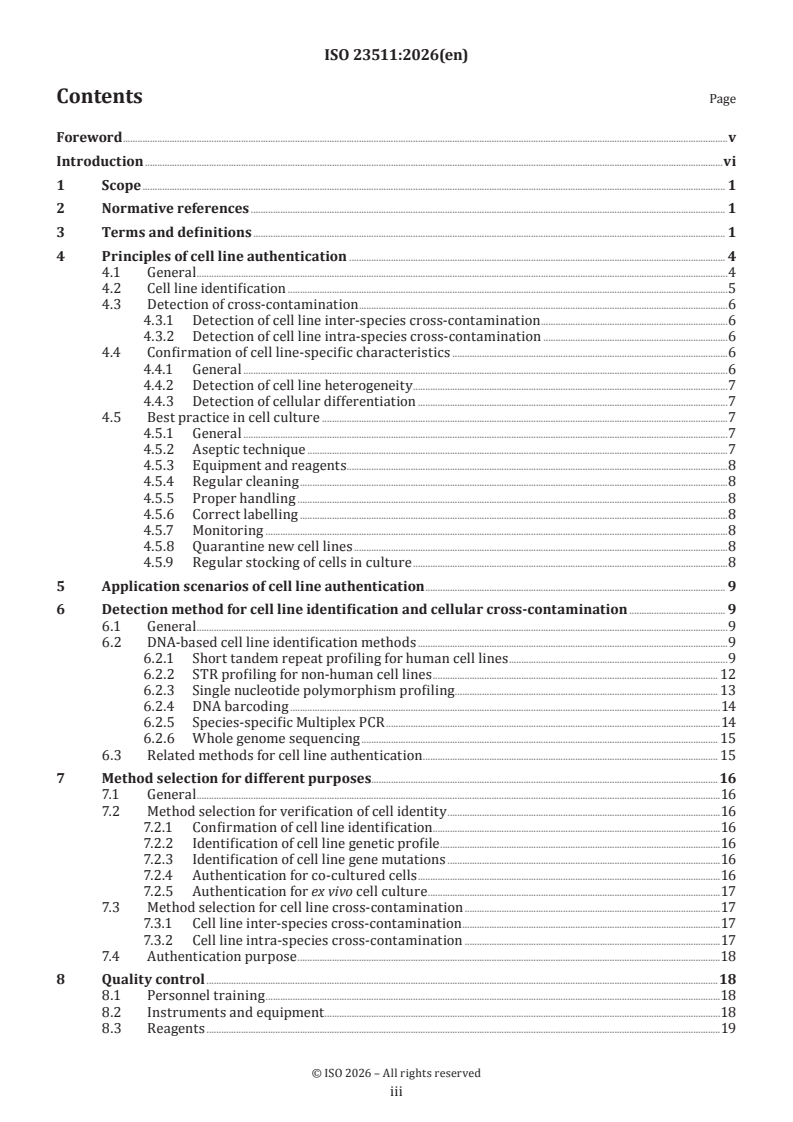
Contents Page
Foreword .v
Introduction .vi
1 Scope . 1
2 Normative references . 1
3 Terms and definitions . 1
4 Principles of cell line authentication . 4
4.1 General .4
4.2 Cell line identification .5
4.3 Detection of cross-contamination .6
4.3.1 Detection of cell line inter-species cross-contamination .6
4.3.2 Detection of cell line intra-species cross-contamination .6
4.4 Confirmation of cell line-specific characteristics .6
4.4.1 General .6
4.4.2 Detection of cell line heterogeneity .7
4.4.3 Detection of cellular differentiation .7
4.5 Best practice in cell culture .7
4.5.1 General .7
4.5.2 Aseptic technique .7
4.5.3 Equipment and reagents .8
4.5.4 Regular cleaning .8
4.5.5 Proper handling .8
4.5.6 Correct labelling .8
4.5.7 Monitoring .8
4.5.8 Quarantine new cell lines .8
4.5.9 Regular stocking of cells in culture .8
5 Application scenarios of cell line authentication . 9
6 Detection method for cell line identification and cellular cross-contamination . 9
6.1 General .9
6.2 DNA-based cell line identification methods .9
6.2.1 Short tandem repeat profiling for human cell lines .9
6.2.2 STR profiling for non-human cell lines . 12
6.2.3 Single nucleotide polymorphism profiling . 13
6.2.4 DNA barcoding .14
6.2.5 Species-specific Multiplex PCR .14
6.2.6 Whole genome sequencing . 15
6.3 Related methods for cell line authentication . 15
7 Method selection for different purposes.16
7.1 General .16
7.2 Method selection for verification of cell identity .16
7.2.1 Confirmation of cell line identification . .16
7.2.2 Identification of cell line genetic profile .16
7.2.3 Identification of cell line gene mutations .16
7.2.4 Authentication for co-cultured cells .16
7.2.5 Authentication for ex vivo cell culture .17
7.3 Method selection for cell line cross-contamination .17
7.3.1 Cell line inter-species cross-contamination .17
7.3.2 Cell line intra-species cross-contamination .17
7.4 Authentication purpose .18
8 Quality control .18
8.1 Personnel training .18
8.2 Instruments and equipment .18
8.3 Reagents .19
iii
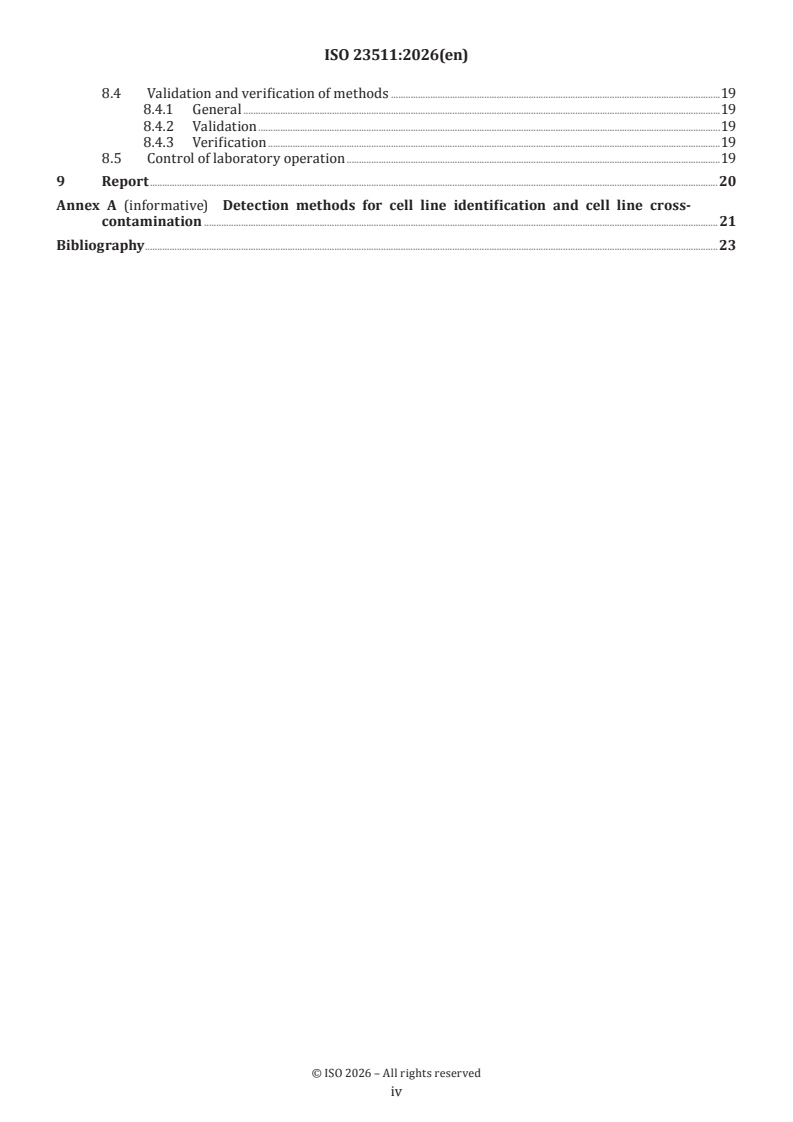
8.4 Validation and verification of methods .19
8.4.1 General .19
8.4.2 Validation .19
8.4.3 Verification .19
8.5 Control of laboratory operation .19
9 Report .20
Annex A (informative) Detection methods for cell line identification and cell line cross-
contamination .21
Bibliography .23
iv
Foreword
ISO (the International Organization for Standardization) is a worldwide federation of national standards
bodies (ISO member bodies). The work of preparing International Standards is normally carried out through
ISO technical committees. Each member body interested in a subject for which a technical committee
has been established has the right to be represented on that committee. International organizations,
governmental and non-governmental, in liaison with ISO, also take part in the work. ISO collaborates closely
with the International Electrotechnical Commission (IEC) on all matters of electrotechnical standardization.
The procedures used to develop this document and those intended for its further maintenance are described
in the ISO/IEC Directives, Part 1. In particular, the different approval criteria needed for the different types
of ISO document should be noted. This document was drafted in accordance with the editorial rules of the
ISO/IEC Directives, Part 2 (see www.iso.org/directives).
ISO draws attention to the possibility that the implementation of this document may involve the use of (a)
patent(s). ISO takes no position concerning the evidence, validity or applicability of any claimed patent
rights in respect thereof. As of the date of publication of this document, ISO had not received notice of (a)
patent(s) which may be required to implement this document. However, implementers are cautioned that
this may not represent the latest information, which may be obtained from the patent database available at
www.iso.org/patents. ISO shall not be held responsible for identifying any or all such patent rights.
Any trade name used in this document is information given for the convenience of users and does not
constitute an endorsement.
For an explanation of the voluntary nature of standards, the meaning of ISO specific terms and expressions
related to conformity assessment, as well as information about ISO's adherence to the World Trade
Organization (WTO) principles in the Technical Barriers to Trade (TBT), see www.iso.org/iso/foreword.html.
This document was prepared by Technical Committee ISO/TC 276, Biotechnology, Subcommittee SC 1,
Analytical methods.
This first edition cancels and replaces the first edition (ISO/TS 23511:2023) which has been technically
revised.
The main changes are as follows:
— Title and Scope revised;
— addition of terms and definitions in Clause 3;
— in 4.1, added Figure 1- “cell line authentication flow chart” and added 4.5 “Best practice in cell culture”;
— in Clause 6, added Table 2 – “Summary of matching criteria” for the method STR profiling, added 6.2.2
profiling for non-human cell lines and Table 3 – “Summary of non-human STR profiling”;
— elaborated on descriptions of current methods, and described their principle, scope of applications,
characteristics of the methods, measurement procedures and limitations.
Any feedback or questions on this document should be directed to the user’s national standards body. A
complete listing of these bodies can be found at www.iso.org/members.html.
v
Introduction
Cell line authentication is a critical quality control (QC) procedure, which aims to verify a cell line’s identity
and show that it is free of contamination from other cell lines, free of adventitious agents, and expresses cell-
specific characteristics (including phenotype, genotype, and function). Each of these methods are necessary
for cell line authentication and are only supportive information on their own. It has been estimated that a
considerable proportion of the cell lines stored in the biobanks and laboratories in the United States, Europe
and Asia are misidentified or cross-contaminated, which results in potentially erroneous or irreproducible
[8]
data, causing tremendous waste of time, money and effort. To facilitate proper utilization of a cell line
and ensure the accuracy and validity of the results of cell research and application, the standardization of
procedures used for cell line authentication is urgently needed. This document gives general requirements
for cell line identification and cross-contamination testing based on existing national standards and state-
of-the-art methods, aiming to represent and provide guidance to stakeholders in life science, biomedicine
and other related fields.
vi
International Standard ISO 23511:2026(en)
Biotechnology — General requirements and considerations
for cell line identification and cross-contamination testing
1 Scope
This document specifies general principles, detection strategies and analytical methods for cell line
identification of mammalian cells in the field of biotechnology. This document also specifies general
requirements and key considerations for method selection, quality control parameters, data analysis and
reporting in cell line identification.
This document is applicable to routine cell line cross-contamination testing in the fields of basic research,
translational medicine studies and cell therapeutic product manufacturing. This document is also applicable
to cell line identity confirmation to prevent cell misidentification in academic and industrial laboratories,
cell banks and manufacturing sites. This document is primarily applicable to mammalian cells.
2 Normative references
There are no normative references in this document.
3 Terms and definitions
For the purposes of this document, the following terms and definitions apply.
ISO and IEC maintain terminology databases for use in standardization at the following addresses:
— ISO Online browsing platform: available at https:// www .iso .org/ obp
— IEC Electropedia: available at https:// www .electropedia .org/
3.1
allele
member of two or more alternative forms of a DNA sequence found at a particular locus
[SOURCE: ISO/IEC 19794-14:2022, 3.1.6]
3.2
cell bank
collection of appropriate containers, whose contents are of uniform composition, stored under defined
conditions, and where each container represents an aliquot of a single pool of cells
[16]
[SOURCE: ICH Q5D — adapted.]
3.3
cell line
progeny of a primary culture after it has been passaged beyond crises or beyond senescence either
spontaneously or after introduction of immortalizing factors
Note 1 to entry: A cell line is continuous for proliferation.
[SOURCE: ISO 21709:2020, 3.2, modified — Note 2 to entry deleted.]
3.4
cell line authentication
process by which the cell line (3.3) is verified by confirming identification, cell line origin (3.11), absence of cell
line cross-contamination, absence of adventitious agents, and that it expresses cell-specific characteristics
(phenotype, genotype, function)
3.5
cell line identification
process by which genomic identity of a cell line (3.3) is verified or confirmed
3.6
DNA barcoding
method of identifying organisms at the species level based on short, standardized DNA fragments containing
both conserved and variable sequences from a specific region or regions of the genome
Note 1 to entry: The principle of DNA barcoding is that by comparison with a reference database the sequence from
these DNA fragments can be used to uniquely identify an organism or link it to a specific taxon.
[SOURCE: ISO 16577:2022, 3.7.3]
3.7
examination reliability
probability that an examined value is the same as a reference value of a nominal property
Note 1 to entry: The nominal property can be the identity of a cell line.
3.8
inter-species cross-contamination
contamination of a cell line (3.3) by cells from another species
3.9
intra-species cross-contamination
contamination of a cell line (3.3) by cells from the same species
Note 1 to entry: Cells from the same species can include the same type of cells from different individuals or different
types of cells from different individuals.
3.10
cell line misidentification
incidence where the cell line (3.3) identity no longer corresponds to the donor or species from which it was
originally established.
Note 1 to entry: Improper naming of newly established cell lines or cell line derivatives (clones) can lead to cell line
misidentification.
3.11
cell line origin
donor attributes and date of cell line (3.3) establishment
Note 1 to entry: Donor attributes can include race, sex, age, tissue, and disease status, depending on the species from
which the cell line is derived.
3.12
cell type
classification used to distinguish among distinct cell forms
[SOURCE: ISO 21709:2020, 3.5]
3.13
detection limit
lowest quantity of a substance that can be distinguished from the absence of that substance with a stated
confidence limit
[SOURCE: ISO 14687:2025, 3.1.5]
3.14
gene mutation
permanent alteration (as by point mutation or frameshift mutation) in the nucleotide sequence of a gene,
referred to as alterations in a single-base pair nucleotide or changes in one or more nucleotides altering the
open-reading frame
3.15
genetic drift
change in allele (3.1) frequency in a cell population, due to a random selection of certain genes
3.16
immunofluorescence
method for detecting the expression of specific protein antigens on cell membrane or in cells by combining
immunological methods (antigen-antibody recognition) with fluorescent labelling techniques
3.17
isozyme analysis
isoenzyme analysis
separation technique based on electrophoresis to generate patterns of enzymatically active polypeptides
with identical specificity (3.26) but of different molecular weight and charge
3.18
karyotype analysis
process of ordering all the chromosomes of each cell and determining chromosomal constitution in cell lines
(3.3) to reveal changes in chromosome number associated with aneuploidy, ploidy and structural changes,
such as deletions, duplications, translocations, or inversions
3.19
massively parallel sequencing
MPS
next generation sequencing
non-Sanger-based high-throughput nucleic acid sequencing
Note 1 to entry: Millions or billions of nucleic acid strands can be sequenced in parallel, yielding substantially more
throughput.
Note 2 to entry: NGS (next generation sequencing) is also well recognized as MPS in the ISO 20397 series.
Note 3 to entry: MPS or NGS covers long read sequencing and short read sequencing.
[SOURCE: ISO 20397-3:2025, 3.15]
3.20
misidentified cell lines
cell lines (3.3) that no longer correspond to original donor or species
Note 1 to entry: Misidentified cell lines can arise due to cross-contamination or mislabelling.
3.21
polymerase chain reaction
PCR
enzymatic procedure that allows in vitro amplification of deoxyribonucleic acid (DNA)
[SOURCE: ISO 22174:2024, 3.1.17]
3.22
Sanger sequencing
method of DNA sequencing based on the selective incorporation of chain-terminating dideoxynucleotides by
a DNA polymerase during in vitro DNA amplification
Note 1 to entry: This method was developed by Frederick Sanger in 1977.
[SOURCE: ISO 16577:2022, 3.7.17]
3.23
short tandem repeat
STR
microsatellite DNA
variable DNA segments from individuals that are composed of polymorphic sequence (typically< 10 base
pairs) which is repeated many times
3.24
single nucleotide polymorphism
SNP
genomic variant defined as one changed base at a specific position in the genome
[SOURCE: ISO/IEC 23092-6:2023, 3.55]
3.25
specificity
property of a method to respond exclusively to the characteristic or analyte under investigation
[SOURCE: ISO 24276:2006, 3.1.4]
3.26
validation
confirmation, through the provision of objective evidence, that the requirements for a specific intended use
or application have been fulfilled
[SOURCE: ISO 9000:2015, 3.8.13. modified — Notes to entry deleted.]
3.27
whole genome sequencing
WGS
process of determining the DNA sequence of an organism’s genome using total genomic DNA as input
[SOURCE: ISO 23418:2022,3.49]
3.28
verification
confirmation, through the provision of objective evidence, that specified requirements have been fulfilled
[SOURCE: ISO 9000:2015, 3.8.12, modified ― Notes to entry deleted.]
4 Principles of cell line authentication
4.1 General
Multiple test methods that rely on genomic analyses combined with phenotypic and functional characteristics
[11]
can be used as part of the process of cell line authentication (Figure 1).
Genomic and phenotypic analysis can include:
a) cell line identification;
b) verification of cell species, to ensure that no cell line inter- or intra-species cross-contamination exists
in cell cultures;
c) identification or confirmation, or both, of certain cell line-specific characteristics. Cell line-specific
characteristics such as gene mutations, protein expression, changes in cellular metabolism, can be
useful supporting evidence for the cell line authentication;
d) confirmation of specific morphological characteristics.
All these test methods are necessary for cell line authentication. Each method on its own is supporting data,
but combined, will give a comprehensive report of cell line authentication.
Figure 1 — Cell line authentication flow chart
4.2 Cell line identification
For a newly established cell line, a liquid or solid tissue sample from which a cell line is derived, or a fluid
or solid tissue sample from the same donor from whom the cell line was derived, shall be stored for identity
[10]
verification. Cell line identification shall be verified by genomic profile. The baseline DNA profile of the
original sample shall be used in cell line identification by comparing it to the DNA profiles of subsequent
passages. If the source tissue or fluid, or both, are not available, the DNA profile of an early passage stock
should be used as the baseline. DNA-based profiling methods intended for routine genotype analysis for
human cell line include:
[9]
a) short tandem repeat (STR) analysis with polymerase chain reaction (PCR) amplification followed by
fragment size analysis or by Sanger sequencing;
b) single nucleotide polymorphism (SNP) analysis by single-base extension assay or SNP genotyping by
qPCR assays;
c) massively parallel sequencing (MPS), including short-read next generation sequencing and long-read
next generation sequencing.
SNP databases of targeted panels are now available for analysis. However, there are no central databases
or universally accepted SNP markers, so any SNP comparison should be in-house or have similar usage
limitations. The whole genome sequencing (WGS) data of newly or already established cell lines can be
provided as a further information source.
4.3 Detection of cross-contamination
4.3.1 Detection of cell line inter-species cross-contamination
4.3.1.1 Inter-species cross-contamination occurs when a cell line is contaminated by undesired cells from
different species.
Inter-species cross-contamination testing should be performed with consideration for various
characteristics, including:
a) genetic characteristics (e.g. mitochondrial cytochrome c oxidase subunit 1(CO1), mitochondrial
cytochrome b (CytB) and NADH dehydrogenase 5 (ND5) genes);
b) cytogenetic characteristics (e.g. chromosome karyotype, marker chromosome).
4.3.1.2 For genetic and cytogenetic characteristics, detection methods include DNA barcoding, species-
specific multiplex PCR assays, isoenzyme analysis and karyotype analysis. DNA barcoding can be used to
investigate the mitochondrial gene sequences associated with species-specific cytochrome c oxidase subunit
1 (CO1) gene using degenerate primers and PCR techniques. Species-specific multiplex PCR utilizes species-
specific primers to amplify DNA fragments for species identification. This method can detect lower levels
of cross-contamination than Sanger sequencing-based DNA barcoding. Isoenzyme analysis can help detect
interspecies cross-contaminations through gel electrophoresis banding patterns, but of low examination
reliability. Karyotype analysis can directly reveal cross-contamination by comparing species-specific
chromosomes among species.
4.3.2 Detection of cell line intra-species cross-contamination
4.3.2.1 Cell line intra-species cross-contamination occurs when a cell line is contaminated with other cells
within the same species. The detection method for cell line intra-species cross-contamination depends on
individual cell line-specific characteristics, which can include:
— genetic characteristics (e.g. STR profiling, SNP profiling, WGS);
— Morphological characteristics (e.g. round, long spindle) can be analysed by using microscopy method
and cell markers (e.g. proteins, lipids, glycosylation, histocompatibility antigen, tissue-specific antigens
) by using FISH, Flow cytometry, ELISA, immunohistochemistry method, etc. and histology (e.g.
extracellular cellular markers) by using histocytochemistry method are useful to provide supporting
data for occurrence of cell line intra-species cross-contamination, but are not suitable for identification
testing when used alone.
4.3.2.2 Sequence-specific STR or SNP profiles can be used to discriminate among individuals within the
same species. STR or SNP profiling based on Sanger sequencing or MPS technologies can be used for cell line
identification and they also can provide data about intra-species cross-contamination. Attention should be
given to contamination at an early stage, which can go unnoticed even by these techniques. Generally, low-
level contamination (<5 % of the culture) cannot be detected by STR or SNP profiling. The limit of detection
is related to the detection limit of STR assay kit.
4.4 Confirmation of cell line-specific characteristics
4.4.1 General
Confirmation of cell line-specific characteristics (including phenotype, genotype, and function) are also
supporting data for cell line authentication. Cell line characteristic changes often occur during extended in
vitro culture and during cellular differentiation processes.
4.4.2 Detection of cell line heterogeneity
4.4.2.1 Optimization of cell expansion and maintenance can reduce or eliminate in vitro artefacts. These
[12]
in vitro artefacts (e.g. increased passage number, split ratio, plating density, serum quality, confluency)
can lead to genetic and epigenetic changes resulting in changes in STR and/or gene expression profiles.
Detection methods of cell line heterogeneity include:
a) single-cell sequencing of genomic DNA;
b) genetic characterization (e.g. STR profiling, SNP profiling);
c) transcription analysis (e.g. mRNA);
d) karyotype analysis.
NOTE Cell line genome heterogeneity is not part of cell line authentication. Methods for cell line authentication
can be used for detecting cell line genome heterogeneity.
4.4.2.2 Cell line gene mutations can be detected by high-throughput sequencing (e.g. WGS) along with
karyotype analysis. The COSMIC database provides list of cell line somatic mutations found in various
[14]
human cancers .
4.4.3 Detection of cellular differentiation
4.4.3.1 Both pluripotent and multipotent stem cells can differentiate, either spontaneously or with
external stimuli into certain cell types in vitro. Cellular differentiation within a given cell line can be
detected by various gene expression markers, morphological characteristics and physiological function,
which can include, but are not limited to:
a) cell surface markers;
b) transcription factors;
c) signalling pathway-related intracellular markers;
d) enzymatic markers;
e) morphological changes;
f) physiological functions.
4.4.3.2 Flow cytometry analysis, immunofluorescent staining and enzyme-linked immunosorbent assays
can be used to detect differentiated cell-specific gene expression, along with gene expression assays,
indicating cellular differentiation status.
NOTE Measurement of cellular differentiation can provide useful supporting data as part of broader cell line
identification but is not suitable for authentication testing when used alone as this relies on genome-based methods.
4.5 Best practice in cell culture
4.5.1 General
Cell line misidentification usually occur from cross-contamination in cell culture due to poor cell culture
[13][31]
practices. Good cell culture practices should be followed .
4.5.2 Aseptic technique
Cell culture manipulations including media changes and sub-culturing shall take place under a laminar flow
hood that has been treated with a suitable disinfectant prior to use. Ensure that all materials and reagents
are sterilized before use. Manipulate only one cell line in hood at any one time. The hood should be wiped
down with a suitable disinfectant and run for a minimum of 5 min before introduction of another cell line.
4.5.3 Equipment and reagents
4.5.3.1 Reagents
Reagents used for cell culture shall be sterile and qualified for cell culture used.
To avoid cross-contamination with other cell lines, reagents, including cell culture media, shall be dedicated
for a specific cell line. Aliquots of culture media and reagents shall be dedicated to one cell line.
4.5.3.2 Equipment
Cell culture equipment such as centrifuges, and pipettors shall be treated with disinfectant prior to use.
Disposable pipettes, pipette tips, and other plasticware shall be used once and discarded in appropriate
biohazard containers immediately after use. Equipment such as laminar flow hoods, pipettors, and thermal
cyclers should perform within the manufacturer’s specifications.
NOTE Calibration, certification and qualification are examples of processes that can be used to confirm the
performance of equipment.
4.5.4 Regular cleaning
Work surfaces, incubators, and other equipment shall be cleaned and disinfected regularly. This practice
helps minimize formation of aerosols and the risk of contamination from the environment.
4.5.5 Proper handling
Cell cultures and media should be handled with care. Interior surfaces of culture vessels and pipettes tips
shall not be touched. Sterile techniques shall always be used when adding or removing media.
4.5.6 Correct labelling
All culture vessels and storage containers shall be labelled carefully and correctly. Labels should include full
name of cell line, passage number and date of transfer, and name or initials of personnel performing the task.
4.5.7 Monitoring
Signs of contamination for cell cultures, such as changes in media colour or turbidity, unusual cell
morphology, or unexpected growth patterns, shall be monitored regularly. Early detection allows for prompt
action to contain and eliminate contamination.
4.5.8 Quarantine new cell lines
Newly introduced cell lines shall be quarantined until negative results for adventitious contamination are
obtained. New cell lines shall be authenticated for characteristics that are indicative of the claim of identify
by the provider of the cell line. This practice helps prevent the spread of contaminants to other cultures.
4.5.9 Regular stocking of cells in culture
Frozen stocks from cell lines in culture should be regularly made. Cell line authentication testing should be
performed for cell lines in continuous culture for more than 10 passages
Master cell banks and working cell banks should be established for each cell line. Master cell banks may be
of lower passage number and serve as a comparator to monitor changes in the cell line overtime.
Frozen stocks of cells should be established after 10 passages or less.
5 Application scenarios of cell line authentication
Even with best practices in place, all cell lines have the potential to be cross-contaminated with other cell
lines or become contaminated with microbes. To avoid cell line misidentification and cross-contamination,
[8]
cell line authentication shall be used in the following scenarios :
a) authentication and characterization of newly established cell lines;
b) routine inspection of cell lines in culture and in stock, especially for rapid growing cell types, cells in
extended culture, cells with unusual phenotype and cells after a selection/sorting process;
c) confirmation of cell line identification upon receiving from other facilities, before sending the material
to other facilities and prior to banking;
d) confirmation of cell line identification after the preparation of a cell bank (i.e. seed stock);
e) authentication of cell lines used in both basic and clinical research when abnormalities were found in
the cultured cells, or after many passages;
f) confirmation of cell line identification when the experimental results are irreproducible and are
suspected to be cross-contaminated, misidentified or suspected of microbial contamination.
6 Detection method for cell line identification and cellular cross-contamination
6.1 General
Each method for cell line authentication has its intrinsic deficiencies, which can affect applicability and
accuracy (as described in Table A.1). Users should select one or more methods depending on their information
of cell type, application scenario, sample preparation or potential contaminating sources.
NOTE 1 Historical methods such as human leukocyte antigen (HLA) profiling by PCR and isozyme analysis have
previously been used for cell line identification, but are no longer used due to their limitations in applicability,
examination reliability and accuracy. Currently, DNA-based methods are most widely used for cell line identification,
which include STR profiling, SNP profiling, HLA sequencing, DNA barcoding and multiplex PCR. With technology
innovation, state-of-the-art methods, such as WGS, have started to play increasingly important roles in the
authentication field.
NOTE 2 Karyotype analyses and optical genome mapping technique can detect large chromosomal structure
changes. Generally, karyotype analysis can be used for species-level identification and can also provide supporting
evidence for cell line origin using marker chromosome that can be readily recognized. Chromosome and chromatid
temporary abnormalities, such as break and gap, can be included in karyotype, but cannot be used for authentication
testing. Although less useful for routine identification of human and animal cells, in certain occasions karyotyping
needs to be kept as a quality control tool for STR profile data prior to entry into a database, especially for primary
cells.
NOTE 3 HLA profiling is only applicable to cross-contamination detection of human cell lines derived from different
individuals. HLA profiling, by serotyping or PCR, can be relatively informative, and is currently only used for analysis
and comparison of historical samples and data.
NOTE 4 Cells derived from different species have different isozyme distribution. Isozyme analysis can have
relatively low detection ability. Isozyme types, quantity and subjective judgement can affect detection accuracy and
examination reliability. Reagents for isozyme analysis are difficult to acquire and this method is rarely used anymore.
6.2 DNA-based cell line identification methods
6.2.1 Short tandem repeat profiling for human cell lines
6.2.1.1 Principle
STR profiling is widely used in human cell line identification, and to a lesser extent, may be used in identity
testing of mouse, dog, and other commonly used mammalian cell lines. STR loci consist of typically 7-20
nucleotides with different numbers of consecutive repeats. Each STR locus can be PCR amplified, labelled
with fluorophores of different wavelengths, and separated by size in base pairs and Relative Fluorescent
Units (RFUs). STR profiling measures the number of repeating units by determining fragment length which
corelates to the exact number of repeats.
6.2.1.2 Scope of human STR profiling application
STR profiling involves three major steps, including target STR locus amplification, fragment separation
and data interpretation. As for data interpretation, the standard 13 STR loci and amelogenin (gender
determination marker) can be used for verification and confirmation of identity. For higher detection
accuracy, 16 STR loci is recommended for identification (see Table 1). STR loci shall be selected to minimize
release of donor-specific information. For the choice of STR loci, the laboratory shall be aware of the relevant
data and personal protection scheme in the country(-ies) of use.
Table 1 — Summary of STR profiling
Elements Methods/ parameters Application/characteristics
a
STR loci PCR/13 STR loci Recommended loci for confirmation of human cell line identification and
cross-contamination
b
PCR/16 STR loci Recommended loci for higher accuracy and resolution for verification or
confirmation of human cell line identification and cross-contamination
a
The 13 STR loci include D5S818, D13S317, D7S820, D16S539, vWA, TH01, TPOX, CSF1PO, D8S1179, D3S1358, D18S51, D21S11,
and FGA.
b
The 16 STR loci include Ame,vWA,D21S11,D18S51,PentaE,D5S818,D13S317,D7S820,
D16S539,FGA,D3S1358,TH01,D8Sll79,TPOX,CSFIP0,and PentaD.
C
Testing can include more loci for higher resolution, however, data shared publicly can be limited due to privacy laws in
particular countries
6.2.1.3 Characteristics of the human STR profiling method
STR profiling is currently applicable for human cell line identification and detecting human cell line cross-
contamination. With a comprehensive collection of STR data on other species, this method can also be
used for broader non-human cell line identification and intra-species cross-contamination detection (with
species-specific probes or primers) and for non-human donor identification.
NOTE 1 Available databases for STR profiling are mainly contributed by the American Type Culture Collection
[7],
(ATCC), Cellosaurus (CLASTR) Deutsche Sammlung von Mikroorganismen und Zellkulturen (DSMZ), Istituto Di
Ricovero e Cura a Carattere Scientifico (IRCSS), Ospedale Policlinico San Martino (CLIMA), Japanese Collection of
Research Bioresources (JCRB), Rikagaku Kenkyusho: Institute of Physical and Chemical Research (RIKEN), Short
Tandem Repeat DNA Internet Data Base (STRBase) and Register of Misidentified Cell Lines database from International
Cell Line Authentication Committee (ICLAC). The resources consist of databases containing cell line STR profiles and
[20][21]
search tools that allow the user to enter one or more STR profiles for similarity-based searches .The resources
[7]
include CLASTR, Cellosaurus, AuthentiCell, DSMZ STR profile database, CLIMA database, ATCC STR profile database
and NCBI BioSample database, etc.
NOTE 2 Even if two cell lines share alleles that match 100 %, it does not mean that they are exactly the same, only
that they come from the same individual. Cell lines from the same individual but derived from different tissues will
share the same STR profile. There are many reports of cell heterogeneity (such as HeLa, MCF7, THP-1). For example,
JEG-3 and BeWo are from the same donor, and SK-N-SH and SH-SY5Y are parents and progeny.
Cell line STR profiles should be
...