


ISO/IEC 30113-61:2020
(Main)Information technology - Gesture-based interfaces across devices and methods - Part 61: Single-point gestures for screen readers
Information technology - Gesture-based interfaces across devices and methods - Part 61: Single-point gestures for screen readers
This document defines single-point gestures for screen readers. It specifies movements for clear and classified single-point gestures recognized by the screen readers. It describes single-point gestures performed by a POI (point of interest). The single-point gestures are intended to operate in a consistent manner regardless of systems, platforms, applications or devices. NOTE A POI can be manipulated by using an object such as a fingertip, a stylus, etc.
Technologies de l'information — Interfaces gestuelles entre dispositifs et méthodes — Partie 61: Gestes n'utilisant qu'un seul point pour lecteurs d'écran
General Information
Overview
ISO/IEC 30113-61:2020 specifies single-point gestures for screen readers, providing a standardized set of touch interactions intended to work consistently across systems, platforms, applications and devices. Focused on accessibility, this part of the ISO/IEC 30113 series defines movements and behaviours for a POI (point of interest - e.g., fingertip, stylus) that screen readers recognize to provide predictable navigation and feedback for users with visual impairments.
Key topics and technical requirements
- Defined single-point gestures: left, right, up, down, tap, double-tap, triple-tap (identifier G61-1), double-tap-and-hold, with general definitions and specific instances of use.
- Gesture parameters and states: e.g., the triple-tap gesture includes a unique identifier, text name, description and three states (initial, intermediate, final).
- Functional mappings:
- Navigation (left/right/up/down) for time-based or hierarchical actions (previous/next item, hierarchy traversal, tile menu movement).
- Content inspection (tap) to read aloud an item or stop speech.
- Activation (double-tap) to execute a selected application or control.
- POI interaction model: gestures are performed by a single POI, which can be a fingertip, pen point or other object; gestures apply regardless of recognition technique or input device.
- Consistency and harmonization: gestures are intended to harmonize with multi-point gestures and follow the general forms and rules described in other parts of the ISO/IEC 30113 series.
- Screen reader behaviors: specifications support functions such as reading the item under a POI, pausing/resuming speech and reporting location context (page, row, tile).
Practical applications
- Implementing consistent touch navigation and interaction models in:
- Mobile and tablet screen reader software (talkback/voiceover-like systems)
- Desktop assistive technologies that accept touch input or stylus input
- Embedded devices and kiosks with tactile screens intended for users with visual impairments
- Guiding UX designers, accessibility engineers and developers to implement predictable gesture-to-command mappings that reduce confusion for visually impaired users.
- Informing QA and accessibility testing to verify gesture behaviours (e.g., tap to read, double-tap to activate, directional gestures for hierarchy traversal).
Who should use this standard
- Accessibility engineers and software developers building screen readers or accessible UIs
- Product designers and UX professionals focused on inclusive design for touch-based interfaces
- Standards bodies, procurement teams and QA/test engineers validating accessibility compliance
Related standards
- ISO/IEC 30113-1:2015 (gesture-based interfaces - general)
- ISO/IEC 30113-11:2017 (single-point gestures for common system actions)
- ISO/IEC 30113-12:2019 and ISO/IEC 24786:2009 (referenced for terminology and related gesture definitions)
ISO/IEC 30113-61:2020 is a practical reference for ensuring consistent, accessible single-point gesture behaviour in screen readers and touch-based assistive technology.
Standards Content (Sample)
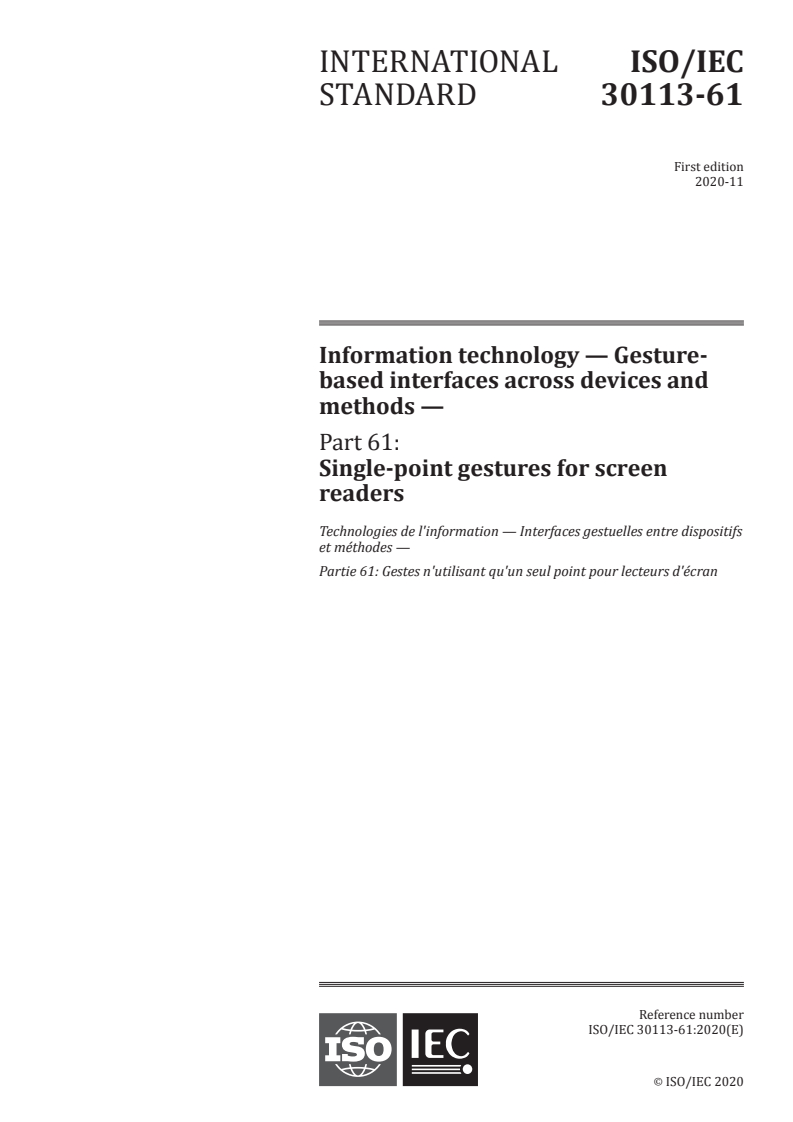
INTERNATIONAL ISO/IEC
STANDARD 30113-61
First edition
2020-11
Information technology — Gesture-
based interfaces across devices and
methods —
Part 61:
Single-point gestures for screen
readers
Technologies de l'information — Interfaces gestuelles entre dispositifs
et méthodes —
Partie 61: Gestes n'utilisant qu'un seul point pour lecteurs d'écran
Reference number
©
ISO/IEC 2020
© ISO/IEC 2020
All rights reserved. Unless otherwise specified, or required in the context of its implementation, no part of this publication may
be reproduced or utilized otherwise in any form or by any means, electronic or mechanical, including photocopying, or posting
on the internet or an intranet, without prior written permission. Permission can be requested from either ISO at the address
below or ISO’s member body in the country of the requester.
ISO copyright office
CP 401 • Ch. de Blandonnet 8
CH-1214 Vernier, Geneva
Phone: +41 22 749 01 11
Email: copyright@iso.org
Website: www.iso.org
Published in Switzerland
ii © ISO/IEC 2020 – All rights reserved
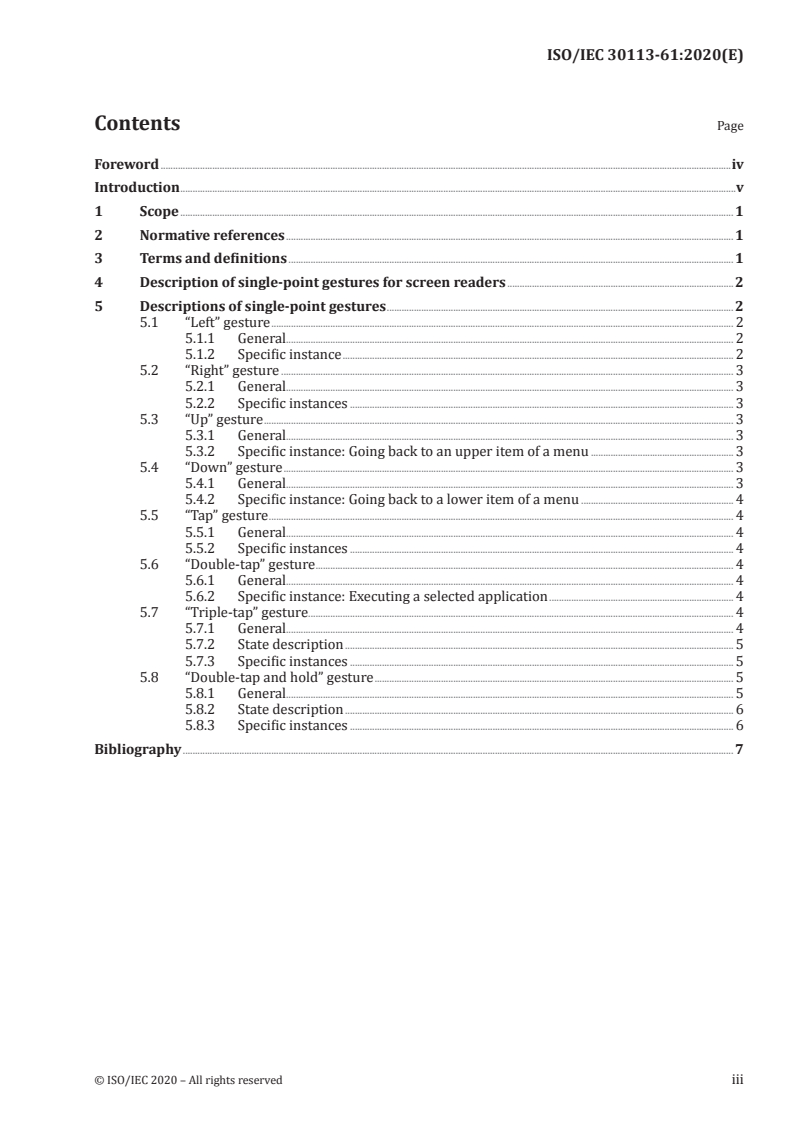
Contents Page
Foreword .iv
Introduction .v
1 Scope . 1
2 Normative references . 1
3 Terms and definitions . 1
4 Description of single-point gestures for screen readers . 2
5 Descriptions of single-point gestures . 2
5.1 “Left” gesture . 2
5.1.1 General. 2
5.1.2 Specific instance . 2
5.2 “Right” gesture . 3
5.2.1 General. 3
5.2.2 Specific instances . 3
5.3 “Up” gesture . 3
5.3.1 General. 3
5.3.2 Specific instance: Going back to an upper item of a menu . 3
5.4 “Down” gesture . 3
5.4.1 General. 3
5.4.2 Specific instance: Going back to a lower item of a menu . 4
5.5 “Tap” gesture . 4
5.5.1 General. 4
5.5.2 Specific instances . 4
5.6 “Double-tap” gesture . 4
5.6.1 General. 4
5.6.2 Specific instance: Executing a selected application . 4
5.7 “Triple-tap” gesture . 4
5.7.1 General. 4
5.7.2 State description . 5
5.7.3 Specific instances . 5
5.8 “Double-tap and hold” gesture . 5
5.8.1 General. 5
5.8.2 State description . 6
5.8.3 Specific instances . 6
Bibliography . 7
© ISO/IEC 2020 – All rights reserved iii
Foreword
ISO (the International Organization for Standardization) and IEC (the International Electrotechnical
Commission) form the specialized system for worldwide standardization. National bodies that
are members of ISO or IEC participate in the development of International Standards through
technical committees established by the respective organization to deal with particular fields of
technical activity. ISO and IEC technical committees collaborate in fields of mutual interest. Other
international organizations, governmental and non-governmental, in liaison with ISO and IEC, also
take part in the work.
The procedures used to develop this document and those intended for its further maintenance are
described in the ISO/IEC Directives, Part 1. In particular, the different approval criteria needed for
the different types of document should be noted. This document was drafted in accordance with the
editorial rules of the ISO/IEC Directives, Part 2 (see www .iso .org/ directives).
Attention is drawn to the possibility that some of the elements of this document may be the subject
of patent rights. ISO and IEC shall not be held responsible for identifying any or all such patent
rights. Details of any patent rights identified during the development of the document will be in the
Introduction and/or on the ISO list of patent declarations received (see www .iso .org/ patents) or the IEC
list of patent declarations received (see https:// patents .iec .ch).
Any trade name used in this document is information given for the convenience of users and does not
constitute an endorsement.
For an explanation of the voluntary nature of standards, the meaning of ISO specific terms and
expressions related to conformity assessment, as well as information about ISO's adherence to the
World Trade Organization (WTO) principles in the Technical Barriers to Trade (TBT) see www .iso .org/
iso/ foreword .html.
This document was prepared by Joint Technical Committee ISO/IEC JTC 1, Information technology,
Subcommittee SC 35, User interfaces.
A list of all parts in the ISO/IEC 30113 series can be found on the ISO website.
Any feedback or questions on this document should be directed to the user’s national standards body. A
complete listing of these bodies can be found at www .iso .org/ members .html.
iv © ISO/IEC 2020 – All rights reserved
Introduction
Screen readers are regarded as a default method of accessing ICT devices for people with visual
impairments who are unable to see and understand the screens of these devices. The content on the
screens, such as letters, words, numbers, punctuation, elements and so on, are spoken out loud by screen
readers. Speakers or headphones connected to the ICT device become the main output components.
Single-point gestures are used for screen readers of several commercially available ICT devices
including smart phones, PCs and so on. Potential variety and inconsistency among the single-point
gestures might cause a serious accessibility problem for people with visually impairments. There is
a strong need for international standards to define the single-point gesture so that visually impaired
users do not get confused while they use ICT devices.
The functions of the screen readers include reading an item under the user’s finger, pausing/resuming
speech, speaking the location of the user’s fingers on a screen, such as page numbers or rows, and so on.
This document presents descr
...
Frequently Asked Questions
ISO/IEC 30113-61:2020 is a standard published by the International Organization for Standardization (ISO). Its full title is "Information technology - Gesture-based interfaces across devices and methods - Part 61: Single-point gestures for screen readers". This standard covers: This document defines single-point gestures for screen readers. It specifies movements for clear and classified single-point gestures recognized by the screen readers. It describes single-point gestures performed by a POI (point of interest). The single-point gestures are intended to operate in a consistent manner regardless of systems, platforms, applications or devices. NOTE A POI can be manipulated by using an object such as a fingertip, a stylus, etc.
This document defines single-point gestures for screen readers. It specifies movements for clear and classified single-point gestures recognized by the screen readers. It describes single-point gestures performed by a POI (point of interest). The single-point gestures are intended to operate in a consistent manner regardless of systems, platforms, applications or devices. NOTE A POI can be manipulated by using an object such as a fingertip, a stylus, etc.
ISO/IEC 30113-61:2020 is classified under the following ICS (International Classification for Standards) categories: 35.240.20 - IT applications in office work. The ICS classification helps identify the subject area and facilitates finding related standards.
You can purchase ISO/IEC 30113-61:2020 directly from iTeh Standards. The document is available in PDF format and is delivered instantly after payment. Add the standard to your cart and complete the secure checkout process. iTeh Standards is an authorized distributor of ISO standards.
Questions, Comments and Discussion
Ask us and Technical Secretary will try to provide an answer. You can facilitate discussion about the standard in here.
Loading comments...