

ISO 8783:2026
(Main)Alpine skis — Guidelines and requirements for conducting slope performance tests
- Abstract
This document provides requirements and recommendations for carrying out comparative testing of alpine skis with the objective of evaluating the performance characteristics. It is applicable to alpine skis in accordance with ISO 6289.
- Status
- Published
- Publication Date
- 23-Jul-2026
- Technical Committee
- ISO/TC 83/SC 4 - Snowsports equipment
- Drafting Committee
- ISO/TC 83/SC 4/WG 3 - Skis and snowboards
- Current Stage
- 6060 - International Standard published
- Start Date
- 24-Jul-2026
- Due Date
- 16-Jul-2028
- Completion Date
- 24-Jul-2026

ISO 8783:2026 is an International Standard from ISO for comparative slope performance tests of alpine skis. It specifies requirements and recommendations for how to carry out those tests, how to rate ski performance characteristics, and how to report the results for alpine skis covered by ISO 6289.
What does ISO 8783:2026 specify?
ISO 8783:2026 specifies the framework for testing alpine skis on snow in a comparative way. The document applies to alpine skis in accordance with ISO 6289 and is organized into clauses on scope, normative references, terms and definitions, principle, test conditions, test personnel, test committee, test skis, rating, preparation, additional elements and tuning, binding and binding systems, test report, and publication of test results.
The structure matters because the standard covers both how the test is run and how the results are recorded and shared. A user can follow the clause sequence from site selection and test staffing through to reporting and publication.
What are the key requirements of ISO 8783:2026?
Test conditions and personnel
ISO 8783:2026 requires testing on a slope that lets every tester perform the same maneuvers at the same place, in grippy and well-prepared snow. In practice, this is meant to keep the skiing conditions comparable so that differences in ratings come from the skis, not from the terrain.
The test personnel shall be independent, neutral and discreet, and their skiing ability and physical condition shall support a representative evaluation. Testers shall be trained to use the ski techniques called for by the test criteria and to perform the movements as single actions. That means the people rating the skis must be able to ski the test in a consistent, controlled way.
Test committee and test skis
ISO 8783:2026 requires supervision by a test committee of at least three technical experts plus the test supervisor. The committee decides by majority vote whether the conditions are adequate for testing. This gives the test an expert check before ratings are accepted.
The test skis shall be typical of the model, tested as delivered by the manufacturer, inspected, and retuned only when needed and in line with the manufacturer’s instructions. The running surfaces shall be cleaned and uniformly waxed for the snow conditions, and the boot and binding shall be fitted correctly to the mounting point. In practice, the standard is trying to make sure the skis are representative and prepared in a controlled way.
Rating method and criteria
ISO 8783:2026 rates ski performance by subjective and comparative judgment supported by enough individual results for the personnel, terrain conditions and test skis. The criteria are turnability, edge grip, steering behaviour, stability, smooth running, and skier friendliness/ski character.
For comparative rating, reference skis shall be used repeatedly by all testers, and test skis are judged against them. A five-grade scale is recommended: very good, good, satisfactory, poor, and very poor. This gives a common frame for comparing different ski models and for turning individual impressions into a repeatable overall score.
Preparation, options and bindings
ISO 8783:2026 requires a test ski to be undamaged and free of burrs before testing. If the running surface is badly damaged, the ski is withdrawn for refurbishment. There shall be no pre-test skiing on the test skis. These controls reduce the risk that one ski gains an unfair advantage from prior use.
If a ski model is sold only with binding and damping elements, it may be tested in its category alongside comparable skis without that kind of element. If optional elements can tune performance, the function should be tested too, or a separate test should be possible. The ski shall also be tested with the bindings or binding systems recommended by the manufacturer.
Reporting and publication
ISO 8783:2026 requires the test report to identify the standard used, say whether skis were tested as delivered or treated for the test, describe the skis and their lengths, give individual ratings, total scores and standard deviations, and note significant deviations such as tester weight or ski dimensions. Published results shall state the test and snow conditions, use clearly defined technical terms, explain any weighting used for an overall score, and publish the reasoning behind that score. Legal responsibility for testing and publication shall be assigned to an appropriate person or body.
What terms does ISO 8783:2026 define?
- turnability - The ski characteristic linked to how easily the ski turns; less force and movement means greater turnability.
- edge grip - The ski’s ability to hold on hard surfaces.
- steering behaviour - The ease with which the ski can complete a turn and change direction.
- stability - The ski’s ability to maintain direction at a given speed while turning.
- smooth running - The ski’s damping and shock-absorbing behaviour.
- skier friendliness - The ease of use, including whether the ski demands exaggerated control actions from the skier.
- total score - The sum of all ratings.
Who uses ISO 8783:2026?
ISO 8783:2026 is used by test personnel, technical experts, test supervisors, and test committees involved in slope performance evaluation of alpine skis. It is also relevant to ski manufacturers and laboratories preparing skis, setting up comparative tests, and documenting results.
Buyers, quality managers, and product teams can use it to understand how a ski model was tested and how to interpret published ratings. That matters when comparing models, checking test credibility, or specifying test conditions in supplier discussions.
What changed in ISO 8783:2026 from the previous edition?
ISO 8783:2026 is the third edition and cancels and replaces ISO 8783:2015. The document states that the main changes are updated terms and definitions and revised test conditions.
Which standards are used with ISO 8783:2026?
- ISO 6289, Skis - Vocabulary - This is the normative reference and provides the vocabulary used for skis and the terms applied in the standard.
What does the ISO 8783:2026 document contain?
ISO 8783:2026 contains clauses on the principle of comparative slope testing, the conditions for running the test, and the competence and independence of test personnel. It also includes requirements for the test committee, the condition and preparation of test skis, and the use of reference skis and a five-grade rating scale.
The document further describes how to handle skis sold with additional elements or tuning options, how to use manufacturer-recommended bindings and binding systems, and what must appear in the test report. Clause 14 adds requirements for publishing results, including the test and snow conditions and the rationale for any overall score.
Relations
- Effective Date
- 12-Jul-2025
Frequently Asked Questions
ISO 8783:2026 is a standard published by the International Organization for Standardization (ISO). Its full title is "Alpine skis — Guidelines and requirements for conducting slope performance tests". This standard covers: This document provides requirements and recommendations for carrying out comparative testing of alpine skis with the objective of evaluating the performance characteristics. It is applicable to alpine skis in accordance with ISO 6289.
This document provides requirements and recommendations for carrying out comparative testing of alpine skis with the objective of evaluating the performance characteristics. It is applicable to alpine skis in accordance with ISO 6289.
ISO 8783:2026 is classified under the following ICS (International Classification for Standards) categories: 97.220.20 - Winter sports equipment. The ICS classification helps identify the subject area and facilitates finding related standards.
ISO 8783:2026 has the following relationships with other standards: It is inter standard links to ISO 8783:2015. Understanding these relationships helps ensure you are using the most current and applicable version of the standard.
ISO 8783:2026 is available in PDF format for immediate download after purchase. The document can be added to your cart and obtained through the secure checkout process. Digital delivery ensures instant access to the complete standard document.
Standards Content (Sample)
International
Standard
ISO 8783
Third edition
Alpine skis — Guidelines and
2026-07
requirements for conducting slope
performance tests
Skis alpins — Lignes directrices et exigences pour la réalisation
d'essais de performance sur piste
Reference number
© ISO 2026
All rights reserved. Unless otherwise specified, or required in the context of its implementation, no part of this publication may
be reproduced or utilized otherwise in any form or by any means, electronic or mechanical, including photocopying, or posting on
the internet or an intranet, without prior written permission. Permission can be requested from either ISO at the address below
or ISO’s member body in the country of the requester.
ISO copyright office
CP 401 • Ch. de Blandonnet 8
CH-1214 Vernier, Geneva
Phone: +41 22 749 01 11
Email: copyright@iso.org
Website: www.iso.org
Published in Switzerland
ii
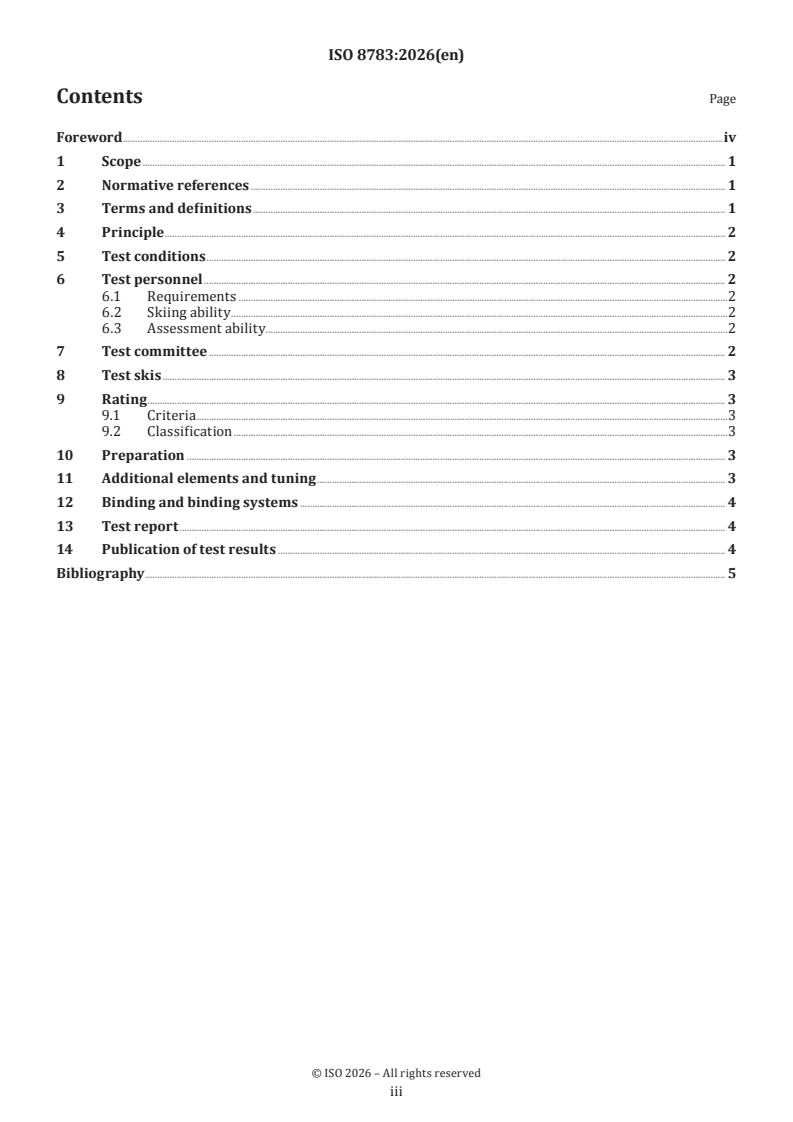
Contents Page
Foreword .iv
1 Scope . 1
2 Normative references . 1
3 Terms and definitions . 1
4 Principle . 2
5 Test conditions . 2
6 Test personnel . 2
6.1 Requirements .2
6.2 Skiing ability .2
6.3 Assessment ability.2
7 Test committee . 2
8 Test skis . 3
9 Rating . 3
9.1 Criteria .3
9.2 Classification .3
10 Preparation . 3
11 Additional elements and tuning . 3
12 Binding and binding systems . 4
13 Test report . 4
14 Publication of test results . 4
Bibliography . 5
iii
Foreword
ISO (the International Organization for Standardization) is a worldwide federation of national standards
bodies (ISO member bodies). The work of preparing International Standards is normally carried out through
ISO technical committees. Each member body interested in a subject for which a technical committee
has been established has the right to be represented on that committee. International organizations,
governmental and non-governmental, in liaison with ISO, also take part in the work. ISO collaborates closely
with the International Electrotechnical Commission (IEC) on all matters of electrotechnical standardization.
The procedures used to develop this document and those intended for its further maintenance are described
in the ISO/IEC Directives, Part 1. In particular, the different approval criteria needed for the different types
of ISO document should be noted. This document was drafted in accordance with the editorial rules of the
ISO/IEC Directives, Part 2 (see www.iso.org/directives).
ISO draws attention to the possibility that the implementation of this document may involve the use of (a)
patent(s). ISO takes no position concerning the evidence, validity or applicability of any claimed patent
rights in respect thereof. As of the date of publication of this document, ISO had not received notice of (a)
patent(s) which may be required to implement this document. However, implementers are cautioned that
this may not represent the latest information, which may be obtained from the patent database available at
www.iso.org/patents. ISO shall not be held responsible for identifying any or all such patent rights.
Any trade name used in this document is information given for the convenience of users and does not
constitute an endorsement.
For an explanation of the voluntary nature of standards, the meaning of ISO specific terms and expressions
related to conformity assessment, as well as information about ISO's adherence to the World Trade
Organization (WTO) principles in the Technical Barriers to Trade (TBT), see www.iso.org/iso/foreword.html.
This document was prepared by Technical Committee ISO/TC 83, Sports and other recreational facilities and
equipment, Subcommitte
...