

ISO 16840-10:2026
(Main)Wheelchair seating — Part 10: Requirements and test method for the assessment of resistance to ignition of postural support devices
- Abstract
This document specifies requirements and a test method to assess the resistance to ignition by a smouldering cigarette equivalent of integrated or non-integrated components of a wheelchair intended either to protect tissue integrity or to provide postural support, or both. The electrical ignition source is also a simulation of other potential sources of environmental ignition hazards. The test measures only the resistance to ignition of the items tested, and not the ignitability of the complete wheelchair. It gives an indication of, but cannot guarantee, the ignition behaviour of the assembled devices of a complete wheelchair. This document does not apply to resistance to ignition of structural parts of a wheelchair. This document does not cover changes in resistance to ignition as a result of regular washing or use of the postural support devices. This document allows for the separate testing of components of a wheelchair that are normally used in the horizontal plane (e.g. a seat cushion) from those normally used in the vertical plane (e.g. a back support). This document describes testing an assembly of the composite of materials as used in the component. The results of the test in this document do not give any indication of the resistance to ignition of any of the separate individual materials of the test sample. NOTE 1 The intent of this document is primarily to address components that interface with the human body, such as cushions for positioning, or whose described purpose is that of protecting skin tissue against pressure, shear, and maceration related damage, as well as textile, foam, and plastic-based postural support devices. NOTE 2 The pass criteria within this document have been set at a basic minimal level and can differ from current requirements in some countries. NOTE 3 Requirements for the control of risks from sources of fire created by electrical and electronic components are included in ISO 7176-14.
- Status
- Published
- Publication Date
- 08-Nov-2026
- Technical Committee
- ISO/TC 173/SC 1 - Wheelchairs
- Drafting Committee
- ISO/TC 173/SC 1/WG 11 - Wheelchair seating
- Current Stage
- 6060 - International Standard published
- Start Date
- 09-Nov-2026
- Completion Date
- 09-Nov-2026
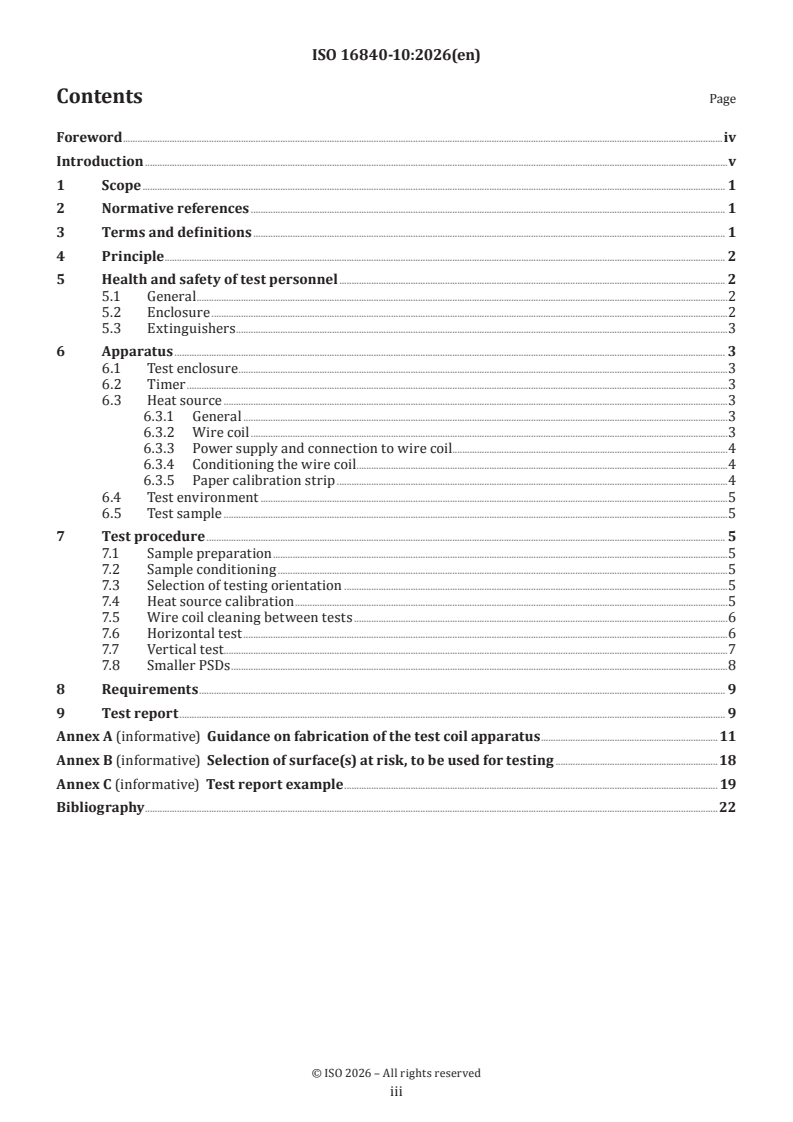
ISO 16840-10 is an ISO standard for wheelchair seating that sets requirements and test methods for checking resistance to ignition of postural support devices (PSD). It is written for integrated and non-integrated wheelchair components that protect tissue integrity or provide postural support, and it uses a smouldering cigarette equivalent as the ignition source. The standard helps manufacturers, test laboratories, and purchasers judge the ignition resistance of the seating component itself, not the full wheelchair.
What does ISO 16840-10 specify?
ISO 16840-10 specifies how to assess the resistance to ignition of wheelchair components intended to protect tissue integrity, provide postural support, or both. It also defines the limits of what the test can and cannot say: the result applies to the tested item or assembly, not to the ignitability of the complete wheelchair.
The scope excludes structural parts of the wheelchair, changes caused by regular washing or use, and risks created by electrical and electronic components. The document is organized into clauses on scope, references, terms, principle, safety, apparatus, test procedure, requirements, and test reporting, followed by three informative annexes.
| Annex | What it covers |
|---|---|
| Annex A | Guidance on fabrication of the test coil apparatus |
| Annex B | How to select the surface or surfaces at risk for testing |
| Annex C | Example test report |
What are the key requirements of ISO 16840-10?
ISO 16840-10 is built around a controlled ignition test, a defined sample setup, and a clear pass criterion. In practice, it tells a laboratory what to test, how to prepare the sample, how to generate the ignition source, and what evidence to record.
Test item selection and orientation
- Clause 6.5 and 7.1 require the sample to be a new or unused assembly made from the materials as used in the final product, including cover, filling, and any other relevant components. This matters because the test is for the delivered configuration, not for separate materials tested on their own.
- Clause 6.5 also requires testing with each specified cover, or with and without the cover when the device is designed for both cases. This matters because the cover can change ignition behaviour.
- Clause 7.3 separates horizontal and vertical use. Items intended only for the horizontal plane use the horizontal test, while other supports use the vertical test. If a part can be used in either plane, only the vertical test is needed.
Surface selection and sample conditioning
- Clause 7.1 and Annex B require the manufacturer to choose the surface or surfaces most at risk from an external ignition source. This matters because the most exposed surface is not always the body-contact surface.
- Clause 7.2 requires conditioning the sample before testing in controlled temperature and humidity for a minimum period. This matters because moisture and ambient conditions can affect ignition behaviour.
- Annex B gives examples of likely risk areas such as outer or upper surfaces of cushions, head supports, belts, harnesses, and lateral supports. In practice, the manufacturer has to justify the selected surface in the risk analysis.
Heat source and calibration
- Clause 6.3 defines the heat source as a hot wire coil made from nickel-chromium resistance wire, powered by a DC supply in constant-current mode. This is the standard's replacement for a cigarette-like ignition source.
- Clause 7.4 requires calibration with a folded paper strip so the heat source produces ignition in a narrow time window. This matters because the test depends on repeatable thermal output, not on an uncontrolled flame source.
- Clause 7.5 requires cleaning the coil between tests to remove carbon build-up. This matters because residue can change the heat source and distort the result.
Test execution
- Clause 7.6 gives the horizontal test and clause 7.7 gives the vertical test. In both cases, the heat source is placed close to the test surface with light contact, then the sample is heated and observed for flaming and smouldering.
- Clause 7.8 adapts the method for smaller PSDs such as belts, harnesses, head supports, and lateral supports. The heat source is applied to the centre of the largest area that could realistically be exposed to an external ignition source.
- The procedure requires two tests. In practice, that gives a simple repeat check without turning the method into a large test programme.
Pass criteria and reporting
- Clause 8 sets a strict pass condition: the PSD shall show no flaming during or after the test, and no smouldering after the post-exposure period. This matters because the standard is aimed at preventing continued ignition, not just delaying it.
- Clause 9 requires the report to identify the standard used, the test laboratory, calibration status, environmental conditions, sample condition, photographs, results, deviations, and unusual observations. This gives purchasers and auditors enough information to interpret the result.
- Clause 9 also requires a statement that the result applies only to the ignitability of the tested material combination under the test conditions. That helps prevent over-reading the result as a full assessment of a complete wheelchair.
What terms does ISO 16840-10 define?
ISO 16840-10 relies on terms from ISO 7176-26 and defines a few key words for the test method itself.
- Flaming - combustion in the gaseous phase with visible light. In practice, this is the failure mode the test does not allow.
- Non-integrated - detachable without tools. The note makes clear that hook-and-loop held cushions are treated as non-integrated.
- Postural support device (PSD) - a structure attached to a wheelchair that contacts the occupant's body and supports, corrects, or stabilises sitting posture. This is the main subject of the standard.
- Smouldering - self-propagating exothermic oxidation without flaming. The test simulates the kind of ignition start-up seen with cigarette-like hazards.
Who uses ISO 16840-10?
ISO 16840-10 is used by wheelchair manufacturers, component suppliers, and test laboratories that need a common method for ignition-resistance assessment. It is also relevant to quality managers, risk managers, and buyers who specify seating performance in procurement or product verification.
In practice, it supports product design, material selection, compliance testing, and comparison of different PSD constructions. It is especially relevant for textile, foam, and plastic-based seating components, as well as cushions and supports that touch the user.
What changed in ISO 16840-10 from the previous edition?
ISO 16840-10 is the third edition and it cancels and replaces ISO 16840-10:2021. It also incorporates ISO 16840-10:2021/Amd. 1:2024.
The main stated change is the removal of the original test method and the incorporation of the amended test method. In practical terms, the edition aligns the body of the standard with the updated method used for the ignition-resistance assessment.
Which standards are used with ISO 16840-10?
ISO 16840-10 names two normative references and points readers to several related standards in the introduction and bibliography.
- ISO 7176-26:2007 - provides wheelchair vocabulary used for terms and definitions.
- ISO 8191-1:1987 - provides the smouldering cigarette ignition source concept that this standard references for comparison.
- ISO 7176-14 - is identified in the introduction as the standard for electrical and electronic component fire risk control on powered wheelchairs.
- ISO 10993-1 - is cited for biological evaluation and biocompatibility considerations when selecting materials.
- ISO 14971 - is cited for risk management when choosing materials and balancing ignition resistance with other safety needs.
What does the ISO 16840-10 document contain?
ISO 16840-10 contains a complete test method, including apparatus requirements, sample preparation, calibration, test execution, pass criteria, and reporting. Clause 6 describes the enclosure, timer, hot wire coil, power supply, test environment, and sample setup. Clause 7 lays out the sequence for preparing the sample, choosing the test orientation, calibrating the heat source, cleaning the coil, and running horizontal, vertical, and small-PSD tests.
The document also includes practical support material. Annex A gives guidance for building the test coil apparatus, with a parts list and figures showing coil fabrication and installation. Annex B helps the user choose the surface or surfaces most at risk. Annex C provides an example test report, which is useful for laboratories and manufacturers that need a consistent reporting format.
Relations
- Effective Date
- 07-Dec-2025
- Effective Date
- 07-Dec-2025
Get Certified
Connect with accredited certification bodies for this standard

BSI Group
BSI (British Standards Institution) is the business standards company that helps organizations make excellence a habit.

TÜV Rheinland
TÜV Rheinland is a leading international provider of technical services.

TÜV SÜD
TÜV SÜD is a trusted partner of choice for safety, security and sustainability solutions.
Sponsored listings
Frequently Asked Questions
ISO 16840-10:2026 is a standard published by the International Organization for Standardization (ISO). Its full title is "Wheelchair seating — Part 10: Requirements and test method for the assessment of resistance to ignition of postural support devices". This standard covers: This document specifies requirements and a test method to assess the resistance to ignition by a smouldering cigarette equivalent of integrated or non-integrated components of a wheelchair intended either to protect tissue integrity or to provide postural support, or both. The electrical ignition source is also a simulation of other potential sources of environmental ignition hazards. The test measures only the resistance to ignition of the items tested, and not the ignitability of the complete wheelchair. It gives an indication of, but cannot guarantee, the ignition behaviour of the assembled devices of a complete wheelchair. This document does not apply to resistance to ignition of structural parts of a wheelchair. This document does not cover changes in resistance to ignition as a result of regular washing or use of the postural support devices. This document allows for the separate testing of components of a wheelchair that are normally used in the horizontal plane (e.g. a seat cushion) from those normally used in the vertical plane (e.g. a back support). This document describes testing an assembly of the composite of materials as used in the component. The results of the test in this document do not give any indication of the resistance to ignition of any of the separate individual materials of the test sample. NOTE 1 The intent of this document is primarily to address components that interface with the human body, such as cushions for positioning, or whose described purpose is that of protecting skin tissue against pressure, shear, and maceration related damage, as well as textile, foam, and plastic-based postural support devices. NOTE 2 The pass criteria within this document have been set at a basic minimal level and can differ from current requirements in some countries. NOTE 3 Requirements for the control of risks from sources of fire created by electrical and electronic components are included in ISO 7176-14.
This document specifies requirements and a test method to assess the resistance to ignition by a smouldering cigarette equivalent of integrated or non-integrated components of a wheelchair intended either to protect tissue integrity or to provide postural support, or both. The electrical ignition source is also a simulation of other potential sources of environmental ignition hazards. The test measures only the resistance to ignition of the items tested, and not the ignitability of the complete wheelchair. It gives an indication of, but cannot guarantee, the ignition behaviour of the assembled devices of a complete wheelchair. This document does not apply to resistance to ignition of structural parts of a wheelchair. This document does not cover changes in resistance to ignition as a result of regular washing or use of the postural support devices. This document allows for the separate testing of components of a wheelchair that are normally used in the horizontal plane (e.g. a seat cushion) from those normally used in the vertical plane (e.g. a back support). This document describes testing an assembly of the composite of materials as used in the component. The results of the test in this document do not give any indication of the resistance to ignition of any of the separate individual materials of the test sample. NOTE 1 The intent of this document is primarily to address components that interface with the human body, such as cushions for positioning, or whose described purpose is that of protecting skin tissue against pressure, shear, and maceration related damage, as well as textile, foam, and plastic-based postural support devices. NOTE 2 The pass criteria within this document have been set at a basic minimal level and can differ from current requirements in some countries. NOTE 3 Requirements for the control of risks from sources of fire created by electrical and electronic components are included in ISO 7176-14.
ISO 16840-10:2026 is classified under the following ICS (International Classification for Standards) categories: 11.180.10 - Aids and adaptation for moving. The ICS classification helps identify the subject area and facilitates finding related standards.
ISO 16840-10:2026 has the following relationships with other standards: It is inter standard links to ISO 16840-10:2021/Amd 1:2024, ISO 16840-10:2021. Understanding these relationships helps ensure you are using the most current and applicable version of the standard.
ISO 16840-10:2026 is available in PDF format for immediate download after purchase. The document can be added to your cart and obtained through the secure checkout process. Digital delivery ensures instant access to the complete standard document.
Standards Content (Sample)
International
Standard
ISO 16840-10
Third edition
Wheelchair seating —
2026-11
Part 10:
Requirements and test method for
the assessment of resistance to
ignition of postural support devices
Sièges de fauteuils roulants —
Partie 10: Exigences et méthode d'essai pour l'évaluation de la
résistance à l'inflammation des dispositifs de soutien postural
Reference number
© ISO 2026
All rights reserved.
This ISO publication is protected by copyright and is owned by ISO and/or its licensors.
The content of this ISO publication is provided under licence, not sold. Use is subject to the applicable licence terms issued by ISO,
an ISO member body, or an authorized third-party distributor.
Except as required for implementation or expressly permitted by a separate licence, no part of this ISO publication may be
reproduced, distributed, modified, used, or made available in any form or by any means – electronic or mechanical, including
photocopying, scanning, recording, or posting on internal or external digital platforms.
Any use beyond the scope of the granted rights is prohibited and may result in legal action.
ISO copyright office
CP 401 • CH-1214 Vernier, Geneva
Phone: +41 22 749 01 11
Email: copyright@iso.org
Website: www.iso.org
Published in Switzerland
ii
Contents Page
Foreword .iv
Introduction .v
1 Scope . 1
2 Normative references . 1
3 Terms and definitions . 1
4 Principle . 2
5 Health and safety of test personnel . 2
5.1 General .2
5.2 Enclosure .2
5.3 Extinguishers .3
6 Apparatus . 3
6.1 Test enclosure .3
6.2 Timer .3
6.3 Heat source .3
6.3.1 General .3
6.3.2 Wire coil .3
6.3.3 Power supply and connection to wire coil.4
6.3.4 Conditioning the wire coil .4
6.3.5 Paper calibration strip .4
6.4 Test environment .5
6.5 Test sample .5
7 Test procedure . 5
7.1 Sample preparation .5
7.2 Sample conditioning .5
7.3 Selection of testing orientation .5
7.4 Heat source calibration .5
7.5 Wire coil cleaning between tests .6
7.6 Horizontal test .6
7.7 Vertical test.7
7.8 Smaller PSDs .8
8 Requirements . 9
9 Test report . 9
Annex A (informative) Guidance on fabrication of the test coil apparatus .11
Annex B (informative) Selection of surface(s) at risk, to be used for testing .18
Annex C (informative) Test report example . 19
Bibliography .22
iii
Foreword
ISO (the International Organization for Standardization) is a worldwide federation of national standards
bodies (ISO member bodies). The work of preparing International Standards is normally carried out through
ISO technical committees. Each member body interested in a subject for which a technical committee
has been established has the right to be represented on that committee. International organizations,
governmental and non-governmental, in liaison with ISO, also take part in the work. ISO collaborates closely
with the International Electrotechnical Commission (IEC) on all matters of electrotechnical standardization.
The procedures used to develop this document and those intended for its further maintenance are described
in the ISO/IEC Directives, Part 1. In particular, the different approval criteria needed for the different types
of ISO documents should be noted. This document was drafted in accordance with the editorial rules of the
ISO/IEC Directives, Part 2 (see www.iso.org/directives).
ISO draws attention to the possibility that the implementation of this document may involve the use of (a)
patent(s). ISO takes no position concerning the evidence, validity or applicability of any claimed patent
rights in respect thereof. As of the date of publication of this document, ISO had not received notice of (a)
patent(s) which may be required to implement this document. However, implementers are cautioned that
this may not represent the latest information, which may be obtained from the patent database available at
www.iso.org/patents. ISO shall not be held responsible for identifying any or all such patent rights.
Any trade name used in this document is information given for the convenience of users and does not
constitute an endorsement.
For an explanation of the voluntary nature of standards, the meaning of ISO specific terms and expressions
related to conformity assessment, as well as information about ISO's adherence to the World Trade
Organization (WTO) principles in the Technical Barriers to Trade (TBT), see www.iso.org/iso/foreword.html.
This document was prepared by Technical Committee ISO/TC 173, Assistive products, Subcommittee SC 1,
Wheelchairs.
This third edition cancels and replaces the second edition (ISO 16840-10:2021) which has been technically
revised. It also incorporates the Amendment ISO 16840-10:2021/Amd. 1:2024.
The main changes are:
— removal of the original test method and incorporation of the test method from the amendment.
A list of all parts in the ISO 16840 series can be found on the ISO website.
Any feedback or questions on this document should be directed to the user’s national standards body. A
complete listing of these bodies can be found at www.iso.org/members.html.
iv
Introduction
The ignition and subsequent burning of wheelchairs is very rare, but this can occur as a result of
— being close to a burning object such as a fire beside the wheelchair,
— overheating of any electrical or electronic device on the wheelchair, and
— contact from sparks or flames (such as welding sparks, cigarettes, or matches).
Wheelchair occupants are at particular risk of injury or death from these fires and resulting fumes because
it is very possible that they do not have the ability to move away from the wheelchair.
NOTE In the United States, data collected in the 1990s showed that only a small number of individuals per
[5] st
million wheelchair users had died due to fire . Public FDA records indicate most 21 century flammability incidents
[6]
involving wheelchairs are from electrical faults .
Wheelchairs can be considered to comprise the following components:
a) structural components such as the frame, wheels, etc., that are essential to the mechanical integrity of
the wheelchair;
b) power-related components such as motors, energy sources, controllers etc., that are required for the
functioning of powered devices on wheelchairs.
c) integrated or non-integrated devices to manage tissue integrity, such as seat and back support cushions,
that are intended to have primarily a clinical function to minimize the risks of skin damage (these can
also be intended to control or accommodate posture);
d) postural support devices, including, but not limited to, sling seats, sling back supports, arm supports,
foot supports, pelvic positioning supports (hip belts), anterior trunk supports (harnesses and chest
belts), lateral pelvic/trunk supports (lateral pads) etc., that are attached to the wheelchair and are
primarily intended to give positioning and postural support to the wheelchair occupant (these can also
be intended to aid in pressure redistribution);
Each of the above components has a different severity of risk associated with its likelihood of igniting and its
resulting harm to the wheelchair occupant. This document specifies requirements and a test method to help
manufacturers and purchasers of wheelchairs to design and procure wheelchairs and their components that
are appropriate for the risk of ignition balanced against the functional needs of the wheelchair occupant.
The aim of this document is to provide appropriate alternatives to using furniture-based flammability
standards, to reflect the uses and purposes of wheelchairs and their accessories.
There is yet no International Standard on the resistance to ignition of structural components [see list item
a) above].
The power related components [see list item b) above] are the subject of ISO 7176-14 which specifies
requirements to prevent overheating in electrical components that could lead to a fire.
The tissue integrity devices [see list item c) above] and postural support devices [see list item d) above] are
the subject of this document, regardless of the seating application (whether used on or off a wheelchair),
for the same benefits of the support device to the individual. For this purpose, a smouldering cigarette as
a standardised heat source is not necessarily a reproducible heat source, since the heat output between
cigarettes from within one pack is variable, and between different packs even more so. Since the early
furnishing flammability standards were introduced, filter tipped and fire safe cigarettes have evolved,
and thus today, testing is not being carried out with the equivalent heat source as when the furnishing
flammability standards were first drafted. The aim of this document is to describe a reproducible
standardised heat source output which reproduces the burn pattern and potential for ignition of a cigarette.
Cross-lab validation testing has shown that the previously recommended cartridge heater did not reproduce
the burn pattern or potential for ignition of a cigarette, and it did not reliably produce the same test results
as the hot wire coil.
v
Various existing flammability standards allow for active flaming for two-minutes after removal of the heat
source. By this time a wheelchair occupant could suffer severe injuries directly or by secondary ignition of
other materials in the environment. This current document differs in that it tests for resistance to ignition
‒ no flaming ignition is allowed. Given the full consideration of the wheelchair user’s safety and long-term
health, this document has been drafted to be used as the flammability standard for all seating textiles/soft
components of a wheelchair that interface with the human body.
Global efforts are under way to eliminate the use of chemicals which present a serious risk to humans and
the environment. Good practice is also to use biocompatible materials that minimize the risk of exposure to
the wheelchair occupant to toxic substances. Materials chosen are required to conform to biocompatibility
requirements and risk management guidance of ISO 10993-1. The change of emphasis around the materials
to be used minimises the use of toxic and hazardous flame-retardant chemicals, which is preferable due to
the minimal contribution of seating system materials to fire severity.
Materials chosen should comply with biocompatibility requirements and risk management guidance of
ISO 10993-1, which includes consideration of cytotoxicity, sensitization, and irritation evaluations for
devices making contact with intact skin.
The pass criteria within this document have been set at a basic minimal level and can differ from current
requirements in some countries. Where practical, manufacturers should use materials with superior
resistance to ignition, when the overall risk analysis indicates the benefits outweigh any unintended harm,
in accordance with ISO 14971.
The day to day usage of a wheelchair can affect its materials’ resistance to ignition through cyclic loading,
movement of materials, washing, cleaning, etc. Manufacturers will often take this effect into account as part
of their risk assessment when selecting materials for their products to minimize the effects of this normal
use. However, although this document can be used on parts that have been used, etc., the test samples
specify new or unused parts. Different environments commonly encountered by some wheelchair occupants
can also affect the flammability of materials. For example, home oxygen systems, delivery systems for drugs
carried in an inflammable medium, etc., can turn an inert material into a flammable one. Dust and other
materials accumulated within the chair have also been found to be a source of readily ignitable material.
Wheelchair manufacturers and occupants should be aware of these risks, and should design and use
wheelchairs accordingly, as covered by ISO 14971.
vi
International Standard ISO 16840-10:2026(en)
Wheelchair seating —
Part 10:
Requirements and test method for the assessment of
resistance to ignition of postural support devices
1 Scope
This document specifies requirements and a test method to assess the resistance to ignition by a smouldering
cigarette equivalent of integrated or non-integrated components of a wheelchair intended either to protect
tissue integrity or to provide postural support, or both. The electrical ignition source is also a simulation of
other potential sources of environmental ignition hazards.
The test measures only the resistance to ignition of the items tested, and not the ignitability of the complete
wheelchair. It gives an indication of, but cannot guarantee, the ignition behaviour of the assembled devices
of a complete wheelchair.
This document does not apply to resistance to ignition of structural parts of a wheelchair. This document
does not cover changes in resistance to ignition as a result of regular washing or use of the postural support
devices.
This document allows for the separate testing of components of a wheelchair that are normally used in the
horizontal plane (e.g. a seat cushion) from those normally used in the vertical plane (e.g. a back support).
This document describes testing an assembly of the composite of materials as used in the component. The
results of the test in this document do not give any indication of the resistance to ignition of any of the
separate individual materials of the test sample.
NOTE 1 The intent of this document is primarily to address components that interface with the human body, such
as cushions for positioning, or whose described purpose is that of protecting skin tissue against pressure, shear, and
maceration related damage, as well as textile, foam, and plastic-based postural support devices.
NOTE 2 The pass criteria within this document have been set at a basic minimal level and can differ from current
requirements in some countries.
NOTE 3 Requirements for the control of risks from sources of fire created by electrical and electronic components
are included in ISO 7176-14.
2 Normative references
The following documents are referred to in the text in such a way that some or all of their content constitutes
requirements of this document. For dated references, only the edition cited applies. For undated references,
the latest edition of the referenced document (including any amendments) applies.
ISO 7176-26, Wheelchairs — Part 26: Vocabulary
3 Terms and definitions
For the purposes of this document, the terms and definitions given in ISO 7176-26 and the following apply.
ISO and IEC maintain terminology databases for use in standardization at the following addresses:
— ISO Online browsing platform: available at https:// www .iso .org/ obp
— IEC Electropedia: available at https:// www .electropedia .org/
3.1
flaming
undergoing combustion in the gaseous phase with the emission of light
3.2
non-integrated
detachable without the use of tools
Note 1 to entry: Seat or back support cushions held in place by hook and loop fastenings are also considered non-
integrated.
3.3
postural support device
PSD
structure, attached to a wheelchair, that has a surface that contacts the occupant’s body and is used either to
support, correct or stabilise the occupant’s sitting posture
EXAMPLE Seat support, back support, lateral support, head support, pelvic positioning belt, anterior trunk
support.
[SOURCE: ISO 7176-26:2007, 4.7.3 modified — The deprecated term “postural support” has been removed; in
the definition, “modify or accommodate” has been changed to “support, correct or stabilise”.]
3.4
smouldering
exothermic oxidation, not accompanied by flaming (3.1), that is self-propagating, i.e. without an external
ignition source
Note 1 to entry: It is possible that smouldering is accompanied by incandescence.
4 Principle
Test materials used in integrated and non-integrated seat and back supports, and other postural support
devices as used in wheelchairs are assembled in either horizontal or vertical samples and subjected to a heat
source that is equivalent to a smouldering cigarette in its thermal output and capacity to ignite materials
used in wheelchair seating. The resulting effects on the test materials are observed and measured.
NOTE The tests are repeated a second time to ensure that they are repeatable, but without incurring the costs of
more tests than needed as a minimum.
5 Health and safety of test personnel
5.1 General
WARNING — The following test requirements call for the use of procedures that can be hazardous to
health if adequate precautions are not taken.
Ensure that there is no hidden smouldering of the sample before disposal.
5.2 Enclosure
For safety, the tests should be conducted in a non-combustible fume cupboard. If such a cupboard is not
available, a test enclosure shall be constructed (see 6.1) so that the operator is protected from the fumes.
...