

ISO 19611
(Main)Traditional Chinese medicine — Air extraction cupping device
- Abstract
ISO 19611:2017 specifies requirements for an air extraction cupping device which operates using negative pressure. This document includes requirements for the material, pressure, sterilization or disinfection, and packaging of the cupping device, as well as appropriate test methods. ISO 19611:2017 is applicable to single-use type and multiple-use type devices. ISO 19611:2017 does not apply to the suction pump used to create the negative pressure.
- Status
- Not Published
- Technical Committee
- SC 1 - Traditional Chinese medicine
- Drafting Committee
- SC 1 - Traditional Chinese medicine
- Current Stage
- 6000 - International Standard under publication - 60 Publication
- Start Date
- 11-Nov-2026
Buy Documents
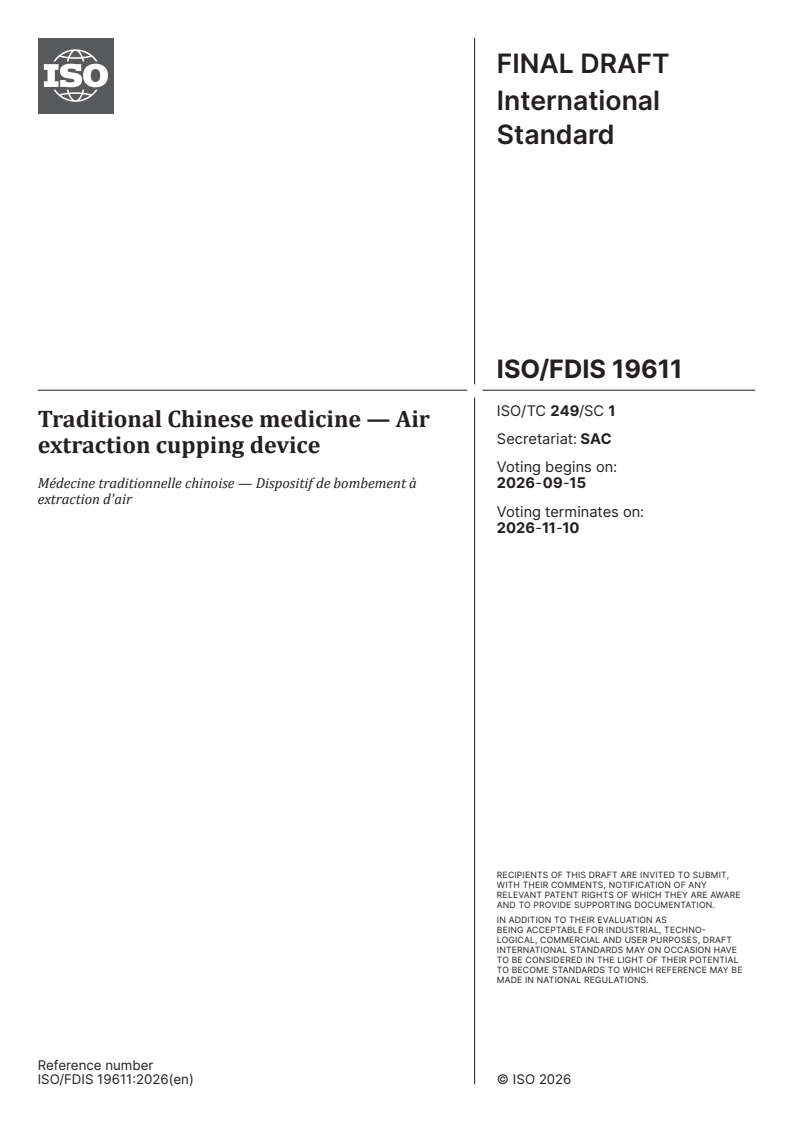

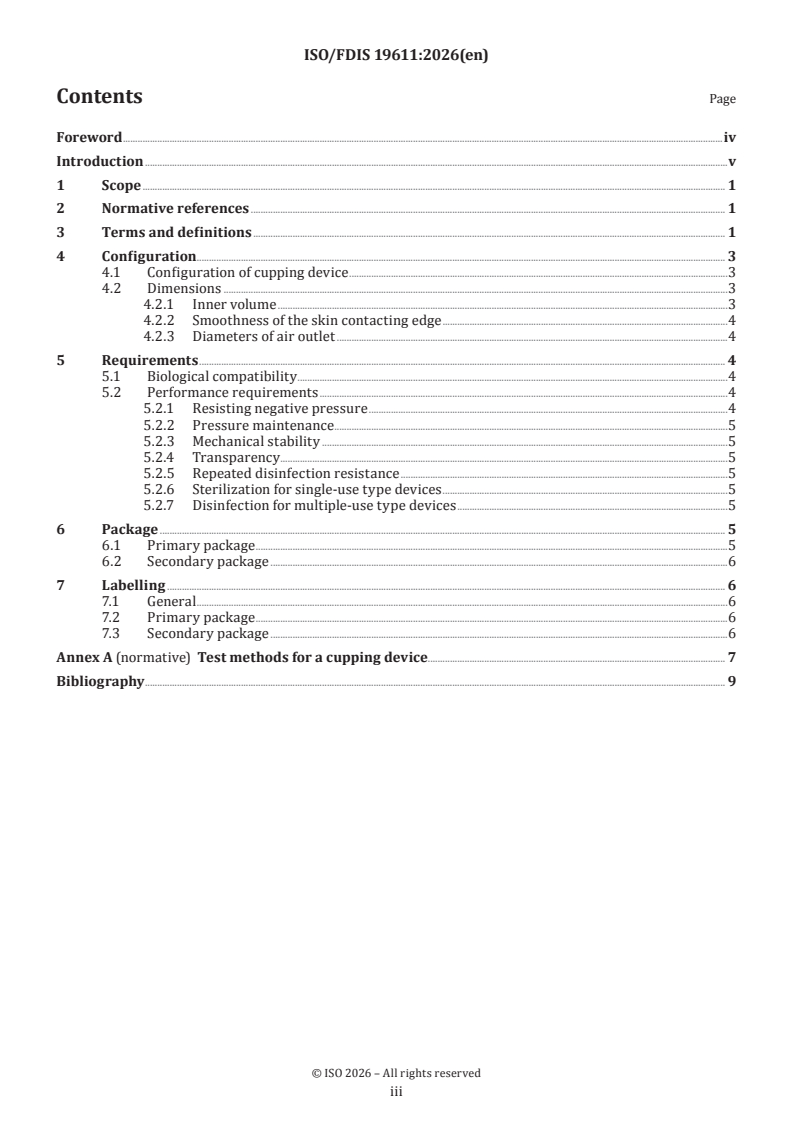
ISO/FDIS 19611 - Traditional Chinese medicine — Air extraction cupping device
REDLINE ISO/FDIS 19611 - Traditional Chinese medicine — Air extraction cupping device
ISO 19611 is an ISO standard for air extraction cupping devices used in traditional Chinese medicine. It specifies the configuration, performance, sterilization or disinfection, packaging and labelling of negative-pressure cupping devices, together with test methods for single-use and multiple-use types. The standard is aimed at manufacturers, test laboratories, and others who need to verify safety and performance before placing these devices on the market or using them in practice.
What does ISO 19611 specify?
ISO 19611 covers the air extraction cupping device itself, not the suction pump that creates the negative pressure. It organizes the subject into clauses on scope, normative references, terms and definitions, configuration, requirements, packaging, labelling, and a normative test annex.
Clause 4 describes the device structure and key dimensions. Clause 5 sets the biological compatibility and performance requirements. Clauses 6 and 7 cover packaging and labelling, which matters because the device may be single-use or multiple-use and the package must tell users how it may be handled.
| Annex | What it covers |
|---|---|
| Annex A (normative) | Test methods for a cupping device |
What are the key requirements of ISO 19611?
Configuration and dimensions
ISO 19611 requires the cupping device to have a defined structure with a body, air outlet, valve unit, inner volume and open end. The body’s skin-contacting edge is to be rounded, which reduces the risk of injury during use. The air outlet also has a minimum outer-diameter portion, and the cup size is identified by inner volume values given for different cup numbers.
In practice, this means manufacturers need to control both shape and size, not just overall appearance. Buyers and inspectors can use the cup number and geometry to compare products consistently.
Biological compatibility
ISO 19611 requires the body of the device that may contact blood during bloodletting cupping to be assessed and documented using the ISO 10993 series. The standard allows several ways to demonstrate conformity, including published data, proven clinical use of similar materials, traceability to similar marketed devices, or published biological evaluation procedures.
The document also links test selection to device type. Table 2 assigns in vitro cytotoxicity, skin sensitization and irritation to both types, while systemic toxicity and interactions with blood apply to the single-use type only; ethylene oxide residuals are checked if ethylene oxide is used.
Performance, sterilization and disinfection
ISO 19611 sets performance checks for resistance to negative pressure, pressure maintenance, mechanical stability, transparency and repeated disinfection resistance. The device must retain its performance and appearance after these tests, so the tests are not only about passing a number but about keeping the product usable.
Single-use type devices are to be sterilized with a validated procedure in accordance with ISO 11135, ISO 11137-1 or ISO 17665. Multiple-use type devices are to be disinfected with validated procedures in accordance with ISO 13408-1 and ISO 17664. For users, this means the processing route must match the intended use and be documented.
Packaging and labelling
ISO 19611 requires a sealed primary package and a secondary package for one or more primary packs. The packaging has to protect cleanliness or sterility, reduce contamination during opening, and make opening evident. The labelling clauses require package information that identifies the manufacturer or supplier, contents, size, lot or manufacture date, and for single-use devices the expiry date, sterilization status and single-use warning.
For multiple-use devices, the secondary package also needs the maximum number of cleaning and disinfection cycles and the recommended cleaning and disinfection methods. This is important because it tells the user how long the device may be reused and how to process it safely.
What terms does ISO 19611 define?
- Cupping - A therapeutic technique in which cups are placed on the skin to create localized negative pressure, either for surface effects or bloodletting.
- Negative pressure - A pressure value below atmospheric pressure; the standard says the method used to create it shall be stated when the term is used.
- Air extraction cupping device - A medical cupping device made up of the body of the cupping device and an air outlet.
- Single-use type device - A disposable cupping device for bloodletting cupping, used when contact with blood or body fluids is likely.
- Multiple-use type device - A cupping device for non-bloodletting cupping on intact skin, used when contact with blood or body fluids is not likely.
- Suction device - The device that generates the negative pressure in the cupping device; it may be manual or automatic.
- Instantaneous pressure - The pressure inside the air extraction cupping device at the moment of air extraction.
Who uses ISO 19611?
ISO 19611 is used by manufacturers of traditional Chinese medicine cupping devices, especially those producing both disposable and reusable products. It is also relevant to quality, regulatory and purchasing teams that need to check biocompatibility, packaging, labelling and processing claims.
Test laboratories use it for pressure, stability, transparency and disinfection-related testing. Practitioners and suppliers use it to distinguish devices intended for bloodletting use from those intended for intact skin use.
What changed in ISO 19611 from the previous edition?
ISO 19611 is a second edition that cancels and replaces ISO 19611:2017. The foreword says the terminology has been aligned with ISO 22213:2020, ISO 5227:2022 and WHO international standard terminology on traditional medicine.
Which standards are used with ISO 19611?
- ISO 10993 (all parts) - Gives the biological evaluation framework used for devices that may contact blood.
- ISO 11135 - Provides validated ethylene oxide sterilization requirements.
- ISO 11137-1 - Provides validated radiation sterilization requirements.
- ISO 15223-1 - Supplies the symbols used on medical device information provided by the manufacturer.
- ISO 13408-1:2023 - Covers aseptic processing requirements relevant to disinfection-related processing.
- ISO 17664 (all parts) - Covers information needed for processing medical devices for cleaning, disinfection and related handling.
- ISO 17665 - Provides validated moist-heat sterilization requirements.
What does the ISO 19611 document contain?
ISO 19611 includes a figure showing the typical cupping-device structure and naming its parts. It also includes a table of cup inner volumes by cup number, and a table linking device type to biological evaluation procedures. Annex A gives the test setups and methods for negative pressure resistance, pressure maintenance, mechanical stability, transparency and repeated disinfection resistance.
Annex A uses specific setups such as a manometer, T-shape valve, silicon plate and spring hammer, so the test environment is defined rather than left to interpretation. That makes the document useful for product development, routine verification and type testing.
Relations
- Effective Date
- 15-Mar-2025
Buy Documents
ISO/FDIS 19611 - Traditional Chinese medicine — Air extraction cupping device
REDLINE ISO/FDIS 19611 - Traditional Chinese medicine — Air extraction cupping device
Get Certified
Connect with accredited certification bodies for this standard

BSI Group
BSI (British Standards Institution) is the business standards company that helps organizations make excellence a habit.

TÜV Rheinland
TÜV Rheinland is a leading international provider of technical services.

TÜV SÜD
TÜV SÜD is a trusted partner of choice for safety, security and sustainability solutions.
Sponsored listings
Frequently Asked Questions
ISO 19611 is a draft published by the International Organization for Standardization (ISO). Its full title is "Traditional Chinese medicine — Air extraction cupping device". This standard covers: ISO 19611:2017 specifies requirements for an air extraction cupping device which operates using negative pressure. This document includes requirements for the material, pressure, sterilization or disinfection, and packaging of the cupping device, as well as appropriate test methods. ISO 19611:2017 is applicable to single-use type and multiple-use type devices. ISO 19611:2017 does not apply to the suction pump used to create the negative pressure.
ISO 19611:2017 specifies requirements for an air extraction cupping device which operates using negative pressure. This document includes requirements for the material, pressure, sterilization or disinfection, and packaging of the cupping device, as well as appropriate test methods. ISO 19611:2017 is applicable to single-use type and multiple-use type devices. ISO 19611:2017 does not apply to the suction pump used to create the negative pressure.
ISO 19611 is classified under the following ICS (International Classification for Standards) categories: 11.040.99 - Other medical equipment. The ICS classification helps identify the subject area and facilitates finding related standards.
ISO 19611 has the following relationships with other standards: It is inter standard links to ISO 19611:2017. Understanding these relationships helps ensure you are using the most current and applicable version of the standard.
ISO 19611 is available in PDF format for immediate download after purchase. The document can be added to your cart and obtained through the secure checkout process. Digital delivery ensures instant access to the complete standard document.
Standards Content (Sample)
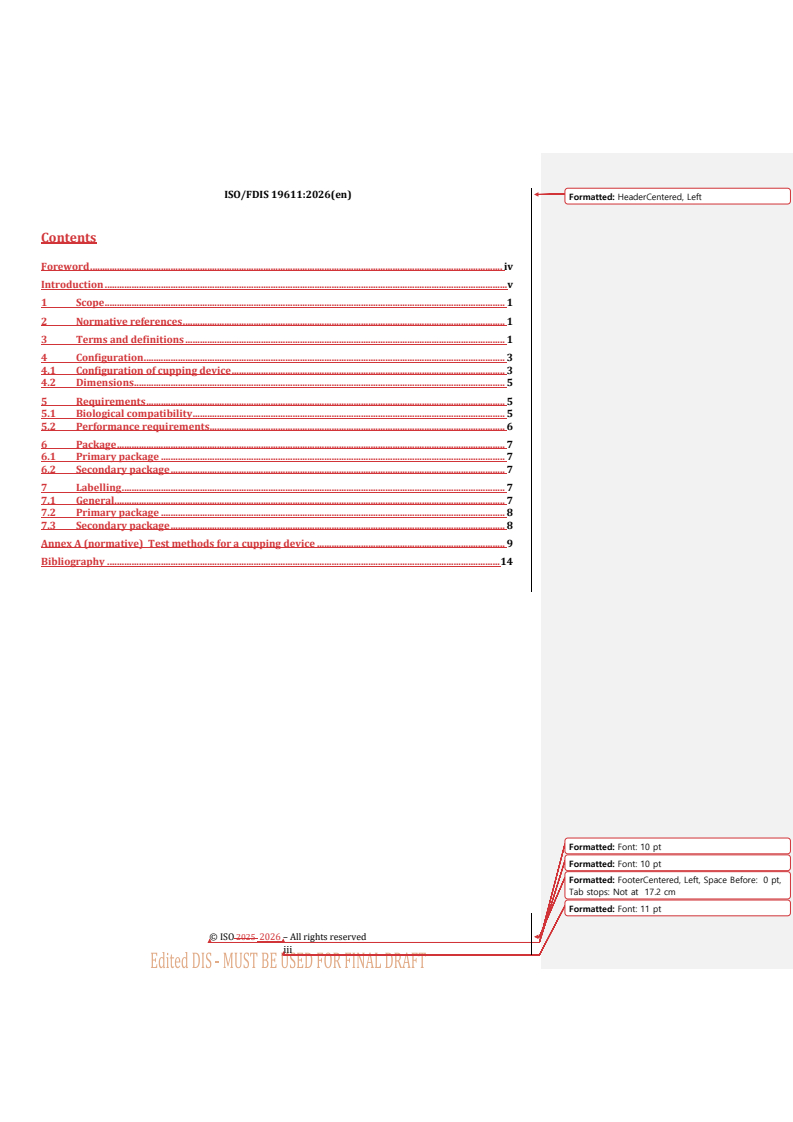
Contents
- Introduction
- 1 Scope
- 2 Normative references
- 3 Terms and definitions
- 3.1 cupping
- 3.2 negative pressure
- 3.3 cupping device
- 3.4 air extraction cupping device
- 3.5 bloodletting
- 3.6 single-use type device
- 3.7 multiple-use type device
- 3.8 body of the cupping device
- 3.9 air outlet
- 3.10 valve unit for air outlet
- 3.11 suction device
- 3.12 initial value
- 3.13 instantaneous pressure
- 4 Configuration
- 4.1 Configuration of cupping device
- 4.2 Dimensions
- 5 Requirements
- 5.1 Biological compatibility
- 5.2 Performance requirements
- 6 Package
- 6.1 Primary package
- 6.2 Secondary package
- 7 Labelling
- 7.1 General
- 7.2 Primary package
- 7.3 Secondary package
- Annex A
- 2 T-shape valve
- Bibliography
Introduction
Cupping therapy is one of the most widely used traditional medical methods, which creates a partial vacuum in cups placed on the skin either by means of heat or mechanical devices (hand or electrical pumps). In the Middle East, cupping therapy has been used since at least 1550 B.C as Hijama. In East Asia, cupping therapy has been used since at least the Han dynasty of China and has evolved into slide cupping, medicated cupping, retained cupping, etc. In Europe, cupping also has been used since at least the Greek era and developed as cupping therapy in England, Schröpfkopf in German, Ventouse in France, Банки in Russia, etc. In these days, cupping device is commonly and widely used as a traditional therapy in various techniques. Even though cupping device is widely used and produced in a number of countries and companies, there is no international standard for cupping device yet. In the aspect of safety, the cupping device directly contacts the skin, and in the case of bloodletting cupping, it directly contacts open wound involving bleeding. To prevent wound infection, it should be distinguished and developed differently in the case of intact skin or wounded skin usage. In addition, as a medical device that directly contacts blood, it requires the use of disposable cups. Therefore, the performance requirements of cupping devices needed for different related functions and usages shall be specified for each intended usage. Therefore, the performance and safety requirements for cupping devices shall be specified for each intended usage.
FINAL DRAFT International Standard ISO/FDIS 19611:2026(en) Traditional Chinese medicine — Air extraction cupping device
1 Scope
This document specifies requirements for the configuration, performance, sterilization and disinfection, packaging and labelling of the air extraction cupping device operated by negative pressure. It also includes the associated test methods.
The document is applicable to single-use type and multiple-use type cupping devices. This document does not apply to the suction pump used to create the negative pressure.
2 Normative references
The following documents are referred to in the text in such a way that some or all of their content constitutes requirements of this document. For dated references, only the edition cited applies. For undated references, the latest edition of the referenced document (including any amendments) applies. ISO 10993 (all parts), — Biological evaluation of medical devices ISO 11135, Sterilization of health-care products — Ethylene oxide — Requirements for the development, validation and routine control of a sterilization process for medical devices ISO 11137-1, Sterilization of health care products — Radiation — Part 1: Requirements for the development, validation and routine control of a sterilization process for medical devices ISO 15223-1, Medical devices — Symbols to be used with information to be supplied by the manufacturer — Part 1: General requirements ISO 13408-1:2023, Aseptic processing of health care products — Part 1: General requirements ISO 17664 (all parts), Processing of health care products ISO 17665, Sterilization of health care products — Moist heat — Requirements for the development, validation and routine control of a sterilization process for medical devices
3 Terms and definitions
For the purposes of this document, the following terms and definitions apply. ISO and IEC maintain terminology databases for use in standardization at the following addresses:
- IEC Electropedia: available at https:// www .electropedia .org/
- ISO Online browsing platform: available at https:// www .iso .org/ obp
3.1 cupping
therapeutic technique in which cups are placed on the skin to create localized negative pressure (3.2) by means of either heat or a suction device (3.11), either for affecting the surface of the body or for increasing bloodletting (3.5), or both
ISO/FDIS 19611:2026(en)
3.2 negative pressure
pressure value below the atmospheric pressure Note 1 to entry: The method of creating negative pressure shall be stated when this term is used. [SOURCE: ISO 8625-1:2018, 3.52, modified — The term 'suction pressure' has been deleted. Note 1 to entry has been added.]
3.3 cupping device
device used to perform cupping (3.1) which includes suction cups that sustain negative pressure
3.4 air extraction cupping device
device for medical cupping, which consists of a body of the cupping device (3.8), and an air outlet (3.9)
3.5 bloodletting
therapeutic method of withdrawing blood to treat or prevent illness and disease by pricking the skin with a needle or blade
3.6 single-use type device
disposable cupping device for bloodletting (3.5) cupping Note 1 to entry: This type of cupping device is used when contact with blood and body fluids is likely.
3.7 multiple-use type device
cupping device used on intact area of skin for non-bloodletting cupping Note 1 to entry: This type of cupping device used when contact with blood and body fluids is not likely.
3.8 body of the cupping device
device which maintains negative pressure (3.2) generated by a suction device (3.11) and has an internal cavity and an open end to contact the body surface
3.9 air outlet
protruding outlet port of a cupping device, connecting to a suction device (3.11) to deliver negative pressure (3.2)
3.10 valve unit for air outlet
one-way valve installed at the air outlet (3.9) Note 1 to entry: See Figure 1 as an example of a typical structure of a cupping device.
3.11 suction device
device for generating negative pressure (3.2) in the cupping device (3.3) Note 1 to entry: The suction device can be manual or automatic pump, rubber bulb, twisting rotary etc.
3.12 initial value
stable value of the pressure inside air extraction cupping device (3.4) immediately after finishing the air extracting
ISO/FDIS 19611:2026(en)
...
Contents
- Introduction
- 1 Scope Formatted: Right: 1.5 cm, Gutter: 0 cm, Header
- 2 Normative references
- 3 Terms and definitions
- 3.10 Formatted: Font: Bold
- 3.10 valve unit for air outlet
- 4 Configuration
- 4.1 Configuration of cupping device
- 4.2 Dimensions
- 5 Requirements
- 5.1 Biological compatibility
- 5.2 Performance requirements
- 6 Package
- 6.1 Primary package
- 6.2 Secondary package
- 7 Labelling
- 7.1 General
- 7.2 Primary package
- 7.3 Secondary package
- Annex A
- 2 T-shape valve
- 2 T-shape valve
- Bibliography
Introduction
Cupping therapy is one of the most widely used traditional medical methods, which creates a partial vacuum in cups placed on the skin either by means of heat or mechanical devices (hand or electrical pumps). In the Middle East, cupping therapy has been used since at least 1550 B.C as Hijama. In East Asia, cupping therapy has been used since at least the Han dynasty of China and has evolved into slide cupping, medicated cupping, retained cupping, etc. In Europe, cupping also has been used since at least the Greek era and developed as cupping therapy in England, Schröpfkopf in German, Ventouse in France, Банки in Russia, etc. In these days, cupping device is commonly and widely used as a traditional therapy in various techniques. Even though cupping device is widely used and produced in a number of countries and companies, there is no international standard for cupping device yet. In the aspect of safety, the cupping device directly contacts the skin, and in the case of bloodletting cupping, it directly contacts open wound involving bleeding. To prevent wound infection, it should be distinguished and developed differently in the case of intact skin or wounded skin usage. In addition, as a medical device that directly contacts blood, it requires the use of disposable cups. Therefore, the performance requirements of cupping devices needed for different related functions and usages shall be specified for each intended usage.
Therefore, the performance and safety requirements for cupping devices shall be specified for each intended usage.
Formatted: Font: 10 pt Formatted: Font: 10 pt Formatted: FooterCentered, Left, Space Before: 0 pt, Tab stops: Not at 17.2 cm Formatted: Font: 11 pt
FINAL DRAFT International Standard ISO/FDIS 19611:2026(en)
Traditional Chinese Medicine-medicine — Air extraction cupping device
1 Scope Formatted: Right: 1.5 cm, Gutter: 0 cm, Header
distance from edge: 1.27 cm, Footer distance from This document specifies requirements for the configuration, performance, sterilization and disinfection, edge: 0.5 cm packaging and labelling of the air extraction cupping device operated by negative pressure. It also includes the associated test methods.
Formatted: Font: Not Italic Formatted: Adjust space between Latin and Asian The document is applicable to single-use type and multiple-use type cupping devices. text, Adjust space between Asian text and numbers, Tab stops: Not at 0.7 cm + 1.4 cm + 2.1 cm + 2.8 This document does not apply to the suction pump used to create the negative pressure. cm + 3.5 cm + 4.2 cm + 4.9 cm + 5.6 cm + 6.3 cm + 7 cm
2 Normative references
Formatted: Default Paragraph Font The following documents are referred to in the text in such a way that some or all of their content constitutes Formatted: Default Paragraph Font requirements of this document. For dated references, only the edition cited applies. For undated references, Formatted: Default Paragraph Font the latest edition of the referenced document (including any amendments) applies. Formatted: Default Paragraph Font ISO 10993 (all parts), — Biological evaluation of medical devices Formatted: Default Paragraph Font Formatted: Default Paragraph Font ISO 11135, Sterilization of health-care products — Ethylene oxide — Requirements for the development, validation and routine control of a sterilization process for medical devices Formatted: Default Paragraph Font Formatted: Default Paragraph Font ISO 11137--1, Sterilization of health care products — Radiation — Part 1: Requirements for the development, Formatted: Default Paragraph Font validation and routine control of a sterilization process for medical devices Formatted: Default Paragraph Font ISO 15223--1, Medical devices — Symbols to be used with information to be supplied by the manufacturer — Formatted: Default Paragraph Font Part 1: General requirements Formatted: Default Paragraph Font ISO 13408-1:2023, Aseptic processing of health care products — Part 1: General requirementrequirements Formatted: Default Paragraph Font Formatted: Default Paragraph Font ISO 17664 (all parts), Processing of health care products Formatted: English (United Kingdom) ISO 17665, Sterilization of health care products — Moist heat: — Requirements for the development, Formatted: English (United Kingdom) validation and routine control of a sterilization process for medical devices Formatted: Font: Not Italic, English (United Kingdom)
3 Terms and definitions
Formatted: Default Paragraph Font Formatted: Default Paragraph Font For the purposes of this document, the following terms and definitions apply. Formatted: Adjust space between Latin and Asian text, Adjust space between Asian text and numbers, ISO and IEC maintain terminology databases for use in standardization at the following addresses:
Tab stops: Not at 0.7 cm + 1.4 cm + 2.1 cm + 2.8 cm + 3.5 cm + 4.2 cm + 4.9 cm + 5.6 cm + 6.3 - — IEC Electropedia: available at https://www.electropedia.org/https://www.electropedia.org/ cm + 7 cm - — ISO Online browsing platform: available at https://www.iso.org/obphttps://www.iso.org/obp Formatted: Default Paragraph Font Formatted: Default Paragraph Font Formatted: Default Paragraph Font Formatted: Default Paragraph Font
ISO/FDIS 19611:2026(en) Formatted: Font: Bold Formatted: HeaderCentered 3.1 3.1 cupping therapeutic technique in which cups are placed on the skin to create localized negative pressure (3.2)(3.2) by means of either heat or a suction device (3.11),(3.11), either for affecting the surface of the body or for increasing bloodletting (3.5),(3.5), or both 3.2 3.2 negative pressure pressure value below the atmospheric pressure Note 1 to entry: The method of creating negative pressure shall be stated when this term is used. [SOURCE: ISO 8625-1:2018, 3.52, modified — The term 'suction pressure' has been deleted. Formatted: Font: Cambria, 11 pt, Font color: Auto, Note 1 to entry has been added.] Pattern: Clear 3.3 3.3 cupping device device used to perform cupping (3.1)(3.1) which includes suction cups that sustain negative pressure
3.4 3.4 air extraction cupping device device for medical cupping, which consists of a body of the cupping device (3.8),(3.8), and an air outlet (3.9) Formatted: Font: Italic (3.9) 3.5 3.5 bloodletting therapeutic method of withdrawing blood to treat or prevent illness and disease by pricking the skin with a needle or blade 3.6 3.6 single-use type device disposable cupping device for bloodletting (3.5)(3.5) cupping Note 1 to entry: This type of cupping device is used when contact with blood and body fluids is likely. 3.7 3.7 multiple-use type device cupping device used on intact area of skin for non-bloodletting cupping Note 1 to entry: This type of cupping device used when contact with blood and body fluids is not likely. Formatted: Adjust space between Latin and Asian text, Adjust space between Asian text and numbers
3.8 3.8 body of the cupping device device which maintains negative pressure (3.2)(3.2) generated by a suction device (3.11)(3.11) and has an internal cavity and an open end to contact the body surface
ISO/FDIS 19611:2026(en) Formatted: HeaderCentered, Left
3.9 3.9 air outlet protruding outlet port of a cupping device, connecting to a suction device (3.11)(3.11) to deliver negative pressure (3.2)(3.2)
3.10 Formatted: Font: Bold
3.10 valve unit for air outlet
one-way valve installed at the air outlet (3.9) (3.9) Note 1 to entry: See Figure 1Figure 1 as an example of a typical structure of a cupping device. 3.11 3.11 suction device device for generating negative pressure (3.2)(3.2) in the cupping device (3.3) (3.3) Note 1 to entry: The suction device can be manual or automatic pump, rubber bulb, twisting rotary etc. 3.12 3.12 initial value Formatted: English (United Kingdom) stable value of the pressure inside air extraction cupping device (3.4) cupping device (3.4) immediately after Formatted: Font: Not Bold, English (United Kingdom) finishing the air extracting Formatted: English (United Kingdom) 3.13 3.13 Formatted: English (United Kingdom) instantaneous pressure Formatted: Font: Not Bold, English (United Kingdom) pressure produced inside air extraction cupping device (3.4) cupping device (3.4) at the instant moment of air Formatted: English (United Kingdom) extracting Formatted: English (United Kingdom) [SOURCE: ISO 22213:2020, 3.4, modified: The term 'glass' has been replaced by 'air extraction'. The term ' Formatted: Font: Not Bold, English (United Kingdom) cupping' has been replaced by 'air extracting'.] Formatted: English (United Kingdom)
4 Configuration
Formatted: English (United Kingdom) Formatted: English (United Kingdom)
4.1 Configuration of cupping device
Formatted: English (United Kingdom) The configuration of the cupping device and the name of each of its parts are shown in Figure 1.Figure 1. Formatted: English (United Kingdom) Formatted: English (United Kingdom) Formatted: English (United Kingdom) Formatted: English (United Kingdom) Formatted: English (United Kingdom) Formatted: Font: 10 pt Formatted: Font: 10 pt Formatted: FooterCentered, Left, Space Before: 0 pt, Tab stops: Not at 17.2 cm Formatted: Font: 11 pt
ISO/FDIS 19611:2026(en) Formatted: Font: Bold Formatted: HeaderCentered
...