


ISO/IEC 9594-4:1990
(Main)Information technology — Open Systems Interconnection — The Directory — Part 4: Procedures for distributed operation
Information technology — Open Systems Interconnection — The Directory — Part 4: Procedures for distributed operation
Technologies de l'information — Interconnexion de systèmes ouverts — L'Annuaire — Partie 4: Procédures pour le fonctionnement réparti
General Information
- Status
- Withdrawn
- Publication Date
- 19-Dec-1990
- Withdrawal Date
- 19-Dec-1990
- Technical Committee
- ISO/IEC JTC 1 - Information technology
- Drafting Committee
- ISO/IEC JTC 1 - Information technology
- Current Stage
- 9599 - Withdrawal of International Standard
- Start Date
- 17-Jun-1998
- Completion Date
- 12-Feb-2026
Relations
- Effective Date
- 06-Jun-2022
- Effective Date
- 06-Jun-2022
- Effective Date
- 06-Jun-2022
- Effective Date
- 15-Apr-2008
- Effective Date
- 15-Apr-2008
- Effective Date
- 15-Apr-2008
- Effective Date
- 15-Apr-2008
ISO/IEC 9594-4:1990 - Information technology -- Open Systems Interconnection -- The Directory

ISO/IEC 9594-4:1990 - Technologies de l'information -- Interconnexion de systemes ouverts -- L'Annuaire
Get Certified
Connect with accredited certification bodies for this standard

BSI Group
BSI (British Standards Institution) is the business standards company that helps organizations make excellence a habit.

NYCE
Mexican standards and certification body.
Sponsored listings
Frequently Asked Questions
ISO/IEC 9594-4:1990 is a standard published by the International Organization for Standardization (ISO). Its full title is "Information technology — Open Systems Interconnection — The Directory — Part 4: Procedures for distributed operation". This standard covers: Information technology — Open Systems Interconnection — The Directory — Part 4: Procedures for distributed operation
Information technology — Open Systems Interconnection — The Directory — Part 4: Procedures for distributed operation
ISO/IEC 9594-4:1990 is classified under the following ICS (International Classification for Standards) categories: 35.100.70 - Application layer. The ICS classification helps identify the subject area and facilitates finding related standards.
ISO/IEC 9594-4:1990 has the following relationships with other standards: It is inter standard links to ISO/IEC 9594-4:1990/Cor 3:1993, ISO/IEC 9594-4:1990/Cor 2:1992, ISO/IEC 9594-4:1990/Cor 1:1991, ISO/IEC 9594-4:1995; is excused to ISO/IEC 9594-4:1990/Cor 2:1992, ISO/IEC 9594-4:1990/Cor 3:1993, ISO/IEC 9594-4:1990/Cor 1:1991. Understanding these relationships helps ensure you are using the most current and applicable version of the standard.
ISO/IEC 9594-4:1990 is available in PDF format for immediate download after purchase. The document can be added to your cart and obtained through the secure checkout process. Digital delivery ensures instant access to the complete standard document.
Standards Content (Sample)
I NTER NATIONAL ISO/IEC
STANDARD
First edition
1990-1 2-1 5
Information technology - Open Systems
Interconnection - The Directory -
Part 4:
Procedures for distributed operation
Technologies de l'information - Interconnexion de systèmes ouverts - L'annuaire -
Partie 4: Procédures pour le fonctionnement réparti
Reference number
IÇO/IEC 9594-4 : 1990 (E)
ISO/IEC 9594-4 : 1990(E)
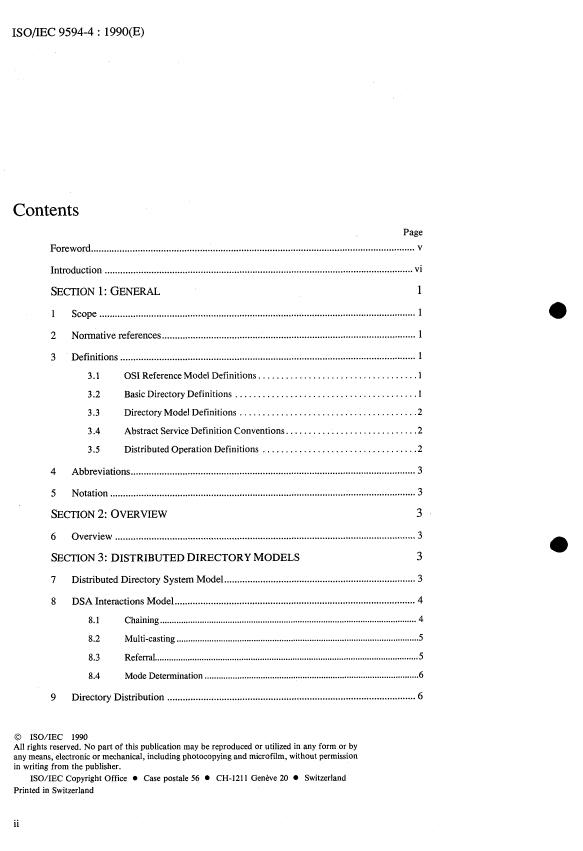
Contents
Page
Foreword . v
Introduction . vi
SECTION i : GENERAL 1
1 Scope . 1 0
2 Normative references . 1
3 Definitions . 1
OS1 Reference Model Definitions . 1
3.1
Basic Directory Definitions . 1
3.2
3.3 Directory Model Definitions . 2
3.4 Abstract Service Definition Conventions . 2
Distributed Operation Definitions . 2
3.5
4 Abbreviations . 3
5 Notation . 3
SECTION 2: OVERVIEW 3
6 Overview . 3
SECTION 3: DISTRIBUTED DIRECTORY MODELS
7 Distributed Directory System Model . 3
8 DSA Interactions Model . 4
8.1 Chaining . 4
8.2 Multi-casting . 5
8.3 Referral . 5
8.4 Mode Determination . 6
9 Directory Distribution . 6
O ISO/IEC 1990
All rights reserved . No part of this publication may be reproduced or utilized in any form or by
any means. electronic or mechanical. including photocopying and microfilm. without permission
the publisher .
in writing from
ISO/IEC Copyright Office 0 Case postale 56 CH-121 1 Genève 20 Switzerland
Printed in Switzerland
ISO/IEC 9594-4 : 1990(E)
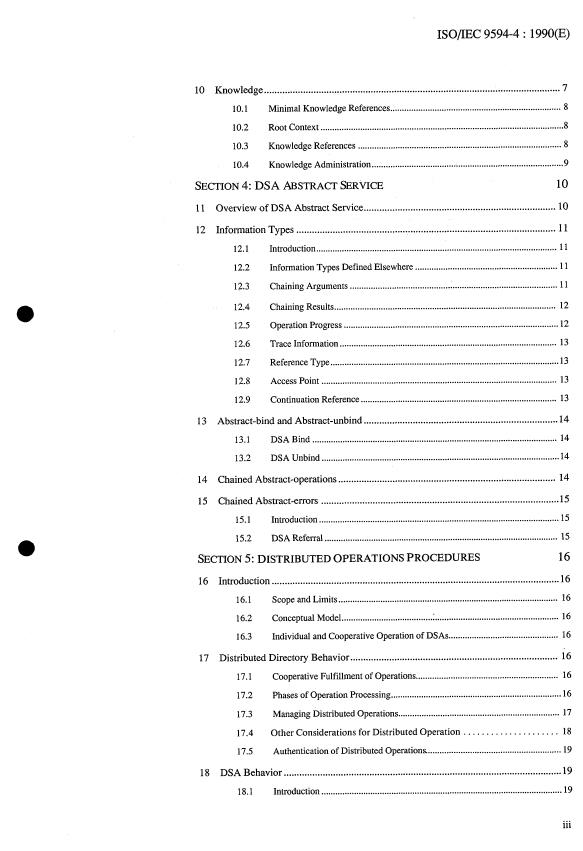
10 Knowledge . 7
Minimal Knowledge References . 8
10.1
10.2 Root Context . 8
10.3 Knowledge References . 8
10.4 Knowledge Administration . 9
SECTION 4: DSA ABSTRACT SERVICE 10
11 Overview of DSA Abstract Service . 10
12 Information Types . 11
12.1 Introduction . 11
............................................................. 11
12.2 Information Types Defined Elsewhere
12.3 Chaining Arguments . 11
12.4 Chaining Results . 12
12.5 Operation Progress . 12
12.6 Trace Information . 13
.................................................................................................. 13
12.7 Reference Type
12.8 Access Point . 13
.................................................................................... 13
12.9 Continuation Reference
13 Abstract-bind and Abstract-unbind . 14
13.1 DSABind . 14
13.2 DSA Unbind . 14
14 Chained Abstract-operations . 14
15 Chained Abstract-errors . 15
15.1 Introduction . 15
15.2 DSAReferral . 15
SECTION 5: DISTRIBUTED OPERATIONS PROCEDURES 16
16 Introduction . 16
.............................................................................................. 16
16.1 Scope and Limits
16.2 Conceptual Model . 16
Individual and Cooperative Operation of DSAs . 16
16.3
Distributed Directory Behavior . 16
17.1 Cooperative Fulfillment of Operations . 16
Phases of Operation Processing . 16
17.2
Managing Distributed Operations . 17
17.3
17.4 Other Considerations for Distributed Operation . 18
Authentication of Distributed Operations. . 19
17.5
18 DSA Behavior . 19
18.1 Introduction . 19
iii
ISO/EC 9594-4 : 1990(E)
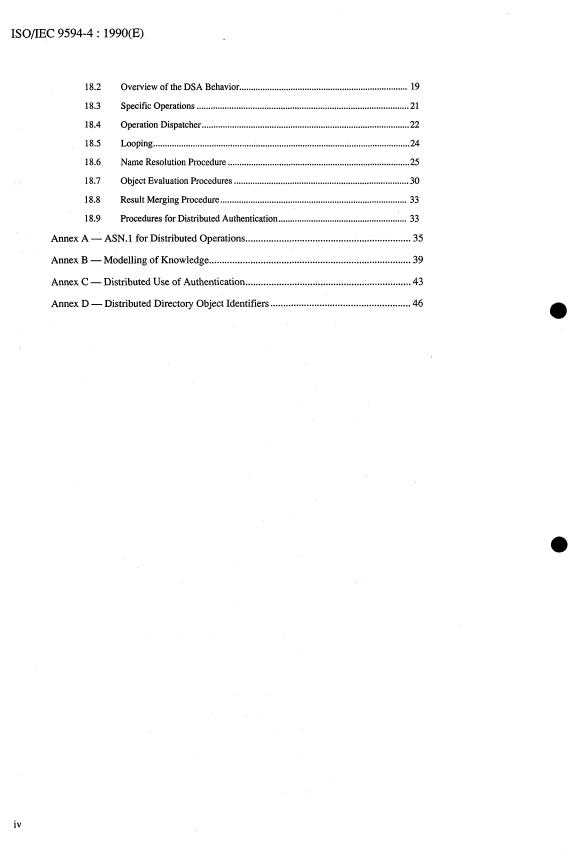
18.2 Overview of the DSA Behavior . 19
18.3 Specific Operations . 21
18.4 Operation Dispatcher . 22
1 8.5 Looping . 24
18.6 Name Resolution Procedure . 25
18.7 Object Evaluation Procedures . 30
18.8 Result Merging Procedure . 33
18.9 Procedures for Distributed Authentication . 33
Annex A - ASN.1 for Distributed Operations . 35
Annex B - Modelling of Knowledge . 39
Annex C - Distributed Use of Authentication . 43
Annex D - Distributed Directory Object Identifiers . 46
iv
SO/IEC 9594-4 : 199O(E)
Foreword
IS0 (the International Organization for Standardization) and IEC (the International
Electrotechnical Commission) form the specialized system for worldwide standardiz-
ation. National bodies that are members of IS0 or IEC participate in the development
of International Standards through technical committees established by the respective
organization to deal with particular fields of technical activity. IS0 and IEC technical
committees collaborate in fields of mutual interest. Other international organizations,
governmental and non-governmental, in liaison with IS0 and IEC, also take part in the
work.
In the field of information technology, IS0 and IEC have established a joint technical
committee, ISO/IEC JTC 1. Draft International Standards adopted by the joint
technical committee are circulated to national bodies for voting. Publication as an
International Standard requires approval by at least 75 'To of the national bodies casting
a vote.
International Standard ISO/IEC 9594-4 was prepared by Joint Technical Committee
ISOAEC JTC 1, Information technology.
ISOAEC 9594 consists of the following parts, under the general title Information
technology - Open Systems Interconnection - The Directory :
- Part I: Overview of concepts, models and services
- Part 2: Models
- Part 3: Abstract service definition
- Part 4: Procedures for distributed operation
- Part 5: Protocol specifications
- Part 6: Selected attribute types
- Part 7: Selected object classes
- Part 8: Authentication framework
Annexes A and D form an integral part of this part of ISOAEC 9594. Annexes B
and C are for information only.
V
Introduction
0.1 This part of ISO/IEC 9594, together with the other parts, has been produced to facilitate the interconnection of
information processing systems to provide directory services. The set of all such systems, together with the directory
information which they hold, can be viewed as an integrated whole, called the Directory. The information held by the
Directory, collectively known as the Directory Information Base (DIB), is typically used to facilitate communication between,
with or about objects such as OS1 application entities, people, terminals and distribution lists.
0.2 The Directory plays a significant role in Open Systems Interconnection, whose aim is to allow, with a minimum of a
technical agreement outside of the interconnection standards themselves, the interconnection of information processing
systems:
from different manufacturers;
under different managements;
of different levels of complexity: and
of different ages.
0.3 This part of ISO/iEC 9594 specifies the procedures by which the distributed components of the Directory interwork in
order to provide a consistent service to its users.
INTERNATIONAL STANDARD
ISO/IEC 9594-4 : 1990 (E)
Information technology - Open Systems Interconnection -
The Directory -
Part 4:
Procedures for distributed operation
SECTION 1: GENERAL
1 Scope ISOAEC 9594-5: 1990, Information Technology - Open
Systems Interconnection - The
1.1 This Part of ISO/IEC 9594 specifies the behavior of
Directory - Part 5: Protocol
DSAs taking part in the distributed Directory application.
Specifications.
The allowed behavior has been designed so as to ensure a
consistent service given a wide distribution of the DIB
ISO/IEC 9594-6: 1990, Information Technology - Open
across many DSAs.
Systems Interconnection - The
Directory - Part 6: Selected At-
1.2 The Directory is not intended to be a general purpose
tribute Types.
database system, although it may be built on such systems.
It is assumed that there is a considerably higher frequency
ISO/IEC 9594-7: 1990, Information Technology - Open
of queries than of updates.
Systems Interconnection - The
Directory - Part 7: Selected Object
Classes.
2 Normative references
ISO/IEC 9594-8: 1990, Information Technology - Open
The following standards contain provisions which, through
Systems Interconnection - The
reference in this text, constitute provisions of this part of
Directory - Part 8: Authentication
ISO/IEC 9594. At the time of publication, the editions
Framework.
indicated were valid. All standards are subject to revision,
and parties to agreements based on this part of ISO/IEC
ISOAEC 10021-3: 1990, Information Technology - Text
9594 are encouraged to investigate the possibility of
Communication - Message
applying the most recent editions of the standards listed
Oriented Text Interchange System
below. Members of IEC and IS0 maintain registers of
('OTIS) - Part 3: Abstract Service
currently valid International Standards.
Definition Conventions.
IS0 7498: 1984, Information Processing Systems -
Open Systems Interconnection -
Basic Reference Model.
3 Definitions
ISO/IEC 8824: 1990, Information Technology -Open
Systems Interconnection -
The definitions contained in this clause make use of the
Specification of Abstract Syntax
abbreviations defined in clause 4.
Notation One (ASN.1).
3.1 OS1 Reference Model Definitions
ISO/IEC 9594-1 : 1990, Information Technology - Open
Systems Interconnection - The
This part of the International Standard makes use of the
Directory - Part I: Overview of
following terms defined in IS0 7498:
Concepts, Models and Services.
a) application entity title;
ISO/IEC 9594-2: 1990, In formation Technology - Open
Systems Interconnection - The
3.2 Basic Directory Definitions
Directory - Part 2: Models.
This part of ISO/IEC 9594 makes use of the following
terms defined in ISO/IEC 9594-1 :
ISO/IEC 9594-3: 1990, Information Technology - Open
Systems Interconnection - The
a) (the) Directory;
Directory - Part 3: Abstract Ser-
b) Directory Information Base ;
vice Definition.
ISO/IEC 9594-4 : 1990(E)
3.5.8 knowledge reference: Knowledge which associates,
3.3 Directory Model Definitions
either directly or indirectly, a DIT entry with the DSA in
This part of ISO/IEC 9594 makes use of the following which it is located.
terms defined in ISO/IEC 9594-2:
3.5.9 knowledge tree: The conceptual model of the
a) access point;
knowledge information that a DSA holds to enable it to per-
b) alias;
form distributed name resolution.
c) distinguished name;
3.5.10 multicasting. A mode of interaction which may
d) Directory Information Tree ;
optionally be used by a DSA which cannot perform an
operation itself. The DSA multicasts the operation, i.e.,
e) Directory System Agent;
invokes the same operation of several other DSAs (in
f) Directory User Agent;
series or in parallel) and passes an appropriate outcome to
the original requestor.
g) relative distinguished name;
3.5.11 name resolution : The process of locating an entry
3.4 Abstract Service Definition Conventions
by sequentially matching each RDN in a purported name
to a vertex of the DIT.
This part of ISODEC9594 makes use of the following
terms defined in ISO/IEC 1002 1 - 1 :
3.5.12 naming context : A partial sub tree of the DIT
a) abstract error :
which starts at a vertex and extends downwards to leaf
and/or non-leaf vertices. Such vertices constitute the
b) abstract operation;
border of the naming context. Subordinates of non-leaf
c) result;
vertices belonging to the border denote the start of further
naming contexts.
3.5 Distributed Operation Definitions
For the purpose of this part of ISODEC 9594 the following
3.513 non-specific subordinate reference : A knowledge
definitions apply:
reference that holds information about the DSA that holds
one or more unspecified subordinate entries.
3.5.1 chaining : A mode of interaction optionally used
by a DSA which cannot perform an operation itself. The
3.5.14 operation progress: A set of values which denotes
DSA chains by invoking an operation of another DSA and
the extent to which name resolution has taken place.
then relaying the outcome to the original requestor.
3.5.15 reference path: A continues sequence of
3.5.2 context prefix : The sequence of RDNs leading
knowledge references.
from the Root of the DIT to the initial vertex of a naming
context, corresponds to the distinguished name of that
3.5.16 referral: An outcome which can be returned by a
vertex.
DSA which cannot perform an operation itself, and which
identifies one or more other DSAs more able to perform the
operation.
3.5.3 cross reference : A knowledge reference
O
containing information about the DSA that holds an entry.
This is used for optimization. The entry need have no
3.5.17 request decomposition : Decomposition of a request
superior or subordinate relationship,
into subrequests each accomplishing a part of the distributed
operation.
DIB fragment : The portion of the DIB that is held
3.5.4
by one DSA, comprising one or more naming contexts.
3.5.18 root context: The naming context for the vertex
whose name comprises the empty sequence of RDNs.
3.5.5 distributed name resolution : The process by which
name resolution is performed in more than one DSA.
3.5.19 subordinate reference: A knowiedge reference
containing information about the DSA that holds a specific
3.5.6 internal reference : A knowledge reference
subordinate entry.
containing an internal pointer to an entry held in the same
DSA.
3.5.20 subrequest: A request generated by request
decomposition.
3.5.7 knowledge information : the information which a
particular DSA has about the entries it holds and how to
3.5.21 superior reference: A knowledge reference
locate other entries in the directory.
containing information about the DSA that holds a
superior entry.
ISO/IEC 9594-4 : 1990(E)
RDN Relative Distinguished Name
4 Abbreviations
5 Notation
The following abbreviations are used in this part of
ISO/IEC 9594:
The notation used in this clause is defined as follows:
the data syntax notation, encoding and macro
a)
DIB Directory Information Base
notation are defined in ISO/IEC 8824;
DIT Directon, Information Tree
DSA Directory System Agent b) the notations for abstract models and abstract services
are defined in ISO/IEC 10021-3.
DUA Directory User Agent
SECTION 2: OVERVIEW
For the limiting case where the DIB is contained within a
single DSA, the Directory is in fact centralized; for the
0 6 Overview
case where the DIB is distributed over two or more DSAs,
knowledge and navigation mechanisms are specified
The Directory Abstract Service allows the interrogation,
which ensure that the whole of the DIB is potentially
retrieval and modification of Directory information in the
accessible from all DSAs that hold constituent entries.
DIB. This service is described in terms of the abstract
Directory object as specified in ISO/IEC 9594-3.
Additionally, request handling interactions are specified
that enable particular operational characteristics of the
Necessarily, the specification of the abstract Directory
Directory to be controlled by its users. In particular, the
object does not in any way address the physical realization
user has control over whether a DSA, responding to a
of the Directory: in particular it does not address the
directory enquiry pertaining to information held in other
specification of Directory System Agents (DSA) within
DSA(s), has the option of interrogating the other DSA(s)
which the DIB is stored and managed, and through which
directly (chaining/multicasting) or, whether it should
the service is provided. Furthermore, it does not consider
respond with information about other DSA(s) which could
whether the DIB is centralized, i.e., contained within a
further progress the enquiry (referral).
single DSA, or distributed over a number of DSAs.
Consequently, the requirements for DSAs to have
knowledge of, navigate to, and cooperate with other DSAs, Generally, the decision by a DSA to chain/multicast or
in order to support the abstract service in a distributed refer is determined by the service controls set by the user,
environment is also not covered by the service description. and by the DSA's own administrative, operational, or
technical circumstances.
This part of ISO/IEC 9594 specifies the refinement of the
0 abstract Directory object, the refinement being expressed
Recognizing that, in general, the Directory will be
in terms of a set of one or more DSA objects which
distributed, that directory enquiries will be satisfied by an
collectively constitute the distributed directory service.
arbitrary number of cooperating DSAs which may
Inherent in this is the identification and specification of the
arbitrarily chain/multicast or refer according to the above
DSA ports that are internal to the Directory object. For
criteria, this part of ISO/IEC 9594 specifies the appropriate
each such port, this part specifies, the associated abstract
procedures to be effected by DSAs in responding to
service, and its procedures.
distributed directory enquiries, These procedures will
ensure that users of the distributed Directory service
In addition this part specifies the permissible ways in perceive it to be both user-friendly and consistent.
which the DIB may be distributed over one or more DSAs.
SECTION 3: DISTRIBUTED DIRECTORY MODELS
provides a set of directory services to its users. The
services of the directory are modelled in terms of ports,
7 Distributed Directory System
where each port provides a particular set of directory
Model
services. Users of the directory access its services through
an access point. The directory may have one or more
The Directory abstract service as defined in
access points and each access point is characterized by the
ISO/IEC 9594-3 models the directory as an object which
ISO/IEC 9594-4 : 1990(E)
services it provides and the mode of interaction used to In addition to the service-ports of the DSA object which
provide these services. accommodate access to the Directory object, a second set
of ports are defined, the chained-service-ports. These
permit inter-DSA communication in order that the
This clause addresses the internal structure of the directory
Directory abstract service can be realized in a distributed
object, identifying its constituent objects and their ports,
environment.
and thereby facilitates the specification of a distributed
directory service.
The chained-service-ports and the operations provided
through them are in direct correspondence to the similarly
Figure 1 illustrates the distributed directory model which
named service-ports, and are, respectively, ChaineciRead,
will be used as the basis for specifying the distributed
chainedsearch, and chainedModify .
aspects of the directory. It illustrates the directory object as
comprising a set of one or more DSA objects.
The process of specifying the constituent objects of a more
abstract object is termed "refinement". The specification of
pZqq---., The Directory
the refinement of the Directory object into its component
parts (the DSAs), and the specification of the abstract
service provided by each of them (the DSA Abstract
Service) is contained in Section Four of this part of
ISO/IEC 9594. (The protocol specification of the
corresponding OS1 application service elements, as derived
from the distributed port definitions, can be found in
ISO/IEC 9594-5).
I
I I
8 DSA Interactions Model
A basic characteristic of the Directory is that, given a
L I
distributed DIB, a user should potentially be able to have
~~ ~
any service request satisfied (subject to security, access
Figure 1 -Objects of the Distributed Directory Model
control and administrator policies) irrespective of the
access point at which the request originates. In
accommodating this requirement it is necessary that any
DSA objects are specified in detail in the subsequent
DSA involved in satisfying a particular service request
clauses of this part of ISODEC 9594. This clause merely
have some knowledge (as specified in clause 10 of this
states a number of their characteristics in order to serve as
part of ISODEC 9594) of where the requested information
an introduction and to establish the relationship between
is located and either return this knowledge to the requestor
this part and other parts of ISO/iEC 9594.
or attempt to have the request satisfied on its behalf. (The
requestor may either be a DUA or another DSA: in the
DSA objects are defined in order that distribution of the
latter case both DSAs shall have a chained-service-port).
DIB can be accommodated and that a number of physically
distributed DSAs can interact in a prescribed, cooperative
Three modes of DSA interaction are defined to meet these
manner to provide directory services to the users of the
requirements, namely "chaining", "multicasting", and
directory (DUAs).
"referral". "Chaining" and "mu1ticasting"are defined to
meet the latter of the above requirements whilst referrals
DSA objects, like the Directory object, are characterized
address the former.
by their externally visible ports. The ports associated with
a DSA object are of two types: service-ports and chained-
service-ports.
8.1 Chaining
This mode of interaction (depicted in figure 2) may be
The service-ports of a DSA object are identical to those of
used by one DSA, to pass on a request to another DSA
the Directory object, namely, read, search, and modify.
when the former has knowledge about naming contexts
Figure 1 illustrates that the service-ports associated with a
held by the latter. Chaining may be used to contact a single
DSA object constitute an access-point through which
DSA pointed to in a cross reference, a subordinate
directory services are made available.
reference, or a superior reference. Multicasting is a form of
chaining, described in 8.2.
The detailed specification of the read, search, and modify
service-ports of the DSA object can be found in
ISO/IEC 9594-3. (The protocol specification for the
corresponding OS1 application service elements, as derived
from these port definitions, can be found in ISO/IEC 9594-
5).
ISO/IEC 9594-4 : 1990(E)
Figure 3a - Multicasting mode (parallel)
Figure 2 - Chaining mode
Note - In figure 2, the order of interactions is defined by the
with the interaction lines.
numbers associated
8.2 Multi-casting
This mode of interaction (depicted in figures 3a and 3b)
may be used by a DSA, to chain an identical request in
* unable to
parallel (figure 3a) or sequential (figure 3b) to one or more
proceed
other DSAs, when the former does not know the complete
% DSA
naming contexts held by the other DSAs. Multi-casting is
only used by a DSA to contact other DSAs pointed to in a
non-specific subordinate reference. Each of the DSAs is
passed the identical request. Normally, during name
resolution, only one of the DSAs will be able to continue
processing the request, all of the others returning the
unable to proceed Service Error. However, during the
evaluation phase of Search and List operations, all the
DSAs in a non-specific subordinate reference should be
able to continue processing the request.
Figure 3b - Multicasting mode (sequential)
-
Note - In figures 3a and 3b the order of interactions is defined
by the numbers associated with the interaction lines.
8.3 Referral
A referral (depicted in figures 4a and 4b) is returned by a
DSA in its response to a request which it had been
requested to perform, either by a DUA, or by another DSA
(in which case both DSAs shall have a chained-service-
port). The referral may constitute the whole response (in
which case it is categorized as an error) or just part of the
response. The referral contains a knowledge reference,
which may be either a superior, subordinate, cross or non-
specific subordinate reference.
The DSA (figure 4a) receiving the referral may use the
knowledge reference contained therein, to subsequently
chain or multi-cast (depending upon the type of reference)
the original request to other DSAs. Alternatively, a DSA
receiving a referral, may in turn pass the referral back in its
response. A DUA (figure 4b) receiving a referral may use
it to contact one or more other DSAs to progress the
request.
ISO/IEC 9594-4 : 1990(E)
9 Directory Distribution
This clause defines the principles according to which the
DIB can be distributed.
0 referral to B
Each entry within the DIB is administered by one, and
O referral to C
only one, DSAs Administrator who is said to have
administrative authority for that entry. Maintenance and
management of an entry shall take place in a DSA
administered by the administrative authority for the entry.
%
Request Response
Although the Directory does not provide any support for
the replication of entries, it is nevertheless possible to
realize replication in two ways.
Q
Copies of an entry may be stored in other DSA(s)
through bilateral agreement. The means by which
Figure 4a - Referral mode
these copies are maintained and managed is a
(DSA with chained-service-port)
function of the bilateral agreement and is not
defined in this part of ISO/IEC 9594.
Copies of an entry may be acquired by storing
(locally and dynamically) a copy of an entry which
results from a request.
Note - The acquisition of cache entries is subject to access
control.
The originator of the request is informed (via fromEntry)
O referral to
as to whether information returned in response to a request
is from a replicated entry or not. A service control,
dontUseCopy , is defined which allows the user to prohibit
the use of replicated entries.
Figure 4b - Referral mode
(DUA requests - DSAs with no chained ports)
Each DSA within the Directory holds a fragment of the
DIB. The DIB fragment held by a DSA is described in
Note - In figures 4a and 4b, the order of interactions is defined
terms of the DIT and comprises one or more naming
by the numbers associated with the interaction lines.
contexts. A naming context is a partial subtree of the DIT
defined as starting at a vertex and extending downwards to
8.4 Mode Determination leaf and/or non-leaf vertices. Such vertices constitute the
border of the naming context. Subordinates of the non-leaf
If a DSA cannot itself fully resolve a request, it shall
vertices belonging to the border denote the start of further
chain/multicast the request (or a request formed by
naming contexts.
decomposing the original one), to another DSA, unless:
chaining is prohibited by the user via the service
It is possible for a DSA's administrator to have
a)
controls, in which case the DSA shall return a
administrative authority for several disjoint naming
referral or a chaining Required ServiceError (at its
contexts. For every naming context for which a DSA has
choice), or administrative authority, it shall logically hold the
sequence of RDNs which lead from the root of the DIT to
b) the DSA has administrative, operational, or
the initial vertex of the subtree comprising the naming
technical reasons for preferring not to chain, in
context. This sequence of RDNs is called the context
which case the DSA shall return a referral.
prefix.
Notes
A DSA's administrator may delegate administrative
1 A "technical reason" for not chaining/multicasting is that
authority for any immediate subordinates of any entry held
the DSA identified in the knowledge reference has no chained-
locally to another DSA. A DSA that delegated authority is
service-ports.
called a superior DSA and the context that holds the
2 If the localScope service control is set, then the DSA (or
superior entry of one for which the administrative
DMD) shall either resolve the request or return an error.
authority was delegated, is called the superior naming
3 If the user prefers referrals, the user should set
context. Delegation of administrative authority begins with
chainingprohibited.
ISO/IEC 9594-4 1990(E)
the root and proceeds downwards in the DIT; that is, it can Whilst the logical to physical mapping of the DIT onto
only occur from an entry to its subordinates. DSAs is potentially arbitrary, the task of information
location and management is simplified if the DSAs are
I
Figure 5 illustrates a hypothetical DIT logically partitioned configured to hold a small number of naming contexts.
into five naming contexts (named A, B, C, D and E),
which are physically distributed over three DSAs (DSAl, In order for a DUA to begin processing a request it shall
DSA2, and DSA3). hold some information, specifically the presentation
address, about at least one DSA that it can contact initially.
How it acquires and holds this information is a local
From the example it can be seen that the naming contexts
matter.
held by particular DSAs may be configured so as to meet a
wide range of operational requirements. Certain DSAs
,
may be configured to hold those entries that represent
During the process of modification of entries it is possible
I
higher level naming domains within some logical part(s) of that the directory may become inconsistent. This will be
I
the DIB, the organizational structure of a large company
particularly likely if modification involves aliases or
say, but not necessarily all the subordinate entries. aliased objects which may be in different DSAs. The
I
Alternatively, DSAs may be configured to hold only those inconsistency shall be corrected by specific administrator
naming contexts representing primarily leaf entries. action, for example to delete aliases if the corresponding
aliased objects have been deleted. The Directory continues
to operate during this period of inconsistency.
From the above definitions, the limiting case for a naming
context can be either a single entry or the whole of the
DIT.
DSAI
DSA3
0 DIBentty
DIB Alias entry
CN=O
Figure 5 -Hypothetical DIT
Note - The Root is not held by any DSA, however some indication shall exist at the local level to distinguish those vertices (e.g., C=VV,
C=WW) which are immediate subordinates of the Root.
It is a requirement of the Directory that, for particular
modes of user interaction, the distribution of the directory
10 Knowledge
be rendered transparent, thereby giving the effect that the
The DIB is potentially distributed across multiple DSAs whole of the DIB appears to be within each and every
with each DSA holding a DIB fragment; the principles that DSA.
govern distribution of the DIB are specified in clause 9 of
this part of ISO/IEC 9594.
In order to support the operational requirements described
above, it is necessary that each DSA holding a fragment of
ISO/IEC 9594-4 : 1990(E)
the DIB be able to identify and optionally interact with which holds the root context. The functionality of a 'root-
other fragments of the DIB held by other DSAs. DSA concerning the name resolution process has to be
provided by those DSAs which have administrative
authority for naming contexts that are immediately
This clause defines knowledge as the basis for the mapping
subordinate to the root. These DSAs are called First Level
of a name to its location within a fragment of the DIT.
DSAs. Each First Level DSA shall be able to simulate the
functionality of the 'root-DSA'. This requires full
Conceptually DSAs hold two types of information:
knowledge about the root naming context. The root
a) Directory Information
context is replicated onto each First Level DSA and
therefore has to be administered commonly by the
b) Knowledge Information
autonomous first level administrative authorities.
Administration procedures have to be determined by
Directory Information is the collection of entries
multilateral agreements outside the scope of this part of
comprising the Naming Context(s) for which the
ISO/IEC 9594.
Administrator of a particular DSA has Administrative
Authority.
Each first level DSA shall hold the root context,
which implies a reference path to each other first
Knowledge Information embodies the Naming Context(s)
level DSA.
held by a particular DSA and denotes how these fit into the
Each non-first level DSA shall have a superior
overall DIT hierarchy. Name Resolution, the process of
reference, which implies a reference path to any
locating the DSA which has Administrative Authority for a
arbitrary first level DSA.
particular entry given that entry's name, is based on
knowledge information.
10.3 Knowledge References
The knowledge possessed by a DSA is defined in terms of
A Context Prefix is the sequence of RDNs leading from
a set of one or more knowledge references where each
the Root of the DIT to the initial vertex of a naming
reference associates, either directly or indirectly, entries of
context and corresponds to the distinguished name of that
the DIB with DSAs which hold those entries.
vertex.
A Naming Context comprises a collection of knowledge
To be able to fulfill the requirements to reach every DIB
references and a Context Prefix. A Naming Context shall
entry from any DSA, every DSA is required to have
contain exactly the following knowledge references:
knowledge about the entries which it itself holds, and
about subordinates and possibly superiors thereof. This
All the internal references which define the internal
gives rise to the following types of knowledge references:
structure of the portion of the DIT included in the
Naming Context.
Internal references
All the subordinate and non-specific subordinate
Subordinate references
references to other Naming Contexts.
Superior references
10.1 Minimal Knowledge References
Non-specific subordinate references
It is a property of the Directory that each entry can be
a
accessed independently of where a request is generated.
Additionally, for optimization purposes the following
types of optional references are defined:
To accomplish this, each DSA shall at least maintain the
Cross references
following knowledge references:
In the event that the set of knowledge references associated
subordinate references as defined in 10.3.2 and/or
with a particular DSA contain only internal references, the
non-specific subordinate references as defined in
DSA has no knowledge of other DSAs and the DIB is
10.3.5; and
therefore centralized.
superior references as defined in 10.3.3.
10.3.1 Internal References
It is then possible to establish a reference path, as a
An internal reference consists of :
continuous sequence of knowledge references, to all
naming contexts within the Directory.
the RDN corresponding to a DIB entry;
an internal pointer to where the entry is stored in the
Optionally, cross references, as defined in 10.3.4, may
local DIB. (The specification of this pointer is
form part of a reference path to optimize performance.
outside the scope of this part of ISO/IEC 9594).
10.2 Root Context
All entries for which a particular DSA has Administrative
Authority are represented by internal references in the
Because of the autonomy of the different countries or
global organizations, there is likely to be no 'single' DSA knowledge information of that DSA.
ISO/IEC 9594-4 1990(E)
10.3.2 Subordinate References
10.4 Knowledge Administration
A subordinate reference consists of
To operate a widely distributed Directory with an
acceptable degree of consistency and performance,
an RDN corresponding to an immediate subordinate
procedures are required to maintain and extend the
DIB entry;
knowledge held by each DSA. The same procedures are
appropriate for creating initial knowledge.
the Access Point of the DSA to which
Administrative Authority for that entry was
Knowledge can be maintained by:
delegated.
The DSA or its administrative authority propagating
a)
All subordinate entries held by another DSA to which this
changes of knowledge to those DSAs holding all
DSA has delegated Administrative Authority, shall be
kinds of references to it, whenever changes at that
represented by subordinate references (or non-specific
DSA cause the references to become invalid. This
subordinate references as described in 10.3.5).
is the only way superior, subordinate and non-
specific subordinate references can be maintained;
10.3.3 Superior References
A superior reference consists of
b) DSAs requesting and obtaining cross references to
improve the performance through ordinary directory
operations.
the Access Point of a DSA.
This part of ISODEC 9594 does not define any procedures
Each non-first level DSA maintains precisely one superior
reference. The superior reference shall form part of a for propagating knowledge changes as described in a).
reference path to the root. Unless some method outside the Bilateral agreements shall be established locally for this.
standard is employed to ensure this, for example within a
DMD, this shall be accomplished by referring to a DSA
10.4.1 Requesting Cross References
which holds a naming context whose context prefix has
To improve the performance of the Directory System, the
less RDNs than the context prefix with fewest RDNs held
local set of cross references can be expanded using
by this DSA.
ordinary Directory operations. If a DSA has a chained-
service-port it may request another DSA (which also shall
10.3.4 Cross References
have a chained-service-port) to return those knowledge
A cross reference consists of references which contain information about the location of
naming contexts related to the target object name of an
a Context Prefix;
ordinary Directory operation.
the Access Point of a DSA which has
If the returnCrossReferences component of the
Administrative Authority for that Naming Context.
ChainedOperationsArgument is set to T R U E , the
This type of reference is optional and serves to optimize
c r O s s R e f e r e n c e component of the
Name Resolution. A DSA may hold any number
ChainedOperationsResult may be present, consisting of a
(including zero) of cross references.
sequence of cross reference items.
10.3.5 Non-specific Subordinate References
If a DSA is not able to chain a request to the next DSA a
referral is returned to the originating DSA. If the
A non-specific subordinate reference consists of
return C r os s Ref e r e n ce component of
the Access Point of a DSA which holds one or more
ChainingArguments was TRUE, the referral may contain
immediately subordinate Naming Contexts.
additionally the context prefix of the naming context
which the referral refers to. The contextprefix component
This type of reference is optional, to allow for the case in
is absent if the referral is based on a non-specific
which a DSA is known to contain some subordinate entries
subordinate reference. The cross reference returned by a
but the specific RDNs of those entries is not known.
referral is based on knowledge held by the DSA which
generated the referral.
For each naming context which it holds, a DSA may hold
any number (including zero) of non-specific subordinate
In both cases (chaining result and referral) an
references, which will be evaluated if all specific internal
administrative authority through its DSA may elect to
and subordinate references have been pursued. DSAs
ignore the request for returning cross references.
a
...
ISO/CEI
NORME \
INTERNATIONALE
9594-4
Première édition
1990-1 2-1 5
Technologies de l’information - Interconnexion
de systèmes ouverts - L’Annuaire -
Partie 4:
Procédures pour le fonctionnement réparti
Information technology - Open Systems Interconnection - The
Directory -
Part 4: Procedures for distributed operation
Numéro de référence
ISO/CEI 9594-4:1990( F)
ISO/CEI 9594-4 : 1990 (F)
O ISO/CEI 1990
Droits de reproduction réservés. Aucune partie de cette publication ne peut être reproduite ni utilisée
sous quelque forme que œ sol et par aucun procédé, électronique ou mécanique, y compris la
photocopie et les microfilms, sans l'accord écrit de I'editeur.
ISOKEI Copyright Office Case postale 56 CH 121 1 Genève 20 Suisse
Version française tirée en 1991
Imprimé en Suisse
II
Sommaire
Page
Avant-propos . v
Introduction . vi
Section 1 : Généralités 1
1 Domaine d'application . 1
2 Références normatives . 1
I
3 Définitions . 2
4 Abréviations . 3
5 Notation . 3
Section 2 : Aperçu général 3
6 Aperçu général . 3
.
Section 3 : Modèle d'Annuaire réparti
7 Modèle de système d'Annuaire réparti . 4
8 Modèle d'interactions de DSA . 5
8.1 Chaînage . 5
8.2 Multi-diffusion . 5
8.3 Renvoi de référence . 6
8.4 Détermination du mode d'interaction . 7
9 Répartition de l'Annuaire . 7
10 Informations de connaissance . 8
10.1 Références de connaissance minimales . 9
10.2 Contexte racine . 9
10.3 Autres références de connaissance . 9
I) 10.4 Gestion des informations de connaissance . 10
Section 4 : Service abstrait de DSA 12
11 Aperçu général du service abstrait de DSA . 12
12 Types d'informations .
12.1 Introduction .
12.2 Types d'informations définis dans d'autres parties de I'ISO/CEI 9594 . 12
12.3 ChainingArguments .
12.4 ChainingResults .
12.5 Operationprogress .
12.6 Tracelnformation . 15
12.7 ReferenceType . 15
12.8 Accesspoint . 15
12.9 ContinuationReference . 15
...
III
I
ISO/CEI 9594-4 : 1990 (F)
13.1 DSABind . 16
13.2 DSAUnbind .
14 Opérations abstraites chaînées .
Erreurs abstraites chaînées . 17
Introduction .
15.1
DSAReferral .
15.2
Section 5 : Procédures d'exploitation répartie 18
16 Introduction .
16.1 Domaine d'application et limites .
Modèle conceptuel . 18
16.2
16.3 Fonctionnement individuel et coopératif .
17 Comportement d'Annuaire réparti .
17.1 Exécution coopérative des opérations .
17.2 Phases de traitement des opérations .
Gestion des opérations réparties . 19
17.3
Autres considérations concernant l'exploitation répartie . 20
17.4
Authentification des opérations réparties . 21
17.5
18 Comportement de DSA . 22
Introduction .
18.1 22
Aperçu général du comportement de DSA . 22
18.2
Opérations spécifiques . 23
18.3
Dispatcher d'opération . 26
18.4
Bouclage .
18.5 27
18.6 Procédure Résolution de nom . 28
18.7 Procédure Evaluation d'objet . 33
18.8 Procédure Fusion des résultats . 36
18.9 Procédures pour l'authentification répartie .
Annexe A . Module ASN.l Distributedoperations .
Annexe B - Modélisation des informations de connaissance . 42
Annexe C - Utilisation répartie de l'authentification . 46
Annexe D - Identificateurs d'objet . 50
iv
ISO/CEI 9594-4 : 1990 (F)
Avant-propos
L’ISO (Organisation internationale de normalisation) et la CE1
(Commission électrotechnique internationale) forment ensemble un
système consacré à la normalisation internationale considérée comme un
tout. Les organismes nationaux membres de 1‘1S0 ou de la CE1 participent
au développement de Normes internationales par l’intermédiaire des
comités techniques créés par l’organisation concernée afin de s’occuper
des différents domaines particuliers de l‘activité technique. Les comités
techniques de I’ISO et de la CE1 collaborent dans les domaines d‘intérêt
commun. D’autres organisations internationales, gouvernementales ou
non gouvernementales, en liaison avec I’ISO et la CE1 participent
également aux travaux.
Dans le domaine des technologies de l’information, I’ISO et la CE1 ont créé
un comité technique mixte, I’ISO/CEI JTC 1. Les projets de Normes
internationales adoptés par le comité technique mixte sont soumis aux
organismes nationaux pour approbation, avant leur acceptation comme
Normes internationales. Les Normes i nt ern at i on al es sont approuvées
conformément aux procédures qui requièrent l‘approbation de 75 % au
moins des organismes nationaux votants.
La Norme internationale ISO/CEI 9594-4 a été élaborée par le comité
technique mixte ISO/CEI JTC 1, Technologies de I’information.
Sous le titre général Technologies de I‘information - Interconnexion de
systèmes ouverts - l’Annuaire, I’ISO/CEI 9594 est composée des parties
suivantes :
- Partie I :Aperçu général des concepts, modèles et services
- Partie 2 : Modèles
- Partie 3 : Définition de service abstrait
- Partie 4 : Procédures d‘exploitation répartie
- Partie 5: Spécifications de protocoles
- Partie 6: Types d‘attribut sélectionnés
- Partie 7: Classes d’objet sélectionnées
- Partie 8: Cadre général d‘authentification
Les annexesA et D de la présente partie de I’ISO/CEI 9594 sont normatives ;
les annexes B et C sont informatives.
V
ISO/CEI 9495-4 : 1990 (FI
Introduction
0.1 La présente partie de I'ISO/CEI 9594, ainsi que les autres parties ont été élaborées pour faciliter I'inter-
connexion de systèmes de traitement de l'information pour fournir des services d'Annuaire. L'ensemble de
ces systèmes, ainsi que les informations d'Annuaire qu'ils contiennent, peuvent être considérés comme un
tout intégré, appelé «l'Annuaire». Les informations détenues par l'Annuaire, appelées ((Base d'informa-
tions d'Annuaire» (DIB), sont généralement utilisées pour faciliter la communication entre, avec ou sur des
objets tels que entités d'application, personnes, terminaux, listes de diffusion.
0.2 L'Annuaire joue un rôle important dans l'interconnexion de systèmes ouverts dont le but est de per-
mettre, moyennant un minimum d'accords techniques en dehors des normes d'interconnexion propre-
ment dites, l'interconnexion de systèmes de traitement de l'information :
0 provenant de divers fabricants ;
gérés différemment ;
0 de niveaux de complexité différents ; et
d'âges différents.
0.3 La présente partie de I'ISO/CEI 9594 spécifie les procédures d'interaction des composants répartis de
l'Annuaire en vue de fournir un service cohérent aux utilisateurs.
ISO/CEI 9594-4 : 1990 (F)
NORM E INTERNATIONALE
Technologies de l'information - Interconnexion de
systèmes ouverts - L'Annuaire
Partie 4 :
Procéd u res d'exploitation répartie
Section 1 : Généralités
ISO/CEI 9594-1 :1990, Technologies de I'infor-
1 Domaine d'application
mation - Interconnexicn
de systèmes ouverts -
1.1 La présente partie de I'ISO/CEI 9594 spécifie
L'Annuaire - Partie 1 :
à une
le comportement des DSA participant
Aperçu général des modè-
application d'Annuaire répartie. Le comporte-
les, concepts et services.
ment autorisé a été conçu de sorte d'assurer un
service cohérent étant donné une large réparti-
ISO/CEI 9594-3:1990, Technologies de I'informa-
tion de la DIB entre plusieurs DSA.
tion - Interconnexion de
systèmes ouverts -L'An-
1.2 L'Annuaire n'est pas destiné à être un sys-
nuaire - Partie 3 : Défini-
tème de bases de données à usage général, bien
tion de service abstrait.
qu'il puisse être construit à partir de tels systè-
mes. II est prévu qu'il y ait beaucoup plus de ISO/CEI 9594-5:1990, Technologies de I'informa-
recherches que de mises à jour. tion - Interconnexion de
systèmes ouverts -L'An-
nuaire - Partie 5 : Spécifi-
2 Références normatives cations de protocoles.
Les normes suivantes contiennent des disposi-
ISO/CEI 9594-6:1990, Technologies de I'informa-
tions qui, par suite de la référence qui est en
tion - Interconnexion de
faite, constituent des dispositions valables pour systèmes ouverts - L'An-
la présente partie de I'ISO/CEI 9594. Au moment
nuaire - Partie 6 : Types
de la publication, les éditions indiquées étaient
d'attribut sélectionnés.
en vigueur. Toute norme est sujette à révision et
les parties prenantes des accords fondés sur la ISO/CEI 9594-7:1990, Technologies de I'informa-
présente partie de I'ISO/CEI 9594 sont invitées à tion - Interconnexion de
rechercher la possibilité d'appliquer les éditions
systèmes ouverts - L'An-
les plus récentes des normes indiquées ci-après.
nuaire - Partie 7 : Classes
Les membres de la CE1 et de I'ISO possèdent le
d'objet sélectionnées.
registre des Normes internationales en vigueur à
un moment donné. ISO/CEI 9594-8:1990, Technologies de I'informa-
tion - Interconnexion de
IS0 7498:1984, Systèmes de traitement
systèmes ouverts - L'An-
de l'information - Inter-
nuaire - Partie 8 : Cadre
connexion de systèmes
général d'authentification.
ouverts - Modèle de réfé-
rence de base.
ISO/CEI 10021-3: 1990, Technologies de I'infor-
mation - Communication
ISO/CEI 8824:1990, Technologies de I'informa-
de texte - MOTlS - Con-
tion - Interconnexion de
ventions pour la définition
systèmes ouverts - Spéci-
du service abstrait.
fication de la notation de
syntaxe abstraite numéro I
(ASN. I).
ISO/CEI 9594-4 : 1990 (F)
3 Définitions
3.5.2 préfixe de contexte : Séquence de RDN
Les définitions contenues dans le présent article
menant de la racine du DIT au sommet initial du
utilisent les abréviations définies à l'article 4.
contexte de dénomination ; il correspond au
nom distinctif de ce sommet.
3.1 Définitions du Modèle de Référence OS1
3.5.3 référence croisée : Référence de connais-
La présente partie de I'ISO/CEI 9594 utilise le
sance contenant des informations sur le DSA qui
terme suivant, défini dans I'ISO 7498 :
détient une entrée. Elle est utilisée à des fins
d'optimisation. L'entrée n'a pas besoin d'avoir
a) titre d'entité d'application.
de relation supérieure ou subordonnée.
3.2 Définitions de base de l'Annuaire
3.5.4 fragment de DIB : Partie de la DIB détenue
par un seul DSA, comprenant un ou plusieurs
La présente partie de I'ISO/CEI 9594 utilise les
contextes de dénomination.
termes suivants, définis dans I'ISO/CEI 9594-1 :
3.5.5 résolution répartie de nom : Processus de
a) l'Annuaire ;
résolution de nom réalisée dans plus d'un DSA.
b) base d'informations d'Annuaire.
3.5.6 référence interne : Référence de connais-
sance contenant un pointeur interne vers une
3.3 Définitions du modèle d'Annuaire
entrée détenue dans le même DSA.
La présente partie de I'ISO/CEI 9594 utilise les
3.5.7 informations de connaissance : Informa-
termes définis dans I'ISO/CEI 9594-2 :
tions possédées par un DSA donné concernant
les entrées qu'il détient et la façon de localiser
a) point d'accès ;
d'autres entrées dans l'Annuaire.
b) pseudonyme ;
3.5.8 référence de connaissance : Connaissance
c) nom distinctif;
qui associe, directement ou indirectement, une
entrée de DIT au DSA où elle est localisée.
d) arbre d'informations d'Annuaire (DIT) ;
e) agent de système d'Annuaire (DSA) ;
3.5.9 arbre de connaissance : Modèle concep-
tuel des informations de connaissance que pos-
f) agent d'utilisateur d'Annuaire (DUA) ;
sède un DSA pour lui permettre de réaliser une
résolution répartie de nom.
g) nom distinctif relatif (RDN).
3.5.10 multidiffusion : Mode d'interaction utili-
3.4 Définitions relatives aux conventions de
sée en option par un DSA qui ne peut pas
définition de service abstrait
lui-même réaliser une opération. Le DSA diffuse
l'opération, c'est à dire : il appelle la même opé-
La présente partie de I'ISO/CEI 9594 utilise les
ration de plusieurs autres DSA (en série ou en
termes suivants, définis dans I'ISO/CEI 10021-3 :
parallèle) et transmet un résultat approprié au
demandeur original.
a) erreur abstraite ;
b) opérations abstraites ;
3.5.11 résolution de nom : Processus de locali-
sation d'une entrée consistant à faire concorder,
c) résultat.
en séquence, chaque RDN d'un nom proposé à
un sommet du DIT.
3.5 Définitions relatives aux opérations
réparties 3.5.12 contexte de dénomination : Sous-arbre
du DIT partant d'un sommet et s'étendant aux
La présente partie de I'ISO/CEI 9594 utilise les
niveaux inférieurs jusqu'à des sommets-feuilles
termes suivants, tels que définis ci-dessous.
et/ou des sommets-non-feuilles. De tels som-
mets représentent les limites du contexte de
3.5.1 chaînage : Mode d'interaction utilisée en
dénomination. Les subordonnés de Som-
un DSA qui ne peut pas lui-même réa-
option par
mets-non-feuilles appartenant à la limite repré-
liser une opération. Le DSA réalise le chaînage
sentent le début d'autres contextes de
en appelant une opération d'un autre DSA et en
dénomination.
relayant ensuite le résultat jusqu'au demandeur
initial.
lSO/CEl9594-4 : 1990 (FI
3.5.13 référence subordonnée non spécifique : 4 Abréviations
Référence de connaissance détenant des infor-
mations concernant le DSA qui détient une ou
Les abréviations suivantes sont utilisées dans la
plusieurs entrées subordonnées non spécifiées.
présente partie de I’ISO/CEI 9594.
3.5.14 avancement d‘opération : Ensemble de NOTE - Les abréviations utilisées sont celles de la
version anglaise. Dans le present article, on donne la
valeurs indiquant où en est une résolution de
forme de ces abréviations développée en français.
nom.
Le forme anglaise est indiquée entre parenthèses
pour aider à la compréhension.
3.5.15 chemin de références : Séquence conti-
nue de références de connaissance.
DIB Base d‘informations d’Annuaire
(Di rectory Information Base)
3.5.16 renvoi de référence : Résultat qui peut
être renvoyé par un DSA ne pouvant pas réaliser
DIT Arbre d‘informations d‘Annuaire
lui-même une opération et qui identifie un ou
(Directory Information Tree)
plusieurs autres DSA plus aptes à réaliser I’opé-
ration.
DSA Agent de système d‘Annuaire
(Directory System Agent)
3.5.17 décomposition d‘une demande : Décom-
position d‘une demande en sous-demandes dont DUA Agent d’uti I isateu r d’Annuaire
chacune accomplit une partie de l’opération (Directory User agent)
répartie.
RDN Nom distinctif relatif
(Relative distinguished Name)
3.5.18 contexte racine : Contexte de dénomina-
tion du sommet dont le nom comprend une
séquence vide de RDN.
5 Notation
3.5.19 référence subordonnée : Référence de
La notation utilisée est définie comme suit
connaissance contenant des informations
concernant le DSA qui détient une entrée subor-
a) la notation de syntaxe des données, le
donnée spécifique.
codage et la notation de macro sont définis
dans I’ISO/CEI 8824 ;
3.5.20 sous-demande : Demande résultant de la
décomposition d’une demande.
b) les notations pour les modèles abstraits et
les services abstraits sont définis dans
3.5.21 référence supérieure : Référence de
I’ISO/CEI 10021.
connaissance contenant des informations
concernant le DSA qui détient une entrée supé-
rieure.
Section 2 : Aperqu général
répartie entre plusieurs DSA. La description de
6 Aperçu general
service ne couvre donc pas les besoins des DSA
de connaître d’autres DSA, de s’y reporter et de
Le service abstrait d’Annuaire permet I’interroga-
coopérer avec eux en vue de fournir le service
tion, la recherche et la modification d’informa-
abstrait dans un environnement réparti.
tions d‘Annuaire de la DIB. Ce service est décrit
en termes d‘objet d’Annuaire abstrait tel que
La présente partie de I’ISO/CEI 9594, précise I’ob-
spécifié dans I‘ISO/CEI 9594-3.
jet d‘Annuaire abstrait ; cette précision est expri-
mée en termes d’ensemble d’un ou plusieurs
La spécification de l’objet Annuaire abstrait ne
objets DSA qui, ensemble, constituent le service
traite pas de la réalisation physique de I’An-
d’Annuaire réparti. Ceci comprend I‘identifica-
nuaire. En particulier, elle ne traite pas de la spé-
tion et la spécification de ports de DSA qui sont
cification des DSA à l‘intérieur desquels la DIB
internes à l’objet Annuaire. Pour chacun de ces
est stockée et gérée et par lesquels le service
ports, la présente partie de I’ISO/CEI 9594 spéci-
d‘Annuaire est fourni. De plus cette spécification
fie le service abstrait associé ainsi que ses procé-
ne précise pas si la DIB est centralisée
dures.
(c‘est-à-dire : contenue dans un DSA unique) ou
ISO/CEI 9594-4 : 1990 (F)
De plus, la présente partie de I'ISO/CEI 9594 spé- (renvoi de référence).
cifie les façons dont la DIB peut être répartie
entre un ou plusieurs DSA. Dans le cas où la DIB
En général, la décision d'un DSA d'utiliser le
est contenue dans un seul DSA, l'Annuaire est, chaînage ou la multidiffusion, ou le renvoi de
en fait, centralisé ; dans le cas où la DIB est référence est déterminée par les contrôles de
répartie entre deux ou plus de deux DSA, des service établis par l'utilisateur et par les circons-
mécanismes de connaissance et de report sont tances administratives, opérationnelles ou tech-
spécifiés pour s'assurer que l'ensemble de la DIB niques propres au DSA.
est accessible à partir de chacun des DSA qui
détiennent les entrées constituant la DIB. Reconnaissant que, en général, l'Annuaire sera
réparti, que les interrogations d'Annuaire seront
satisfaites par plusieurs DSA coopérants qui
En outre, sont spécifiées des interactions de traite-
pourront utiliser le chaînage, la multidiffusion ou
ment des demandes, ce qui permet aux utilisa-
teurs de contrôler les caractéristiques opération- le renvoi de référence suivant les critères spéci-
nelles particulières de l'Annuaire. En particulier, fiés ci-dessus, la présente partie de I'ISO/CEI 9594
l'utilisateur peut contrôler si le DSA, pour répondre
spécifie les procédures à effectuer par le DSA
à une demande relative à des informations détenues répond a n t aux i n t e r rog at i o n s d'An n u a ire réparti .
dans d'autres DSA, a la possibilité d'interroger
Ces procédures garantissent que les utilisateurs
directement d'autres DSA (par chaînage ou multi-
du service d'Annuaire réparti en auront une per-
diffusion) ou si le DSA renverra des informations ception conviviale et cohérente.
sur les DSA qui pourraient traiter la demande
Section 3 : Modèles d'Annuaire réparti
L'An n ua ire
7 Modèle de système d'Annuaire
I Points d'accès - .
I) I \
réparti
I 1
Le service abstrait d'Annuaire tel que défini dans
I'ISO/CEI 9594-3 représente l'Annuaire comme
un objet fournissant un ensemble de services
d'Annuaire à ses utilisateurs. Les services d'An-
nuaire sont représentés en termes de ports, cha-
que port fournissant un ensemble particulier de
services d'Annuaire. Les utilisateurs de I'An-
I t
I
nuaire accèdent à ses services via un point d'ac-
Ports de services chaînés
cès. L'Annuaire peut avoir un ou plusieurs points
d'accès et chaque point d'accès est caractérisé
par les services fournis via ce point d'accès et
1 : Lecture 4 : Lecture chaînée
par le mode d'interaction utilisé pour fournir ces
2: Recherche 5 : Recherche chaînée
services
3 : Modification 6 : Modification chaînée
Le présent article traite de la structure interne de
Figure 1 - Objets du modèle d'Annuaire réparti
l'objet Annuaire, identifie les objets qui le com-
posent et leurs ports et facilite ainsi la spécifica-
Les objets DSA sont spécifiés en détail dans les
tion d'un service d'Annuaire réparti.
articles suivants. Le présent article établit sim-
plement certaines de leurs caractéristiques en
La figure 1 illustre le modèle d'Annuaire réparti
guise d'introduction et pour établir la relation
qui sera utilisé comme base de la spécification
entre la présente partie de I'ISO/CEI 9594 et les
des aspects répartis de l'Annuaire. La figure illus-
autres parties.
tre l'Annuaire en tant qu'objet comprenant un
ensemble d'un ou plusieurs DSA (eux-mêmes
Les objets DSA sont définis pour permettre
étant réprésentés comme des objets).
d'établir la répartition et pour que plusieurs DSA
physiquement répartis puissent interagir d'une
manière prescrite et coopérative pour fournir des
services d'Annuaire aux utilisateurs de I'An-
nuaire (les DUA).
DUA soit un autre DSA ; dans ce cas, les deux
Les objets DSA, comme l'Annuaire, sont caracté-
DSA doivent avoir un port de service chaîne).
risés par leurs ports visibles de l'extérieur. II y a
deux types de ports associés à un DSA : les ports
Pour satisfaire ces besoins, trois modes d'inter-
de services et les ports de services chaînés.
actions sont définis : le chaînage, la multidiffu-
sion et le renvoi de référence. Le chaînage et la
Les ports de services d'un objet DSA sont identi-
multi-diffusion sont définis pour permettre à un
ques à ceux de l'objet Annuaire : lecture,
DSA de répondre lui-même à la demande ; le
recherche et modification. La figure 1 montre
renvoi de référence permet à un DSA de ren-
que les ports de services associés à un objet DSA
voyer au DUA les informations relatives à la
constituent un point d'accès via lequel les servi-
localisation de l'information demandée.
ces d'Annuaire sont rendus disponibles.
L'ISO/CEI 9594-3 donne une spécification détail-
8.1 Chaînage
lée des ports de services lecture, recherche,
Ce mode d'interaction (illustré par la figure 2)
modification. L'ISO/CEI 9594-5 donne la spécifi-
peut être utilisé par un DSA pour transmettre
cation du protocole pour les éléments de service
une demande à un autre DSA quand le premier a
d'application OS1 correspondants, dérivés de ces
connaissance des contextes de dénomination
définitions de ports.
détenus par le second. Le chaînage peut être uti-
lisé pour contacter un DSA unique désigné dans
En plus des ports de services de l'objet DSA qui
une référence croisée, une référence subordon-
permettent d'accéder à l'Annuaire, un second
née ou une référence supérieure. La multidiff I-
ensemble de ports est défini : les ports de services
sion, décrite en 8.2, est une forme de chaînage.
chaînés. Ils permettent la communication entre DSA
pour que le service abstrait d'Annuaire puisse
être réalisé dans un environnement réparti.
Les ports de services chaînés et les opérations
fournies via ces ports correspondent directement
aux ports de services de même nom ; ce sont
respectivement : lecture chaînée, recherche chaî-
née et modification chaînée.
Le processus de spécification des objets consti-
tuant un objet plus abstrait est appelé ((préci-
sion». La section quatre de la présente partie de
I'îSO/CEI 9594 spécifie la précision de l'Annuaire
en parties composantes (les DSA) et le service
abstrait fourni par chacun de ces composants (le
service abstrait de DSA).
L'ISO/CEI 9594-5 spécifie le protocole des éléments
I)
de service d'application OS1 correspondants.
Figure 2 - Chaînage
8 Modèle d'interactions de DSA
NOTE - Dans la figure 2, l'ordre des interactions
Une caractéristique de base de l'Annuaire est
est défini par les numéros associés aux flèches.
que, étant donné une DIB répartie, n'importe
quelle demande de service présentée par un uti-
8.2 Multidiffusion
lisateur devrait pouvoir être satisfaite (sous ré-
serve des politiques de sécurité, de contrôle
Ce mode d'interaction (illustré par les figures 3a
d'accès et de l'administrateur) quel que soit le
et 3b) peut être utilisé par un DSA pour diffuser
point d'où vient la demande.
la même demande, en parallèle (figure 3a) ou en
séquence (figure 3b), à un ou plusieurs autres
Pour remplir cette condition, tous les DSA impliqués
DSA ; ce mode est utilisé lorsque le premier DSA
dans la réponse à une demande de service doivent
ne connaît pas les contextes de dénomination
avoir connaissance de l'endroit où est localisée
complets détenus par les autres DSA. La multi-
l'information demandée (tel que spécifié à I'arti-
diffusion est utilisée par un DSA pour ne contac-
cle 10 de la présente partie de I'ISO/CEI 9594) ;
ter que des DSA désignés dans une référence
les DSA doivent renvoyer cette connaissance au
subordonnée non spécifique. La même demande
demandeur ou essayer de répondre à la demande
est transmise à chacun des DSA.
en son nom. (Le demandeur peut être soit un
ISO/CEI 9594-4 : 1990 (FI
constituer la réponse entière (dans ce cas, il est
Normalement au cours de la résolution de nom,
considéré comme une erreur) ou une partie de la
un seul DSA pourra traiter la demande, les autres
réponse. Le renvoi de référence contient une
renvoyant l'erreur de service «unableToProceed».
référence de connaissance qui peut être soit une
Cependant, au cours de la phase d'évaluation des
référence subordonnée, soit une référence croi-
opérations Search et List, tous les DSA désignés
sée, soit une référence subordonnée non spécifi-
dans une référence subordonnée non spécifique
que.
devraient pouvoir poursuivre le traitement de la
demande.
Le DSA (figure 4a) recevant le renvoi de réfé-
NOTE - Dans les figures 3a et 3b, l'ordre des inter-
rence peut utiliser la référence qu'il contient pour
actions est défini par les numéros associés aux flè-
transmettre (chaînage) ou diffuser (multi-diffu-
ches.
sion) la demande d'origine à d'autres DSA. Autre
possibilité : un DSA recevant un renvoi de réfé-
rence peut, à son tour, le transmettre dans sa
réponse. Un DUA (figure 4b) recevant un renvoi
de référence peut l'utiliser pour contacter un ou
plusieurs DSA pour traiter la demande.
Figure 3a - Multidiffusion (en parallèle)
Figure 4a - Renvoi de référence (DSA avec port
de service chaîné)
* unable to
Proceed
Figure 3b - Multidiffusion (en séquence)
Figure 4b - Renvoi de référence (DSA sans port
de service chaîné)
8.3 Renvoi de référence
NOTE -Dans les figure 4a et 4b, l'ordre des interac-
Un renvoi de référence (illustré par les figures 4a
tions est déterminé par les numéros associés aux
et 4b) est retourné par un DSA dans sa réponse à
flèches.
une demande reçue d'un DUA ou d'un autre DSA
(dans ce cas, les deux DSA doivent avoir un port
de service chaîné). Le renvoi de référence peut
ISO/CEI 9594-4 : 1990 (F)
8.4 Détermination du mode d’interaction L‘initiateur de la demande est informé (via from-
Entry) si l‘information renvoyée dans la réponse
Si un DSA ne peut pas lui-même répondre à une
à la demande vient d’une entrée dupliquée. Un
demande, il doit transmettre (chaînage) ou diffu-
contrôle de service, dontUseCopy, permet à I’uti-
ser (multidiffusion) la demande, ou une
lisateur d‘interdire d’utiliser des entrées dupli-
demande résultant de la décomposition de la
quées.
demande, à un autre DSA, sauf si :
Chaque DSA de l’Annuaire détient un fragment
a} le chaînage est interdit par l‘utilisateur via
de la DIB qui est décrit en termes de DIT et qui
des contrôles de service ; dans ce cas, le DSA
comprend un ou plusieurs contextes de dénomi-
doit retourner un renvoi de référence ou une
nation. Un contexte de dénomination est un
erreur ccchainingRequired)) (au choix) ; ou si
sous-arbre du DIT partant d‘un sommet et s‘éten-
dant, de haut en bas, aux sommets-feuilles et
b) le DSA a des raisons administratives, opé-
aux sommets-non-feuilles ; ces sommets consti-
rationnelles ou techniques de ne pas utiliser
tuent la limite du contexte de dénomination. Des
le chaînage ; dans ce cas, le DSA doit retour-
subordonnés des sommets-non-feuilles apparte-
ner un renvoi de référence.
nant à la limite, marquent le début d’autres
contextes de dénomination.
NOTES
Un administrateur de DSA peut avoir l’autorité
1 Une raison technique interdisant le chaînage ou la
administrative sur plusieurs contextes de déno-
multidiffusion est que le DSA identifié dans la référence
3)
de connaissance n’a pas de port de service chaîné. mination différents. Pour chacun, le DSA dcit
détenir la séquence de RDN menant de la racine
2 Si le contrôle de service localScope est établi, le DSA du DIT au sommet initial du sous-arbre compre-
(ou le DMD) doit soit répondre a la demande, soit retour-
nant le contexte de dénomination. Cette
ner une erreur.
séquence est appelée préfixe de contexte.
3 Si l’utilisateur préfère les renvois de référence, il doit
Un administrateur de DSA peut déléguer à un
établir le contrôle de service chainingprohibited.
autre DSA l’autorité administrative sur toutes les
subordonnées immédiates de toute entrée déte-
nue localement. Un DSA déléguant son autorité
9 Répartition de l‘Annuaire
est appelé DSA supérieur ; le contexte de déno-
mination détenant l‘entrée supérieure d’une
Le présent article établit les principes de réparti-
entrée pour laquelle l’autorité a été déléguée est
tion de la DIB.
appelé contexte de dénomination supérieur. La
délégation d‘autorité administrative commence
Chaque entrée de la DIB est administrée par un,
à la racine et s‘étend, de haut en bas, dans le DIT ;
et un seul, administrateur de DSA qui a l’autorité
autrement dit, elle ne peut se produire que d’une
administrative pour cette entrée. La mise à jour
entrée vers ses subordonnées.
et la gestion d’une entrée doivent se dérouler
dans un DSA administré par l‘autorité adminis-
La figure 5 illustre un DIT fictif partagé en 5
trative de l’entrée.
e contextes de dénomination (appelés A, 6, C, D et E),
qui sont répartis entre trois DSA (DSA 1, DSA 2
Bien que l’Annuaire ne la prenne pas en charge,
et DSA 3).
la duplication des entrées peut être réalisée de
deux façons :
Cet exemple montre que les contextes de déno-
mination détenus par des DSA peuvent être
- des copies d’une entrée peuvent être stoc-
configurés de telle sorte qu‘ils satisfassent une
kées dans d’autre(s) DSA(s) après accord bila-
large gamme de besoins. Certains DSA peuvent
téral. La présente partie de I’ISO/CEI 9594 ne
être configurés pour détenir les entrées repré-
définit pas comment ces copies sont mises à
sentant des domaines de dénomination du
jour et gérées ; ceci est défini par l‘accord bila-
niveau supérieur (par exemple, la structure orga-
téral ;
nisationnelle d’une grande compagnie) mais pas
toutes les entrées subordonnées. Autre possibi-
-des copies d’une entrée peuvent être obte-
lité : des DSA peuvent être contigurés pour ne
nues en stockant (localement et d‘une façon
détenir que les contextes de dénomination repré-
dynamique) une copie d’une entrée qui résulte
sentant essentiellement des entrées-feuilles.
d’une demande.
Dans les cas extrêmes, un contexte de dénomi-
NOTE - L‘acquisition d‘entrées-caches est soumise
nation peut être soit une entrée unique soit le
au contrôle d’accès.
DIT entier.
Bien que la mise en correspondance de la struc- Au cours du processus de modification des
ture logique du DIT et de la configuration des entrées, I'Ann uai re peut devenir incohérent, su r-
tout si la modification porte sur des pseudony-
DSA soit arbitraire, la localisation des informa-
tions et la gestion sont simplifiées si les DSA mes ou des objets avec pseudonymes détenus
sont configurés pour détenir un petit nombre de dans différents DSA. L'incohérence peut être cor-
contextes de dénomination. rigée par une action spécifique de I'administra-
teur qui peut, par exemple, supprimer les
pseudonymes si les objets correspondant à ces
Pour qu'un DUA commence à traiter une
pseudonymes ont été supprimés. L'Annuaire
demande, il doit détenir certaines informations,
continue de fonctionner pendant cette période
en particulier l'adresse de présentation, concer-
nant au moins un DSA qu'il peut contacter. La d'incohérence.
façon d'acquérir et de détenir ces informations
relève d'une initiative locale.
Racine
A
DSA 2 \.
DSA 3
DSA 1
Contexte C Contexte A Contexte B
O=DEF
Contexte E
-
OU=K
OU=J
I
entrée de la DIB
0 entrée-pseudonyme
Figure 5 - DIT fictif
NOTE -La racine n'est détenue par aucun DSA, cependant il doit y avoir localement des informations pour repérer les
sommets (par exemple : C=VV et C=W) qui sont des subordonnés immédiats de la racine.
D'un point de vue conceptuel, les DSA détien-
10 Informations de connaissance
nent deux types d'information :
La DIB peut être répartie entre plusieurs DSA,
a) des informations d'Annuaire ;
chacun détenant un fragment de la DIB. L'article 9
de la présente partie de I'ISO/CEI 9594 spécifie
b) des informations de connaissance.
les principes de la répartition de la DIB.
Les informations d'Annuaire sont les entrées
Pour certains modes d'interaction avec I'utilisa-
comprenant le(s) contexte(s) de dénomination
teur, la répartition de l'Annuaire doit être trans-
sur le(s)quel(s) l'administrateur d'un DSA donné
parente, donnant ainsi l'impression que la DIB
a l'autorité administrative.
entière est détenue par chacun et tous les DSA.
Les informations de connaissance comprennent
Pour satisfaire ce besoin de transparence, chaque
le(s) contexte(s) de dénomination détenu(s) par
DSA détenant un fragment de la DIB doit pouvoir
un DSA donné ; elles indiquent comment ces
identifier et entrer en interaction avec d'autres
contextes s'insèrent dans la hiérarchie du DIT. La
fragments de la DIB détenus par d'autres DSA.
résolution de nom, qui est le processus de locali-
sation du DSA ayant l'autorité administrative sur
Le présent article définit l'information de
une entrée désignée par ce nom d'entrée, est fon-
connaissance comme base pour mettre en cor-
dée sur les informations de connaissance.
respondance un nom avec sa localisation dans
un fragment du DIT.
ISO/CEI 9594-4 : 1990 (F)
doivent être établies par accords multilatéraux
Un préfixe de contexte est la séquence de RDN
menant de la racine du DIT au sommet initial (ceci est en dehors du domaine d'application de
d'un contexte de dénomination ; il correspond au la présente partie de I'ISO/CEI 9594) :
nom distinctif de ce sommet.
-chaque DSA de premier niveau doit détenir
Un contexte de dénomination comprend un le contexte racine, ce qui implique un chemin
de références à chaque autre DSA de premier
ensemble de références de connaissance et un
niveau ;
préfixe de contexte. Un contexte de dénomina-
tion doit contenir les références de connaissance
-chaque DSA qui n'est pas de premier niveau
suivantes :
doit avoir une référence supérieure, ce qui
implique un chemin de références à tout DSA
- toutes les références internes définissant la
de premier niveau.
structure interne de la partie du DIT incluse
dans le contexte de dénomination ;
10.3 Autres références de connaissance
-toutes les références subordonnées et les
références subordonnées non spécifiques à
La connaissance qu'a un DSA est définie en ter-
d'autres contextes de dénomination. mes d'ensemble d'une ou de plusieurs référen-
ces de connaissance où chaque référence
associe, directement ou indirectement, des
10.1 Références de connaissance minimales
entrées de la DIB aux DSA détenant ces entrées.
Une des propriétés de l'Annuaire est qu'il est
possible d'accéder à chaque entrée d'où que
Pour pouvoir atteindre chaque entrée de DIB à
vienne la demande. Pour cela, chaque DSA doit
partir de tout DSA, tous les DSA doivent avoir
au moins garder les références de connaissance
des connaissances sur les entrées qu'il détient
suivantes :
ainsi que sur leurs subordonnées et, peut-être,
sur leurs supérieures. Ceci conduit à identifier les
- références subordonnées telles que définies
types de références de connaissance suivants :
en 10.3.2 et/ou références subordonnées non
spécifiques telles que définies en 10.3.5 ; et
- références internes ;
- références supérieures telles que définies
- références subordonnées ;
en 10.3.3.
- références supérieures ;
II est alors possible d'établir un chemin de réfé-
- références subordonnées non spécifiques.
rences, séquence continue tie références de
connaissance, à tous les contextes de dénomina-
De plus, le type de références optionnelles sui-
tion de l'Annuaire.
vant est défini en vue d'améliorer les performan-
ces :
En option, en vue d'améliorer les performances,
des références croisées, telles que définies en
- références croisées.
10.3.4, peuvent appartenir à un chemin de réfé-
rences.
Au cas où l'ensemble de références de connais-
sance associé à un DSA ne contient que des réfé-
10.2 Contexte racine
rences internes, le DSA n'a pas connaissance
d'autres DSA et la DIB est donc centralisée.
Du fait de l'autonomie des divers pays ou des
organisations, il est probable que le contexte de
10.3.1 Références internes
racine ne soit pas détenu par un DSA unique. La
fonction d'un DSA racine concernant la résolu-
Une référence interne comprend :
tion de nom doit être fournie par les DSA ayant
l'autorité administrative pour les contextes de
-le RDN correspond à une entrée de la DIB ;
dénomination qui sont subordonnés immédiats
- un pointeur interne indiquant où l'entrée est
de la racine. Ces DSA sont appelés DSA de pre-
stockée dans la DIB. (La spécification de ce
mier niveau. Chaque DSA de premier niveau doit
pointeur est en dehors du domaine d'applica-
pouvoir simuler la fonction de DSA racine. Ceci
tion de la présente partie de I'ISO/CEI 9594.)
nécessite une connaissance complète du
contexte de dénomination racine. Le contexte
racine est dupliqué dans chaque DSA de premier
Toutes les entrées sur lesquelles un DSA a I'au-
niveau et doit donc être administré en commun
torité administrative sont représentées par des
par les autorités administratives autonomes de
références internes dans les informations de
premier niveau. Des procédures d'administration
connaissance de ce DSA.
ISO/CEI 9594-4 : 1990 (F)
10.3.2 Références subordonnées Pour chaque contexte de dénomination qu'il
détient, un DSA peut détenir n'importe quel
Une référence subordonnée comprend
nombre de références subordonnées non spécifi-
ques (même aucune référence ,su bordonnée non
-un RDN correspondant à une entrée de la
spécifique) qui seront examinées si toutes les
DIB su
...
Questions, Comments and Discussion
Ask us and Technical Secretary will try to provide an answer. You can facilitate discussion about the standard in here.
Loading comments...