


ISO 5474-4
(Main)Electrically propelled road vehicles — Functional and safety requirements for power transfer between vehicle and external electric circuit — Part 4: Magnetic field wireless power transfer
Electrically propelled road vehicles — Functional and safety requirements for power transfer between vehicle and external electric circuit — Part 4: Magnetic field wireless power transfer
Véhicules routiers à propulsion électrique — Exigences fonctionnelles et exigences de sécurité pour le transfert de puissance entre le véhicule et le circuit électrique externe — Partie 4: Transfert d'énergie sans fil par champ magnétique
General Information
Relations
Buy Standard
Standards Content (Sample)
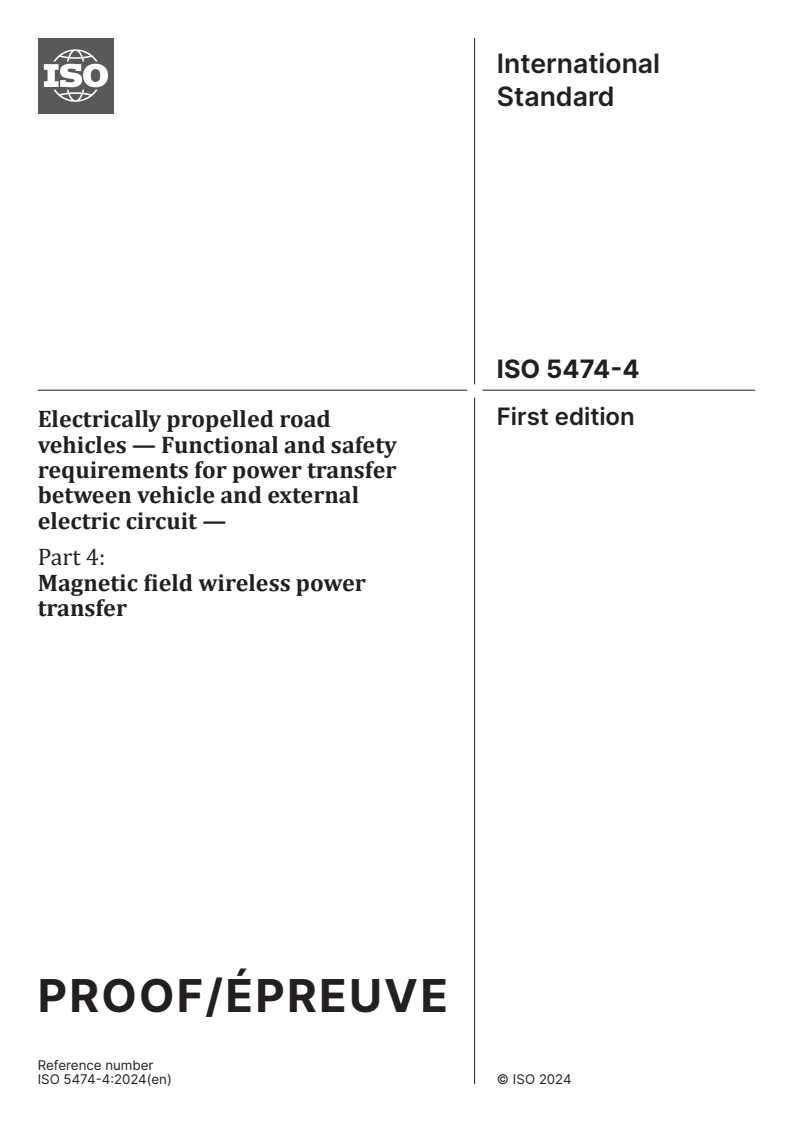
International
Standard
First edition
Electrically propelled road
vehicles — Functional and safety
requirements for power transfer
between vehicle and external
electric circuit —
Part 4:
Magnetic field wireless power
transfer
PROOF/ÉPREUVE
Reference number
© ISO 2024
All rights reserved. Unless otherwise specified, or required in the context of its implementation, no part of this publication may
be reproduced or utilized otherwise in any form or by any means, electronic or mechanical, including photocopying, or posting on
the internet or an intranet, without prior written permission. Permission can be requested from either ISO at the address below
or ISO’s member body in the country of the requester.
ISO copyright office
CP 401 • Ch. de Blandonnet 8
CH-1214 Vernier, Geneva
Phone: +41 22 749 01 11
Email: copyright@iso.org
Website: www.iso.org
Published in Switzerland
PROOF/ÉPREUVE
ii
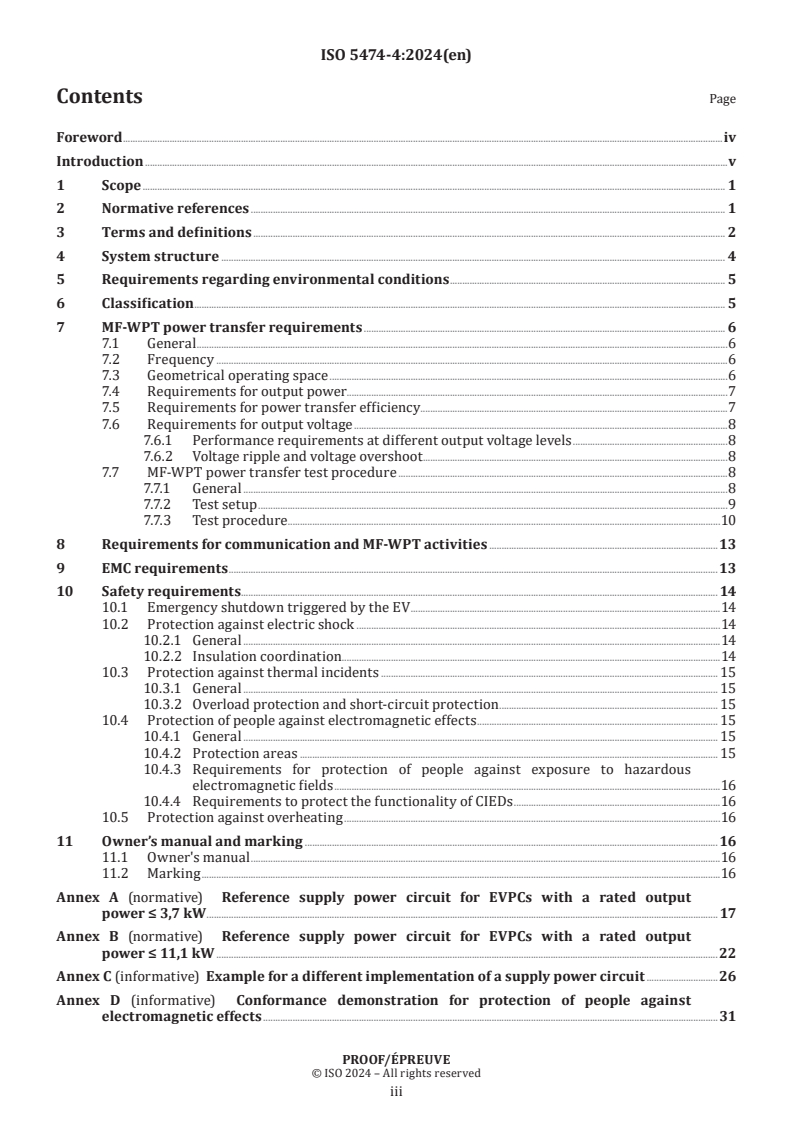
Contents Page
Foreword .iv
Introduction .v
1 Scope . 1
2 Normative references . 1
3 Terms and definitions . 2
4 System structure . 4
5 Requirements regarding environmental conditions . 5
6 Classification . 5
7 MF-WPT power transfer requirements . 6
7.1 General .6
7.2 Frequency .6
7.3 Geometrical operating space .6
7.4 Requirements for output power.7
7.5 Requirements for power transfer efficiency.7
7.6 Requirements for output voltage .8
7.6.1 Performance requirements at different output voltage levels .8
7.6.2 Voltage ripple and voltage overshoot .8
7.7 MF-WPT power transfer test procedure .8
7.7.1 General .8
7.7.2 Test setup .9
7.7.3 Test procedure.10
8 Requirements for communication and MF-WPT activities .13
9 EMC requirements .13
10 Safety requirements. 14
10.1 Emergency shutdown triggered by the EV .14
10.2 Protection against electric shock .14
10.2.1 General .14
10.2.2 Insulation coordination.14
10.3 Protection against thermal incidents . 15
10.3.1 General . 15
10.3.2 Overload protection and short-circuit protection . 15
10.4 Protection of people against electromagnetic effects . 15
10.4.1 General . 15
10.4.2 Protection areas . 15
10.4.3 Requirements for protection of people against exposure to hazardous
electromagnetic fields .16
10.4.4 Requirements to protect the functionality of CIEDs .16
10.5 Protection against overheating .16
11 Owner’s manual and marking . 16
11.1 Owner's manual .16
11.2 Marking .16
Annex A (normative) Reference supply power circuit for EVPCs with a rated output
power ≤ 3,7 kW . 17
Annex B (normative) Reference supply power circuit for EVPCs with a rated output
power ≤ 11,1 kW .22
Annex C (informative) Example for a different implementation of a supply power circuit .26
Annex D (informative) Conformance demonstration for protection of people against
electromagnetic effects .31
PROOF/ÉPREUVE
iii
Foreword
ISO (the International Organization for Standardization) is a worldwide federation of national standards
bodies (ISO member bodies). The work of preparing International Standards is normally carried out through
ISO technical committees. Each member body interested in a subject for which a technical committee
has been established has the right to be represented on that committee. International organizations,
governmental and non-governmental, in liaison with ISO, also take part in the work. ISO collaborates closely
with the International Electrotechnical Commission (IEC) on all matters of electrotechnical standardization.
The procedures used to develop this document and those intended for its further maintenance are described
in the ISO/IEC Directives, Part 1. In particular, the different approval criteria needed for the different types
of ISO document should be noted. This document was drafted in accordance with the editorial rules of the
ISO/IEC Directives, Part 2 (see www.iso.org/directives).
ISO draws attention to the possibility that the implementation of this document may involve the use of (a)
patent(s). ISO takes no position concerning the evidence, validity or applicability of any claimed patent
rights in respect thereof. As of the date of publication of this document, ISO had received notice of (a)
patent(s) which may be required to implement this document. However, implementers are cautioned that
this may not represent the latest information, which may be obtained from the patent database available at
www.iso.org/patents. ISO shall not be held responsible for identifying any or all such patent rights.
Any trade name used in this document is information given for the convenience of users and does not
constitute an endorsement.
For an explanation of the voluntary nature of standards, the meaning of ISO specific terms and expressions
related to conformity assessment, as well as information about ISO's adherence to the World Trade
Organization (WTO) principles in the Technical Barriers to Trade (TBT), see www.iso.org/iso/foreword.html.
This document was prepared by Technical Committee ISO/TC 22, Road vehicles, SC 37, Electrically propelled
vehicles.
This first edition cancels and replaces ISO 19363:2020, which has been technically revised.
The main changes are as follows:
— the Scope has been adjusted to include passenger cars and light commercial vehicles only;
— the terms and definitions have been aligned with the ISO 5474 series and the IEC 61980 series;
— the efficiency requirements for unmatched power levels between on-board and off-board devices have
been specified;
— the source for EMC limits and the corresponding test procedure have been updated.
A list of all parts in the ISO 5474 series can be found on the ISO website.
Any feedback or questions on this document should be directed to the user’s national standards body. A
complete listing of these bodies can be found at www.iso.org/members.html.
PROOF/ÉPREUVE
iv
Introduction
This document specifies requirements for the onboard side of a magnetic field wireless power transfer
system for vehicles intended for passenger use and for light duty commercial applications. This document
also addresses safety and functionality with off-board systems from different manufacturers.
The systems specified in this document are intended to work with off-board systems that meet the MF-WPT-
related requirements of IEC 61980-1, IEC 61980-2 and IEC 61980-3.
PROOF/ÉPREUVE
v
International Standard ISO 5474-4:2024(en)
Electrically propelled road vehicles — Functional and safety
requirements for power transfer between vehicle and
external electric circuit —
Part 4:
Magnetic field wireless power transfer
1 Scope
This document defines the requirements and operation of the on-board vehicle equipment that enables
magnetic field wireless power transfer (MF-WPT) between supply device and electric vehicles (EV). It is
intended to be used for passenger cars and light commercial vehicles.
This document addresses the following aspects for an EV device:
— safety requirements;
— transferred power and power transfer efficiency;
— ground clearance of the EV device;
— functionality with associated off-board systems under various conditions and independent of
manufacturer (interoperability);
— test procedures.
This document does not provide:
— requirements for dynamic (vehicle in motion) applica
...
ISO/DISPRF 5474-4:2024(E)
ISO/TC 22/SC 37/WG 5
Secretariat: DIN
Date: 2024-05-1511-27
Electrically propelled road vehicles — Functional and safety
requirements for power transfer between vehicle and external
electric circuit — Part 4: Magnetic field wireless power transfer —
Part 4:
Magnetic field wireless power transfer
PROOF
ISO/DISPRF 5474-4:2024(Een)
All rights reserved. Unless otherwise specified, or required in the context of its implementation, no part of this publication
may be reproduced or utilized otherwise in any form or by any means, electronic or mechanical, including photocopying,
or posting on the internet or an intranet, without prior written permission. Permission can be requested from either ISO
at the address below or ISO’s member body in the country of the requester.
ISO copyright office
CP 401 • Ch. de Blandonnet 8
CH-1214 Vernier, Geneva
Phone: + 41 22 749 01 11
EmailE-mail: copyright@iso.org
Website: www.iso.org
Published in Switzerland
ii © ISO 2024 – All rights reserved
ii
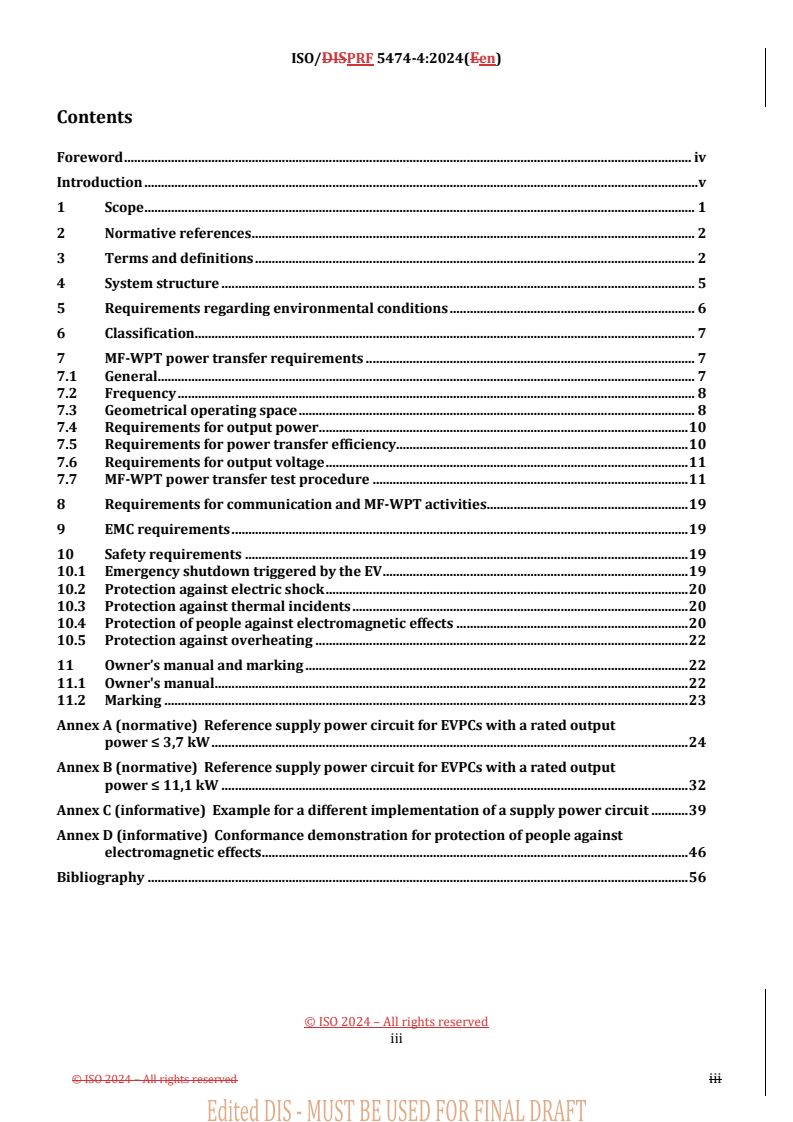
ISO/DISPRF 5474-4:2024(Een)
Contents
Foreword . iv
Introduction . v
1 Scope . 1
2 Normative references . 2
3 Terms and definitions . 2
4 System structure . 5
5 Requirements regarding environmental conditions . 6
6 Classification. 7
7 MF-WPT power transfer requirements . 7
7.1 General. 7
7.2 Frequency . 8
7.3 Geometrical operating space . 8
7.4 Requirements for output power . 10
7.5 Requirements for power transfer efficiency. 10
7.6 Requirements for output voltage . 11
7.7 MF-WPT power transfer test procedure . 11
8 Requirements for communication and MF-WPT activities . 19
9 EMC requirements . 19
10 Safety requirements . 19
10.1 Emergency shutdown triggered by the EV . 19
10.2 Protection against electric shock . 20
10.3 Protection against thermal incidents . 20
10.4 Protection of people against electromagnetic effects . 20
10.5 Protection against overheating . 22
11 Owner’s manual and marking . 22
11.1 Owner's manual . 22
11.2 Marking . 23
Annex A (normative) Reference supply power circuit for EVPCs with a rated output
power ≤ 3,7 kW . 24
Annex B (normative) Reference supply power circuit for EVPCs with a rated output
power ≤ 11,1 kW . 32
Annex C (informative) Example for a different implementation of a supply power circuit . 39
Annex D (informative) Conformance demonstration for protection of people against
electromagnetic effects . 46
Bibliography . 56
iii
ISO/DISPRF 5474-4:2024(Een)
Foreword
ISO (the International Organization for Standardization) is a worldwide federation of national standards
bodies (ISO member bodies). The work of preparing International Standards is normally carried out through
ISO technical committees. Each member body interested in a subject for which a technical committee has been
established has the right to be represented on that committee. International organizations, governmental and
non-governmental, in liaison with ISO, also take part in the work. ISO collaborates closely with the
International Electrotechnical Commission (IEC) on all matters of electrotechnical standardization.
The procedures used to develop this document and those intended for its further maintenance are described
in the ISO/IEC Directives, Part 1. In particular, the different approval criteria needed for the different types of
ISO document should be noted. This document was drafted in accordance with the editorial rules of the
ISO/IEC Directives, Part 2 (see www.iso.org/directives).
ISO draws attention to the possibility that the implementation of this document may involve the use of (a)
patent(s). ISO takes no position concerning the evidence, validity or applicability of any claimed patent rights
in respect thereof. As of the date of publication of this document, ISO had received notice of (a) patent(s) which
may be required to implement this document. However, implementers are cautioned that this may not
represent the latest information, which may be obtained from the patent database available at
www.iso.org/patents. ISO shall not be held responsible for identifying any or all such patent rights.
Any trade name used in this document is information given for the convenience of users and does not
constitute an endorsement.
For an explanation of the voluntary nature of standards, the meaning of ISO specific terms and expressions
related to conformity assessment, as well as information about ISO's adherence to the World Trade
Organization (WTO) principles in the Technical Barriers to Trade (TBT), see www.iso.org/iso/foreword.html.
This document was prepared by Technical Committee ISO/TC 22, Road vehicles, SC 37, Electrically propelled
vehicles.
This first edition cancels and replaces ISO 19363:2020, which has been technically revised. The main changes
compared to the previous ISO 19363:2020 are as follows:
— The main changes are as follows:
— the Scope has been adjusted to include passenger cars and light commercial vehicles only;
— — the terms and definitions have been aligned with the ISO 5474 series and the IEC 61980 series;
— — the efficiency requirements for unmatched power levels between on-board and off-board devices have
been specified;
— — the source for EMC limits and the corresponding test procedure have been updated.
A list of all parts in the ISO 5474 series can be found on the ISO website.
Any feedback or questions on this document should be directed to the user’s national standards body. A
complete listing of these bodies can be found at www.iso.org/members.html.
iv © ISO 2024 – All rights reserved
iv
ISO/DISPRF 5474-4:2024(Een)
Introduction
This document specifies requirements for the onboard side of a magnetic field wireless power transfer system
for vehicles intended for passenger use and for light duty commercial applications. This document also
addresses safety and functionality with off-board systems from different manufacturers.
The systems specified in this document are intended to work with off-board systems that meet the MF-WPT-
related requirements of IEC 61980-1, IEC 61980-2 and IEC 61980-3.
v
DRAFT INTERNATIONAL STANDARD ISO/DIS 5474-4:2024(E)
Electrically propelled road vehicles — Functional requirements and
safety requirements for power transfer — between vehicle and
external electric circuit —
Part 4:
Magnetic field wireless power transfer — Safety and interoperability
requirements
1 Scope
This document defines the requirements and operation of the on-board vehicle equipment that enables
magnetic field wireless power transfer (MF-WPT) between supply device and electric vehicles (EV). It is
intended to be used for passenger cars and light commercial vehicles.
This document addresses the following aspects for an EV device:
— — safety requirements;
— — transferred power and power transfer efficiency;
— — ground clearance of the EV device;
— — functionality with associated off-board systems under various conditions and independent of
manufacturer (interoperability);
— — test procedures.
This document does not provide;:
— — requirements for dynamic (vehicle in motion) applications, ;
— — requirements for reverse WPT, and;
— — requirements for the operation of EV devices specified in this document with supply devices according
to IEC 61980-4,.
but they are under consideration.
EV devices that fulfil the requirements of this document are intended to operate with supply devices that fulfil
the MF-WPT related requirements of IEC 61980-1, IEC 61980-2 and IEC 61980-3.
NOTE 2 IEC 61980-4 specifies requirements for supply devices of power levels above the limits of the reference supply
power circuits in this document. Requirements related to dynamic applications of supply devices are specified in IEC
61980-5 and IEC 61980-6.
ISO/DISPRF 5474-4:2024(Een)
2 Normative references
The following documents are referred to in the text in such a way that some or all of their content constitutes
requirements of this document. For dated references, only the edition cited applies. For undated references,
the latest edition of the referenced document (including any amendments) applies.
ISO 5474--1, Electrically propelled road vehicles — Functional and safety requirements for power transfer
between vehicle and external electric circuit — Part 1: General requirements for conductive power transfer
ISO 6469--3:20182021, Electrically propelled road vehicles — Safety specifications — Part 3: Electrical safety
ISO 20653, Road vehicles — Degrees of protection (IP code) — Protection of electrical equipment against foreign
objects, water and access
IEC 60664 (all parts), Insulation coordination for equipment within low-voltage systems
IEC 61980--1, Electric vehicle wireless power transfer (WPT) systems - Part 1: General requirements
IEC 61980--2, Electric vehicle wireless power transfer (WPT) systems - Part 2: Specific requirements for
communication between electric road vehicle (EV) and infrastructure
IEC 61980--3, Electric vehicle wireless power transfer (WPT) systems - Part 3: Specific requirements for magnetic
field wireless power transfer systems
ICNIRP guidelinesGuidelines for limiting exposure to time-varying electric and magnetic fields (1 Hz – 100 kHz),
Health Physics 99(6):818-836; 2010
IEC 60664 (all parts), Insulation coordination for equipment within low-voltage systems
3 Terms and definitions
For the purposes of this document, the terms and definitions given in ISO 5474-1 and the following terms and
definitions apply.
ISO and IEC maintain terminologicalterminology databases for use in standardization at the following
addresses:
— — ISO Online browsing platform: available at https://www.iso.org/obp
— — IEC Electropedia: available at https://www.electropedia.org/
3.1 3.1
alignment
relative position in the x- and y-directions of the secondary device (3.14(3.14)) to the primary device (3.9(3.9))
for a given secondary device ground clearance (3.15(3.15))
Note 1 to entry: The coordinate system conforms with ISO 4130.
3.2 3.2
alignment tolerance area
intended wireless power transfer (WPT) (3.20 (3.20)) operating area in the x- and y-directions for a given
secondary device ground clearance (3.15(3.15))
2 © ISO 2024 – All rights reserved
ISO/DISPRF 5474-4:2024(Een)
3.3 3.3
centre alignment point
spatial X, Y centre of the alignment tolerance area (3.2(3.2))
Note 1 to entry: The centre alignment point is not
...
Questions, Comments and Discussion
Ask us and Technical Secretary will try to provide an answer. You can facilitate discussion about the standard in here.