

ISO 20754:2018
(Main)Textiles — Man-made fibres — Determination of shape factors in cross section
General Information
- Abstract
ISO 20754:2018 specifies methods for the determination of shape factors in the cross-section of man-made fibres.
- Status
- Published
- Publication Date
- 04-Apr-2018
- Technical Committee
- ISO/TC 38/SC 23 - Fibres and yarns
- Drafting Committee
- ISO/TC 38/SC 23/WG 6 - Fibres - Man-made
- Current Stage
- 9093 - International Standard confirmed
- Start Date
- 25-Sep-2023
- Completion Date
- 29-Aug-2026
Buy Documents
ISO 20754:2018 - Textiles -- Man-made fibres -- Determination of shape factors in cross section
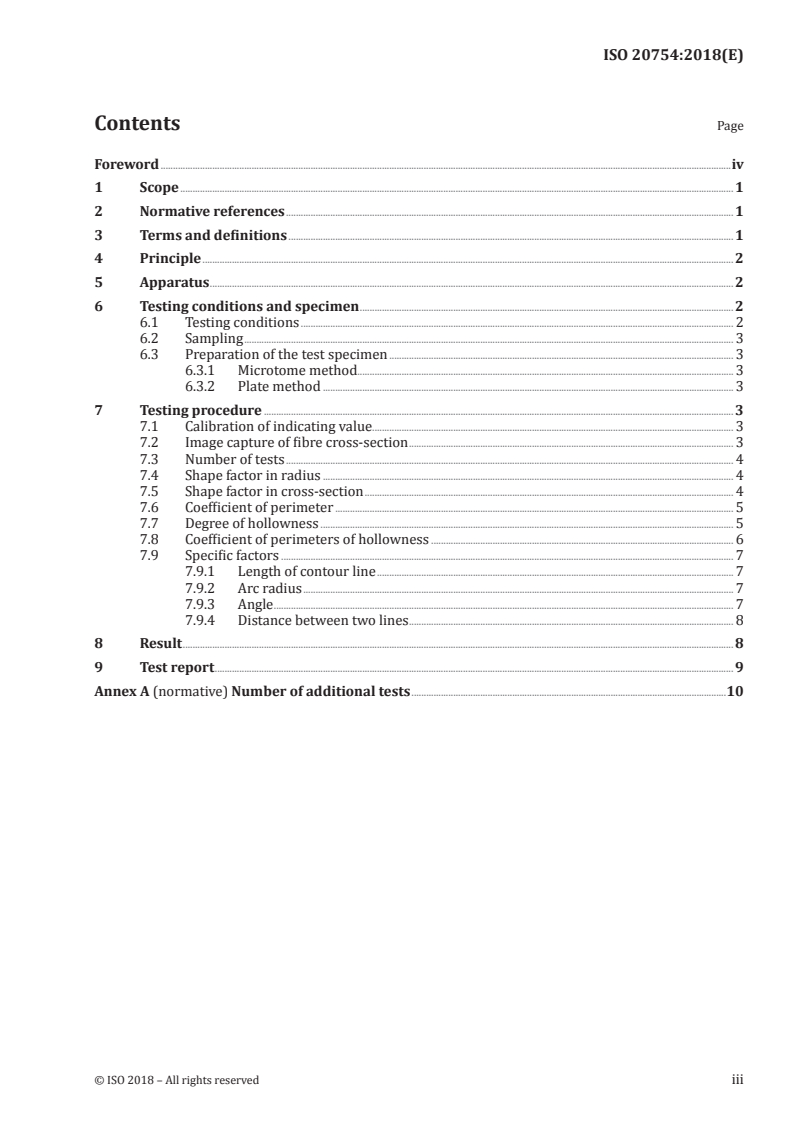
ISO 20754:2018 - Textiles — Man-made fibres — Determination of shape factors in cross section/5/2018
Overview
ISO 20754:2018 - Textiles - Man-made fibres - Determination of shape factors in cross section - specifies laboratory methods to quantify the geometric shape of man‑made fibre cross‑sections. The standard defines how to prepare specimens (microtome or plate methods), capture microscope images, and calculate shape factors, perimeter coefficients, and degree of hollowness using measured radii, areas and perimeters. It is intended for use in fibre characterization, quality control and research.
Key topics and requirements
- Scope: Methods for determination of shape factors in the cross‑section of man‑made fibres.
- Specimen preparation:
- Microtome method (slice thickness exposing fibres at about 20–30 µm) or plate method (stretched bundle through a sample plate).
- Sampling: filaments ~0.5 m cut from a package; staple bundles ~0.5 g.
- Apparatus: measuring microscope with magnification ≥ 400×, minimum resolvable distance 1.5 µm, digital measuring stage; fibre microtome; sample plate (≈70 × 20 × 0.2–0.4 mm); stage micrometer (0.01 mm divisions).
- Testing conditions: ambient laboratory conditions are acceptable; avoid compressed edge sections.
- Image capture and testing: capture clear cross‑section images, exclude damaged or incomplete images; test at least 30 cross‑sections per slide (additional tests if confidence criteria are not met).
- Defined metrics and calculations:
- Shape factor (radius): (R − r) / R × 100% where R = radius of minimum circumscribed circle and r = radius of concentric circle internally tangent to the section.
- Shape factor (cross‑section): area difference expressed as percentage of the minimum circumscribed circle area.
- Coefficient of perimeter: ratio of contour perimeter to circle perimeter for same area.
- Degree of hollowness and coefficient of perimeters of hollowness for hollow fibres.
- Additional specific measurements: contour length, arc radius, angles, and distances.
Applications
- Quality control and dimensional verification in textile manufacturing and fibre extrusion processes.
- Morphological analysis for R&D (fibre cross‑section design, hollow fibre evaluation).
- Comparative testing for fibre identification and specification compliance.
- Input data for fabric performance modeling where cross‑sectional geometry affects mechanical, optical or bulk properties.
Who should use this standard
- Textile testing laboratories and quality assurance teams.
- Fibre manufacturers and process engineers.
- Research scientists working on synthetic fibre morphology.
- Standards developers and conformity assessment bodies.
Related standards
- ISO 2076 (man‑made fibres - generic names) - cited normative reference in ISO 20754:2018.
Keywords: ISO 20754, man-made fibres, fibre cross-section, shape factor, degree of hollowness, measuring microscope, microtome, textile testing.
Buy Documents
ISO 20754:2018 - Textiles -- Man-made fibres -- Determination of shape factors in cross section
ISO 20754:2018 - Textiles — Man-made fibres — Determination of shape factors in cross section/5/2018
Get Certified
Connect with accredited certification bodies for this standard

Control Union Certifications
Global certification for agriculture and sustainability.

Hohenstein Institut
Textile testing and certification.

Bureau Veritas Bangladesh
Bureau Veritas certification services in Bangladesh.
Sponsored listings
Frequently Asked Questions
ISO 20754:2018 is a standard published by the International Organization for Standardization (ISO). Its full title is "Textiles — Man-made fibres — Determination of shape factors in cross section". This standard covers: ISO 20754:2018 specifies methods for the determination of shape factors in the cross-section of man-made fibres.
ISO 20754:2018 specifies methods for the determination of shape factors in the cross-section of man-made fibres.
ISO 20754:2018 is classified under the following ICS (International Classification for Standards) categories: 59.060.20 - Man-made fibres. The ICS classification helps identify the subject area and facilitates finding related standards.
ISO 20754:2018 is available in PDF format for immediate download after purchase. The document can be added to your cart and obtained through the secure checkout process. Digital delivery ensures instant access to the complete standard document.
Standards Content (Sample)
INTERNATIONAL ISO
STANDARD 20754
First edition
2018-04
Textiles — Man-made fibres —
Determination of shape factors in
cross section
Textiles — Fibres fabriquées — Détermination des facteurs de forme
dans la section
Reference number
©
ISO 2018
© ISO 2018
All rights reserved. Unless otherwise specified, or required in the context of its implementation, no part of this publication may
be reproduced or utilized otherwise in any form or by any means, electronic or mechanical, including photocopying, or posting
on the internet or an intranet, without prior written permission. Permission can be requested from either ISO at the address
below or ISO’s member body in the country of the requester.
ISO copyright office
CP 401 • Ch. de Blandonnet 8
CH-1214 Vernier, Geneva
Phone: +41 22 749 01 11
Fax: +41 22 749 09 47
Email: copyright@iso.org
Website: www.iso.org
Published in Switzerland
ii © ISO 2018 – All rights reserved
Contents Page
Foreword .iv
1 Scope . 1
2 Normative references . 1
3 Terms and definitions . 1
4 Principle . 2
5 Apparatus . 2
6 Testing conditions and specimen . 2
6.1 Testing conditions . 2
6.2 Sampling . 3
6.3 Preparation of the test specimen . 3
6.3.1 Microtome method . . . 3
6.3.2 Plate method . 3
7 Testing procedure . 3
7.1 Calibration of indicating value. 3
7.2 Image capture of fibre cross-section . 3
7.3 Number of tests . 4
7.4 Shape factor in radius . 4
7.5 Shape factor in cross-section . 4
7.6 Coefficient of perimeter . 5
7.7 Degree of hollowness . 5
7.8 Coefficient of perimeters of hollowness . 6
7.9 Specific factors . 7
7.9.1 Length of contour line . 7
7.9.2 Arc radius . 7
7.9.3 Angle . 7
7.9.4 Distance between two lines . 8
8 Result . 8
9 Test report . 9
Annex A (normative) Number of additional tests .10
Foreword
ISO (the International Organization for Standardization) is a worldwide federation of national standards
bodies (ISO member bodies). The work of preparing International Standards is normally carried out
through ISO technical committees. Each member body interested in a subject for which a technical
committee has been established has the right to be represented on that committee. International
organizations, governmental and non-governmental, in liaison with ISO, also take part in the work.
ISO collaborates closely with the International Electrotechnical Commission (IEC) on all matters of
electrotechnical standardization.
The procedures used to develop this document and those intended for its further maintenance are
described in the ISO/IEC Directives, Part 1. In particular the different approval criteria needed for the
different types of ISO documents should be noted. This document was drafted in accordance with the
editorial rules of the ISO/IEC Directives, Part 2 (see www .iso .org/ directives).
Attention is drawn to the possibility that some of the elements of this document may be the subject of
patent rights. ISO shall not be held responsible for identifying any or all such patent rights. Details of
any patent rights identified during the development of the document will be in the Introduction and/or
on the ISO list of patent declarations received (see www .iso .org/ patents).
Any trade name used in this document is information given for the convenience of users and does not
constitute an endorsement.
For an explanation on the voluntary nature of standards, the meaning of ISO specific terms and
expressions related to conformity assessment, as well as information about ISO's adherence to the
World Trade Organization (WTO) principles in the Technical Barriers to Trade (TBT) see the following
URL: www .iso .org/ iso/ foreword .html.
This document was prepared by Technical Committee ISO/TC 38, Textiles, Subcommittee SC 23, Fibres
and yarns.
iv © ISO 2018 – All rights reserved
INTERNATIONAL STANDARD ISO 20754:2018(E)
Textiles — Man-made fibres — Determination of shape
factors in cross section
1 Scope
This document specifies methods for the determination of shape factors in the cross-section of man-
made fibres.
2 Normative references
The following documents are referred to in the text in such a way that some or all of their content
constitutes requirements of this document. For dated references, only the edition cited applies. For
undated references, the latest edition of the referenced document (including any amendments) applies.
ISO 2076, Textiles — Man-made fibres — Generic names
3 Terms and definitions
For the purposes of this document, the terms and definitions given in ISO 2076 and the following apply.
ISO and IEC maintain terminological databases for use in standardization at the following addresses:
— ISO Online browsing platform: available at https:// www .iso .org/ obp
— IEC Electropedia: available at http:// www .electropedia .org/
3.1
shape factor
radius difference between the minimum circumscribed circle and the concentric circle
internally tangent to the section
Note 1 to entry: It is expressed as a percentage of radius of the minimum circumscribed circle.
3.2
shape factor
area difference between the minimum circumscribed circle and the cross-section shape
Note 1 to entry: It is expressed as a percentage of area of the minimum circumscribed circle.
3.3
coefficient of perimeter
X
L
perimeter ratio between the cross-section shape and the circle shape in same area
3.4
degree of hollowness
area difference between the outer contour line of the cross-section and all hollow parts
Note 1 to entry: It is expressed as a percentage of area of outer contour line, used to express the shape factor of
hollow fibres.
3.5
coefficient of perimeter of hollowness
C
XL
perimeter ratio between all the hollow parts and the outer contour line
Note 1 to entry: It is used to express the shape factor of hollow fibres.
4 Principle
This method provides techniques for the assessment of the cross-sectional shape of man-made fibres,
based on contour lines, measured radii and perimeters, calculated area and other geometric quantities.
Furthermore, the method provides techniques for the calculation of specified shape factors in the cross-
sectional shape.
5 Apparatus
The usual laboratory apparatus and, in particular, the following.
5.1 Measuring microscope apparatus, which meets the following requirements:
a) stage mechanism
...
INTERNATIONAL ISO
STANDARD 20754
First edition
2018-04
Textiles — Man-made fibres —
Determination of shape factors in
cross section
Textiles — Fibres fabriquées — Détermination des facteurs de forme
dans la section
Reference number
©
ISO 2018
© ISO 2018
All rights reserved. Unless otherwise specified, or required in the context of its implementation, no part of this publication may
be reproduced or utilized otherwise in any form or by any means, electronic or mechanical, including photocopying, or posting
on the internet or an intranet, without prior written permission. Permission can be requested from either ISO at the address
below or ISO’s member body in the country of the requester.
ISO copyright office
CP 401 • Ch. de Blandonnet 8
CH-1214 Vernier, Geneva
Phone: +41 22 749 01 11
Fax: +41 22 749 09 47
Email: copyright@iso.org
Website: www.iso.org
Published in Switzerland
ii © ISO 2018 – All rights reserved
Contents Page
Foreword .iv
1 Scope . 1
2 Normative references . 1
3 Terms and definitions . 1
4 Principle . 2
5 Apparatus . 2
6 Testing conditions and specimen . 2
6.1 Testing conditions . 2
6.2 Sampling . 3
6.3 Preparation of the test specimen . 3
6.3.1 Microtome method . . . 3
6.3.2 Plate method . 3
7 Testing procedure . 3
7.1 Calibration of indicating value. 3
7.2 Image capture of fibre cross-section . 3
7.3 Number of tests . 4
7.4 Shape factor in radius . 4
7.5 Shape factor in cross-section . 4
7.6 Coefficient of perimeter . 5
7.7 Degree of hollowness . 5
7.8 Coefficient of perimeters of hollowness . 6
7.9 Specific factors . 7
7.9.1 Length of contour line . 7
7.9.2 Arc radius . 7
7.9.3 Angle . 7
7.9.4 Distance between two lines . 8
8 Result . 8
9 Test report . 9
Annex A (normative) Number of additional tests .10
Foreword
ISO (the International Organization for Standardization) is a worldwide federation of national standards
bodies (ISO member bodies). The work of preparing International Standards is normally carried out
through ISO technical committees. Each member body interested in a subject for which a technical
committee has been established has the right to be represented on that committee. International
organizations, governmental and non-governmental, in liaison with ISO, also take part in the work.
ISO collaborates closely with the International Electrotechnical Commission (IEC) on all matters of
electrotechnical standardization.
The procedures used to develop this document and those intended for its further maintenance are
described in the ISO/IEC Directives, Part 1. In particular the different approval criteria needed for the
different types of ISO documents should be noted. This document was drafted in accordance with the
editorial rules of the ISO/IEC Directives, Part 2 (see www .iso .org/ directives).
Attention is drawn to the possibility that some of the elements of this document may be the subject of
patent rights. ISO shall not be held responsible for identifying any or all such patent rights. Details of
any patent rights identified during the development of the document will be in the Introduction and/or
on the ISO list of patent declarations received (see www .iso .org/ patents).
Any trade name used in this document is information given for the convenience of users and does not
constitute an endorsement.
For an explanation on the voluntary nature of standards, the meaning of ISO specific terms and
expressions related to conformity assessment, as well as information about ISO's adherence to the
World Trade Organization (WTO) principles in the Technical Barriers to Trade (TBT) see the following
URL: www .iso .org/ iso/ foreword .html.
This document was prepared by Technical Committee ISO/TC 38, Textiles, Subcommittee SC 23, Fibres
and yarns.
iv © ISO 2018 – All rights reserved
INTERNATIONAL STANDARD ISO 20754:2018(E)
Textiles — Man-made fibres — Determination of shape
factors in cross section
1 Scope
This document specifies methods for the determination of shape factors in the cross-section of man-
made fibres.
2 Normative references
The following documents are referred to in the text in such a way that some or all of their content
constitutes requirements of this document. For dated references, only the edition cited applies. For
undated references, the latest edition of the referenced document (including any amendments) applies.
ISO 2076, Textiles — Man-made fibres — Generic names
3 Terms and definitions
For the purposes of this document, the terms and definitions given in ISO 2076 and the following apply.
ISO and IEC maintain terminological databases for use in standardization at the following addresses:
— ISO Online browsing platform: available at https:// www .iso .org/ obp
— IEC Electropedia: available at http:// www .electropedia .org/
3.1
shape factor
radius difference between the minimum circumscribed circle and the concentric circle
internally tangent to the section
Note 1 to entry: It is expressed as a percentage of radius of the minimum circumscribed circle.
3.2
shape factor
area difference between the minimum circumscribed circle and the cross-section shape
Note 1 to entry: It is expressed as a percentage of area of the minimum circumscribed circle.
3.3
coefficient of perimeter
X
L
perimeter ratio between the cross-section shape and the circle shape in same area
3.4
degree of hollowness
area difference between the outer contour line of the cross-section and all hollow parts
Note 1 to entry: It is expressed as a percentage of area of outer contour line, used to express the shape factor of
hollow fibres.
3.5
coefficient of perimeter of hollowness
C
XL
perimeter ratio between all the hollow parts and the outer contour line
Note 1 to entry: It is used to express the shape factor of hollow fibres.
4 Principle
This method provides techniques for the assessment of the cross-sectional shape of man-made fibres,
based on contour lines, measured radii and perimeters, calculated area and other geometric quantities.
Furthermore, the method provides techniques for the calculation of specified shape factors in the cross-
sectional shape.
5 Apparatus
The usual laboratory apparatus and, in particular, the following.
5.1 Measuring microscope apparatus, which meets the following requirements:
a) stage mechanism
...