

ISO 3215:1998
(Main)Oil of nutmeg, Indonesian type (Myristica fragrans Houtt.)
General Information
- Abstract
This International Standard specifies certain characteristics of the oil of nutmeg, Indonesian type (Myristica fragrans Houtt.), in order to facilitate assessment of its quality.
- Status
- Published
- Publication Date
- 16-Dec-1998
- Technical Committee
- ISO/TC 54 - Essential oils
- Drafting Committee
- ISO/TC 54 - Essential oils
- Current Stage
- 9093 - International Standard confirmed
- Start Date
- 12-Jan-2026
- Completion Date
- 29-Aug-2026
Buy Documents
ISO 3215:1998 - Oil of nutmeg, Indonesian type (Myristica fragrans Houtt.)
ISO 3215:1998 - Oil of nutmeg, Indonesian type (Myristica fragrans Houtt.)/17/1998
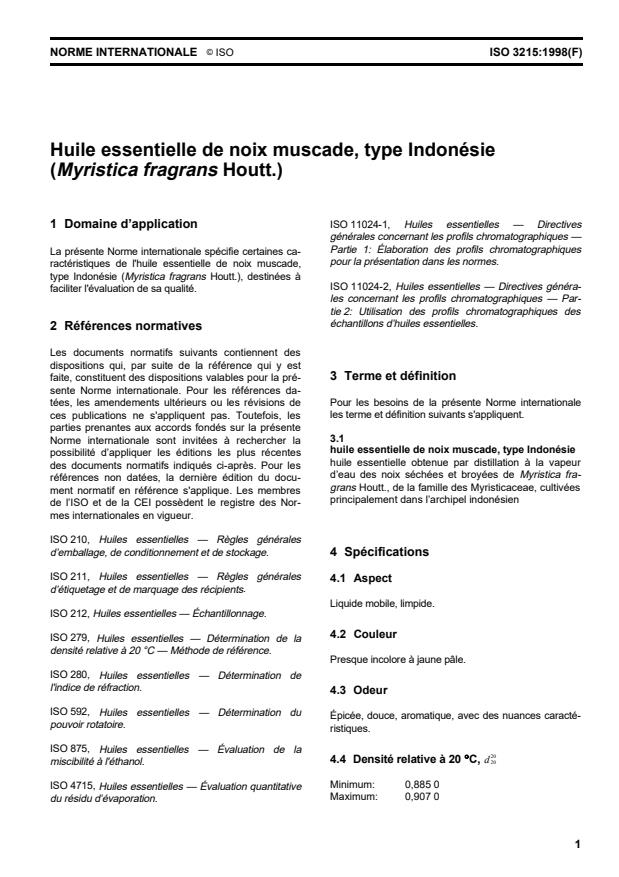
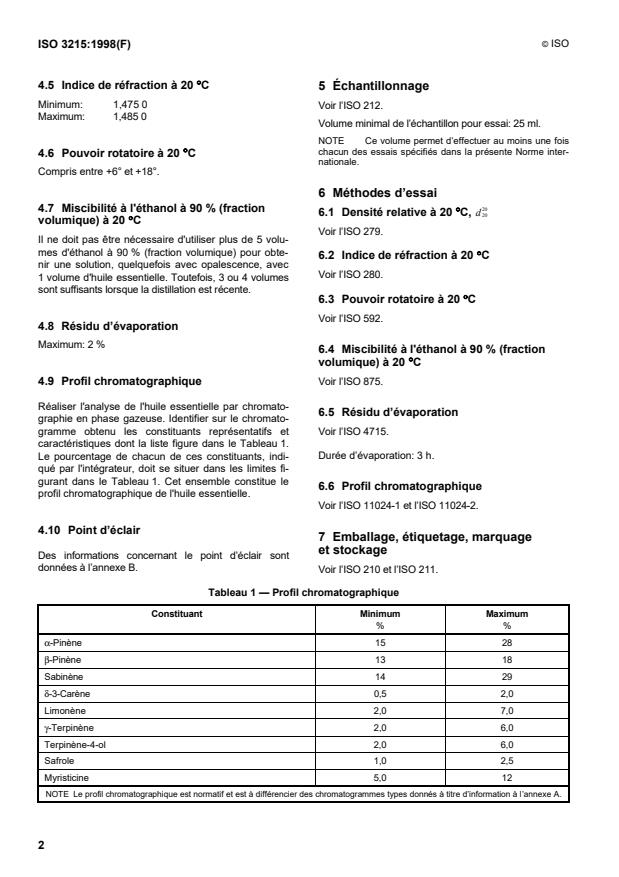
ISO 3215:1998 - Huile essentielle de noix muscade, type Indonésie (Myristica fragrans Houtt.)
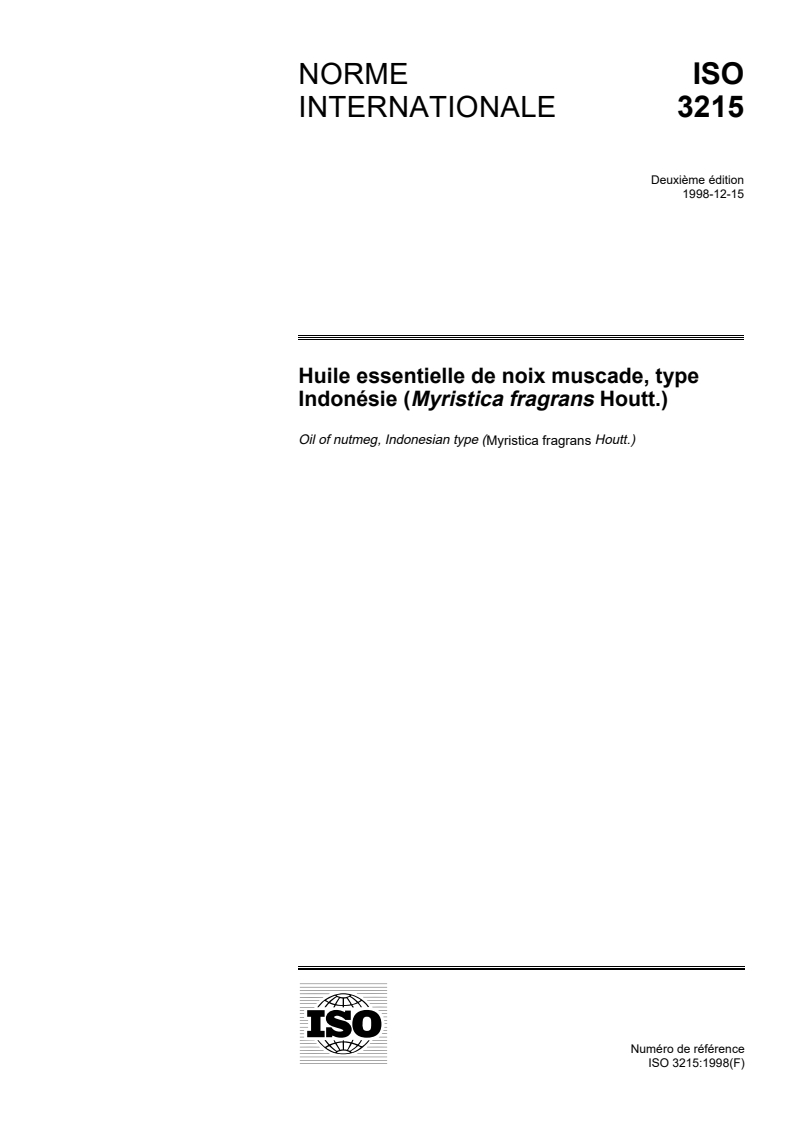
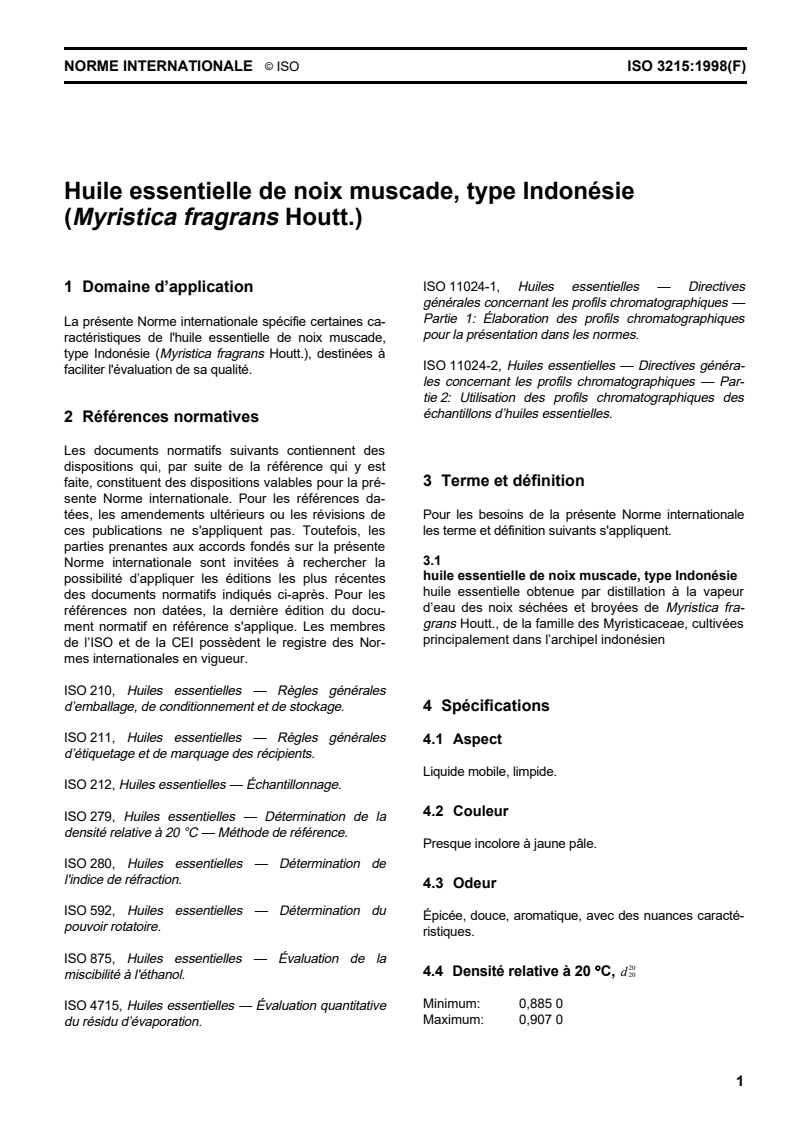
ISO 3215:1998 - Huile essentielle de noix muscade, type Indonésie (Myristica fragrans Houtt.)/17/1998
Overview
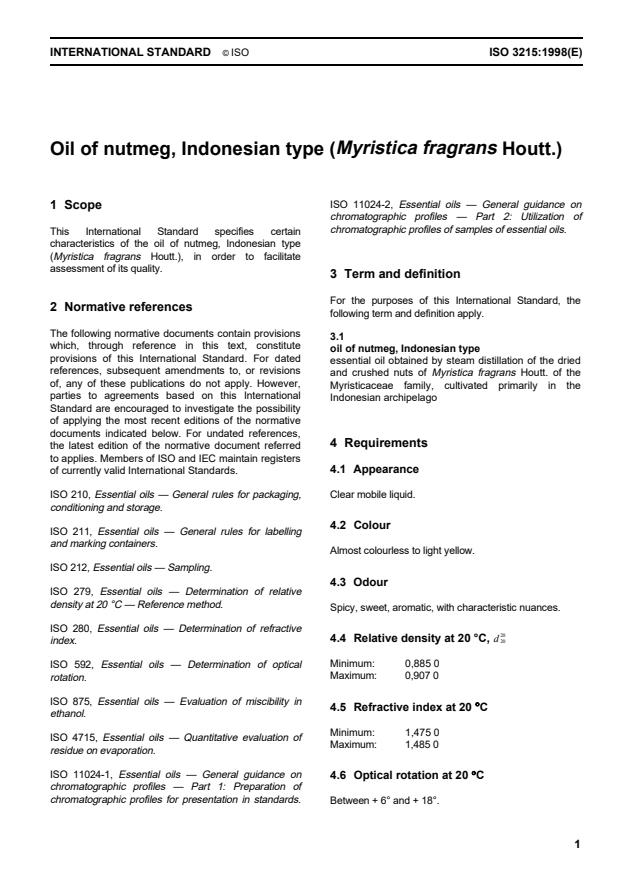
ISO 3215:1998 specifies the quality characteristics and testing approaches for oil of nutmeg, Indonesian type (Myristica fragrans Houtt.) to facilitate consistent assessment of product quality. The standard covers organoleptic properties, physical constants, residue limits, chromatographic profiling and guidance on sampling, packaging and storage. Annexes provide informative chromatograms and flashpoint data.
Key measurable attributes include:
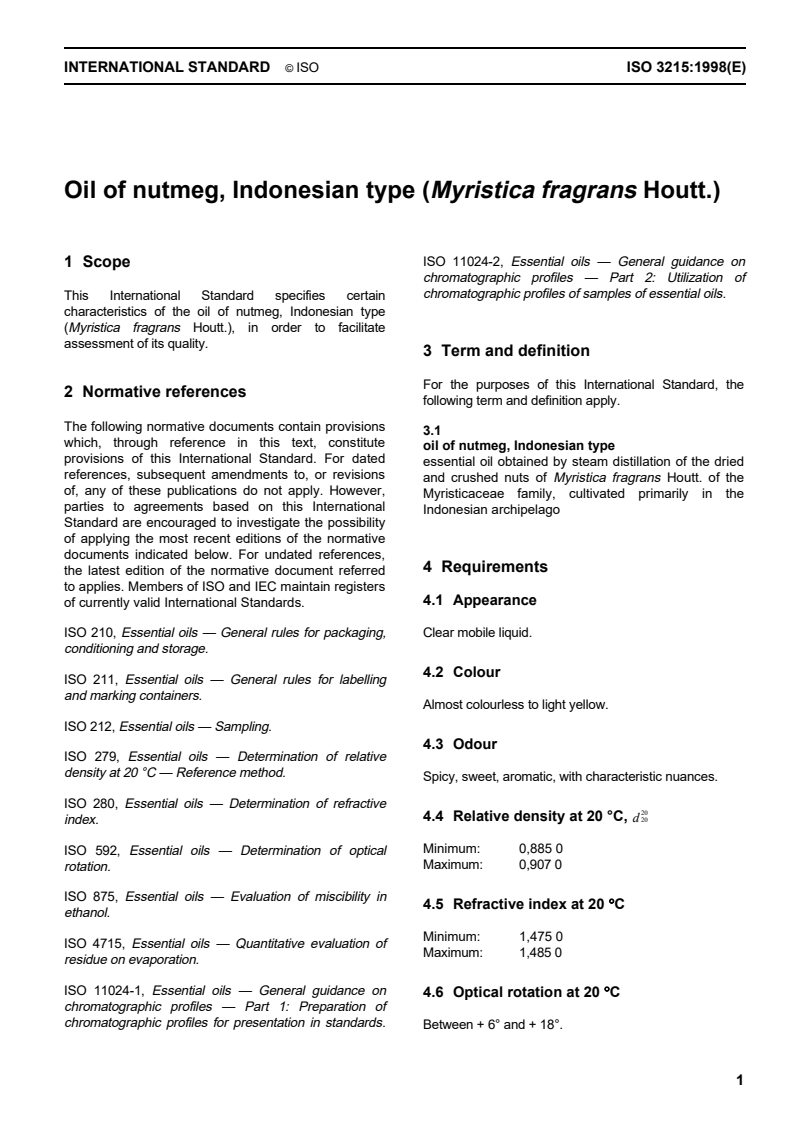
- Appearance: Clear mobile liquid.
- Colour: Almost colourless to light yellow.
- Odour: Spicy, sweet, aromatic with characteristic nuances.
- Relative density (d20): Minimum 0.885, maximum 0.907.
- Refractive index (n20): Minimum 1.475, maximum 1.485.
- Optical rotation (20 °C): Between +6° and +18°.
- Residue on evaporation: Maximum 2% (evaporation time: 3 h).
- Miscibility in ethanol (90 % v/v): 1 volume oil should dissolve within a maximum of 5 volumes ethanol (3–4 volumes typical for freshly distilled oils).
Key Topics
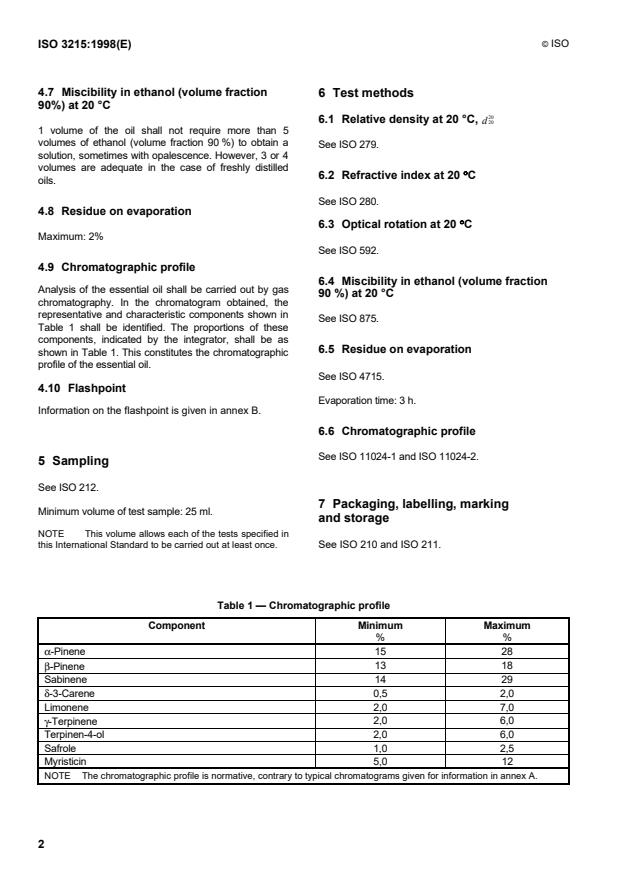
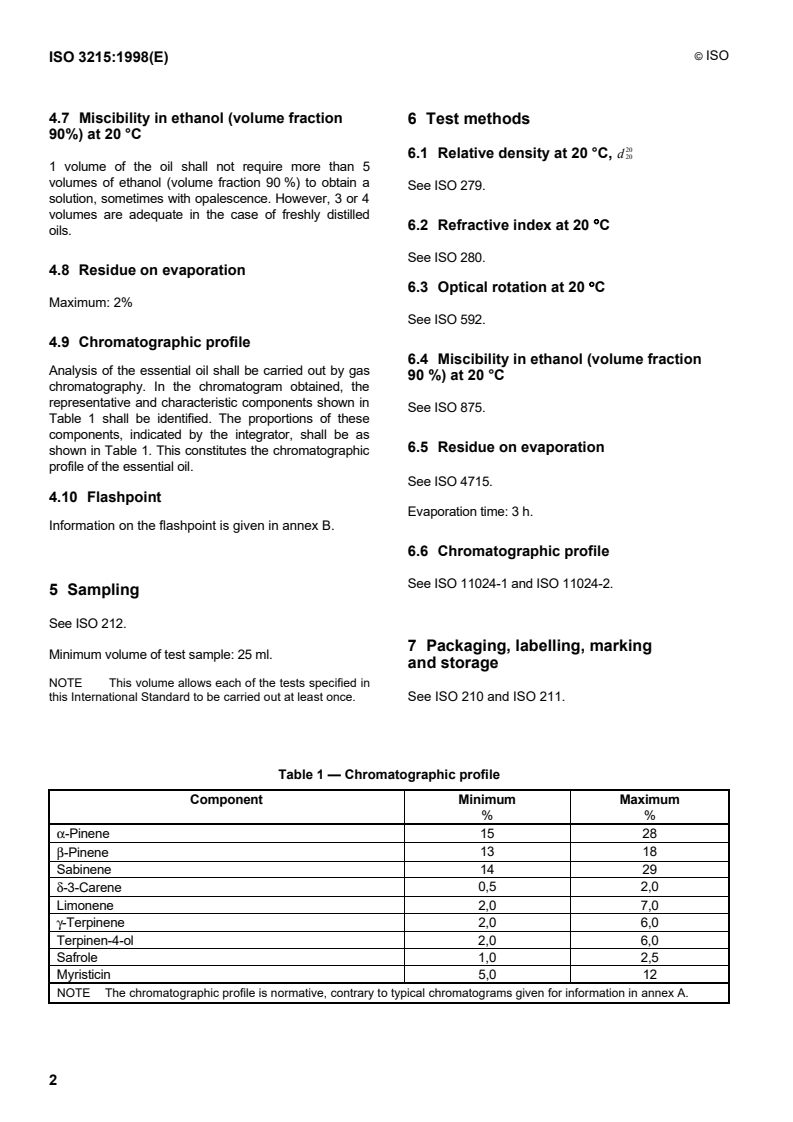
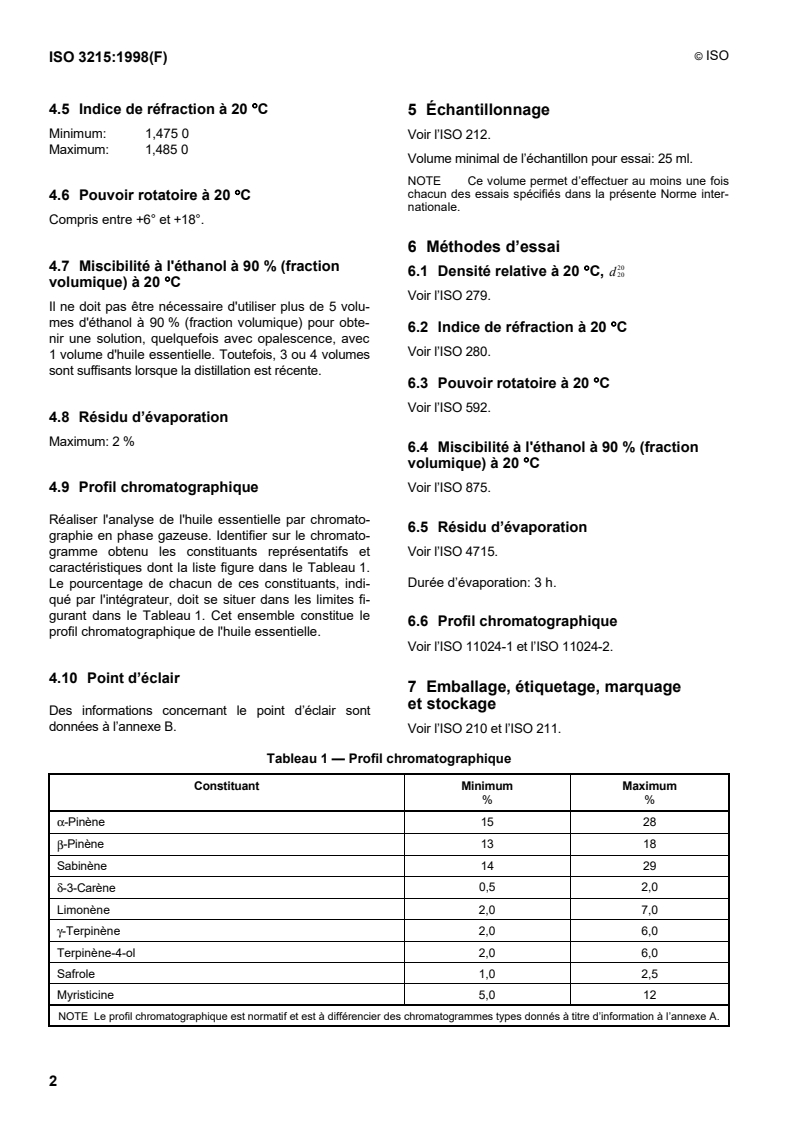
Gas chromatography and chromatographic profile: Analysis by gas chromatography is normative. The standard lists representative components and acceptable ranges that constitute the chromatographic profile, including:
- α-Pinene: 15–28 %
- β-Pinene: 13–18 %
- Sabinene: 14–29 %
- δ-3-Carene: 0.5–2.0 %
- Limonene: 2.0–7.0 %
- γ-Terpinene: 2.0–6.0 %
- Terpinen-4-ol: 2.0–6.0 %
- Safrole: 1.0–2.5 %
- Myristicin: 5.0–12 %
Identification and proportion assessment is performed using integrator data from GC runs. Annex A gives example chromatograms and recommended operating conditions for polar and apolar columns.
Flashpoint information: Annex B gives mean flashpoint values for information (+48 °C with Luchaire; +38 °C with Setaflash) and explains variability between test methods.
Sampling and testing: Minimum test sample volume is 25 ml. The standard references ISO methods for density, refractive index, optical rotation, miscibility, residue on evaporation and chromatographic profiling.
Applications
ISO 3215:1998 is used by:
- Quality control laboratories for acceptance testing and release of Indonesian nutmeg oil.
- Traders and purchasers to verify specification compliance during procurement.
- Regulatory and safety teams for packaging, labelling and transport decisions (in conjunction with flashpoint guidance).
- R&D and formulation teams to ensure ingredient consistency in flavors, fragrances and related products.
Related Standards
The standard cites and should be used alongside these ISO documents:
- ISO 210, 211, 212 (packaging, labelling, sampling)
- ISO 279, 280, 592 (density, refractive index, optical rotation)
- ISO 875, ISO 4715 (miscibility, residue on evaporation)
- ISO 11024‑1 and ISO 11024‑2 (chromatographic profile guidance)
For implementers, ISO 3215:1998 provides a practical, test-oriented framework to ensure consistent quality, traceability and safe handling of Indonesian nutmeg essential oil.
Relations
- Consolidated By
ISO 15980:2002 - Open end blind rivets with break pull mandrel and countersunk head — St/St - Effective Date
- 06-Jun-2022
- Effective Date
- 15-Apr-2008
Buy Documents
ISO 3215:1998 - Oil of nutmeg, Indonesian type (Myristica fragrans Houtt.)
ISO 3215:1998 - Oil of nutmeg, Indonesian type (Myristica fragrans Houtt.)/17/1998
ISO 3215:1998 - Huile essentielle de noix muscade, type Indonésie (Myristica fragrans Houtt.)
ISO 3215:1998 - Huile essentielle de noix muscade, type Indonésie (Myristica fragrans Houtt.)/17/1998
Get Certified
Connect with accredited certification bodies for this standard

ECOCERT
Organic and sustainability certification.

Eurofins Food Testing Global
Global leader in food, environment, and pharmaceutical product testing.

Intertek Bangladesh
Intertek certification and testing services in Bangladesh.
Sponsored listings
Frequently Asked Questions
ISO 3215:1998 is a standard published by the International Organization for Standardization (ISO). Its full title is "Oil of nutmeg, Indonesian type (Myristica fragrans Houtt.)". This standard covers: This International Standard specifies certain characteristics of the oil of nutmeg, Indonesian type (Myristica fragrans Houtt.), in order to facilitate assessment of its quality.
This International Standard specifies certain characteristics of the oil of nutmeg, Indonesian type (Myristica fragrans Houtt.), in order to facilitate assessment of its quality.
ISO 3215:1998 is classified under the following ICS (International Classification for Standards) categories: 71.100.60 - Essential oils. The ICS classification helps identify the subject area and facilitates finding related standards.
ISO 3215:1998 has the following relationships with other standards: It is inter standard links to ISO 15980:2002, ISO 3215:1974. Understanding these relationships helps ensure you are using the most current and applicable version of the standard.
ISO 3215:1998 is available in PDF format for immediate download after purchase. The document can be added to your cart and obtained through the secure checkout process. Digital delivery ensures instant access to the complete standard document.
Standards Content (Sample)
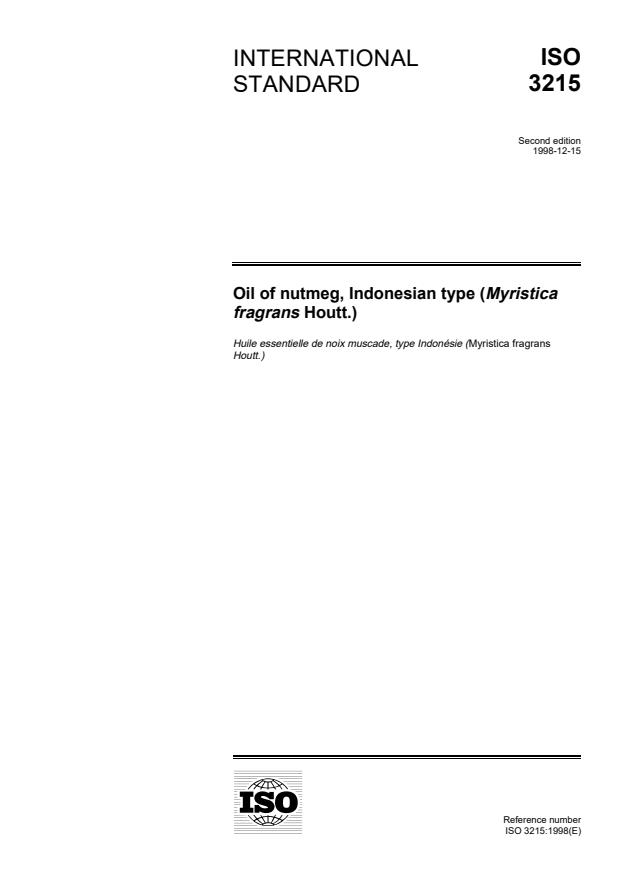
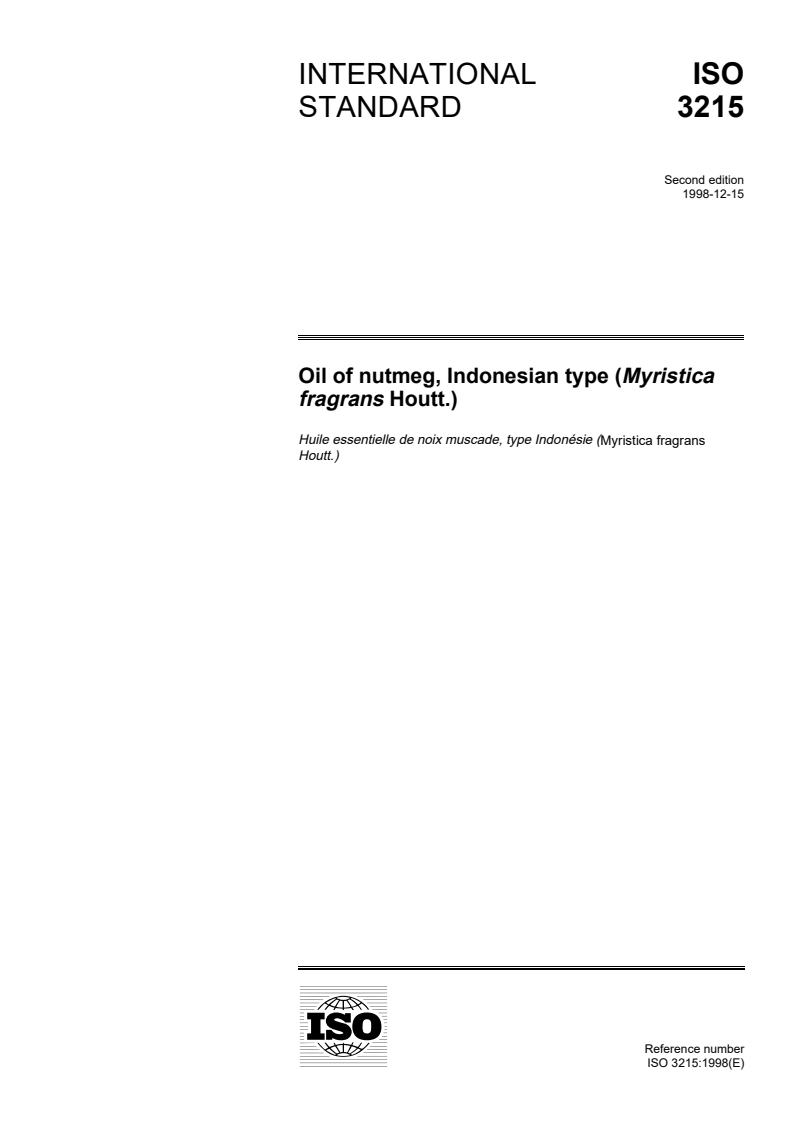
INTERNATIONAL ISO
STANDARD 3215
Second edition
1998-12-15
Oil of nutmeg, Indonesian type (Myristica
fragrans Houtt.)
Huile essentielle de noix muscade, type Indonésie (Myristica fragrans
Houtt.)
A
Reference number
Foreword
ISO (the International Organization for Standardization) is a worldwide federation of national standards bodies (ISO
member bodies). The work of preparing International Standards is normally carried out through ISO technical
committees. Each member body interested in a subject for which a technical committee has been established has
the right to be represented on that committee. International organizations, governmental and non-governmental, in
liaison with ISO, also take part in the work. ISO collaborates closely with the International Electrotechnical
Commission (IEC) on all matters of electrotechnical standardization.
International Standards are drafted in accordance with the rules given in the ISO/IEC Directives, Part 3.
Draft International Standards adopted by the technical committees are circulated to the member bodies for voting.
Publication as an International Standard requires approval by at least 75 % of the member bodies casting a vote.
International Standard ISO 3215 was prepared by Technical Committee ISO/TC 54, Essential oils.
This second edition cancels and replaces the first edition (ISO 3215:1974), which has been technically revised.
Annexes A and B of this International Standard are for information only.
© ISO 1998
All rights reserved. Unless otherwise specified, no part of this publication may be reproduced or utilized in any form or by any means, electronic
or mechanical, including photocopying and microfilm, without permission in writing from the publisher.
International Organization for Standardization
Case postale 56 • CH-1211 Genève 20 • Switzerland
Internet iso@iso.ch
Printed in Switzerland
ii
INTERNATIONAL STANDARD © ISO ISO 3215:1998(E)
Oil of nutmeg, Indonesian type (Myristica fragrans Houtt.)
ISO 11024-2, Essential oils — General guidance on
1 Scope
chromatographic profiles — Part 2: Utilization of
chromatographic profiles of samples of essential oils.
This International Standard specifies certain
characteristics of the oil of nutmeg, Indonesian type
(Myristica fragrans Houtt.), in order to facilitate
assessment of its quality.
3 Term and definition
For the purposes of this International Standard, the
2 Normative references
following term and definition apply.
The following normative documents contain provisions
3.1
which, through reference in this text, constitute
oil of nutmeg, Indonesian type
provisions of this International Standard. For dated
essential oil obtained by steam distillation of the dried
references, subsequent amendments to, or revisions
and crushed nuts of Myristica fragrans Houtt. of the
of, any of these publications do not apply. However,
Myristicaceae family, cultivated primarily in the
parties to agreements based on this International
Indonesian archipelago
Standard are encouraged to investigate the possibility
of applying the most recent editions of the normative
documents indicated below. For undated references,
4 Requirements
the latest edition of the normative document referred
to applies. Members of ISO and IEC maintain registers
4.1 Appearance
of currently valid International Standards.
ISO 210, Essential oils — General rules for packaging, Clear mobile liquid.
conditioning and storage.
4.2 Colour
ISO 211, Essential oils — General rules for labelling
and marking containers.
Almost colourless to light yellow.
ISO 212, Essential oils — Sampling.
4.3 Odour
ISO 279, Essential oils — Determination of relative
density at 20 °C — Reference method.
Spicy, sweet, aromatic, with characteristic nuances.
ISO 280, Essential oils — Determination of refractive
4.4 Relative density at 20 °C, d
index.
Minimum: 0,885 0
ISO 592, Essential oils — Determination of optical
Maximum: 0,907 0
rotation.
ISO 875, Essential oils — Evaluation of miscibility in
4.5 Refractive index at 20 °C
ethanol.
Minimum: 1,475 0
ISO 4715, Essential oils — Quantitative evaluation of
Maximum: 1,485 0
residue on evaporation.
ISO 11024-1, Essential oils — General guidance on
4.6 Optical rotation at 20 °C
chromatographic profiles — Part 1: Preparation of
chromatographic profiles for presentation in standards.
Between + 6° and + 18°.
© ISO
4.7 Miscibility in ethanol (volume fraction
6 Test methods
90%) at 20 °C
6.1 Relative density at 20 °C, d
1 volume of the oil shall not require more than 5
volumes of ethanol (volume fraction 90 %) to obtain a
See ISO 279.
solution, sometimes with opalescence. However, 3 or 4
volumes are adequate in the case of freshly distilled
6.2 Refractive index at 20 °C
oils.
See ISO 280.
4.8 Residue on
...
INTERNATIONAL ISO
STANDARD 3215
Second edition
1998-12-15
Oil of nutmeg, Indonesian type (Myristica
fragrans Houtt.)
Huile essentielle de noix muscade, type Indonésie (Myristica fragrans
Houtt.)
A
Reference number
Foreword
ISO (the International Organization for Standardization) is a worldwide federation of national standards bodies (ISO
member bodies). The work of preparing International Standards is normally carried out through ISO technical
committees. Each member body interested in a subject for which a technical committee has been established has
the right to be represented on that committee. International organizations, governmental and non-governmental, in
liaison with ISO, also take part in the work. ISO collaborates closely with the International Electrotechnical
Commission (IEC) on all matters of electrotechnical standardization.
International Standards are drafted in accordance with the rules given in the ISO/IEC Directives, Part 3.
Draft International Standards adopted by the technical committees are circulated to the member bodies for voting.
Publication as an International Standard requires approval by at least 75 % of the member bodies casting a vote.
International Standard ISO 3215 was prepared by Technical Committee ISO/TC 54, Essential oils.
This second edition cancels and replaces the first edition (ISO 3215:1974), which has been technically revised.
Annexes A and B of this International Standard are for information only.
© ISO 1998
All rights reserved. Unless otherwise specified, no part of this publication may be reproduced or utilized in any form or by any means, electronic
or mechanical, including photocopying and microfilm, without permission in writing from the publisher.
International Organization for Standardization
Case postale 56 • CH-1211 Genève 20 • Switzerland
Internet iso@iso.ch
Printed in Switzerland
ii
INTERNATIONAL STANDARD © ISO ISO 3215:1998(E)
Oil of nutmeg, Indonesian type (Myristica fragrans Houtt.)
ISO 11024-2, Essential oils — General guidance on
1 Scope
chromatographic profiles — Part 2: Utilization of
chromatographic profiles of samples of essential oils.
This International Standard specifies certain
characteristics of the oil of nutmeg, Indonesian type
(Myristica fragrans Houtt.), in order to facilitate
assessment of its quality.
3 Term and definition
For the purposes of this International Standard, the
2 Normative references
following term and definition apply.
The following normative documents contain provisions
3.1
which, through reference in this text, constitute
oil of nutmeg, Indonesian type
provisions of this International Standard. For dated
essential oil obtained by steam distillation of the dried
references, subsequent amendments to, or revisions
and crushed nuts of Myristica fragrans Houtt. of the
of, any of these publications do not apply. However,
Myristicaceae family, cultivated primarily in the
parties to agreements based on this International
Indonesian archipelago
Standard are encouraged to investigate the possibility
of applying the most recent editions of the normative
documents indicated below. For undated references,
4 Requirements
the latest edition of the normative document referred
to applies. Members of ISO and IEC maintain registers
4.1 Appearance
of currently valid International Standards.
ISO 210, Essential oils — General rules for packaging, Clear mobile liquid.
conditioning and storage.
4.2 Colour
ISO 211, Essential oils — General rules for labelling
and marking containers.
Almost colourless to light yellow.
ISO 212, Essential oils — Sampling.
4.3 Odour
ISO 279, Essential oils — Determination of relative
density at 20 °C — Reference method.
Spicy, sweet, aromatic, with characteristic nuances.
ISO 280, Essential oils — Determination of refractive
4.4 Relative density at 20 °C, d
index.
Minimum: 0,885 0
ISO 592, Essential oils — Determination of optical
Maximum: 0,907 0
rotation.
ISO 875, Essential oils — Evaluation of miscibility in
4.5 Refractive index at 20 °C
ethanol.
Minimum: 1,475 0
ISO 4715, Essential oils — Quantitative evaluation of
Maximum: 1,485 0
residue on evaporation.
ISO 11024-1, Essential oils — General guidance on
4.6 Optical rotation at 20 °C
chromatographic profiles — Part 1: Preparation of
chromatographic profiles for presentation in standards.
Between + 6° and + 18°.
© ISO
4.7 Miscibility in ethanol (volume fraction
6 Test methods
90%) at 20 °C
6.1 Relative density at 20 °C, d
1 volume of the oil shall not require more than 5
volumes of ethanol (volume fraction 90 %) to obtain a
See ISO 279.
solution, sometimes with opalescence. However, 3 or 4
volumes are adequate in the case of freshly distilled
6.2 Refractive index at 20 °C
oils.
See ISO 280.
4.8 Residue on
...
NORME ISO
INTERNATIONALE 3215
Deuxième édition
1998-12-15
Huile essentielle de noix muscade, type
Indonésie (Myristica fragrans Houtt.)
Oil of nutmeg, Indonesian type (Myristica fragrans Houtt.)
A
Numéro de référence
Avant-propos
L'ISO (Organisation internationale de normalisation) est une fédération mondiale d'organismes nationaux de norma-
lisation (comités membres de l'ISO). L'élaboration des Normes internationales est en général confiée aux comités
techniques de l'ISO. Chaque comité membre intéressé par une étude a le droit de faire partie du comité technique
créé à cet effet. Les organisations internationales, gouvernementales et non gouvernementales, en liaison avec
l'ISO participent également aux travaux. L'ISO collabore étroitement avec la Commission électrotechnique interna-
tionale (CEI) en ce qui concerne la normalisation électrotechnique.
Les Normes internationales sont rédigées conformément aux règles données dans les Directives ISO/CEI, Partie 3.
Les projets de Normes internationales adoptés par les comités techniques sont soumis aux comités membres pour
vote. Leur publication comme Normes internationales requiert l'approbation de 75 % au moins des comités mem-
bres votants.
La Norme internationale ISO 3215 a été élaborée par le comité technique ISO/TC 54, Huiles essentielles.
Cette deuxième édition annule et remplace la première édition (ISO 3215:1974), dont elle constitue une révision
technique.
Les annexes A et B de la présente Norme internationale sont données uniquement à titre d’information.
© ISO 1998
Droits de reproduction réservés. Sauf prescription différente, aucune partie de cette publication ne peut être reproduite ni utilisée sous quelque
forme que ce soit et par aucun procédé, électronique ou mécanique, y compris la photocopie et les microfilms, sans l'accord écrit de l'éditeur.
Organisation internationale de normalisation
Case postale 56 • CH-1211 Genève 20 • Suisse
Internet iso@iso.ch
Imprimé en Suisse
ii
©
NORME INTERNATIONALE ISO ISO 3215:1998(F)
Huile essentielle de noix muscade, type Indonésie
Myristica fragrans
( Houtt.)
ISO 11024-1, Huiles essentielles — Directives
1 Domaine d’application
générales concernant les profils chromatographiques —
Partie 1: Élaboration des profils chromatographiques
La présente Norme internationale spécifie certaines ca-
pour la présentation dans les normes.
ractéristiques de l'huile essentielle de noix muscade,
type Indonésie (Myristica fragrans Houtt.), destinées à
ISO 11024-2,
Huiles essentielles — Directives généra-
faciliter l'évaluation de sa qualité.
les concernant les profils chromatographiques — Par-
tie 2: Utilisation des profils chromatographiques des
échantillons d’huiles essentielles.
2 Références normatives
Les documents normatifs suivants contiennent des
dispositions qui, par suite de la référence qui y est
3 Terme et définition
faite, constituent des dispositions valables pour la pré-
sente Norme internationale. Pour les références da-
tées, les amendements ultérieurs ou les révisions de Pour les besoins de la présente Norme internationale
ces publications ne s'appliquent pas. Toutefois, les les terme et définition suivants s'appliquent.
parties prenantes aux accords fondés sur la présente
3.1
Norme internationale sont invitées à rechercher la
huile essentielle de noix muscade, type Indonésie
possibilité d’appliquer les éditions les plus récentes
huile essentielle obtenue par distillation à la vapeur
des documents normatifs indiqués ci-après. Pour les
d’eau des noix séchées et broyées de Myristica fra-
références non datées, la dernière édition du docu-
grans Houtt., de la famille des Myristicaceae, cultivées
ment normatif en référence s'applique. Les membres
principalement dans l’archipel indonésien
de l’ISO et de la CEI possèdent le registre des Nor-
mes internationales en vigueur.
ISO 210, Huiles essentielles — Règles générales
d’emballage, de conditionnement et de stockage. 4 Spécifications
ISO 211, Huiles essentielles — Règles générales
4.1 Aspect
d’étiquetage et de marquage des récipients.
Liquide mobile, limpide.
ISO 212, Huiles essentielles — Échantillonnage.
4.2 Couleur
ISO 279, Huiles essentielles — Détermination de la
densité relative à 20 °C — Méthode de référence.
Presque incolore à jaune pâle.
ISO 280, Huiles essentielles — Détermination de
l'indice de réfraction.
4.3 Odeur
ISO 592, Huiles essentielles — Détermination du
Épicée, douce, aromatique, avec des nuances caracté-
pouvoir rotatoire.
ristiques.
ISO 875, Huiles essentielles — Évaluation de la
4.4 Densité relative à 20 °C, d
miscibilité à l'éthanol.
Minimum: 0,885 0
ISO 4715,
Huiles essentielles — Évaluation quantitative
Maximum: 0,907 0
du résidu d’évaporation.
© ISO
4.5 Indice de réfraction à 20 °C
5 Échantillonnage
Minimum: 1,475 0
Voir l’ISO 212.
Maximum: 1,485 0
Volume minimal de l’échantillon pour essai: 25 ml.
NOTE Ce volume permet d’effectuer au moins une fois
chacun des essais spécifiés dans la présente Norme inter-
4.6 Pouvoir rotatoire à 20 °C
nationale.
Compris entre +6° et +18°.
6 Méthodes d’essai
4.7 Miscibilité à l'éthanol à 90 % (fraction
6.1 Densité relative à 20 °C, d
volumique) à 20 °C
Voir l’ISO 279.
Il ne doit pas être nécessaire d'utiliser plus de 5 volu-
mes d'éthanol à 90 % (fraction volumique) pour obte-
6.2 Indice de
...
NORME ISO
INTERNATIONALE 3215
Deuxième édition
1998-12-15
Huile essentielle de noix muscade, type
Indonésie (Myristica fragrans Houtt.)
Oil of nutmeg, Indonesian type (Myristica fragrans Houtt.)
A
Numéro de référence
Avant-propos
L'ISO (Organisation internationale de normalisation) est une fédération mondiale d'organismes nationaux de norma-
lisation (comités membres de l'ISO). L'élaboration des Normes internationales est en général confiée aux comités
techniques de l'ISO. Chaque comité membre intéressé par une étude a le droit de faire partie du comité technique
créé à cet effet. Les organisations internationales, gouvernementales et non gouvernementales, en liaison avec
l'ISO participent également aux travaux. L'ISO collabore étroitement avec la Commission électrotechnique interna-
tionale (CEI) en ce qui concerne la normalisation électrotechnique.
Les Normes internationales sont rédigées conformément aux règles données dans les Directives ISO/CEI, Partie 3.
Les projets de Normes internationales adoptés par les comités techniques sont soumis aux comités membres pour
vote. Leur publication comme Normes internationales requiert l'approbation de 75 % au moins des comités mem-
bres votants.
La Norme internationale ISO 3215 a été élaborée par le comité technique ISO/TC 54, Huiles essentielles.
Cette deuxième édition annule et remplace la première édition (ISO 3215:1974), dont elle constitue une révision
technique.
Les annexes A et B de la présente Norme internationale sont données uniquement à titre d’information.
© ISO 1998
Droits de reproduction réservés. Sauf prescription différente, aucune partie de cette publication ne peut être reproduite ni utilisée sous quelque
forme que ce soit et par aucun procédé, électronique ou mécanique, y compris la photocopie et les microfilms, sans l'accord écrit de l'éditeur.
Organisation internationale de normalisation
Case postale 56 • CH-1211 Genève 20 • Suisse
Internet iso@iso.ch
Imprimé en Suisse
ii
©
NORME INTERNATIONALE ISO ISO 3215:1998(F)
Huile essentielle de noix muscade, type Indonésie
Myristica fragrans
( Houtt.)
ISO 11024-1, Huiles essentielles — Directives
1 Domaine d’application
générales concernant les profils chromatographiques —
Partie 1: Élaboration des profils chromatographiques
La présente Norme internationale spécifie certaines ca-
pour la présentation dans les normes.
ractéristiques de l'huile essentielle de noix muscade,
type Indonésie (Myristica fragrans Houtt.), destinées à
ISO 11024-2,
Huiles essentielles — Directives généra-
faciliter l'évaluation de sa qualité.
les concernant les profils chromatographiques — Par-
tie 2: Utilisation des profils chromatographiques des
échantillons d’huiles essentielles.
2 Références normatives
Les documents normatifs suivants contiennent des
dispositions qui, par suite de la référence qui y est
3 Terme et définition
faite, constituent des dispositions valables pour la pré-
sente Norme internationale. Pour les références da-
tées, les amendements ultérieurs ou les révisions de Pour les besoins de la présente Norme internationale
ces publications ne s'appliquent pas. Toutefois, les les terme et définition suivants s'appliquent.
parties prenantes aux accords fondés sur la présente
3.1
Norme internationale sont invitées à rechercher la
huile essentielle de noix muscade, type Indonésie
possibilité d’appliquer les éditions les plus récentes
huile essentielle obtenue par distillation à la vapeur
des documents normatifs indiqués ci-après. Pour les
d’eau des noix séchées et broyées de Myristica fra-
références non datées, la dernière édition du docu-
grans Houtt., de la famille des Myristicaceae, cultivées
ment normatif en référence s'applique. Les membres
principalement dans l’archipel indonésien
de l’ISO et de la CEI possèdent le registre des Nor-
mes internationales en vigueur.
ISO 210, Huiles essentielles — Règles générales
d’emballage, de conditionnement et de stockage. 4 Spécifications
ISO 211, Huiles essentielles — Règles générales
4.1 Aspect
d’étiquetage et de marquage des récipients.
Liquide mobile, limpide.
ISO 212, Huiles essentielles — Échantillonnage.
4.2 Couleur
ISO 279, Huiles essentielles — Détermination de la
densité relative à 20 °C — Méthode de référence.
Presque incolore à jaune pâle.
ISO 280, Huiles essentielles — Détermination de
l'indice de réfraction.
4.3 Odeur
ISO 592, Huiles essentielles — Détermination du
Épicée, douce, aromatique, avec des nuances caracté-
pouvoir rotatoire.
ristiques.
ISO 875, Huiles essentielles — Évaluation de la
4.4 Densité relative à 20 °C, d
miscibilité à l'éthanol.
Minimum: 0,885 0
ISO 4715,
Huiles essentielles — Évaluation quantitative
Maximum: 0,907 0
du résidu d’évaporation.
© ISO
4.5 Indice de réfraction à 20 °C
5 Échantillonnage
Minimum: 1,475 0
Voir l’ISO 212.
Maximum: 1,485 0
Volume minimal de l’échantillon pour essai: 25 ml.
NOTE Ce volume permet d’effectuer au moins une fois
chacun des essais spécifiés dans la présente Norme inter-
4.6 Pouvoir rotatoire à 20 °C
nationale.
Compris entre +6° et +18°.
6 Méthodes d’essai
4.7 Miscibilité à l'éthanol à 90 % (fraction
6.1 Densité relative à 20 °C, d
volumique) à 20 °C
Voir l’ISO 279.
Il ne doit pas être nécessaire d'utiliser plus de 5 volu-
mes d'éthanol à 90 % (fraction volumique) pour obte-
6.2 Indice de
...