

ISO 1388-10:1981
(Main)Ethanol for industrial use — Methods of test — Part 10: Estimation of hydrocarbons content — Distillation method
General Information
- Abstract
The principle is based on distillation of a test portion in the presence of water, addition to the distillate of a saturated sodium chloride solution and measurement of the volume of insoluble hydrocarbons. A Hempel fractionating column with Liebig condenser is used for the distillation. - International Standards ISO 1388/1 to ISO 1377/12 cancel and replace ISO Recommendation R 1388-1970 of which they constitute a technical revision.
- Status
- Published
- Publication Date
- 31-Oct-1981
- Technical Committee
- ISO/TC 47 - Chemistry
- Drafting Committee
- ISO/TC 47 - Chemistry
- Current Stage
- 9093 - International Standard confirmed
- Start Date
- 29-Nov-2023
- Completion Date
- 29-Aug-2026
Buy Documents
ISO 1388-10:1981 - Ethanol for industrial use — Methods of test — Part 10: Estimation of hydrocarbons content — Distillation method Released:11/1/1981
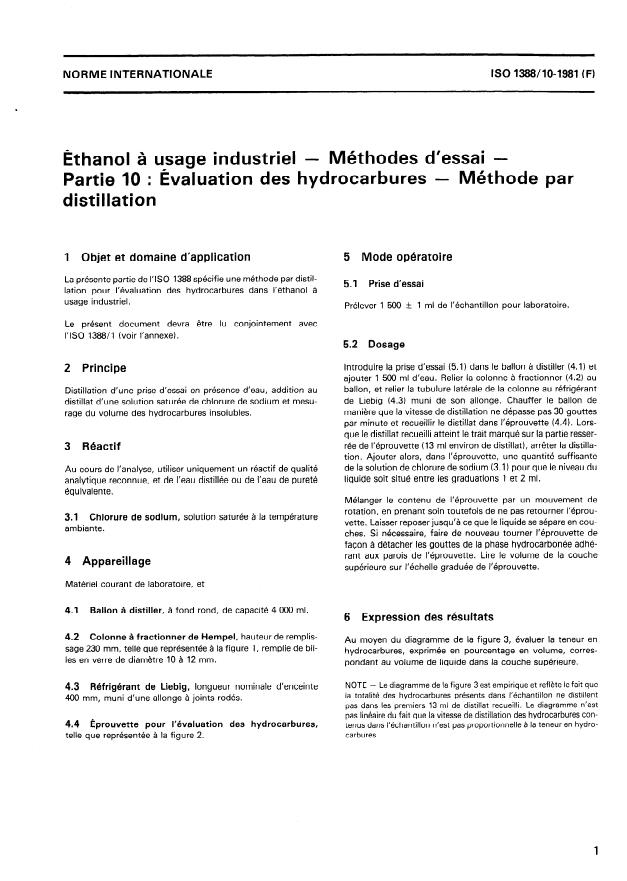
ISO 1388-10:1981 - Éthanol a usage industriel — Méthodes d'essai — Partie 10: Évaluation des hydrocarbures — Méthode par distillation Released:11/1/1981
ISO 1388-10:1981 - Éthanol a usage industriel — Méthodes d'essai — Partie 10: Évaluation des hydrocarbures — Méthode par distillation Released:11/1/1981
Overview
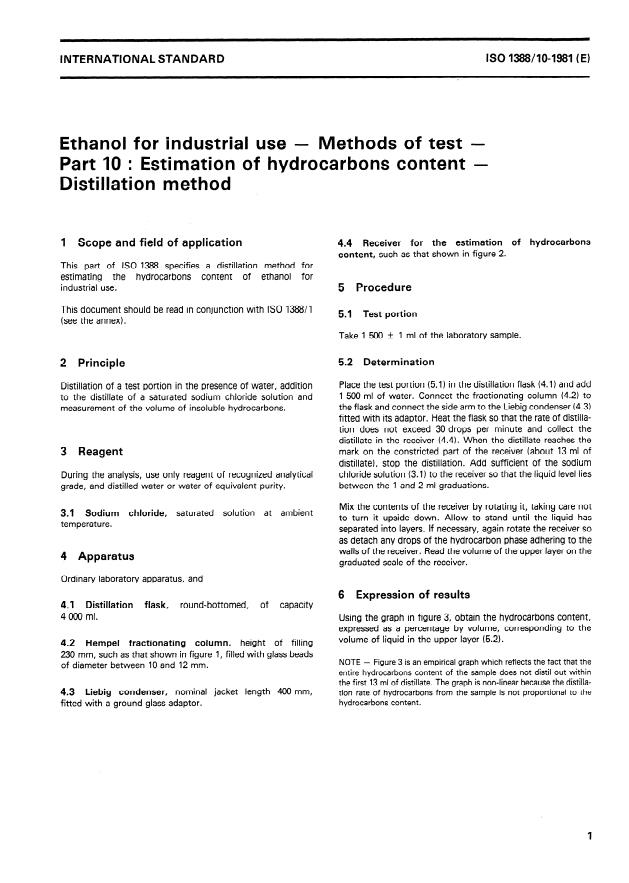
ISO 1388-10:1981 - "Ethanol for industrial use - Methods of test - Part 10: Estimation of hydrocarbons content - Distillation method" (first edition, 1981) specifies a laboratory distillation procedure for evaluating hydrocarbon contamination in industrial ethanol. The method is based on distilling a measured test portion in the presence of water, extracting the distillate with a saturated sodium chloride solution, and measuring the volume of the insoluble hydrocarbon layer.
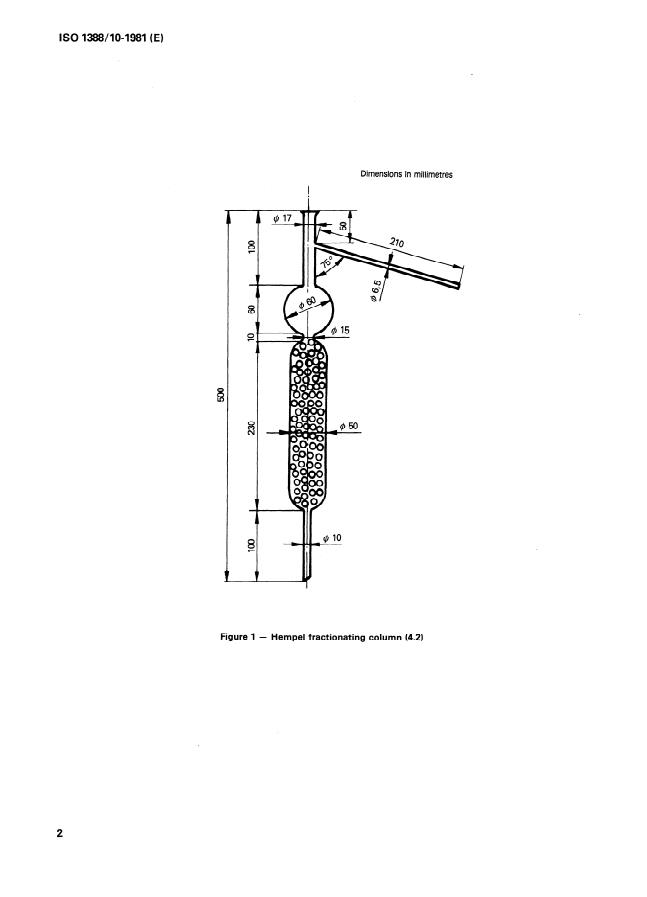
Key procedural elements described in the standard include the use of a Hempel fractionating column coupled to a Liebig condenser, a 4 000 ml round-bottom distillation flask, and a graduated evaluation tube for direct reading of hydrocarbon volume. The method requires collection of the initial distillate (approximately 13 ml), addition of saturated NaCl, separation of layers and reading the volume of the upper hydrocarbon layer. An empirical diagram (figure 3 in the standard) converts the measured layer volume to percentage (v/v) hydrocarbons - the diagram reflects that hydrocarbon distillation is not strictly proportional to concentration and that not all hydrocarbons distill in the first 13 ml.
This part of ISO 1388 should be read in conjunction with ISO 1388/1 (general provisions) and uses analytical-grade reagents and distilled or equivalent-quality water.
Key Topics
- Scope and principle: Distillation in presence of water, salt-saturated extraction, volumetric reading of insoluble hydrocarbons.
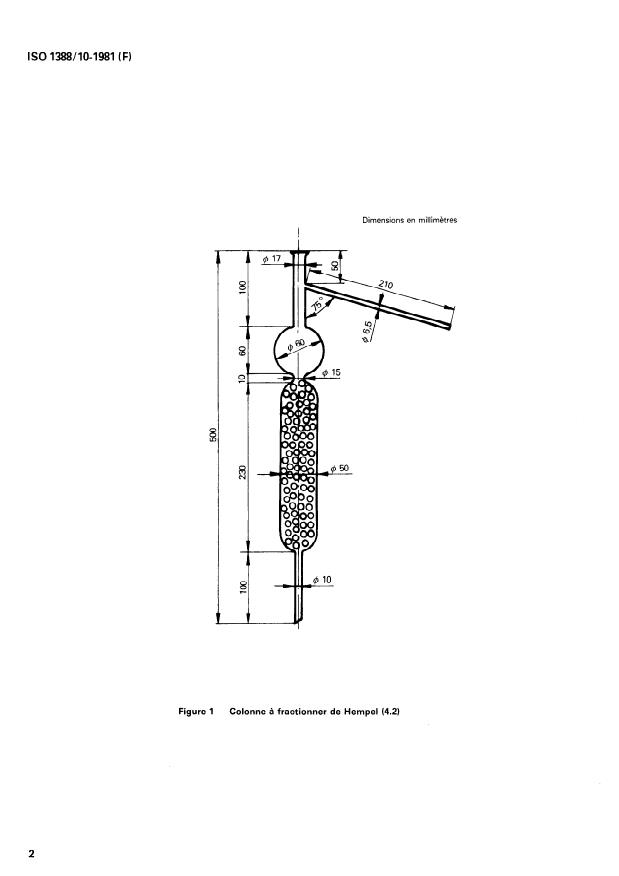
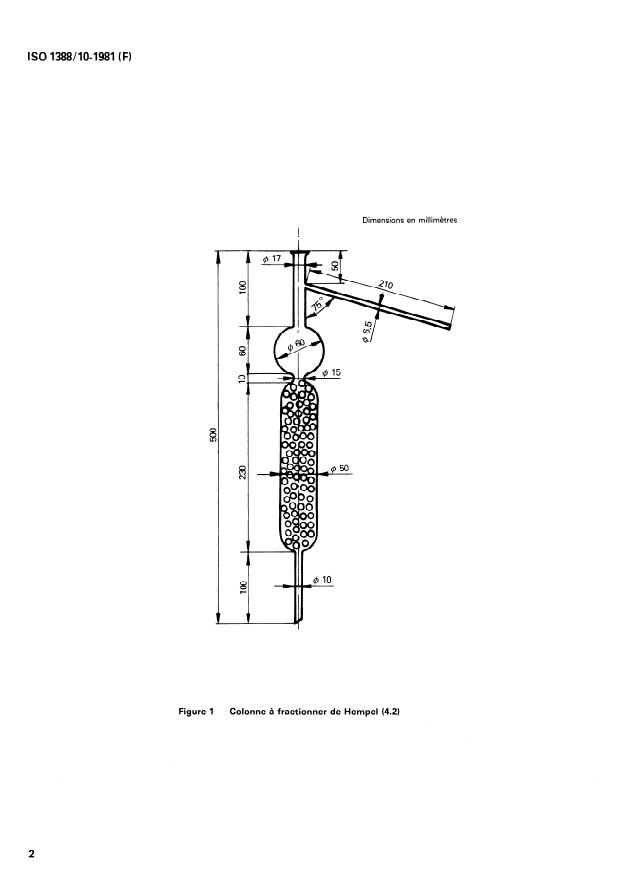
- Apparatus: Hempel fractionating column (230 mm packing height), Liebig condenser with extension, 4 000 ml distillation flask, graduated evaluation tube (as per figures).
- Sampling: Laboratory sample size indicated in the text (1 500 ml sample portion, taken per ISO 1388/1 guidance).
- Procedure controls: Maintain distillation rate (not exceeding ~30 drops/min), collect initial distillate to the marked volume (~13 ml), mix gently to separate layers without inverting the tube.
- Result expression: Use the empirical diagram provided to convert measured upper-layer volume to percentage (v/v) hydrocarbons.
Applications
This test method provides practical value for:
- Quality control of industrial ethanol production and incoming raw material inspection.
- Process monitoring where hydrocarbon carryover or contamination must be tracked.
- Batch release and routine laboratory testing in chemical and fuel-related industries.
- Comparative assessments when referenced alongside other ISO 1388 parts for a comprehensive ethanol test program.
Advantages:
- Simple volumetric endpoint that is straightforward to implement in a standard laboratory.
- Uses commonly available glassware (Hempel column, Liebig condenser) and standard reagents (saturated sodium chloride solution).
Related Standards
- ISO 1388/1 - Generalities (must be read in conjunction with Part 10)
- Other parts in the ISO 1388 series (examples listed in the annex of the standard): ISO 1388/2, ISO 1388/3, ISO 1388/4, ISO 1388/5, ISO 1388/6, ISO 1388/7, ISO 1388/8, ISO 1388/9, ISO 1388/11, ISO 1388/12
For implementation, laboratories should consult the full text of ISO 1388-10:1981 for figures, exact apparatus dimensions, safety guidance and the empirical diagram for converting measured volumes to % (v/v) hydrocarbons.
Relations
- Effective Date
- 15-Apr-2008
Buy Documents
ISO 1388-10:1981 - Ethanol for industrial use — Methods of test — Part 10: Estimation of hydrocarbons content — Distillation method Released:11/1/1981
ISO 1388-10:1981 - Éthanol a usage industriel — Méthodes d'essai — Partie 10: Évaluation des hydrocarbures — Méthode par distillation Released:11/1/1981
ISO 1388-10:1981 - Éthanol a usage industriel — Méthodes d'essai — Partie 10: Évaluation des hydrocarbures — Méthode par distillation Released:11/1/1981
Get Certified
Connect with accredited certification bodies for this standard

ECOCERT
Organic and sustainability certification.

Eurofins Food Testing Global
Global leader in food, environment, and pharmaceutical product testing.

Intertek Bangladesh
Intertek certification and testing services in Bangladesh.
Sponsored listings
Frequently Asked Questions
ISO 1388-10:1981 is a standard published by the International Organization for Standardization (ISO). Its full title is "Ethanol for industrial use — Methods of test — Part 10: Estimation of hydrocarbons content — Distillation method". This standard covers: The principle is based on distillation of a test portion in the presence of water, addition to the distillate of a saturated sodium chloride solution and measurement of the volume of insoluble hydrocarbons. A Hempel fractionating column with Liebig condenser is used for the distillation. - International Standards ISO 1388/1 to ISO 1377/12 cancel and replace ISO Recommendation R 1388-1970 of which they constitute a technical revision.
The principle is based on distillation of a test portion in the presence of water, addition to the distillate of a saturated sodium chloride solution and measurement of the volume of insoluble hydrocarbons. A Hempel fractionating column with Liebig condenser is used for the distillation. - International Standards ISO 1388/1 to ISO 1377/12 cancel and replace ISO Recommendation R 1388-1970 of which they constitute a technical revision.
ISO 1388-10:1981 is classified under the following ICS (International Classification for Standards) categories: 71.080.60 - Alcohols. Ethers. The ICS classification helps identify the subject area and facilitates finding related standards.
ISO 1388-10:1981 has the following relationships with other standards: It is inter standard links to ISO/R 1388:1970. Understanding these relationships helps ensure you are using the most current and applicable version of the standard.
ISO 1388-10:1981 is available in PDF format for immediate download after purchase. The document can be added to your cart and obtained through the secure checkout process. Digital delivery ensures instant access to the complete standard document.
Standards Content (Sample)
International Standard 1388llO
INTERNATIONAL ORGANIZATION FOR STANDARDIZATlON.MEX,QYHAPO~HAR OPrAHM3ALUdR fl0 CTAH~APTH3ALWl~RGANlSATlON INTERNATIONALE DE hORMALlSATlON
Ethanol for industrial use - Methods of test -
Part 10 : Estimation of hydrocarbons content -
Distillation method
Ethanol ;i usage industriel - Methodes d ’essai -
Partie 70 : Evaluation des h ydrocarbures - Methode par distillation
First edition - 1981-11-01
UDC 661.722 : 543.824
Ref. No. IS0 1388/10-1981 (E)
Descriptors : industrial products, ethanols, tests, determination of content, hydrocarbons, distillation method.
Price based on 5 pages
Preisgr.
D
Foreword
IS0 (the International Organization for Standardization) is a worldwide federation of
national standards institutes (IS0 member bodies). The work of developing Inter-
national Standards is carried out through IS0 technical committees. Every member
body interested in a subject for which a technical committee has been set up has the
right to be represented on that committee. International organizations, governmental
and non-governmental, in liaison with ISO, also take part in the work.
Draft International Standards adopted by the technical committees are circulated to
the member bodies for approval before their acceptance as International Standards by
the IS0 Council.
International Standard IS0 1388/10 was developed by Technical Committee
ISO/TC 47, Chemistry, and was circulated to the member bodies in February 1980.
It has been approved by the member bodies of the following countries :
France Philippines
Australia
Germany, F. R. Poland
Austria
Romania
Belgium Hungary
Brazil India South Africa, Rep. of
Switzerland
Bulgaria Italy
Korea, Rep. of Thailand
China
Czechoslovakia Netherlands USSR
The member body of the following country expressed disapproval of the document on
technical grounds
United Kingdom
International Standards IS0 1388/l to IS0 1388/12 cancel and replace IS0 Recom-
mendation R 1388-1970, of which they constitute a technical revision.
0 International Organization for Standardization, 1981
Printed in Switzerland
INTERNATIONAL STANDARD IS0 1388/10-1981 (E)
Ethanol for industrial use - Methods of test -
Part 10 : Estimation of hydrocarbons content -
Distillation method
1 Scope and field of application 4.4 Receiver for the estimation of hydrocarbons
content, such as that shown in figure 2.
This part of IS0 1388 specifies a distillation method for
estimating the hydrocarbons content of ethanol for
industrial use.
5 Procedure
This document should be read in conjunction with IS0 1388/l
5.1 Test portion
(see the annex).
Take I 500 + 1 ml of the laboratory sample.
5.2 Determination
2 Principle
Place the test portion (5.1) in the distillation flask (4.1) and add
Distillation of a test portion in the presence of water, addition
I 500 ml of water. Connect the fractionating column (4.2) to
to the distillate of a saturated sodium chloride solution and
the flask and connect the side arm to the Liebig condenser (4.3)
measurement of the volume of insoluble hydrocarbons.
fitted with its adaptor. Heat the flask so that the rate of distilla-
tion does not exceed 30 drops per minute and collect the
distillate in the receiver (4.4). When the distillate reaches the
ma
...
Norme internationale
INTERNATIONAL ORGANIZATION FOR STANDARDIZATIONWlE>KC1YHAPO~HAR OPI-AHM3AlJtlR fl0 CTAH~APTH3A~MM@ORGANISATION INTERNATIONALE DE NORMALISATION
Éthanol à usage industriel - Méthodes d’essai -
Partie 10 : Évaluation des hydrocarbures - Méthode par
distillation
Part 70 : Estimation of hydrocarbons content - Distillation method
Ethanol for industrial use - Methods of test -
Première édition - 1981-11-15
iî
7 CDU 661.722 : 543.824 Réf. no : ISO l388/10-1981 (F)
Descripteurs : produit industriel, éthanol, essai, dosage, hydrocarbure, méthode par distillation.
Prix basé sur 5 pages
Avant-propos
L’ISO (Organisation internationale de normalisation) est une fédération mondiale
d’organismes nationaux de normalisation (comités membres de I’ISO). L’élaboration
des Normes internationales est confiée aux comités techniques de I’ISO. Chaque
comité membre intéressé par une étude a le droit de faire partie du comité technique
correspondant. Les organisations internationales, gouvernementales et non gouverne-
mentales, en liaison avec I’ISO, participent également aux travaux.
Les projets de Normes internationales adoptés par les comités techniques sont soumis
aux comités membres pour approbation, avant leur acceptation comme Normes inter-
nationales par le Conseil de I’ISO.
La Norme internationale ISO 13WlO a été élaborée par le comité technique
ISO/TC 47, Chimie, et a été soumise aux comités membres en février 1980.
Les comités membres des pays suivants l’ont approuvée :
Chine Philippines
Afrique du Sud, Rép. d’
Corée, Rép. de Pologne
Allemagne, R. F.
France Roumanie
Australie
Autriche Hongrie Suisse
Inde Tchécoslovaquie
Belgique
Brésil Italie Thaïlande
Bulgarie Pays- Bas URSS
Le comité membre du pays suivant l’a désapprouvée pour des raisons techniques :
Royaume-Uni
Les Normes internationales ISO 13Wl à ISO 13W12 annulent et remplacent la
Recommandation ISO/R 1388-1970, dont elles constituent une révision technique.
0 Organisation internationale de normalisation, 1981
Imprimé en Suisse
NORME INTERNATIONALE ISO 1388/10-1981 (F)
Éthanol à usage industriel - Méthodes d’essai -
Partie 10 : Évaluation des hydrocarbures - Méthode par
distillation
5 Mode opératoire
1 Objet et domaine d’application
La présente partie de I’ISO 1388 spécifie une méthode par distil-
5.1 Prise d’essai
lation pour l’évaluation des hydrocarbures dans I’éthanol à
usage industriel.
Prélever 1 500 + 1 ml de l’échantillon pour laboratoire.
Le présent document devra être lu conjointement avec
I’ISO 1388/1 (voir l’annexe).
5.2 Dosage
Introduire la prise d’essai (5.1) dans le ballon à distiller (4.1) et
2 Principe
ajouter 1 500 ml d’eau. Relier la colonne à fractionner (4.2) au
ballon, et relier la tubulure latérale de la colonne au réfrigérant
Distillation d’une prise d’essai en présence d’eau, addition au
de Liebig (4.3) muni de son allonge. Chauffer le ballon de
distillat d’une solution saturée de chlorure de sodium et mesu-
manière que la vitesse de distillation ne dépasse pas 30 gouttes
rage du volume des hydrocarbures insolubles.
par minute et recueillir le distillat dans l’éprouvette (4.4). Lors-
que le distillat recueilli atteint le trait marqué sur la partie resser-
rée de l’éprouvette (13 ml environ de distillat), arrêter la distilla-
3 Réactif
tion. Ajouter alors, dans l’éprouvette, une quantité suffisante
de la solution de c
...
Norme internationale
INTERNATIONAL ORGANIZATION FOR STANDARDIZATIONWlE>KC1YHAPO~HAR OPI-AHM3AlJtlR fl0 CTAH~APTH3A~MM@ORGANISATION INTERNATIONALE DE NORMALISATION
Éthanol à usage industriel - Méthodes d’essai -
Partie 10 : Évaluation des hydrocarbures - Méthode par
distillation
Part 70 : Estimation of hydrocarbons content - Distillation method
Ethanol for industrial use - Methods of test -
Première édition - 1981-11-15
iî
7 CDU 661.722 : 543.824 Réf. no : ISO l388/10-1981 (F)
Descripteurs : produit industriel, éthanol, essai, dosage, hydrocarbure, méthode par distillation.
Prix basé sur 5 pages
Avant-propos
L’ISO (Organisation internationale de normalisation) est une fédération mondiale
d’organismes nationaux de normalisation (comités membres de I’ISO). L’élaboration
des Normes internationales est confiée aux comités techniques de I’ISO. Chaque
comité membre intéressé par une étude a le droit de faire partie du comité technique
correspondant. Les organisations internationales, gouvernementales et non gouverne-
mentales, en liaison avec I’ISO, participent également aux travaux.
Les projets de Normes internationales adoptés par les comités techniques sont soumis
aux comités membres pour approbation, avant leur acceptation comme Normes inter-
nationales par le Conseil de I’ISO.
La Norme internationale ISO 13WlO a été élaborée par le comité technique
ISO/TC 47, Chimie, et a été soumise aux comités membres en février 1980.
Les comités membres des pays suivants l’ont approuvée :
Chine Philippines
Afrique du Sud, Rép. d’
Corée, Rép. de Pologne
Allemagne, R. F.
France Roumanie
Australie
Autriche Hongrie Suisse
Inde Tchécoslovaquie
Belgique
Brésil Italie Thaïlande
Bulgarie Pays- Bas URSS
Le comité membre du pays suivant l’a désapprouvée pour des raisons techniques :
Royaume-Uni
Les Normes internationales ISO 13Wl à ISO 13W12 annulent et remplacent la
Recommandation ISO/R 1388-1970, dont elles constituent une révision technique.
0 Organisation internationale de normalisation, 1981
Imprimé en Suisse
NORME INTERNATIONALE ISO 1388/10-1981 (F)
Éthanol à usage industriel - Méthodes d’essai -
Partie 10 : Évaluation des hydrocarbures - Méthode par
distillation
5 Mode opératoire
1 Objet et domaine d’application
La présente partie de I’ISO 1388 spécifie une méthode par distil-
5.1 Prise d’essai
lation pour l’évaluation des hydrocarbures dans I’éthanol à
usage industriel.
Prélever 1 500 + 1 ml de l’échantillon pour laboratoire.
Le présent document devra être lu conjointement avec
I’ISO 1388/1 (voir l’annexe).
5.2 Dosage
Introduire la prise d’essai (5.1) dans le ballon à distiller (4.1) et
2 Principe
ajouter 1 500 ml d’eau. Relier la colonne à fractionner (4.2) au
ballon, et relier la tubulure latérale de la colonne au réfrigérant
Distillation d’une prise d’essai en présence d’eau, addition au
de Liebig (4.3) muni de son allonge. Chauffer le ballon de
distillat d’une solution saturée de chlorure de sodium et mesu-
manière que la vitesse de distillation ne dépasse pas 30 gouttes
rage du volume des hydrocarbures insolubles.
par minute et recueillir le distillat dans l’éprouvette (4.4). Lors-
que le distillat recueilli atteint le trait marqué sur la partie resser-
rée de l’éprouvette (13 ml environ de distillat), arrêter la distilla-
3 Réactif
tion. Ajouter alors, dans l’éprouvette, une quantité suffisante
de la solution de c
...