


ISO/TS 22741-2:2024
(Main)Intelligent transport systems - Roadside modules AP-DATEX data interface - Part 2: Generalised field device basic management
Intelligent transport systems - Roadside modules AP-DATEX data interface - Part 2: Generalised field device basic management
Field devices are a key component in intelligent transport systems (ITS). Field devices include traffic signals, message signs, weather stations, traffic sensors, roadside equipment for connected ITS (C-ITS) environments, etc. Field devices often need to exchange information with central devices (managers). Field devices can be quite complex necessitating the standardization of many data concepts for exchange. As such, the ISO 22741 series is divided into several individual parts. This document identifies basic user needs for the management of virtually any field device and traces these needs to interoperable designs. This includes the ability to identify the device, its capabilities and its status. ISO 22741-1 provides additional details about how the ISO 22741 series relates to the overall ITS architecture.
Systèmes de transport intelligents — Interface de données AP-DATEX pour les modules en bord de route — Partie 2: Dispositif de terrain généralisés — Gestion de base
General Information
Overview
ISO/TS 22741-2:2024 - Intelligent transport systems - Roadside modules AP‑DATEX data interface - Part 2: Generalised field device basic management - defines core management concepts and data needs for roadside field devices in ITS. The technical specification identifies basic user needs for managing devices such as traffic signals, variable message signs, weather stations, traffic sensors and other roadside equipment used in connected ITS (C‑ITS) environments. It traces those needs to interoperable data designs to support device identification, capability discovery and status monitoring.
Key topics and requirements
This document frames a generalised management interface for field devices and covers architecture, data exchange and security considerations. Key topics include:
- Architecture views: functional, physical and communications views of the AP‑DATEX data interface, plus security and data protection considerations.
- Conformance & terminology: conformance clauses, normative references, terms and abbreviated terms to ensure consistent implementation.
- User needs: monitoring and control needs such as device identification, capability reporting, status monitoring, and single‑value I/O control.
- Cabinet and environmental monitoring: standardized data concepts for cabinet doors, fans, heaters, humidity, temperature and related design constraints.
- Power monitoring: AC power, battery, generator, solar and wind power data exchange requirements and capability descriptions.
- I/O and device capabilities: general‑purpose I/O definitions, data exchange requirements and capability statements to support diverse field equipment.
- Security: identification of security vulnerabilities and requirements for secure data exchange and device management.
Applications and who uses it
ISO/TS 22741-2:2024 is practical for organizations that design, deploy or operate ITS roadside equipment:
- Field device manufacturers - to provide interoperable management interfaces and capability metadata.
- Systems integrators and software vendors - to implement AP‑DATEX-based device managers and central systems.
- Traffic authorities and municipalities - for remote monitoring, asset management, fault detection and power/environmental monitoring.
- C‑ITS deployments - to ensure roadside modules can interoperate with central managers and connected vehicles.
- Procurement and testing teams - to specify conformance criteria for field device behaviour and data exchange.
Practical benefits include improved interoperability, standardized device discovery and status reporting, easier remote diagnostics and more consistent power/environmental monitoring.
Related standards
- ISO/TS 22741‑1 - provides context on how the ISO 22741 series relates to the overall ITS architecture.
- AP‑DATEX data interface (series) - the broader interface family for roadside module data exchange and interoperability.
Standards Content (Sample)
Technical
Specification
ISO/TS 22741-2
First edition
Intelligent transport systems —
2024-06
Roadside modules AP-DATEX data
interface —
Part 2:
Generalised field device basic
management
Systèmes de transport intelligents — Interface de données AP-
DATEX pour les modules en bord de route —
Partie 2: Dispositif de terrain généralisés — Gestion de base
Reference number
© ISO 2024
All rights reserved. Unless otherwise specified, or required in the context of its implementation, no part of this publication may
be reproduced or utilized otherwise in any form or by any means, electronic or mechanical, including photocopying, or posting on
the internet or an intranet, without prior written permission. Permission can be requested from either ISO at the address below
or ISO’s member body in the country of the requester.
ISO copyright office
CP 401 • Ch. de Blandonnet 8
CH-1214 Vernier, Geneva
Phone: +41 22 749 01 11
Email: copyright@iso.org
Website: www.iso.org
Published in Switzerland
ii
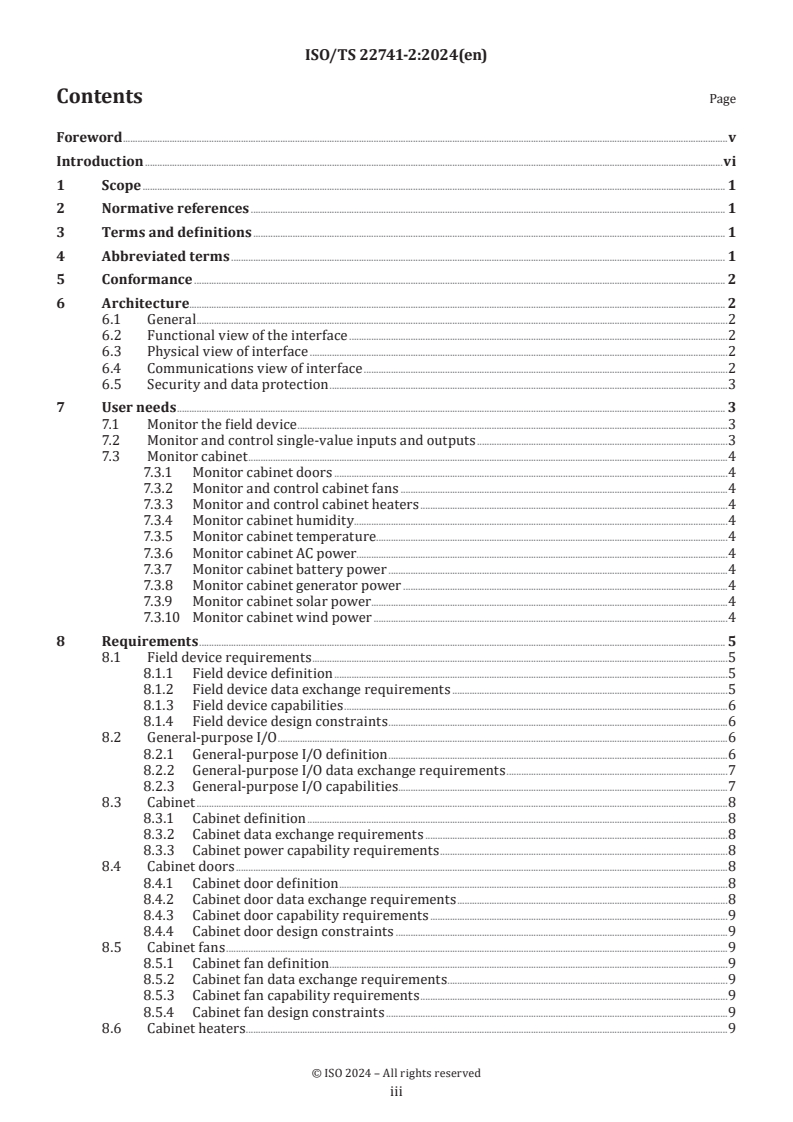
Contents Page
Foreword .v
Introduction .vi
1 Scope . 1
2 Normative references . 1
3 Terms and definitions . 1
4 Abbreviated terms . 1
5 Conformance . 2
6 Architecture. 2
6.1 General .2
6.2 Functional view of the interface .2
6.3 Physical view of interface .2
6.4 Communications view of interface .2
6.5 Security and data protection .3
7 User needs . 3
7.1 Monitor the field device .3
7.2 Monitor and control single-value inputs and outputs .3
7.3 Monitor cabinet .4
7.3.1 Monitor cabinet doors .4
7.3.2 Monitor and control cabinet fans .4
7.3.3 Monitor and control cabinet heaters .4
7.3.4 Monitor cabinet humidity.4
7.3.5 Monitor cabinet temperature.4
7.3.6 Monitor cabinet AC power.4
7.3.7 Monitor cabinet battery power .4
7.3.8 Monitor cabinet generator power .4
7.3.9 Monitor cabinet solar power .4
7.3.10 Monitor cabinet wind power .4
8 Requirements . 5
8.1 Field device requirements .5
8.1.1 Field device definition .5
8.1.2 Field device data exchange requirements .5
8.1.3 Field device capabilities .6
8.1.4 Field device design constraints .6
8.2 General-purpose I/O .6
8.2.1 General-purpose I/O definition .6
8.2.2 General-purpose I/O data exchange requirements .7
8.2.3 General-purpose I/O capabilities .7
8.3 Cabinet .8
8.3.1 Cabinet definition .8
8.3.2 Cabinet data exchange requirements .8
8.3.3 Cabinet power capability requirements .8
8.4 Cabinet doors .8
8.4.1 Cabinet door definition .8
8.4.2 Cabinet door data exchange requirements .8
8.4.3 Cabinet door capability requirements .9
8.4.4 Cabinet door design constraints .9
8.5 Cabinet fans .9
8.5.1 Cabinet fan definition . .9
8.5.2 Cabinet fan data exchange requirements .9
8.5.3 Cabinet fan capability requirements .9
8.5.4 Cabinet fan design constraints .9
8.6 Cabinet heaters .9
iii
8.6.1 Cabinet heater definition .9
8.6.2 Cabinet heater data exchange requirements .9
8.6.3 Cabinet heater capability requirements .9
8.6.4 Cabinet heater design constraints .10
8.7 Cabinet humidity .10
8.7.1 Cabinet humidity definition .10
8.7.2 Cabinet humidity data exchange requirements .10
8.7.3 Cabinet humidity capability requirements .10
8.7.4 Cabinet humidity design constraints .10
8.8 Cabinet temperature .10
8.8.1 Cabinet temperature definition .10
8.8.2 Cabinet temperature data exchange requirements .10
8.8.3 Cabinet temperature capability requirements . .10
8.8.4 Cabinet temperature design constraints .10
8.9 Cabinet AC power .11
8.9.1 Cabinet AC power definition .11
8.9.2 Cabinet AC power data exchange requirements .11
8.9.3 Cabinet AC power capability requirements . .11
8.9.4 Cabinet AC power design constraints .11
8.10 Cabinet battery .11
8.10.1 Cabinet battery definition .11
8.10.2 Cabinet battery data exchange requirements .11
8.10.3 Cabinet battery capability requirements .11
8.10.4 Cabinet battery design constraints . 12
8.11 Cabinet generator . 12
8.11.1 Cabinet generator definition . 12
8.11.2 Cabinet generator data exchange requirements . 12
8.11.3 Cabinet generator capability requirements . 12
8.11.4 Cabinet generator design constraints . 13
8.12 Cabinet solar power . 13
8.12.1 Cabinet solar power definition . 13
8.12.2 Cabinet solar power data exchange requirements . 13
8.12.3 Cabinet solar power capability requirements . 13
8.12.4 Cabinet solar power design constraints . 13
8.13 Cabinet wind power .14
8.13.1 Cabinet wind power feature . .14
8.13.2 Cabinet wind power data exchange requirements .14
8.13.3 Cabinet wind power capability requirements .14
8.13.4 Cabinet wind power design constraints .14
9 Security vulnerabilities . 14
Bibliography .15
iv
Foreword
ISO (the International Organization for Standardization) is a worldwide federation of national standards
bodies (ISO member bodies). The work of preparing International Standards is normally carried out through
ISO technical committees. Each member body interested in a subject for which a technical committee
has been established has the right to be represented on that committee. International organizations,
governmental and non-governmental, in liaison with ISO, also take part in the work. ISO collaborates closely
with the International Electrotechnical Commission (IEC) on all matters of electrotechnical standardization.
The procedures used to develop this document and those intended for its further maintenance are described
in the ISO/IEC Directives, Part 1. In particular, the different approval criteria needed for the different types
of ISO document should be noted. This document was drafted in accordance with the editorial rules of the
ISO/IEC Directives, Part 2 (see www.iso.org/directives).
ISO draws attention to the possibility that the implementation of this document may involve the use of (a)
patent(s). ISO takes no position concerning the evidence, validity or applicability of any claimed patent
rights in respect thereof. As of the date of publication of this document, ISO had not received notice of (a)
patent(s) which may be required to implement this document. However, implementers are cautioned that
this may not represent the latest information, which may be obtained from the patent database available at
www.iso.org/patents. ISO shall not be held responsible for identifying any or all such patent rights.
Any trade name used in this document is information given for the convenience of users and does not
constitute an endorsement.
For an explanation of the voluntary nature of standards, the meaning of ISO specific terms and expressions
related to conformity assessment, as well as information about ISO's adherence to the World Trade
Organization (WTO) principles in the Technical Barriers to Trade (TBT), see www.iso.org/iso/foreword.html.
This document was prepared by Technical Committee ISO/TC 204, Intelligent transport systems.
A list of all parts in the ISO 22741 series can be found on the ISO website.
Any feedback or questions on this document should be directed to the user’s national standards body. A
complete listing of these bodies can be found at www.iso.org/members.html.
v
Introduction
0.1 Background
The need for standardized communication with field devices is growing around the world. Several countries
have already adopted application profile data exchange (AP-DATEX) based field device communication
standards.
There is a growing opinion, supported by empirical evidence, that standardizing this activity will result
in improved intelligent transport service (ITS) performance, reduced cost, reduced deployment time
and improved maintainability. The ISO 22741 series extends ISO 15784-3 by defining the management
information necessary to monitor, configure and control features of field devices. The data elements defined
in all parts of the ISO 22741 series can be used with any protocol, but were designed with an expectation
that they would be used with one of the ISO 15784-3 protocols.
By using the approach described in this document, agencies can specify open procurements and systems
can be expanded geographically in an open and non-proprietary manner, which reduces the costs, speeds
and deployment, and simplifies the integration.
0.2 Overview
AP-DATEX is a collection of proven concepts and principles. AP-DATEX employs the principles of abstraction
and standardization. This has led to AP-DATEX being widely accepted as the prime choice for communication
between management systems and devices on the Internet, and other communications networks.
This document defines management information for ITS field devices following the AP-DATEX conventions.
0.3 Document approach and layout
This document defines:
a) user needs that are deemed to be common to many types of field devices (Clause 7);
b) requirements for implementing the identified user needs, organized by major feature (Clause 8);
c) security vulnerabilities (Clause 9).
vi
Technical Specification ISO/TS 22741-2:2024(en)
Intelligent transport systems — Roadside modules AP-DATEX
data interface —
Part 2:
Generalised field device basic management
1 Scope
Field devices are a key component in intelligent transport systems (ITS). Field devices include traffic
signals, message signs, weather stations, traffic sensors, roadside equipment for connected ITS (C-ITS)
environments, etc.
Field devices often need to exchange information with central devices (managers). Field devices can be quite
complex necessitating the standardization of many data concepts for exchange. As such, the ISO 22741 series
is divided into several individual parts.
This document identifies basic user needs for the management of virtually any field device and traces these
needs to interoperable designs. This includes the ability to identify the device, its capabilities and its status.
ISO 22741-1 provides additional details about how the ISO 22741 series relates to the overall ITS architecture.
2 Normative references
The following documents are referred to in the text in such a way that some or all of their content constitutes
requirements of this document. For dated references, only the edition cited applies. For undated references,
the latest edition of the referenced document (including any amendments) applies.
ISO 22741-1, Intelligent transport systems — Roadside modules AP-DATEX data interface — Part 1: Overview
3 Terms and definitions
For the purposes of this document, the terms and definitions given in ISO 22741-1 apply.
ISO and IEC maintain terminology databases for use in standardization at the following addresses:
— ISO Online browsing platform: available at https:// www .iso .org/ obp
— IEC Electropedia: available at https:// www .electropedia .org/
4 Abbreviated terms
I/O input and output
PROM programmable read-only memory
RAM random-access memory
UPS uninterrupted power supply
5 Conformance
This document specifies conformance tables based on the requirements of ISO 22741-1. These tables identify
the user needs associated with the part, indicate whether they are mandatory or optional for conformance
to that part and trace each feature to the requirements.
6 Architecture
6.1 General
This document defines data for the management and control of roadside field equipment. Figure 1
(ISO/TS 20684-1:2021) depicts the physical view of an interface between manager and field equipment.
Manager, which is the manager of the field equipment, can be a central system, another field device, a
maintenance laptop or any other device that supports the defined interface.
The field equipment located in the field (e.g. along the roadside) shall have a connection to the manager and
may have any number of connections to other ITS-S or external systems.
Figure 1 — Physical view of interface
6.2 Functional view of the interface
This document specifies the data concepts used to manage a field device. This document does not define the
logic used to manage the field device or the protocols used to exchange the defined data elements. However,
the data concepts defined in this document have been defined with the assumption that they would be
exchanged using an AP-DATEX.
6.3 Physical view of interface
This document addresses interfaces between field equipment and the physical objects that can potentially
manage the field equipment, typically centres and other field equipment. Specific information flows
considered within the scope of this document include:
a) device identification;
b) information used to initialize, configure and control the field device.
This document also defines other flows as deemed necessary during the development of detailed designs.
6.4 Communications view of interface
This document addresses the data within
...
Frequently Asked Questions
ISO/TS 22741-2:2024 is a technical specification published by the International Organization for Standardization (ISO). Its full title is "Intelligent transport systems - Roadside modules AP-DATEX data interface - Part 2: Generalised field device basic management". This standard covers: Field devices are a key component in intelligent transport systems (ITS). Field devices include traffic signals, message signs, weather stations, traffic sensors, roadside equipment for connected ITS (C-ITS) environments, etc. Field devices often need to exchange information with central devices (managers). Field devices can be quite complex necessitating the standardization of many data concepts for exchange. As such, the ISO 22741 series is divided into several individual parts. This document identifies basic user needs for the management of virtually any field device and traces these needs to interoperable designs. This includes the ability to identify the device, its capabilities and its status. ISO 22741-1 provides additional details about how the ISO 22741 series relates to the overall ITS architecture.
Field devices are a key component in intelligent transport systems (ITS). Field devices include traffic signals, message signs, weather stations, traffic sensors, roadside equipment for connected ITS (C-ITS) environments, etc. Field devices often need to exchange information with central devices (managers). Field devices can be quite complex necessitating the standardization of many data concepts for exchange. As such, the ISO 22741 series is divided into several individual parts. This document identifies basic user needs for the management of virtually any field device and traces these needs to interoperable designs. This includes the ability to identify the device, its capabilities and its status. ISO 22741-1 provides additional details about how the ISO 22741 series relates to the overall ITS architecture.
ISO/TS 22741-2:2024 is classified under the following ICS (International Classification for Standards) categories: 03.220.20 - Road transport; 35.240.60 - IT applications in transport. The ICS classification helps identify the subject area and facilitates finding related standards.
You can purchase ISO/TS 22741-2:2024 directly from iTeh Standards. The document is available in PDF format and is delivered instantly after payment. Add the standard to your cart and complete the secure checkout process. iTeh Standards is an authorized distributor of ISO standards.
Questions, Comments and Discussion
Ask us and Technical Secretary will try to provide an answer. You can facilitate discussion about the standard in here.
Loading comments...