

ISO/IEC 26585:2026
(Main)Information technology — Cybersecurity — Secure software development framework
- Status
- Published
- Publication Date
- 04-Nov-2026
- Technical Committee
- ISO/IEC JTC 1 - Information technology
- Drafting Committee
- ISO/IEC JTC 1 - Information technology
- Current Stage
- 6060 - International Standard published
- Start Date
- 05-Nov-2026
- Completion Date
- 05-Nov-2026
ISO/IEC 26585 is an International Standard from ISO that defines a Secure Software Development Framework (SSDF) for secure software development practices. It gives high-level practices for software producers and software acquirers so they can plan, communicate, and improve secure development across a software development life cycle (SDLC).
What does ISO/IEC 26585 specify?
ISO/IEC 26585 specifies a framework of secure software development practices, not a detailed implementation recipe. It is organized so organizations can use the practices in any SDLC model and adapt them to their own risk, scale, and delivery model.
The document is structured as follows:
- Clause 1 - Scope
- Clause 2 - Normative references
- Clause 3 - Terms and definitions and abbreviations
- Clause 4 - Background, approach, SSDF use, and the framework structure
- Clause 5 - Prepare the Organization
- Clause 6 - Protect the Software
- Clause 7 - Produce Well-Secured Software
- Clause 8 - Respond to Vulnerabilities
- Annex A - Implementation Examples
- Bibliography
Annex A is informative and gives example actions for the practices and tasks.
What are the key requirements of ISO/IEC 26585?
ISO/IEC 26585 organizes its requirements into four practice groups: prepare the organization, protect the software, produce well-secured software, and respond to vulnerabilities. In practice, the document asks an organization to define, apply, and maintain secure development practices across people, process, technology, and release handling.
Prepare the Organization
Clause 5 focuses on making the organization ready to do secure development consistently. It matters because many security problems are caused by weak planning, unclear responsibilities, or poorly protected development environments.
- Define and communicate security requirements for software development infrastructures, processes, and developed software. This means the organization should collect requirements from internal policies and external obligations, keep them current, and pass them to third parties that supply reusable software components.
- Define roles, responsibilities, training, and management commitment. Clause 5 expects the organization to update role definitions, provide role-based training, and make upper management commitment visible to development teams. In practice, this helps avoid security work being treated as optional or ad hoc.
- Use supporting toolchains and generate artifacts. The document calls for tools to be specified, secured, and configured to produce evidence of secure development work. That matters because automation can reduce manual mistakes and create records for audits, reviews, and continuous improvement.
- Set criteria for software security checks and maintain secure development environments. Clause 5 asks organizations to define what they will check, collect the supporting information, separate and protect environments, and harden endpoints. In practice, this reduces the chance that development systems become an attack path into the software.
Protect the Software
Clause 6 is about preventing tampering and preserving trust in code and releases. It matters because secure software can still be compromised if the code, build outputs, or release records are altered after development.
- Store code with least-privilege access. ISO/IEC 26585 covers source code, executable code, and configuration-as-code. The practical effect is that only authorized people, tools, and services should be able to change sensitive code.
- Provide integrity verification for releases. The document expects software acquirers to be able to verify that a release is authentic and unchanged, using integrity information such as checksums or digital signatures.
- Archive releases and track provenance data. Clause 6 requires retention of release files and supporting data, including provenance information. That helps teams investigate later vulnerabilities and trace where each release component came from.
Produce Well-Secured Software
Clause 7 is the core engineering part of the document. It covers secure design, reuse of trusted components, coding, build configuration, review, testing, and secure defaults.
- Model security risk and track design decisions. The standard calls for methods such as threat modeling, attack modeling, or attack surface mapping, then recording how risks were addressed. This matters because design-time decisions shape later security outcomes.
- Reuse well-secured software where feasible. Clause 7 favors verified third-party and in-house components instead of rebuilding the same function from scratch. That reduces duplicate work and can lower the chance of introducing new vulnerabilities.
- Apply secure coding, build, review, and test practices. The document covers secure coding practices, compiler and build tool settings, code review or analysis, and executable testing. In practice, this means catching weaknesses before release, not after customers find them.
- Configure secure defaults. ISO/IEC 26585 asks organizations to define and document a secure baseline so software installs with secure settings by default. That matters because weak default settings often become the easiest way to compromise deployed software.
Respond to Vulnerabilities
Clause 8 addresses vulnerabilities that remain after release. It matters because secure development does not end at release; products still need monitoring, triage, and remediation.
- Identify and confirm vulnerabilities on an ongoing basis. The standard expects teams to investigate reports, review software for vulnerabilities, and run a vulnerability disclosure and remediation process.
- Assess, prioritize, and remediate vulnerabilities. The document requires risk-based analysis and response planning, including temporary mitigations when a permanent fix is not yet available.
- Find root causes and update the SDLC. Clause 8 goes beyond patching individual issues. It asks teams to look for patterns, remove recurring causes, and update the SDLC so the same class of problem is less likely to return.
What terms does ISO/IEC 26585 define?
- Artifact - evidence of secure software development practices.
- Environment - the context that determines the setting and circumstances affecting a system; in this document it is important for development, build, test, and distribution environments.
- Provenance - information about the origin, derivation, generation, authenticity, or ownership history of a data set.
- Secure software development framework (SSDF) - a set of high-level practices based on established standards, guidance, and secure software development practice documents.
- Software development life cycle (SDLC) - a formal or informal methodology for designing, creating, and maintaining software, including code built into hardware.
- Stakeholder - a person or organization that can affect, be affected by, or perceive itself to be affected by a decision or activity.
Who uses ISO/IEC 26585?
ISO/IEC 26585 is used by software producers, software acquirers, and the teams that support them. It is written for business owners, software developers, project managers, cybersecurity professionals, operations and platform engineers, testers, and software assurance staff who need a common language for secure development.
It is also relevant across software delivered as IT, artificial intelligence (AI), industrial control systems (ICS), cyber-physical systems (CPS), and the Internet of Things (IoT). In practice, buyers use it to define supplier expectations, producers use it to structure secure development, and internal teams use it to coordinate design, build, release, and vulnerability response work.
Which standards are used with ISO/IEC 26585?
ISO/IEC 26585 cites and refers to several standards and related documents in support of its practices.
- ISO/IEC 29147:2018 - supports the vulnerability disclosure process mentioned in Clause 8, so organizations can structure how reports are received and handled.
- ISO/IEC 30111:2019 - supports the handling of vulnerability reports and incidents, especially the response activities described in Clause 8.
- NIST SP 800-218, Secure Software Development Framework (SSDF) - appears in the bibliography as a related reference on secure software development.
- ISO/IEC/IEEE 42010:2011 - supplies the source definition used for environment.
- ISO/IEC 11179-33:2023 - supplies the source definition used for provenance.
- ISO/IEC 27000:2018 - supplies the source definition used for stakeholder.
What does the ISO/IEC 26585 document contain?
ISO/IEC 26585 contains a framework narrative, practice groups, tasks, and an informative annex of implementation examples. The body is organized around what an organization should do, while Annex A shows how those practices can be turned into concrete actions.
Annex A gives notional examples for each practice group, including policy setting, training, toolchain integration, secure environment controls, code storage, release integrity, provenance handling, design risk modeling, code review, testing, secure baselines, vulnerability disclosure, remediation, and SDLC updates. The examples are action-oriented but are not mandatory steps.
The document also includes the terms and definitions needed to use the framework consistently, plus a bibliography that points readers to related secure software development guidance.
Get Certified
Connect with accredited certification bodies for this standard

BSI Group
BSI (British Standards Institution) is the business standards company that helps organizations make excellence a habit.

Bureau Veritas
Bureau Veritas is a world leader in laboratory testing, inspection and certification services.

DNV
DNV is an independent assurance and risk management provider.
Sponsored listings
Frequently Asked Questions
ISO/IEC 26585:2026 is a standard published by the International Organization for Standardization (ISO). Its full title is "Information technology — Cybersecurity — Secure software development framework". This standard covers: Information technology — Cybersecurity — Secure software development framework
Information technology — Cybersecurity — Secure software development framework
ISO/IEC 26585:2026 is classified under the following ICS (International Classification for Standards) categories: 35.030 - IT Security. The ICS classification helps identify the subject area and facilitates finding related standards.
ISO/IEC 26585:2026 is available in PDF format for immediate download after purchase. The document can be added to your cart and obtained through the secure checkout process. Digital delivery ensures instant access to the complete standard document.
Standards Content (Sample)
International
Standard
ISO/IEC 26585
First edition
Information technology —
2026-11
Cybersecurity — Secure software
development framework
Reference number
© ISO/IEC 2026
All rights reserved.
This ISO publication is protected by copyright and is owned by ISO and/or its licensors.
The content of this ISO publication is provided under licence, not sold. Use is subject to the applicable licence terms issued by ISO,
an ISO member body, or an authorized third-party distributor.
Except as required for implementation or expressly permitted by a separate licence, no part of this ISO publication may be
reproduced, distributed, modified, used, or made available in any form or by any means – electronic or mechanical, including
photocopying, scanning, recording, or posting on internal or external digital platforms.
Any use beyond the scope of the granted rights is prohibited and may result in legal action.
ISO copyright office
CP 401 • CH-1214 Vernier, Geneva
Phone: +41 22 749 01 11
Email: copyright@iso.org
Website: www.iso.org
Published in Switzerland
© ISO/IEC 2026 – All rights reserved
ii
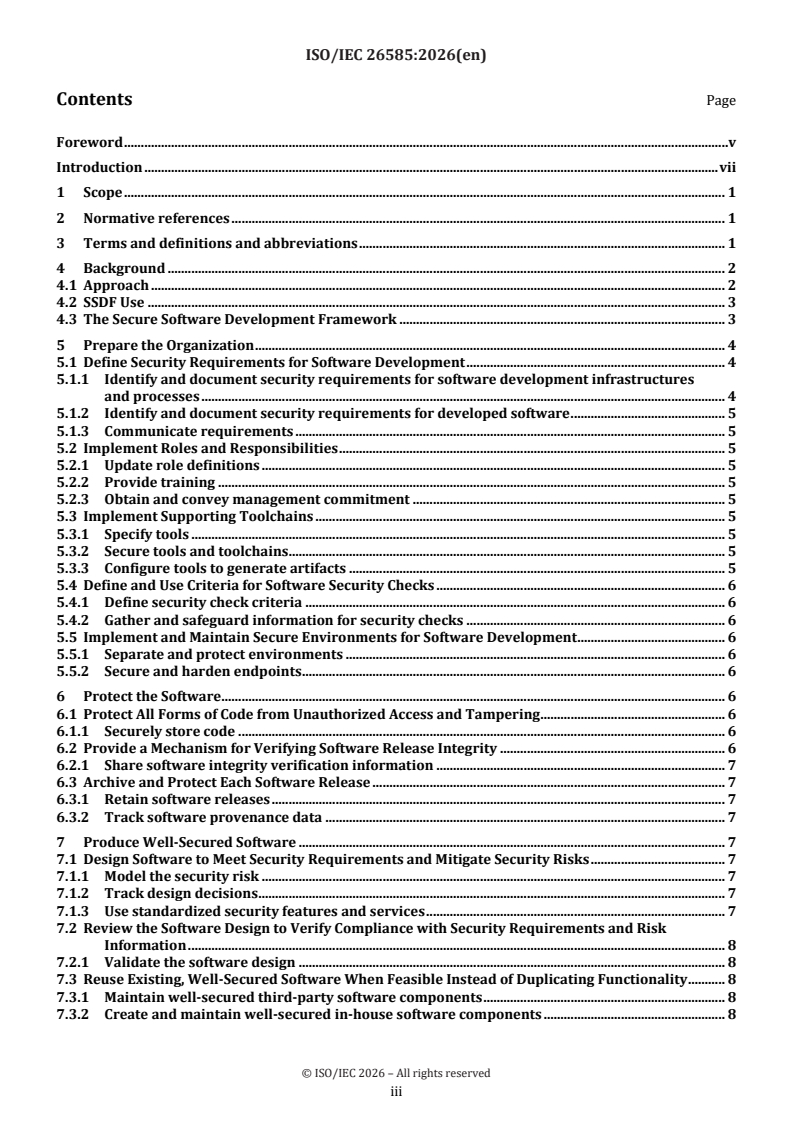
Contents Page
Foreword . v
Introduction . vii
1 Scope . 1
2 Normative references . 1
3 Terms and definitions and abbreviations . 1
4 Background . 2
4.1 Approach . 2
4.2 SSDF Use . 3
4.3 The Secure Software Development Framework . 3
5 Prepare the Organization . 4
5.1 Define Security Requirements for Software Development . 4
5.1.1 Identify and document security requirements for software development infrastructures
and processes . 4
5.1.2 Identify and document security requirements for developed software . 5
5.1.3 Communicate requirements . 5
5.2 Implement Roles and Responsibilities . 5
5.2.1 Update role definitions . 5
5.2.2 Provide training . 5
5.2.3 Obtain and convey management commitment . 5
5.3 Implement Supporting Toolchains . 5
5.3.1 Specify tools . 5
5.3.2 Secure tools and toolchains. 5
5.3.3 Configure tools to generate artifacts . 5
5.4 Define and Use Criteria for Software Security Checks . 6
5.4.1 Define security check criteria . 6
5.4.2 Gather and safeguard information for security checks . 6
5.5 Implement and Maintain Secure Environments for Software Development . 6
5.5.1 Separate and protect environments . 6
5.5.2 Secure and harden endpoints . 6
6 Protect the Software . 6
6.1 Protect All Forms of Code from Unauthorized Access and Tampering . 6
6.1.1 Securely store code . 6
6.2 Provide a Mechanism for Verifying Software Release Integrity . 6
6.2.1 Share software integrity verification information . 7
6.3 Archive and Protect Each Software Release . 7
6.3.1 Retain software releases . 7
6.3.2 Track software provenance data . 7
7 Produce Well-Secured Software . 7
7.1 Design Software to Meet Security Requirements and Mitigate Security Risks . 7
7.1.1 Model the security risk . 7
7.1.2 Track design decisions . 7
7.1.3 Use standardized security features and services . 7
7.2 Review the Software Design to Verify Compliance with Security Requirements and Risk
Information . 8
7.2.1 Validate the software design . 8
7.3 Reuse Existing, Well-Secured Software When Feasible Instead of Duplicating Functionality . 8
7.3.1 Maintain well-secured third-party software components . 8
7.3.2 Create and maintain well-secured in-house software components . 8
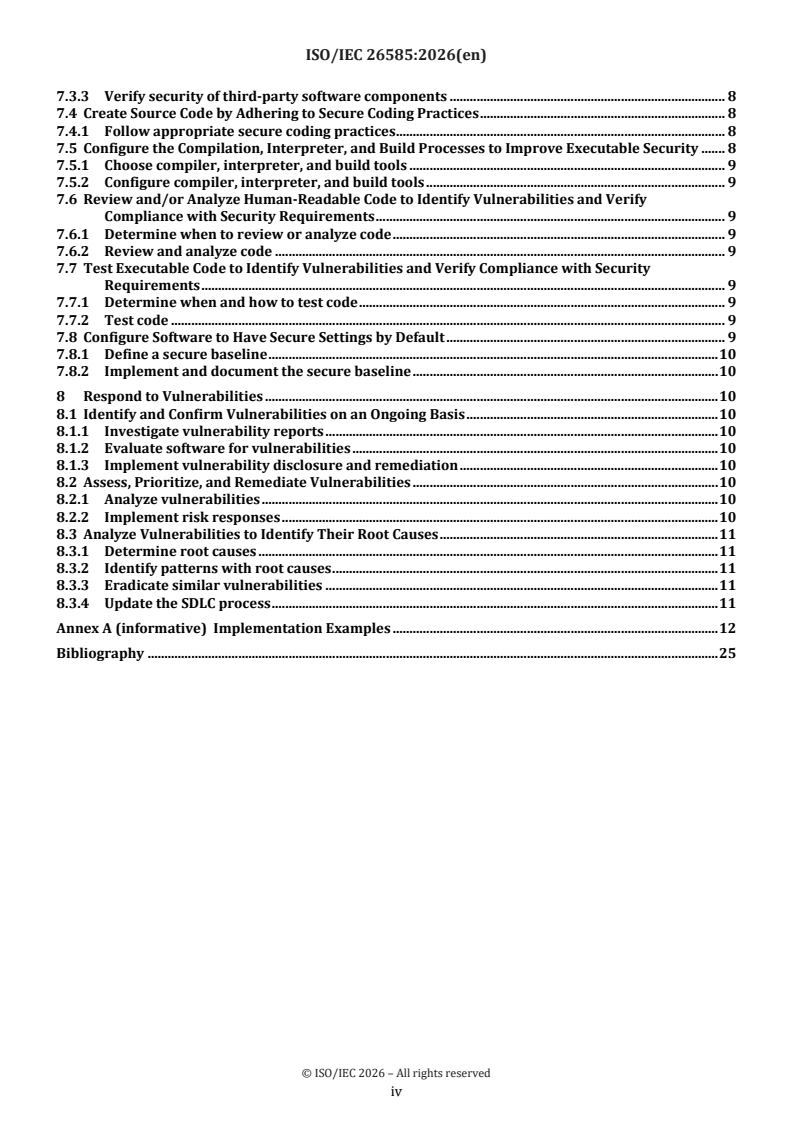
© ISO/IEC 2026 – All rights reserved
iii
7.3.3 Verify security of third-party software components . 8
7.4 Create Source Code by Adhering to Secure Coding Practices . 8
7.4.1 Follow appropriate secure coding practices . 8
7.5 Configure the Compilation, Interpreter, and Build Processes to Improve Executable Security . 8
7.5.1 Choose compiler, interpreter, and build tools . 9
7.5.2 Configure compiler, interpreter, and build tools . 9
7.6 Review and/or Analyze Human-Readable Code to Identify Vulnerabilities and Verify
Compliance with Security Requirements . 9
7.6.1 Determine when to review or analyze code . 9
7.6.2 Review and analyze code . 9
7.7 Test Executable Code to Identify Vulnerabilities and Verify Compliance with Security
Requirements . 9
7.7.1 Determine when and how to test code . 9
7.7.2 Test code . 9
7.8 Configure Software to Have Secure Settings by Default . 9
7.8.1 Define a secure baseline . 10
7.8.2 Implement and document the secure baseline . 10
8 Respond to Vulnerabilities . 10
8.1 Identify and Confirm Vulnerabilities on an Ongoing Basis . 10
8.1.1 Investigate vulnerability reports . 10
8.1.2 Evaluate software for vulnerabilities . 10
8.1.3 Implement vulnerability disclosure and remediation . 10
8.2 Assess, Prioritize, and Remediate Vulnerabilities . 10
8.2.1 Analyze vulnerabilities . 10
8.2.2 Implement risk responses . 10
8.3 Analyze Vulnerabilities to Identify Their Root Causes . 11
8.3.1 Determine root causes . 11
8.3.2 Identify patterns with root causes . 11
8.3.3 Eradicate similar vulnerabilities . 11
8.3.4 Update the SDLC process . 11
Annex A (informative) Implementation Examples . 12
Bibliography . 25
© ISO/IEC 2026 – All rights reserved
iv
Foreword
ISO (the International Organization for Standardization) and IEC (the International Electrotechnical
Commission) form the specialized system for worldwide standardization. National bodies that are members
of ISO or IEC participate in the development of International Standards through technical committees
established by the respective organization to deal with particular fields of technical activity. ISO and IEC
technical committees collaborate in fields of mutual interest. Other international organizations, governmental
and non-governmental, in liaison with ISO and IEC, also take part in the work.
The procedures used to develop this document and those intended for its further maintenance are described
in the ISO/IEC Directives, Part 1. In particular, the different approval criteria needed for the different types of
document should be noted (see www.iso.org/directives or www.iec.ch/members_experts/refdocs).
ISO and IEC draw attention to the possibility that the implementation of this document may involve the use of
(a) patent(s). ISO and IEC take no position concerning the evidence, validity or applicability of any claimed
patent rights in respect thereof. As of the date of publication of this document, ISO and IEC had not received
notice of (a) patent(s) which may be required to implement this document. However, implementers are
cautioned that this may not represent the latest information, which may be obtained from the patent database
available at www.iso.org/patents and https://patents.iec.ch. ISO and IEC shall not be held responsible for
identifying any or all such patent rights.
Any trade name used in this document is information given for the convenience of users and does not
constitute an endorsement.
For an explanation of the voluntary nature of standards, the meaning of ISO specific terms and expressions
related to conformity assessment, as well as information about ISO's adherence to the World Trade
Organization (WTO) principles in the Technical Barriers to Trade (TBT), see www.iso.org/iso/foreword.html.
In the IEC, see www.iec.ch/understanding-standards.
This document was prepared by INCITS (as INCITS 585-2025) and drafted in accordance with its editorial
rules. It was adopted, under the JTC 1 PAS procedure, by Joint Technical Committee ISO/IEC JTC 1, Information
technology.
Any feedback or questions on this document should be directed to the user’s national standards body. A
complete listing of these bodies can be found at www.iso.org/members.html and www.iec.ch/national-
committees.
© ISO/IEC 2026 – All rights reserved
v
Foreword (This foreword is not part of American National Standard INICTS 585-2025.)
The Secure Software Development Framework describes a core set of high-level secure software development
practices that can be integrated into any software development life cycle (SDLC) implementation. Following
such practices should help software producers reduce the number of vulnerabilities in released software,
reduce the potential impact of the exploitation of undetected or unaddressed vulnerabilities, and address the
root causes of vulnerabilities to prevent future recurrences. Because the framework provides a common
vocabulary for secure software development, software acquirers can also use it to foster communications with
suppliers in acquisition processes and other management activities. This standard was developed by
Technical Committee Cybersecurity and Privacy of Accredited Standards Committee INCITS during 2023-
2024. The standards approval process started in 2023.
Requests for interpretation, suggestions for improvements or addenda, or defect reports are welcome. They
should be sent to the INCITS Secretariat, Information Technology Industry Council, 700 K St NW, Suite 600,
Washington, DC 20001.
This standard was processed and approved for submittal to ANSI by the InterNational Committee for
Information Technology Standards (INCITS).
© ISO/IEC 2026 – All rights reserved
vi
Introduction
A software development life cycle (SDLC) is a formal or informal methodology for designing, creating, and
maintaining software (including code built into hardware). There are many models for SDLCs, including
waterfall, spiral, agile, and agile combined with software development and IT operations (DevOps) practices.
Regardless of which SDLC model is used, secure software development practices should be integrated
throughout it for three reasons: to reduce the number of vulnerabilities in released software, to reduce the
potential impact of the exploitation of undetected or unaddressed vulnerabilities, and to address the root
causes of vulnerabilities to prevent recurrences. Vulnerabilities include not just bugs caused by coding flaws,
but also weaknesses caused by security configuration settings, incorrect trust assumptions, and outdated risk
analysis.
Most aspects of security can be addressed multiple times within an SDLC, but in general, the earlier in the
SDLC that security is addressed, the less effort and cost is ultimately required to achieve the same level of
security. This principle, known as shifting left, is critically important regardless of the SDLC model. Shifting
left minimizes any technical debt that would require remediating early security flaws late in development or
after the software is in production. Shifting left can also result in software with stronger security and
resiliency.
© ISO/IEC 2026 – All rights reserved
vii
International Standard ISO/IEC 26585:2026(en)
Information technology — Cybersecurity — Secure software
development framework
1 Scope
This document provides a framework for secure software development practices.
2 Normative references
There are no normative references in this document.
3 Terms and definitions and abbreviations
ISO and IEC maintain terminology databases for use in standardization at the following addresses:
— ISO Online browsing platform: available at https://www.iso.org/obp
— IEC Electropedia: available at https://www.electropedia.org/
3.1
artifact
piece of evidence
Note 1 to entry: Artifacts provide records of secure software development practices.
3.2
environment
context determining the setting and circumstances of all influences upon a system
[SOURCE: ISO/IEC/IEEE 42010:2011]
3.3
provenance
information on the place and time of origin, derivation or generation of a data set, proof of authenticity of the
data set, or a record of past and present ownership of the data set
[SOURCE: ISO/IEC 11179-33:2023. 3.11, modified – references to the definition of data set have been
removed.]
3.4
secure software development framework
high-level practices based on established standards, guidance, and secure software development practice
documents
© ISO/IEC 2026 – All rights reserved
3.5
software development life cycle
a formal or informal methodology for designing, creating, and maintaining software (including code built into
hardware)
3.6
stakeholder
person or organization that can affect, be affected by, or perceive itself to be affected by a decision or activity
[SOURCE: ISO/IEC 27000:2018]
Abbreviations
SDLC software development life cycle
SSDF Secure Software Development Framework
4 Background
This document describes a set of high-level secure software development practices based on established
standards, guidance, and other documents. These practices, collectively called the Secure Software
Development Framework (SSDF), are intended to help the target audiences achieve secure software
development objectives. Many of the practices directly involve the software itself, while others indirectly
involve it (e.g., securing the development environment).
This document provides a common language to describe fundamental secure software development practices.
Expertise in secure software development is not required to understand the practices. The common language
helps facilitate communications about secure software practices among both internal and external
organizational stakeholders, such as:
• Business owners, software developers, project managers and leads, cybersecurity professionals, and
operations and platform engineers within an organization who need to clearly communicate with each
other about secure software development
• Software acquirers that want to define required or desired characteristics for software in their
acquisition processes in order to have higher-quality software (particularly with fewer significant
security vulnerabilities)
• Software producers (e.g., commercial-off-the-shelf [COTS] product vendors, government-off-the-shelf
[GOTS] software developers, software developers working within or on behalf of software acquirer
organizations) that want to integrate secure software development practices throughout their SDLCs,
express their secure software practices to their customers, or define requirements for their suppliers
4.1 Approach
This document identifies secure software development practices but does not prescribe how to implement
them. The focus is on the outcomes of the practices to be implemented rather than on the tools, techniques,
and mechanisms used to do so. Advantages of specifying the practices at a high level include the following:
• Can be used by organizations in any sector or community, regardless of size or cybersecurity
sophistication
• Can be applied to software developed to support information technology (IT), artificial intelligence
(AI), industrial control systems (ICS), cyber-physical systems (CPS), or the Internet of Things (IoT)
© ISO/IEC 2026 – All rights reserved
• Can be integrated into any existing software development workflow and automated toolchain; should
not negatively affect organizations that already have robust secure software development practices in
place
• Makes the practices broadly applicable, not specific to particular technologies, platforms,
programming languages, SDLC models, development environments, operating environments, tools,
etc.
• Can help an organization document its secure software development practices today and define its
future target practices as part of its continuous improvement process
• Can assist an organization currently using a classic software development model in transitioning its
secure software development practices for use with a modern software development model (e.g., agile,
DevOps)
• Can assist organizations that are procuring and using software to understand secure software
development practices employed by their suppliers
4.2 SSDF Use
This document’s practices are not based on the assumption that all organizations have the same security
objectives and priorities. Rather, the recommendations reflect that each software producer may have unique
security requirements, and each software acquirer may have unique security needs and requirements. While
the aim is for each software producer to follow all applicable practices, the expectation is that the degree to
which each practice is implemented and the formality of the implementation will vary based on the producer’s
security requirements. The practices provide flexibility for implementers, but they are also clear to avoid
leaving too much open to interpretation.
Although most of these practices are relevant to any software development effort, some are not. For example,
if developing a particular piece of software does not involve using a compiler, there would be no need to follow
a practice on configuring the compiler to improve executable security. Some practices are foundational, while
others are more advanced and depend on certain foundational practices already being in place. Also, practices
are not all equally important for all cases.
Factors such as risk, cost, feasibility, and applicability should be considered when deciding which practices to
use and how much time and resources to devote to each practice. Automatability is also an important factor
to consider, especially for implementing practices at scale. The practices, tasks, and implementation examples
(implementation examples are in Annex A) represent a starting point to consider; they are meant to be
changed and customized, and they are not prioritized. Any stated frequency for performing practices is
notional. The intention of the SSDF is not to create a checklist to follow, but to provide a basis for planning and
implementing a risk-based approach to adopting secure software development practices.
The responsibility for implementing the practices may be distributed among different organizations based on
the delivery of the software and services (e.g., infrastructure as a service, software as a service, platform as a
service, container as a service, serverless). In these situations, it likely follows a shared responsibility model
involving the platform/service providers and the tenant organization that is consuming those
platforms/services. The tenant organization should establish an agreement with the providers that specifies
which party is responsible for each practice and task and how each provider will attest to their conformance
with the agreement.
4.3 The Secure Software Development Framework
This document defines the Secure Software Development Framework (SSDF) with fundamental, sound, and
secure recommended practices based on established secure software development practice documents. The
practices are organized into four practice groups:
© ISO/IEC 2026 – All rights reserved
Prepare the Organization: Organizations should ensure that their people, processes, and technology are
prepared to perform secure software development at the organization level. Many organizations will find
some Prepare the Organization practices to also be applicable to subsets of their software development, like
individual development groups or projects. Prepare the Organization provides a foundation for the other
practice groups, as Figure 1 depicts.
Protect the Software : Organizations should protect all components of their software from tampering and
unauthorized access.
Produce Well-Secured Software: Organizations should produce well-secured software with minimal
security vulnerabilities in its releases.
Respond to Vulnerabilities: Organizations should identify residual vulnerabilities in their software releases
and respond appropriately to address those vulnerabilities and prevent similar ones from occurring in the
future.
Figure 1. SSDF Practice Groups
Each practice group contains multiple practices. Each practice definition includes the name of the practice,
followed by a brief explanation of what the practice is and why it is beneficial. Each practice also defines one
or more tasks, which are actions that may be needed to perform the practice. A task definition includes an
explanation of the task.
The rest of this document defines the practices. Note that the order of the practices and tasks is not intended
to imply the sequence of implementation or the relative importance of any practice or task.
5 Prepare the Organization
Organizations should ensure that their people, processes, and technology are prepared to perform secure
software development at the organization level. Many organizations will find some of these practices to also
be applicable to subsets of their software development, like individual development groups or projects.
5.1 Define Security Requirements for Software Development
Ensure that security requirements for software development are known at all times so that they can be taken
into account throughout the SDLC and requirements information can be collected once and shared to minimize
the duplication of effort. This includes requirements from internal sources (e.g., the organization’s policies,
business objectives, and risk management strategy) and external sources (e.g., applicable laws and
regulations).
5.1.1 Identify and document security requirements for software development infrastructures and
processes
Identify and document all security requirements for the organization’s software development
infrastructures and processes, and maintain the requirements over time.
© ISO/IEC 2026 – All rights reserved
5.1.2 Identify and document security requirements for developed software
Identify and document all security requirements for organization-developed software to meet, and maintain
the requirements over time.
5.1.3 Communicate requirements
Communicate requirements to all third parties who will provide commercial software components to the
organization for reuse by the organization’s own software.
5.2 Implement Roles and Responsibilities
Ensure that everyone inside and outside of the organization involved in the SDLC is prepared to perform their
SDLC-related roles and responsibilities throughout the SDLC.
5.2.1 Update role definitions
Create new roles and alter responsibilities for existing roles as needed to encompass all parts of the SDLC.
Periodically review and maintain the defined roles and responsibilities, updating them as needed.
5.2.2 Provide training
Provide role-based training for all personnel with responsibilities that contribute to secure development.
Periodically review personnel proficiency and role-based training, and update the training as needed.
5.2.3 Obtain and convey management commitment
Obtain upper management or authorizing official commitment to secure development and convey that
commitment to those with development related roles and responsibilities.
5.3 Implement Supporting Toolchains
Use automation to reduce human effort and improve the accuracy, reproducibility, usability, and
comprehensiveness of security practices throughout the SDLC, as well as provide a way to document and
demonstrate the use of these practices. Toolchains and tools may be used at different levels of the
organization, such as organization-wide or project-specific, and may address a particular part of the SDLC, like
a build pipeline.
5.3.1 Specify tools
Specify which tools or tool types must or should be included in each toolchain to mitigate identified risks, as
well as how the toolchain components are to be integrated with each other.
5.3.2 Secure tools and toolchains
Follow recommended security practices to deploy, operate, and maintain tools and toolchains.
5.3.3 Configure tools to generate artifacts
Configure tools to generate artifacts representing evidence of secure software development practices as
defined by the organization.
© ISO/IEC 2026 – All rights reserved
5.4 Define and Use Criteria for Software Security Checks
Help ensure that the software resulting from the SDLC meets the organization’s expectations by defining and
using criteria for checking the software’s security during development.
5.4.1 Define security check criteria
Define criteria for software security checks and track throughout the SDLC.
5.4.2 Gather and safeguard information for security checks
Implement processes, mechanisms, and controls to gather and safeguard the necessary information in support
of the criteria.
5.5 Implement and Maintain Secure Environments for Software Development
Ensure that all components of the environments for software development are strongly protected from
internal and external threats to prevent compromises of the environments or the software being developed
or maintained within them. Examples of environments for software development include development, build,
test, and distribution environments.
5.5.1 Separate and protect environments
Separate and protect each environment involved in software development.
5.5.2 Secure and harden endpoints
Secure and harden development endpoints (i.e., endpoints for software designers, developers, testers,
builders, etc.) to perform development-related tasks using a risk-based approach.
6 Protect the Software
Organizations should protect all components of their software from tampering and unauthorized access.
6.1 Protect All Forms of Code from Unauthorized Access and Tampering
Help prevent unauthorized changes to code, both inadvertent and intentional, which could circumvent or
negate the intended security characteristics of the software. Code not intended to be publicly accessible is
accessible only for authorized access to help prevent theft of the software and potentially make it more
difficult or time-consuming for attackers to find vulnerabilities in the software.
6.1.1 Securely store code
Store all forms of code – including source code, executable code, and configuration-as-code – based on the
principle of least privilege so that only authorized personnel, tools, services, etc. have access.
6.2 Provide a Mechanism for Verifying Software Release Integrity
Help software acquirers ensure that the software they acquire is authentic and has not been tampered with.
© ISO/IEC 2026 – All rights reserved
6.2.1 Share software integrity verification information
Make software integrity verification information available to software acquirers (e.g., cryptographic
checksums or digital signatures captured in a machine-readable data format that can be used with a software
bill of materials (SBOM) or a provenance tracking system).
6.3 Archive and Protect Each Software Release
Preserve software releases in order to help identify, analyze, and eliminate vulnerabilities discovered in the
software after release.
6.3.1 Retain software releases
Securely archive the necessary files and supporting data (e.g., integrity verification information, provenance
data) to be retained for each software release.
6.3.2 Track software provenance data
Collect, safeguard, maintain, and track provenance data for all components of each software release as artifacts
for traceability and sharing when appropriate (e.g., in a software bill of materials (SBOM) or provenance
tracking system).
7 Produce Well-Secured Software
Organizations should produce well-secured software with minimal security vulnerabilities in its releases.
7.1 Design Software to Meet Security Requirements and Mitigate Security Risks
Identify and evaluate the security requirements for the software; determine what security risks the software
is likely to face during operation and how the software’s design and architecture should mitigate those risks;
and document any cases where risk-based analysis indicates that security requirements should be relaxed or
waived. Addressing security requirements and risks during software design (secure by design) is key for
improving software security and also helps improve development efficiency.
7.1.1 Model the security risk
Use forms of risk modeling – such as threat modeling, attack modeling, or attack surface mapping – to help
assess the security risk for the software.
7.1.2 Track design decisions
Track and maintain the software’s security requirements, risks, and design decisions.
7.1.3 Use standardized security features and services
Where appropriate, build in support for using standardized security features and services (e.g., enabling
software to integrate with existing log management, identity management, access control, and vulnerability
management systems) instead of creating proprietary implementations of security features and services.
© ISO/IEC 2026 – All rights reserved
7.2 Review the Software Design to Verify Compliance with Security Requirements and
Risk Information
Help ensure that the software will meet the security requirements and satisfactorily address the identified
risk information.
7.2.1 Validate the software design
Have 1) a qualified person (or people) who were not involved with the design and/or 2) automated processes
instantiated in the toolchain review the software design to confirm and enforce that it meets all of the security
requirements and satisfactorily addresses the identified risk information.
7.3 Reuse Existing, Well-Secured Software When Feasible Instead of Duplicating
Functionality
Lower the costs of software development, expedite software development, and decrease the likelihood of
introducing additional security vulnerabilities into the software by reusing software modules and services
that have already had their security posture verified. This is particularly important for software that
implements security functionality, such as cryptographic modules and protocols.
7.3.1 Maintain well-secured third-party software components
Acquire and maintain well-secured software components (e.g., software libraries, modules, middleware,
frameworks) from commercial, opensource, and other third-party developers for use by the organization’s
software.
7.3.2 Create and maintain well-secured in-house software components
Create and maintain well-secured software components in-house following SDLC processes to meet common
internal software development needs that cannot be better met by third-party software components.
7.3.3 Verify security of third-party software components
Verify that acquired commercial, open-source, and all other third-party software components comply with the
requirements, as defined by the organization, throughout their life cycles.
7.4 Create Source Code by Adhering to Secure Coding Practices
Decrease the number of security vulnerabilities in the software and reduce costs by minimizing vulnerabilities
introduced during source code creation.
7.4.1 Follow appropriate secure coding practices
Follow all secure coding practices that are appropriate to the development languages and environment to
meet the organization’s requirements.
7.5 Configure the Compilation, Interpreter, and Build Processes to Improve Executable
Security
Decrease the number of security vulnerabilities in the software and reduce costs by eliminating vulnerabilities
before testing occurs.
© ISO/IEC 2026 – All rights reserved
7.5.1 Choose compiler, interpreter, and build tools
Use compiler, interpreter, and build tools that offer features to improve executable security.
7.5.2 Configure compiler, interpreter, and build tools
Determine which compiler, interpreter, and build tool features should be used and how each should be
configured, then implement and use the approved configurations.
7.6 Review and/or Analyze Human-Readable Code to Identify Vulnerabilities and Verify
Compliance with Security Requirements
Help identify vulnerabilities so that they can be corrected before the software is released to prevent
exploitation. Using automated methods lowers the effort and resources needed to detect vulnerabilities.
Human-readable code includes source code, scripts, and any other form of code that an organization deems
human readable.
7.6.1 Determine when to review or analyze code
Determine whether code review (a person looks directly at the code to find issues) and/or code analysis (tools
are used to find issues in code, either in a fully automated way or in conjunction with a person) should be used,
as defined by the organization.
7.6.2 Review and analyze code
Perform the code review and/or code analysis based on the organization’s secure coding standards, and
record and triage all discovered issues and recommended remediations in the development team’s workflow
or issue tracking system.
7.7 Test Executable Code to Identify Vulnerabilities and Verify Compliance with Security
Requirements
Help identify vulnerabilities so that they can be corrected before the software is released in order to prevent
exploitation. Using automated methods lowers the effort and resources needed to detect vulnerabilities and
improves traceability and repeatability. Executable code includes binaries, directly executed bytecode and
source code, and any other form of code that an organization deems executable.
7.7.1 Determine when and how to test code
Determine whether executable code testing should be performed to find vulnerabilities not identified by
previous reviews, analysis, or testing and, if so, which types of testing should be used.
7.7.2 Test code
Scope the testing, design the tests, perform the testing, and document the results, including recording and
triaging all discovered issues and recommended remediations in the development team’s workflow or issue
tracking system.
7.8 Configure Software to Have Secure Settings by Default
Help improve the security of the software at the time of installation to reduce the likelihood of the software
being deployed with weak security settings, putting it at greater risk of compromise.
© ISO/IEC 2026 – All rights reserved
7.8.1 Define a secure baseline
Define a secure baseline by determining how to configure each setting that influences security or a security-
related setting so that the default settings are secure and do not weaken the security functions provided by
the platform, network infrastructure, or services.
7.8.2 Implement and document the secure baseline
Implement the default settings (or groups of default settings, if applicable), and document each setting for
software administrators
8 Respond to Vulnerabilities
Organizations should identify residual vulnerabilities in their software releases and respond appropriately to
address those vulnerabilities and prevent similar ones from occurring in the future.
8.1 Identify and Confirm Vulnerabilities on an Ongoing Basis
Help ensure that vulnerabilities are identified more quickly so that they can be remediated more quickly in
accordance with risk, reducing the window of opportunity for attackers.
8.1.1 Investigate vulnerability reports
Gather information from software acquirers, users, and public sources on potential vulnerabilities in the
software and third-party components that the software uses, and investigate all credible reports.
8.1.2 Evaluate software for vulnerabilities
Review, analyze, and/or test the software’s code to identify or confirm the presence of previously undetected
...