


ISO 21942:2019
(Main)Station uniform for firefighters
Station uniform for firefighters
This document sets out minimum performance requirements for station uniforms for firefighters that are provided by agencies to be worn under primary protective garments compliant with the relevant standards. NOTE A station uniform, as defined by this document, is understood to not be a formal uniform or parade uniform, which are not likely to be worn under primary protective firefighting garments. Garments developed in accordance with this document complement the performance built into primary protection firefighting garments in terms of minimising impact on hindrance, metabolic heat and comfort. This document specifies two levels of requirements for station uniforms: — Level 1 specifies minimum no melting nor dripping requirements that provide no additional protection but ensure the firefighter is not harmed by the melting of station uniform materials in cases where heat or flames impinge the station uniform. — Level 2 specifies heat and flame requirements to provide minimum protection. It can be combined with additional layers or garments to meet the requirements of a standard for a specific primary protection garment, this combination should provide improved protection and comfort.
Tenue de travail pour les pompiers
General Information
- Status
- Published
- Publication Date
- 18-Nov-2019
- Technical Committee
- ISO/TC 94/SC 14 - Firefighters' personal equipment
- Drafting Committee
- ISO/TC 94/SC 14/WG 2 - Firefighting
- Current Stage
- 9060 - Close of review
- Completion Date
- 04-Jun-2030
Relations
- Effective Date
- 24-Sep-2022
Overview
ISO 21942:2019 - Station uniform for firefighters - sets minimum performance and design requirements for agency‑issued station uniforms (station wear) intended to be worn under primary protective garments. It defines two protection levels:
- Level 1: materials must exhibit no melting / no dripping to avoid secondary burn hazards (provides no additional thermal protection).
- Level 2: minimum heat and flame performance to give basic protection and can be combined with other layers to contribute to primary protection.
The standard emphasizes comfort, ergonomics and minimizing hindrance and metabolic heat when worn under turnout or other primary protective garments.
Key topics and technical requirements
ISO 21942:2019 references established test methods and specifies performance areas rather than prescriptive designs. Key topics include:
- Protection levels: Level 1 (no melt/no drip) and Level 2 (minimum heat & flame requirements).
- Limited flame spread: Testing in accordance with ISO 15025 (Procedure A).
- Heat resistance: Required heat resistance testing (including a test at ~180 °C and an optional higher‑temperature test).
- Heat transmission: Convective and radiant heat transmission requirements (referencing methods such as ISO 9151, ISO 6942, ISO 17493).
- Physical performance: Tensile strength, tear strength, bursting strength, seam strength and optional abrasion resistance.
- Comfort & ergonomics: Thermal resistance and water‑vapour resistance (ISO 11092) to ensure wearer comfort during duties.
- Material acceptability: Innocuousness and colour fastness, sampling/pre‑treatment and conditioning procedures.
- Optional properties: Electrostatic resistance and other optional tests (e.g., EN 1149 series).
- Marking & manufacturer information: Requirements for labelling and supplied information to users.
- Risk assessment: Guidance to select appropriate level based on operational risk (informative Annex A).
Applications and who uses it
ISO 21942:2019 is used by:
- Fire and rescue services specifying agency station uniforms that will be worn under turnout gear.
- PPE and workwear manufacturers designing firefighter station wear to meet agency procurement requirements.
- Procurement officers, safety managers and standards committees who need to ensure compatibility between station wear and primary protective garments.
- Occupational safety professionals and test laboratories implementing referenced test methods.
Practical benefits include reduced secondary burn risk (no melt/drip), improved wearer comfort and a clear basis for combining station wear with primary protective layers to meet higher protection needs.
Related standards
- ISO 11612 (protection against heat and flame)
- ISO 13688 (general requirements for protective clothing)
- ISO 15025, ISO 9151, ISO 6942, ISO 11092 (test methods)
- ISO/TR 21808 (selection, use, care and maintenance guidance)
- ISO 11999‑3 (integration with turn‑out gear standards)
Keywords: ISO 21942, station uniform for firefighters, firefighter station wear, no melt no drip, Level 1, Level 2, heat and flame requirements, PPE, protective clothing.
Frequently Asked Questions
ISO 21942:2019 is a standard published by the International Organization for Standardization (ISO). Its full title is "Station uniform for firefighters". This standard covers: This document sets out minimum performance requirements for station uniforms for firefighters that are provided by agencies to be worn under primary protective garments compliant with the relevant standards. NOTE A station uniform, as defined by this document, is understood to not be a formal uniform or parade uniform, which are not likely to be worn under primary protective firefighting garments. Garments developed in accordance with this document complement the performance built into primary protection firefighting garments in terms of minimising impact on hindrance, metabolic heat and comfort. This document specifies two levels of requirements for station uniforms: — Level 1 specifies minimum no melting nor dripping requirements that provide no additional protection but ensure the firefighter is not harmed by the melting of station uniform materials in cases where heat or flames impinge the station uniform. — Level 2 specifies heat and flame requirements to provide minimum protection. It can be combined with additional layers or garments to meet the requirements of a standard for a specific primary protection garment, this combination should provide improved protection and comfort.
This document sets out minimum performance requirements for station uniforms for firefighters that are provided by agencies to be worn under primary protective garments compliant with the relevant standards. NOTE A station uniform, as defined by this document, is understood to not be a formal uniform or parade uniform, which are not likely to be worn under primary protective firefighting garments. Garments developed in accordance with this document complement the performance built into primary protection firefighting garments in terms of minimising impact on hindrance, metabolic heat and comfort. This document specifies two levels of requirements for station uniforms: — Level 1 specifies minimum no melting nor dripping requirements that provide no additional protection but ensure the firefighter is not harmed by the melting of station uniform materials in cases where heat or flames impinge the station uniform. — Level 2 specifies heat and flame requirements to provide minimum protection. It can be combined with additional layers or garments to meet the requirements of a standard for a specific primary protection garment, this combination should provide improved protection and comfort.
ISO 21942:2019 is classified under the following ICS (International Classification for Standards) categories: 13.340.10 - Protective clothing. The ICS classification helps identify the subject area and facilitates finding related standards.
ISO 21942:2019 has the following relationships with other standards: It is inter standard links to ISO 21942:2019/Amd 1:2024. Understanding these relationships helps ensure you are using the most current and applicable version of the standard.
You can purchase ISO 21942:2019 directly from iTeh Standards. The document is available in PDF format and is delivered instantly after payment. Add the standard to your cart and complete the secure checkout process. iTeh Standards is an authorized distributor of ISO standards.
Standards Content (Sample)
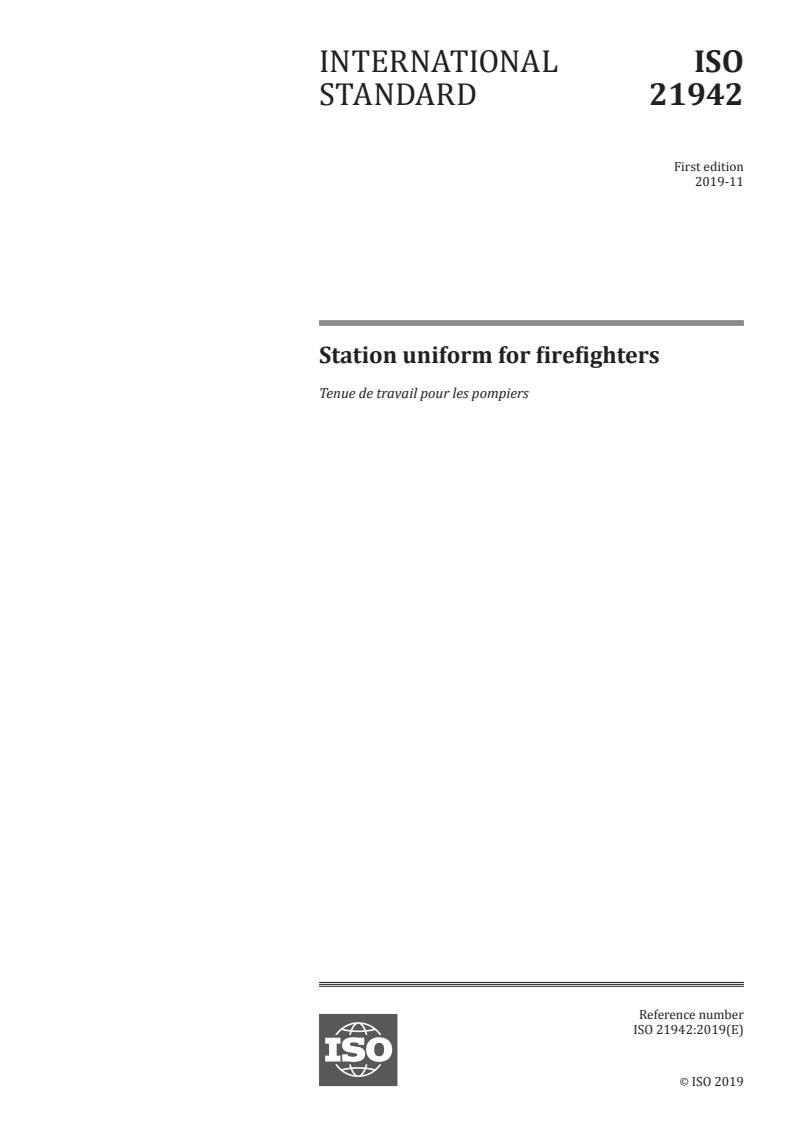
INTERNATIONAL ISO
STANDARD 21942
First edition
2019-11
Station uniform for firefighters
Tenue de travail pour les pompiers
Reference number
©
ISO 2019
© ISO 2019
All rights reserved. Unless otherwise specified, or required in the context of its implementation, no part of this publication may
be reproduced or utilized otherwise in any form or by any means, electronic or mechanical, including photocopying, or posting
on the internet or an intranet, without prior written permission. Permission can be requested from either ISO at the address
below or ISO’s member body in the country of the requester.
ISO copyright office
CP 401 • Ch. de Blandonnet 8
CH-1214 Vernier, Geneva
Phone: +41 22 749 01 11
Fax: +41 22 749 09 47
Email: copyright@iso.org
Website: www.iso.org
Published in Switzerland
ii © ISO 2019 – All rights reserved
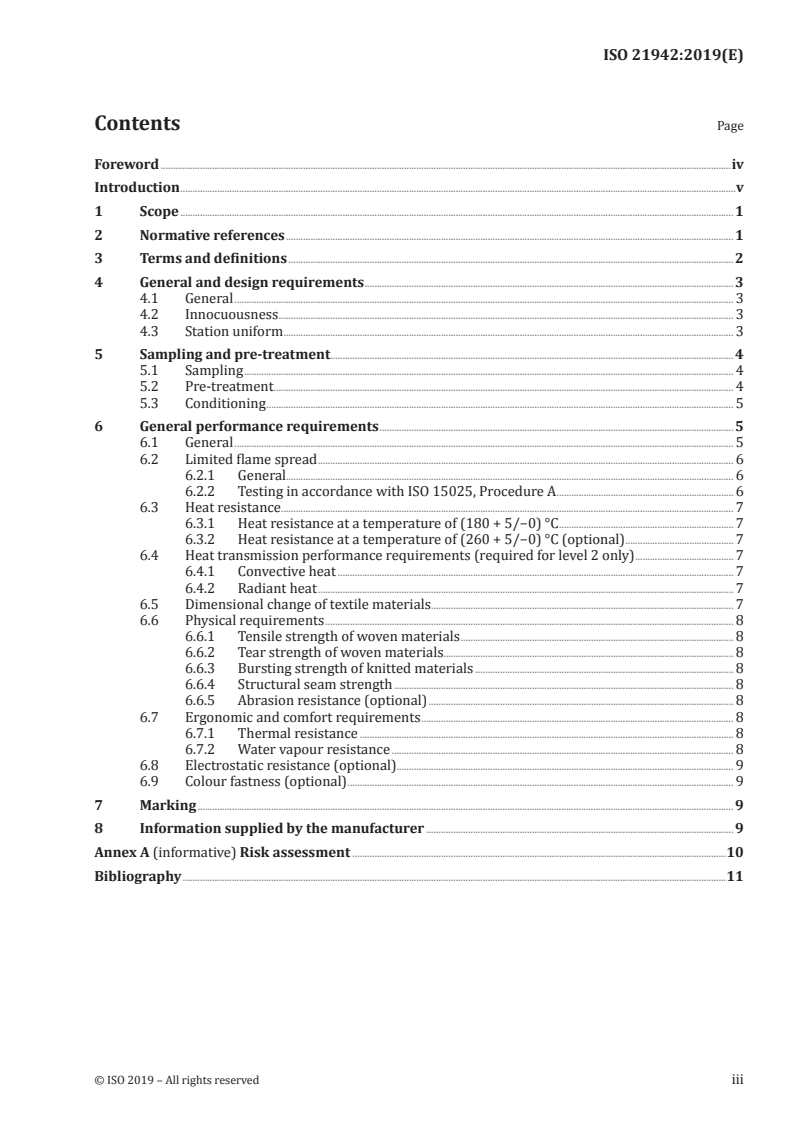
Contents Page
Foreword .iv
Introduction .v
1 Scope . 1
2 Normative references . 1
3 Terms and definitions . 2
4 General and design requirements . 3
4.1 General . 3
4.2 Innocuousness . 3
4.3 Station uniform . 3
5 Sampling and pre-treatment . 4
5.1 Sampling . 4
5.2 Pre-treatment . 4
5.3 Conditioning . 5
6 General performance requirements . 5
6.1 General . 5
6.2 Limited flame spread . 6
6.2.1 General. 6
6.2.2 Testing in accordance with ISO 15025, Procedure A . 6
6.3 Heat resistance . 7
6.3.1 Heat resistance at a temperature of (180 + 5/−0) °C . 7
6.3.2 Heat resistance at a temperature of (260 + 5/−0) °C (optional) . 7
6.4 Heat transmission performance requirements (required for level 2 only) . 7
6.4.1 Convective heat . 7
6.4.2 Radiant heat . 7
6.5 Dimensional change of textile materials . 7
6.6 Physical requirements . 8
6.6.1 Tensile strength of woven materials . 8
6.6.2 Tear strength of woven materials. 8
6.6.3 Bursting strength of knitted materials . 8
6.6.4 Structural seam strength . 8
6.6.5 Abrasion resistance (optional) . 8
6.7 Ergonomic and comfort requirements . 8
6.7.1 Thermal resistance . 8
6.7.2 Water vapour resistance . 8
6.8 Electrostatic resistance (optional) . 9
6.9 Colour fastness (optional) . 9
7 Marking . 9
8 Information supplied by the manufacturer . 9
Annex A (informative) Risk assessment .10
Bibliography .11
Foreword
ISO (the International Organization for Standardization) is a worldwide federation of national standards
bodies (ISO member bodies). The work of preparing International Standards is normally carried out
through ISO technical committees. Each member body interested in a subject for which a technical
committee has been established has the right to be represented on that committee. International
organizations, governmental and non-governmental, in liaison with ISO, also take part in the work.
ISO collaborates closely with the International Electrotechnical Commission (IEC) on all matters of
electrotechnical standardization.
The procedures used to develop this document and those intended for its further maintenance are
described in the ISO/IEC Directives, Part 1. In particular the different approval criteria needed for the
different types of ISO documents should be noted. This document was drafted in accordance with the
editorial rules of the ISO/IEC Directives, Part 2 (see www .iso .org/ directives).
Attention is drawn to the possibility that some of the elements of this document may be the subject of
patent rights. ISO shall not be held responsible for identifying any or all such patent rights. Details of
any patent rights identified during the development of the document will be in the Introduction and/or
on the ISO list of patent declarations received (see www .iso .org/ patents).
Any trade name used in this document is information given for the convenience of users and does not
constitute an endorsement.
For an explanation of the voluntary nature of standards, the meaning of ISO specific terms and
expressions related to conformity assessment, as well as information about ISO's adherence to the
World Trade Organization (WTO) principles in the Technical Barriers to Trade (TBT), see www .iso .org/
iso/ foreword .html.
This document was prepared by Technical Committee ISO/TC 94, Personal safety — Personal protective
clothing , Subcommittee SC 14, Firefighters' personal equipment.
Any feedback or questions on this document should be directed to the user’s national standards body. A
complete listing of these bodies can be found at www .iso .org/ members .html.
iv © ISO 2019 – All rights reserved
Introduction
This document provides two levels of performance requirements for station uniforms that may be
provided by agencies that should be worn under primary protection garments compliant with the
relevant standards.
Level 1 is intended to provide limited protection and minimise harm through no melt and no drip
performance of materials, when exposed to accidental heat or flame.
Level 2 is intended to provide minimum protection in case of flame impingement or heat exposure.
The level 2 garment can also be combined with additional garments to contribute to the primary
protection, such as turn-out-gear described in ISO 11999-3. In this case, level 2 will fulfil the minimum
heat and flame requirements of this document and the level 2 garment in combination with additional
layers will fulfil the requirements of the specific primary protection garment for the specific higher
level standard (e.g. turn out gear standards, wildland).
Station uniforms are intended to provide the highest comfort possible through the use of materials that
meet required performance requirements and ergonomics of design.
This document is largely based on ISO 11612, which has been frequently used as a basis to develop and
specify station wear.
Attention is drawn to ISO/TR 21808, which sets out guidelines for selection, use, care, and maintenance
of protective clothing against heat and flame for firefighters.
The level of protection required should be determined using a risk assessment process (see Annex A).
INTERNATIONAL STANDARD ISO 21942:2019(E)
Station uniform for firefighters
1 Scope
This document sets out minimum performance requirements for station uniforms for firefighters that
are provided by agencies to be worn under primary protective garments compliant with the relevant
standards.
NOTE A station uniform, as defined by this document, is understood to not be a formal uniform or parade
uniform, which are not likely to be worn under primary protective firefighting garments.
Garments developed in accordance with this document complement the performance built into primary
protection firefighting garments in terms of minimising impact on hindrance, metabolic heat and
comfort.
This document specifies two levels of requirements for station uniforms:
— Level 1 specifies minimum no melting nor dripping requirements that provide no additional
protection but ensure the firefighter is not harmed by the melting of station uniform materials in
cases where heat or flames impinge the station uniform.
— Level 2 specifies heat and flame requirements to provide minimum protection. It can be combined
with additional layers or garments to meet the requirements of a standard for a specific primary
protection garment, this combination should provide improved protection and comfort.
2 Normative references
The following documents are referred to in the text in such a way that some or all of their content
constitutes requirements of this document. For dated references, only the edition cited applies. For
undated references, the latest edition of the referenced document (including any amendments) applies.
ISO 105-B02, Textiles — Tests for colour fastness — Part B02: Colour fastness to artificial light: Xenon arc
fading lamp test
ISO 105-C06, Textiles — Tests for colour fastness — Part C06: Colour fastness to domestic and commercial
laundering
ISO 105-D01, Textiles — Tests for colour fastness — Part D01: Colour fastness to drycleaning using
perchloroethylene solvent
ISO 105-E04, Textiles — Tests for colour fastness — Part E04: Colour fastness to perspiration
ISO 105-X12, Textiles — Tests for colour fastness — Part X12: Colour fastness to rubbing
ISO 3175-2, Textiles — Professional care, drycleaning and wetcleaning of fabrics and garments — Part 2:
Procedure for testing performance when cleaning and finishing using tetrachloroethene
ISO 5077, Textiles — Determination of dimensional change in washing and drying
ISO 6330, Textiles — Domestic washing and drying procedures for textile testing
ISO 6942, Protective clothing — Protection against heat and fire — Method of test: Evaluation of materials
and material assemblies when exposed to a source of radiant heat
ISO 9151, Protective clothing against heat and flame — Determination of heat transmission on exposure
to flame
ISO 11092, Textiles — Physiological effects — Measurement of thermal and water-vapour resistance under
steady-state conditions (sweating guarded-hotplate test)
ISO 12947-2, Textiles — Determination of the abrasion resistance of fabrics by the Martindale method —
Part 2: Determination of specimen breakdown
ISO 13688, Protective clothing — General requirements
ISO 13934-1, Textiles — Tensile properties of fabrics — Part 1: Determination of maximum force and
elongation at maximum force using the strip method
ISO 13935-2, Textiles — Seam tensile properties of fabrics and made-up textile articles — Part 2:
Determination of maximum force to seam rupture using the grab method
ISO 13937-2, Textiles — Tear properties of fabrics — Part 2: Determination of tear force of trouser-shaped
test specimens (Single tear method)
ISO 13938-1, Textiles — Bursting properties of fabrics — Part 1: Hydraulic method for determination of
bursting strength and bursting distension
ISO 13938-2, Textiles — Bursting properties of fabrics — Part 2: Pneumatic method for determination of
bursting strength and bursting distension
ISO 14116, Protective clothing — Protection against heat and flame — Limited flame spread materials,
material assemblies and clothing
ISO 15025, Protective clothing — Protection against flame — Method of test for limited flame spread
ISO 17493, Clothing and equipment for protection against heat — Test method for convective heat
resistance using a hot air circulating oven
ISO/TR 19591, Personal protective equipment for firefighters — Standard terms and definitions
EN 1149-1, Protective clothing — Electrostatic properties — Part 1: Test method for measurement of
surface resistivity
EN 1149-3, Protective clothing — Electrostatic properties — Part 3: Test methods for measurement of
charge decay
EN 1149-5, Protective clothing — Electrostatic properties. Material performance and design requirements
3 Terms and definitions
For the purposes of this document, the terms and definitions given in ISO/TR 19591 and the
following apply.
ISO and IEC maintain terminological databases for use in standardization at the following addresses:
— ISO Online browsing platform: available at https:// www .iso .org/ obp
— IEC Electropedia: available at http:// www .electropedia .org/
3.1
hole
opening, break, or discontinuity of any size not present in the original structure of the test specimen’s
fabric caused by application of the test challenge (e.g. flame, abradant or abrasion)
2 © ISO 2019 – All rights reserved
3.2
primary protection
level of protection afforded by garment(s) needed to protect against hazards related to the incident
worn over the station uniform
3.3
primary protective garment
single item of clothing which may consist of single or multiple layers to provide protection against one
or more hazards
EXAMPLE Protective coat, protective trouser, or protective coverall.
3.4
primary protective clothing
clothing which covers or replaces personal clothing and which is designed to provide protection against
one or more hazards
3.5
station uniform
form of clothing worn by firefighters whilst carrying out a range of tasks that do not require the
protection provided by primary firefighting garments
Note 1 to entry: Other terms also used are station wear, work wear, but understood not to be a formal uniform or
parade uniform, which are not likely to be worn under primary protective firefighter garments.
3.6
structural seam
seams that are necessary for the integrity of the garment
4 General and design requirements
4.1 General
General requirements which are not specifically covered in this document shall be in accordance with
ISO 13688.
4.2 Innocuousness
Acceptability of materials shall be according to ISO 13688:2013, 4.2.
4.3 Station uniform
Station uniforms shall be designed to meet the needs of firefighters carrying out tasks that do not
require protection against hazards related to incident activities. This document does not provide for
protection of the hands, feet, or head of the firefighter.
It is essential that the station uniform is compatible with all items of clothing and PPE being worn. It
shall not cause impairments to the wearer whilst being worn.
Station uniforms should be designed with the understanding that their performance and comfort are
determined by the nature of the work being undertaken, the metabolic rate, ambient temperature and
compatibility with primary protective clothing worn in conjunction with them.
Station uniforms may consist of the following:
— a single protective garment, e.g. one-piece coverall that conforms to either level 1 or level 2 of this
standard;
— multiple protective garments, e.g. a two-piece combination (i.e. shirt/trouser) that conforms to
either level 1 or level 2 of this standard.
...
The article discusses ISO 21942:2019, which sets out minimum performance requirements for station uniforms for firefighters. These uniforms are worn under primary protective garments that comply with relevant standards. The station uniforms specified in the document are not formal or parade uniforms and are not likely to be worn under primary protective firefighting garments. The purpose of these uniforms is to complement the performance of primary protection firefighting garments by minimizing hindrance, metabolic heat, and ensuring comfort. The document specifies two levels of requirements for station uniforms: Level 1, which ensures that the materials used in the uniform do not melt or drip and harm the firefighter in cases of heat or flames impinging on the uniform, and Level 2, which provides minimum protection against heat and flames. Level 2 requirements can be combined with additional layers or garments to meet the standards of a specific primary protection garment, which would improve protection and comfort for the firefighters.
記事タイトル:ISO 21942:2019-消防士の駅制服 記事内容:この文書は、関連する基準に準拠する主要な保護服の下に着用される消防士の駅制服について、機関が提供する最低限の性能要件を規定しています。なお、この文書で定義される駅制服は、主要な防火服の下で着用されない公式の制服やパレード制服のことを指し、防火服の下で着用されない可能性が高いです。この文書によって開発された衣類は、阻害、代謝熱、快適さの面で主要な防火服に組み込まれた性能を補完します。この文書では、駅制服に対する2つのレベルの要件が規定されています:Level 1は追加の保護を提供せず、駅制服の材料が熱や炎によって溶けたり滴ったりして消防士に害を与えないことを保証する最低限の溶融と滴らない要件を規定しています。Level 2は最小限の熱と炎の要件を提供します。これは他の層や衣類と組み合わせて特定の主要な保護服の基準を満たすために使用することができ、この組み合わせは保護と快適さを向上させます。
기사 제목: ISO 21942:2019 - 소방사용소방복 기사 내용: 이 문서는 주요 보호복에 착용되는 소방사용소방복을 제공하는 기관이 제공하는 소방사용소방복에 대한 최소 성능 요구 사항을 제시합니다. 참고로, 이 문서에서 정의한 소방사용소방복은 주요 보호 소방복 아래에 착용되지 않는 형식적인 복장이나 퍼레이드 복장을 의미하며, 주요 보호 소방복 아래에서 착용되지 않을 가능성이 높습니다. 이 문서에 따라 개발된 의류는 방해, 대사 열 및 편안함의 측면에서 주요 보호 소방복에 내장된 성능을 보완합니다. 이 문서는 소방사용소방복에 대한 두 가지 수준의 요구 사항을 명시합니다. - 1급은 추가적인 보호를 제공하지는 않지만 소방사용소방복 재료의 용융 및 떨어짐으로 인한 소방사용소방복 재료의 용융으로 인해 소방사용소방복이 손상되지 않도록 보장하는 최소한의 용융 없음 및 떨어짐 없음 요구 사항을 명시합니다. - 2급은 최소한의 열과 불꽃 보호를 제공하기 위한 열 및 화염 요구 사항을 명시합니다. 이는 추가 층이나 의복과 결합하여 특정 주요 보호 의복에 대한 표준 요구 사항을 충족할 수 있으며, 이러한 조합은 보호 및 편안함을 향상시켜 줍니다.
Questions, Comments and Discussion
Ask us and Technical Secretary will try to provide an answer. You can facilitate discussion about the standard in here.
Loading comments...