


ISO 8643:2017
(Main)Earth-moving machinery — Hydraulic excavator and backhoe loader lowering control device — Requirements and tests
Earth-moving machinery — Hydraulic excavator and backhoe loader lowering control device — Requirements and tests
ISO 8643:2017 establishes uniform requirements and test procedures for lowering control devices fitted on the boom, intermediate boom and arm cylinders of hydraulic excavators and backhoe loaders to control the rate of drop in the case of a hydraulic line failure or rupture. It is applicable to the lowering control devices of hydraulic excavators and the backhoe equipment of backhoe loaders used for object handling which are equipped with the standard linkage as defined by the manufacturer. On machines where alternative linkage combinations are offered, only the standard length defined by the manufacturer is subject to testing.
Engins de terrassement — Dispositif de contrôle d'abaissement de la flèche des pelles et chargeuses-pelleteuses hydrauliques — Exigences et méthodes d'essai
ISO 8643:2017 établit des exigences uniformes et des modes opératoires d'essai pour les dispositifs de contrôle d'abaissement montés sur les vérins de flèche, de flèche intermédiaire ou de bras des pelles hydrauliques ou chargeuses‑pelleteuses pour contrôler le taux de chute en cas de défaillance ou de rupture du circuit hydraulique. Il s'applique aux dispositifs de contrôle d'abaissement des pelles hydrauliques et équipement pelle des chargeuses-pelleteuses utilisés pour la manutention d'objets qui sont équipés d'une liaison standard telle que définie par le fabricant. Sur les engins ayant d'autres combinaisons de liaison proposées, seule la longueur standard définie par le fabricant est sujette à l'essai.
General Information
- Status
- Withdrawn
- Publication Date
- 01-Feb-2017
- Technical Committee
- ISO/TC 127/SC 1 - Test methods relating to safety and machine performance
- Current Stage
- 9599 - Withdrawal of International Standard
- Start Date
- 08-May-2024
- Completion Date
- 12-Feb-2026
Relations
- Effective Date
- 28-Oct-2023
- Effective Date
- 30-Apr-2011
ISO 8643:2017 - Earth-moving machinery -- Hydraulic excavator and backhoe loader lowering control device -- Requirements and tests
ISO 8643:2017 - Engins de terrassement -- Dispositif de contrôle d'abaissement de la fleche des pelles et chargeuses-pelleteuses hydrauliques -- Exigences et méthodes d'essai
Frequently Asked Questions
ISO 8643:2017 is a standard published by the International Organization for Standardization (ISO). Its full title is "Earth-moving machinery — Hydraulic excavator and backhoe loader lowering control device — Requirements and tests". This standard covers: ISO 8643:2017 establishes uniform requirements and test procedures for lowering control devices fitted on the boom, intermediate boom and arm cylinders of hydraulic excavators and backhoe loaders to control the rate of drop in the case of a hydraulic line failure or rupture. It is applicable to the lowering control devices of hydraulic excavators and the backhoe equipment of backhoe loaders used for object handling which are equipped with the standard linkage as defined by the manufacturer. On machines where alternative linkage combinations are offered, only the standard length defined by the manufacturer is subject to testing.
ISO 8643:2017 establishes uniform requirements and test procedures for lowering control devices fitted on the boom, intermediate boom and arm cylinders of hydraulic excavators and backhoe loaders to control the rate of drop in the case of a hydraulic line failure or rupture. It is applicable to the lowering control devices of hydraulic excavators and the backhoe equipment of backhoe loaders used for object handling which are equipped with the standard linkage as defined by the manufacturer. On machines where alternative linkage combinations are offered, only the standard length defined by the manufacturer is subject to testing.
ISO 8643:2017 is classified under the following ICS (International Classification for Standards) categories: 53.100 - Earth-moving machinery. The ICS classification helps identify the subject area and facilitates finding related standards.
ISO 8643:2017 has the following relationships with other standards: It is inter standard links to ISO 8643:2024, ISO 8643:1997. Understanding these relationships helps ensure you are using the most current and applicable version of the standard.
ISO 8643:2017 is available in PDF format for immediate download after purchase. The document can be added to your cart and obtained through the secure checkout process. Digital delivery ensures instant access to the complete standard document.
Standards Content (Sample)
INTERNATIONAL ISO
STANDARD 8643
Third edition
2017-02
Earth-moving machinery —
Hydraulic excavator and backhoe
loader lowering control device —
Requirements and tests
Engins de terrassement — Dispositif de contrôle d’abaissement de la
flèche des pelles et chargeuses-pelleteuses hydrauliques — Exigences
et méthodes d’essai
Reference number
©
ISO 2017
© ISO 2017, Published in Switzerland
All rights reserved. Unless otherwise specified, no part of this publication may be reproduced or utilized otherwise in any form
or by any means, electronic or mechanical, including photocopying, or posting on the internet or an intranet, without prior
written permission. Permission can be requested from either ISO at the address below or ISO’s member body in the country of
the requester.
ISO copyright office
Ch. de Blandonnet 8 • CP 401
CH-1214 Vernier, Geneva, Switzerland
Tel. +41 22 749 01 11
Fax +41 22 749 09 47
copyright@iso.org
www.iso.org
ii © ISO 2017 – All rights reserved
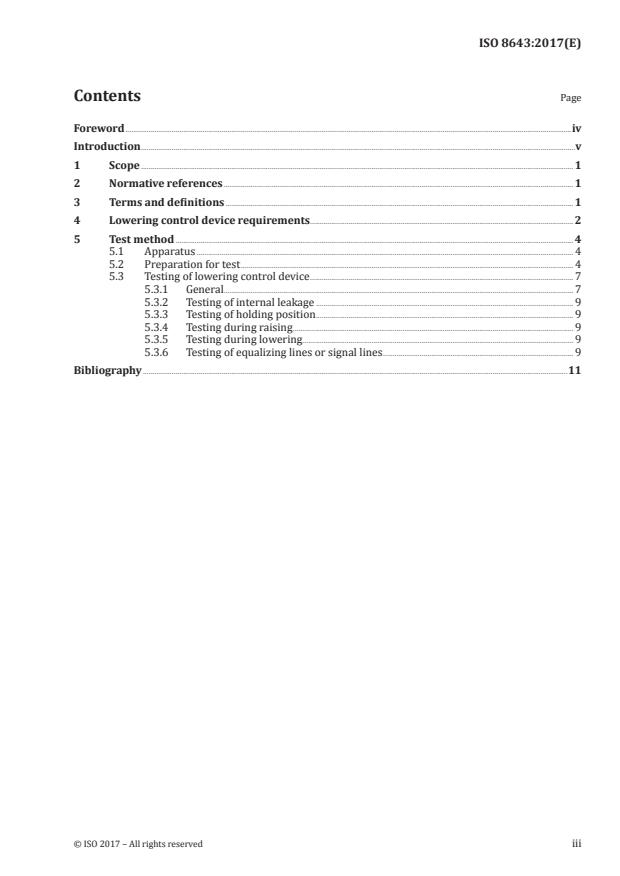
Contents Page
Foreword .iv
Introduction .v
1 Scope . 1
2 Normative references . 1
3 Terms and definitions . 1
4 Lowering control device requirements . 2
5 Test method . 4
5.1 Apparatus . 4
5.2 Preparation for test . 4
5.3 Testing of lowering control device . 7
5.3.1 General. 7
5.3.2 Testing of internal leakage . 9
5.3.3 Testing of holding position . 9
5.3.4 Testing during raising . 9
5.3.5 Testing during lowering. 9
5.3.6 Testing of equalizing lines or signal lines . 9
Bibliography .11
Foreword
ISO (the International Organization for Standardization) is a worldwide federation of national standards
bodies (ISO member bodies). The work of preparing International Standards is normally carried out
through ISO technical committees. Each member body interested in a subject for which a technical
committee has been established has the right to be represented on that committee. International
organizations, governmental and non-governmental, in liaison with ISO, also take part in the work.
ISO collaborates closely with the International Electrotechnical Commission (IEC) on all matters of
electrotechnical standardization.
The procedures used to develop this document and those intended for its further maintenance are
described in the ISO/IEC Directives, Part 1. In particular the different approval criteria needed for the
different types of ISO documents should be noted. This document was drafted in accordance with the
editorial rules of the ISO/IEC Directives, Part 2 (see www .iso .org/ directives).
Attention is drawn to the possibility that some of the elements of this document may be the subject of
patent rights. ISO shall not be held responsible for identifying any or all such patent rights. Details of
any patent rights identified during the development of the document will be in the Introduction and/or
on the ISO list of patent declarations received (see www .iso .org/ patents).
Any trade name used in this document is information given for the convenience of users and does not
constitute an endorsement.
For an explanation on the meaning of ISO specific terms and expressions related to conformity assessment,
as well as information about ISO’s adherence to the World Trade Organization (WTO) principles in the
Technical Barriers to Trade (TBT) see the following URL: www . i so .org/ iso/ foreword .html.
This document was prepared by Technical Committee ISO/TC 127, Earth-moving machinery,
Subcommittee SC 1, Test methods relating to safety and machine performance.
This third edition cancels and replaces the second edition (ISO 8643:1997), which has been technically
revised and contains the following changes:
— requirements and test provisions have been extended to support a wider range of lowering control
device configurations.
iv © ISO 2017 – All rights reserved
Introduction
Where excavators or backhoe loaders are used for object handling, a failure or rupture in the hydraulic
circuit can endanger persons under raised loads.
This risk can be reduced by applying a lowering control device, which ensures controlled lowering of
the load in the case of a hydraulic line failure or rupture.
Test procedures are based on the design characteristics of the hydraulic systems of hydraulic excavators
and the backhoe part of backhoe loaders, and conditions of use.
INTERNATIONAL STANDARD ISO 8643:2017(E)
Earth-moving machinery — Hydraulic excavator and
backhoe loader lowering control device — Requirements
and tests
1 Scope
This document establishes uniform requirements and test procedures for lowering control devices
fitted on the boom, intermediate boom and arm cylinders of hydraulic excavators and backhoe loaders
to control the rate of drop in the case of a hydraulic line failure or rupture.
It is applicable to the lowering control devices of hydraulic excavators and the backhoe equipment of
backhoe loaders used for object handling which are equipped with the standard linkage as defined by
the manufacturer. On machines where alternative linkage combinations are offered, only the standard
length defined by the manufacturer is subject to testing.
2 Normative references
The following documents are referred to in the text in such a way that some or all of their content
constitutes requirements of this document. For dated references, only the edition cited applies. For
undated references, the latest edition of the referenced document (including any amendments) applies.
ISO 6165, Earth-moving machinery — Basic types — Identification and terms and definitions
ISO 9248:1992, Earth-moving machinery — Units for dimensions, performance and capacities, and their
measurement accuracies
3 Terms and definitions
For the purposes of this document, the terms and definitions given in ISO 6165 and the following apply.
ISO and IEC maintain terminological databases for use in standardization at the following addresses:
— IEC Electropedia: available at http:// www .electropedia .org/
— ISO Online browsing platform: available at http:// www .iso .org/ obp
3.1
linkage control system
hydraulic control components (including pilot and slave valves) used for raising and lowering the lift
point in object handling applications
3.2
lifting linkage
assembly of parts that can be a combination of booms and arms used for raising and lowering the lift
point in the object handling process
3.3
lowering control device
hydraulic control valves used for controlled linkage lowering in the case of a hydraulic line failure
or rupture
3.4
failure-simulation device
hydraulic valves used for simulating a failure or rupture in a hydraulic line in the linkage control system
3.5
signal line
hydraulic circuit that is used to sense a pressure
EXAMPLE Diagnostic test port, stability limit system.
3.6
rated lift capacity
smaller of either the rated tipping capacity or the rated hydraulic lift capacity
[SOURCE: ISO 10567:2007, 3.13]
3.7
lift point
LP
location on the attachment (e.g. bucket) or the quick coupler, as specified by the manufacturer, to which
a load can be attached
[SOURCE: ISO 10567:2007, 3.2, modified]
3.8
lift point radius
LPR
horizontal distance from the axis of rotation to the vertical hoist line or tackle
[SOURCE: ISO 10567:2007, 3.5]
3.9
object handling
application of earth-moving machinery comprising lifting, lowering and transporting of a load by use
of lifting accessories, whereby the assistance of a person or the operator of the machine is required for
hooking, unhooking or stabilizing (whilst transporting) the load
Note 1 to entry: If the load is picked-up by a self-acting device and no assistance of a person is required for
hooking, unhooking or stabilizing the load, this work is considered as a usual earth-moving application.
Note 2 to entry: Lifting accessories are, e.g. wire ropes, chains or textile straps; loads in object handling
application are, e.g. pipes, vessels; self-acting devices are, e.g. grabs, clamshell buckets, log clamps, vacuum lifting
device, magnetic plate or fork.
4 Lowering control device requirements
4.1 Lowering control devices shall comply with the requirements given in 4.1.1 to 4.1.8.
4.1.1 The lowering control device shall operate automatically while the cylinders in the linkage control
system that keep the load in a lifted position are pressurized, even if t
...
NORME ISO
INTERNATIONALE 8643
Troisième édition
2017-02
Engins de terrassement — Dispositif
de contrôle d’abaissement de la flèche
des pelles et chargeuses-pelleteuses
hydrauliques — Exigences et
méthodes d’essai
Earth-moving machinery — Hydraulic excavator and backhoe loader
lowering control device — Requirements and tests
Numéro de référence
©
ISO 2017
DOCUMENT PROTÉGÉ PAR COPYRIGHT
© ISO 2017, Publié en Suisse
Droits de reproduction réservés. Sauf indication contraire, aucune partie de cette publication ne peut être reproduite ni utilisée
sous quelque forme que ce soit et par aucun procédé, électronique ou mécanique, y compris la photocopie, l’affichage sur
l’internet ou sur un Intranet, sans autorisation écrite préalable. Les demandes d’autorisation peuvent être adressées à l’ISO à
l’adresse ci-après ou au comité membre de l’ISO dans le pays du demandeur.
ISO copyright office
Ch. de Blandonnet 8 • CP 401
CH-1214 Vernier, Geneva, Switzerland
Tel. +41 22 749 01 11
Fax +41 22 749 09 47
copyright@iso.org
www.iso.org
ii © ISO 2017 – Tous droits réservés
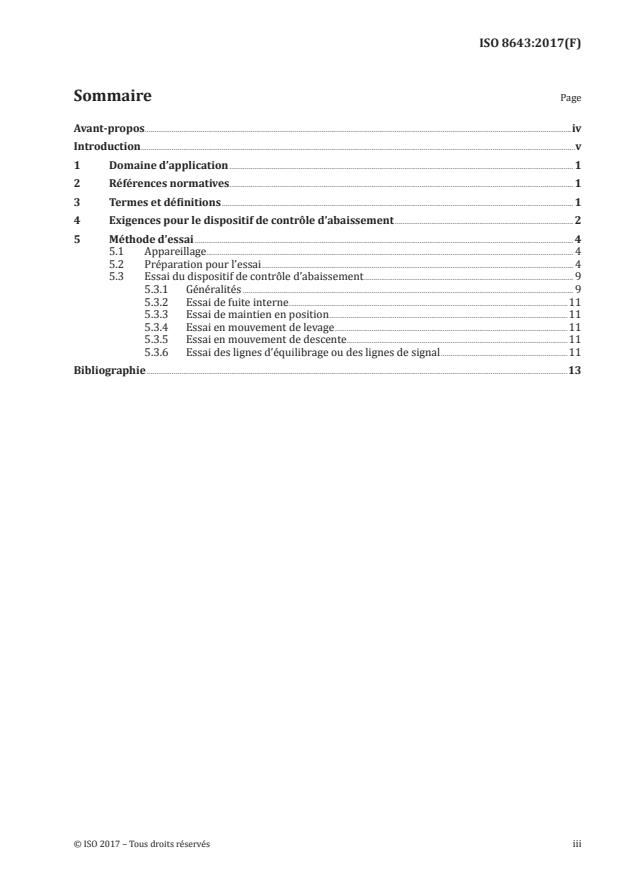
Sommaire Page
Avant-propos .iv
Introduction .v
1 Domaine d’application . 1
2 Références normatives . 1
3 Termes et définitions . 1
4 Exigences pour le dispositif de contrôle d’abaissement . 2
5 Méthode d’essai . 4
5.1 Appareillage. 4
5.2 Préparation pour l’essai . 4
5.3 Essai du dispositif de contrôle d’abaissement . 9
5.3.1 Généralités . 9
5.3.2 Essai de fuite interne .11
5.3.3 Essai de maintien en position .11
5.3.4 Essai en mouvement de levage .11
5.3.5 Essai en mouvement de descente .11
5.3.6 Essai des lignes d’équilibrage ou des lignes de signal .11
Bibliographie .13
Avant-propos
L’ISO (Organisation internationale de normalisation) est une fédération mondiale d’organismes
nationaux de normalisation (comités membres de l’ISO). L’élaboration des Normes internationales est
en général confiée aux comités techniques de l’ISO. Chaque comité membre intéressé par une étude
a le droit de faire partie du comité technique créé à cet effet. Les organisations internationales,
gouvernementales et non gouvernementales, en liaison avec l’ISO participent également aux travaux.
L’ISO collabore étroitement avec la Commission électrotechnique internationale (IEC) en ce qui
concerne la normalisation électrotechnique.
Les procédures utilisées pour élaborer le présent document et celles destinées à sa mise à jour sont
décrites dans les Directives ISO/IEC, Partie 1. Il convient, en particulier de prendre note des différents
critères d’approbation requis pour les différents types de documents ISO. Le présent document a été
rédigé conformément aux règles de rédaction données dans les Directives ISO/IEC, Partie 2 (voir www
.iso .org/ directives).
L’attention est appelée sur le fait que certains des éléments du présent document peuvent faire l’objet de
droits de propriété intellectuelle ou de droits analogues. L’ISO ne saurait être tenue pour responsable
de ne pas avoir identifié de tels droits de propriété et averti de leur existence. Les détails concernant
les références aux droits de propriété intellectuelle ou autres droits analogues identifiés lors de
l’élaboration du document sont indiqués dans l’Introduction et/ou dans la liste des déclarations de
brevets reçues par l’ISO (voir www .iso .org/ brevets).
Les appellations commerciales éventuellement mentionnées dans le présent document sont données
pour information, par souci de commodité, à l’intention des utilisateurs et ne sauraient constituer un
engagement.
Pour une explication de la signification des termes et expressions spécifiques de l’ISO liés à l’évaluation
de la conformité, ou pour toute information au sujet de l’adhésion de l’ISO aux principes de l’Organisation
mondiale du commerce (OMC) concernant les obstacles techniques au commerce (OTC), voir le lien
suivant: w w w . i s o .org/ iso/ fr/ avant -propos .html
Le présent document a été élaboré par le comité technique l’ISO/TC 127, Engins de terrassement, sous-
comité SC 1, Méthodes d’essai relatives aux performances et à la sécurité des engins.
Cette troisième édition annule et remplace la deuxième édition (ISO 8643:1997), qui a fait l’objet d’une
révision technique et contient les modifications suivantes:
— les exigences et les dispositions d’essai ont été étendues pour supporter une gamme plus large de
configurations du dispositif de contrôle d’abaissement.
iv © ISO 2017 – Tous droits réservés
Introduction
Lorsqu’une pelle hydraulique ou une chargeuse-pelleteuse est utilisée en levage d’objets, une défaillance
ou une rupture dans le circuit hydraulique peut mettre en danger les personnes se trouvant au-dessous
des charges levées.
Ce risque peut être réduit en installant un dispositif de contrôle d’abaissement qui assure une descente
contrôlée de la charge en cas de défaillance ou de rupture de canalisation hydraulique.
Les méthodes d’essai sont basées sur les caractéristiques de conception des systèmes hydrauliques des
pelles hydrauliques et de l’équipement pelle des chargeuses-pelleteuses, ainsi que de leurs conditions
d’utilisation.
NORME INTERNATIONALE ISO 8643:2017(F)
Engins de terrassement — Dispositif de contrôle
d’abaissement de la flèche des pelles et chargeuses-
pelleteuses hydrauliques — Exigences et méthodes d’essai
1 Domaine d’application
Le présent document établit des exigences uniformes et des modes opératoires d’essai pour les
dispositifs de contrôle d’abaissement montés sur les vérins de flèche, de flèche intermédiaire ou de bras
des pelles hydrauliques ou chargeuses-pelleteuses pour contrôler le taux de chute en cas de défaillance
ou de rupture du circuit hydraulique.
Il s’applique aux dispositifs de contrôle d’abaissement des pelles hydrauliques et équipement pelle des
chargeuses-pelleteuses utilisés pour la manutention d’objets qui sont équipés d’une liaison standard
telle que définie par le fabricant. Sur les engins ayant d’autres combinaisons de liaison proposées, seule
la longueur standard définie par le fabricant est sujette à l’essai.
2 Références normatives
Les documents suivants cités dans le texte constituent, pour tout ou partie de leur contenu, des
exigences du présent document. Pour les références datées, seule l’édition citée s’applique. Pour les
références non datées, la dernière édition du document de référence s’applique (y compris les éventuels
amendements).
ISO 6165, Engins de terrassement — Principaux types — Identification et termes et définitions
ISO 9248:1992, Engins de terrassement — Unités pour exprimer les dimensions, les performances et les
capacités, et exactitude de leur mesurage
3 Termes et définitions
Pour les besoins du présent document, les termes et définitions de l’ISO 6165 ainsi que les suivants
s’appliquent.
L’ISO et l’IEC tiennent à jour des bases de données terminologiques destinées à être utilisées en
normalisation, consultables aux adresses suivantes:
— IEC Electropedia: disponible à l’adresse http:// www .electropedia .org/
— ISO Online browsing platform: disponible à l’adresse http:// www .iso .org/ obp
3.1
système de contrôle de liaison
composants pour le contrôle hydraulique (y compris les clapets pilotés et d’asservissement) utilisés
pour lever et abaisser le point de levage lors des applications en manutention d’objets
3.2
liaison de levage
ensemble de composants qui peuvent être une combinaison de flèches et de bras utilisés pour lever et
abaisser le point de levage dans le processus de manutention d’objet
3.3
dispositif de contrôle d’abaissement
clapets hydrauliques utilisés pour la descente contrôlée de la liaison en cas de défaillance ou de rupture
du circuit hydraulique
3.4
dispositif simulant une défaillance
clapets hydrauliques utilisés pour simuler la défaillance ou une rupture du circuit hydraulique du
système de contrôle de la liaison
3.5
ligne de signal
circuit hydraulique qui est utilisé pour capter une pression
EXEMPLE Port de test de diagnostic, système pour la limite de stabilité.
3.6
capacité de levage nominale
valeur la plus faible entre la charge de basculement nominale et la capacité de levage hydraulique
nominale
[SOURCE: ISO 10567:2007, 3.13]
3.7
point de levage
LP
emplacement sur l’accessoire (par exemple, godet) ou sur l’attache rapide, tel que spécifié par le
fabricant, sur lequel une charge peut être fixée
[SOURCE: ISO 10567:2007, 3.2, modifiée]
3.8
rayon du point de levage
LPR
distance horizontale entre l’axe de rotation et le câble de levage vertical ou le dispositif de levage
[SOURCE: ISO 10567:2007, 3.5]
3.9
manutention d’objets
utilisation d’un engin de terrassement comprenant le levage, la descente et le transport d’une charge au
moyen d’accessoires de levage, pour lequel l’assistance d’une personne ou de l’opérateur de l’engin est
requise pour accrocher, décrocher ou stabiliser (lors du déplacement) la charge
Note 1 à l’article: Si la charge est prise par un dispositif automatique et si aucune assistance de personne n’est
requise pour l’accrochage, le décrochage ou la stabilisation de la charge, ce travail est considéré comme une
application courante de terrassement.
Note 2 à l’article: Comme exemple d’accessoires de levage, on peut citer les câbles, les chaînes ou les élingues
textiles; comme exemple de charges dans les applications de manutention d’objets on peut citer les tuyaux, les
réservoirs; comme exemple des dispositifs automatiques, on peut citer les grappins, les bennes preneuses, les
pinces de manutention pour grumes, les ventouses de levage, les plateaux ou fourches magnétiques.
4 Exigences pour le dispositif de contrôle d’abaissement
4.1 Les dispositifs de contrôle d’abaissement doivent satisfaire aux exigences données dans les
paragraphes 4.1.1 à 4.1.8.
4.1.1 Les dispositifs doivent fonctionner automatiquement tant que les vérins des liaisons qui
maintiennent la charge en position levée sont sous pression, même si la machine/l’allumage est coupé.
4.1.2 Le fonctionnement du dispositif de contrôle d’abaissement ne doit compromettre ni la réponse
normale de l’engin pendant son fonctionnement ni, à aucun moment, la stabilité de l’engin.
2 © ISO 2017 – Tous droits
...
Questions, Comments and Discussion
Ask us and Technical Secretary will try to provide an answer. You can facilitate discussion about the standard in here.
Loading comments...