

ISO 13397-1:1995
(Main)Periodontal curettes, dental scalers and excavators — Part 1: General requirements
General Information
- Abstract
Specifies the general material and performance requirements for periodontal curettes, dental scalers and excavators.
- Status
- Published
- Publication Date
- 13-Dec-1995
- Technical Committee
- ISO/TC 106/SC 4 - Dental instruments
- Drafting Committee
- ISO/TC 106/SC 4/WG 8 - Dental hand instruments
- Current Stage
- 9060 - Close of review
- Completion Date
- 02-Sep-2030
Buy Documents
ISO 13397-1:1995 - Periodontal curettes, dental scalers and excavators — Part 1: General requirements Released:12/14/1995
ISO 13397-1:1995 - Curettes parodontales, instruments dentaires pour détartrage et excavateurs dentaires — Partie 1: Prescriptions générales Released:12/14/1995
ISO 13397-1:1995 - Curettes parodontales, instruments dentaires pour détartrage et excavateurs dentaires — Partie 1: Prescriptions générales Released:12/14/1995
Overview
ISO 13397-1:1995 is an international standard developed by ISO Technical Committee 106 (Dentistry), specifically Subcommittee SC 4, which focuses on dental instruments. This standard sets forth general material and performance requirements for periodontal curettes, dental scalers, and excavators, which are essential dental hand instruments used in periodontal treatments and procedures. By defining clear specifications, ISO 13397-1 ensures consistent quality, safety, and reliability across these critical dental instruments.
Key Topics
Material Requirements
- Working ends of instruments must be made of martensitic stainless steel complying with ISO 7153-1 or equivalent materials that meet strict durability and hardness standards.
- Handles may use manufacturer-selected materials, provided they conform to hardness and performance criteria outlined in the standard.
Performance Criteria
- Instruments must exhibit Vickers hardness within two specified classes:
- Class 1: 600 HV to 700 HV
- Class 2: 550 HV to 620 HV
- Resistance to corrosion and thermal exposure is mandatory, ensuring longevity and safety when instruments undergo sterilization processes such as autoclaving or boiling.
- The working end and handle union must withstand tensile loads of 600 N and torque forces of 400 N·cm without loosening, emphasizing secure instrument construction.
- Instruments must exhibit Vickers hardness within two specified classes:
Surface Quality
- Surfaces must be free from pores, crevices, and residual materials.
- Satin and mirror finishes are defined with requirements for smoothness and reflectivity to reduce glare and improve handling comfort.
Dimensional Design
- Instruments must adhere to design and dimensional specifications as detailed in ISO 13397 series parts.
- Measurement methods include the use of optical projectors to ensure precise dimensions and angular alignments for optimized performance.
Testing Procedures
- Includes autoclave, boiling water, and thermal tests based on ISO 13402 to assess corrosion resistance and material stability.
- Specific tests on the union strength between the handle and working end ensure mechanical robustness.
Applications
ISO 13397-1:1995 is vital for manufacturers, dental professionals, and regulatory bodies engaged in the production, procurement, and regulation of periodontal curettes, dental scalers, and excavators. Practical applications include:
Dental Equipment Manufacturers
- Guiding the design, material selection, and manufacturing processes to meet internationally recognized quality benchmarks.
- Ensuring product consistency and safety before market distribution.
Dental Clinics and Practitioners
- Selecting reliable instruments that conform to global standards for better clinical outcomes and patient safety.
- Understanding instrument classifications aids in choosing appropriate tools based on hardness and durability requirements.
Regulatory Compliance
- Providing a recognized framework for certification and conformity assessment for dental hand instruments.
- Facilitating international trade and market access by adhering to harmonized standards.
Related Standards
- ISO 7153-1: Specifies requirements for surgical stainless steel materials, relevant for the working ends of dental instruments.
- ISO 6507-2: Defines Vickers hardness testing methods, critical for classifying instrument hardness.
- ISO 13402: Outlines procedures for testing surgical and dental hand instruments’ resistance to autoclaving, corrosion, and thermal exposure.
- ISO 1942-3: Provides dental vocabulary, ensuring consistent terminology related to dental instruments.
- Other parts of the ISO 13397 series specify particular instrument types, including:
- Part 2: Dental curettes - Gr-type
- Part 3: Dental scalers - H-type
- Part 4: Dental excavators
Keywords
Periodontal curettes, dental scalers, dental excavators, ISO 13397-1, dental instruments standard, stainless steel dental tools, dental instrument hardness, Vickers hardness, corrosion resistance, autoclave testing, dental equipment manufacturing, dental instrument specifications, dental tool performance, dental instrument testing, ISO dental standards, periodontal dental tools, dental instrument material requirements.
Relations
- Effective Date
- 25-Aug-2026
- Effective Date
- 25-Aug-2026
- Effective Date
- 12-Feb-2026
- Effective Date
- 06-Jun-2022
Buy Documents
ISO 13397-1:1995 - Periodontal curettes, dental scalers and excavators — Part 1: General requirements Released:12/14/1995
ISO 13397-1:1995 - Curettes parodontales, instruments dentaires pour détartrage et excavateurs dentaires — Partie 1: Prescriptions générales Released:12/14/1995
ISO 13397-1:1995 - Curettes parodontales, instruments dentaires pour détartrage et excavateurs dentaires — Partie 1: Prescriptions générales Released:12/14/1995
Get Certified
Connect with accredited certification bodies for this standard

BSI Group
BSI (British Standards Institution) is the business standards company that helps organizations make excellence a habit.

TÜV Rheinland
TÜV Rheinland is a leading international provider of technical services.

TÜV SÜD
TÜV SÜD is a trusted partner of choice for safety, security and sustainability solutions.
Sponsored listings
Frequently Asked Questions
ISO 13397-1:1995 is a standard published by the International Organization for Standardization (ISO). Its full title is "Periodontal curettes, dental scalers and excavators — Part 1: General requirements". This standard covers: Specifies the general material and performance requirements for periodontal curettes, dental scalers and excavators.
Specifies the general material and performance requirements for periodontal curettes, dental scalers and excavators.
ISO 13397-1:1995 is classified under the following ICS (International Classification for Standards) categories: 11.060.20 - Dental equipment. The ICS classification helps identify the subject area and facilitates finding related standards.
ISO 13397-1:1995 has the following relationships with other standards: It is inter standard links to EN ISO 13397-5:2015, EN ISO 13397-2:2005, EN ISO 13397-1:1995, ISO 4254-1:2005. Understanding these relationships helps ensure you are using the most current and applicable version of the standard.
ISO 13397-1:1995 is available in PDF format for immediate download after purchase. The document can be added to your cart and obtained through the secure checkout process. Digital delivery ensures instant access to the complete standard document.
Standards Content (Sample)
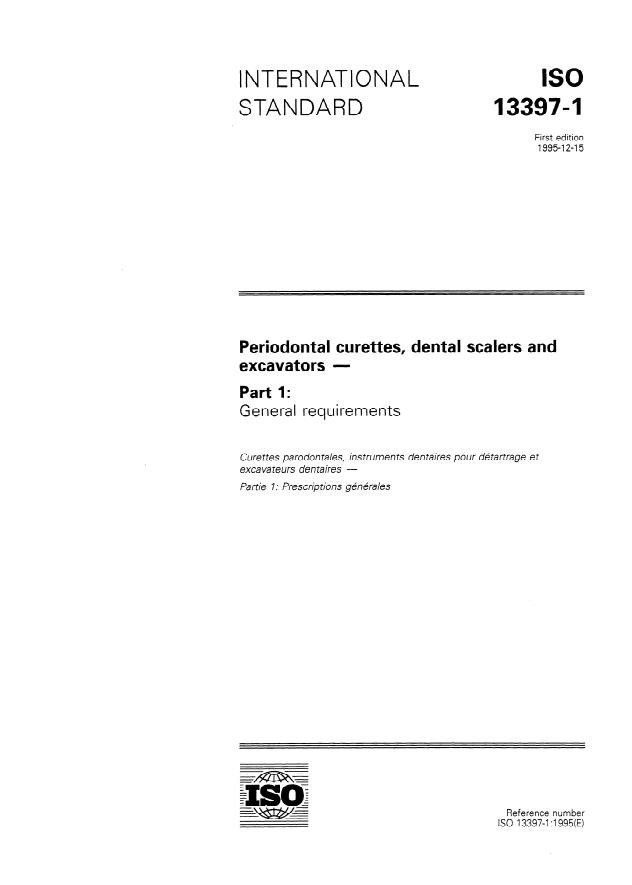
Is0
INTERNATIONAL
STANDARD 13397-I
First edition
1995-l 2-15
Periodontal curettes, dental scalers and
excavators -
Part 1:
General requirements
Curettes parodon tales, instruments den taires pour d6 tartrage et
excavateurs dentaires -
Partie 7 : Prescriptions g&Wales
Reference number
IS0 13397-l :I 995(E)
IS0 133974:1995(E)
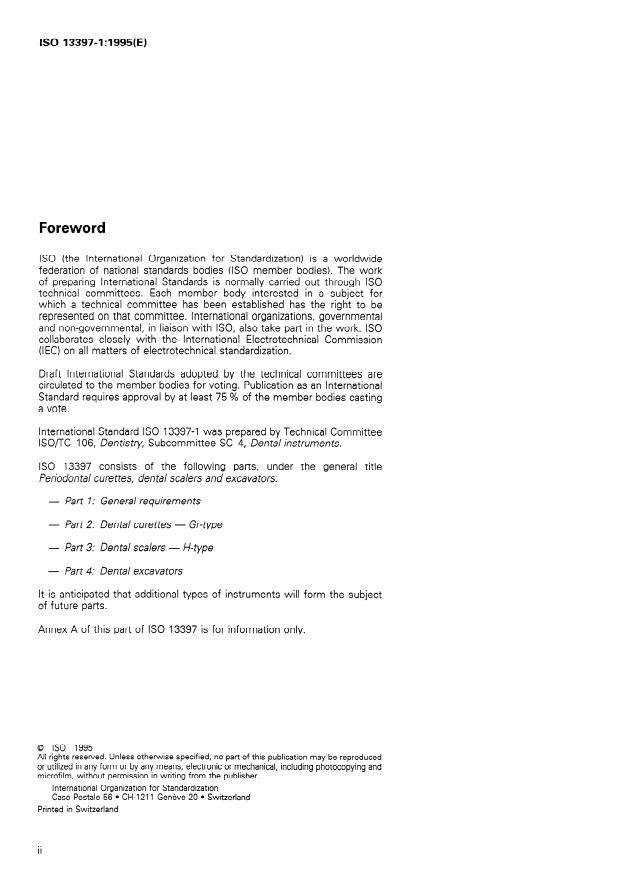
Foreword
IS0 (the International Organization for Standardization) is a worldwide
federation of national standards bodies (IS0 member bodies). The work
of preparing International Standards is normally carried out through IS0
technical committees. Each member body interested in a subject for
which a technical committee has been established has the right to be
represented on that committee. International organizations, governmental
and non-governmental, in liaison with ISO, also take part in the work. IS0
collaborates closely with the International Electrotechnical Commission
(I EC) on all matters of electrotechnical standardization.
Draft International Standards adopted by the technical committees are
circulated to the member bodies for voting. Publication as an International
Standard requires approval by at least 75 % of the member bodies casting
a vote.
International Standard IS0 13397-l was prepared by Technical Committee
lSO/TC 106, Dentistry, Subcommittee SC 4, Dental instruments.
IS0 13397 consists of the following parts, under the general title
Periodontal cure ttes, dental scalers and excava tars:
- Part 7: General requirements
- Part 2: Dental curettes - Gr-type
- Part 3: Dental scalers - H-type
- Part 4: Dental excavators
It is anticipated that additional types of instruments will form the subject
of future parts.
Annex A of this part of IS0 13397 is for information only.
0 IS0 1995
All rights reserved. Unless otherwise specified, no part of this publication may be reproduced
or utilized in any form or by any means, electronic or mechanical, including photocopying and
microfilm, without permission in writing from the publisher.
Organization for Standardization
International
56 l CH-121 1 Geneve 20 l Switzerland
Case Postale
Printed in Switzerland
ii
IS0 13397=1:1995(E)
INTERNATIONAL STANDARD Q IS0
Periodontal curettes, dental scalers and excavators -
Part 1:
General -requirements
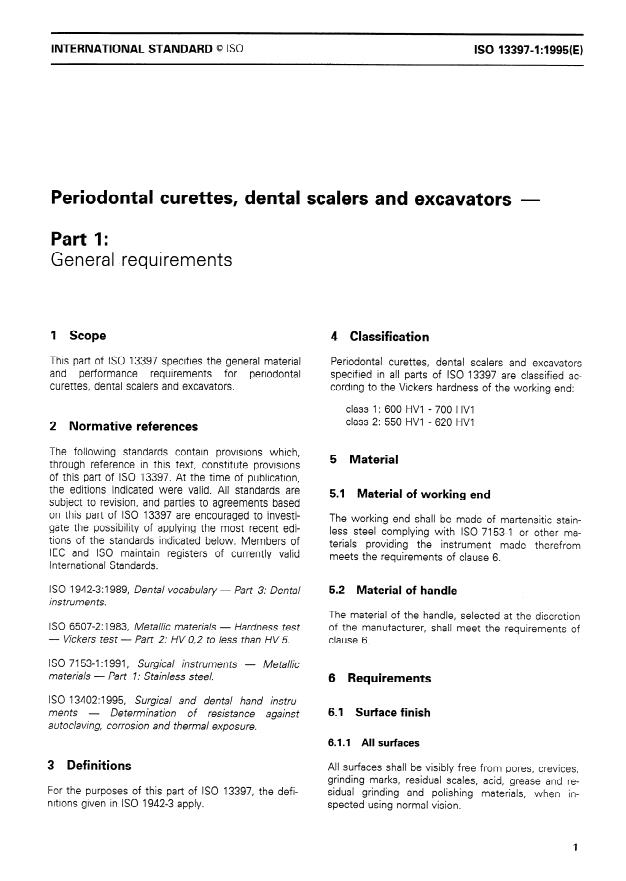
1 Scope 4 Classification
Periodontal curettes, dental scalers and excavators
This part of IS0 13397 specifies the general material
specified in all parts of IS0 13397 are classified ac-
and performance requirements for periodontal
cording to the Vickers hardness of the working end:
curettes, dental scalers and excavators.
class 1: 600 HVI - 700 HVI
class 2: 550 HVI - 620 HVI
2 Normative references
The following standards contain provisions which,
5 Material
through reference in this text, constitute provisions
of this part of IS0 13397. At the time of publication,
the editions indicated were valid. All standards are
5.1 Material of working end
subject to revision, and parties to agreements based
on this part of IS0 13397 are encouraged to investi-
The working end shall be made of martensitic stain-
gate the possibility of applying the most recent edi-
less steel complying with IS0 7153-1 or other ma-
tions of the standards indicated below. Members of
terials providing the instrument made therefrom
IEC and IS0 maintain registers of currently valid
meets the requirements of clause 6.
International Standards.
5.2 Material of handle
IS0 1942-3: 1989, Dental vocabulary - Part 3: Dental
instruments.
The material of the handle, selected at the discretion
of the manufacturer, shall meet the requirements of
IS0 6507-2:1983, Metallic materials - Hardness test
c!ause 6.
- Vickers test - Part 2: HV 0,2 to less than HV5.
IS0 7153-I :I 991, Surgical instruments - Metallic
materials - Part 1: Stainless steel.
6 Requirements
IS0 13402:1995, Surgical and dental hand instru-
6.1 Surface finish
ments - Determination of resistance against
autoclaving, corrosion and thermal exposure.
6.1.1 All surfaces
All surfaces shall be visibly free from pores, crevices,
3 Definitions
grinding marks, residual scales, acid, grease and re-
sidual grinding and polishing materials, when in-
For the purposes of this part of IS0 13397, the defi-
spected using normal vision.
nitions given in IS0 1942-3 apply.
0 IS0
IS0 13397=1:1995(E)
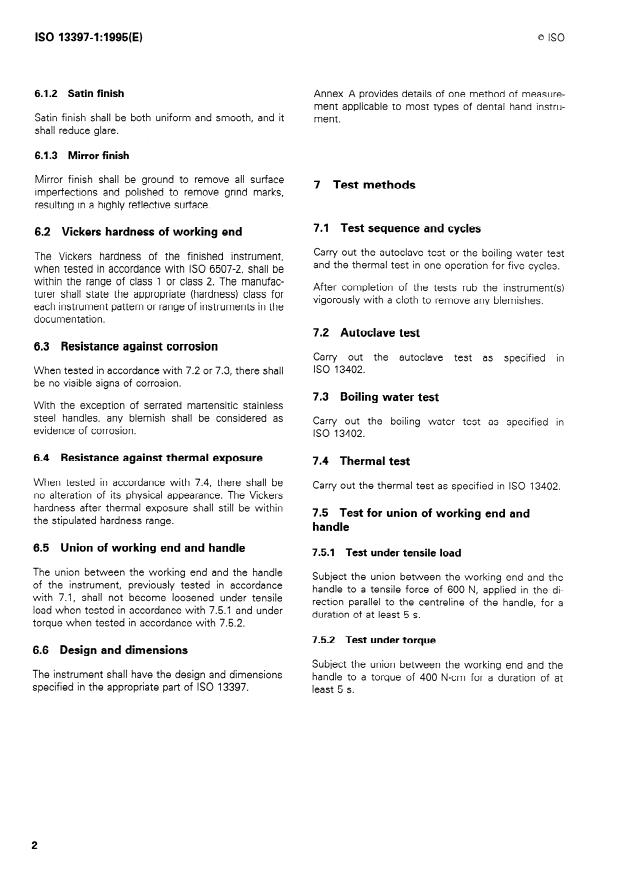
Annex A provides details of one method of measure-
6.1.2 Satin finish
ment applicable to most types of dental hand instru-
Satin finish shall be both uniform and smooth, and it ment.
shall reduce glare.
6.1.3 Mirror finish
Mirror finish shall be ground to remove all surface
7 Test methods
imperfections and polished to remove grind marks,
resulting in a highly reflective surface.
7.1 Test sequence and cycles
6.2 Vickers hardness of working end
Carry out the autoclave test or the boiling water tes t
The Vickers hardness of the finished instrument,
and the thermal test in one operation for five cycles.
when tested in accordance with IS0 6507-2, shall be
within the range of class 1 or
...
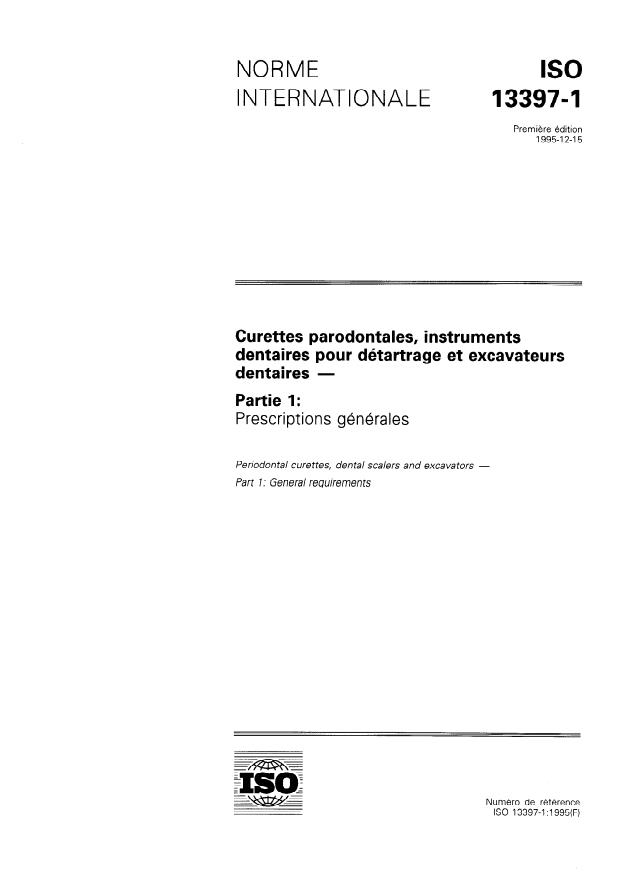
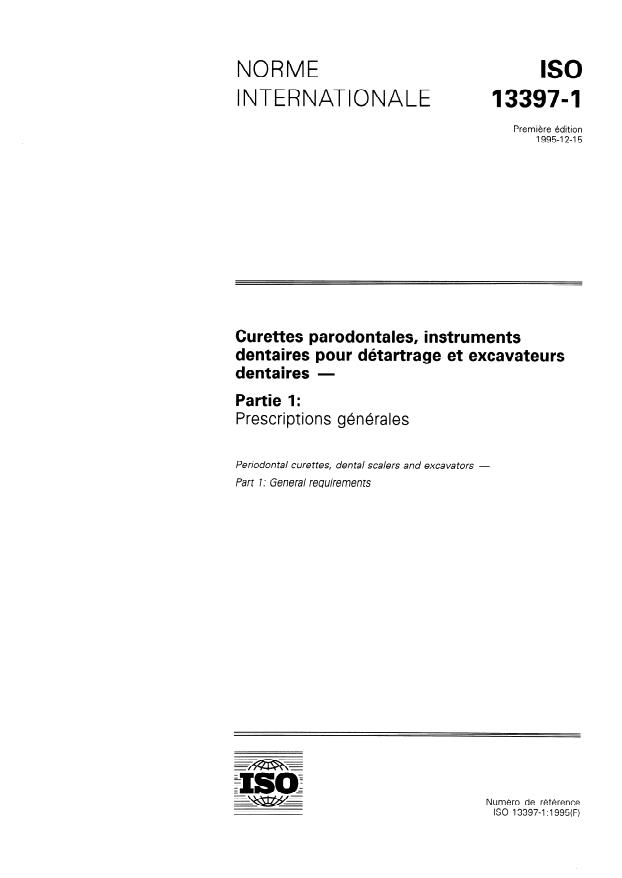
NORME ISO
INTERNATIONALE 13397-l
Première édition
1995-12-15
Curettes parodontales, instruments
dentaires pour détartrage et excavateurs
dentaires -
Partie 1:
Prescriptions générales
Periodontal curettes, dental scalers and excavators -
Part 1: General requiremen ts
Numéro de référence
ISO 13397-I :1995(F)
ISO 13397=1:1995(F)
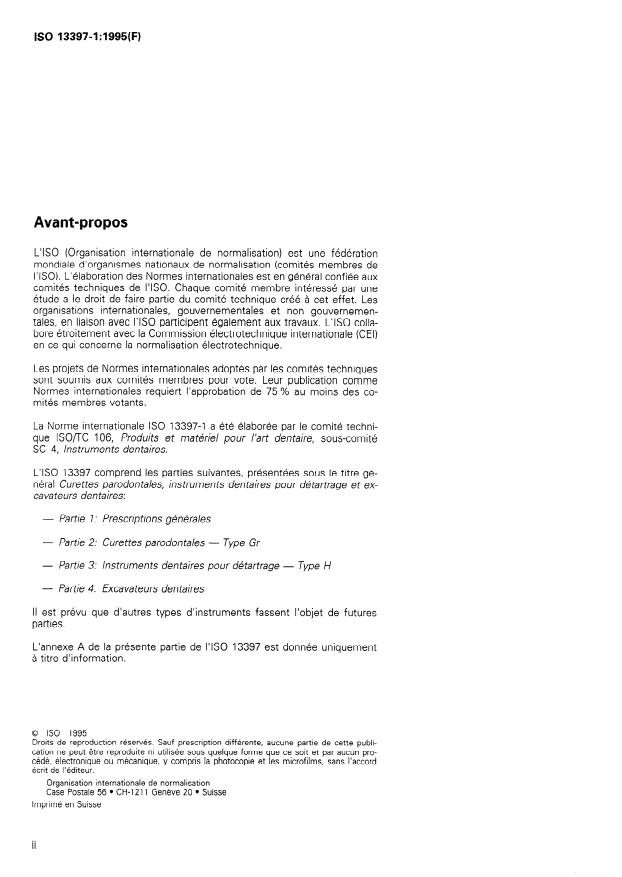
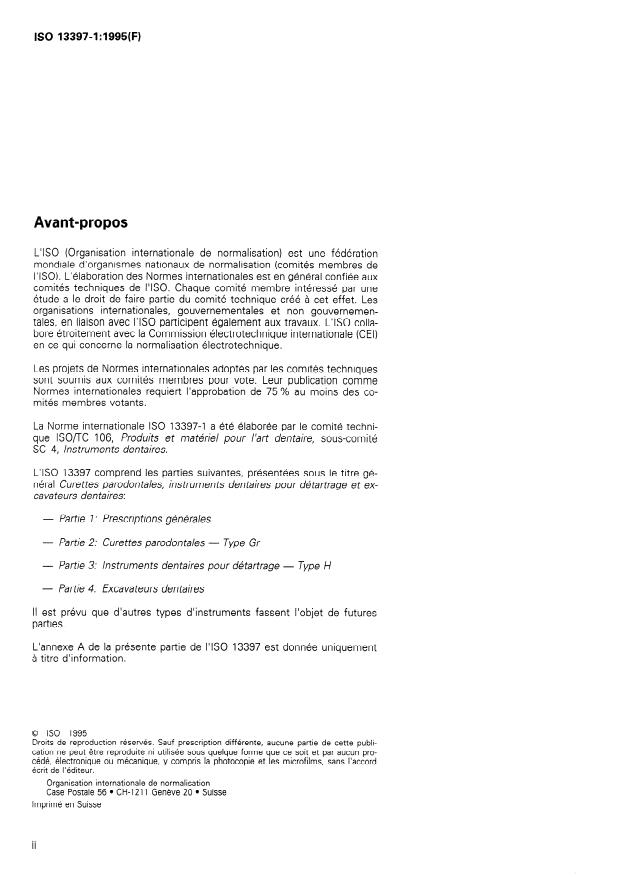
Avant-propos
L’ISO (Organisation internationale de normalisation) est une fédération
mondiale d’organismes nationaux de normalisation (comités membres de
I’ISO). L’élaboration des Normes internationales est en général confiée aux
comités techniques de I’ISO. Chaque comité membre intéressé par une
étude a le droit de faire partie du comité technique créé à cet effet. Les
organisations internationales, gouvernementales et non gouvernemen-
tales, en liaison avec I’ISO participent également aux travaux. L’ISO colla-
bore étroitement avec la Commission électrotechnique internationale (CEI)
en ce qui concerne la normalisation électrotechnique.
Les projets de Normes internationales adoptés par les comités techniques
sont soumis aux comités membres pour vote. Leur publication comme
Normes internationales requiert l’approbation de 75 % au moins des co-
mités membres votants.
La Norme internationale ISO 13397-1 a été élaborée par le comité techni-
que lSO/TC 106, Produits et matériel pour /‘art dentaire, sous-comité
SC 4, /ns trumen ts dentaires.
L’ISO 13397 comprend les parties suivantes, présentées sous le titre gé-
néral Curettes parodontales, instruments dentaires pour détartrage et ex-
cava teurs dentaires:
- Partie 1: Prescriptions générales
- Partie 2: Curettes parodontales - Type Gr
- Partie 3: lnstrumen ts dentaires pour dé tartrage - Type H
- Partie 4: Excavateurs dentaires
II est p révu que d’autres d’instruments fassent l’objet de futures
types
parties.
L’annexe A de la présente partie de I’ISO 13397 est donnée uniquement
à titre d’information.
0 ISO 1995
Droits de reproduction réservés. Sauf prescription différente, aucune partie de cette publi-
cation ne peut être reproduite ni utilisée sous quelque forme que ce soit et par aucun pro-
cédé, électronique ou mécanique, y compris la photocopie et les microfilms, sans l’accord
écrit de l’éditeur.
Organisation internationale de normalisation
Case Postale 56 l CH-l 211 Genève 20 l Suisse
Imprimé en Suisse
ii
ISO 13397=1:1995(F)
NORME INTERNATIONALE 0 60
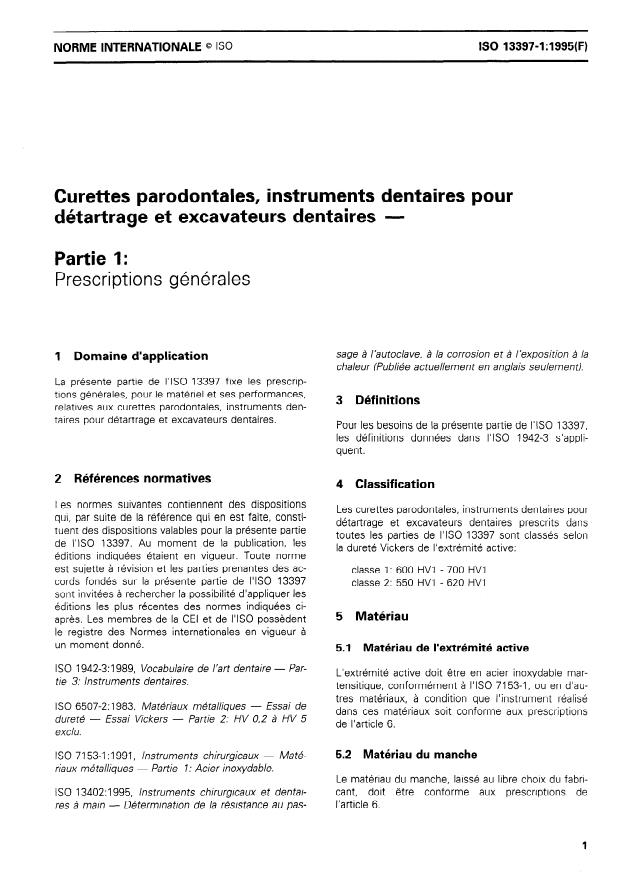
Curettes parodontales, instruments dentaires pour
détartrage et excavateurs dentaires -
Partie 1:
Prescriptions générales
sage à l’autoclave, à la corrosion et à l’exposition à la
1 Domaine d’application
chaleur (Publiée actuellement en anglais seulement).
La présente partie de I’ISO 13397 fixe les prescrip-
tions générales, pour le matériel et ses performances,
3 Définitions
relatives aux curettes parodontales, instruments den-
taires pour détartrage et excavateurs dentaires.
Pour les besoins de la présente partie de I’ISO 13397,
les définitions données dans I’ISO 1942-3 s’appli-
quent.
2 Références normatives
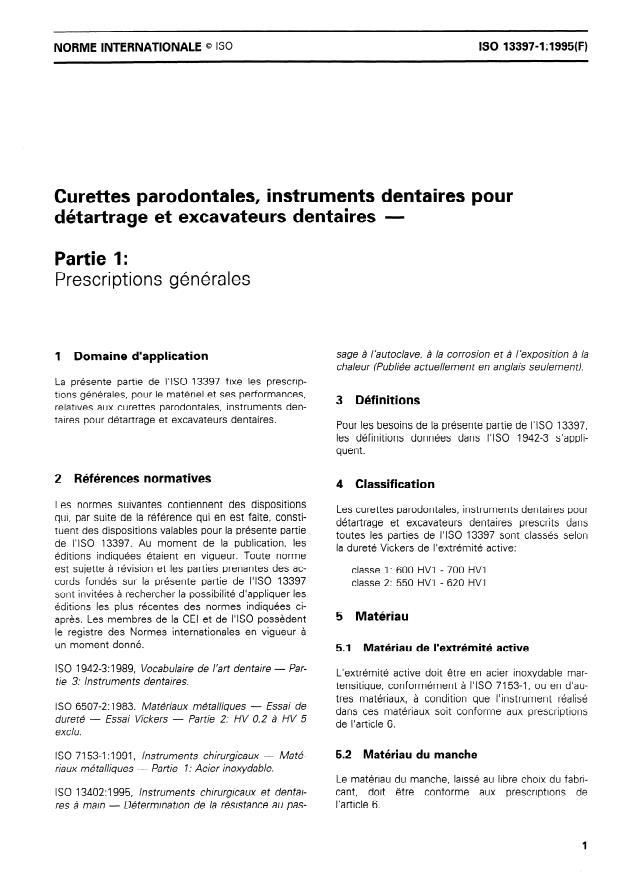
4 Classification
Les normes suivantes contiennent des dispositions
Les curettes parodontales, instruments dentaires pour
qui, par suite de la référence qui en est faite, consti-
détartrage et excavateurs dentaires prescrits dans
tuent des dispositions valables pour la présente partie
toutes les parties de I’ISO 13397 sont classés selon
de I’ISO 13397. Au moment de la publication, les
la dureté Vickers de l’extrémité active:
éditions indiquées étaient en vigueur. Toute norme
est sujette à révision et les parties prenantes des ac-
classe 1: 600 HVI - 700 HVI
cords fondés sur la présente partie de I’ISO 13397
classe 2: 550 HVI - 620 HVI
sont invitées à rechercher la possibilité d’appliquer les
éditions les plus récentes des normes indiquées ci-
5 Matériau
après. Les membres de la CEI et de I’ISO possèdent
le registre des Normes internationales en vigueur à
un moment donné.
5.1 Matériau de l’extrémité active
ISO 1942-3: 1989, Vocabulaire de l’art dentaire - Par-
L’extrémité active doit être en acier inoxydable mar-
tie 3: /ns trumen ts dentaires.
tensitique, conformément à I’ISO 7153-1, ou en d’au-
tres matériaux, à condition que l’instrument réalisé
ISO 6507-2:1983, Matériaux métalliques - Essai de
dans ces matériaux soit conforme aux prescriptions
dureté - Essai Vickers - Partie 2: HV 0,2 à HV 5
de l’article 6.
exclu.
ISO 7153-I : 1991, instruments chirurgicaux - Maté- 5.2 Matériau du manche
Partie 1: Acier inoxydable.
riaux métalliques -
Le matériau du manche, laissé au libre choix du fabri-
cant, doit être conforme aux prescriptions de
ISO 13402: 1995, Instruments chirurgicaux et dentai-
l’article 6.
res à main - Détermination de la résistance au pas-
0 ISO
ISO 13397=1:1995(F)
conformément à 7.5.1, ou une force de torsion lors
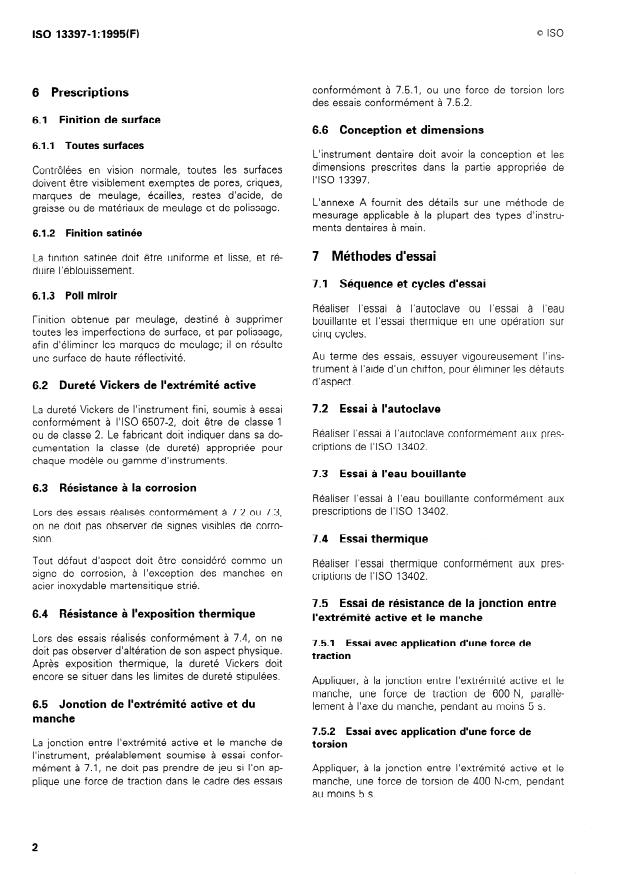
6 Prescriptions
des essais conformément à 7.5.2.
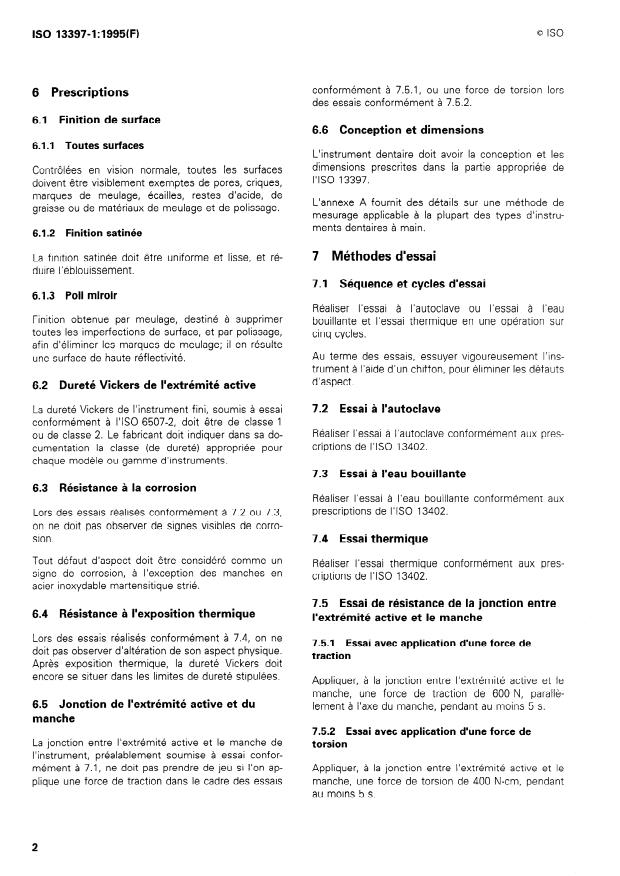
6.1 Finition de surface
6.6 Conception et dimensions
6.1.1 Toutes surfaces
L’instrument dentaire doit avoir la conception et les
dimensions prescrites dans la partie appropriée de
Contrôlées en vision normale, toutes les surfaces
I’ISO 13397.
doivent être visiblement exemptes de pores, criques,
marques de meulage, écailles, restes d’acide, de
L’annexe A fournit des détails sur une méthode de
graisse ou de matériaux de meulage et de polissage.
mesurage applicable à la plupart des types d’instru-
ments dentaires à main.
6.1.2 Finition satinée
7 Méthodes d’essai
La finition satinée doit être uniforme et lisse, et ré-
duire l’éblouissement.
7.1 Séquence et cycles d’essai
6.1.3 Poli miroir
Réaliser l’essai à l’autoclave ou l’essai à l’eau
Finition obtenue par
...
NORME ISO
INTERNATIONALE 13397-l
Première édition
1995-12-15
Curettes parodontales, instruments
dentaires pour détartrage et excavateurs
dentaires -
Partie 1:
Prescriptions générales
Periodontal curettes, dental scalers and excavators -
Part 1: General requiremen ts
Numéro de référence
ISO 13397-I :1995(F)
ISO 13397=1:1995(F)
Avant-propos
L’ISO (Organisation internationale de normalisation) est une fédération
mondiale d’organismes nationaux de normalisation (comités membres de
I’ISO). L’élaboration des Normes internationales est en général confiée aux
comités techniques de I’ISO. Chaque comité membre intéressé par une
étude a le droit de faire partie du comité technique créé à cet effet. Les
organisations internationales, gouvernementales et non gouvernemen-
tales, en liaison avec I’ISO participent également aux travaux. L’ISO colla-
bore étroitement avec la Commission électrotechnique internationale (CEI)
en ce qui concerne la normalisation électrotechnique.
Les projets de Normes internationales adoptés par les comités techniques
sont soumis aux comités membres pour vote. Leur publication comme
Normes internationales requiert l’approbation de 75 % au moins des co-
mités membres votants.
La Norme internationale ISO 13397-1 a été élaborée par le comité techni-
que lSO/TC 106, Produits et matériel pour /‘art dentaire, sous-comité
SC 4, /ns trumen ts dentaires.
L’ISO 13397 comprend les parties suivantes, présentées sous le titre gé-
néral Curettes parodontales, instruments dentaires pour détartrage et ex-
cava teurs dentaires:
- Partie 1: Prescriptions générales
- Partie 2: Curettes parodontales - Type Gr
- Partie 3: lnstrumen ts dentaires pour dé tartrage - Type H
- Partie 4: Excavateurs dentaires
II est p révu que d’autres d’instruments fassent l’objet de futures
types
parties.
L’annexe A de la présente partie de I’ISO 13397 est donnée uniquement
à titre d’information.
0 ISO 1995
Droits de reproduction réservés. Sauf prescription différente, aucune partie de cette publi-
cation ne peut être reproduite ni utilisée sous quelque forme que ce soit et par aucun pro-
cédé, électronique ou mécanique, y compris la photocopie et les microfilms, sans l’accord
écrit de l’éditeur.
Organisation internationale de normalisation
Case Postale 56 l CH-l 211 Genève 20 l Suisse
Imprimé en Suisse
ii
ISO 13397=1:1995(F)
NORME INTERNATIONALE 0 60
Curettes parodontales, instruments dentaires pour
détartrage et excavateurs dentaires -
Partie 1:
Prescriptions générales
sage à l’autoclave, à la corrosion et à l’exposition à la
1 Domaine d’application
chaleur (Publiée actuellement en anglais seulement).
La présente partie de I’ISO 13397 fixe les prescrip-
tions générales, pour le matériel et ses performances,
3 Définitions
relatives aux curettes parodontales, instruments den-
taires pour détartrage et excavateurs dentaires.
Pour les besoins de la présente partie de I’ISO 13397,
les définitions données dans I’ISO 1942-3 s’appli-
quent.
2 Références normatives
4 Classification
Les normes suivantes contiennent des dispositions
Les curettes parodontales, instruments dentaires pour
qui, par suite de la référence qui en est faite, consti-
détartrage et excavateurs dentaires prescrits dans
tuent des dispositions valables pour la présente partie
toutes les parties de I’ISO 13397 sont classés selon
de I’ISO 13397. Au moment de la publication, les
la dureté Vickers de l’extrémité active:
éditions indiquées étaient en vigueur. Toute norme
est sujette à révision et les parties prenantes des ac-
classe 1: 600 HVI - 700 HVI
cords fondés sur la présente partie de I’ISO 13397
classe 2: 550 HVI - 620 HVI
sont invitées à rechercher la possibilité d’appliquer les
éditions les plus récentes des normes indiquées ci-
5 Matériau
après. Les membres de la CEI et de I’ISO possèdent
le registre des Normes internationales en vigueur à
un moment donné.
5.1 Matériau de l’extrémité active
ISO 1942-3: 1989, Vocabulaire de l’art dentaire - Par-
L’extrémité active doit être en acier inoxydable mar-
tie 3: /ns trumen ts dentaires.
tensitique, conformément à I’ISO 7153-1, ou en d’au-
tres matériaux, à condition que l’instrument réalisé
ISO 6507-2:1983, Matériaux métalliques - Essai de
dans ces matériaux soit conforme aux prescriptions
dureté - Essai Vickers - Partie 2: HV 0,2 à HV 5
de l’article 6.
exclu.
ISO 7153-I : 1991, instruments chirurgicaux - Maté- 5.2 Matériau du manche
Partie 1: Acier inoxydable.
riaux métalliques -
Le matériau du manche, laissé au libre choix du fabri-
cant, doit être conforme aux prescriptions de
ISO 13402: 1995, Instruments chirurgicaux et dentai-
l’article 6.
res à main - Détermination de la résistance au pas-
0 ISO
ISO 13397=1:1995(F)
conformément à 7.5.1, ou une force de torsion lors
6 Prescriptions
des essais conformément à 7.5.2.
6.1 Finition de surface
6.6 Conception et dimensions
6.1.1 Toutes surfaces
L’instrument dentaire doit avoir la conception et les
dimensions prescrites dans la partie appropriée de
Contrôlées en vision normale, toutes les surfaces
I’ISO 13397.
doivent être visiblement exemptes de pores, criques,
marques de meulage, écailles, restes d’acide, de
L’annexe A fournit des détails sur une méthode de
graisse ou de matériaux de meulage et de polissage.
mesurage applicable à la plupart des types d’instru-
ments dentaires à main.
6.1.2 Finition satinée
7 Méthodes d’essai
La finition satinée doit être uniforme et lisse, et ré-
duire l’éblouissement.
7.1 Séquence et cycles d’essai
6.1.3 Poli miroir
Réaliser l’essai à l’autoclave ou l’essai à l’eau
Finition obtenue par
...