

ISO 16750-3:2023
(Main)Road vehicles — Environmental conditions and testing for electrical and electronic equipment — Part 3: Mechanical loads
General Information
- Abstract
This document applies to electric and electronic systems and components for vehicles including electric propulsion systems and components with maximum working voltages according to voltage class B. It describes the potential environmental stresses and specifies tests and requirements recommended for the specific mounting location on/in the vehicle. This document describes mechanical loads. This document is not intended to apply to environmental requirements or testing for systems and components of motorcycles and mopeds. Systems and their components released for production, or systems and their components already under development prior to the publication date of this document, can be exempted from fulfilling the changes in this edition compared to the previous one.
- Status
- Published
- Publication Date
- 25-Jul-2023
- Technical Committee
- ISO/TC 22/SC 32 - Electrical and electronic components and general system aspects
- Drafting Committee
- ISO/TC 22/SC 32/WG 2 - Environmental conditions
- Current Stage
- 9092 - International Standard to be revised
- Start Date
- 21-Mar-2025
- Completion Date
- 29-Aug-2026
Overview
ISO 16750-3:2023 - "Road vehicles - Environmental conditions and testing for electrical and electronic equipment - Part 3: Mechanical loads" defines mechanical environmental stresses and recommended test methods for automotive electrical and electronic (E/E) systems and components. It applies to systems including electric propulsion and components with maximum working voltages in voltage class B. The standard focuses on mechanical loads (vibration, shock, free-fall, abrasion, gravel impact, etc.), specifies test selection by mounting location, and distinguishes between small/lightweight (typically < 2 kg) and large/heavy (typically ≥ 2 kg) devices under test (DUT). It does not cover motorcycles or mopeds.
Key topics and requirements
- Vibration testing: Multiple vehicle-based vibration profiles are defined (tests for passenger cars, commercial vehicles, rotating machines, electric drive components, sprung/unsprung masses). Test choice depends on mounting location, DUT mass and real vehicle measurements.
- Mechanical shock: Defined shock tests for components on doors, body/frame, gearbox and other rigid mounting points.
- Free-fall and guided-fall: Procedures and guidance for drop testing to assess handling/installation robustness.
- Surface strength / abrasion / gravel bombardment: Methods for scratch, stone-chip and wear resistance relevant to exposed components.
- Test selection process: Emphasis on verifying laboratory profiles with vehicle measurements; code letters and documentation requirements for traceability.
- Annexes for guidance: Informative annexes include development of vibration profiles, recommended mechanical requirements by mounting location, shaker testing for rotating machines, free-fall guidance, and 3D vibration testing.
Practical applications - who uses it
- Automotive OEMs and Tier 1/2 suppliers use ISO 16750-3:2023 to specify mechanical qualification for ECUs, sensors, actuators, inverters, DC/DC converters, electric motors, alternators and fuel-system components.
- Design and validation engineers use the standard to choose appropriate vibration/shock profiles and to size mounting hardware and housings for durability.
- Test laboratories adopt the document’s procedures and annex guidance (e.g., shaker setups, 3D testing, guided-fall) for repeatable qualification testing.
- Procurement & quality teams incorporate the standard into contracts and acceptance criteria to ensure field reliability across ICE, hybrid and fully electric vehicles.
How to use it (practical steps)
- Identify the DUT and mounting location.
- Classify DUT mass (small/light vs large/heavy) and operating environment.
- Select relevant vibration, shock or impact tests and consult annexes for test setup guidance.
- Verify laboratory profiles against in-vehicle measurements and document results using the code letters and documentation clauses.
Related standards
- ISO 16750-1:2023 (General)
- ISO 16750-4:2023 (Climatic loads)
- IEC 60068 series (vibration and shock test methods)
- UL 969; ISO 20567-1 for stone-chip testing
Keywords: ISO 16750-3:2023, mechanical loads, vibration testing, shock testing, free fall, automotive electronic testing, EV components, environmental testing, mounting location, vehicle qualification.
Relations
- Effective Date
- 25-Feb-2023
- Effective Date
- 23-Apr-2020
Get Certified
Connect with accredited certification bodies for this standard

TÜV Rheinland
TÜV Rheinland is a leading international provider of technical services.

TÜV SÜD
TÜV SÜD is a trusted partner of choice for safety, security and sustainability solutions.

DEKRA Certification Inc.
DEKRA US certification services.
Sponsored listings
Frequently Asked Questions
ISO 16750-3:2023 is a standard published by the International Organization for Standardization (ISO). Its full title is "Road vehicles — Environmental conditions and testing for electrical and electronic equipment — Part 3: Mechanical loads". This standard covers: This document applies to electric and electronic systems and components for vehicles including electric propulsion systems and components with maximum working voltages according to voltage class B. It describes the potential environmental stresses and specifies tests and requirements recommended for the specific mounting location on/in the vehicle. This document describes mechanical loads. This document is not intended to apply to environmental requirements or testing for systems and components of motorcycles and mopeds. Systems and their components released for production, or systems and their components already under development prior to the publication date of this document, can be exempted from fulfilling the changes in this edition compared to the previous one.
This document applies to electric and electronic systems and components for vehicles including electric propulsion systems and components with maximum working voltages according to voltage class B. It describes the potential environmental stresses and specifies tests and requirements recommended for the specific mounting location on/in the vehicle. This document describes mechanical loads. This document is not intended to apply to environmental requirements or testing for systems and components of motorcycles and mopeds. Systems and their components released for production, or systems and their components already under development prior to the publication date of this document, can be exempted from fulfilling the changes in this edition compared to the previous one.
ISO 16750-3:2023 is classified under the following ICS (International Classification for Standards) categories: 43.040.10 - Electrical and electronic equipment. The ICS classification helps identify the subject area and facilitates finding related standards.
ISO 16750-3:2023 has the following relationships with other standards: It is inter standard links to ISO 20122:2024, ISO 16750-3:2012. Understanding these relationships helps ensure you are using the most current and applicable version of the standard.
ISO 16750-3:2023 is available in PDF format for immediate download after purchase. The document can be added to your cart and obtained through the secure checkout process. Digital delivery ensures instant access to the complete standard document.
Standards Content (Sample)
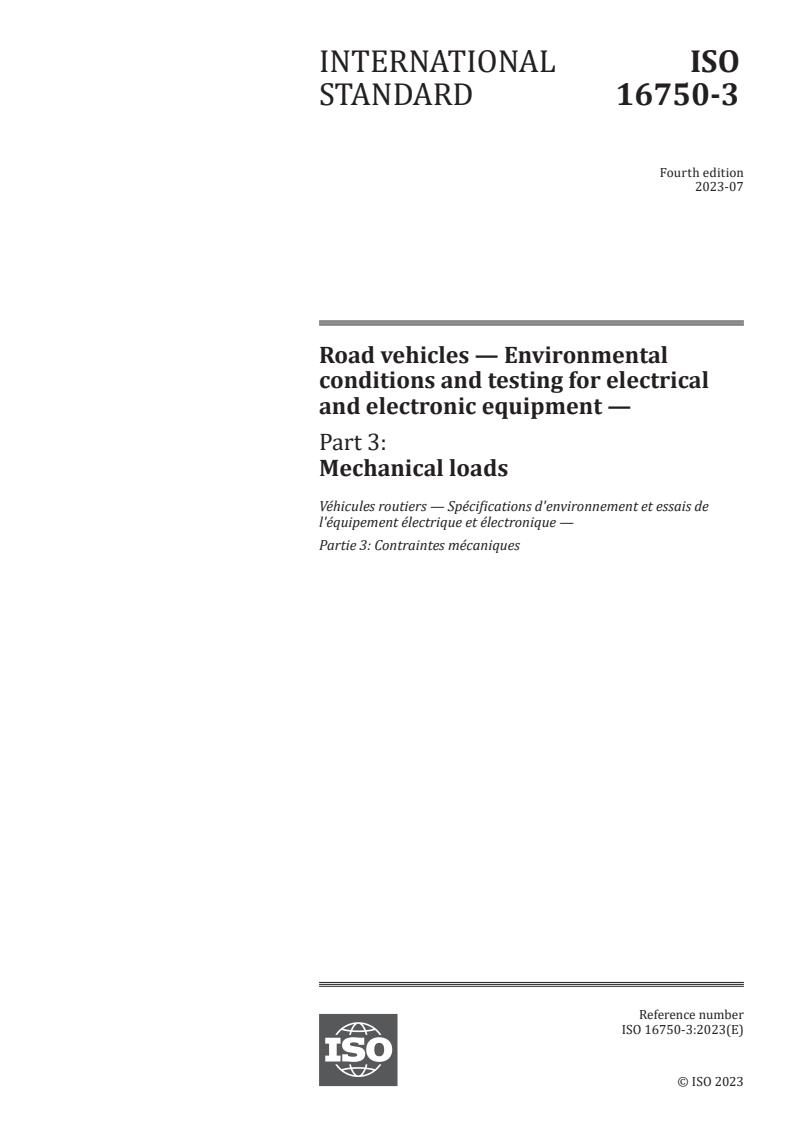
INTERNATIONAL ISO
STANDARD 16750-3
Fourth edition
2023-07
Road vehicles — Environmental
conditions and testing for electrical
and electronic equipment —
Part 3:
Mechanical loads
Véhicules routiers — Spécifications d'environnement et essais de
l'équipement électrique et électronique —
Partie 3: Contraintes mécaniques
Reference number
© ISO 2023
All rights reserved. Unless otherwise specified, or required in the context of its implementation, no part of this publication may
be reproduced or utilized otherwise in any form or by any means, electronic or mechanical, including photocopying, or posting on
the internet or an intranet, without prior written permission. Permission can be requested from either ISO at the address below
or ISO’s member body in the country of the requester.
ISO copyright office
CP 401 • Ch. de Blandonnet 8
CH-1214 Vernier, Geneva
Phone: +41 22 749 01 11
Email: copyright@iso.org
Website: www.iso.org
Published in Switzerland
ii
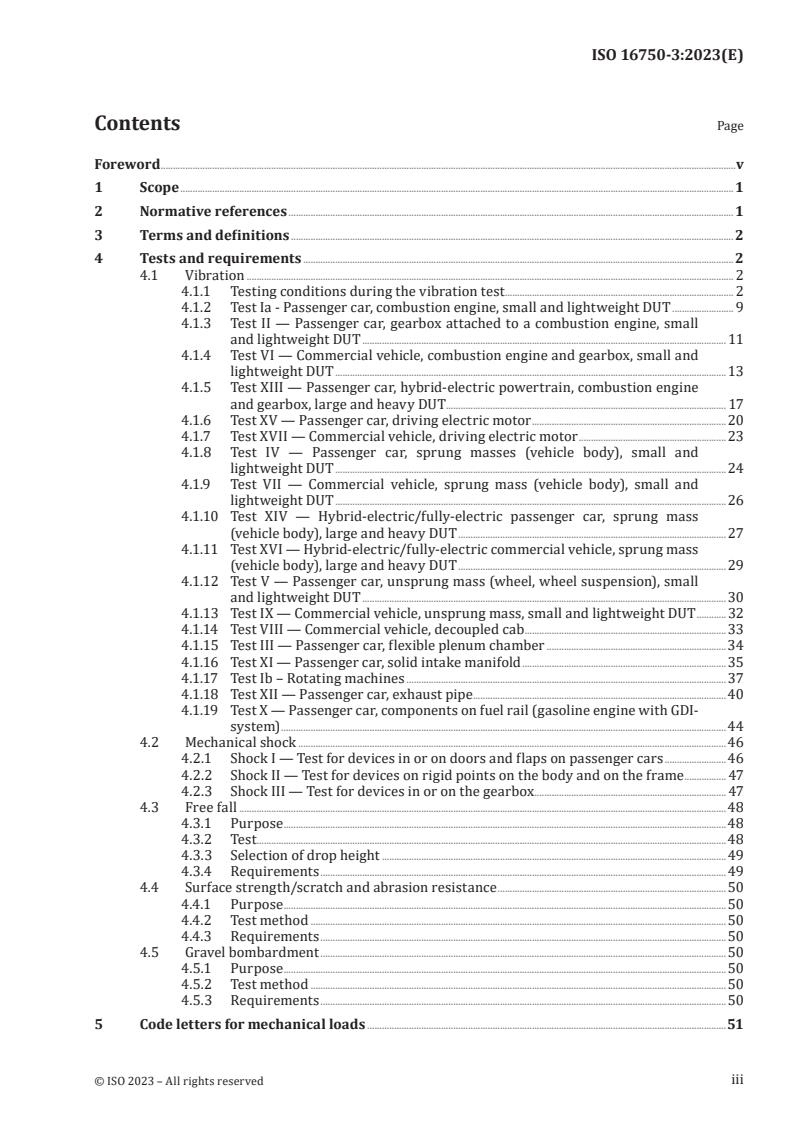
Contents Page
Foreword .v
1 Scope . 1
2 Normative references . 1
3 Terms and definitions . 2
4 Tests and requirements .2
4.1 Vibration . 2
4.1.1 Testing conditions during the vibration test . 2
4.1.2 Test Ia - Passenger car, combustion engine, small and lightweight DUT . 9
4.1.3 Test II — Passenger car, gearbox attached to a combustion engine, small
and lightweight DUT . 11
4.1.4 Test VI — Commercial vehicle, combustion engine and gearbox, small and
lightweight DUT .13
4.1.5 Test XIII — Passenger car, hybrid-electric powertrain, combustion engine
and gearbox, large and heavy DUT. 17
4.1.6 Test XV — Passenger car, driving electric motor . 20
4.1.7 Test XVII — Commercial vehicle, driving electric motor .23
4.1.8 Test IV — Passenger car, sprung masses (vehicle body), small and
lightweight DUT . 24
4.1.9 Test VII — Commercial vehicle, sprung mass (vehicle body), small and
lightweight DUT .26
4.1.10 Test XIV — Hybrid-electric/fully-electric passenger car, sprung mass
(vehicle body), large and heavy DUT . 27
4.1.11 Test XVI — Hybrid-electric/fully-electric commercial vehicle, sprung mass
(vehicle body), large and heavy DUT .29
4.1.12 Test V — Passenger car, unsprung mass (wheel, wheel suspension), small
and lightweight DUT .30
4.1.13 Test IX — Commercial vehicle, unsprung mass, small and lightweight DUT . 32
4.1.14 Test VIII — Commercial vehicle, decoupled cab . 33
4.1.15 Test III — Passenger car, flexible plenum chamber .34
4.1.16 Test XI — Passenger car, solid intake manifold . 35
4.1.17 Test Ib – Rotating machines . 37
4.1.18 Test XII — Passenger car, exhaust pipe .40
4.1.19 Test X — Passenger car, components on fuel rail (gasoline engine with GDI-
system) .44
4.2 Mechanical shock .46
4.2.1 Shock I — Test for devices in or on doors and flaps on passenger cars .46
4.2.2 Shock II — Test for devices on rigid points on the body and on the frame . 47
4.2.3 Shock III — Test for devices in or on the gearbox . 47
4.3 Free fall .48
4.3.1 Purpose .48
4.3.2 Test . . .48
4.3.3 Selection of drop height .49
4.3.4 Requirements .49
4.4 Surface strength/scratch and abrasion resistance .50
4.4.1 Purpose .50
4.4.2 Test method . 50
4.4.3 Requirements .50
4.5 Gravel bombardment . 50
4.5.1 Purpose .50
4.5.2 Test method . 50
4.5.3 Requirements .50
5 Code letters for mechanical loads .51
iii
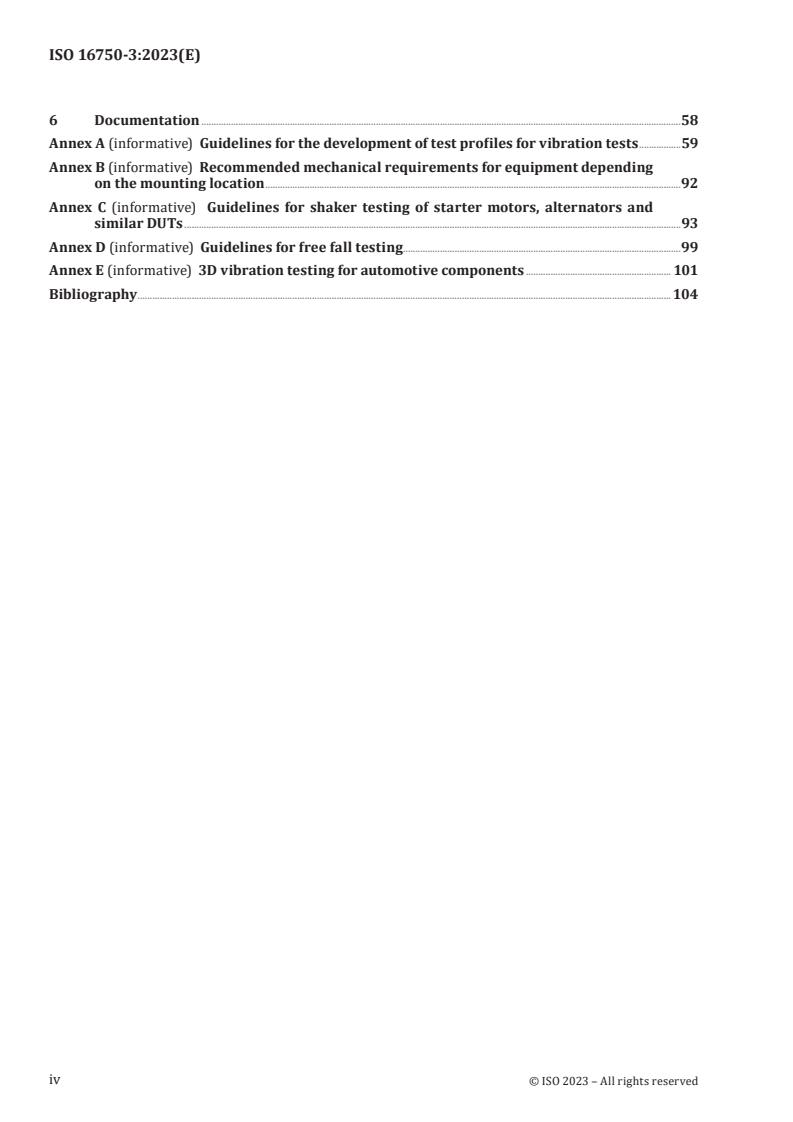
6 Documentation .58
Annex A (informative) Guidelines for the development of test profiles for vibration tests .59
Annex B (informative) Recommended mechanical requirements for equipment depending
on the mounting location .92
Annex C (informative) Guidelines for shaker testing of starter motors, alternators and
similar DUTs .93
Annex D (informative) Guidelines for free fall testing .99
Annex E (informative) 3D vibration testing for automotive components . 101
Bibliography . 104
iv
Foreword
ISO (the International Organization for Standardization) is a worldwide federation of national standards
bodies (ISO member bodies). The work of preparing International Standards is normally carried out
through ISO technical committees. Each member body interested in a subject for which a technical
committee has been established has the right to be represented on that committee. International
organizations, governmental and non-governmental, in liaison with ISO, also take part in the work.
ISO collaborates closely with the International Electrotechnical Commission (IEC) on all matters of
electrotechnical standardization.
The procedures used to develop this document and those intended for its further maintenance are
described in the ISO/IEC Directives, Part 1. In particular, the different approval criteria needed for the
different types of ISO document should be noted. This document was drafted in accordance with the
editorial rules of the ISO/IEC Directives, Part 2 (see www.iso.org/directives).
ISO draws attention to the possibility that the implementation of this document may involve the use
of (a) patent(s). ISO takes no position concerning the evidence, validity or applicability of any claimed
patent rights in respect thereof. As of the date of publication of this document, ISO had not received
notice of (a) patent(s) which may be required to implement this document. However, implementers are
cautioned that this may not represent the latest information, which may be obtained from the patent
database available at www.iso.org/patents. ISO shall not be held responsible for identifying any or all
such patent rights.
Any trade name used in this document is information given for the convenience of users and does not
constitute an endorsement.
For an explanation of the voluntary nature of standards, the meaning of ISO specific terms and
expressions related to conformity assessment, as well as information about ISO's adherence to
the World Trade Organization (WTO) principles in the Technical Barriers to Trade (TBT), see
www.iso.org/iso/foreword.html.
This document was prepared by Technical Committee ISO/TC 22, Road vehicles, Subcommittee SC 32,
Electrical and electronic components and general system aspects.
This fourth edition cancels and replaces the third edition (ISO 16750-3:2012), which has been
technically revised.
The main changes are as follows:
— integrating and harmonizing content from ISO 19453-3:2018;
— distinction between small and lightweight versus large and heavy DUTs;
— revising vibration profiles where necessary due to extended datasets of and experience from vehicle
measurements;
— addition of vibration test for rotating machines on combustion engines and Annex C;
— addition of vibration tests for hybrid-electric/fully-electric commercial vehicles;
— addition of guided fall test description and Annex D;
— addition of Annex E as guidance for 3D shaker testing;
— test order appearing in the document has been changed for a logical grouping depending on test
type, however test numbers have been kept for backwards compatibility.
A list of all parts in the ISO 16750 series can be found on the ISO website.
Any feedback or questions on this document should be directed to the user’s national standards body. A
complete listing of these bodies can be found at www.iso.org/members.html.
v
INTERNATIONAL STANDARD ISO 16750-3:2023(E)
Road vehicles — Environmental conditions and testing for
electrical and electronic equipment —
Part 3:
Mechanical loads
1 Scope
This document applies to electric and electronic systems and components for vehicles including electric
propulsion systems and components with maximum working voltages according to voltage class B. It
describes the potential environmental stresses and specifies tests and requirements recommended for
the specific mounting location on/in the vehicle.
This document describes mechanical loads.
This document is not intended to apply to environmental requirements or testing for systems and
components of motorcycles and mopeds.
Systems and their components released for production, or systems and their components already under
development prior to the publication date of this document, can be exempted from fulfilling the changes
in this edition compared to the previous one.
2 Normative references
The following documents are referred to in the text in such a way that some or all of their content
constitutes requirements of this document. For dated references, only the edition cited applies. For
undated references, the latest edition of the referenced document (including any amendments) applies.
ISO 16750-1:2023, Road vehicles — Environmental conditions and testing for electrical and electronic
equipment — Part 1: General
ISO 16750-4:2023, Road vehicles — Environmental conditions and testing for electrical and electronic
equipment— Part 4: Climatic loads
IEC 60068-2-6, Environmental testing — Part 2-6: Testing, Test Fc: Vibration (Sinusoidal)
IEC 60068-2-14, Environmental testing — Part 2-14: Tests — Test N: Change of temperature
IEC 60068-2-27, Environmental testing — Part 2-27: Tests — Test Ea and guidance: Shock
IEC 60068-2-31, Environmental testing — Part 2-31: Tests — Test Ec: Rough handling shocks, primarily for
equipment-type specimens
IEC 60068-2-64, Environmental testing — Part 2-64: Tests — Test Fh: Vibration, broadband random and
guidance
IEC 60068-2-80, Environmental testing — Part 2-80: Tests — Test Fi: Vibration — Mixed mode
UL 969:2017, Standard for Marking and Labeling Systems
ISO 20567-1:2017, Paints and varnishes — Determination of stone-chip resistance of coatings — Part 1:
Multi-impact testing
3 Terms and definitions
For the purposes of this document, the terms and definitions given in ISO 16750-1 apply.
ISO and IEC maintain terminology databases for use in standardization at the following addresses:
— ISO Online browsing platform: available at https:// www .iso .org/ obp
— IEC Electropedia: available at https:// www .electropedia .org/
4 Tests and requirements
4.1 Vibration
4.1.1 Testing conditions during the vibration test
4.1.1.1 General
The vibration test methods specified consider various levels of vibration severities applicable to on-
board electrical and electronic equipment. The customer and the supplier should choose the test
method, environmental temperature and vibration parameters depending on the specific mounting
location.
A clear dependence of the typical vibration load on the size and mass of the DUT is evident from vehicle
measurements. This applies to all mounting locations due to dynamic system coupling. That is why
in this document a distinction is made between small and lightweight E/E components (typically
<2 kg, unless stated otherwise in the individual test description, e.g. sensors, ECUs or fuel injection
equipment), mostly belonging but not limited to ICE vehicles, and much larger and heavier components
(typically ≥2 kg, unless stated otherwise in the individual test description, e.g. electric motors,
inverters, DC/DC converters or alternators), mostly belonging but not limited to electric powertrains
in electric propulsion vehicles. In each application the applicability of the intended vibration profile
should be verified with a vehicle measurement. See a mass classification example in ISO 16750-1:2023,
Annex C. For further information and guidance please refer to Tables 38-40 (code letters).
The following basic idea of environmental test methods is expressed in the Foreword of Reference [7].
When applied properly, the environmental management and engineering processes described in
this document can be of enormous value in generating confidence in the environmental worthiness
and overall durability of the tested equipment. However, it is important to recognize that limitations
inherent in laboratory testing make it imperative to use proper caution and engineering judgment when
extrapolating these laboratory results to results that can be obtained under actual service conditions.
In many cases, real world environmental stresses (singularly or in combination) cannot be duplicated
practically or reliably in test laboratories. Therefore, users of this document should not assume that
a system or component that passes laboratory tests of this document would also pass field/fleet
verification trials.
The specified values are the best estimation that can be obtained up to the moment when results from
measurements in the vehicle are received, but they do not replace a vehicle measurement.
The specified values apply to direct mounting in defined mounting locations. The specified vibration
profiles apply to direct mounting in defined mounting locations. Since the use of an installation support
(e.g. mounting bracket) can influence test vibration loads on the shaker to be much higher or much
lower than actual vehicle loads, in principle, each vibration test should be carried out with only DUT
itself. If using an installation support, the applied loads on the shaker should be checked to reproduce
the actual vehicle loads as realistically as possible.
Carry out the vibration with the DUT rigidly mounted on a vibration table for reasons of comparability
and reproducibility (see also IEC 60068-2-47:2005, Clauses 5 and 6). If using a bracket is technically
unavoidable in order to fix the DUT to the shaker instead of a rigid mounting, then the transfer functions
from the excitation to the DUT compared to vehicle measurements as well as a proper control strategy
shall be considered. For further information refer to A.3. The mounting method(s) used shall be noted
in the test report. The scope of the recommended vibration tests is to avoid malfunctions and breakage
mainly due to fatigue in the field. Testing for wear has special requirements and is not covered in this
document.
If active operation and/or signal monitoring is applied during the test, extra care shall be taken with
respect to the fixation of the power cables and the wiring harnesses. This aims at avoiding signal
disturbances and negative mechanical impact on the connector, caused by dynamic motion of the
harness itself. The routing, rigidity, mass and fixation of wire harness in vehicle installation should also
be considered when deciding on the fixation of wire harness in a test setup in order to avoid a wrong
testing load for the DUT.
Loads outside the designated test frequency ranges can be considered separately if agreed between
the customer and the supplier. If it is known that resonance frequencies of the DUT are present that are
critical for fatigue and are not covered by the test frequency ranges, then it is recommended to perform
separate durability tests, such as resonance dwell testing.
NOTE Deviations from the load on the DUT can occur if vibration testing is carried out according to this
document on a large and heavy DUT, as mounting rigidity and dynamic reaction on the vibrator table excitation
are different compared to the situation in the vehicle. Such deviations can be minimized by applying the average
control method (see A.3).
The application of the weighted average control method in accordance with IEC 60068-2-64 may be
agreed upon.
4.1.1.2 Overlaid temperature cycles during vibration testing
4.1.1.2.1 General
Vibration tests are typically run with an overlaid temperature cycle. The intention is not to create
additional aging of the DUTs, but to induce a temperature-dependent dynamic response of or within the
DUT that might otherwise not occur if only tested at room temperature.
In the vehicle, vibration stress can occur together at low or high temperatures; for this reason, this
interaction between mechanical and temperature stress is simulated in the test, too. A failure
mechanism occurs when material characteristics of components change and cannot withstand the
acceleration under this condition. For example, a plastic part may mellow due to the high temperature.
The mass of the DUT as well as the installation area are the main influence factors that determine
the design of the temperature cycle which is why in the following clauses the different use cases are
distinguished.
For longer test durations of the vibration test the test cycles can be either repeated for a sufficient
number of times or stretched to fit the test duration. None of the following temperature cycles shall be
further compressed in their duration, otherwise a temperature equilibrium within the DUT might not
be ensured.
Depending on the failure mode of the DUT, a deviating temperature profile may be used if agreed
between the customer and the supplier.
Intentional humidity control is not permitted even if water condensation on the DUT occurs during
temperature cycles.
4.1.1.2.2 Temperature profile for small and lightweight components not mounted on the
combustion engine
During the vibration test, for small and lightweight DUT not mounted on the combustion engine,
perform the temperature cycling in accordance with IEC 60068-2-14, Test Nb, not using its specified
temperature changing rates, but using the variant given in Figure 1 and Table 1.
NOTE 1 This temperature profile can also be applied to small and lightweight components mounted on electric
drive systems or components.
Perform temperature cycling with the following as one cycle. Decrease ambient temperature from RT
to T , expose the DUT at T , increase ambient temperature from T to T , expose the DUT at T
min min min max max
and then decrease ambient temperature from T to RT (see Figure 1).
max
Perform a functional test at the end of T and T as short as possible with operating mode 3.3 or
min max
4.3 as defined in ISO 16750-1 (see key a in Figure 1). In addition, operate with operating mode 3.4 or
4.4 as defined in ISO 16750-1 (see key b in Figure 1) during the section from room temperature (RT) to
T . During the other sections, operate with operating mode 2.1 as defined in ISO 16750-1 (see key c
max
in Figure 1). If operating mode 4.3/4.4 is not technically feasible, operating mode 3.3/3.4 may be used if
agreed between the customer and the supplier.
NOTE 2 A permanent operation starting at T prevents possible condensation of humidity on DUT because
min
the self-heating of the DUT occurs. An electrical operation starting at RT allows this phenomenon.
NOTE 3 Condensation can lead to swelling of plastic sub-components of the DUT and therefore, influence the
dynamic behaviour under vibrational load.
Key
T temperature [°C]
t time
T minimum operating temperature as defined in ISO 16750-4
min
T maximum operating temperature as defined in ISO 16750-4
max
RT room temperature as defined in ISO 16750-1
t , t , t , t , t , t time parameter as defined in Table 1
1 2 3 4 5 6
a
Functional test with operating mode 3.3 or 4.3 as defined in ISO 16750-1.
b
Operating mode 3.4 or 4.4 as defined in ISO 16750-1.
c
Operating mode 2.1 as defined in ISO 16750-1.
d
One cycle.
e
Functional test with operating mode 3.4 or 4.4 as defined in ISO 16750-1.
Figure 1 — Temperature cycle with specified change rate for the vibration test of a small and
lightweight DUT
Table 1 — Temperatures versus time duration for temperature cycling for the vibration test of a
small and lightweight DUT
Duration Temperature
Parameter
[min] [°C]
t 60 From RT to T
1 min
t 90 Exposure time at T
2 min
t 60 From T to RT
3 min
t 90 From RT to T
4 max
t 110 Exposure time at T
5 max
t 70 From T to RT
6 max
NOTE T and T are defined in ISO 16750-4:2023, Table 1.
min max
4.1.1.2.3 Temperature profile for large and heavy components not mounted on the combustion
engine
During the vibration test, for large and heavy DUT not mounted on the combustion engine, perform the
temperature cycling in accordance with IEC 60068-2-14, Test Nb, not using its specified temperature
changing rates, but using the variant given in Figure 2 and Table 2.
Perform temperature cycling with the following as one cycle. Decrease ambient temperature from RT
to T , expose the DUT at T , increase ambient temperature from T to T , expose the DUT at T
min min min max max
and then decrease ambient temperature from T to RT (see Figure 2).
max
Before performing this test, a separate temperature measurement (with DUT in operating mode 2.1
as defined in ISO 16750-1) shall be performed to determine what exposure time at T , T (see
max min
Figure 2) is necessary to warrant that this desired temperature is also reached in DUT temperature.
The measuring point of the DUT shall be agreed between the customer and the supplier, considering
a target device (e.g. microprocessor, motor coil) which is temperature-influenced in functionality or
performance.
If operating mode 2.1 is technically not feasible for the separate temperature measurement, operating
mode 1.2 as defined in ISO 16750-1, can be used as agreed between the customer and the supplier.
Measures regarding the functional performance, for example, de-rating of the e-motor, are allowed to
avoid overheating of the DUT during high-temperature operation with self-heating effects.
The dwell time t of the DUT at T and T shall be more than 30 min each per temperature cycle;
x min max
therefore, exposure time shall be adjusted accordingly depending on the size and other characteristics
of the DUT. The customer and the supplier shall agree on a complete profile of temperature cycle
including dwell time and stabilisation time depending on the size and other properties of the DUT.
NOTE This temperature profile can also be applied to large and heavy components mounted on electric
drive systems or components.
Perform a functional test at the end of T and T as short as possible with operating mode 3.3 or
min max
4.3 as defined in ISO 16750-1 (see key a in Figure 2). In addition, operate with operating mode 3.4 or
4.4 as defined in ISO 16750-1 (see key b in Figure 2) during the section from room temperature (RT) to
T . During the other sections, operate with operating mode 2.1 as defined in ISO 16750-1 (see key c
max
in Figure 2). If operating mode 4.3/4.4 is not technically feasible, operating mode 3.3/3.4 may be used if
agreed between the customer and the supplier. For electric motors, active operation in operation mode
3.3 or 4.3 instead of 2.1 can be performed in order to avoid unrealistic failure mechanism, e.g. wear in
the bearing of an e-motor due to the vibration input.
Key
T temperature [°C]
t time
1 ambient temperature
2 DUT temperature, exemplary for non-heat dissipating DUTs
T minimum operating temperature as defined in ISO 16750-4
min
T maximum operating temperature as defined in ISO 16750-4
max
RT room temperature as defined in ISO 16750-1
t , t , t , t , t , t time parameter as defined in Table 2
1 2 3 4 5 6
t dwell time at T or T
x min max
a
Functional test with operating mode 3.3 or 4.3 as defined in ISO 16750-1.
b
Operating mode 3.4 or 4.4 as defined in ISO 16750-1.
c
Operating mode 2.1 as defined in ISO 16750-1.
d
One cycle.
e
Functional test with operating mode 3.4 or 4.4 as defined in ISO 16750-1.
Figure 2 — Temperature cycle with specified change rate for the vibration test of large and
heavy DUTs
Table 2 — Temperatures versus time duration for temperature cycling for the vibration test of
large and heavy DUTs
Duration Temperature
Parameter
[min] [°C]
t 60 From RT to T
1 min
t As agreed Exposure time at T
2 min
t 60 From T to RT
3 min
t 90 From RT to T
4 max
t As agreed Exposure time at T
5 max
t 70 From T to RT
6 max
t > 30 Dwell time at T or T
x min max
NOTE T and T are defined in ISO 16750-4:2023, Table 1.
min max
4.1.1.2.4 Temperature profile for components mounted on the combustion engine
In case of combustion engine-mounted DUTs (e.g. ECUs) a dwell time at T as given in Table 1 can
min
lead to a failure mode that is not occurring under field conditions as the combustion engine will warm
up any attached components quickly, so that an extended superposition of vibration load and T is
min
unrealistic. Therefore, the temperature profile shall be changed as given in Figure 3 and Table 3.
Key
T temperature [°C]
t time
T minimum operating temperature as defined in ISO 16750-4
min
T maximum operating temperature as defined in ISO 16750-4
max
RT room temperature as defined in ISO 16750-1
t , t , t , t , t , t time parameter as defined in Table 3
1 2 3 4 5 6
a
Functional test with operating mode 3.3 or 4.3 as defined in ISO 16750-1.
b
Operating mode 3.4 or 4.4 as defined in ISO 16750-1.
c
Operating mode 2.1 as defined in ISO 16750-1.
d
One cycle.
e
Functional test with operating mode 3.4 or 4.4 as defined in ISO 16750-1.
Figure 3 — Temperature cycle for DUTs mounted on the combustion engine
Table 3 — Temperatures versus time duration for temperature cycling for the vibration test of a
combustion engine-mounted DUT
Duration Temperature
Parameter
[min] [°C]
t 60 From RT to T
1 min
t 20 Exposure time at T
2 min
t 60 From T to RT
3 min
NOTE 1 T and T are defined in ISO 16750-4:2023, Table 1.
min max
NOTE 2 The exposure time at T , t , can be shortened if agreed between the customer and the
min 2
supplier based on justification from their field experience.
TTaabbllee 33 ((ccoonnttiinnueuedd))
Duration Temperature
Parameter
[min] [°C]
t 160 From RT to T
4 max
t 110 Exposure time at T
5 max
t 70 From T to RT
6 max
NOTE 1 T and T are defined in ISO 16750-4:2023, Table 1.
min max
NOTE 2 The exposure time at T , t , can be shortened if agreed between the customer and the
min 2
supplier based on justification from their field experience.
Similar to the profile given in Table 1 also for the overlaid temperature profile for a combustion engine-
mounted DUT, a short functional test at the end of the low temperature phase shall be done as well as
for the duration in which room temperature or above is given. If experience from the field justifies to
change the exposure time at T to avoid unrealistic failure modes during shaker testing, then this
min
exposure time shall be adjusted accordingly.
4.1.2 Test Ia - Passenger car, combustion engine, small and lightweight DUT
4.1.2.1 Purpose
This test checks the small and lightweight DUT (e.g. small sensors and ECUs) for malfunctions and
breakage caused by vibration.
The vibrations of a piston engine can be split up into two kinds: sinusoidal vibration which results from
the unbalanced mass forces in the cylinders and random noise due to all other vibration-schemes of an
engine, e.g. closing of valves. In the lowest frequency range from 10 Hz to 100 Hz the influence of rough-
road conditions is taken into account. The main failure to be identified by this test is breakage due to
fatigue.
NOTE 1 Road profile usually has a negligible impact on combustion engine-mounted components. Shock
inputs are effectively isolated by suspension, and combustion engine-mounting systems.
The test profiles specified in the following clauses apply to loads generated by (four stroke) reciprocating
combustion engines.
NOTE 2 If the DUT is to be tested for a specific resonance effect, then a resonance dwell test according to
IEC 60068-2-6:2007, 8.3.2 can also be applied.
4.1.2.2 Test
4.1.2.2.1 General
This test shall be performed as a mixed mode vibration test according to IEC 60068-2-80.
4.1.2.2.2 Sinusoidal vibration
Perform the test according to IEC 60068-2-6, but using a sweep rate of ≤ 0,5 octave/min. Use a test
duration of 30 h for each axis of the DUT.
NOTE The test duration is based on A.4.
Use curve 1 in Table 4/Figure 4 for the DUT intended for mounting on combustion engines with five
cylinders or fewer.
Use curve 2 in Table 4/Figure 4 for the DUT test intended for mounting on combustion engines with six
cylinders or more.
Both curves may be combined to cover all combustion engine types in one test.
Key
Y amplitude of acceleration [m/s ]
f frequency [Hz]
1 curve 1 (≤5 cylinders)
2 curve 2 (≥6 cylinders)
Figure 4 — Acceleration versus frequency
Table 4 — Values for acceleration versus frequency
Curve 1 (see Figure 4)
Frequency Amplitude of acceleration
[Hz] [m/s ]
100 100
200 200
240 200
270 100
440 100
Curve 2 (see Figure 4)
Frequency Amplitude of acceleration
[Hz] [m/s ]
100 100
150 150
440 150
Combination
Frequency Amplitude of acceleration
[Hz] [m/s ]
100 100
200 200
240 200
255 150
440 150
4.1.2.2.3 Random vibration
Perform the test according to IEC 60068-2-64. Use a test duration of 30 h for each axis of the DUT.
The root mean square (RMS) acceleration value shall be 181 m/s .
Values for power spectral density (PSD) versus frequency are referred to in Figure 5 and Table 5.
NOTE The PSD values (random vibration) are reduced in the frequency range of the sinusoidal vibration
test.
Key
2 2
Y PSD [(m/s ) /Hz]
f frequency [Hz]
Figure 5 — PSD of acceleration versus frequency
Table 5 — Values for PSD versus frequency
Frequency PSD
2 2
[Hz] [(m/s ) /Hz]
10 10
100 10
300 0,51
500 20
2 000 20
4.1.2.3 Requirement
Malfunctions or breakage shall not occur. Functional status class A as defined in ISO 16750-1 is required
during active operating modes, and functional status class C is required during periods with other
operating modes.
4.1.3 Test II — Passenger car, gearbox attached to a combustion engine, small and lightweight
DUT
4.1.3.1 Purpose
This test checks the small and lightweight DUT (e.g. small sensors or transmission control units) for
malfunctions and breakage caused by vibration.
The vibrations of a gearbox can be split up into two kinds which result partly from sinusoidal vibration
from unbalanced mass forces of the combustion engine (e.g. dominating orders) in the frequency range
from 100 Hz to 440 Hz and partly from vibration from the friction of the gear wheels and other schemes,
which are tested in the random part. In the lowest frequency range from 10 Hz to 100 Hz the influence
of rough-road conditions is taken into account. The main failure to be identified by this test is breakage
due to fatigue.
The test profiles specified in the following subclauses apply to loads generated by gearbox vibrations.
Changing the gears can create additional mechanical shock and is tested in 4.2.3.
4.1.3.2 Test
4.1.3.2.1 General
This test shall be performed as a mixed mode vibration test according to IEC 60068-2-80.
NOTE The test duration is based on A.4. The temperature in the chamber is above RT at the end of the test
(3 ¾ temperature cycles).
4.1.3.2.2 Sinusoidal vibration
Perform the test according to IEC 60068-2-6, but using a sweep rate of ≤0,5 octave/min. Use a test
duration of 30 h for each axis of the DUT.
Values for amplitude versus frequency are referred to in Figure 6 and Table 6.
Key
Y amplitude of acceleration [m/s ]
f frequency [Hz]
Figure 6 — Acceleration versus frequency
Table 6 — Values for acceleration versus frequency
Frequency Amplitude of acceleration
[Hz] [m/s ]
100 30
200 60
440 60
4.1.3.2.3 Random vibration
Perform the test according to IEC 60068-2-64. Use a test duration of 30 h for each axis of the DUT.
The RMS acceleration value shall be 96,6 m/s .
NOTE The PSD values (random vibration) are reduced in the frequency range of the sinusoidal vibration
test.
Values for PSD versus frequency are referred to in Figure 7 and Table 7.
Key
2 2
Y PSD [(m/s ) /Hz]
f frequency [Hz]
Figure 7 — PSD of acceleration versus frequency
Table 7 — Values for PSD versus frequency
Frequency PSD
2 2
[Hz] [(m/s ) /Hz]
10 10
100 10
300 0,51
500 5
2 000 5
4.1.3.3 Requirement
Malfunctions and/or breakage shall not occur. Functional status class A as defined in ISO 16750-1 is
required during active operating modes, and functional status class C is required during periods with
other operating modes.
4.1.4 Test VI — Commercial vehicle, combustion engine and gearbox, small and lightweight
DUT
4.1.4.1 Purpose
This test checks the small and lightweight DUT (such as small sensors or ECUs) for malfunctions and
breakage caused by vibration.
The vibrations of a piston-engine can be split up into two kinds: sinusoidal vibration which results from
unbalanced mass forces and random noise due to all other vibration sources of an engine, e.g. closing of
valves.
Because the gearbox is rigidly attached to the combustion engine, this test can also be used for systems/
components mounted at the gearbox. But there is no sufficient number of measurements on gearbox-
mounted systems/components performed up to now.
The main failure to be identified by this test is breakage due to fatigue.
If the DUT has natural frequencies below 30 Hz, an additional test (see Table 10) is to be carried out with
a duration of 32 h in all critical axes of the DUT. When it is required to determine the natural frequency
of the DUT in the relevant test specification, the vibration response investigation shall be carried
out according to IEC 60068-2-6, but using a frequency range of 10 Hz to 50 Hz with an acceleration
amplitude of 10 m/s as excitation at a sweep rate of ≤0,5 octave/min.
4.1.4.2 Test
4.1.4.2.1 General
This test shall be performed as a mixed mode vibration test according to IEC 60068-2-80.
NOTE The temperature in the chamber is above RT at the end of the test (11 ¾ cycles).
4.1.4.2.2 Sinusoidal vibration
Perform the test according to IEC 60068-2-6, but using a sweep rate of ≤0,5 octave/min. Use a test
duration of 94 h for each axis of the DUT (equivalent to approximatively 20 h per octave). This is
equivalent to 10 cycles in resonance in case of resonance bandwidth of 100 Hz or more. See Table A.5.
Values for amplitude versus frequency are referred to in Figure 8 and Table 8.
Key
Y amplitude of acceleration [m/s ]
f frequency [Hz]
Figure 8 — Acceleration versus frequency
Table 8 — Values for acceleration versus frequency
Frequency Amplitude of acceleration
[Hz] [m/s ]
20 26
65 120
TTaabbllee 88 ((ccoonnttiinnueuedd))
Frequency Amplitude of acceleration
[Hz] [m/s ]
260 120
270 90
350 90
360 60
520 60
NOTE The sinusoidal profile given in previous editions of this document has been modified in three aspects.
A higher amplitude of acceleration at the starting frequency was applied as even modern controllers have
difficulty distinguishing the sine and random part of the SoR (sine on random) signal at this frequency. Therefore,
the sine part was raised reasonably. Secondly, instead of a constant slope of displacement, now a constant slope of
acceleration was applied from this first break point to the second. And lastly, instead of vertical slopes at 260 Hz
and 350 Hz, slightly more shallow slopes were applied to allow for better control of the signal by the controllers.
4.1.4.2.3 Random vibration
Perform the test according to IEC 60068-2-64.
Test duration:
— 94 h for each axis of the DUT (standard) (see Figure 9 and Table 9),
— 32 h additionally for each critical axis of the DUT (for natural frequencies below 30 Hz) (see Table 10).
NOTE The PSD values (random vibration) are reduced in the frequency range of the sinusoidal vibration
test.
The PSD versus frequency is referred to in Figure 9 and Table 9.
Key
2 2
Y PSD [(m/s ) /Hz]
f frequency [Hz]
1 standard random test profile
2 additional profile in case of f < 30 Hz
n
Figure 9 — PSD of acceleration versus frequency
Table 9 — Values for PSD versus frequency
Frequency PSD
2 2
[Hz] [(m/s ) /Hz]
10 14
20 28
30 28
180 0,75
300 0,75
600 20
2 000 20
RMS acceleration value = 177 m/s .
Table 10 — Values for PSD versus frequency, additional test in case of natural frequencies f of
n
DUT below 30 Hz
Frequency PSD
2 2
[Hz] [(m/s ) /Hz]
10 50
30 30
45 0,1
RMS acceleration value = 28,6 m/s .
4.1.4.3 Requirement
Malfunctions and/or breakage shall not occur. Functional status class A as defined in ISO 16750-1 is
required during active operating modes, and functional status class C is required during periods with
other operating modes.
4.1.5 Test XIII — Passenger car, hybrid-electric powertrain, combustion engine and gearbox,
la
...