

ISO 4724:2004
(Main)Oil of cedarwood, Virginian (Juniperus virginiana L.)
General Information
- Abstract
ISO 4724:2004 specifies certain characteristics of the oil of cedarwood, Virginian (Juniperus virginiana L.), in order to facilitate assessment of its quality.
- Status
- Published
- Publication Date
- 14-Jun-2004
- Technical Committee
- ISO/TC 54 - Essential oils
- Drafting Committee
- ISO/TC 54 - Essential oils
- Current Stage
- 9093 - International Standard confirmed
- Start Date
- 17-Jul-2023
- Completion Date
- 29-Aug-2026
Buy Documents
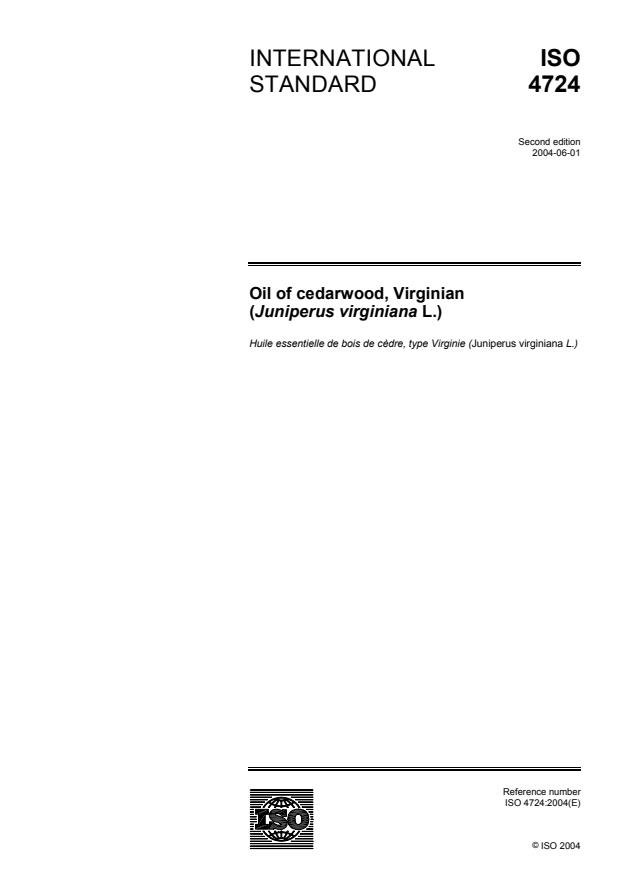

ISO 4724:2004 - Oil of cedarwood, Virginian (Juniperus virginiana L.) Released:6/15/2004
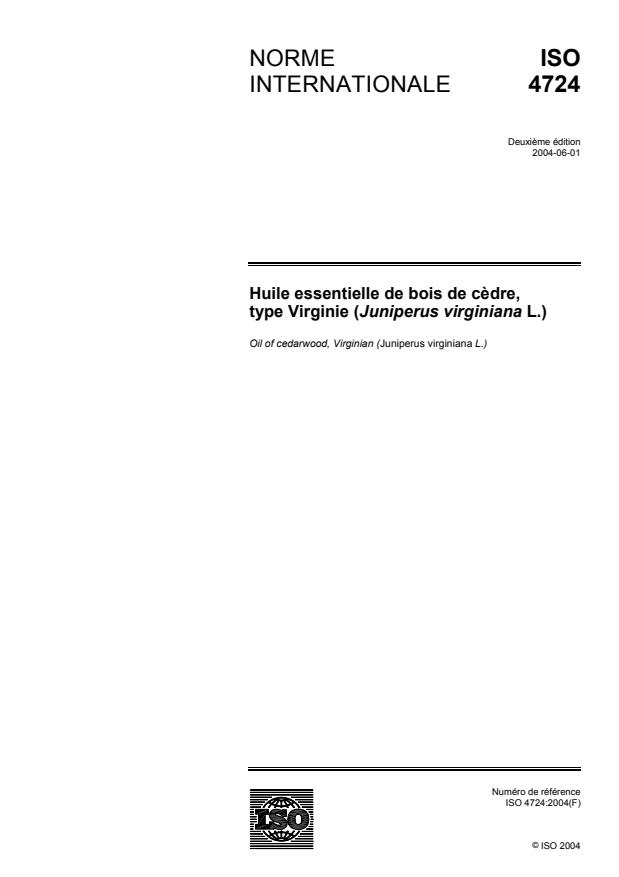

ISO 4724:2004 - Huile essentielle de bois de cedre, type Virginie (Juniperus virginiana L.) Released:6/15/2004
Overview
ISO 4724:2004 is an international standard developed by the International Organization for Standardization (ISO) that specifies quality characteristics for Oil of Cedarwood, Virginian (Juniperus virginiana L.). This essential oil is extracted from the wood of the Virginian cedar tree native to the southeastern United States. The standard aims to facilitate the assessment and ensure consistency in the quality of this specific cedarwood oil by defining its physical properties, chemical composition, and testing methods.
This standard serves producers, suppliers, quality controllers, and users of Virginian cedarwood oil by providing reliable criteria for evaluating its authenticity, purity, and safety measures. Adherence to ISO 4724:2004 helps support trade and regulatory compliance globally.
Key Topics
Scope and Definitions: ISO 4724:2004 applies exclusively to oil obtained by steam distillation from Juniperus virginiana L. wood. It clarifies definitions such as the botanical source and essential oil characteristics.
Physical Characteristics:
- Appearance: Slightly viscous liquid, occasionally with crystals
- Colour: Nearly colourless to pale yellow
- Odour: Warm, woody, and characteristic of Virginian cedarwood oil
Chemical and Physical Parameters:
- Relative density at 20 °C: 0.9410–0.9650
- Refractive index at 20 °C: 1.5010–1.5100
- Optical rotation at 20 °C: Between −36° and −16°
- Miscibility in 95% ethanol: Clear solution must form using no more than 5 volumes of ethanol per volume of oil
- Flashpoint: Informative mean value around +93 °C (using Setaflash apparatus)
Chromatographic Profile:
Chemical components characterized by gas chromatography form the core of quality assessment. Essential components with specified concentration ranges include:- α-Cedrene + β-funebrene (20–35%)
- β-Cedrene + β-caryophyllene (4–8%)
- Thujopsene (10–25%)
- Cuparene (1.5–7%)
- Cedrol (16–25%)
- Widdrol (2–5%)
Sampling and Testing Methods: ISO 212 covers sampling, and dedicated ISO standards provide methods for measuring density, refractive index, optical rotation, ethanol miscibility, and chromatographic analysis to ensure reproducibility and reliability.
Applications
ISO 4724:2004 is essential for various stakeholders engaged with Virginian cedarwood oil, including:
- Essential Oil Manufacturers: To certify product quality and authenticity for both domestic and international markets.
- Perfume and Fragrance Industry: For formulation consistency and compliance with regulations.
- Pharmaceutical and Aromatherapy Sectors: To guarantee the safety and purity of medicinal and therapeutic-grade cedarwood oils.
- Regulatory Authorities and Quality Control Labs: To enforce standards for imports, exports, and trade fair practices.
- Transport and Storage Providers: For safe handling instructions referencing properties like flashpoint and miscibility.
Implementing this standard reduces risks of adulteration, enhances consumer confidence, and supports the sustainable use of natural essential oils.
Related Standards
ISO 4724:2004 works in conjunction with several important ISO technical references for essential oils, including:
- ISO/TR 210 - General rules for packaging, conditioning, and storage of essential oils
- ISO/TR 211 - Labelling and marking requirements for essential oil containers
- ISO 212 - Sampling procedure for essential oils
- ISO 279 - Determination of relative density at 20 °C
- ISO 280 - Determination of refractive index
- ISO 592 - Determination of optical rotation
- ISO 875 - Evaluation of miscibility in ethanol
- ISO 11024-1 and ISO 11024-2 - Guidance on preparation and use of chromatographic profiles
- ISO/TR 11018 - Guidance on determining flashpoint of essential oils
- ISO/TR 21092 - Characterization of essential oils including CAS number references
Together, these standards form a comprehensive framework ensuring the accurate identification, testing, and quality control of Virginian cedarwood oil and other essential oils within global trade.
Keywords: ISO 4724:2004, Virginian cedarwood oil, Juniperus virginiana, essential oil quality, steam distilled cedarwood oil, chromatographic profile, essential oil testing, oil of cedarwood Virginian standard, cedarwood oil chemical composition, essential oil flashpoint, essential oil standards, ISO essential oils.
Relations
- Effective Date
- 15-Apr-2008
Buy Documents
ISO 4724:2004 - Oil of cedarwood, Virginian (Juniperus virginiana L.) Released:6/15/2004
ISO 4724:2004 - Huile essentielle de bois de cedre, type Virginie (Juniperus virginiana L.) Released:6/15/2004
Get Certified
Connect with accredited certification bodies for this standard

ECOCERT
Organic and sustainability certification.

Eurofins Food Testing Global
Global leader in food, environment, and pharmaceutical product testing.

Intertek Bangladesh
Intertek certification and testing services in Bangladesh.
Sponsored listings
Frequently Asked Questions
ISO 4724:2004 is a standard published by the International Organization for Standardization (ISO). Its full title is "Oil of cedarwood, Virginian (Juniperus virginiana L.)". This standard covers: ISO 4724:2004 specifies certain characteristics of the oil of cedarwood, Virginian (Juniperus virginiana L.), in order to facilitate assessment of its quality.
ISO 4724:2004 specifies certain characteristics of the oil of cedarwood, Virginian (Juniperus virginiana L.), in order to facilitate assessment of its quality.
ISO 4724:2004 is classified under the following ICS (International Classification for Standards) categories: 71.100.60 - Essential oils. The ICS classification helps identify the subject area and facilitates finding related standards.
ISO 4724:2004 has the following relationships with other standards: It is inter standard links to ISO 4724:1984. Understanding these relationships helps ensure you are using the most current and applicable version of the standard.
ISO 4724:2004 is available in PDF format for immediate download after purchase. The document can be added to your cart and obtained through the secure checkout process. Digital delivery ensures instant access to the complete standard document.
Standards Content (Sample)
INTERNATIONAL ISO
STANDARD 4724
Second edition
2004-06-01
Oil of cedarwood, Virginian
(Juniperus virginiana L.)
Huile essentielle de bois de cèdre, type Virginie (Juniperus virginiana L.)
Reference number
©
ISO 2004
PDF disclaimer
This PDF file may contain embedded typefaces. In accordance with Adobe's licensing policy, this file may be printed or viewed but
shall not be edited unless the typefaces which are embedded are licensed to and installed on the computer performing the editing. In
downloading this file, parties accept therein the responsibility of not infringing Adobe's licensing policy. The ISO Central Secretariat
accepts no liability in this area.
Adobe is a trademark of Adobe Systems Incorporated.
Details of the software products used to create this PDF file can be found in the General Info relative to the file; the PDF-creation
parameters were optimized for printing. Every care has been taken to ensure that the file is suitable for use by ISO member bodies. In
the unlikely event that a problem relating to it is found, please inform the Central Secretariat at the address given below.
© ISO 2004
All rights reserved. Unless otherwise specified, no part of this publication may be reproduced or utilized in any form or by any means,
electronic or mechanical, including photocopying and microfilm, without permission in writing from either ISO at the address below or
ISO's member body in the country of the requester.
ISO copyright office
Case postale 56 • CH-1211 Geneva 20
Tel. + 41 22 749 01 11
Fax + 41 22 749 09 47
E-mail copyright@iso.org
Web www.iso.org
Published in Switzerland
ii © ISO 2004 – All rights reserved
Foreword
ISO (the International Organization for Standardization) is a worldwide federation of national standards bodies
(ISO member bodies). The work of preparing International Standards is normally carried out through ISO
technical committees. Each member body interested in a subject for which a technical committee has been
established has the right to be represented on that committee. International organizations, governmental and
non-governmental, in liaison with ISO, also take part in the work. ISO collaborates closely with the
International Electrotechnical Commission (IEC) on all matters of electrotechnical standardization.
International Standards are drafted in accordance with the rules given in the ISO/IEC Directives, Part 2.
The main task of technical committees is to prepare International Standards. Draft International Standards
adopted by the technical committees are circulated to the member bodies for voting. Publication as an
International Standard requires approval by at least 75 % of the member bodies casting a vote.
Attention is drawn to the possibility that some of the elements of this document may be the subject of patent
rights. ISO shall not be held responsible for identifying any or all such patent rights.
ISO 4724 was prepared by Technical Committee ISO/TC 54, Essential oils.
This second edition cancels and replaces the first edition (ISO 4724:1984), which has been technically revised.
INTERNATIONAL STANDARD ISO 4724:2004(E)
Oil of cedarwood, Virginian (Juniperus virginiana L.)
1 Scope 3 Terms and definitions
This International Standard specifies certain For the purposes of this document, the following
characteristics of the oil of cedarwood, Virginian terms and definitions apply.
(Juniperus virginiana L.), in order to facilitate
assessment of its quality. 3.1
oil of cedarwood, Virginian
essential oil obtained by steam distillation of
the wood of Juniperus virginiana L., of the
2 Normative references
Cupressaceae family, growing in the United States
of America from the South Eastern part of Virginia to
The following referenced documents are indispen-
Eastern Texas
sable for the application of this document. For dated
references, only the edition cited applies. For un-
NOTE For information on the CAS number, see
dated references, the latest edition of the referenced
ISO/TR 21092.
document (including any amendments) applies.
ISO/TR 210, Essential oils — General rules for
4 Requirements
packaging, conditioning and storage
ISO/TR 211, Essential oils — General rules for la-
4.1 Appearance
belling and marking of containers
Slightly viscous liquid, sometimes containing
ISO 212, Essential oils — Sampling
crystals.
ISO 279, Essential oils — Determination of relative
4.2 Colour
density at 20 °C — Reference method
Almost colourless to pale yellow.
ISO 280, Essential oils — Determination of refrac-
tive index
4.3 Odour
ISO 592, Essential oils — Determination of optical
Characteristic, warm and woody.
rotation
ISO 875, Essential oils — Evaluation of miscibility in
4.4 Relative density at 20 °C,
d
ethanol
Minimum: 0,941 0
ISO 11024-1, Essential oils — General guidance on
Maximum: 0,965 0
chromatographic profiles — Part 1: Preparation of
chromatographic profiles for presentation in stan-
4.5 Refractive index at 20 °C
dards
Minimum: 1,501 0
ISO 11024-2, Essential oils — General guidance on
chromatographic profiles — Part 2
...
NORME ISO
INTERNATIONALE 4724
Deuxième édition
2004-06-01
Huile essentielle de bois de cèdre,
type Virginie (Juniperus virginiana L.)
Oil of cedarwood, Virginian (Juniperus virginiana L.)
Numéro de référence
©
ISO 2004
PDF – Exonération de responsabilité
Le présent fichier PDF peut contenir des polices de caractères intégrées. Conformément aux conditions de licence d'Adobe, ce fichier
peut être imprimé ou visualisé, mais ne doit pas être modifié à moins que l'ordinateur employé à cet effet ne bénéficie d'une licence
autorisant l'utilisation de ces polices et que celles-ci y soient installées. Lors du téléchargement de ce fichier, les parties concernées
acceptent de fait la responsabilité de ne pas enfreindre les conditions de licence d'Adobe. Le Secrétariat central de l'ISO décline toute
responsabilité en la matière.
Adobe est une marque déposée d'Adobe Systems Incorporated.
Les détails relatifs aux produits logiciels utilisés pour la création du présent fichier PDF sont disponibles dans la rubrique General Info
du fichier; les paramètres de création PDF ont été optimisés pour l'impression. Toutes les mesures ont été prises pour garantir l'exploi-
tation de ce fichier par les comités membres de l'ISO. Dans le cas peu probable où surviendrait un problème d'utilisation, veuillez en
informer le Secrétariat central à l'adresse donnée ci-dessous.
© ISO 2004
Droits de reproduction réservés. Sauf prescription différente, aucune partie de cette publication ne peut être reproduite ni utilisée sous
quelque forme que ce soit et par aucun procédé, électronique ou mécanique, y compris la photocopie et les microfilms, sans l'accord écrit
de l'ISO à l'adresse ci-après ou du comité membre de l'ISO dans le pays du demandeur.
ISO copyright office
Case postale 56 • CH-1211 Geneva 20
Tel. + 41 22 749 01 11
Fax. + 41 22 749 09 47
E-mail copyright@iso.org
Web www.iso.org
Publié en Suisse
ii © ISO 2004 – Tous droits réservés
Avant-propos
L'ISO (Organisation internationale de normalisation) est une fédération mondiale d'organismes nationaux de
normalisation (comités membres de l'ISO). L'élaboration des Normes internationales est en général confiée
aux comités techniques de l'ISO. Chaque comité membre intéressé par une étude a le droit de faire partie du
comité technique créé à cet effet. Les organisations internationales, gouvernementales et non
gouvernementales, en liaison avec l'ISO participent également aux travaux. L'ISO collabore étroitement avec
la Commission électrotechnique internationale (CEI) en ce qui concerne la normalisation électrotechnique.
Les Normes internationales sont rédigées conformément aux règles données dans les Directives ISO/CEI,
Partie 2.
La tâche principale des comités techniques est d'élaborer les Normes internationales. Les projets de Normes
internationales adoptés par les comités techniques sont soumis aux comités membres pour vote. Leur
publication comme Normes internationales requiert l'approbation de 75 % au moins des comités membres
votants.
L'attention est appelée sur le fait que certains des éléments du présent document peuvent faire l'objet de
droits de propriété intellectuelle ou de droits analogues. L'ISO ne saurait être tenue pour responsable de ne
pas avoir identifié de tels droits de propriété et averti de leur existence.
L'ISO 4724 a été élaborée par le comité technique ISO/TC 54, Huiles essentielles.
Cette deuxième édition annule et remplace la première édition (ISO 4724:1984), dont elle constitue une
révision technique.
NORME INTERNATIONALE ISO 4724:2004(F)
Huile essentielle de bois de cèdre, type Virginie (Juniperus
virginiana L.)
1 Domaine d'application 3 Termes et définitions
La présente Norme internationale spécifie certaines Pour les besoins du présent document, les termes
caractéristiques de l'huile essentielle de bois de et définitions suivants s'appliquent.
cèdre, type Virginie (Juniperus virginiana L.), desti-
nées à faciliter l'appréciation de sa qualité.
3.1
huile essentielle de bois de cèdre, type Virginie
huile essentielle obtenue par distillation à la vapeur
d’eau du bois de Juniperus virginiana L., de la
2 Références normatives
famille des Cupressaceae, poussant naturellement
aux États-Unis d'Amérique, de la partie sud-est de
Les documents de référence suivants sont indis-
la Virginie jusqu'à la partie est du Texas
pensables pour l'application du présent document.
Pour les références datées, seule l'édition citée
NOTE Pour information sur le numéro CAS, voir
s'applique. Pour les références non datées, la der-
l'ISO/TR 21092.
nière édition du document de référence s'applique
(y compris les éventuels amendements).
4 Spécifications
ISO/TR 210, Huiles essentielles — Règles généra-
les d'emballage, de conditionnement et de stockage
4.1 Aspect
ISO/TR 211, Huiles essentielles — Règles généra-
les d'étiquetage et de marquage des récipients
Liquide légèrement visqueux, parfois contenant des
cristaux.
ISO 212, Huiles essentielles — Échantillonnage
ISO 279, Huiles essentielles — Détermination de la
4.2 Couleur
densité relative à 20 °C — Méthode de référence
De presque incolore à jaune pâle.
ISO 280, Huiles essentielles — Détermination de
l'indice de réfraction
4.3 Odeur
ISO 592, Huiles essentielles — Détermination du
pouvoir rotatoire
Caractéristique, agréable, boisée.
ISO 875, Huiles essentielles — Évaluation de la
4.4 Densité relative à 20 °C, d
miscibilité à l'éthanol 20
ISO 11024-1, Huiles essentielles — Directives gé-
Minimum: 0,941 0
nérales concernant les profils chromatographiques
Maximum: 0,965 0
— Partie 1: Élaboration des profils chromatographi-
ques pour la présentation dans les normes
4.5 Indice de réfraction à 20
...