

ISO 14669:2026
(Main)Water quality — Determination of acute lethal toxicity to marine copepods (Copepoda, Crustacea)
- Abstract
This document describes a method for the determination of the acute toxicity to one of three specified species of marine copepod (Copepoda, Crustacea). This document is applicable to: industrial or sewage effluents, treated or untreated, after decantation, filtration or centrifugation if necessary; marine or estuarine waters; )aqueous extracts (pore water, elutriates, eluates and leachates) from sediments; chemical substances which are soluble, or which can be maintained as a stable suspension or dispersion, under the conditions of the test.
- Status
- Published
- Publication Date
- 15-Jun-2026
- Technical Committee
- ISO/TC 147/SC 5 - Biological methods
- Drafting Committee
- ISO/TC 147/SC 5/WG 2 - Toxicity to invertebrates
- Current Stage
- 6060 - International Standard published
- Start Date
- 16-Jun-2026
- Due Date
- 10-Oct-2026
- Completion Date
- 16-Jun-2026
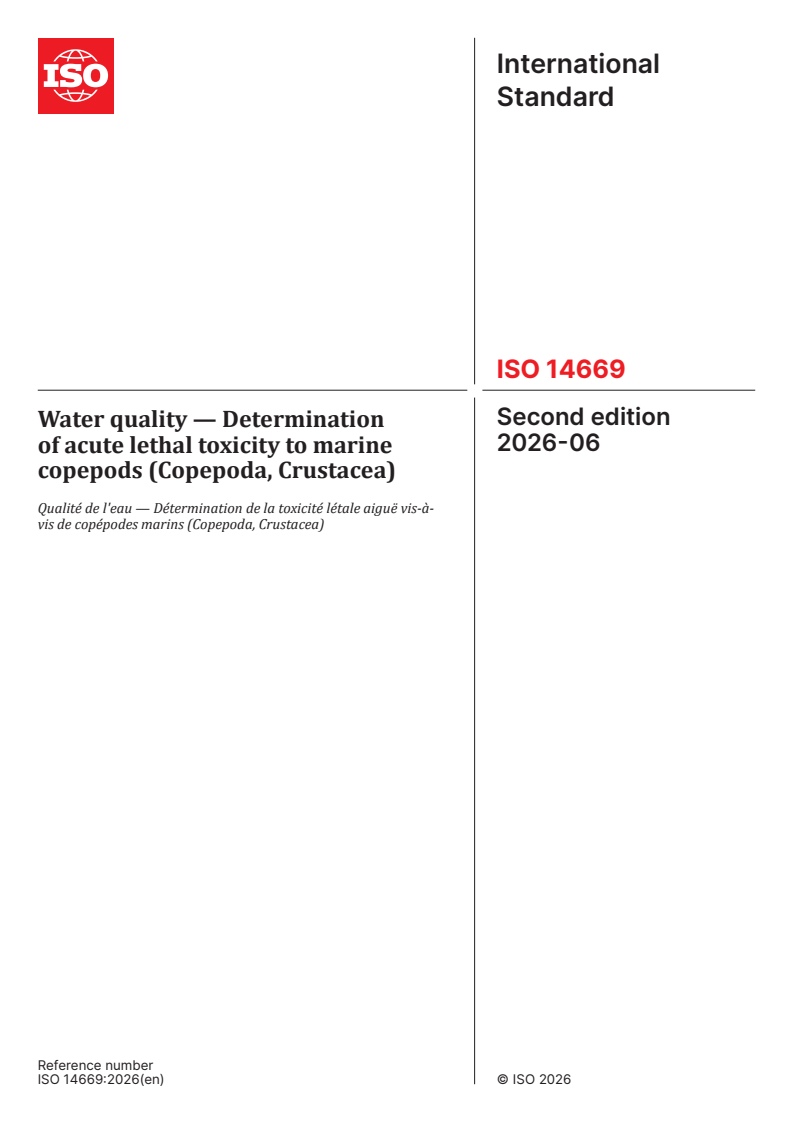
ISO 14669:2026 is an International Standard published by ISO for measuring the acute lethal toxicity of samples to one of three specified marine copepod species. It specifies a laboratory bioassay for industrial or sewage effluents, marine or estuarine waters, aqueous sediment extracts, and certain chemical substances, and it is aimed at environmental testing laboratories and anyone comparing acute toxicity results.
What does ISO 14669:2026 specify?
ISO 14669:2026 specifies a copepod mortality test and the way to report the result as an LC50. The document is organized as a complete test method, from sampling and test setup through calculation, validity checks, performance data, and the test report.
| Annex | What it covers |
|---|---|
| Annex A | Example of determining acute lethal toxicity for a chemical substance |
| Annex B | Culture methods for Acartia tonsa, Tisbe battagliai and Nitocra spinipes |
| Annex C | Precision data from interlaboratory trials |
| Annex D | Defined culture and test media |
The method applies to the sample types listed in the scope and uses one of the three named marine copepod species. In practice, the document gives laboratories a fixed way to prepare organisms and test solutions so results can be compared between sites and over time.
What are the key requirements of ISO 14669:2026?
Test setup and organisms
ISO 14669:2026 requires testing under controlled laboratory conditions at 20 °C ± 2 °C with a 16 h:8 h light-dark photoperiod, and the atmosphere must be free from vapours or dusts toxic to copepods. This matters because temperature, light and contamination can change mortality and make results unreliable.
The test organism shall be one of these species: Acartia tonsa, Tisbe battagliai or Nitocra spinipes. The age and life stage at test start must be recorded, and the document gives the required stage for each species. That detail matters because copepod sensitivity depends strongly on life stage.
The dilution water may be natural seawater or artificial seawater, with salinity normally between 25 PSU and 36 PSU. Lower salinity is allowed for estuarine or brackish situations if justified, and the copepods must be cultured or maintained at the same salinity for at least seven days before testing. The dilution water also has to meet dissolved oxygen and pH conditions before it is used.
Sampling, sample preparation and test solutions
Sampling and storage of water, effluent and sediment samples are linked to ISO 5667-1, ISO 5667-15, ISO 5667-16 and ISO 5667-19. The test should be carried out as soon as possible, ideally within 12 h, and the document gives practical storage options if that is not possible. For the reader, this means sample handling is part of the test quality, not just logistics.
For chemical substances, stock solutions are prepared from a known quantity in a known volume of dilution water, deionized water or distilled water. Poorly soluble substances may be aided by ultrasonic treatment or similar devices, and low-toxicity solvents such as acetone may be used only if the final solvent level stays within the stated limit and solvent controls are run in parallel. This keeps the test focused on the substance itself rather than the solvent.
For sediment-related testing, aqueous extracts such as pore water, elutriates, eluates and leachates are prepared using the appropriate protocol, for example ISO 21268-2. The test solutions are then made by adding the stock solution or sample to dilution water at the chosen concentrations.
Test procedure and concentration design
ISO 14669:2026 uses a preliminary test followed, if toxicity is observed, by a definitive test. The preliminary test uses a wide concentration range to locate the response range, while the definitive test uses at least five concentrations with a narrower spacing so that LC50 can be calculated. In practice, this reduces wasted testing and gives enough data around the effect level.
For the definitive test, each concentration and each control uses at least 20 copepods, and replicate containers are recommended. The density of copepods in the vessels must not exceed 1 per 0.5 ml of solution, and Acartia tonsa has a lower recommended maximum density. The copepods are not fed during the test unless they have been fed for a specific reason that is documented and mirrored in the positive control.
Mortality is checked after 24 h and 48 h, and copepods that show no swimming or appendage movement within 10 s are considered dead. The document also allows an extended exposure period to 96 h if needed. For chemical substances, a limit test is used at 100 mg/l or at the maximum soluble or stably dispersed concentration.
Sensitivity check, calculation and validity
ISO 14669:2026 requires periodic sensitivity checks with a reference chemical toxicant, recommended as 3,5-dichlorophenol, or another suitable chemical with a historical database. If the reference result falls outside the expected range, the document directs the user to check the procedure, breeding conditions and, if needed, use a new culture. That check protects against drift in organism sensitivity.
LC50 is calculated from pooled replicate data using an appropriate statistical method, with ISO/TS 20281 given as the guide for statistical interpretation. If measured concentrations are stable enough, they may be used in the calculation; if they vary too much, the mean measured concentrations may be used instead. Valid results require at least 4 mg/l dissolved oxygen at the end of the test, control mortality of 10 % or less, and acceptable reference-chemical performance.
What terms does ISO 14669:2026 define?
- LC50 - the concentration at which 50 % of the test organisms die under the test conditions.
- x % confidence interval - an interval that is expected to contain the true value of the estimated parameter with x % confidence.
- Reference chemical toxicant - a known chemical used to check that the copepods and test procedure still respond as expected.
- Dilution water - the seawater or prepared seawater used to make the test solutions and controls.
- Limit test - a single-concentration test used when the substance is tested at 100 mg/l or at its maximum soluble or stable-dispersion level.
- Copepodid - a developmental stage of copepods between the naupliar stages and the adult stage.
Who uses ISO 14669:2026?
ISO 14669:2026 is used by environmental testing laboratories, water-quality specialists, and ecotoxicology labs that measure the acute toxicity of marine samples. It is also relevant to wastewater operators, marine monitoring teams, sediment testing laboratories, chemical manufacturers, and buyers who need a standard method for judging whether a sample is toxic to marine copepods.
In practice, users apply it to industrial or sewage effluents, marine or estuarine waters, sediment extracts, and soluble chemical substances. Quality managers use it to standardize test conditions and reporting, while technical staff use it to culture copepods, run the bioassay, calculate LC50 and verify test sensitivity.
What changed in ISO 14669:2026 from the previous edition?
ISO 14669:2026 cancels and replaces ISO 14669:1999 and is described as technically revised. The stated changes are:
- aqueous extracts - pore water, elutriates, eluates and leachates - were added to the scope
- the use of copepods from hatcheries was included
- informative Annexes A, B and C were amended
- informative Annex D on culture and test media was added
Which standards are used with ISO 14669:2026?
| Standard | How it contributes |
|---|---|
| ISO 5667-1 | Sampling programme design and sampling techniques for water and effluent samples |
| ISO 5667-15 | Preservation and handling of sludge, sediment and suspended matter samples |
| ISO 5667-16 | Guidance on biotesting of samples |
| ISO 5667-19 | Guidance on sampling of marine sediments |
| ISO 21268-2 | Example protocol for preparing aqueous extracts from sediments |
| ISO/TS 20281 | Statistical interpretation of ecotoxicity data and choice of LC50 method |
| ISO 5725-2 | Basis used for the interlaboratory precision data in Annex C |
| ISO 16778:2015 | Source of the defined media tables reproduced in Annex D |
What does the ISO 14669:2026 document contain?
ISO 14669:2026 contains the full test method, including organism selection, culture and test conditions, sample preparation, test procedure, statistical calculation, validity criteria and reporting rules. It also contains an example test in Annex A, practical culture guidance in Annex B, interlaboratory precision data in Annex C, and defined media compositions in Annex D.
The annexes support day-to-day laboratory work: Annex A shows how to set the concentration range and calculate LC50, Annex B supports culture and maintenance of the three copepod species, and Annex D gives media formulations for culture and testing. Annex C helps users understand the expected precision of the method when it is applied in practice.
Relations
- Effective Date
- 28-Oct-2023
Get Certified
Connect with accredited certification bodies for this standard

CIS Institut d.o.o.
Personal Protective Equipment (PPE) certification body. Notified Body NB-2890 for EU Regulation 2016/425 PPE.

Kiwa BDA Testing
Building and construction product certification.
Kmetijski inštitut Slovenije
Agricultural Institute of Slovenia. Soil testing, plant health, agricultural product analysis.
Sponsored listings
Frequently Asked Questions
ISO 14669:2026 is a standard published by the International Organization for Standardization (ISO). Its full title is "Water quality — Determination of acute lethal toxicity to marine copepods (Copepoda, Crustacea)". This standard covers: This document describes a method for the determination of the acute toxicity to one of three specified species of marine copepod (Copepoda, Crustacea). This document is applicable to: industrial or sewage effluents, treated or untreated, after decantation, filtration or centrifugation if necessary; marine or estuarine waters; )aqueous extracts (pore water, elutriates, eluates and leachates) from sediments; chemical substances which are soluble, or which can be maintained as a stable suspension or dispersion, under the conditions of the test.
This document describes a method for the determination of the acute toxicity to one of three specified species of marine copepod (Copepoda, Crustacea). This document is applicable to: industrial or sewage effluents, treated or untreated, after decantation, filtration or centrifugation if necessary; marine or estuarine waters; )aqueous extracts (pore water, elutriates, eluates and leachates) from sediments; chemical substances which are soluble, or which can be maintained as a stable suspension or dispersion, under the conditions of the test.
ISO 14669:2026 is classified under the following ICS (International Classification for Standards) categories: 13.060.70 - Examination of biological properties of water. The ICS classification helps identify the subject area and facilitates finding related standards.
ISO 14669:2026 has the following relationships with other standards: It is inter standard links to ISO 14669:1999. Understanding these relationships helps ensure you are using the most current and applicable version of the standard.
ISO 14669:2026 is available in PDF format for immediate download after purchase. The document can be added to your cart and obtained through the secure checkout process. Digital delivery ensures instant access to the complete standard document.
Standards Content (Sample)
International
Standard
ISO 14669
Second edition
Water quality — Determination
2026-06
of acute lethal toxicity to marine
copepods (Copepoda, Crustacea)
Qualité de l'eau — Détermination de la toxicité létale aiguë vis-à-
vis de copépodes marins (Copepoda, Crustacea)
Reference number
© ISO 2026
All rights reserved. Unless otherwise specified, or required in the context of its implementation, no part of this publication may
be reproduced or utilized otherwise in any form or by any means, electronic or mechanical, including photocopying, or posting on
the internet or an intranet, without prior written permission. Permission can be requested from either ISO at the address below
or ISO’s member body in the country of the requester.
ISO copyright office
CP 401 • Ch. de Blandonnet 8
CH-1214 Vernier, Geneva
Phone: +41 22 749 01 11
Email: copyright@iso.org
Website: www.iso.org
Published in Switzerland
ii
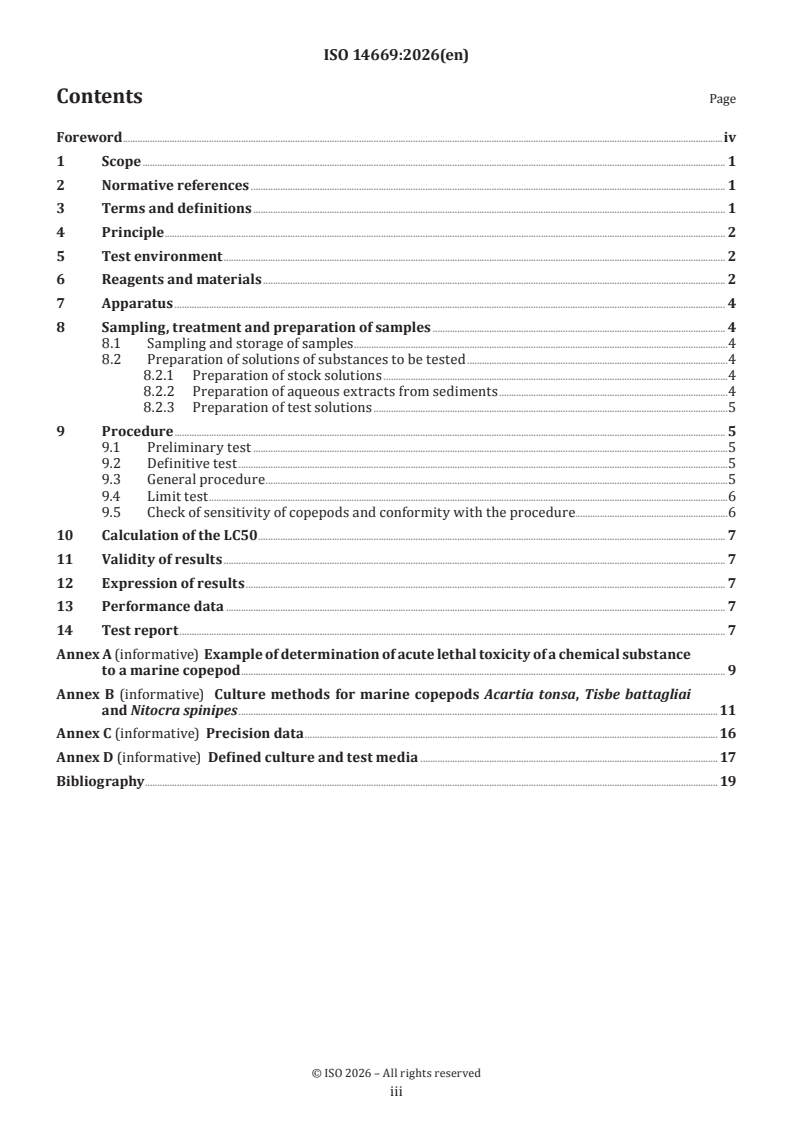
Contents Page
Foreword .iv
1 Scope . 1
2 Normative references . 1
3 Terms and definitions . 1
4 Principle . 2
5 Test environment . 2
6 Reagents and materials . 2
7 Apparatus . 4
8 Sampling, treatment and preparation of samples . 4
8.1 Sampling and storage of samples .4
8.2 Preparation of solutions of substances to be tested .4
8.2.1 Preparation of stock solutions .4
8.2.2 Preparation of aqueous extracts from sediments .4
8.2.3 Preparation of test solutions .5
9 Procedure . 5
9.1 Preliminary test .5
9.2 Definitive test .5
9.3 General procedure .5
9.4 Limit test .6
9.5 Check of sensitivity of copepods and conformity with the procedure.6
10 Calculation of the LC50 . 7
11 Validity of results . 7
12 Expression of results . 7
13 Performance data . 7
14 Test report . 7
Annex A (informative) Example of determination of acute lethal toxicity of a chemical substance
to a marine copepod . 9
Annex B (informative) Culture methods for marine copepods Acartia tonsa, Tisbe battagliai
and Nitocra spinipes .11
Annex C (informative) Precision data . 16
Annex D (informative) Defined culture and test media . 17
Bibliography . 19
iii
Foreword
ISO (the International Organization for Standardization) is a worldwide federation of national standards
bodies (ISO member bodies). The work of preparing International Standards is normally carried out through
ISO technical committees. Each member body interested in a subject for which a technical committee
has been established has the right to be represented on that committee. International organizations,
governmental and non-governmental, in liaison with ISO, also take part in the work. ISO collaborates closely
with the International Electrotechnical Commission (IEC) on all matters of electrotechnical standardization.
The procedures used to develop this document and those intended for its further maintenance are described
in the ISO/IEC Directives, Part 1. In particular, the different approval criteria needed for the different types
of ISO documents should be noted. This document was drafted in accordance with the editorial rules of the
ISO/IEC Directives, Part 2 (see www.iso.org/directives).
ISO draws attention to the possibility that the implementation of this document may involve the use of (a)
patent(s). ISO takes no position concerning the evidence, validity or applicability of any claimed patent
rights in respect thereof. As of the date of publication of this document, ISO had not received notice of (a)
patent(s) which may be required to implement this document. However, implementers are cautioned that
this may not represent the latest information, which may be obtained from the patent database available at
www.iso.org/patents. ISO shall not be held responsible for identifying any or all such patent rights.
Any trade name used in this document is information given for the convenience of users and does not
constitute an endorsement.
For an explanation of the voluntary nature of standards, the meaning of ISO specific terms and expressions
related to conformity assessment, as well as information about ISO’s adherence to the World Trade
Organization (WTO) principles in the Technical Barriers to Trade (TBT), see www.iso.org/iso/foreword.html.
This document was prepared by Technical Committee ISO/TC 147, Water quality, Subcommittee SC 5,
Biological methods.
This second edition cancels and replaces the first edition (ISO 14669:1999), which has been technically
revised.
The main changes are as follows:
— aqueous extracts (pore water, elutriates, eluates and leachates) have been added to the scope;
— possibility of using copepods from hatcheries has been included;
— informative Annexes A, B and C were amended;
— informative Annex D (culture and test media) was added.
Any feedback or questions on this document should be directed to the user’s national standards body. A
complete listing of these bodies can be found at www.iso.org/members.html.
iv
International Standard ISO 14669:2026(en)
Water quality — Determination of acute lethal toxicity to
marine copepods (Copepoda, Crustacea)
1 Scope
This document describes a method for the determination of the acute toxicity to one of three specified
species of marine copepod (Copepoda, Crustacea). This document is applicable to:
a) industrial or sewage effluents, treated or untreated, after decantation, filtration or centrifugation if
necessary;
b) marine or estuarine waters;
c) aqueous extracts (pore water, elutriates, eluates and leachates) from sediments;
d) chemical substances which are soluble, or which can be maintained as a stable suspension or dispersion,
under the conditions of the test.
2 Normative references
The following documents are referred to in the text in such a way that some or all of their content constitutes
requirements of this document. For dated references, only the edition cited applies. For undated references,
the latest edition of the referenced document (including any amendments) applies.
ISO 5667-1, Water quality — Sampling — Part 1: Guidance on the design of sampling programmes and sampling
techniques
ISO 5667-15, Water quality — Sampling — Part 15: Preservation and handling of samples of sludge, sediment
and suspended matter
ISO 5667-16, Water quality — Sampling — Part 16: Guidance on biotesting of samples
ISO 5667-19, Water quality — Sampling — Part 19: Guidance on sampling of marine sediments
3 Terms and definitions
For the purposes of this document, the following terms and definitions apply.
ISO and IEC maintain terminology databases for use in standardization at the following addresses:
— ISO Online browsing platform: available at https:// www .iso .org/ obp
— IEC Electropedia: available at https:// www .electropedia .org/
3.1
50 % lethal concentration
LC50
concentration at which 50 % of the test organisms would die in an experiment
[SOURCE: ISO 13073-3:2016, 2.28]
3.2
x % confidence interval
interval of values that theoretically covers the true value of the estimated parameter with x % confidence
Note 1 to entry: Standard confidence intervals are based on the assumption that the underlying mathematical model
is correct. It does not capture model uncertainty.
Note 2 to entry: A more precise definition is given in ISO 3534-1:2006, 1.28: interval estimator (T , T ) for the
0 1
parameter θ with the statistics T and T as interval limits and for which it holds that P[T > θ > T ] ≥ 1 − α.
0 1 0 1
Note 3 to entry: Associated with this confidence interval is the confidence level 100(1 − α) % where α is generally a
small number. The confidence level is typically 90 % or 95 %. The inequality P[T > θ > T ] ≥ 1 − α holds for any specific
0 1
but unknown population value of θ.
Note 4 to entry: A confidence interval does not reflect the probability that the observed interval contains the true
value of the parameter (it either does or does not contain it). The confidence reflects the proportion of cases that
the confidence interval would contain the true parameter value in a long series of repeated random samples under
identical conditions.
[SOURCE: ISO/TS 20281:2006, 3.5]
4 Principle
Copepods are exposed to a range of concentrations of chemical substances in seawater, effluent, water
samples or aqueous extracts from sediments. Mortality of the copepods is recorded after 24 h and 48 h.
In 48 h, the concentration at which 50 % of exposed copepods are killed, under the test conditions described
above, is determined. This concentration, known as the median lethal concentration, is designated 48 h
lethal concentration 50 % (48 h LC50).
NOTE If possible, the concentration which kills 50 % of the exposed copepods in 24 h is also determined (24 h
LC50). It is possible to extend the exposure period to 96 h (96 h LC50).
An indication of the lowest concentration tested which kills all the copepods and the highest concentration
tested which does not kill any of the copepods is desirable and provides useful information in cases where
the 48 h LC50 cannot be determined.
The test is carried out in one or two stages:
— a preliminary test which determines the range of concentrations to be tested in the definitive test and
gives an approximate value of the 48 h LC50 (and where appropriate, the 24 h LC50);
— a definitive test, if toxicity is observed, which permits calculation of the 48 h LC50 (and where appropriate,
the 24 h LC50) and determines concentrations corresponding to 0 % and 100 % mortality.
If the method described in this document is used for chemical substances, a limit test should be performed at
100 mg/l or at a lower concentration which is the maximum at which the substance is soluble or is in stable
dispersion under the conditions of the test.
5 Test environment
The procedure described in this document shall be carried out in a room, incubator or water-bath controlled
at 20 °C ± 2 °C and under a 16 h:8 h light: dark photoperiod. The atmosphere shall be free from vapours or
dusts toxic to copepods.
6 Reagents and materials
6.1 Test organism, one of the following species of marine copepod:
a) Acartia tonsa Dana;
b) Tisbe battagliai Volkmann-Rocco;
c) Nitocra spinipes Boeck.
Obtain the test organisms from laboratory cultures. Guidance on identification and culture methods for each
species are given in Annex B. After hatching of eggs, the lifecycle of copepods consists of naupliar, copepodid
and adult stages. The age and life stage at the start of the test shall be indicated in the test report and are as
follows:
— Acartia tonsa: large copepodids (Stage 5) or adults;
— Tisbe battagliai: copepodids 6 ± 2 days old;
— Nitocra spinipes: adults 3 to 4 weeks old.
Suitable organisms may be purchased from hatcheries outside the laboratory that performs the acute
toxicity test. Only healthy animals from an unpolluted source should be used.
If individuals are received at an early stage, they should be maintained in cultured conditions similar to
the hatchery (sea water, temperature) and fed with appropriate algae mix (similar to the hatchery) until
they reach the proper development stage. Organisms should be tested after confirming that the above
developmental stage has been reached.
If individuals are received at the life stage mentioned above, the test should be conducted the day of reception
or the day after in order to guarantee the developmental stage certified by the hatchery. In this case, feeding
should be added at the start of the test with the same algae mix that in the hatchery and the test conditions
should be similar to the hatchery water characteristics (water salinity and temperature).
In any case, the copepods shall have the age and life stage mentioned above and be in a good health at the
beginning of the test.
6.2 Dilution water.
A natural or an artificial seawater may be used as the dilution water. Culture and test media are prepared
from either reconstituted salt water or filtered (0,2 μm) natural marine water from an unpolluted location.
An example of reconstituted salt water suitable for cultivation and testing is given in Annex D (see Tables D.1,
D.2, D.3 and D.4). Reconstituted salt water media with a known composition in which the copepods show
suitable long-term survival, normal behaviour, development and fecundity may be used as culture and test
media, i.e. dilution water.
If natural seawater is used, it shall be collected from a location as distant as possible from known sources of
pollution and filtered to remove indigenous organisms. If artificial seawater is used, it shall be prepared by
dissolving reagents of recognized analytical grade, or a commercially available formulation, in distilled or
deionized water. However, for the copepod species in this document, there is insufficient information on the
use of artificial seawater to allow a particular example to be recommended.
The salinity of the dilution water shall be between 25 pratical salinity unit (PSU) and 36 PSU. The use of a
lower salinity, which is more appropriate for tests concerning estuarine or brackish water situations, shall
be justified in the test report. Nitocra spinipes can be used at salinities down to 1 PSU and Tisbe battagliai
can be used at salinities down to 20 PSU. Whichever salinity is employed, the test organisms shall be
cultured or maintained at the same salinity (±3 PSU) for at least seven days before the start of the test. The
dilution water shall have a dissolved oxygen concentration above 80 % of the air saturation value, and a pH
of 8,0 ± 0,3 before being used to prepare the test solutions.
The dilution water shall permit survival of the copepods for at least 48 h and should be from the same source
as water that has been found to support culture of the organisms through at least two generations.
6.3 Reference chemical toxicant, e.g. 3,5-dichlorophenol or a suitable alternative (9.5), of recognized
analytical grade.
7 Apparatus
Ordinary laboratory apparatus shall be used, and in particular the following.
7.1 Apparatus, for measuring dissolved oxygen, temperature, salinity and pH.
7.2 Low-power stereo microscope, preferably with darkfield illumination.
7.3 Ultrasonic device or other apparatus for the preparation of stock solutions of poorly soluble
substances (8.2.1).
7.4 Test containers, of chemically and physically inert material and of sufficient capacity (e.g. glass
beakers or disposable rigid plastic tissue-culture well-plates). Loose-fitting lids or covers are recommended
to minimize evaporation of the test solutions. Containers which are suitable for low-power microscopical
observation should be used for nauplii or copepodid stages.
Before use, the test containers shall be carefully washed and then rinsed, first with deionised water and
then with the dilution water (6.2).
8 Sampling, treatment and preparation of samples
8.1 Sampling and storage of samples
Sampling of water or effluent shall be carried out in accordance with the general procedure specified in
ISO 5667-1. Bottles shall be completely filled to exclude air (if the toxicity test is carried out within 48 h and
not frozen).
The preservation and storage of marine sediment shall be carried out in accordance with ISO 5667-15 or
ISO 5667-19. The preservation and storage of water or effluent samples shall be carried out in accordance
with ISO 5667-16; the following is only a summary. The toxicity test should be carried out as soon as possible,
ideally within 12 h of collection. If this time interval cannot be observed, cool the sample (0 °C to 4 °C) and
test the sample within 48 h. If testing cannot be carried out within 48 h, the sample may be frozen (below
−18 °C) for testing within 2 months of collection.
8.2 Preparation of solutions of substances to be tested
8.2.1 Preparation of stock solutions
Prepare stock solutions of the substance to be tested by dissolving or diluting a known quantity of the
substance in a known volume of dilution water, deionized water or distilled water in a glass container. They
shall be prepared at the moment of use unless the substance is known to be stable in solution, in which case
the stock solution may be prepared up to two days in advance.
For substances which are poorly soluble in water, ultrasonic or other suitable devices may be used in the
preparation of the stock solutions to aid solubilization or dispersion of the substance. Organic and inorganic
solvents of low toxicity to copepods (for example acetone) may be used provided that the concentration of
the solvent in the final test solution does not exceed 0,1 ml/l and that two series of control tests, one with no
solvent, the other with the maximum concentration of solvent, are carried out at the same time as the test.
No single procedure for the preparation of stock solutions of poorly soluble substances can be recommended
due to the differing nature of chemicals and physical agents.
8.2.2 Preparation of aqueous extracts from sediments
The aqueous extracts from sediments are carried out with the appropriate protocol, for example, in
accordance with the ISO 21268-2.
8.2.3 Preparation of test solutions
Prepare the test solutions by adding the stock solutions (see 8.2.1) or aqueous sample (see 8.1 and 8.2.2) to
the dilution water (6.2) in specified quantities to obtain the concentrations selected (see 9.1 and 9.2) for the
test.
If the stock solutions are prepared in deionized or distilled water, all the solutions, including the control,
shall receive the same quantity of distilled or deionized water and the final salinity and pH, shall be within
the range specified for the test (6.2).
It is recommended to prepare a volume of test solution sufficient to allow determination of the dissolved
oxygen concentration, pH, temperature and salinity at the start of the test (9.3) using the excess remaining
after filling the test containers.
9 Procedure
9.1 Preliminary test
The preliminary test provides an approximate value of the 48 h LC50 and enables, if necessary, a range of
concentrations to be selected for use in the definitive test. For this purpose, a wide range of concentrations
(generally chosen in geometric series) of the chemical substance, effluent or water sample is tested.
Typically, a factor of 10 or 3,2 between concentrations and a minimum of five animals per concentration,
without replication, is appropriate.
An example is given in Annex A.
9.2 Definitive test
The definitive test enables to determine the percentages of copepods which are killed by different
concentrations and the 24 h and 48 h LC50. Select a range of concentrations (at least five), based on the results
of the preliminary test (9.1), but employing a smaller factor (typically 1,8 or 2) between concentrations. It is
desirable that the concentrations selected result in three percentages of mortality between 10 % and 90 %.
An example of the selection of a range of concentrations is given in Annex A.
For each concentration and each control, use a minimum of 20 copepods (e.g. four replicates each containing
five copepods). Replicate containers are recommended to facilitate counting of the copepods.
9.3 General procedure
Place equal volumes of the test solutions (see 8.2.3) into a series of test containers (7.4). The volume per
container shall be such that, with the required number of copepods, the density of copepods does not exceed
1 per 0,5 ml of solution. For Acartia tonsa, the recommended maximum density is 1 copepod per 5 ml of
solution. For each series of tests, prepare control containers each having a volume of dilution water (6.2)
equal to the volume of the test solutions. If a solvent is used to solubilize or disperse the substance, prepare a
second set of control containers with the dilution water containing the solvent at the maximum concentration
used.
Before the start of the test determine, as a minimum, the dissolved oxygen concentration and pH of the
dilution water (or control solution) and the pH of test solutions corresponding with the lowest and highest
concentrations being tested.
Place the required number of copepods in each test container. It is recommended to transfer the copepods to
the test solutions using a pipette of sufficiently wide bore to avoid damage to the organisms. Minimize the
quantity of water transferred to the test solutions.
The copepods shall not be fed during the test if they come from a culture in the laboratory or obtained from
hatcheries and maintained in the laboratory until the appropriate life stage.
If copepods are fed for some reason (see 6.1), it should be detailed in the report (quantity and content of the
algae mix) and the positive control test should be performed in the same condition. The addition of algae mix
volume should not exceed 10 % of the total tested volume and shall be provided at the beginning of the test.
During the test, keep the vessels at a temperature of 20 °C ± 2 °C and under a 16 h:8 h light: dark photoperiod.
Nitocra spinipes is an epibenthic species and lives in dim light conditions. The vessels in the N. spinipes
bioassay are preferably placed in darkness. A photoperiod of 16:8 h light: dark may also be used but at a low
‒1 ‒2
light intensity (5 µmol to 10 µmol × s × m ).
After 24 h and 48 h, count the surviving copepods in each container. It is recommended to use a low-power
microscope (7.2) to aid observation. Copepods which are showing no swimming or appendage movements
within an observation period of 10 s are considered to be dead. Record an
...