


ISO 4604:1978
(Main)Textile glass — Woven fabrics — Determination of conventional flexural stiffness — Fixed angle flexometer method
Textile glass — Woven fabrics — Determination of conventional flexural stiffness — Fixed angle flexometer method
Verre textile — Tissus — Détermination de la rigidité conventionnelle en flexion — Méthode du flexomètre à angle fixe
General Information
- Status
- Withdrawn
- Publication Date
- 30-Sep-1978
- Withdrawal Date
- 30-Sep-1978
- Technical Committee
- ISO/TC 61/SC 13 - Composites and reinforcement fibres
- Drafting Committee
- ISO/TC 61/SC 13/WG 1 - Reinforcements and reinforcement products
- Current Stage
- 9599 - Withdrawal of International Standard
- Start Date
- 21-Nov-2011
- Completion Date
- 12-Feb-2026
Relations
- Effective Date
- 12-Feb-2011
ISO 4604:1978 - Textile glass -- Woven fabrics -- Determination of conventional flexural stiffness -- Fixed angle flexometer method
ISO 4604:1978 - Verre textile -- Tissus -- Détermination de la rigidité conventionnelle en flexion -- Méthode du flexometre a angle fixe
ISO 4604:1978 - Verre textile -- Tissus -- Détermination de la rigidité conventionnelle en flexion -- Méthode du flexometre a angle fixe
Get Certified
Connect with accredited certification bodies for this standard

Control Union Certifications
Global certification for agriculture and sustainability.

Bureau Veritas Bangladesh
Bureau Veritas certification services in Bangladesh.

ECOCERT France
Leader in organic and sustainability certification worldwide.
Sponsored listings
Frequently Asked Questions
ISO 4604:1978 is a standard published by the International Organization for Standardization (ISO). Its full title is "Textile glass — Woven fabrics — Determination of conventional flexural stiffness — Fixed angle flexometer method". This standard covers: Textile glass — Woven fabrics — Determination of conventional flexural stiffness — Fixed angle flexometer method
Textile glass — Woven fabrics — Determination of conventional flexural stiffness — Fixed angle flexometer method
ISO 4604:1978 is classified under the following ICS (International Classification for Standards) categories: 59.100.10 - Textile glass materials. The ICS classification helps identify the subject area and facilitates finding related standards.
ISO 4604:1978 has the following relationships with other standards: It is inter standard links to ISO 4604:2011. Understanding these relationships helps ensure you are using the most current and applicable version of the standard.
ISO 4604:1978 is available in PDF format for immediate download after purchase. The document can be added to your cart and obtained through the secure checkout process. Digital delivery ensures instant access to the complete standard document.
Standards Content (Sample)
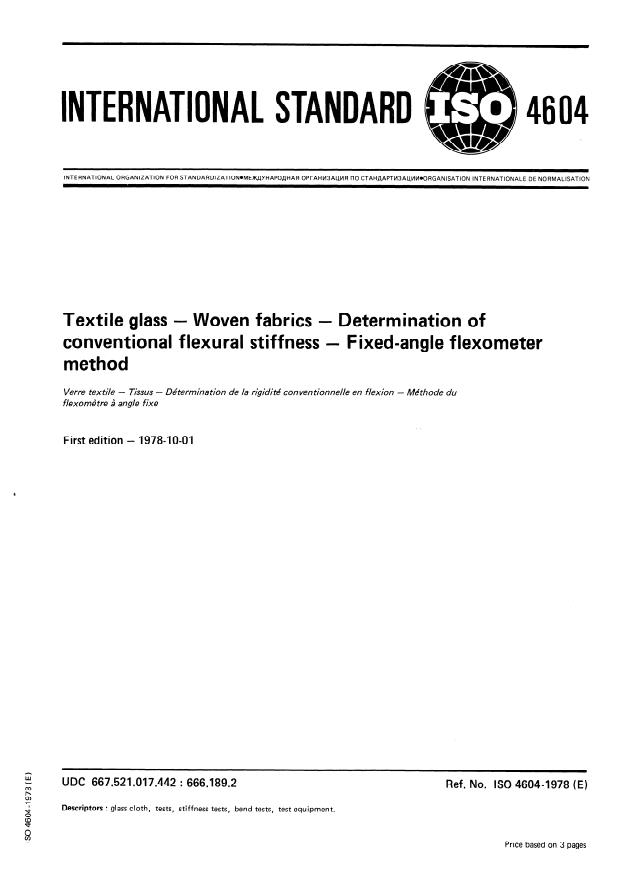
INTERNATIONAL STA
INTERNATIONAL ORGANIZATION FOR STANDARDIZATION.MEXfiYHAPOflHAR OPl-AHM3A~MR I-IO CTAH~APTM3AlJWl.ORGANlSATlON INTERNATIONALE DE NORMALISATION
Textile glass - Woven fabrics - Determination of
conventional flexural stiffness - Fixed-angle flexometer
method
Verre textile - Tissus - Dktermination de Ja rigid&! conventionnele en flexion - Miotbode du
flexomtitre 2 angle fixe
First edition - 1978-10-01
UDC 667.521 mO17.442 : 666.189.2
Ref. No. ISO 4604-1978 (E)
Descriptors : glass cloth, tests, stiffness tests, bend tests, test equipment.
Price based on 3 pages
FOREWORD
ISO (the International Qrganization for Standardization) is a worldwide federation
of national Standards institutes (ISO member bodies). The work of developing
International Standards is carried out through ISO technical committees. Every
member body interested in a subject for which a technical committee has been set
up has the right to be represented on that committee. International organizations,
governmental and non-governmental, in liaison with ISQ, also take part in the work.
Draft International Standards adopted by the technical committees are circulated
to the member bodies for approval before their acceptance as International
Standards by the ISO Council.
International Standard ISO 4604 was developed by Technical Committee
lSO/TC 61, Plastics, and was circulated to the member bodies in November 1976.
lt has been approved by the member bodies of the following countries :
Australia India Portugal
Austria Iran Romania
Belgium Israel Sweden
Brazil I taly Switzerland
Bulgaria Japan Turkey
Canada Korea, Rep. of United Kingdom
Czechoslovakia Mexico U.S.A.
Finland Netherlands Yugoslavia
France Philippines
Germany Poland
No member body expressed disapproval of the document.
cc) International Organkation for Standardkation, 1978 l
Printed in Switzerland
ISO 4604-1978 (E)
INTERNATIONAL STANDARD
Textile glass - Woven fabrics - Determination of
conventional flexural stiffness - Fixed-angle flexometer
method
1 SCOPE AND FIELD OF APPLICATION 4 APPARATUS
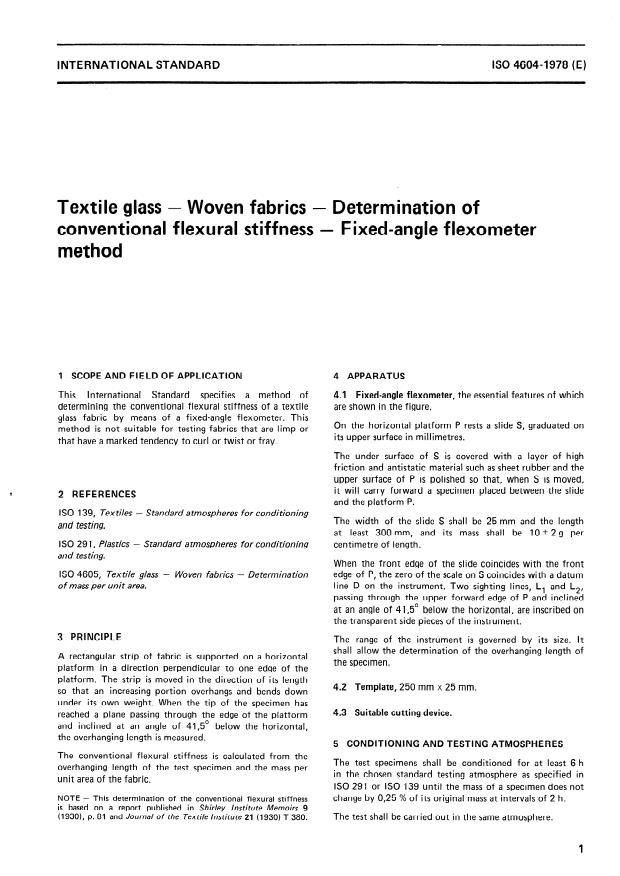
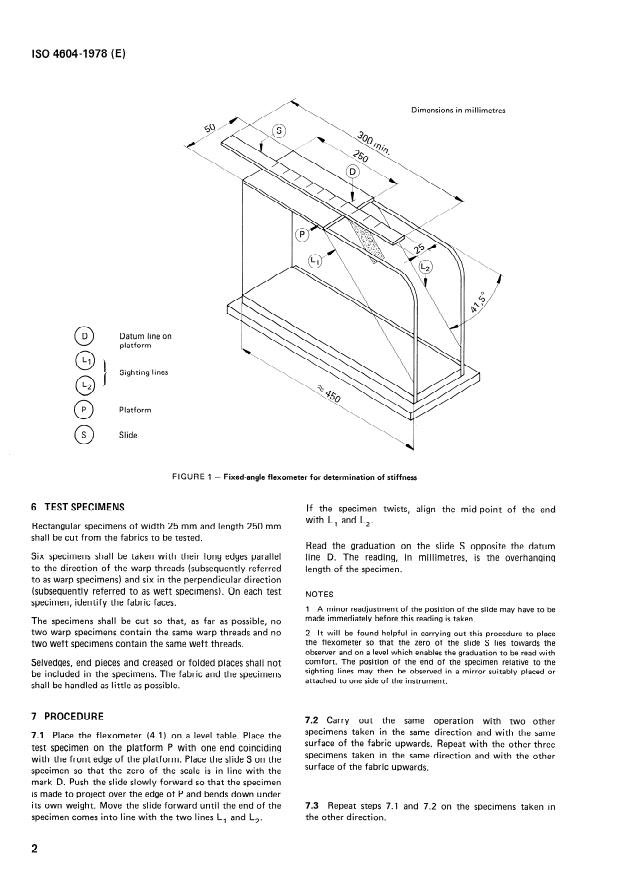
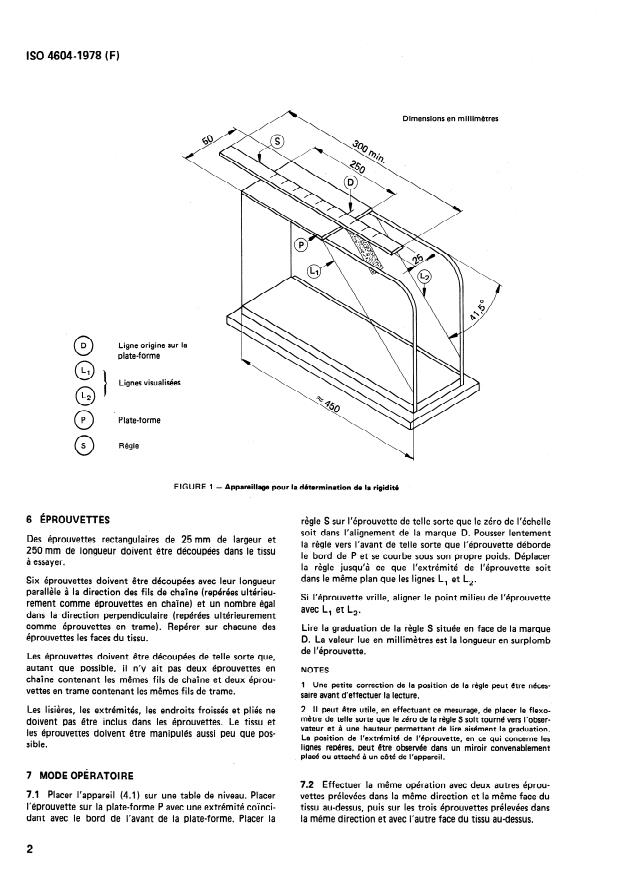
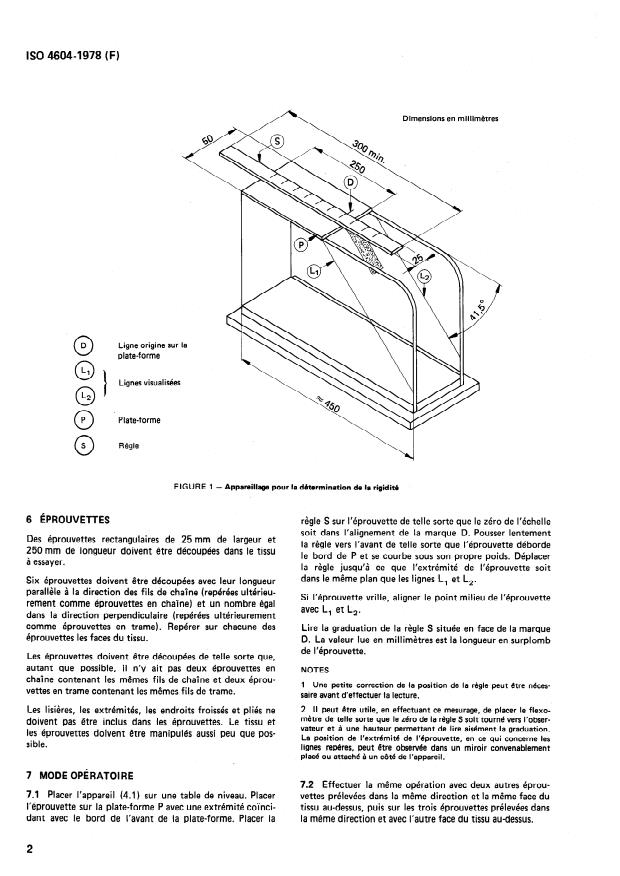
This International Standard specifies a method of 4.1 Fixed-angle flexometer, the essential features of which
determining the conventional flexural stiffness of a textile are shown in the figure.
glass fabric by means of a fixed-angle flexometer. This
On the horizontal. platform P rests a slide S, graduated on
method is not suitable for testing fabrics that are limp or
its upper surface in millimetres.
that have a marked tendency to curl or twist or fray.
The under surface of S is covered with a layer of high
friction and antistatic material such as sheet rubber and the
upper surface of P is polished so that, when S is moved,
it will carry forward a specimen placed between the slide
2 REFERENCES
and the platform P.
ISO 139, Textiles - Standard a tmospheres for conditioning
The width of the slide S shall be 25 mm and the length
and tes ting.
at least 300 mm, and its mass shall be 10 + 2 g per
ISO 291, Plastics - Standard a tmospheres for conditioning centimetre of length.
and tes ting.
When the front edge of the slide coincides with the front
ISO 4605, Textile glass - Woven fabrics - Determination edge of P, the zero of the scale on S coincides with a datum
of mass per mit area. line D on the instrument. Two sighting lines, L, and L,,
passing through the upper forward edge of P and inclined
at an angle of 41,5” below the horizontal, are inscribed on
the transparent side pieces of the instrument.
3 PRINCIPLE
The range of the instrument is governed by its size. lt
shall allow the determination of the overhanging length of
A rectangular Strip of fabric is supported on a horizontal
the specimen.
platform in a direction perpendicular to one edge of the
platform. The Strip is moved in the direction of its length
4.2 Template, 250 mm x 25 mm.
so that an increasing Portion overhangs and bends down
under its own weight. When the tip of the specimen has
4.3 Suitable cutting device.
reached a plane passing through the edge of the platform
and inclined at an angle of 41,5” below the horizontal,
the overhanging length is measured.
5 CONDITIONING AND TESTING ATMOSPHERES
The conventional flexural stiffness is calculated from the
The test specimens shall be conditioned for at least 6 h
overhanging length of the test specimen and the mass per
in the Chosen Standard testing atmosphere as specified in
unit area of the fabric.
ISO
...
NORME INTERNATIONALE
INTERNATIONAL ORGANlZATlON FOR STANDARDIZATION.MEW(C1YHAPOC1HAR OPrAHM3AUMfl IlO CTAH~APTM3ALU’lWORGANISATION INTERNATIONALE DE NORMALISATION
Verre textile - Tissus - Détermination de la rigidité
conventionnelle en flexion - Méthode du flexomètre
à angle fixe
De termina tion of con ven tional flexural stiffness - Fixed-angle
Textile glass - Woven fabrics -
flexome ter me thod
Première édition - 1978-10-01
Réf. no : ISO 4604-1978 (F)
CDU 667.521.017.442 : 666.189.2
tissu de verre textile, essai, essai de rigidité, essai de flexion, matériel d’essai.
Descripteurs :
Prix basé sur 3 pages
AVANT-PROPOS
L’ISO (Organisation internationale de normalisation) est une fédération mondiale
d’organismes nationaux de normalisation (comités membres de I’ISO). l’élaboration
des Normes internationales est confiée aux comités techniques de I’ISO. Chaque
comité membre intéressé par une étude a le droit de faire partiedu comité technique
internationales, gouvernementales et non
correspondant. Les organisations
gouvernementales, en liaison avec I’ISO, participent également aux travaux.
Les projets de Normes internationales adoptés par les comités techniques sont
soumis aux comités membres pour approbation, avant leur acceptation comme
Normes internationales par le Conseil de I’ISO.
La Norme internationale ISO 4604 a été élaborée par le comité technique
lSO/TC 61, Plastiques, et a été soumise aux comités membres en novembre 1976.
Les comités membres des pays suivants l’ont approuvee :
Roumanie
Allemagne Inde
Royaume-Uni
Australie Iran
Suède
Autriche Israël
Italie Suisse
Belgique
Japon Tchécoslovaquie
Brésil
Bulgarie Mexique Turquie
Canada Pays-Bas U.S.A.
Corée, Rép. de Philippines Yougoslavie
Finlande Pologne
France Portugal
Aucun comité membre ne l’a désapprouvée.
0 Organisation internationale de normalisation, 1978 l
Imprimé en Suisse
[SO 4604-1978 (F)
NORME INTERNATIONALE
Détermination de la rigidité
Verre textile - Tissus -
conventionn.elle en flexion - Méthode du flexomètre
à angle fixe
1 OBJET ET DOMAINE D’APPLICATION 4 APPAREILLAGE
La présente Norme internationale spécifie une méthode 4.1 Flexomètre à angle fixe, dont les caractéristiques
pour déterminer la rigidité conventionnelle en flexion des essentielles sont données à la figure 1.
tissus de verre textile, à l’aide d’un flexomètre à angle
Sur une plate-forme horizontale P repose une règle S
fixe.
graduée sur sa face supérieure en millimètres.
Cette méthode n’est pas applicable aux tissus de verre
La face inférieure de S est recouverte d’une couche antista-
textile très mous ou ayant une tendance marquée au vrillage
tique à coefficient de frottement élevé telle qu’une feuille
ou à I’effilochage.
de caoutchouc, et la surface supérieure de P est polie de
telle sorte que lorsque la règle S se déplace, elle entraîne
une éprouvette placée entre elle-même et la surface P.
2 RÉFÉRENCES
La largeur de la règle S doit être de 25 mm, sa longueur
ISO 139, Textiles - A tmosphères normales de condition-
d’au moins 300 mm, et sa masse de 10 k 2 g par centimètre
nement et d’essai.
de longueur.
ISO 291, Plastiques - A tmosphères normales de condition-
Lorsque le bord avant de la règle graduée coïncide avec le
nement et d’essai.
bord avant de la plate-forme P, le zéro de l’échelle sur S
ISO 4605, Verre textile - Tissus - Détermination de la
coïncide avec une ligne origine D de l’instrument. Deux
masse surfaciqueJ )
lignes visibles, L, et L,, partant du bord supérieur de P
et inclinées de 41,5’ sous l’horizontale sont inscrites sur
les plaques latérales transparentes de l’appareil.
3 PRINCIPE
La plage de mesurage de l’instrument dépend de sa taille;
Une bande rectangulaire de tissu est supportée par une
il doit permettre de déterminer la longueur en surplomb
plate-forme horizontale dans une direction perpendiculaire
de l’éprouvette.
à l’un des bords de cette plate-forme. Cette bande est
déplacée dans la direction de sa longueur de façon que la
4.2 Gabarit, de dimensions 250 mm x 25 mm.
longueur en surplomb augmente et qu’elle fléchisse sous
Lorsque l’extrémité de l’éprouvette
son propre poids.
4.3 Outil de découpage convenable.
atteint un plan passant par le bord de la plate-forme et
faisant un angle de 41,5’ en dessous de l’horizontale, la
longueur en surplomb est mesurée.
5 ATMOSPHÈRE DE CONDITIONNEMENT ET D’ESSAI
La rigidité conventionnelle en flexion est obtenue à partir
L’éprouvette doit être conditionnée durant au moins 6 h
de la longueur en surplomb de l’éprouvette et de la masse
à l’une des atmosphères choisies parmi celles indiquées dans
surfacique du tissu.
I’ISO 291 ou I’ISO 139, jusqu’à ce que la masse d’une
éprouvette ne varie
...
NORME INTERNATIONALE
INTERNATIONAL ORGANlZATlON FOR STANDARDIZATION.MEW(C1YHAPOC1HAR OPrAHM3AUMfl IlO CTAH~APTM3ALU’lWORGANISATION INTERNATIONALE DE NORMALISATION
Verre textile - Tissus - Détermination de la rigidité
conventionnelle en flexion - Méthode du flexomètre
à angle fixe
De termina tion of con ven tional flexural stiffness - Fixed-angle
Textile glass - Woven fabrics -
flexome ter me thod
Première édition - 1978-10-01
Réf. no : ISO 4604-1978 (F)
CDU 667.521.017.442 : 666.189.2
tissu de verre textile, essai, essai de rigidité, essai de flexion, matériel d’essai.
Descripteurs :
Prix basé sur 3 pages
AVANT-PROPOS
L’ISO (Organisation internationale de normalisation) est une fédération mondiale
d’organismes nationaux de normalisation (comités membres de I’ISO). l’élaboration
des Normes internationales est confiée aux comités techniques de I’ISO. Chaque
comité membre intéressé par une étude a le droit de faire partiedu comité technique
internationales, gouvernementales et non
correspondant. Les organisations
gouvernementales, en liaison avec I’ISO, participent également aux travaux.
Les projets de Normes internationales adoptés par les comités techniques sont
soumis aux comités membres pour approbation, avant leur acceptation comme
Normes internationales par le Conseil de I’ISO.
La Norme internationale ISO 4604 a été élaborée par le comité technique
lSO/TC 61, Plastiques, et a été soumise aux comités membres en novembre 1976.
Les comités membres des pays suivants l’ont approuvee :
Roumanie
Allemagne Inde
Royaume-Uni
Australie Iran
Suède
Autriche Israël
Italie Suisse
Belgique
Japon Tchécoslovaquie
Brésil
Bulgarie Mexique Turquie
Canada Pays-Bas U.S.A.
Corée, Rép. de Philippines Yougoslavie
Finlande Pologne
France Portugal
Aucun comité membre ne l’a désapprouvée.
0 Organisation internationale de normalisation, 1978 l
Imprimé en Suisse
[SO 4604-1978 (F)
NORME INTERNATIONALE
Détermination de la rigidité
Verre textile - Tissus -
conventionn.elle en flexion - Méthode du flexomètre
à angle fixe
1 OBJET ET DOMAINE D’APPLICATION 4 APPAREILLAGE
La présente Norme internationale spécifie une méthode 4.1 Flexomètre à angle fixe, dont les caractéristiques
pour déterminer la rigidité conventionnelle en flexion des essentielles sont données à la figure 1.
tissus de verre textile, à l’aide d’un flexomètre à angle
Sur une plate-forme horizontale P repose une règle S
fixe.
graduée sur sa face supérieure en millimètres.
Cette méthode n’est pas applicable aux tissus de verre
La face inférieure de S est recouverte d’une couche antista-
textile très mous ou ayant une tendance marquée au vrillage
tique à coefficient de frottement élevé telle qu’une feuille
ou à I’effilochage.
de caoutchouc, et la surface supérieure de P est polie de
telle sorte que lorsque la règle S se déplace, elle entraîne
une éprouvette placée entre elle-même et la surface P.
2 RÉFÉRENCES
La largeur de la règle S doit être de 25 mm, sa longueur
ISO 139, Textiles - A tmosphères normales de condition-
d’au moins 300 mm, et sa masse de 10 k 2 g par centimètre
nement et d’essai.
de longueur.
ISO 291, Plastiques - A tmosphères normales de condition-
Lorsque le bord avant de la règle graduée coïncide avec le
nement et d’essai.
bord avant de la plate-forme P, le zéro de l’échelle sur S
ISO 4605, Verre textile - Tissus - Détermination de la
coïncide avec une ligne origine D de l’instrument. Deux
masse surfaciqueJ )
lignes visibles, L, et L,, partant du bord supérieur de P
et inclinées de 41,5’ sous l’horizontale sont inscrites sur
les plaques latérales transparentes de l’appareil.
3 PRINCIPE
La plage de mesurage de l’instrument dépend de sa taille;
Une bande rectangulaire de tissu est supportée par une
il doit permettre de déterminer la longueur en surplomb
plate-forme horizontale dans une direction perpendiculaire
de l’éprouvette.
à l’un des bords de cette plate-forme. Cette bande est
déplacée dans la direction de sa longueur de façon que la
4.2 Gabarit, de dimensions 250 mm x 25 mm.
longueur en surplomb augmente et qu’elle fléchisse sous
Lorsque l’extrémité de l’éprouvette
son propre poids.
4.3 Outil de découpage convenable.
atteint un plan passant par le bord de la plate-forme et
faisant un angle de 41,5’ en dessous de l’horizontale, la
longueur en surplomb est mesurée.
5 ATMOSPHÈRE DE CONDITIONNEMENT ET D’ESSAI
La rigidité conventionnelle en flexion est obtenue à partir
L’éprouvette doit être conditionnée durant au moins 6 h
de la longueur en surplomb de l’éprouvette et de la masse
à l’une des atmosphères choisies parmi celles indiquées dans
surfacique du tissu.
I’ISO 291 ou I’ISO 139, jusqu’à ce que la masse d’une
éprouvette ne varie
...
Questions, Comments and Discussion
Ask us and Technical Secretary will try to provide an answer. You can facilitate discussion about the standard in here.
Loading comments...