

ISO 5025:2017
(Main)Reinforcement products — Woven fabrics — Determination of width and length
General Information
- Abstract
ISO 5025:2017 specifies a method for determining the width and length of a woven-fabric reinforcement in the form of a roll[1] . [1] Attention is drawn to ISO 22198 which is a related International Standard dealing with textiles.
- Status
- Published
- Publication Date
- 29-Nov-2017
- Technical Committee
- ISO/TC 61/SC 13 - Composites and reinforcement fibres
- Drafting Committee
- ISO/TC 61/SC 13/WG 1 - Reinforcements and reinforcement products
- Current Stage
- 9093 - International Standard confirmed
- Start Date
- 28-Jul-2022
- Completion Date
- 29-Aug-2026
Buy Documents


ISO 5025:2017 - Reinforcement products -- Woven fabrics -- Determination of width and length
ISO 5025:2017 - Reinforcement products — Woven fabrics — Determination of width and length/30/2017
Overview
ISO 5025:2017 is an internationally recognized standard that specifies the method for determining the width and length of woven-fabric reinforcement products presented in roll form. Published by the International Organization for Standardization (ISO), this standard provides precise guidelines for measuring these critical dimensions in reinforcement fabrics used across various industries. The method ensures accuracy, repeatability, and consistency essential for quality control, product specification, and compliance in manufacturing and supply chains.
Key Topics
- Measurement Scope: Applies specifically to woven-fabric reinforcements in roll form, focusing on the accurate determination of fabric width and length.
- Width Definition: Width is measured as the distance perpendicular to the warp yarns, between the outermost warp yarn edges.
- Measurement Tools: Requires calibrated rulers or measuring devices with strict permitted error margins (not exceeding 0.1 cm for fabrics up to 150 cm wide and 0.15% for wider fabrics).
- Length Measurement: Uses measurement equipment capable of assessing roll length with a maximum permissible error of 1%, including devices like drum counters or counting systems calibrated for tension during fabric measurement.
- Testing Procedure:
- Width is determined by averaging two measurements at least 100 cm apart on the fabric roll.
- Length is measured directly via meters or fractions of meters to maintain 1% accuracy.
- Sampling and Specimen: The test specimen typically includes one full fabric roll. Sampling sizes may be adapted according to product specifications or buyer requirements.
- Result Expression: Width is expressed in centimeters to the nearest 0.1 cm; length is recorded in meters or fractions thereof.
- Report Requirements: Test reports must reference ISO 5025:2017, give detailed fabric descriptions, dimensions measured, and note any unusual conditions affecting results.
Applications
ISO 5025:2017 plays a vital role in industries utilizing woven fabric reinforcements, such as:
- Composite Materials Manufacturing: Ensuring accurate fabric dimensions for optimal reinforcement in composite parts.
- Textile and Technical Fabrics: Quality control of industrial textiles to match precise customer or engineering specifications.
- Construction and Civil Engineering: Verification of geotextile fabric sizes for infrastructure applications.
- Automotive and Aerospace: Compliance checking for fabric reinforcements used in high-performance structural components.
- Roll Goods Inspection: Standardized measurement method enabling efficient inspection, inventory management, and logistics of fabric rolls.
By adopting ISO 5025:2017, companies can reduce discrepancies in fabric sizing, streamline quality assurance workflows, and enhance communication between suppliers and customers.
Related Standards
- ISO 22198 – Textiles: Provides related measurement methods for fabric width and length, specifically covering textile fabrics beyond reinforcement products.
- ISO 2859-1 – Sampling Procedures for Inspection by Attributes: Offers sampling guidance that complements the testing sampling approach in ISO 5025.
- ISO 3951-1 – Sampling Procedures for Inspection by Variables: Defines variable inspection sampling plans, useful for fabric roll quality acceptance.
Using ISO 5025:2017 in conjunction with these standards supports comprehensive quality and conformity assessments for woven fabric reinforcements and textiles.
Implementing ISO 5025:2017 ensures precise, reproducible measurements of woven fabric reinforcement dimensions, critical for manufacturing excellence and reliable product performance in diverse industrial sectors.
Relations
- Effective Date
- 17-Jun-2017
Buy Documents
ISO 5025:2017 - Reinforcement products -- Woven fabrics -- Determination of width and length
ISO 5025:2017 - Reinforcement products — Woven fabrics — Determination of width and length/30/2017
Get Certified
Connect with accredited certification bodies for this standard

Control Union Certifications
Global certification for agriculture and sustainability.

Hohenstein Institut
Textile testing and certification.

Bureau Veritas Bangladesh
Bureau Veritas certification services in Bangladesh.
Sponsored listings
Frequently Asked Questions
ISO 5025:2017 is a standard published by the International Organization for Standardization (ISO). Its full title is "Reinforcement products — Woven fabrics — Determination of width and length". This standard covers: ISO 5025:2017 specifies a method for determining the width and length of a woven-fabric reinforcement in the form of a roll[1] . [1] Attention is drawn to ISO 22198 which is a related International Standard dealing with textiles.
ISO 5025:2017 specifies a method for determining the width and length of a woven-fabric reinforcement in the form of a roll[1] . [1] Attention is drawn to ISO 22198 which is a related International Standard dealing with textiles.
ISO 5025:2017 is classified under the following ICS (International Classification for Standards) categories: 59.100.10 - Textile glass materials. The ICS classification helps identify the subject area and facilitates finding related standards.
ISO 5025:2017 has the following relationships with other standards: It is inter standard links to ISO 5025:1997. Understanding these relationships helps ensure you are using the most current and applicable version of the standard.
ISO 5025:2017 is available in PDF format for immediate download after purchase. The document can be added to your cart and obtained through the secure checkout process. Digital delivery ensures instant access to the complete standard document.
Standards Content (Sample)
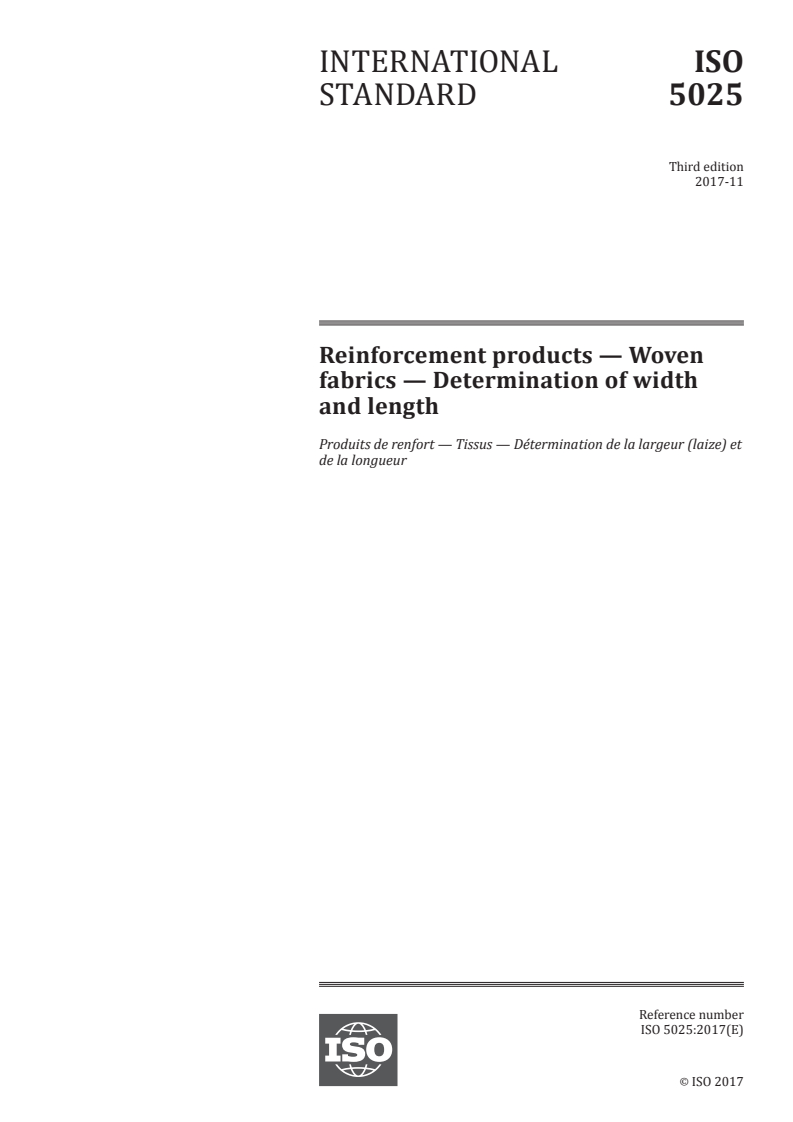
INTERNATIONAL ISO
STANDARD 5025
Third edition
2017-11
Reinforcement products — Woven
fabrics — Determination of width
and length
Produits de renfort — Tissus — Détermination de la largeur (laize) et
de la longueur
Reference number
©
ISO 2017
© ISO 2017, Published in Switzerland
All rights reserved. Unless otherwise specified, no part of this publication may be reproduced or utilized otherwise in any form
or by any means, electronic or mechanical, including photocopying, or posting on the internet or an intranet, without prior
written permission. Permission can be requested from either ISO at the address below or ISO’s member body in the country of
the requester.
ISO copyright office
Ch. de Blandonnet 8 • CP 401
CH-1214 Vernier, Geneva, Switzerland
Tel. +41 22 749 01 11
Fax +41 22 749 09 47
copyright@iso.org
www.iso.org
ii © ISO 2017 – All rights reserved
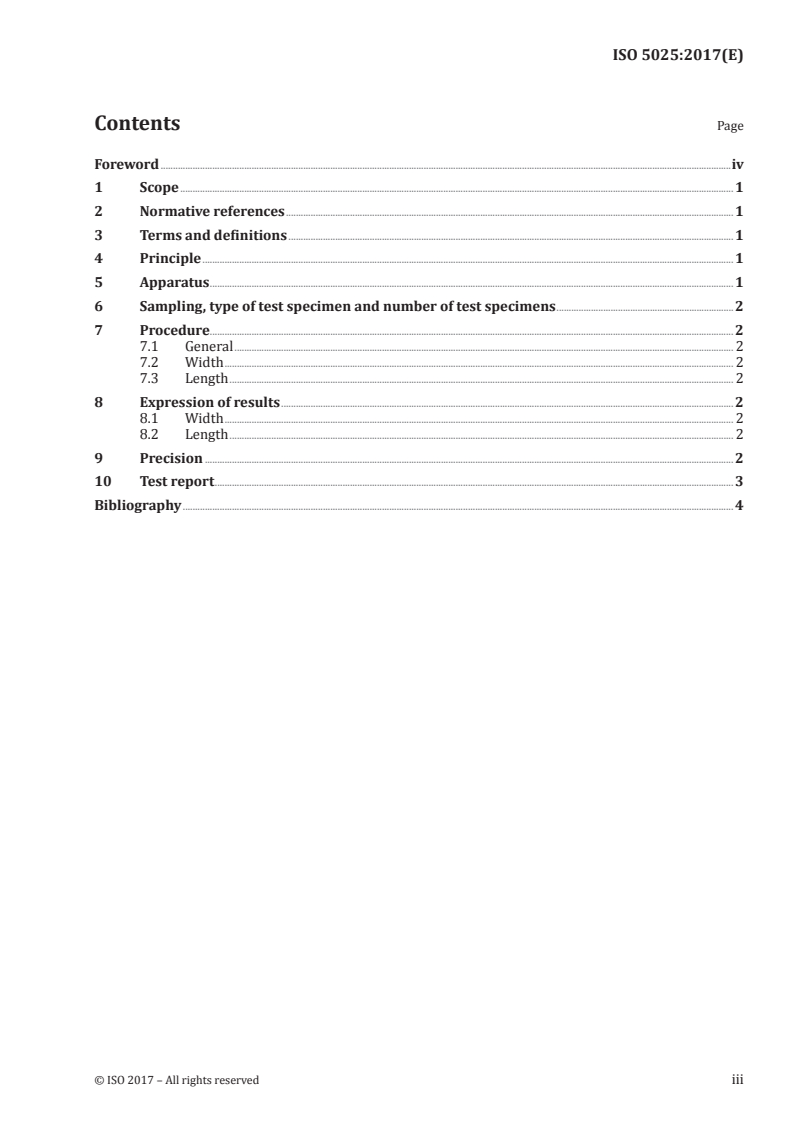
Contents Page
Foreword .iv
1 Scope . 1
2 Normative references . 1
3 Terms and definitions . 1
4 Principle . 1
5 Apparatus . 1
6 Sampling, type of test specimen and number of test specimens . 2
7 Procedure. 2
7.1 General . 2
7.2 Width . 2
7.3 Length . 2
8 Expression of results . 2
8.1 Width . 2
8.2 Length . 2
9 Precision . 2
10 Test report . 3
Bibliography . 4
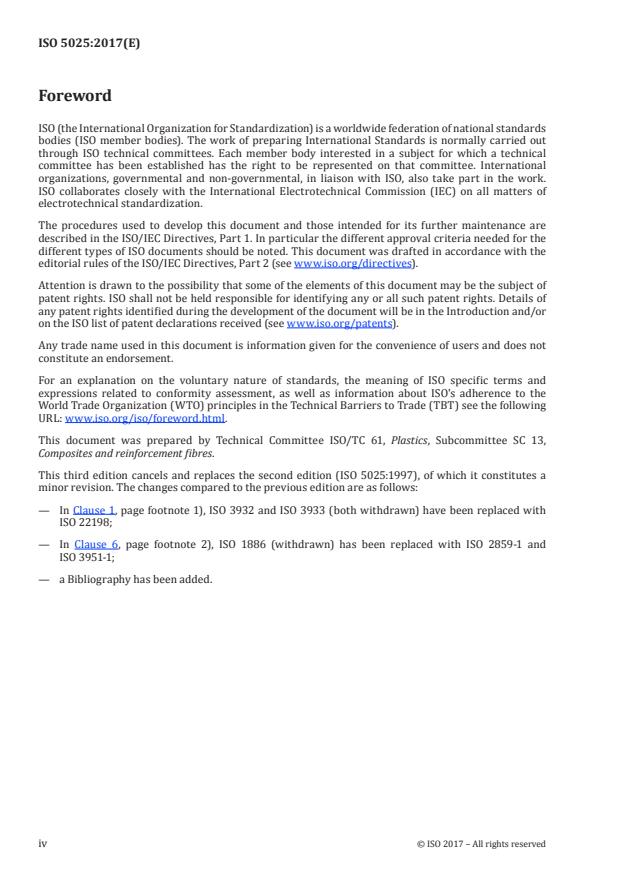
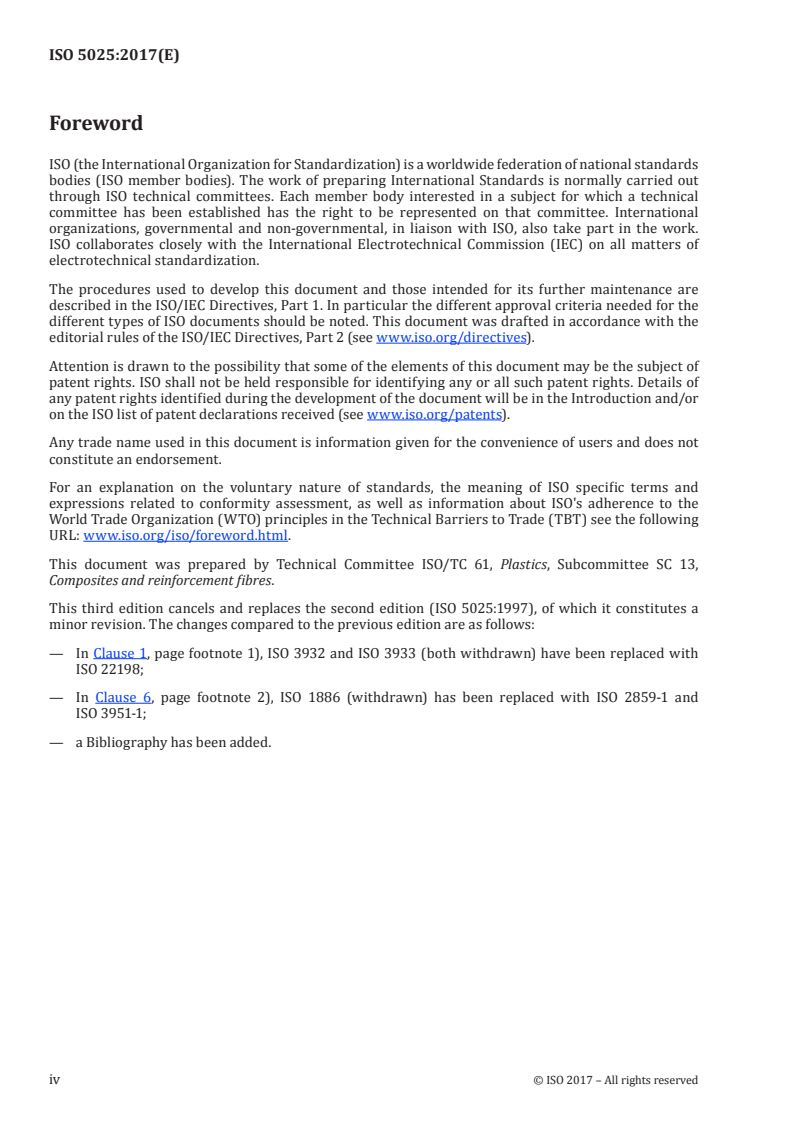
Foreword
ISO (the International Organization for Standardization) is a worldwide federation of national standards
bodies (ISO member bodies). The work of preparing International Standards is normally carried out
through ISO technical committees. Each member body interested in a subject for which a technical
committee has been established has the right to be represented on that committee. International
organizations, governmental and non-governmental, in liaison with ISO, also take part in the work.
ISO collaborates closely with the International Electrotechnical Commission (IEC) on all matters of
electrotechnical standardization.
The procedures used to develop this document and those intended for its further maintenance are
described in the ISO/IEC Directives, Part 1. In particular the different approval criteria needed for the
different types of ISO documents should be noted. This document was drafted in accordance with the
editorial rules of the ISO/IEC Directives, Part 2 (see www.iso.org/directives).
Attention is drawn to the possibility that some of the elements of this document may be the subject of
patent rights. ISO shall not be held responsible for identifying any or all such patent rights. Details of
any patent rights identified during the development of the document will be in the Introduction and/or
on the ISO list of patent declarations received (see www.iso.org/patents).
Any trade name used in this document is information given for the co
...
INTERNATIONAL ISO
STANDARD 5025
Third edition
2017-11
Reinforcement products — Woven
fabrics — Determination of width
and length
Produits de renfort — Tissus — Détermination de la largeur (laize) et
de la longueur
Reference number
©
ISO 2017
© ISO 2017, Published in Switzerland
All rights reserved. Unless otherwise specified, no part of this publication may be reproduced or utilized otherwise in any form
or by any means, electronic or mechanical, including photocopying, or posting on the internet or an intranet, without prior
written permission. Permission can be requested from either ISO at the address below or ISO’s member body in the country of
the requester.
ISO copyright office
Ch. de Blandonnet 8 • CP 401
CH-1214 Vernier, Geneva, Switzerland
Tel. +41 22 749 01 11
Fax +41 22 749 09 47
copyright@iso.org
www.iso.org
ii © ISO 2017 – All rights reserved
Contents Page
Foreword .iv
1 Scope . 1
2 Normative references . 1
3 Terms and definitions . 1
4 Principle . 1
5 Apparatus . 1
6 Sampling, type of test specimen and number of test specimens . 2
7 Procedure. 2
7.1 General . 2
7.2 Width . 2
7.3 Length . 2
8 Expression of results . 2
8.1 Width . 2
8.2 Length . 2
9 Precision . 2
10 Test report . 3
Bibliography . 4
Foreword
ISO (the International Organization for Standardization) is a worldwide federation of national standards
bodies (ISO member bodies). The work of preparing International Standards is normally carried out
through ISO technical committees. Each member body interested in a subject for which a technical
committee has been established has the right to be represented on that committee. International
organizations, governmental and non-governmental, in liaison with ISO, also take part in the work.
ISO collaborates closely with the International Electrotechnical Commission (IEC) on all matters of
electrotechnical standardization.
The procedures used to develop this document and those intended for its further maintenance are
described in the ISO/IEC Directives, Part 1. In particular the different approval criteria needed for the
different types of ISO documents should be noted. This document was drafted in accordance with the
editorial rules of the ISO/IEC Directives, Part 2 (see www.iso.org/directives).
Attention is drawn to the possibility that some of the elements of this document may be the subject of
patent rights. ISO shall not be held responsible for identifying any or all such patent rights. Details of
any patent rights identified during the development of the document will be in the Introduction and/or
on the ISO list of patent declarations received (see www.iso.org/patents).
Any trade name used in this document is information given for the co
...