


ISO 7240-12:2022
(Main)Fire detection and alarm systems — Part 12: Line type smoke detectors using a transmitted optical beam
Fire detection and alarm systems — Part 12: Line type smoke detectors using a transmitted optical beam
This document specifies requirements, test methods and performance criteria for line-type smoke detectors for use in fire detection systems installed in buildings. The detectors consist of at least a transmitter and a receiver and can include reflector(s) for the detection of smoke by the attenuation and/or changes in attenuation of an optical beam. This document is not applicable to: — line-type smoke detectors designed to operate with separations between opposed components of less than 1 m; — line-type smoke detectors whose optical path length is defined or adjusted by an integral mechanical connection; — line-type smoke detectors with special characteristics, which cannot be assessed by the test methods in this document. NOTE The term “optical” is used to describe that part of the electromagnetic spectrum produced by the transmitter to which the receiver is responsive; this is not restricted to visible wavelengths.
Systèmes de détection d'incendie et d'alarme — Partie 12: Détecteurs linéaires de fumée utilisant une transmission par faisceaux lumineux
General Information
Relations

Standards Content (Sample)
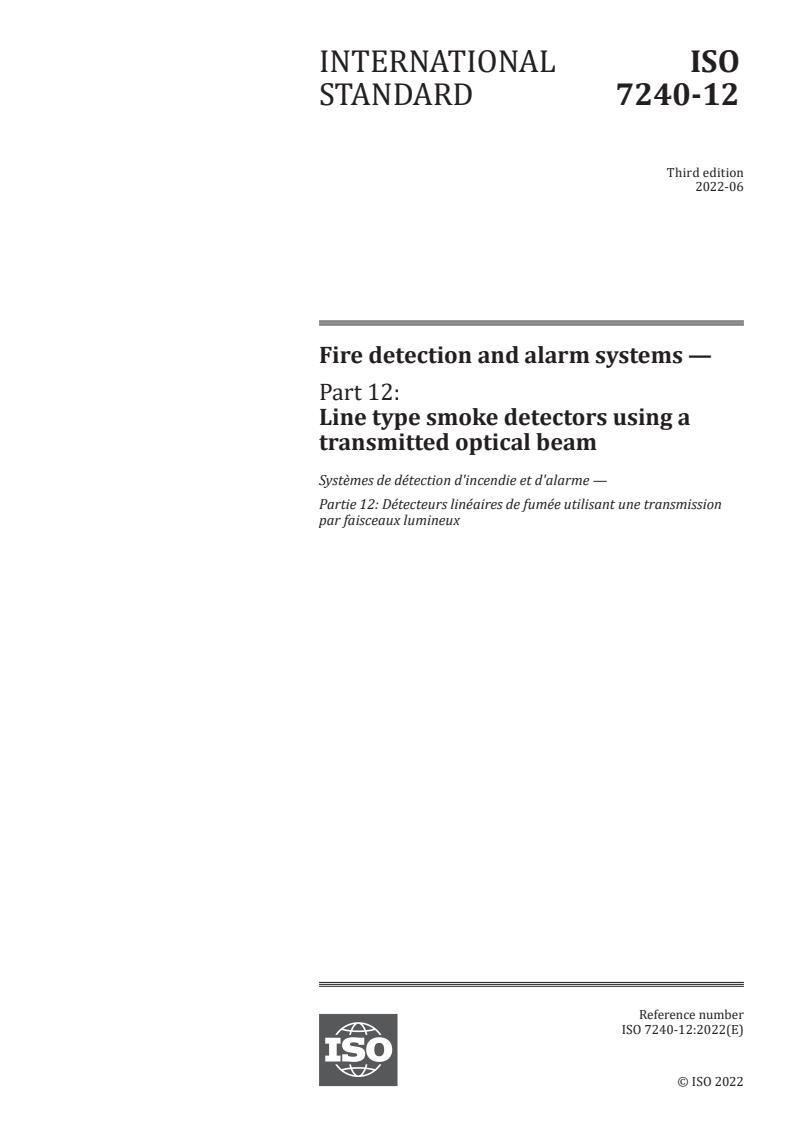
INTERNATIONAL ISO
STANDARD 7240-12
Third edition
2022-06
Fire detection and alarm systems —
Part 12:
Line type smoke detectors using a
transmitted optical beam
Systèmes de détection d'incendie et d'alarme —
Partie 12: Détecteurs linéaires de fumée utilisant une transmission
par faisceaux lumineux
Reference number
© ISO 2022
All rights reserved. Unless otherwise specified, or required in the context of its implementation, no part of this publication may
be reproduced or utilized otherwise in any form or by any means, electronic or mechanical, including photocopying, or posting on
the internet or an intranet, without prior written permission. Permission can be requested from either ISO at the address below
or ISO’s member body in the country of the requester.
ISO copyright office
CP 401 • Ch. de Blandonnet 8
CH-1214 Vernier, Geneva
Phone: +41 22 749 01 11
Email: copyright@iso.org
Website: www.iso.org
Published in Switzerland
ii
Contents Page
Foreword . vi
Introduction .vii
1 Scope . 1
2 Normative references . 1
3 Terms and definitions . 2
4 Requirements . 3
4.1 Conformance . 3
4.2 Individual alarm indication . 3
4.3 Connection of ancillary devices. 4
4.4 Monitoring of detachable detectors and connections . 4
4.5 Manufacturer’s adjustments . 4
4.6 On-site adjustment of response threshold value. 4
4.7 Protection of optical components . 4
4.8 Limit of compensation . 4
4.9 Fault signalling . 5
4.10 Software-controlled detectors . . 5
4.10.1 General . 5
4.10.2 Software documentation . 5
4.10.3 Software design . 6
4.10.4 Storage of programs and data . 6
5 Test methods . 6
5.1 General . 6
5.1.1 Atmospheric conditions for tests. 6
5.1.2 Mounting arrangements . 6
5.1.3 Operating conditions for tests. 6
5.1.4 Tolerances . 7
5.1.5 Measurement of response value . 7
5.1.6 Provision for tests . 8
5.1.7 Test schedule . 8
5.1.8 Test report . 9
5.2 Reproducibility . 9
5.2.1 Object of test. 9
5.2.2 Test procedure. 9
5.2.3 Requirements . 9
5.3 Repeatability . 9
5.3.1 Object of test. 9
5.3.2 Test procedure. 9
5.3.3 Requirements . 10
5.4 Alignment dependence . 10
5.4.1 Object of test. 10
5.4.2 Test procedure. 10
5.4.3 Requirements . 11
5.5 Variation of supply parameters . 11
5.5.1 Object . 11
5.5.2 Test procedure. 11
5.5.3 Requirements . 11
5.6 Rapid changes in attenuation . 11
5.6.1 Object of test. 11
5.6.2 Test procedure. 11
5.6.3 Requirements .12
5.7 Slow changes in attenuation . 12
5.7.1 Object of test. 12
iii
5.7.2 Test procedure.12
5.7.3 Requirements .12
5.8 Optical path length dependence . 13
5.8.1 Object of test. 13
5.8.2 Test procedure.13
5.8.3 Requirements .13
5.9 Fire sensitivity . 13
5.9.1 Object of test. 13
5.9.2 Test procedure.13
5.9.3 Requirements .15
5.10 Stray light . 15
5.10.1 Object of test. 15
5.10.2 Test procedure. 15
5.10.3 Requirements . 16
5.11 Dry heat (operational) . 16
5.11.1 Object of test. 16
5.11.2 Test procedure. 16
5.11.3 Requirements . 17
5.12 Cold (operational) . 17
5.12.1 Object of test. 17
5.12.2 Test procedure. 17
5.12.3 Requirements . 18
5.13 Damp heat, steady-state (operational) . 18
5.13.1 Object of the test . 18
5.13.2 Test procedure. 18
5.13.3 Requirements . 19
5.14 Damp heat, steady-state (endurance) . 19
5.14.1 Object of test. 19
5.14.2 Test procedure. 19
5.14.3 Requirements .20
5.15 Vibration, sinusoidal (endurance) . 20
5.15.1 Object of test. 20
5.15.2 Test procedure.20
5.15.3 Requirements . 21
5.16 Electromagnetic compatibility (EMC), immunity tests (operational) . 21
5.17 Sulfur dioxide, SO , corrosion (endurance) . 22
5.17.1 Object of test. 22
5.17.2 Test procedure.22
5.17.3 Requirements .22
5.18 Impact (operational) . 23
5.18.1 Object of test. 23
5.18.2 Test procedure.23
5.18.3 Requirements . 23
6 Test report .24
7 Mrking .24
8 Data .25
Annex A (informative) Compensation for detector drift .26
Annex B (normative) Bench for response threshold value measurements .31
Annex C (normative) Fire test room .33
Annex D (normative) Smouldering pyrolysis wood fire (TF2) .35
Annex E (normative) Glowing smouldering cotton fire (TF3) .38
Annex F (normative) Flaming plastics (polyurethane) fire (TF4) .41
Annex G (normative) Flaming liquid (n-heptane) fire (TF5) .43
iv
Annex H (normative) Smoke-measuring instruments .45
Annex I (normative) Apparatus for stray light .48
Annex J (informative) Information concerning the construction of the measuring
ionization chamber .50
Bibliography .53
v
Foreword
ISO (the International Organization for Standardization) is a worldwide federation of national standards
bodies (ISO member bodies). The work of preparing International Standards is normally carried out
through ISO technical committees. Each member body interested in a subject for which a technical
committee has been established has the right to be represented on that committee. International
organizations, governmental and non-governmental, in liaison with ISO, also take part in the work.
ISO collaborates closely with the International Electrotechnical Commission (IEC) on all matters of
electrotechnical standardization.
The procedures used to develop this document and those intended for its further maintenance are
described in the ISO/IEC Directives, Part 1. In particular, the different approval criteria needed for the
different types of ISO documents should be noted. This document was drafted in accordance with the
editorial rules of the ISO/IEC Directives, Part 2 (see www.iso.org/directives).
Attention is drawn to the possibility that some of the elements of this document may be the subject of
patent rights. ISO shall not be held responsible for identifying any or all such patent rights. Details of
any patent rights identified during the development of the document will be in the Introduction and/or
on the ISO list of patent declarations received (see www.iso.org/patents).
Any trade name used in this document is information given for the convenience of users and does not
constitute an endorsement.
For an explanation of the voluntary nature of standards, the meaning of ISO specific terms and
expressions related to conformity assessment, as well as information about ISO's adherence to
the World Trade Organization (WTO) principles in the Technical Barriers to Trade (TBT), see
www.iso.org/iso/foreword.html.
This document was prepared by Technical Committee ISO/TC 21, Equipment for fire protection and fire
fighting, Subcommittee SC 3, Fire detection and alarm systems.
This third edition cancels and replaces the second edition (ISO 7240-12:2014), which has been
technically revised.
The main changes are as follows:
— references to EN 50130-4 have been replaced with references to IEC 62599-2 (electromagnetic
compatibility immunity test);
— uniform acceptance criteria has been adopted for all line-type smoke detectors;
— editorial corrections have been made to bring the document in line with current ISO drafting rules.
A list of all parts in the ISO 7240 series can be found on the ISO website.
Any feedback or questions on this document should be directed to the user’s national standards body. A
complete listing of these bodies can be found at www.iso.org/members.html.
vi
Introduction
A fire detection and alarm system is required to function satisfactorily not only in the event of fire, but
also during and after exposure to conditions likely to be met in practice, including corrosion, vibration,
direct impact, indirect shock and electromagnetic interference. Specific tests are intended to assess the
performance of the smoke detectors under such conditions.
This document is not intended to place any other restrictions on the design and construction of such
detectors.
vii
INTERNATIONAL STANDARD ISO 7240-12:2022(E)
Fire detection and alarm systems —
Part 12:
Line type smoke detectors using a transmitted optical
beam
1 Scope
This document specifies requirements, test methods and performance criteria for line-type smoke
detectors for use in fire detection systems installed in buildings. The detectors consist of at least a
transmitter and a receiver and can include reflector(s) for the detection of smoke by the attenuation
and/or changes in attenuation of an optical beam.
This document is not applicable to:
— line-type smoke detectors designed to operate with separations between opposed components of
less than 1 m;
— line-type smoke detectors whose optical path length is defined or adjusted by an integral mechanical
connection;
— line-type smoke detectors with special characteristics, which cannot be assessed by the test
methods in this document.
NOTE The term “optical” is used to describe that part of the electromagnetic spectrum produced by the
transmitter to which the receiver is responsive; this is not restricted to visible wavelengths.
2 Normative references
The following documents are referred to in the text in such a way that some or all of their content
constitutes requirements of this document. For dated references, only the edition cited applies. For
undated references, the latest edition of the referenced document (including any amendments) applies.
ISO 7240-1, Fire detection and alarm systems — Part 1: General and definitions
IEC 60064, Tungsten filament lamps for domestic and similar general lighting purposes — Performance
requirements
IEC 60068-1, Environmental testing — Part 1: General and guidance
IEC 60068-2-1:2007, Environmental testing — Part 2-1: Tests. Tests A: Cold
IEC 60068-2-2:2007, Environmental testing — Part 2-2: Tests. Tests B: Dry heat
IEC 60068-2-6:2007, Environmental testing — Part 2-6: Tests. Test Fc: Vibration (sinusoidal)
IEC 60068-2-42:2003, Environmental testing — Part 2-42: Tests. Test Kc: Sulphur dioxide test for contacts
and connections
IEC 60068-2-75:2014, Environmental testing — Part 2-75: Tests Eh: Hammer test
IEC 60068-2-78:2012, Environmental testing — Part 2-78: Tests. Test Cab: Damp heat, steady state
IEC 60081, Double-capped fluorescent lamps — Performance specifications
IEC 62599-2, Alarm systems – Part 2: Electromagnetic compatibility – Immunity requirements for
components of fire and security alarm systems
3 Terms and definitions
For the purposes of this document, the terms and definitions given in ISO 7240-1 and the following
apply.
ISO and IEC maintain terminology databases for use in standardization at the following addresses:
— ISO Online browsing platform: available at https:// www .iso .org/ obp
— IEC Electropedia: available at https:// www .electropedia .org/
3.1
attenuation
A
reduction in intensity of the optical beam at the receiver, defined by the formula:
I
A=10log
10
I
where
I is the received intensity without reduction in intensity;
I is the received intensity after reduction in intensity.
Note 1 to entry: The attenuation is expressed in units of decibels (dB).
3.2
opposed component
component [transmitter and receiver or transmitter-receiver and reflector(s)] of the detector whose
position determines the optical path
3.3
optical path length
total distance traversed by the optical beam between the transmitter and the receiver
3.4
receiver
component that receives the optical beam
3.5
response threshold value
C
value of attenuation at which an alarm signal is generated, calculated using the formula:
n
f
CF=×
n
v
where
F is the value of attenuation resulting from a beam passing once through a filter, given by the
I
formula 10log ;
I
I is the received intensity of the optical beam without reduction through an attenuating filter;
I is the received intensity of the optical beam after passing once through an attenuating filter;
n is the number of times the beam passes through the filter;
f
n is the number of times the beam passes through the measured volume.
v
Note 1 to entry: The attenuation is expressed in units of decibels (dB).
n
f
Note 2 to entry: The inclusion of means that the value of C recorded for a multi–pass arrangement tested
n
v
by obscuring the beam only once (at the receiver, as recommended in B.1.2) is consistent with a single pass (end-
to-end) arrangement.
3.6
adjustment of response threshold value
any adjustment during or after commissioning which leads to a change in the response to fire
3.7
separation
physical distance between the opposed components
3.8
transmitter
component from which the optical beam emanates
4 Requirements
4.1 Conformance
In order to conform to this document, the detector shall meet the requirements laid out in the following
clauses:
a) Clause 4, which shall be verified by visual inspection or engineering assessment, shall be tested in
accordance with Clause 5 and shall meet the requirements of the tests.
b) Clauses 7 and 8, which shall be verified by visual inspection.
4.2 Individual alarm indication
4.2.1 Each detector shall be provided with an integral red visual indicator by which the individual
detector releasing an alarm can be identified, until the alarm condition is reset. Where other conditions
of the detector can be visually indicated, these shall be clearly distinguishable from the alarm indication,
except when the detector is switched into a service mode. For detachable detectors, the indicator may
be integral with the base or the detector head.
4.2.2 The visual indicator shall be visible from a distance of 6 m in an ambient light intensity up to
500 lx at an angle up to:
a) 5° from the vertical axis of the detector when viewed from beneath the detector in any direction;
and
b) 45° from the vertical axis of the detector when viewed from beneath the detector in at least one
direction.
4.3 Connection of ancillary devices
The detector may provide for connections to ancillary devices (remote indicators, control relays, etc.),
but open- or short-circuit failures of these connections shall not prevent the correct operation of the
detector.
4.4 Monitoring of detachable detectors and connections
4.4.1 For detachable detectors, a means shall be provided for a remote monitoring system (e.g. the
control and indicating equipment) to detect the removal of the head from the base, in order to give a
fault signal.
4.4.2 If there are cables connecting separate parts of the detector, then a means shall be provided for
a remote monitoring system (e.g. the fire detection control and indicating equipment) to detect a short
or open circuit on those cables, in order to give a fault signal.
4.4.3 If more than one detector can be connected to the transmission path of a remote monitoring
system (e.g. control and indicating equipment), the removal of a head from the base shall not prevent an
alarm signal from another detector connected to the same transmission path.
4.5 Manufacturer’s adjustments
It shall not be possible to change the manufacturer's settings except by special means (e.g. the use of a
special code or tool) or by breaking or removing a seal.
4.6 On-site adjustment of response threshold value
4.6.1 If there is provision for on-site adjustment of the response threshold value of the detector then:
a) for all of the settings at which the manufacturer claims conformance, the detector shall conform
to the requirements of this document and access to the adjustment means shall be possible only by
the use of a code or special tool or by removing the detector from its base or mounting;
b) any setting or settings at which the manufacturer does not claim conformance to this document
shall be accessible only by the use of a code or special tool, and it shall be clearly marked on the
detector or in the associated data that if this setting or these settings are used, the detector does
not conform to this document.
4.6.2 These adjustments may be carried out at the detector or at the fire detection control and
indicating equipment.
4.7 Protection of optical components
The detector shall be so designed that a sphere of diameter greater than (1,3 ± 0,05) mm cannot pass
into any enclosure containing optical components when the detector is in the operational condition.
NOTE This requirement is intended to restrict the access of insects into the sensitive parts of the detector. It
is known that this requirement is not sufficient to prevent the access of all insects, therefore, it can be necessary
to take other precautions against unwanted alarms due to the entry of small insects.
4.8 Limit of compensation
4.8.1 Compensation may be used to mitigate changes in sensitivity due to the build-up of dust and
other contaminants on the optical surfaces (see Annex A).
4.8.2 The detector shall emit either a fault or alarm signal at the limit of compensation for the effect
of a slowly changing signal response.
4.8.3 Since it is practically impossible to perform tests with very slight increases in attenuation, an
evaluation of the detector's conformity shall be made by analysing the circuits/software and/or by
physical tests and simulations.
4.9 Fault signalling
A fire alarm signal shall not be cancelled by a fault resulting from a rapid change in obscuration (in
accordance with 5.6) or by a result of the limit of compensation being reached (in accordance with 4.8).
4.10 Software-controlled detectors
4.10.1 General
The requirements of 4.10.2, 4.10.3 and 4.10.4 shall be met for detectors that rely on software control in
order to fulfil the requirements of this document.
4.10.2 Software documentation
4.10.2.1 The manufacturer shall prepare documentation that gives an overview of the software design.
This documentation shall be in sufficient detail for the design to be inspected for conformance to this
document and shall include at least the following:
a) functional description of the main program flow (e.g. as a flow diagram or structogram), including:
1) a brief description of the modules and the functions that they perform,
2) the way in which the modules interact,
3) the overall hierarchy of the program,
4) the way in which the software interacts with the hardware of the detector,
5) the way in which the modules are called, including any interrupt processing;
b) description of those areas of memory used for the various purposes (e.g. the program, site-specific
data and running data);
c) designation by which the software and its version can be uniquely identified.
4.10.2.2 The manufacturer shall prepare and maintain detailed design documentation. This shall be
available for inspection in a manner that respects the manufacturers' rights for confidentiality. It shall
comprise at least the following:
a) overview of the whole system configuration, including all software and hardware components;
b) description of each module of the program, containing at least:
1) the name of the module,
2) a description of the tasks performed,
3) a description of the interfaces, including the type of data transfer, the valid data range and the
checking for valid data;
c) full source code listings, as a hard copy or in machine-readable form [e.g. American Standard Code
for Information Interchange (ASCII) code], including all global and local variables, constants and
labels used, and sufficient comments for the program flow to be recognized;
d) details of any software tools used in the design and implementation phase, e.g. computer-aided
software engineering (CASE) tools, compilers, etc.
NOTE This detailed design documentation can be reviewed at the manufacturers' premises.
4.10.3 Software design
In order to ensure the reliability of the detector, the following requirements for software design apply:
a) the software shall have a modular structure;
b) the design of the interfaces for manually and automatically generated data shall not permit invalid
data to cause errors in the program operation;
c) the software shall be designed to avoid the occurrence of deadlock of the program flow.
4.10.4 Storage of programs and data
4.10.4.1 The program necessary to conform to this document and any preset data, such as
manufacturer's settings, shall be held in non-volatile memory. Writing to areas of memory containing
this program and data shall be possible only by the use of some special tool or code and shall not be
possible during normal operation of the detector.
4.10.4.2 Site-specific data shall be held in memory which will retain data for at least two weeks
without external power to the detector, unless provision is made for the automatic renewal of such
data, following loss of power, within 1 h of power being restored.
5 Test methods
5.1 General
5.1.1 Atmospheric conditions for tests
5.1.1.1 Unless otherwise stated in a test procedure, carry out the testing after the test specimen
has been allowed to stabilize in the standard atmospheric conditions for testing as specified in
IEC 60068-1:2013 as follows:
— temperature: (15 to 35) °C;
— relative humidity: (25 to 75) %;
— air pressure: (86 to 106) kPa.
5.1.1.2 The temperature and humidity shall be substantially constant for each environmental test
where the standard atmospheric conditions are applied.
5.1.2 Mounting arrangements
Mount the specimen by its normal means of attachment in accordance with the manufacturer's
instructions. If these instructions describe more than one method of mounting, then the method
considered to be most unfavourable for each test shall be chosen.
5.1.3 Operating conditions for tests
5.1.3.1 If a test method requires a specimen to be operational, then connect the specimen to suitable
supply and monitoring equipment having the characteristics required by the manufacturer's data.
Unless otherwise specified in the test method, set the supply parameters applied to the specimen within
the manufacturer's specified range(s) and maintain them substantially constant throughout the tests.
The value chosen for each parameter shall normally be the nominal value, or the mean of the specified
range. If a test procedure requires a specimen to be monitored to detect any alarm or fault signals, then
connect the specimen to any necessary ancillary devices (e.g. through wiring to an end-of-line device
for non-addressable detectors) to allow a fault signal to be recognized.
5.1.3.2 The details of the supply and monitoring equipment and the alarm criteria used shall be given
in the test report (Clause 6).
5.1.4 Tolerances
5.1.4.1 Unless otherwise stated, the tolerances for the environmental test parameters shall be as
given in the basic reference standards for the test (e.g. the relevant part of the IEC 60068 series).
5.1.4.2 If a specific tolerance or deviation limit is not specified in a requirement or test procedure,
then a tolerance of ±5 % shall be applied.
5.1.5 Measurement of response value
5.1.5.1 General
5.1.5.1.1 Install the specimen for which the response threshold value is to be measured on the
measuring bench, conforming to Annex B, in its normal operating position and by its normal means of
attachment in accordance with 5.1.2.
5.1.5.1.2 Connect the specimen to its supply and monitoring equipment in accordance with 5.1.3, and
allow it to stabilize for at least 15 min.
5.1.5.2 Operating conditions
5.1.5.2.1 Assemble the receiver on a rigid support at a longitudinal distance of at least 500 mm from
the transmitter or the transmitter-receiver at the same distance from the reflector in accordance with
Figure B.1.
5.1.5.2.2 In the case of opposed components with a separate transmitter and receiver, place a filter
holder as close as possible to the front of the receiver.
5.1.5.2.3 Adjust the filter holder so that the whole beam passes through the filter. Use the filter holder
to mount the filters used during the measurement of the response threshold value.
5.1.5.2.4 The height, h, separating the axis of the optical beam above the support shall be 10 times the
diameter (or the vertical dimension) of the optical system of the receiver.
5.1.5.2.5 Carry out adjustment for path length or alignment, if required, in accordance with the
manufacturer's instructions.
5.1.5.2.6 Unless otherwise stated in a test procedure, measure the response threshold value with
the maximum separation or a simulated maximum separation carried out using means agreed by the
manufacturer.
5.1.5.3 Measurements
5.1.5.3.1 The response threshold value is determined by the value of the lowest value test filter
required to give an alarm within 30 s after introduction in the beam. The minimum resolution for
optical density filters shall be in accordance with Table B.1.
5.1.5.3.2 Record the response threshold value as C.
5.1.6 Provision for tests
5.1.6.1 Provide the following for testing conformance with this document:
a) seven detectors;
b) data specified in Clause 8.
5.1.6.2 The specimens submitted shall be representative of the manufacturer's normal production
with regard to their construction and calibration. This implies that the mean response threshold value
of the seven specimens found in the reproducibility test should also represent the production mean,
and that the limits specified in the reproducibility test should also be applicable to the manufacturer's
production.
5.1.7 Test schedule
Test the specimens in accordance with the test schedule in Table 1. After the reproducibility test,
number the two least sensitive specimens (i.e. those with the highest response thresholds) 6 and 7 and
the others 1 to 5 arbitrarily.
Table 1 — Test schedule
Test Subclause Specimen No.(s)
Reproducibility 5.2 all specimens
Repeatability 5.3 2
Alignment dependence 5.4 1
Variation of supply parameters 5.5 1
Rapid changes in attenuation 5.6 1
Slow changes in attenuation 5.7 1
Optical path length dependence 5.8 1
Fire sensitivity 5.9 6 and 7
Stray light 5.10 6
Dry heat (operational) 5.11 3
Cold (operational) 5.12 3
Damp heat, steady-state (operational) 5.13 2
Damp heat, steady-state (endurance) 5.14 2
Vibration (endurance) 5.15 7
a
Electrostatic discharge (operational) 5.16 4
a
Radiated electromagnetic fields (operational) 5.16 6
a
Conducted disturbances induced by electromagnetic fields (operation- 5.16 6
al)
a
In the interests of test economy, it is permitted to use the same specimen for more than one EMC test. In that case,
intermediate functional test(s) on the specimen(
...
Questions, Comments and Discussion
Ask us and Technical Secretary will try to provide an answer. You can facilitate discussion about the standard in here.
Loading comments...