

ISO 24375:2026
(Main)Ships and marine technology — Model tests for ships and offshore structures in snow-covered ice
- Abstract
This document specifies the model tests for ships and offshore structures in snow-covered ice. It covers the physical modelling techniques, test methods, analysis methods of results, and requirements of the facilities and data documentation used in these tests. This document applies to the model test methods used for estimating the ice resistance of ships and ice loads on offshore structures in snow-covered ice.
- Status
- Published
- Publication Date
- 31-Aug-2026
- Technical Committee
- ISO/TC 8/SC 8 - Ship design
- Drafting Committee
- ISO/TC 8/SC 8 - Ship design
- Current Stage
- 6060 - International Standard published
- Start Date
- 01-Sep-2026
- Due Date
- 23-May-2027
- Completion Date
- 01-Sep-2026


ISO 24375:2026 is an International Standard from ISO for model tests in snow-covered ice. ISO 24375:2026 specifies how to model snow-covered ice, run ship resistance tests and offshore structure ice load tests, and report the data so engineers can compare results on the same basis. It is aimed at ice basin users, ship and offshore structure designers, and others estimating ice resistance or ice loads.
What does ISO 24375:2026 specify?
ISO 24375:2026 specifies model tests for ships and offshore structures in snow-covered ice. The document covers physical modelling techniques, test methods, result analysis, and the facility and documentation needed for those tests.
The standard is organized into:
- Clause 1 scope
- Clause 2 normative references
- Clause 3 terms and definitions
- Clause 4 test facility and instruments
- Clause 5 modelling of snow-covered ice
- Clause 6 ice resistance tests for ships in snow-covered ice
- Clause 7 ice load tests for offshore structures in snow-covered ice
- Annex A and Annex B, both informative
| Annex | What it covers |
|---|---|
| Annex A | Diagram of a test facility |
| Annex B | Examples of artificially produced snow-covered model ice |
In practice, this means the document is for controlled model testing in an ice basin or ice tank, not for full-scale sea trials. It focuses on tests used to estimate ship resistance and offshore structure ice loads when snow cover affects the ice response.
What are the key requirements of ISO 24375:2026?
ISO 24375:2026 sets out how to prepare the test environment, model the snow cover, run the tests, and correct and report the results. The main practical point is that the model ice, snow layer, measurements, and documentation all need to match the purpose of the test.
Test facility and instruments
Clause 4 says tests should be conducted in an ice basin or ice tank. The basin provides the cold, controlled environment needed to make model ice with scaled properties, and Annex A shows the facility layout.
Clause 4 also identifies the main instruments:
- load sensors for total resistance, global ice load, or mooring-line tension
- optional tactile pressure sensors for local normal ice load
- video cameras for ice failure and broken-ice flow
- a data acquisition system for sampling the measured parameters
In practice, this means the test setup must be chosen around the designer’s objective, and sensors should be calibrated under conditions close to those used in the test.
Modelling snow-covered ice
Clause 5 gives three ways to model snow in an ice basin:
- add an allowance as extra ice thickness
- use natural snow collected from the field
- generate snow artificially in the basin
Clause 5 also says the thickness and crystal size of the snow should be recorded when snow is collected or artificially generated, and the mechanical properties of the whole snow-covered model ice should be measured. It recommends in situ measurements in the basin because snow cover can flood or fall off when samples are lifted.
For friction, Clause 5 highlights that the altered friction between the ice, snow, hull, and structure is often the most important measurable change. That matters because the test result can depend strongly on whether the snow cover changes sliding and clearing behavior.
Ship resistance tests
Clause 6 describes tests for ships in snow-covered level ice. The ship model is towed at constant speed, while it is free to roll, pitch, and heave but constrained in surge, sway, and yaw.
For the results, Clause 6 focuses on total resistance and, where needed, resistance components:
- ice-breaking resistance from local crushing and bending failure
- submersion resistance, including submerging, clearing, and friction
Clause 6 also notes an optional method using tactile sensors to measure the breaking component directly. In practice, this helps separate the part of resistance caused by the hull breaking the ice from the part caused by pushing broken ice and moving through it.
For data treatment, Clause 6 provides correction methods for deviations in ice thickness, flexural strength, and friction, and then gives extrapolation to prototype scale using Froude and Cauchy scaling laws. That matters because the measured model result must be adjusted to the target test conditions before it is used for design decisions.
Offshore structure ice load tests
Clause 7 covers ice load tests for offshore structures in snow-covered ice. It describes two main approaches: pushing or pulling the model through a stationary ice sheet, or moving the ice sheet against a fixed or moored model.
For fixed structures, the model should be rigid enough to avoid dynamic amplification. For floating structures, the model’s stability and dynamics at the relevant degrees of freedom should be similar to full scale, and mooring-line forces should be measured when a mooring system is used.
Clause 7 also requires video recording, including underwater video, so the ice failure and ice movement can be matched with the force and motion data. In practice, this is important for understanding ride-up, ride-down, rubble building, and clearing behavior.
Analysis, correction, and reporting
Clauses 6 and 7 both require correction of measured results to target ice conditions. They also both use scale-based extrapolation to full scale, with alternative scaling allowed only when supported by validation. The reader should take this to mean that the basin’s correction method and scaling approach need to be defensible for the specific test program.
Clauses 6.4 and 7.4 also require documentation of the measured ice parameters, the setup, and the results. This is what makes the test repeatable and reviewable by designers, owners, and basin operators.
What terms does ISO 24375:2026 define?
ISO 24375:2026 uses terms from ISO 19906 and ISO 35106, plus its own definitions.
- depth hoar - low-strength ice crystals formed within dry snow beneath the snow surface.
- ice breaking - fracture and fragmentation of ice caused by external forces to open a path through ice-covered water.
- ice clearing - removal of fragmented ice or ice blocks from a target area to keep the surface clear.
- ice resistance - the time-averaged ice-related force acting opposite the ship’s motion.
- snow cover - the areal distribution of snow on the ground or ice surface.
- snow ice - whitish porous ice formed from half-melted snow or compacted snow.
- snow-covered ice - ice with snow cover on the surface.
These terms matter because the test conditions, measurements, and reporting all depend on whether the behavior is breaking, clearing, submerging, or friction-driven.
Who uses ISO 24375:2026?
ISO 24375:2026 is used by ship designers, offshore structure designers, and model test basin operators who need repeatable snow-covered-ice testing. It also serves engineering designers and ship owners who define the test objective, select sensor specifications, and interpret the resistance or load results.
In practice, the standard supports:
- ship performance assessment in ice
- evaluation of hull-form effectiveness in ice breaking and ice clearing
- design studies for Arctic offshore structures
- validation of ice-resistance and ice-load prediction methods
- documentation of model test campaigns for review and comparison
What changed in ISO 24375:2026 from the previous edition?
ISO 24375:2026 is the first edition.
Which standards are used with ISO 24375:2026?
ISO 24375:2026 cites two normative references:
- ISO 19906 - provides terminology used in Clause 3 and detailed context for Arctic offshore structures and model-ice properties without snow cover.
- ISO 35106:2017 - provides terminology for snow cover and is used alongside ISO 19906 in the definitions.
These references matter because ISO 24375:2026 builds on established Arctic offshore and ice terminology rather than redefining the wider field.
What does the ISO 24375:2026 document contain?
ISO 24375:2026 contains procedures for setting up an ice basin test, selecting instruments, and modelling snow cover in three different ways. It also includes methods for measuring snow-covered model-ice properties, running ship resistance tests, and running ice load tests for fixed and floating offshore structures.
The document gives correction and extrapolation formulae for ship resistance and offshore ice load results, together with guidance on when basin-specific correction methods are needed. It also lists the measurements and setup details that should be recorded in the test documentation.
Annex A gives a facility diagram, and Annex B shows examples of layered artificial snow-covered model ice. Those annexes support test planning and help readers visualize how a snow-covered-ice model test is arranged and produced.
Get Certified
Connect with accredited certification bodies for this standard

DNV
DNV is an independent assurance and risk management provider.

Lloyd's Register
Lloyd's Register is a global professional services organisation specialising in engineering and technology.

FSC International
Forest Stewardship Council certification.
Sponsored listings
Frequently Asked Questions
ISO 24375:2026 is a standard published by the International Organization for Standardization (ISO). Its full title is "Ships and marine technology — Model tests for ships and offshore structures in snow-covered ice". This standard covers: This document specifies the model tests for ships and offshore structures in snow-covered ice. It covers the physical modelling techniques, test methods, analysis methods of results, and requirements of the facilities and data documentation used in these tests. This document applies to the model test methods used for estimating the ice resistance of ships and ice loads on offshore structures in snow-covered ice.
This document specifies the model tests for ships and offshore structures in snow-covered ice. It covers the physical modelling techniques, test methods, analysis methods of results, and requirements of the facilities and data documentation used in these tests. This document applies to the model test methods used for estimating the ice resistance of ships and ice loads on offshore structures in snow-covered ice.
ISO 24375:2026 is classified under the following ICS (International Classification for Standards) categories: 47.020.01 - General standards related to shipbuilding and marine structures. The ICS classification helps identify the subject area and facilitates finding related standards.
ISO 24375:2026 is available in PDF format for immediate download after purchase. The document can be added to your cart and obtained through the secure checkout process. Digital delivery ensures instant access to the complete standard document.
Standards Content (Sample)
International
Standard
ISO 24375
First edition
Ships and marine technology —
2026-09
Model tests for ships and offshore
structures in snow-covered ice
Navires et technologie maritime — Essais sur modèles pour les
navires et les structures offshore dans les situations de glace
recouverte de neige
Reference number
© ISO 2026
All rights reserved. Unless otherwise specified, or required in the context of its implementation, no part of this publication may
be reproduced or utilized otherwise in any form or by any means, electronic or mechanical, including photocopying, or posting on
the internet or an intranet, without prior written permission. Permission can be requested from either ISO at the address below
or ISO’s member body in the country of the requester.
ISO copyright office
CP 401 • Ch. de Blandonnet 8
CH-1214 Vernier, Geneva
Phone: +41 22 749 01 11
Email: copyright@iso.org
Website: www.iso.org
Published in Switzerland
ii
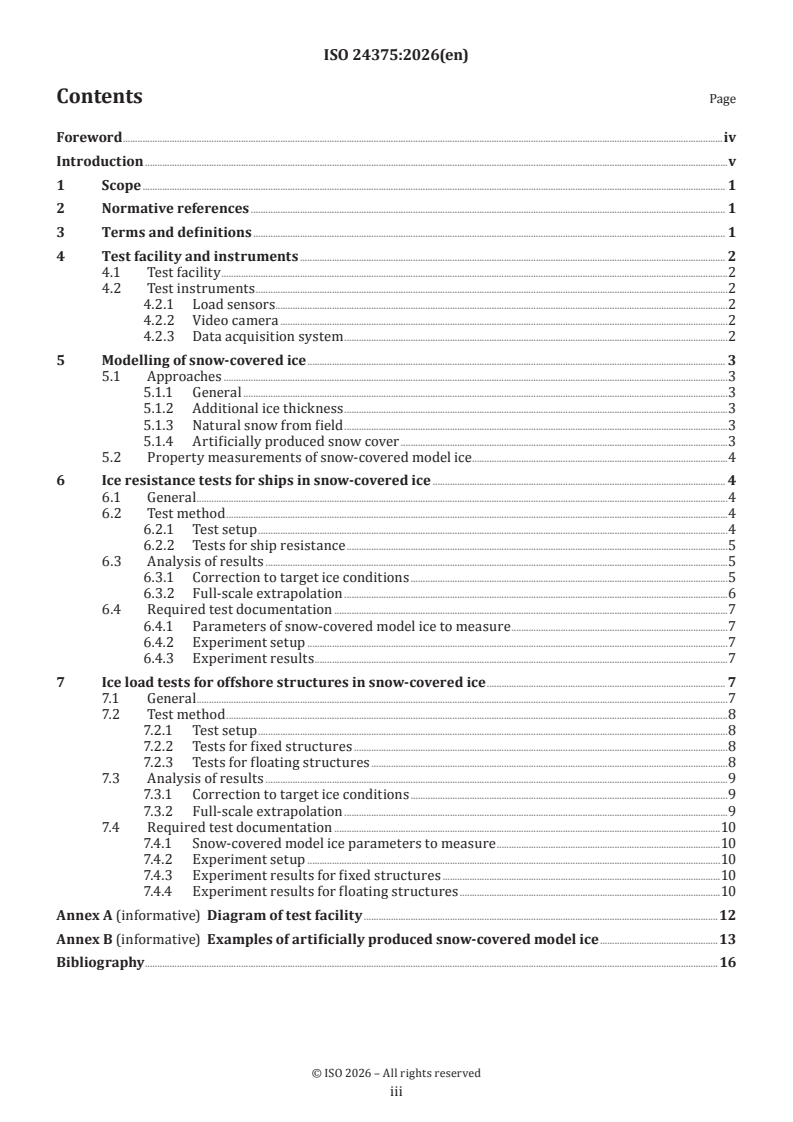
Contents Page
Foreword .iv
Introduction .v
1 Scope . 1
2 Normative references . 1
3 Terms and definitions . 1
4 Test facility and instruments . 2
4.1 Test facility .2
4.2 Test instruments .2
4.2.1 Load sensors . . .2
4.2.2 Video camera .2
4.2.3 Data acquisition system .2
5 Modelling of snow-covered ice . 3
5.1 Approaches .3
5.1.1 General .3
5.1.2 Additional ice thickness .3
5.1.3 Natural snow from field .3
5.1.4 Artificially produced snow cover .3
5.2 Property measurements of snow-covered model ice .4
6 Ice resistance tests for ships in snow-covered ice . 4
6.1 General .4
6.2 Test method .4
6.2.1 Test setup .4
6.2.2 Tests for ship resistance .5
6.3 Analysis of results .5
6.3.1 Correction to target ice conditions .5
6.3.2 Full-scale extrapolation .6
6.4 Required test documentation .7
6.4.1 Parameters of snow-covered model ice to measure .7
6.4.2 Experiment setup .7
6.4.3 Experiment results .7
7 Ice load tests for offshore structures in snow-covered ice . 7
7.1 General .7
7.2 Test method .8
7.2.1 Test setup .8
7.2.2 Tests for fixed structures .8
7.2.3 Tests for floating structures .8
7.3 Analysis of results .9
7.3.1 Correction to target ice conditions .9
7.3.2 Full-scale extrapolation .9
7.4 Required test documentation .10
7.4.1 Snow-covered model ice parameters to measure .10
7.4.2 Experiment setup .10
7.4.3 Experiment results for fixed structures .10
7.4.4 Experiment results for floating structures .10
Annex A (informative) Diagram of test facility .12
Annex B (informative) Examples of artificially produced snow-covered model ice .13
Bibliography .16
iii
Foreword
ISO (the International Organization for Standardization) is a worldwide federation of national standards
bodies (ISO member bodies). The work of preparing International Standards is normally carried out through
ISO technical committees. Each member body interested in a subject for which a technical committee
has been established has the right to be represented on that committee. International organizations,
governmental and non-governmental, in liaison with ISO, also take part in the work. ISO collaborates closely
with the International Electrotechnical Commission (IEC) on all matters of electrotechnical standardization.
The procedures used to develop this document and those intended for its further maintenance are described
in the ISO/IEC Directives, Part 1. In particular, the different approval criteria needed for the different types
of ISO document should be noted. This document was drafted in accordance with the editorial rules of the
ISO/IEC Directives, Part 2 (see www.iso.org/directives).
ISO draws attention to the possibility that the implementation of this document may involve the use of (a)
patent(s). ISO takes no position concerning the evidence, validity or applicability of any claimed patent
rights in respect thereof. As of the date of publication of this document, ISO had not received notice of (a)
patent(s) which may be required to implement this document. However, implementers are cautioned that
this may not represent the latest information, which may be obtained from the patent database available at
www.iso.org/patents. ISO shall not be held responsible for identifying any or all such patent rights.
Any trade name used in this document is information given for the convenience of users and does not
constitute an endorsement.
For an explanation of the voluntary nature of standards, the meaning of ISO specific terms and expressions
related to conformity assessment, as well as information about ISO's adherence to the World Trade
Organization (WTO) principles in the Technical Barriers to Trade (TBT), see www.iso.org/iso/foreword.html.
This document was prepared by Technical Committee ISO/TC 8, Ships and marine technology, Subcommittee
SC 8, Ship design.
Any feedback or questions on this document should be directed to the user’s national standards body. A
complete listing of these bodies can be found at www.iso.org/members.html.
iv
Introduction
Snow cover is usually the concomitant circumstance for natural ice, particularly in polar regions. Due to its
different physical and mechanical properties compared with fine-grained level ice, snow cover usually leads
the ice-structure interacting processes to different modes. Therefore, the presence of snow cover should not
be neglected during the investigations on ice-structure interactions. A large number of field observations
have indicated that snow covers have significant effects on both the ice-resistance of ships and the ice loads
on offshore structures. Snow cover changes the friction property of ice sheets and also affects the mode of
crack propagation in ice, consequentially altering the breaking length of ice and the accumulation process of
broken ice fragments.
In order to meet the requirements of the Polar Code established by the International Maritime Organization
[1]
(IMO), information on the influence of snow cover must be included in the Polar Water Operational Manual.
In the experimental prediction of the ship performance in ice, ship owners often request the inclusion of test
data under snow-covered ice conditions, especially for ships with a higher ice class. In the design of Arctic
offshore structures, actions and influences on operations by ice rubble accumulations are one of the major
concerns, and snow cover is considered to accelerate the rubble building process. Standard procedures
for the modelling of snow cover in scaled model tests are lacking, making it difficult to judge the accuracy
and rationale of the experimental prediction. This document therefore provides a standardized model
test method for ships and offshore structures in snow-covered ice, to ensure that all groups can assess the
accuracy of their predicting methods on the same basis.
v
International Standard ISO 24375:2026(en)
Ships and marine technology — Model tests for ships and
offshore structures in snow-covered ice
1 Scope
This document specifies the model tests for ships and offshore structures in snow-covered ice. It covers the
physical modelling techniques, test methods, analysis methods of results, and requirements of the facilities
and data documentation used in these tests.
This document applies to the model test methods used for estimating the ice resistance of ships and ice loads
on offshore structures in snow-covered ice.
2 Normative references
The following documents are referred to in the text in such a way that some or all of their content constitutes
requirements of this document. For dated references, only the edition cited applies. For undated references,
the latest edition of the referenced document (including any amendments) applies.
ISO 19906, Petroleum and natural gas industries — Arctic offshore structures
ISO 35106:2017, Petroleum and natural gas industries — Arctic operations — Metocean, ice, and seabed data
3 Terms and definitions
For the purposes of this document, the terms and definitions given in ISO 19906, ISO 35106 and the following
apply.
ISO and IEC maintain terminology databases for use in standardization at the following addresses:
— ISO Online browsing platform: available at https:// www .iso .org/ obp
— IEC Electropedia: available at https:// www .electropedia .org/
3.1
depth hoar
ice crystals (usually cup-shaped, faceted crystals) of low strength formed by sublimation within dry snow
beneath the snow surface
3.2
ice breaking
process where external forces induce fracture and fragmentation in ice, overcoming its structural integrity
to create pathways (usually for ships and offshore structures) through ice-covered waters
3.3
ice clearing
process of removing fragmented ice or ice blocks from a targeted area (usually ship bottom or structure
surface) to maintain ice-free conditions
3.4
ice resistance
time average of the ice-related forces acting parallel to the axis of motion of a ship in such a way as to resist
its motion
3.5
snow cover
areal distribution of snow on the ground or ice surface
[SOURCE: ISO 35106:2017, 3.53]
3.6
snow ice
whitish porous ice formed by the freezing of half-melted snow or the compacting of snow
3.7
snow-covered ice
ice with snow cover (3.5) on the surface
4 Test facility and instruments
4.1 Test facility
Model tests for ships and offshore structures in snow-covered ice should be conducted in an ice basin (or
ice tank), which provides a physical modelling environment for the interaction of ships or structures with
both ice and water. Additionally, an ice basin provides the cold environment which can be controlled for the
production of model ice with scaled properties. A diagram of the test facility is provided in Annex A.
4.2 Test instruments
4.2.1 Load sensors
Load cells should be used for measuring the total ice resistance of the model ship, the global ice load of
the model offshore structure, or the tension force of the mooring line. The specifications of the load cell
(e.g. capacity, accuracy, protection) shall be selected in accordance with the requirements from engineering
designers or the ship owner's research objective. Calibration of the load cell shall be performed prior to the
tests under a similar temperature, humidity and applied load as used in the model test.
Flexible, grid-based, tactile pressure sensors are optional for measuring the local normal ice load on the
model. Selections of the size, sampling rate and spatial resolution of the tactile sensor depend on the
requirements from the engineering designers or the ship owner's research objective. Calibration of the
tactile sensor is recommended to be performed under a similar temperature, humidity, material interface
and applied pressure as used in the model test.
4.2.2 Video camera
Video cameras are used for recording the ice failure and flow of the broken ice around or beneath the model
during the test. The specifications of the camera (e.g. resolution, frame rate, protection) shall satisfy the
requirements established by engineering designers or the ship owner's research objective.
4.2.3 Data acquisition system
Data acquisition systems are used for sampling the measured physical parameters during the model test,
which consists of a collection of hardware and software. The number of channels and the sampling rate shall
satisfy the requirements of the model test, including the specific measurements required.
5 Modelling of snow-covered ice
5.1 Approaches
5.1.1 General
There are three approaches that can be used for modelling snow in an ice basin:
a) applying snow as an additional thickness to the ice sheet;
b) collecting natural snow from a field; and
c) artificially generating snow in a basin.
The methods described in 5.1.2 to 5.1.4 are equally useful for modelling snow in an ice basin.
5.1.2 Additional ice thickness
Additional ice thickness is introduced to evaluate the effect of snow on the ship’s performance in ice, which
is defined as the allowance for the snow-covered ice properties (primarily snow thickness) based on net ice
thickness. In this case, it is assumed that the ice resistance of a ship moving through continuous snow-free
ice considering the additional thickness is equal to that of the same ship moving through snow-covered ice.
The allowance for the snow-covered ice properties is treated as the snow thickness multiplied by a certain
empirical coefficient.
5.1.3 Natural snow from field
While collecting snow samples from a field, isothermal containers are used to store the natural snow
in transportation. The snow microstructure is affected by these physical manipulations (collection,
transportation) due to the isothermal metamorphism of dry snow. To obtain snow samples with low density,
a sieving process is introduced in such type of tests, and in many cases the snow samples are placed in a
stable cold environment to sinter. The above procedures indicate that the snow samples collected from a
field cannot maintain their natural material states, which means this is actually an artificial approach to
simulate natural snow although the samples are originated from a field.
5.1.4 Artificially produced snow cover
There are many methods that can produce snow artificially, but the applicability to model tests in an ice
basin varies. Commercial snow making machines generally require a large spraying height and possibly do
not produce sufficiently uniform and fine-grained ice particles used for scaled model tests. Preparing snow
[2]
samples in a temperature-controlled chamber can be a suitable approach to generating snow samples for
the investigation of snow properties, but the snow grown in such method can be difficult to be spread on the
ice sheet with a size of ice basin.
Another method of artificially generating snow in ice basin is forcing water vapour flowing over a cold snow
[3][4]
surface to accelerate the formation of coarse-grained snow ice. A layer of snow ice is firstly generated
on the model ice sheet by performing the two-order water pulverization procedure. Then a layer of coarse-
grained snow ice with large crystal size is formed by spraying the water vapour on the surface of the new
snow layer directly. As the wet snow particles are completely refrozen, another new snow layer is sprayed
on this base layer subsequently. After that, water vapour is driven to flow horizontally over the new snow
surface to accelerate the formation of depth hoar. Then a layer of dense and close-grained depth hoar quickly
develops on the base snow ice layer. The last step is spraying a layer of new snow over the middle layer of
depth hoar. Examples of artificially produced snow-covered model ice are provided in Annex B. Alternative
methods can be used if the layered feature of the snow cover is carefully replicated or its effect is validated
by experimental data.
5.2 Property measurements of snow-covered model ice
ISO 19906 contains detailed specifications on the property measurements of model ice without snow cover.
For snow-covered model ice, the following issues should be addressed.
a) The thickness of the snow cover and the crystal size of the snow particles should be recorded when the
snow is modelled by collecting or artificially generating.
b) The mechanical properties of the entire snow-covered model ice should be measured.
c) As the snow cover can be flooded or fall off from the parent model ice, it is recommended to perform
property measurements in situ in the basin instead of lifting the samples out of the natural environment
to maintain reliable results. All measurement procedures should be as simple as possible to allow the
desired parameter to be measured directly and effectively.
d) As the predominant quantifiable alteration in the ice sheet due to snow cover is the friction property,
measurements of the sliding friction of ice-structure and ice-ice (e.g. studies of ice pile-ups) are
recommended under the conditions with and without snow cover. The friction measurements of ice
blocks with dry and wet snow covers are also recommended.
6 Ice resistance tests for ships in snow-covered ice
6.1 General
The primary purpose of ice resistance tests for ships in snow-covered ice is to measure ice resistance under
specified ice and ship conditions, evaluate hull-form effectiveness in ice breaking and ice clearing, and
provide data to assess the ship’s ice-breaking and ice-clearing capability in the presence of snow cover.
The speci
...