


ISO/FDIS 19014-3
(Main)Earth-moving machinery — Functional safety — Part 3: Environmental performance and test requirements of electronic and electrical components used in safety-related parts of the control system
General Information
- Abstract
This document specifies the minimum requirements for environmental testing of electronic and electrical components identified as safety-related parts of the control system (SRP/CS) used on earth-moving machinery (EMM) as defined in ISO 6165 and their attachments.
- Status
- Not Published
- Technical Committee
- ISO/TC 127/SC 2 - Safety, ergonomics and general requirements
- Drafting Committee
- ISO/TC 127/SC 2/WG 24 - Control system functional safety
- Current Stage
- 5020 - FDIS ballot initiated: 2 months. Proof sent to secretariat
- Start Date
- 26-Jun-2026
- Completion Date
- 26-Jun-2026
Buy Documents
ISO/FDIS 19014-3 - Earth-moving machinery — Functional safety — Part 3: Environmental performance and test requirements of electronic and electrical components used in safety-related parts of the control system/30/2025
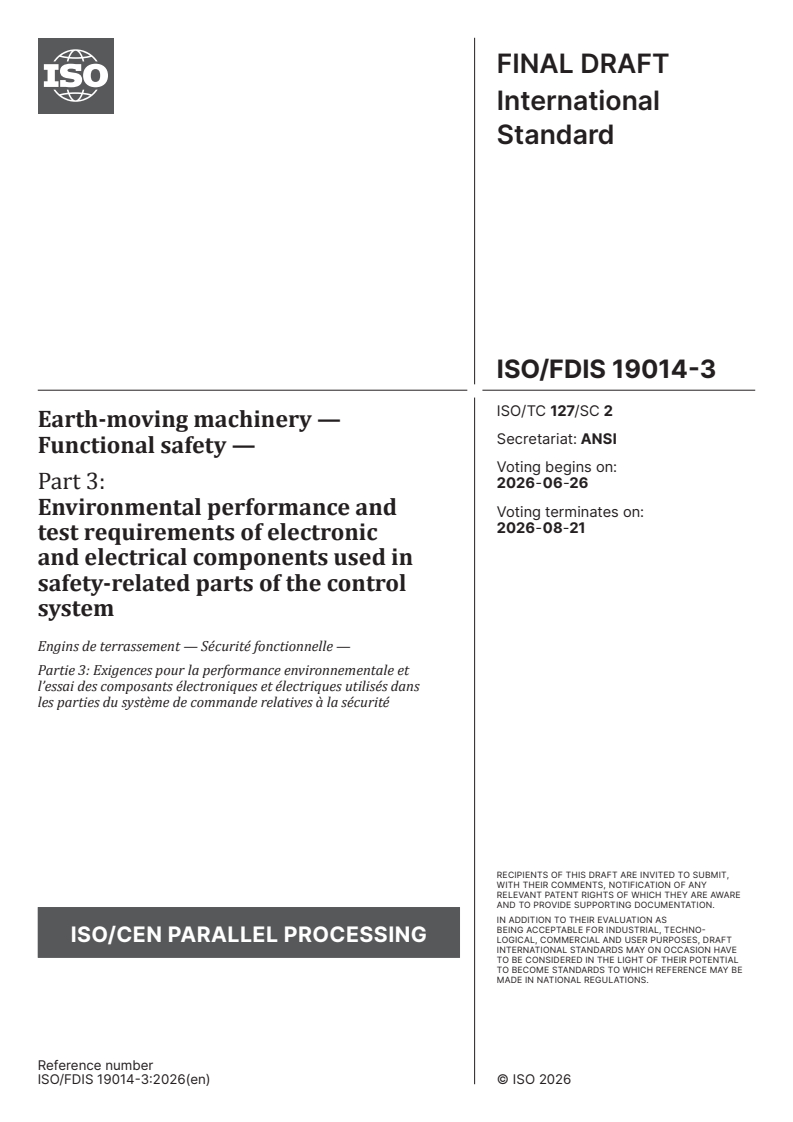
ISO/FDIS 19014-3 - Earth-moving machinery — Functional safety — Part 3: Environmental performance and test requirements of electronic and electrical components used in safety-related parts of the control system
REDLINE ISO/FDIS 19014-3 - Earth-moving machinery — Functional safety — Part 3: Environmental performance and test requirements of electronic and electrical components used in safety-related parts of the control system
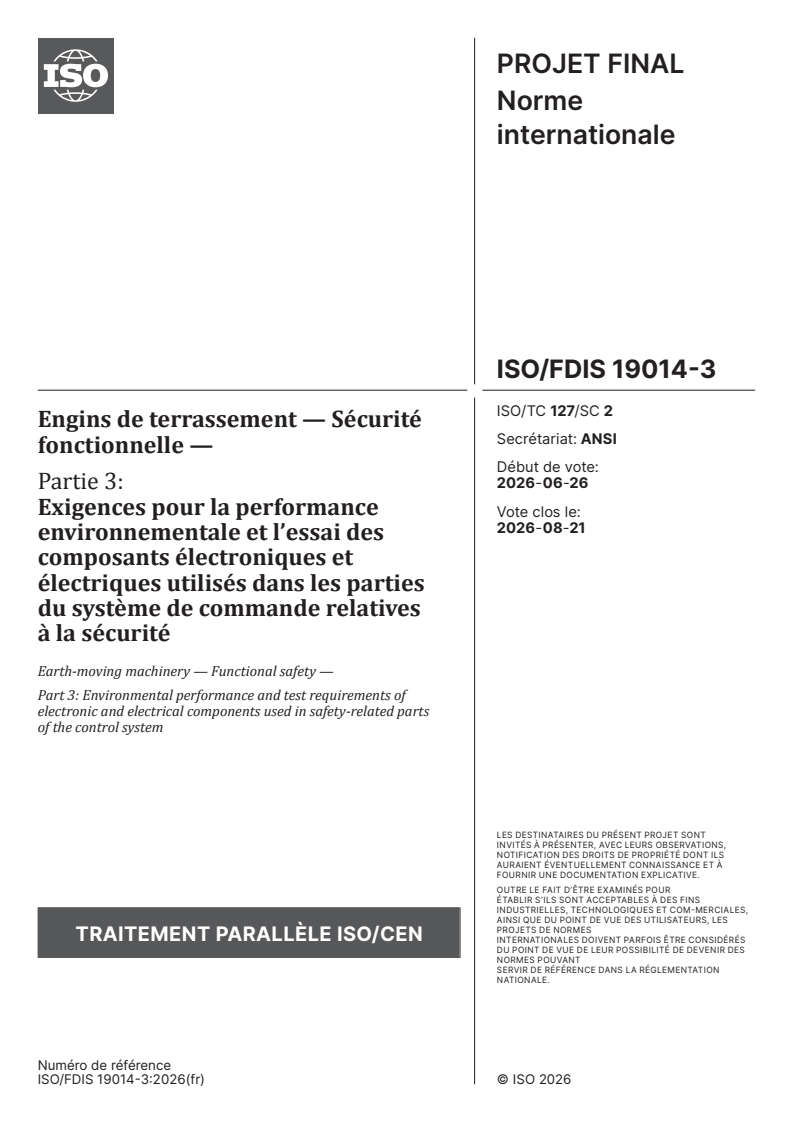
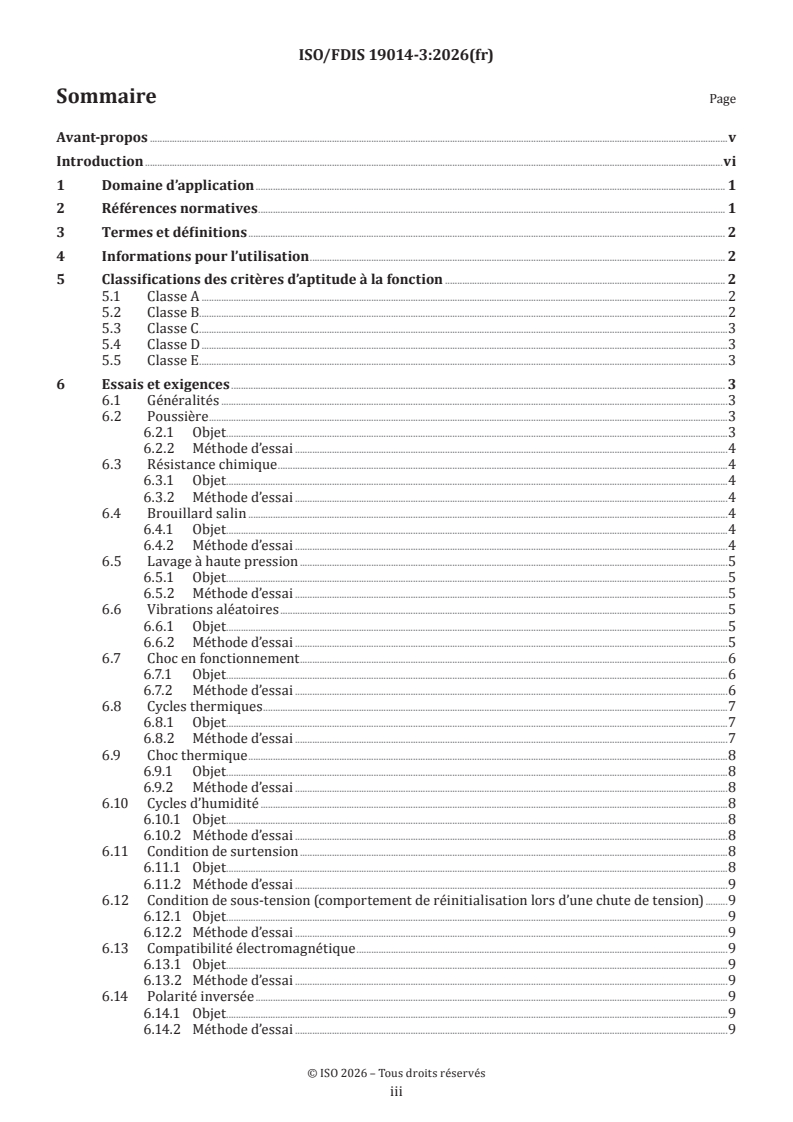
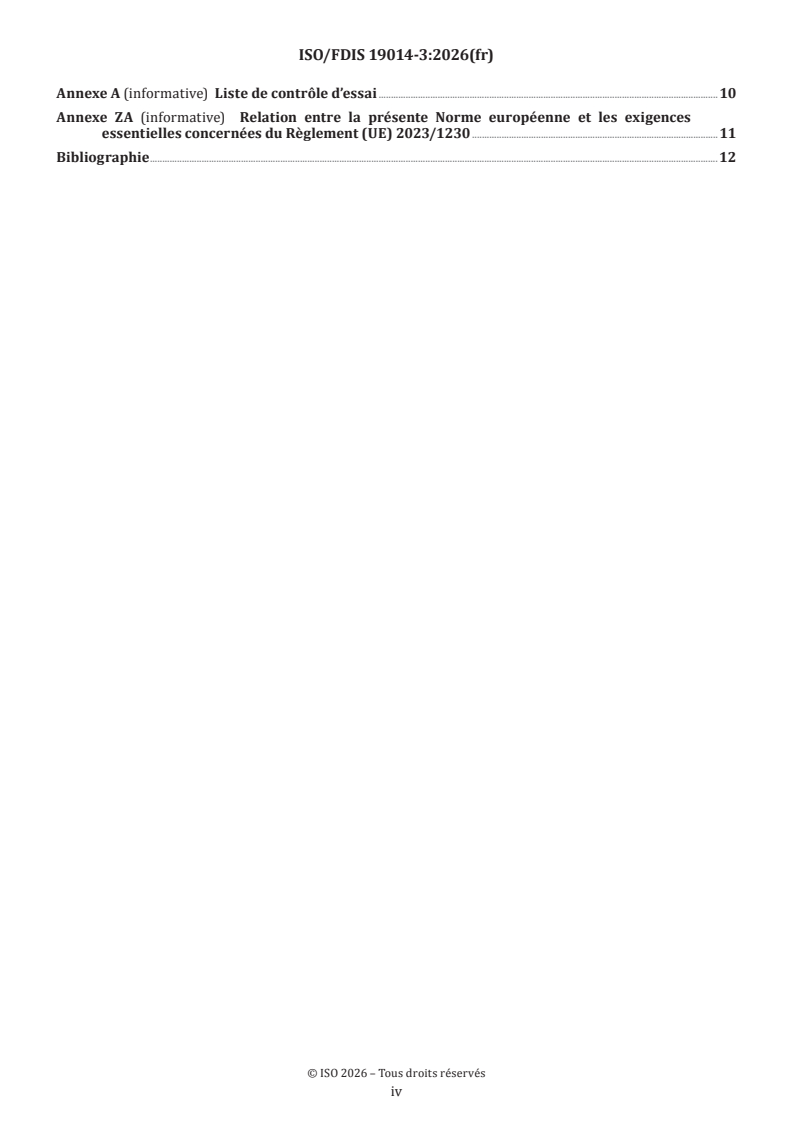
ISO/FDIS 19014-3 - Engins de terrassement — Sécurité fonctionnelle — Partie 3: Exigences pour la performance environnementale et l’essai des composants électroniques et électriques utilisés dans les parties du système de commande relatives à la sécurité
ISO/FDIS 19014-3 - Engins de terrassement — Sécurité fonctionnelle — Partie 3: Exigences pour la performance environnementale et l’essai des composants électroniques et électriques utilisés dans les parties du système de commande relatives à la sécurité/24/2025
Overview
ISO/FDIS 19014-3: Earth-moving machinery - Functional safety - Part 3: Environmental performance and test requirements of electronic and electrical components used in safety-related parts of the control system sets out minimum requirements for environmental testing of electronic and electrical components used in the safety-related parts of the control systems (SRP/CS) for earth-moving machinery (EMM). This standard, developed by ISO/TC 127/SC 2, addresses the unique demands placed on machinery used in construction, mining, forestry, and similar industries by ensuring that critical control systems components can withstand challenging operational environments.
Conformance to ISO/FDIS 19014-3 enhances machine reliability, supports functional safety objectives, and helps manufacturers demonstrate compliance with global safety and performance requirements.
Key Topics
Environmental Performance Requirements
- Defines clear criteria for the environmental robustness of SRP/CS components.
- Addresses challenges such as exposure to dust, chemicals, salt spray, vibration, shock, humidity, and extreme temperatures.
Functional Status Classifications
- Outlines five functional status classes (A-E) for components during and after testing, specifying expected behavior and acceptance criteria.
- Class A: Full functionality maintained.
- Class B-E: Varying degrees of acceptable performance degradation or failure, with defined recovery requirements.
Test Methods and Minimum Conditions
- Standardizes test procedures referencing key ISO and IEC standards for:
- Dust ingress protection (IP codes)
- Chemical and salt resistance
- Pressure washing
- Random vibration and shock
- Temperature and humidity cycling
- Overvoltage and undervoltage conditions
- Electromagnetic compatibility
- Reverse polarity
Manufacturer Responsibilities
- Requires manufacturers to determine suitable test conditions based on component application, mounting location, and expected environmental exposure.
- Urges early assessment of chemical resistance and documentation for exemptions where applicable.
Applications
Who Should Apply This Standard?
- Earth-moving machinery designers and manufacturers: Required to select, test, and document SRP/CS components that meet environmental and safety requirements.
- Component suppliers: Must ensure their electrical and electronic parts are validated to withstand typical and extreme operational conditions defined in the standard.
- Regulatory and market surveillance bodies: Reference the standard as a benchmark for safety and environmental compliance in machinery assessment.
- Maintenance providers and safety specialists: Benefit from clear acceptance and test criteria, supporting long-term reliability and reduced risk of safety system failures.
Practical Benefits
- Improved operational safety: Reduces the risk of environmental-related failures in control systems that can lead to hazardous situations on construction sites or in mining operations.
- Regulatory alignment: Supports compliance with international and regional regulations (e.g., Regulation (EU) 2023/1230).
- Market access: Facilitates acceptance in global markets by demonstrating adherence to recognized international standards.
Related Standards
The following standards are referenced by or closely related to ISO/FDIS 19014-3:
- ISO 6165: Defines types, terms, and definitions for earth-moving machinery.
- ISO 13766-1 & ISO 13766-2: Electromagnetic compatibility requirements for earth-moving machinery.
- ISO 16750 series: Environmental conditions and testing for electrical/electronic equipment in vehicles.
- ISO 20653 and IEC 60529: Degrees of protection provided by enclosures (IP codes).
- IEC 60068 series: Environmental testing methodologies, including shock, vibration, temperature cycles, humidity, and more.
- ISO 19014-1 & ISO 19014-2: Foundational standards for safety risk assessment and control system methodologies.
By adhering to ISO/FDIS 19014-3, organizations ensure their earth-moving equipment control systems meet stringent environmental and functional safety requirements essential in demanding industrial applications.
Relations
- Effective Date
- 12-Feb-2026
- Effective Date
- 16-Dec-2023
- Effective Date
- 09-Dec-2023
Buy Documents
ISO/FDIS 19014-3 - Earth-moving machinery — Functional safety — Part 3: Environmental performance and test requirements of electronic and electrical components used in safety-related parts of the control system/30/2025
ISO/FDIS 19014-3 - Earth-moving machinery — Functional safety — Part 3: Environmental performance and test requirements of electronic and electrical components used in safety-related parts of the control system
REDLINE ISO/FDIS 19014-3 - Earth-moving machinery — Functional safety — Part 3: Environmental performance and test requirements of electronic and electrical components used in safety-related parts of the control system
ISO/FDIS 19014-3 - Engins de terrassement — Sécurité fonctionnelle — Partie 3: Exigences pour la performance environnementale et l’essai des composants électroniques et électriques utilisés dans les parties du système de commande relatives à la sécurité
ISO/FDIS 19014-3 - Engins de terrassement — Sécurité fonctionnelle — Partie 3: Exigences pour la performance environnementale et l’essai des composants électroniques et électriques utilisés dans les parties du système de commande relatives à la sécurité/24/2025
Frequently Asked Questions
ISO/FDIS 19014-3 is a draft published by the International Organization for Standardization (ISO). Its full title is "Earth-moving machinery — Functional safety — Part 3: Environmental performance and test requirements of electronic and electrical components used in safety-related parts of the control system". This standard covers: This document specifies the minimum requirements for environmental testing of electronic and electrical components identified as safety-related parts of the control system (SRP/CS) used on earth-moving machinery (EMM) as defined in ISO 6165 and their attachments.
This document specifies the minimum requirements for environmental testing of electronic and electrical components identified as safety-related parts of the control system (SRP/CS) used on earth-moving machinery (EMM) as defined in ISO 6165 and their attachments.
ISO/FDIS 19014-3 is classified under the following ICS (International Classification for Standards) categories: 53.100 - Earth-moving machinery. The ICS classification helps identify the subject area and facilitates finding related standards.
ISO/FDIS 19014-3 has the following relationships with other standards: It is inter standard links to FprEN ISO 19014-3, ISO 2407:2024, ISO 19014-3:2018. Understanding these relationships helps ensure you are using the most current and applicable version of the standard.
ISO/FDIS 19014-3 is available in PDF format for immediate download after purchase. The document can be added to your cart and obtained through the secure checkout process. Digital delivery ensures instant access to the complete standard document.
Standards Content (Sample)
DRAFT
International
Standard
ISO/DIS 19014-3.2
ISO/TC 127/SC 2
Earth-moving machinery —
Secretariat: ANSI
Functional safety —
Voting begins on:
Part 3: 2025-07-25
Environmental performance and
Voting terminates on:
2025-09-19
test requirements of electronic
and electrical components used in
safety-related parts of the control
system
Engins de terrassement — Sécurité fonctionnelle —
Partie 3: Exigences pour la performance environnementale et
l'essai des composants électroniques et électriques utilisés dans
les parties relatives à la sécurité du système de commande
ICS: 53.100
THIS DOCUMENT IS A DRAFT CIRCULATED
FOR COMMENTS AND APPROVAL. IT
IS THEREFORE SUBJECT TO CHANGE
AND MAY NOT BE REFERRED TO AS AN
INTERNATIONAL STANDARD UNTIL
PUBLISHED AS SUCH.
This document is circulated as received from the committee secretariat.
IN ADDITION TO THEIR EVALUATION AS
BEING ACCEPTABLE FOR INDUSTRIAL,
TECHNOLOGICAL, COMMERCIAL AND
USER PURPOSES, DRAFT INTERNATIONAL
STANDARDS MAY ON OCCASION HAVE TO
ISO/CEN PARALLEL PROCESSING
BE CONSIDERED IN THE LIGHT OF THEIR
POTENTIAL TO BECOME STANDARDS TO
WHICH REFERENCE MAY BE MADE IN
NATIONAL REGULATIONS.
RECIPIENTS OF THIS DRAFT ARE INVITED
TO SUBMIT, WITH THEIR COMMENTS,
NOTIFICATION OF ANY RELEVANT PATENT
RIGHTS OF WHICH THEY ARE AWARE AND TO
PROVIDE SUPPORTING DOCUMENTATION.
Reference number
ISO/DIS 19014-3.2:2025(en)
DRAFT
ISO/DIS 19014-3.2:2025(en)
International
Standard
ISO/DIS 19014-3.2
ISO/TC 127/SC 2
Earth-moving machinery —
Secretariat: ANSI
Functional safety —
Voting begins on:
Part 3:
2025-07-25
Environmental performance and
Voting terminates on:
2025-09-19
test requirements of electronic and
electrical components used in safety-
related parts of the control system
Engins de terrassement — Sécurité fonctionnelle —
Partie 3: Exigences pour la performance environnementale et
l'essai des composants électroniques et électriques utilisés dans
les parties relatives à la sécurité du système de commande
ICS: 53.100
THIS DOCUMENT IS A DRAFT CIRCULATED
FOR COMMENTS AND APPROVAL. IT
IS THEREFORE SUBJECT TO CHANGE
AND MAY NOT BE REFERRED TO AS AN
INTERNATIONAL STANDARD UNTIL
PUBLISHED AS SUCH.
This document is circulated as received from the committee secretariat.
IN ADDITION TO THEIR EVALUATION AS
BEING ACCEPTABLE FOR INDUSTRIAL,
© ISO 2025
TECHNOLOGICAL, COMMERCIAL AND
USER PURPOSES, DRAFT INTERNATIONAL
All rights reserved. Unless otherwise specified, or required in the context of its implementation, no part of this publication may
STANDARDS MAY ON OCCASION HAVE TO
ISO/CEN PARALLEL PROCESSING
be reproduced or utilized otherwise in any form or by any means, electronic or mechanical, including photocopying, or posting on
BE CONSIDERED IN THE LIGHT OF THEIR
the internet or an intranet, without prior written permission. Permission can be requested from either ISO at the address below
POTENTIAL TO BECOME STANDARDS TO
WHICH REFERENCE MAY BE MADE IN
or ISO’s member body in the country of the requester.
NATIONAL REGULATIONS.
ISO copyright office
RECIPIENTS OF THIS DRAFT ARE INVITED
CP 401 • Ch. de Blandonnet 8
TO SUBMIT, WITH THEIR COMMENTS,
CH-1214 Vernier, Geneva
NOTIFICATION OF ANY RELEVANT PATENT
Phone: +41 22 749 01 11
RIGHTS OF WHICH THEY ARE AWARE AND TO
PROVIDE SUPPORTING DOCUMENTATION.
Email: copyright@iso.org
Website: www.iso.org
Published in Switzerland Reference number
ISO/DIS 19014-3.2:2025(en)
ii
ISO/DIS 19014-3.2:2025(en)
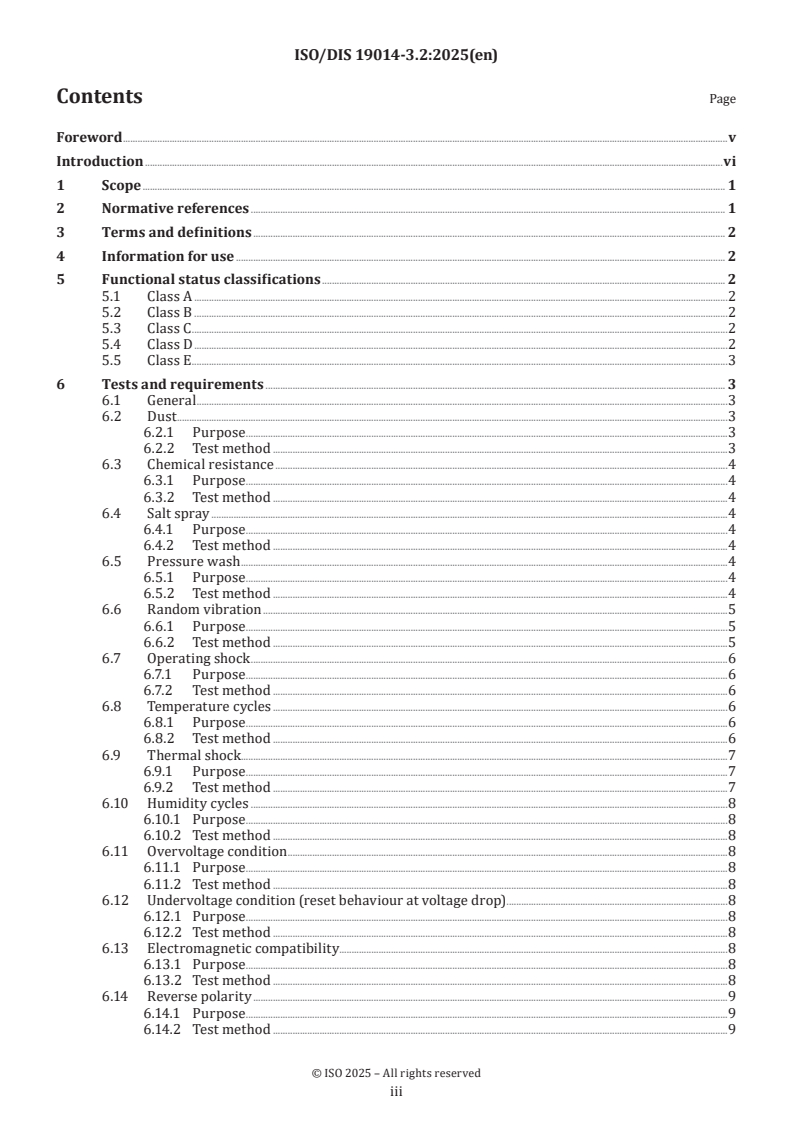
Contents Page
Foreword .v
Introduction .vi
1 Scope . 1
2 Normative references . 1
3 Terms and definitions . 2
4 Information for use . 2
5 Functional status classifications . 2
5.1 Class A .2
5.2 Class B .2
5.3 Class C .2
5.4 Class D .2
5.5 Class E . .3
6 Tests and requirements . 3
6.1 General .3
6.2 Dust . .3
6.2.1 Purpose .3
6.2.2 Test method .3
6.3 Chemical resistance .4
6.3.1 Purpose .4
6.3.2 Test method .4
6.4 Salt spray .4
6.4.1 Purpose .4
6.4.2 Test method .4
6.5 Pressure wash .4
6.5.1 Purpose .4
6.5.2 Test method .4
6.6 Random vibration .5
6.6.1 Purpose .5
6.6.2 Test method .5
6.7 Operating shock .6
6.7.1 Purpose .6
6.7.2 Test method .6
6.8 Temperature cycles .6
6.8.1 Purpose .6
6.8.2 Test method .6
6.9 Thermal shock.7
6.9.1 Purpose .7
6.9.2 Test method .7
6.10 Humidity cycles .8
6.10.1 Purpose .8
6.10.2 Test method .8
6.11 Overvoltage condition .8
6.11.1 Purpose .8
6.11.2 Test method .8
6.12 Undervoltage condition (reset behaviour at voltage drop) .8
6.12.1 Purpose .8
6.12.2 Test method .8
6.13 Electromagnetic compatibility.8
6.13.1 Purpose .8
6.13.2 Test method .8
6.14 Reverse polarity .9
6.14.1 Purpose .9
6.14.2 Test method .9
iii
ISO/DIS 19014-3.2:2025(en)
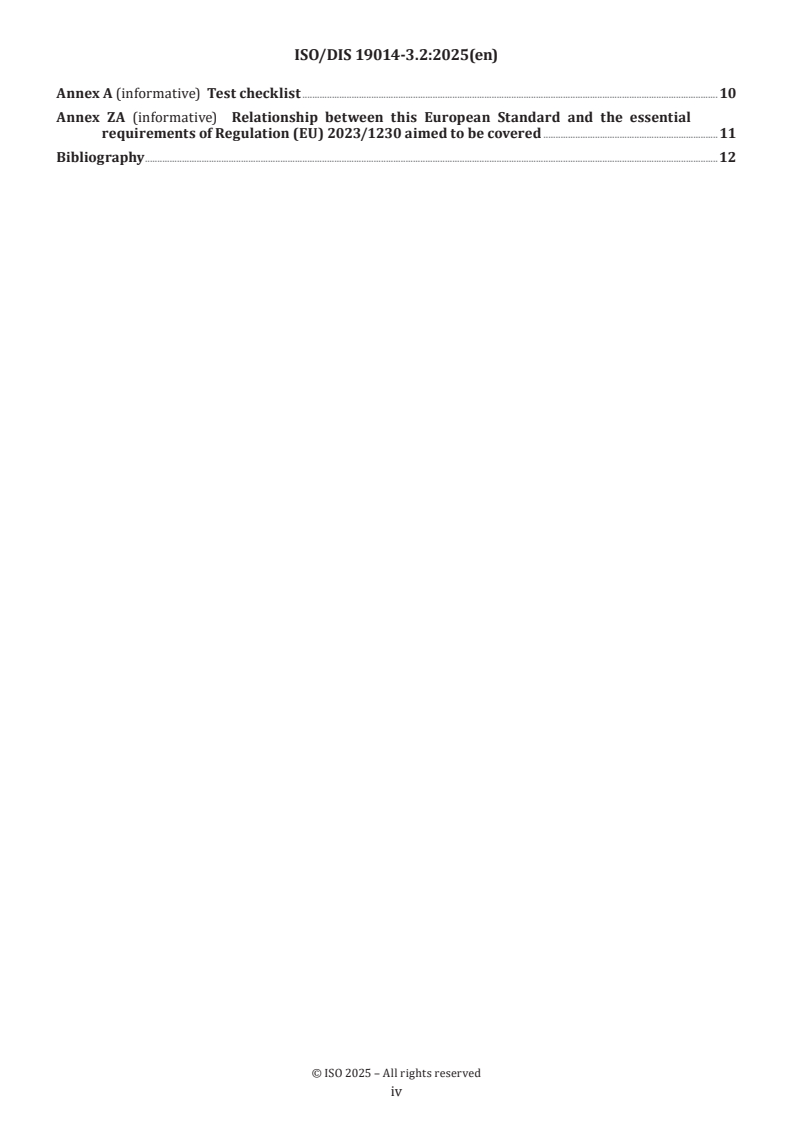
Annex A (informative) Test checklist . 10
Annex ZA (informative) Relationship between this European Standard and the essential
requirements of Regulation (EU) 2023/1230 aimed to be covered .11
Bibliography .12
iv
ISO/DIS 19014-3.2:2025(en)
Foreword
ISO (the International Organization for Standardization) is a worldwide federation of national standards
bodies (ISO member bodies). The work of preparing International Standards is normally carried out through
ISO technical committees. Each member body interested in a subject for which a technical committee
has been established has the right to be represented on that committee. International organizations,
governmental and non-governmental, in liaison with ISO, also take part in the work. ISO collaborates closely
with the International Electrotechnical Commission (IEC) on all matters of electrotechnical standardization.
The procedures used to develop this document and those intended for its further maintenance are described
in the ISO/IEC Directives, Part 1. In particular, the different approval criteria needed for the different types
of ISO document should be noted. This document was drafted in accordance with the editorial rules of the
ISO/IEC Directives, Part 2 (see www.iso.org/directives).
ISO draws attention to the possibility that the implementation of this document may involve the use of (a)
patent(s). ISO takes no position concerning the evidence, validity or applicability of any claimed patent
rights in respect thereof. As of the date of publication of this document, ISO had not received notice of (a)
patent(s) which may be required to implement this document. However, implementers are cautioned that
this may not represent the latest information, which may be obtained from the patent database available at
www.iso.org/patents. ISO shall not be held responsible for identifying any or all such patent rights.
Any trade name used in this document is information given for the convenience of users and does not
constitute an endorsement.
For an explanation of the voluntary nature of standards, the meaning of ISO specific terms and expressions
related to conformity assessment, as well as information about ISO's adherence to the World Trade
Organization (WTO) principles in the Technical Barriers to Trade (TBT), see www.iso.org/iso/foreword.html.
This document was prepared by Technical Committee ISO/TC 127, Earth-moving machinery, Subcommittee
SC 2, Safety, ergonomics and general requirements, in collaboration with the European Committee for
Standardization (CEN) Technical Committee CEN/TC 151, Construction equipment and building material
machines - Safety, in accordance with the Agreement on technical cooperation between ISO and CEN (Vienna
Agreement).
This second edition cancels and replaces the first edition (ISO 19014-3:2018), which has been technically
revised.
The main changes are as follows:
— certain referenced standards have been dated.
— information for use added
— additional functional status “Class E” added
— typographical error corrected, “IPXK6” changed to “IPX6K”
— minor editorial improvements.
Any feedback or questions on this document should be directed to the user’s national standards body. A
complete listing of these bodies can be found at www.iso.org/members.html.
v
ISO/DIS 19014-3.2:2025(en)
Introduction
This document addresses electronic and electrical systems used for functional safety in earth-moving
machinery.
The structure of safety standards in the field of machinery is as follows.
Type-A standards (basis standards) give basic concepts, principles for design and general aspects that can
be applied to machinery.
Type-B standards (generic safety standards) deal with one or more safety aspects, or one or more types of
safeguards that can be used across a wide range of machinery:
— type-B1 standards on particular safety aspects (e.g. safety distances, surface temperature, noise);
— type-B2 standards on safeguards (e.g. two-hands controls, interlocking devices, pressure sensitive
devices, guards).
Type-C standards (machinery safety standards) deal with detailed safety requirements for a particular
machine or group of machines.
This document, when taken together with the other parts of ISO 19014, is a type-C standard as stated in
ISO 12100.
This document is of relevance for the following stakeholder groups representing the market players
regarding machinery safety:
— machine manufacturers (small, medium and large enterprises)
— health and safety bodies (regulators, accident prevention organizations, market surveillance etc.).
Others can be affected by the level of machinery safety achieved with this document by the aforementioned
stakeholder groups:
— machine users/employers (small, medium and large enterprises)
— machine users/employees (e.g. trade unions, organizations for people with special needs)
— service providers, e. g. for maintenance (small, medium and large enterprises)
— consumers (in case of machinery intended for use by consumers)
— component manufacturers.
The machinery concerned and the extent to which hazards, hazardous situations or hazardous events are
covered are indicated in the scope of this document.
When requirements of this type-C standard are different from those which are stated in type-A or type-B
standards, the requirements of this type-C standard take precedence over the requirements of the other
standards for machines that have been designed and built according to the requirements of this type-C
standard.
vi
DRAFT International Standard ISO/DIS 19014-3.2:2025(en)
Earth-moving machinery — Functional safety —
Part 3:
Environmental performance and test requirements of
electronic and electrical components used in safety-rel
...
FINAL DRAFT
International
Standard
ISO/TC 127/SC 2
Earth-moving machinery —
Secretariat: ANSI
Functional safety —
Voting begins on:
2026-06-26
Part 3:
Environmental performance and
Voting terminates on:
2026-08-21
test requirements of electronic
and electrical components used in
safety-related parts of the control
system
Engins de terrassement — Sécurité fonctionnelle —
Partie 3: Exigences pour la performance environnementale et
l’essai des composants électroniques et électriques utilisés dans
les parties du système de commande relatives à la sécurité
RECIPIENTS OF THIS DRAFT ARE INVITED TO SUBMIT,
WITH THEIR COMMENTS, NOTIFICATION OF ANY
RELEVANT PATENT RIGHTS OF WHICH THEY ARE AWARE
AND TO PROVIDE SUPPOR TING DOCUMENTATION.
IN ADDITION TO THEIR EVALUATION AS
BEING ACCEPTABLE FOR INDUSTRIAL, TECHNO-
ISO/CEN PARALLEL PROCESSING LOGICAL, COMMERCIAL AND USER PURPOSES, DRAFT
INTERNATIONAL STANDARDS MAY ON OCCASION HAVE
TO BE CONSIDERED IN THE LIGHT OF THEIR POTENTIAL
TO BECOME STAN DARDS TO WHICH REFERENCE MAY BE
MADE IN NATIONAL REGULATIONS.
Reference number
FINAL DRAFT
International
Standard
ISO/TC 127/SC 2
Earth-moving machinery —
Secretariat: ANSI
Functional safety —
Voting begins on:
Part 3:
Environmental performance and
Voting terminates on:
test requirements of electronic
and electrical components used in
safety-related parts of the control
system
Engins de terrassement — Sécurité fonctionnelle —
Partie 3: Exigences pour la performance environnementale et
l’essai des composants électroniques et électriques utilisés dans
les parties du système de commande relatives à la sécurité
RECIPIENTS OF THIS DRAFT ARE INVITED TO SUBMIT,
WITH THEIR COMMENTS, NOTIFICATION OF ANY
RELEVANT PATENT RIGHTS OF WHICH THEY ARE AWARE
AND TO PROVIDE SUPPOR TING DOCUMENTATION.
© ISO 2026
IN ADDITION TO THEIR EVALUATION AS
All rights reserved. Unless otherwise specified, or required in the context of its implementation, no part of this publication may
BEING ACCEPTABLE FOR INDUSTRIAL, TECHNO-
ISO/CEN PARALLEL PROCESSING
LOGICAL, COMMERCIAL AND USER PURPOSES, DRAFT
be reproduced or utilized otherwise in any form or by any means, electronic or mechanical, including photocopying, or posting on
INTERNATIONAL STANDARDS MAY ON OCCASION HAVE
the internet or an intranet, without prior written permission. Permission can be requested from either ISO at the address below
TO BE CONSIDERED IN THE LIGHT OF THEIR POTENTIAL
or ISO’s member body in the country of the requester.
TO BECOME STAN DARDS TO WHICH REFERENCE MAY BE
MADE IN NATIONAL REGULATIONS.
ISO copyright office
CP 401 • Ch. de Blandonnet 8
CH-1214 Vernier, Geneva
Phone: +41 22 749 01 11
Email: copyright@iso.org
Website: www.iso.org
Published in Switzerland Reference number
ii
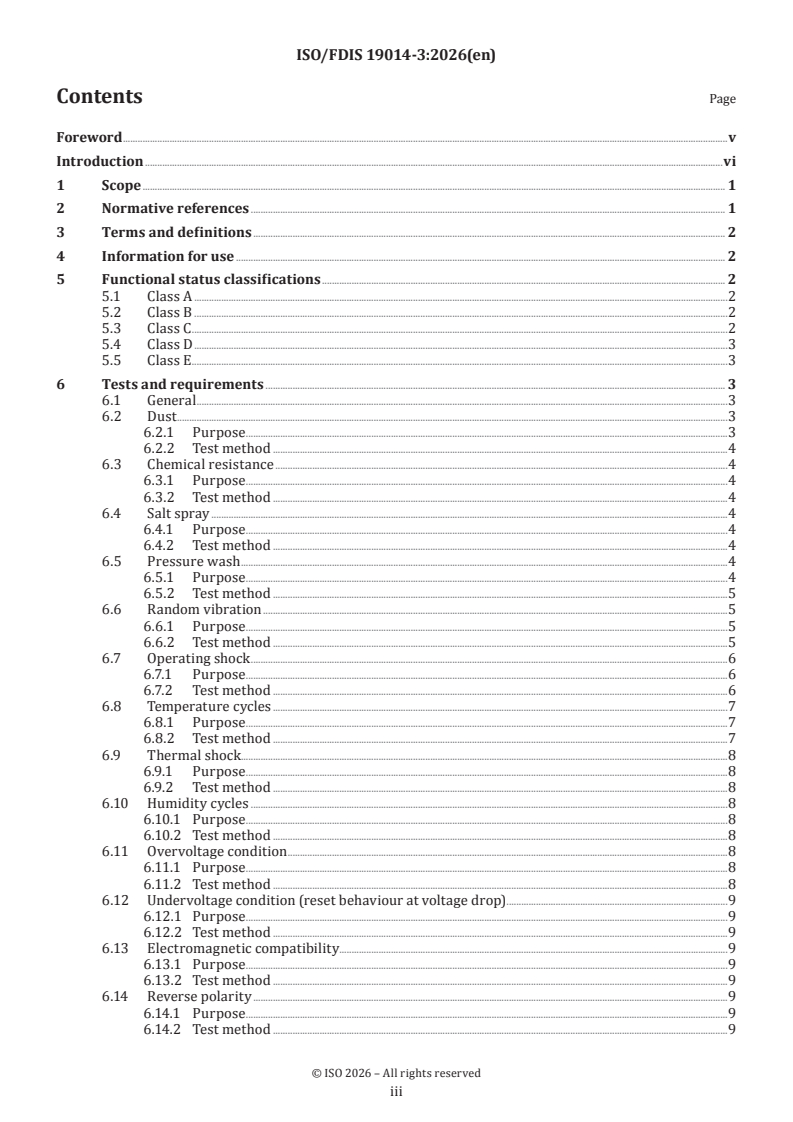
Contents Page
Foreword .v
Introduction .vi
1 Scope . 1
2 Normative references . 1
3 Terms and definitions . 2
4 Information for use . 2
5 Functional status classifications . 2
5.1 Class A .2
5.2 Class B .2
5.3 Class C .2
5.4 Class D .3
5.5 Class E . .3
6 Tests and requirements . 3
6.1 General .3
6.2 Dust . .3
6.2.1 Purpose .3
6.2.2 Test method .4
6.3 Chemical resistance .4
6.3.1 Purpose .4
6.3.2 Test method .4
6.4 Salt spray .4
6.4.1 Purpose .4
6.4.2 Test method .4
6.5 Pressure wash .4
6.5.1 Purpose .4
6.5.2 Test method .5
6.6 Random vibration .5
6.6.1 Purpose .5
6.6.2 Test method .5
6.7 Operating shock .6
6.7.1 Purpose .6
6.7.2 Test method .6
6.8 Temperature cycles .7
6.8.1 Purpose .7
6.8.2 Test method .7
6.9 Thermal shock.8
6.9.1 Purpose .8
6.9.2 Test method .8
6.10 Humidity cycles .8
6.10.1 Purpose .8
6.10.2 Test method .8
6.11 Overvoltage condition .8
6.11.1 Purpose .8
6.11.2 Test method .8
6.12 Undervoltage condition (reset behaviour at voltage drop) .9
6.12.1 Purpose .9
6.12.2 Test method .9
6.13 Electromagnetic compatibility.9
6.13.1 Purpose .9
6.13.2 Test method .9
6.14 Reverse polarity .9
6.14.1 Purpose .9
6.14.2 Test method .9
iii
Annex A (informative) Test checklist . 10
Annex ZA (informative) Relationship between this European Standard and the essential
requirements of Regulation (EU) 2023/1230 aimed to be covered .11
Bibliography .12
iv
Foreword
ISO (the International Organization for Standardization) is a worldwide federation of national standards
bodies (ISO member bodies). The work of preparing International Standards is normally carried out through
ISO technical committees. Each member body interested in a subject for which a technical committee
has been established has the right to be represented on that committee. International organizations,
governmental and non-governmental, in liaison with ISO, also take part in the work. ISO collaborates closely
with the International Electrotechnical Commission (IEC) on all matters of electrotechnical standardization.
The procedures used to develop this document and those intended for its further maintenance are described
in the ISO/IEC Directives, Part 1. In particular, the different approval criteria needed for the different types
of ISO document should be noted. This document was drafted in accordance with the editorial rules of the
ISO/IEC Directives, Part 2 (see www.iso.org/directives).
ISO draws attention to the possibility that the implementation of this document may involve the use of (a)
patent(s). ISO takes no position concerning the evidence, validity or applicability of any claimed patent
rights in respect thereof. As of the date of publication of this document, ISO had not received notice of (a)
patent(s) which may be required to implement this document. However, implementers are cautioned that
this may not represent the latest information, which may be obtained from the patent database available at
www.iso.org/patents. ISO shall not be held responsible for identifying any or all such patent rights.
Any trade name used in this document is information given for the convenience of users and does not
constitute an endorsement.
This document was prepared by Technical Committee ISO/TC 127, Earth-moving machinery, Subcommittee
SC 2, Safety, ergonomics and general requirements, in collaboration with the European Committee for
Standardization (CEN) Technical Committee CEN/TC 151, Construction equipment and building material
machines - Safety, in accordance with the Agreement on technical cooperation between ISO and CEN (Vienna
Agreement).
This second edition cancels and replaces the first edition (ISO 19014-3:2018), which has been technically
revised.
The main changes are as follows:
— addition of information for use;
— addition of functional status “Class E”;
— correction of typographical error “IPXK6” to “IPX6K”.
Any feedback or questions on this document should be directed to the user’s national standards body. A
complete listing of these bodies can be found at www.iso.org/members.html.
v
Introduction
This document addresses electronic and electrical systems used for functional safety in earth-moving
machinery.
The structure of safety standards in the field of machinery is as follows.
Type-A standards (basic standards) give basic concepts, principles for design and general aspects that can
be applied to machinery.
Type-B standards (generic safety standards) deal with one or more safety aspects, or one or more types of
safeguards that can be used across a wide range of machinery.
— Type-B1 standards on particular safety aspects (e.g. safety distances, surface temperature, noise).
— Type-B2 standards on safeguards (e.g. two-hands controls, interlocking devices, pressure sensitive
devices, guards).
Type-C standards (machinery safety standards) deal with detailed safety requirements for a particular
machine or group of machines.
This document is a type-C standard as stated in ISO 12100:2010.
This document is of relevance, in particular, for the following stakeholder groups representing the market
players with regard to machinery safety:
— machine manufacturers (small, medium and large enterprises);
— health and safety bodies (regulators, accident prevention organizations, market surveillance etc.).
Others can be affected by the level of machinery safety achieved in accordance with this document:
— machine users and employers (small, medium and large enterprises);
— machine users and employees (e.g. trade unions, organizations for people with special needs);
— service providers, e. g. for maintenance (small, medium and large enterprises);
— consumers (in case of machinery intended for use by consumers);
— component manufacturers.
The above-mentioned stakeholder groups have been given the possibility to participate in the drafting
process of this document.
The machinery concerned and the extent to which hazards or hazardous events are covered are indicated in
the Scope of this document.
When requirements of this type-C standard are different from those which are stated in type-A or type-B
standards, the requirements of this type-C standard take precedence over the requirements of the other
standards for machines that have been designed and built according to the requirements of this type-C
standard.
vi
FINAL DRAFT International Standard ISO/FDIS 19014-3:2026(en)
Earth-moving machinery — Functional safety —
Part 3:
Environmental performance and test requirements of
electronic and electrical components used in safety-related
parts of the control system
1 Scope
This document specifies the minimum requirements for environmental testing of electronic and electrical
components identified as safety-related parts of the control system (SRP/CS) used on earth-moving
machinery as defined in ISO 6165:2022.
To cover all the relevant safety requirements for the products in its scope, this document is used in
combination with ISO 19014-1:2026, ISO 19014-2:2026, ISO 19014-4:2026, and ISO 19014-5:2026.
This document does not address explosion proofing.
NOTE National or regional requirements can apply. For information about explosion proofing, see the IEC 60079
series.
2 Normative references
The following documents are referred to in the text in such a way that some or all of their content constitutes
requirements of this document. For dated references, only the edition cited applies. For undated references,
the latest edition of the referenced docum
...
ISO/DISFDIS 19014-3.2:2025(en)
ISO/TC 127/SC 2
Secretariat: ANSI
Date: 2025-09-122026-06-10
Earth-moving machinery — Functional safety — —
Part 3:
Environmental performance and test requirements of electronic and
electrical components used in safety-related parts of the control
system
Engins de terrassement — Sécurité fonctionnelle — —
Partie 3: Exigences pour la performance environnementale et l'essail’essai des composants électroniques et
électriques utilisés dans les parties du système de commande relatives à la sécurité du système de commande
FDIS stage
TTTTTThhhhhhiiiiiis drs drs drs drs drs draaaaaafffffftttttt i i i i i is s s s s s susususususubbbbbbmmmmmmiiiiiitttttttttttteeeeeed d d d d d ttttttoooooo aaaaaa ppppppaaaaaarrrrrraaaaaallellellellellellel l l l l l vvvvvvooooootttttteeeeee i i i i i innnnnn IIIIIISSSSSSOOOOOO,,,,,, CCCCCCEEEEEEN.N.N.N.N.N.
All rights reserved. Unless otherwise specified, or required in the context of its implementation, no part of this publication
may be reproduced or utilized otherwise in any form or by any means, electronic or mechanical, including photocopying,
or posting on the internet or an intranet, without prior written permission. Permission can be requested from either ISO
at the address below or ISO'sISO’s member body in the country of the requester.
ISO Copyright Officecopyright office
CP 401 • Ch. de Blandonnet 8
CH-1214 Vernier, Geneva
Phone: + 41 22 749 01 11
Email:
E-mail: copyright@iso.org
Website: www.iso.org
Published in Switzerland.
ii
ISO/DISFDIS 19014-3.2:2025:2026(en)
Contents Page
Foreword . iv
Introduction . v
1 Scope . 1
2 Normative references . 1
3 Terms and definitions . 2
4 Information for use . 2
5 Functional status classifications . 3
5.1 Class A . 3
5.2 Class B . 3
5.3 Class C . 3
5.4 Class D . 3
5.5 Class E . 3
6 Tests and requirements . 3
6.1 General . 3
6.2 Dust . 4
6.3 Chemical resistance . 4
6.4 Salt spray . 5
6.5 Pressure wash . 5
6.6 Random vibration . 5
6.7 Operating shock . 7
6.8 Temperature cycles. 7
6.9 Thermal shock . 9
6.10 Humidity cycles . 9
6.11 Overvoltage condition . 9
6.12 Undervoltage condition (reset behaviour at voltage drop) . 10
6.13 Electromagnetic compatibility . 10
6.14 Reverse polarity . 10
Annex A (informative) Test checklist . 11
Annex ZA (informative) Relationship between this European Standard and the essential
requirements of Regulation (EU) 2023/1230 aimed to be covered . 12
Bibliography . 13
iii
Foreword
ISO (the International Organization for Standardization) is a worldwide federation of national standards
bodies (ISO member bodies). The work of preparing International Standards is normally carried out through
ISO technical committees. Each member body interested in a subject for which a technical committee has been
established has the right to be represented on that committee. International organizations, governmental and
non-governmental, in liaison with ISO, also take part in the work. ISO collaborates closely with the
International Electrotechnical Commission (IEC) on all matters of electrotechnical standardization.
The procedures used to develop this document and those intended for its further maintenance are described
in the ISO/IEC Directives, Part 1. In particular, the different approval criteria needed for the different types of
ISO document should be noted. This document was drafted in accordance with the editorial rules of the
ISO/IEC Directives, Part 2 (see www.iso.org/directives).
ISO draws attention to the possibility that the implementation of this document may involve the use of (a)
patent(s). ISO takes no position concerning the evidence, validity or applicability of any claimed patent rights
in respect thereof. As of the date of publication of this document, ISO had not received notice of (a) patent(s)
which may be required to implement this document. However, implementers are cautioned that this may not
represent the latest information, which may be obtained from the patent database available at
www.iso.org/patents. ISO shall not be held responsible for identifying any or all such patent rights.
Any trade name used in this document is information given for the convenience of users and does not
constitute an endorsement.
This document was prepared by Technical Committee ISO/TC 127, Earth-moving machinery, Subcommittee
SC 2, Safety, ergonomics and general requirements, in collaboration with the European Committee for
Standardization (CEN) Technical Committee CEN/TC 151, Construction equipment and building material
machines - Safety, in accordance with the Agreement on technical cooperation between ISO and CEN (Vienna
Agreement).
This second edition cancels and replaces the first edition (ISO 19014-3:2018), which has been technically
revised.
The main changes are as follows:
— — addition of information for use;
— — addition of functional status “Class E”;
— — correction of typographical error “IPXK6” to “IPX6K”.
Any feedback or questions on this document should be directed to the user’s national standards body. A
complete listing of these bodies can be found at www.iso.org/members.html.
iv
ISO/DISFDIS 19014-3.2:2025:2026(en)
Introduction
This document addresses electronic and electrical systems used for functional safety in earth-moving
machinery (EMM).
The structure of safety standards in the field of machinery is as follows.
Type-A standards (basisbasic standards) give basic concepts, principles for design and general aspects that
can be applied to machinery.
Type-B standards (generic safety standards) deal with one or more safety aspects, or one or more types of
safeguards that can be used across a wide range of machinery:.
— — Type-B1 standards on particular safety aspects (e.g. safety distances, surface temperature, noise).
— — Type-B2 standards on safeguards (e.g. two-hands controls, interlocking devices, pressure sensitive
devices, guards).
Type-C standards (machinery safety standards) deal with detailed safety requirements for a particular
machine or group of machines.
This document is a type-C standard as stated in ISO 12100:2010.
This document is of relevance, in particular, for the following stakeholder groups representing the market
players with regard to machinery safety:
— — machine manufacturers (small, medium and large enterprises);
— — health and safety bodies (regulators, accident prevention organizations, market surveillance etc.).
Others can be affected by the level of machinery safety achieved in accordance with this document:
— — machine users and employers (small, medium and large enterprises);
— — machine users and employees (e.g. trade unions, organizations for people with special needs);
— — service providers, e. g. for maintenance (small, medium and large enterprises);
— — consumers (in case of machinery intended for use by consumers);
— — component manufacturers.
The above-mentioned stakeholder groups have been given the possibility to participate in the drafting process
of this document.
The machinery concerned and the extent to which hazards, hazardous situations or hazardous events are
covered are indicated in the Scope of this document.
When requirements of this type-C standard are different from those which are stated in type-A or type-B
standards, the requirements of this type-C standard take precedence over the requirements of the other
standards for machines that have been designed and built according to the requirements of this type-C
standard.
v
DRAFT International Standard ISO/DIS 19014-3.2:2025(en)
Earth-moving machinery — Functional safety — —
Part 3:
Environmental performance and test requirements of electronic and
electrical components used in safety-related parts of the control
system
1 Scope
This document specifies the minimum requirements for environmental testing of electronic and electrical
components identified as safety-related parts of the control system (SRP/CS) used on earth-moving
machinery (EMM) as defined in ISO 6165:2022.
To cover all the relevant safety requirements for the products in its scope, this document is used in
combination with ISO 19014-1:2026, ISO 19014-2:2026, ISO 19014-4:2026, and ISO 19014-5:2026.
This document does not address explosion proofing.
NOTE National or regional requirements can apply. For information about explosion proofing, see the IEC 60079
series.
2 Normative references
The following documents are referred to in the text in such a way that some or all of their content constitutes
requirements of this document. For dated references, only the edition cited applies. For undated references,
the latest edition of the referenced document (including any amendments) applies.
ISO 6165:2022, Earth-moving machinery — Basic types — Identification and vocabulary
ISO 12100:2010, Safety of machinery — General principles for design — Risk assessment and risk reduction
ISO 13766--1:2018, Earth-moving and building construction machinery — Electromagnetic compatibility
(EMC) of machines with internal electrical power supply — Part 1: General EMC requirements under typical
electromagnetic environmental conditions
ISO 13766--2:2018, Earth-moving and building construction machinery — Electromagnetic compatibility
(EMC) of machines with internal electrical power supply — Part 2: Additional EMC requirements for functional
safety
ISO 16750--2:2023, Road vehicles — Environmental conditions and testing for electrical and electronic
equipment — Part 2: Electrical loads
ISO 16750--5:2023, Road vehicles — Environmental conditions and testing for electrical and electronic
equipment — Part 5: Chemical loads
1 1)
ISO 19014--1:— ,:2026 , Earth-moving machinery — Safety — Part 1: Risk assessment methodology to
determine control system performance requirements
ISO 20653:2023, Road vehicles — Degrees of protection (IP code) — Protection of electrical equipment against
foreign objects, water and access
IEC 60068--2-1:2007, Basic environmental testing procedures — Part 2: Tests — Test A: Cold
IEC 60068--2-2:2007, Basic environmental testing procedures — Part 2: Tests — Test B: Dry heat
IEC 60068--2-11:2021, Basic environmental testing procedures — Part 2: Tests — Test Ka: Salt mist
IEC 60068--2-14:2023, Environmental testing — Part 2: Tests — Test N: Change of temperature
IEC 60068--2-27:2008, Environmental testing — Part 2-27: Tests — Test Ea and guidance: Shock
IEC 60068--2-38:2021, Environmental testing — Part 2-38: Tests — Test Z/AD: Composite
temperature/humidity cyclic test
IEC 60068--2-52:2017, Environmental testing — Part 2-52: Tests — Test Kb: Salt mist, cyclic (sodium chloride
solution)
IEC 60068--2-64:2008, Environmental testing — Part 2-64: Tests — Test Fh: Vibration, broadband random and
guidance
IEC 60529:1989+AMD1:1999+AMD2:2013 CSV, Degrees of protection provided by enclosures (IP Code)
3 Terms and definitions
For the purposes of this document, the terms and definitions given in ISO 6165:2022, ISO 19014-1:—:2026
and the following apply.
ISO and IEC maintain terminology databases for use in standardization at the following addresses:
— — ISO Online browsing platform: available at https://www.iso.org/obp
— — IEC Electropedia: available at https://www.electropedia.org/
3.1 3.1
life cycle
time between commissioning and decommissioning of a component
4 Information for use
Limits of machine use, notable assumptions or examples of machine abuse considered in this document shall
be communicated in the information for use in accordance with ISO 19014-2:,:2026, Clause 8 and ISO
12100:2010, 6.4 and 6.4.5.
Under preparation. Stage at the time of publication: ISO/DIS 19014-1:2025.
1)
Under preparation. Stage at the time of publication: ISO/FDIS 19014-1:2026.
ISO/DISFDIS 19014-3:20242026(en)
5 Functional status classifications
5.1 Class A
All safety functions of the device under test (DUT) perform as designed during and after the test.
5.2 Class B
All safety functions of the DUT perform as designed during the test. The DUT may perform outside of the
designed tolerance during the test; however, all functions shall automatically return within the specified
tolerance after the test. Memory functions shall remain class A.
The functions of the DUT that are required to perform as designed during the test, and the functions that are
permitted to perform beyond the specified tolerance, shall be specified by the machine manufacturer.
5.3 Class C
For DUTs that are powered and monitored, one or more safety functions of a DUT do not perform as designed
during the test but return automatically to normal operation after the test.
For DUTs that are not powered and monitored, the DUT performs as designed after the test.
5.4 Class D
One or more safety functions of a DUT do not perform as designed during the test and do not return to normal
operation after the test until the DUT is reset.
5.5 Class E
One or more safety functions of a
...
PROJET FINAL
Norme
internationale
ISO/TC 127/SC 2
Engins de terrassement — Sécurité
Secrétariat: ANSI
fonctionnelle —
Début de vote:
2026-06-26
Partie 3:
Exigences pour la performance
Vote clos le:
2026-08-21
environnementale et l’essai des
composants électroniques et
électriques utilisés dans les parties
du système de commande relatives
à la sécurité
Earth-moving machinery — Functional safety —
Part 3: Environmental performance and test requirements of
electronic and electrical components used in safety-related parts
of the control system
LES DESTINATAIRES DU PRÉSENT PROJET SONT
INVITÉS À PRÉSENTER, AVEC LEURS OBSERVATIONS,
NOTIFICATION DES DROITS DE PROPRIÉTÉ DONT ILS
AURAIENT ÉVENTUELLEMENT CONNAISSANCE ET À
FOURNIR UNE DOCUMENTATION EXPLICATIVE.
OUTRE LE FAIT D’ÊTRE EXAMINÉS POUR
ÉTABLIR S’ILS SONT ACCEPTABLES À DES FINS
INDUSTRIELLES, TECHNOLOGIQUES ET COM-MERCIALES,
AINSI QUE DU POINT DE VUE DES UTILISATEURS, LES
PROJETS DE NORMES
TRAITEMENT PARALLÈLE ISO/CEN
INTERNATIONALES DOIVENT PARFOIS ÊTRE CONSIDÉRÉS
DU POINT DE VUE DE LEUR POSSI BILITÉ DE DEVENIR DES
NORMES POUVANT
SERVIR DE RÉFÉRENCE DANS LA RÉGLEMENTATION
NATIONALE.
Numéro de référence
PROJET FINAL
Norme
internationale
ISO/TC 127/SC 2
Engins de terrassement — Sécurité
Secrétariat: ANSI
fonctionnelle —
Début de vote:
Partie 3: 2026-06-26
Exigences pour la performance
Vote clos le:
2026-08-21
environnementale et l’essai des
composants électroniques et
électriques utilisés dans les parties
du système de commande relatives
à la sécurité
Earth-moving machinery — Functional safety —
Part 3: Environmental performance and test requirements of
electronic and electrical components used in safety-related parts
of the control system
LES DESTINATAIRES DU PRÉSENT PROJET SONT
INVITÉS À PRÉSENTER, AVEC LEURS OBSERVATIONS,
NOTIFICATION DES DROITS DE PROPRIÉTÉ DONT ILS
AURAIENT ÉVENTUELLEMENT CONNAISSANCE ET À
FOURNIR UNE DOCUMENTATION EXPLICATIVE.
DOCUMENT PROTÉGÉ PAR COPYRIGHT
OUTRE LE FAIT D’ÊTRE EXAMINÉS POUR
ÉTABLIR S’ILS SONT ACCEPTABLES À DES FINS
© ISO 2026 INDUSTRIELLES, TECHNOLOGIQUES ET COM-MERCIALES,
AINSI QUE DU POINT DE VUE DES UTILISATEURS, LES
Tous droits réservés. Sauf prescription différente ou nécessité dans le contexte de sa mise en œuvre, aucune partie de cette
PROJETS DE NORMES
TRAITEMENT PARALLÈLE ISO/CEN
INTERNATIONALES DOIVENT PARFOIS ÊTRE CONSIDÉRÉS
publication ne peut être reproduite ni utilisée sous quelque forme que ce soit et par aucun procédé, électronique ou mécanique,
DU POINT DE VUE DE LEUR POSSI BILITÉ DE DEVENIR DES
y compris la photocopie, ou la diffusion sur l’internet ou sur un intranet, sans autorisation écrite préalable. Une autorisation peut
NORMES POUVANT
être demandée à l’ISO à l’adresse ci-après ou au comité membre de l’ISO dans le pays du demandeur.
SERVIR DE RÉFÉRENCE DANS LA RÉGLEMENTATION
NATIONALE.
ISO copyright office
Case postale 401 • Ch. de Blandonnet 8
CH-1214 Vernier, Genève
Tél.: +41 22 749 01 11
E-mail: copyright@iso.org
Web: www.iso.org
Publié en Suisse Numéro de référence
ii
Sommaire Page
Avant-propos .v
Introduction .vi
1 Domaine d’application . 1
2 Références normatives . 1
3 Termes et définitions . 2
4 Informations pour l’utilisation . 2
5 Classifications des critères d’aptitude à la fonction . 2
5.1 Classe A .2
5.2 Classe B.2
5.3 Classe C .3
5.4 Classe D .3
5.5 Classe E .3
6 Essais et exigences . 3
6.1 Généralités .3
6.2 Poussière .3
6.2.1 Objet .3
6.2.2 Méthode d’essai .4
6.3 Résistance chimique .4
6.3.1 Objet .4
6.3.2 Méthode d’essai .4
6.4 Brouillard salin .4
6.4.1 Objet .4
6.4.2 Méthode d’essai .4
6.5 Lavage à haute pression .5
6.5.1 Objet .5
6.5.2 Méthode d’essai .5
6.6 Vibrations aléatoires .5
6.6.1 Objet .5
6.6.2 Méthode d’essai .5
6.7 Choc en fonctionnement .6
6.7.1 Objet .6
6.7.2 Méthode d’essai .6
6.8 Cycles thermiques .7
6.8.1 Objet .7
6.8.2 Méthode d’essai .7
6.9 Choc thermique .8
6.9.1 Objet .8
6.9.2 Méthode d’essai .8
6.10 Cycles d’humidité .8
6.10.1 Objet .8
6.10.2 Méthode d’essai .8
6.11 Condition de surtension .8
6.11.1 Objet .8
6.11.2 Méthode d’essai .9
6.12 Condition de sous-tension (comportement de réinitialisation lors d’une chute de tension) .9
6.12.1 Objet .9
6.12.2 Méthode d’essai .9
6.13 Compatibilité électromagnétique .9
6.13.1 Objet .9
6.13.2 Méthode d’essai .9
6.14 Polarité inversée .9
6.14.1 Objet .9
6.14.2 Méthode d’essai .9
iii
Annexe A (informative) Liste de contrôle d’essai . 10
Annexe ZA (informative) Relation entre la présente Norme européenne et les exigences
essentielles concernées du Règlement (UE) 2023/1230 .11
Bibliographie .12
iv
Avant-propos
L’ISO (Organisation internationale de normalisation) est une fédération mondiale d’organismes nationaux
de normalisation (comités membres de l’ISO). L’élaboration des Normes internationales est en général
confiée aux comités techniques de l’ISO. Chaque comité membre intéressé par une étude a le droit de faire
partie du comité technique créé à cet effet. Les organisations internationales, gouvernementales et non
gouvernementales, en liaison avec l’ISO, participent également aux travaux. L’ISO collabore étroitement avec
la Commission électrotechnique internationale (IEC) en ce qui concerne la normalisation électrotechnique.
Les procédures utilisées pour élaborer le présent document et celles destinées à sa mise à jour sont
décrites dans les Directives ISO/IEC, Partie 1. Il convient, en particulier, de prendre note des différents
critères d’approbation requis pour les différents types de documents ISO. Le présent document
a été rédigé conformément aux règles de rédaction données dans les Directives ISO/IEC, Partie 2
(voir www.iso.org/directives).
L’ISO attire l’attention sur le fait que la mise en application du présent document peut entraîner l’utilisation
d’un ou de plusieurs brevets. L’ISO ne prend pas position quant à la preuve, à la validité et à l’applicabilité de
tout droit de propriété revendiqué à cet égard. À la date de publication du présent document, l’ISO n’avait pas
reçu notification qu’un ou plusieurs brevets pouvaient être nécessaires à sa mise en application. Toutefois,
il y a lieu d’avertir les responsables de la mise en application du présent document que des informations
plus récentes sont susceptibles de figurer dans la base de données de brevets, disponible à l’adresse
www.iso.org/brevets. L’ISO ne saurait être tenue pour responsable de ne pas avoir identifié tout ou partie de
tels droits de propriété.
Les appellations commerciales éventuellement mentionnées dans le présent document sont données pour
information, par souci de commodité, à l’intention des utilisateurs et ne sauraient constituer un engagement.
Le présent document a été élaboré par le comité ISO/TC 127, Engins de terrassement, sous-comité SC 2,
Sécurité, ergonomie et exigences générales, en collaboration avec le comité technique CEN/TC 151, Machines
de génie civil et de production de matériaux de construction — Sécurité, du Comité européen de normalisation
(CEN), conformément à l’Accord de coopération technique entre l’ISO et le CEN (Accord de Vienne).
Cette deuxième édition annule et remplace la première édition (ISO 19014-3:2018), qui a fait l’objet d’une
révision technique.
Les principales modifications sont les suivantes:
— l’ajout des informations pour l’utilisation;
— l’ajout du critère d’aptitude à la fonction supplémentaire «Classe E»;
— la correction d’une erreur typographique «IPXK6» en «IPX6K».
Il convient que l’utilisateur adresse tout retour d’information ou toute question concernant le présent
document à l’organisme national de normalisation de son pays. Une liste exhaustive desdits organismes se
trouve à l’adresse www.iso.org/fr/members.html.
v
Introduction
Le présent document traite des systèmes électriques et électroniques utilisés pour assurer la sécurité
fonctionnelle des engins de terrassement.
Dans le domaine de la sécurité des machines, les normes sont articulées de la façon suivante.
Les normes de type A (normes fondamentales de sécurité) contiennent des notions fondamentales, des
principes de conception et des aspects généraux relatifs aux machines.
Les normes de type B (normes génériques de sécurité) traitent d’un ou de plusieurs aspects de la sécurité ou
d’un ou de plusieurs types de moyens de protection valables pour une large gamme de machines:
— normes de type B1, traitant d’aspects particuliers de la sécurité (par exemple, distances de sécurité,
température superficielle, bruit);
— normes de type B2, traitant de moyens de protection (par exemple, commandes bimanuelles, dispositifs
de verrouillage, dispositifs sensibles à la pression, protecteurs).
Les normes de type C (normes de sécurité par catégorie de machines) traitent des exigences de sécurité
détaillées s’appliquant à une machine particulière ou à un groupe de machines particulier.
Le présent document constitue une norme de type C tel que mentionné dans l’ISO 12100:2010.
Le présent document concerne, notamment, les groupes de parties prenantes suivants représentant les
acteurs du marché en ce qui concerne la sécurité des machines:
— fabricants de machines (petites, moyennes et grandes entreprises);
— organismes de santé et de sécurité (organismes de réglementation, de prévention des accidents,
surveillance du marché, etc.).
D’autres groupes peuvent être concernés par le niveau de sécurité des machines atteint conformément au
présent document:
— utilisateurs de machines et employeurs (petites, moyennes et grandes entreprises);
— utilisateurs de machines et employés (par exemple, syndicats, organisations pour les personnes ayant
des besoins spéciaux);
— prestataires de services, par exemple, pour la maintenance (petites, moyennes et grandes entreprises);
— consommateurs (dans le cas de machines destinées à l’utilisation par les consommateurs);
— fabricants de composants.
Les groupes de parties prenantes susmentionnés ont eu la possibilité de participer au processus d'élaboration
du présent document.
Les machines concernées et l’étendue des phénomènes ou événements dangereux couverts sont indiquées
dans le domaine d’application du présent document.
Lorsque les prescriptions de la présente norme de type C diffèrent de celles spécifiées dans les normes de
type A ou B, les exigences de la présente norme de type C prévalent sur celles des autres normes pour les
machines qui ont été conçues et construites conformément aux exigences de la présente norme de type C.
vi
PROJET FINAL Norme internationale ISO/FDIS 19014-3:2026(fr)
Engins de terrassement — Sécurité fonctionnelle —
Partie 3:
Exigences pour la performance environnementale et l’essai
des composants électroniques et électriques utilisés dans les
parties du système de commande relatives à la sécurité
1 Domaine d’application
Le présent document spécifie les exigences minimales pour les essais d’environnement des composants
électroniques et électriques identifiés comme des parties du système de commande relatives à la sécurité
(SRP/CS) utilisés sur les engins de terrassement, comme défini dans l’ISO 6165:2022.
Afin de couvrir l'ensemble des exigences de sécurité applicables aux produits relevant de son domaine
d'application, le présent document est utilisé conjointement avec les normes ISO 19014-1:2026,
ISO 19014-2:2026, ISO 19014-4:2026 et ISO 19014-5:2026.
Le présent document ne traite pas de la protection contre les explosions.
NOTE Des exigences nationales ou régionales peuvent s’appliquer. Pour plus d’informations sur les traitements
antidéflagrants, voir la série IEC 60079.
2 Références normatives
Les documents suivants sont cités dans le texte de sorte qu’ils constituent, pour tout ou partie de leur
contenu, des exigences du présent document. Pour les références datées, seule l’édition citée s’applique. Pour
les références non datées, la dernière édition du document de référence s’applique (y compris les éventuels
amendements).
ISO 6165:2022, Engins de terrassement — Principaux types — Identification et vocabulaire
ISO 12100:2010, Sécurité des machines — Principes généraux de conception — Appréciation du risque et
réduction du risque
ISO 13766-1:2018, Engins de terrassement et machines pour la construction des bâtiments — Compatibilité
électromagnétique (CEM) des machines équipées de réseaux électriques de distribution interne — Partie 1:
Exigences CEM générales dans des conditions électromagnétiques environnementales typiques
ISO 13766-2:2018, Engins de terrassement et machines pour la construction des bâtiments — Compatibilité
électromagnétique (CEM) des machines équipées de réseaux électriques de distribution interne — Partie 2:
Exigences CEM supplémentaires pour les fonctions de sécurité
ISO 16750-2:2023, Véhicules routiers — Spécifications d'environnement et essais de l'équipement électrique et
électronique — Partie 2: Contraintes électriques
ISO 16750-5:2023, Véhicules routiers — Spécifications
...
PROJET
Norme
internationale
ISO/DIS 19014-3.2
ISO/TC 127/SC 2
Engins de terrassement — Sécurité
Secrétariat: ANSI
fonctionnelle —
Début de vote:
Partie 3: 2025-07-25
Exigences pour la performance
Vote clos le:
2025-09-19
environnementale et l’essai des
composants électroniques et
électriques utilisés dans les parties
du système de commande relatives
à la sécurité
Earth-moving machinery — Functional safety —
Part 3: Environmental performance and test requirements of
electronic and electrical components used in safety-related parts
of the control system
ICS: 53.100
CE DOCUMENT EST UN PROJET DIFFUSÉ
POUR OBSERVATIONS ET APPROBATION. IL
EST DONC SUSCEPTIBLE DE MODIFICATION
ET NE PEUT ÊTRE CITÉ COMME NORME
INTERNATIONALE AVANT SA PUBLICATION EN
TANT QUE TELLE.
OUTRE LE FAIT D’ÊTRE EXAMINÉS POUR
Ce document n’a pas été rédigé par le Secrétariat central de l’ISO.
ÉTABLIR S’ILS SONT ACCEPTABLES À DES
FINS INDUSTRIELLES, TECHNOLOGIQUES ET
COMMERCIALES, AINSI QUE DU POINT DE VUE
DES UTILISATEURS, LES PROJETS DE NORMES
INTERNATIONALES DOIVENT PARFOIS ÊTRE
TRAITEMENT PARALLÈLE ISO/CEN
CONSIDÉRÉS DU POINT DE VUE DE LEUR
POSSIBILITÉ DE DEVENIR DES NORMES
POUVANT SERVIR DE RÉFÉRENCE DANS LA
RÉGLEMENTATION NATIONALE.
LES DESTINATAIRES DU PRÉSENT PROJET
SONT INVITÉS À PRÉSENTER, AVEC LEURS
OBSERVATIONS, NOTIFICATION DES DROITS
DE PROPRIÉTÉ DONT ILS AURAIENT
ÉVENTUELLEMENT CONNAISSANCE
ET À FOURNIR UNE DOCUMENTATION
EXPLICATIVE.
Numéro de référence
ISO/DIS 19014-3.2:2025(fr)
ISO 19014-3:2025(fr)
ISO TC 127/SC 2
ISO/DIS 19014-3.2:2025(fr)
Date : 2025-07-11
Engins de terrassement — Sécurité fonctionnelle — Partie 3 :
Exigences pour la performance environnementale et l’essai des
composants électroniques et électriques utilisés dans les parties du
système de commande relatives à la sécurité
Étape DIS
DOCUMENT PROTÉGÉ PAR COPYRIGHT
© ISO 2025
Tous droits réservés. Sauf prescription différente ou nécessité dans le contexte de sa mise en œuvre, aucune partie de cette
publication ne peut être reproduite ni utilisée sous quelque forme que ce soit et par aucun procédé, électronique ou mécanique,
y compris la photocopie, ou la diffusion sur l’internet ou sur un intranet, sans autorisation écrite préalable. Une autorisation peut
Type de document : Erreur ! Source du renvoi introuvable.
être demandée à l’ISO à l’adresse ci-après ou au comité membre de l’ISO dans le pays du demandeur.
Sous-type de document : Erreur ! Source du renvoi introuvable.
ISO copyright office
Stade du document : Erreur ! Source du renvoi introuvable.
Case postale 401 • Ch. de Blandonnet 8
CH-1214 Vernier, Genève Langue du document : Erreur ! Source du renvoi introuvable.
Tél.: +41 22 749 01 11
E-mail: copyright@iso.org
Erreur ! Source du renvoi introuvable.
Web: www.iso.org
Publié en Suisse
ii
ISO 19014-3:2025(fr)
Tous droits réservés. Sauf prescription différente ou nécessité dans le contexte de sa mise en œuvre, aucune partie de
cette publication ne peut être reproduite ni utilisée sous quelque forme que ce soit et par aucun procédé,
électronique ou mécanique, y compris la photocopie, ou la diffusion sur l’internet ou sur un intranet, sans
autorisation écrite préalable. Une autorisation peut être demandée à l’ISO à l’adresse ci-après ou au comité
membre de l’ISO dans le pays du demandeur.
ISO copyright office
CP 401 • Ch. de Blandonnet 8
CH-1214 Vernier, Geneva
Phone : +41 22 749 01 11
E-mail : copyright@iso.org
Website : www.iso.org
Publié en Suisse
iii
ISO 19014-3:2025(fr)
Sommaire
Page
Avant-propos . vi
Introduction . viii
1 Domaine d’application . 1
2 Références normatives . 1
3 Termes et définitions . 2
4 Informations pour l’utilisation . 2
5 Classifications des critères d’aptitude à la fonction . 2
5.1 Classe A . 2
5.2 Classe B . 2
5.3 Classe C . 3
5.4 Classe D . 3
5.5 Classe E . 3
6 Essais et exigences . 3
6.1 Généralités . 3
6.2 Poussière . 3
6.2.1 Objet . 3
6.2.2 Méthode d’essai. 4
6.3 Résistance chimique . 4
6.3.1 Objet . 4
6.3.2 Méthode d’essai. 4
6.4 Brouillard salin . 4
6.4.1 Objet . 4
6.4.2 Méthode d’essai. 5
6.5 Lavage à haute pression . 5
6.5.1 Objet . 5
6.5.2 Méthode d’essai. 5
6.6 Vibrations aléatoires. 5
6.6.1 Objet . 5
6.6.2 Méthode d’essai. 5
6.7 Choc en fonctionnement . 6
6.7.1 Objet . 6
6.7.2 Méthode d’essai. 6
6.8 Cycles thermiques . 7
6.8.1 Objet . 7
6.8.2 Méthode d’essai. 7
6.9 Choc thermique . 8
6.9.1 Objet . 8
6.9.2 Méthode d’essai. 8
6.10 Cycles d’humidité . 9
6.10.1 Objet . 9
6.10.2 Méthode d’essai. 9
6.11 Condition de surtension . 9
6.11.1 Objet . 9
6.11.2 Méthode d’essai. 9
6.12 Condition de sous-tension (comportement de réinitialisation lors d’une chute de
tension) . 9
iv
ISO 19014-3:2025(fr)
6.12.1 Objet . 9
6.12.2 Méthode d’essai. 9
6.13 Compatibilité électromagnétique . 10
6.13.1 Objet . 10
6.13.2 Méthode d’essai. 10
6.14 Polarité inversée . 10
6.14.1 Objet . 10
6.14.2 Méthode d’essai. 10
(informative) Liste de contrôle d’essai . 11
Annexe ZA (informative) Relation entre la présente Norme européenne et les exigences
essentielles concernées du Règlement (UE) 2023/1230 . 12
Bibliographie. 13
v
ISO 19014-3:2025(fr)
Avant-propos
L’ISO (Organisation internationale de normalisation) est une fédération mondiale d’organismes
nationaux de normalisation (comités membres de l’ISO). L’élaboration des Normes internationales est
en général confiée aux comités techniques de l’ISO. Chaque comité membre intéressé par une étude a le
droit de faire partie du comité technique créé à cet effet. Les organisations internationales,
gouvernementales et non gouvernementales, en liaison avec l’ISO, participent également aux travaux.
L’ISO collabore étroitement avec la Commission électrotechnique internationale (IEC) en ce qui
concerne la normalisation électrotechnique.
Les procédures utilisées pour élaborer le présent document et celles destinées à sa mise à jour sont
décrites dans les Directives ISO/IEC, Partie 1. Il convient, en particulier, de prendre note des différents
critères d’approbation requis pour les différents types de documents ISO. Le présent document a été
rédigé conformément aux règles de rédaction données dans les Directives ISO/IEC, Partie 2
(voir www.iso.org/directives).
L’ISO attire l’attention sur le fait que la mise en application du présent document peut entraîner
l’utilisation d’un ou de plusieurs brevets. L’ISO ne prend pas position quant à la preuve, à la validité et à
l’applicabilité de tout droit de propriété revendiqué à cet égard. À la date de publication du présent
document, l’ISO n’avait pas reçu notification qu’un ou plusieurs brevets pouvaient être nécessaires à sa
mise en application. Toutefois, il y a lieu d’avertir les responsables de la mise en application du présent
document que des informations plus récentes sont susceptibles de figurer dans la base de données de
brevets, disponible à l’adresse www.iso.org/brevets. L’ISO ne saurait être tenue pour responsable de ne
pas avoir identifié tout ou partie de tels droits de propriété.
Les appellations commerciales éventuellement mentionnées dans le présent document sont données
pour information, par souci de commodité, à l’intention des utilisateurs et ne sauraient constituer un
engagement.
Pour une explication de la nature volontaire des normes, la signification des termes et expressions
spécifiques de l’ISO liés à l’évaluation de la conformité, ou pour toute information au sujet de l’adhésion
de l’ISO aux principes de l’Organisation mondiale du commerce (OMC) concernant les obstacles
techniques au commerce (OTC), voir www.iso.org/avant-propos.
Le présent document a été élaboré par le comité ISO/TC 127, Engins de terrassement, sous-comité SC 2,
Sécurité, ergonomie et exigences générales, en collaboration avec le comité technique CEN/TC 151,
Machines de génie civil et de production de matériaux de construction — Sécurité, du Comité européen de
normalisation (CEN), conformément à l’Accord de coopération technique entre l’ISO et le CEN (Accord
de Vienne).
Cette deuxième édition annule et remplace la première édition (ISO 19014-3:2018), qui a fait l’objet
d’une révision technique.
Les principales modifications sont les suivantes :
— certaines normes de référence ont été datées.
— des informations pour l’utilisation ont été ajoutées ;
— le critère d’aptitude à la fonction supplémentaire « Classe E » a été ajouté ;
— une erreur typographique a été corrigée, et « IPXK6 » a été remplacé par « IPX6K » ;
— des améliorations rédactionnelles mineures ont été apportées.
vi
ISO 19014-3:2025(fr)
Il convient que l’utilisateur adresse tout retour d’information ou toute question concernant le présent
document à l’organisme national de normalisation de son pays. Une liste exhaustive desdits organismes
se trouve à l’adresse www.iso.org/fr/members.html.
vii
ISO 19014-3:2025(fr)
Introduction
Le présent document traite des systèmes électriques et électroniques utilisés pour assurer la sécurité
fonctionnelle des engins de terrassement.
Dans le domaine de la sécurité des machines, les normes sont articulées de la façon suivante.
Les normes de type A (normes fondamentales de sécurité) contiennent des notions fondamentales, des
principes de conception et des aspects généraux relatifs aux machines.
Les normes de type B (normes génériques de sécurité) traitent d’un ou de plusieurs aspects de la
sécurité ou d’un ou de plusieurs types de moyens de protection valables pour une large gamme de
machines :
— normes de type B1, traitant d’aspects particuliers de la sécurité (par exemple, distances de sécurité,
température superficielle, bruit) ;
— normes de type B2, traitant de moyens de protection (par exemple, commandes bimanuelles,
dispositifs de verrouillage, dispositifs sensibles à la pression, protecteurs).
Les normes de type C (normes de sécurité par catégorie de machines) traitent des exigences de sécurité
détaillées s’appliquant à une machine particulière ou à un groupe de machines particulier.
Le présent document, pris conjointement avec les autres parties de l’ISO 19014, constitue une norme de
type C tel que mentionné dans l’ISO 12100.
Le présent document concerne les groupes de parties prenantes suivants représentant les acteurs du
marché en ce qui concerne la sécurité des machines :
— fabricants de machines (petites, moyennes et grandes entreprises) ;
— organismes de santé et de sécurité (organismes de réglementation, de prévention des accidents,
surveillance du marché, etc.).
D’autres groupes peuvent être concernés par le niveau de sécurité des machines atteint avec le présent
document par les groupes de parties prenantes mentionnés ci-dessus :
— utilisateurs de machines / employeurs (petites, moyennes et grandes entreprises) ;
— utilisateurs de machines / employés (par exemple, syndicats, organisations pour les personnes
ayant des besoins spéciaux) ;
— prestataires de services, par exemple, pour la maintenance (petites, moyennes et grandes
entreprises) ;
— consommateurs (dans le cas de machines destinées à l’utilisation par les consommateurs) ;
— fabricants de composants.
Les machines concernées et l’étendue des phénomènes, situations ou événements dangereux couverts
sont indiquées dans le domaine d’application du présent document.
viii
ISO 19014-3:2025(fr)
Lorsque les prescriptions de la présente norme de type C diffèrent de celles spécifiées dans les normes
de type A ou B, les exigences de la présente norme de type C prévalent sur celles des autres normes pour
les machines qui ont été conçues et construites conformément aux exigences de la présente norme de
type C.
ix
ISO 19014-3:2025(fr)
Engins de terrassement — Sécurité fonctionnelle — Partie 3 :
Exigences pour la performance environnementale et l’essai
des composants électroniques et électriques utilisés dans les
parties du système de commande relatives à la sécurité
1 Domaine d’application
Le présent document spécifie les exigences minimales pour les essais d’environnement des composants
électroniques et électriques identifiés comme des parties du système de commande relatives à la sécurité
(SRP/CS) utilisés sur les engins de terrassement, comme défini dans l’ISO 6165:2022.
Le présent document ne traite pas des traitements antidéflagrants.
NOTE Des exigences nationales ou régionales peuvent s’appliquer. Pour plus d’informations sur les traitements
antidéflagrants, voir IEC 60079.
2 Références normatives
Les documents suivants sont cités dans le texte de sorte qu’ils constituent, pour tout ou partie de leur
contenu, des exigences du présent document. Pour les références datées, seule l’édition citée s’applique.
Pour les références non datées, la dernière édition du document de référence s’applique (y compris les
éventuels amendements).
ISO 12100:2010, Sécurité des machines — Principes généraux de conception — Appréciation du risque et
réduction du risque
ISO 13766-1:2018, Engins de terrassement et machines pour la construction des bâtiments — Compatibilité
électromagnétique (CEM) des machines équipées de réseaux électriques de distribution interne — Partie 1 :
Exigences CEM générales dans des conditions électromagnétiques environnementales typiques
ISO 13766-2:2018, Engins de terrassement et machines pour la construction des bâtiments — Compatibilité
électromagnétique (CEM) des machines équipées de réseaux électriques de distribution interne — Partie 2 :
Exigences CEM supplémentaires pour les fonctions de sécurité
ISO 16750-2:2012, Véhicules routiers — Spécifications d’environnement et essais de l’équipement
électrique et électronique — Partie 2 : Contraintes électriques
ISO 16750-5:2023, Véhicules routiers — Spécifications d’environnement et essais de l’équipement
électrique et électronique — Partie 5 : Contraintes chimiques
ISO 19014-1:202X, Engins de terrassement — Sécurité fonctionnelle — Partie 1 : Méthodologie pour la
détermination des parties du système de commande relatives à la sécurité et les exigences de performance
ISO 20653:2013, Véhicules routiers — Degrés de protection (codes IP) — Protection des équipements
électriques contre les corps étrangers, l’eau et les contacts
IEC 60068-2-1:2007, Essais d’environnement — Partie 2-1 : Essais — Essai A : Froid
IEC 60068-2-2:2007, Essais d’environnement — Partie 2-2 : Essais — Essai B : Chaleur sèche
IEC 60068-2-11:2021, Essais d’environnement — Partie 2-11 : Essais — Essai Ka : Brouillard salin
ISO 19014-3:2025(fr)
IEC 60068-2-14:2009, Essais d’environnement — Partie 2-14 : Essais — Essai N :
...