

ISO 251:2024
(Main)Conveyor belts with textile carcass — Widths and lengths
General Information
- Abstract
This document specifies the widths and lengths of conveyor belts with a textile carcass. It also specifies the corresponding tolerances. It is not applicable to light conveyor belts as described in ISO 21183-1, as tolerances on the widths and lengths of cut light conveyor belts are given in ISO 15147. NOTE The lengths of conveyor belts are not standardized.
- Status
- Published
- Publication Date
- 11-Dec-2024
- Technical Committee
- ISO/TC 41/SC 3 - Conveyor belts
- Drafting Committee
- ISO/TC 41/SC 3 - Conveyor belts
- Current Stage
- 6060 - International Standard published
- Start Date
- 12-Dec-2024
- Due Date
- 20-Nov-2025
- Completion Date
- 12-Dec-2024
Overview
ISO 251:2024 is the international standard published by the International Organization for Standardization (ISO) that specifies the widths and lengths of conveyor belts with a textile carcass, along with their corresponding tolerances. This fifth edition replaces the 2012 version and introduces updated tolerance tables for slab belting. The standard is essential for manufacturers, suppliers, and users of textile carcass conveyor belts, ensuring consistency, compatibility, and quality control across global markets.
This standard applies specifically to conveyor belts reinforced with textile carcasses and excludes light conveyor belts, which are covered under ISO 21183-1 and ISO 15147 for their width and length tolerances.
Key Topics
Conveyor Belt Widths and Tolerances
ISO 251:2024 provides a detailed table outlining nominal widths ranging from 300 mm to 3200 mm, with tolerated deviations increasing with belt size. For example:- 300 mm ±5 mm tolerance
- 1000 mm ±10 mm tolerance
- 3200 mm ±32 mm tolerance
These tolerances help ensure precision in belt manufacturing to fit various industrial conveyor applications.
Length Tolerances
The standard also defines permissible length tolerances for both endless (joined to form a continuous loop) and open-ended belts (cut to length).- Endless conveyor belts have tolerances based on length categories-up to 15 m length tolerance is ±50 mm, while lengths above 20 m allow ±0.5% of the length.
- Open-ended belts vary according to delivery condition and whether the belt is slab belting or delivered in single/multiple lengths, with typical tolerances of ±5% or tighter as specified.
Exclusions
The standard does not apply to light conveyor belts. Industry professionals must refer to ISO 15147 for tolerances related to cut light conveyor belts.
Applications
ISO 251:2024 is crucial in industries utilizing conveyor systems, including mining, manufacturing, agriculture, logistics, and bulk material handling. Practical benefits include:
Quality Assurance
Ensures conveyor belts meet dimensional requirements for optimal performance and durability.Interoperability
Facilitates compatibility between conveyor belt manufacturers and equipment suppliers worldwide.Design Precision
Enables engineers and designers to correctly specify belt dimensions and tolerances for system reliability and efficiency.Procurement Clarity
Provides clear criteria for purchasing and contract specifications, reducing disputes about belt sizing and acceptance.
Related Standards
- ISO 21183-1: Light conveyor belts – Principal characteristics and applications. Covers the classification and use of light conveyor belts that do not fall under ISO 251:2024.
- ISO 15147: Light conveyor belts – Tolerances on widths and lengths of cut light conveyor belts. Provides tolerances specifically for cut light conveyor belts, complementing ISO 251:2024’s scope.
Together, these standards ensure comprehensive coverage across different types of conveyor belts used in the materials handling industry.
For more information about ISO 251:2024 and other conveyor belt standards, visit the official ISO website at www.iso.org. Implementing ISO 251:2024 helps maintain global supply chain efficiency and ensures your conveyor belts meet internationally recognized dimensions and tolerance requirements.
Relations
- Effective Date
- 25-Nov-2023
Frequently Asked Questions
ISO 251:2024 is a standard published by the International Organization for Standardization (ISO). Its full title is "Conveyor belts with textile carcass — Widths and lengths". This standard covers: This document specifies the widths and lengths of conveyor belts with a textile carcass. It also specifies the corresponding tolerances. It is not applicable to light conveyor belts as described in ISO 21183-1, as tolerances on the widths and lengths of cut light conveyor belts are given in ISO 15147. NOTE The lengths of conveyor belts are not standardized.
This document specifies the widths and lengths of conveyor belts with a textile carcass. It also specifies the corresponding tolerances. It is not applicable to light conveyor belts as described in ISO 21183-1, as tolerances on the widths and lengths of cut light conveyor belts are given in ISO 15147. NOTE The lengths of conveyor belts are not standardized.
ISO 251:2024 is classified under the following ICS (International Classification for Standards) categories: 53.040.20 - Components for conveyors. The ICS classification helps identify the subject area and facilitates finding related standards.
ISO 251:2024 has the following relationships with other standards: It is inter standard links to ISO 251:2012. Understanding these relationships helps ensure you are using the most current and applicable version of the standard.
ISO 251:2024 is available in PDF format for immediate download after purchase. The document can be added to your cart and obtained through the secure checkout process. Digital delivery ensures instant access to the complete standard document.
Standards Content (Sample)
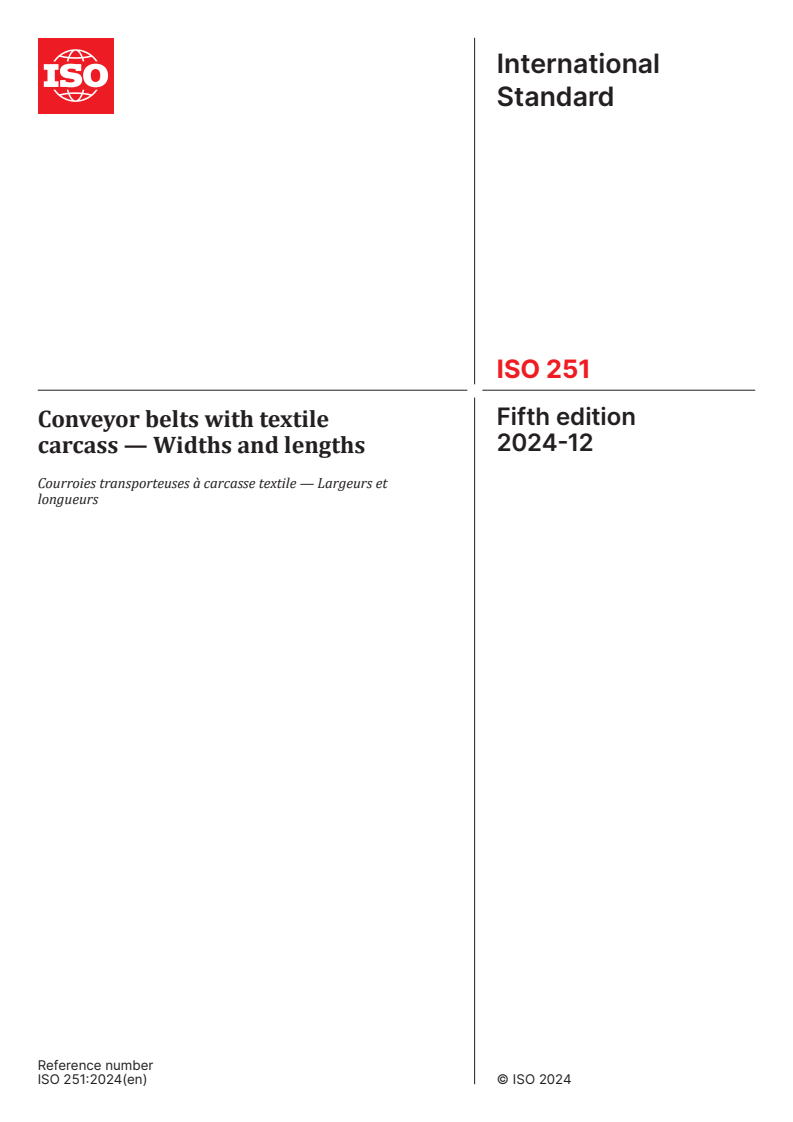
International
Standard
ISO 251
Fifth edition
Conveyor belts with textile
2024-12
carcass — Widths and lengths
Courroies transporteuses à carcasse textile — Largeurs et
longueurs
Reference number
© ISO 2024
All rights reserved. Unless otherwise specified, or required in the context of its implementation, no part of this publication may
be reproduced or utilized otherwise in any form or by any means, electronic or mechanical, including photocopying, or posting on
the internet or an intranet, without prior written permission. Permission can be requested from either ISO at the address below
or ISO’s member body in the country of the requester.
ISO copyright office
CP 401 • Ch. de Blandonnet 8
CH-1214 Vernier, Geneva
Phone: +41 22 749 01 11
Email: copyright@iso.org
Website: www.iso.org
Published in Switzerland
ii
Contents Page
Foreword .iv
1 Scope . 1
2 Normative references . 1
3 Terms and definitions . 1
4 Widths and tolerances . 1
5 Tolerances on lengths . 2
Bibliography . 3
iii
Foreword
ISO (the International Organization for Standardization) is a worldwide federation of national standards
bodies (ISO member bodies). The work of preparing International Standards is normally carried out through
ISO technical committees. Each member body interested in a subject for which a technical committee
has been established has the right to be represented on that committee. International organizations,
governmental and non-governmental, in liaison with ISO, also take part in the work. ISO collaborates closely
with the International Electrotechnical Commission (IEC) on all matters of electrotechnical standardization.
The procedures used to develop this document and those intended for its further maintenance are described
in the ISO/IEC Directives, Part 1. In particular, the different approval criteria needed for the different types
of ISO documents should be noted. This document was drafted in accordance with the editorial rules of the
ISO/IEC Directives, Part 2 (see www.iso.org/directives).
ISO draws attention to the possibility that the implementation of this document may involve the use of (a)
patent(s). ISO takes no position concerning the evidence, validity or ap
...