

ISO 29988-2:2018
(Main)Plastics — Polyoxymethylene (POM) moulding and extrusion materials — Part 2: Preparation of test specimens and determination of properties
General Information
- Abstract
ISO 29988-2:2018 specifies the methods of preparation of test specimens and the test methods to be used in determining the properties of polyoxymethlene (POM) moulding and extrusion materials. Requirements for handling test materials and for conditioning both the test materials before moulding and the specimens before testing are specified. Procedures and conditions for the preparation of test specimens and procedures for measuring properties of the materials from which these specimens are made are given. Properties and test methods which are suitable and necessary to characterize POM moulding and extrusion materials are listed. The properties have been selected from the general test methods. Other test methods in wide use for, or of particular significance to, these moulding and extrusion materials are also included in this document, as are the designatory properties: melt flow rate and tensile modulus. In order to obtain reproducible and comparable test results, it is intended to use the methods of preparation and conditioning, the specimen dimensions and the test procedures specified in this document. Values determined will not necessarily be identical to those obtained using specimens of different dimensions or prepared using different procedures.
- Status
- Published
- Publication Date
- 19-Apr-2018
- Technical Committee
- ISO/TC 61/SC 9 - Thermoplastic materials
- Drafting Committee
- ISO/TC 61/SC 9 - Thermoplastic materials
- Current Stage
- 9093 - International Standard confirmed
- Start Date
- 04-Sep-2023
- Completion Date
- 29-Aug-2026
Buy Documents
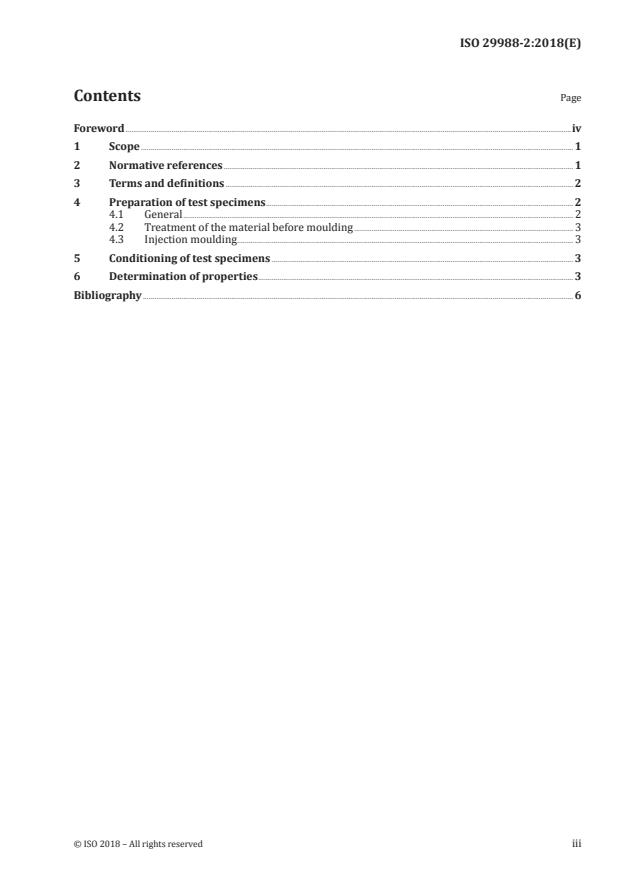
ISO 29988-2:2018 - Plastics -- Polyoxymethylene (POM) moulding and extrusion materials
ISO 29988-2:2018 - Plastics — Polyoxymethylene (POM) moulding and extrusion materials — Part 2: Preparation of test specimens and determination of properties/20/2018
ISO 29988-2:2018 - Plastiques -- Matériaux a base de polyoxyméthylene (POM) pour moulage et extrusion
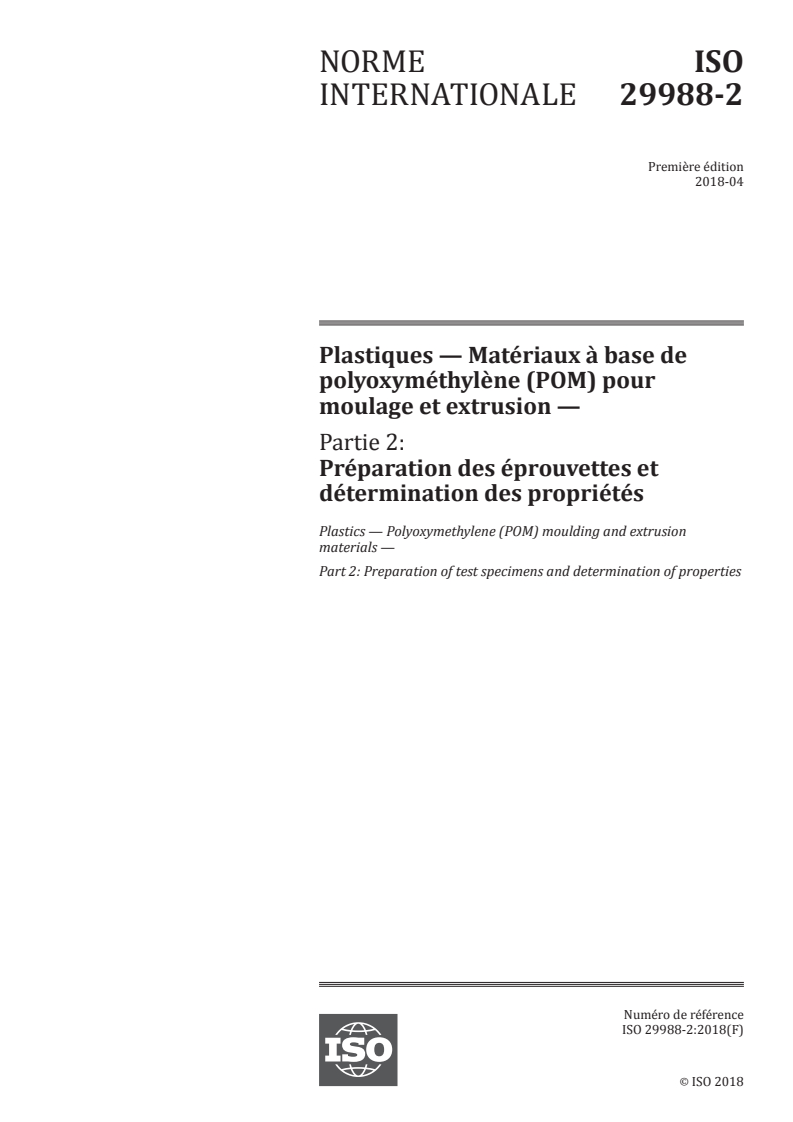
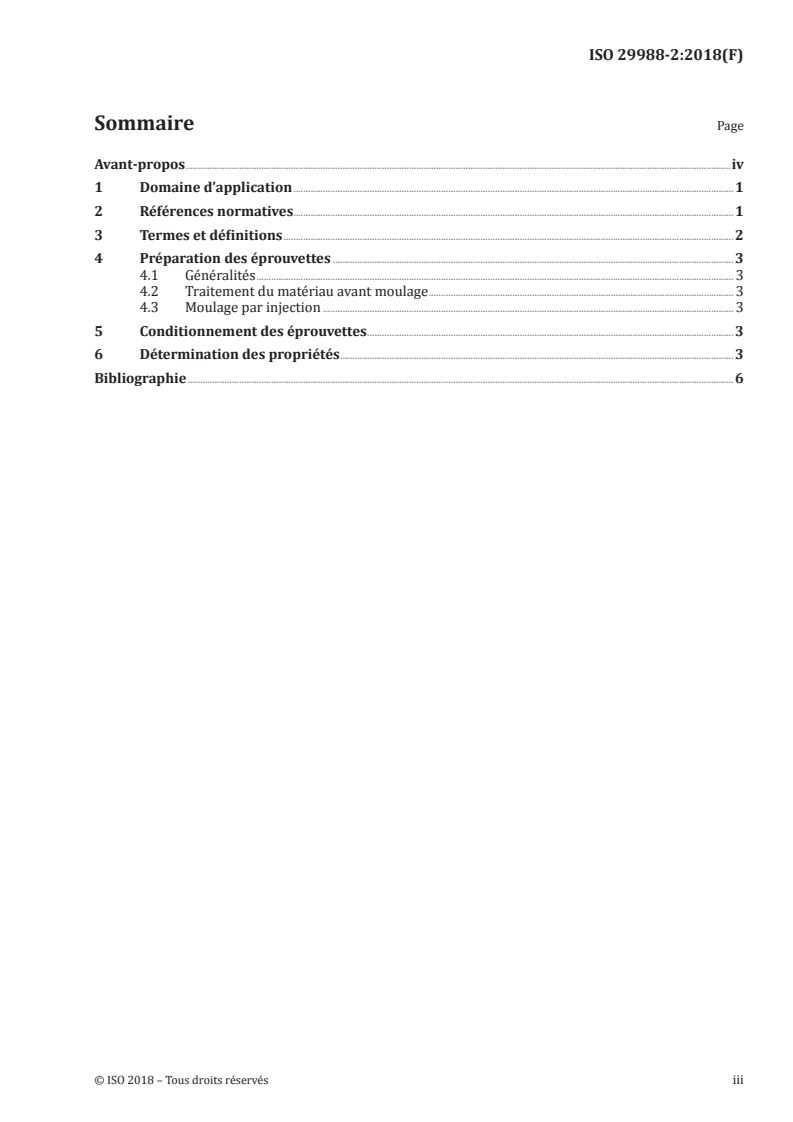
ISO 29988-2:2018 - Plastiques — Matériaux à base de polyoxyméthylène (POM) pour moulage et extrusion — Partie 2: Préparation des éprouvettes et détermination des propriétés/20/2018
Overview
ISO 29988-2:2018 is an international standard published by ISO that focuses on polyoxymethylene (POM) moulding and extrusion materials. It specifies the standardized methods for preparing test specimens and determining the properties of POM materials used in injection moulding and extrusion processes. The standard outlines precise procedures for handling, conditioning, and testing specimens to ensure reproducible and comparable results globally.
This standard is essential for manufacturers, quality control laboratories, and researchers working with POM plastics, as it ensures consistency and reliability in assessing material properties critical for product design and performance evaluation.
Key Topics
Specimen Preparation
Specimens are prepared primarily by injection moulding under controlled conditions, adhering to specific melt temperatures, mould temperatures, and injection velocities depending on the POM type (homopolymer, copolymer, modified grades). Handling protocols include storing materials in moisture-proof containers and optional drying to avoid surface defects caused by moisture.Conditioning
Test specimens must be conditioned as per ISO 291, typically at 23 ± 2°C and 50 ± 10% relative humidity for at least 16 hours, to ensure uniform moisture content and stabilize material properties prior to testing.Property Determination
The standard describes the test methods suitable for a wide range of POM material properties, including:- Mechanical Properties: Tensile modulus, yield stress and strain, flexural modulus, Charpy and Izod impact strength, tensile creep modulus
- Thermal Properties: Melting temperature, temperature of deflection under load, coefficient of linear thermal expansion
- Rheological Properties: Melt mass-flow rate (MFR), melt volume-flow rate (MVR)
- Electrical Properties: Relative permittivity, dissipation factor, resistivity, electric strength, and comparative tracking index
- Other Properties: Water absorption and density
Standardized Test Conditions and Specimen Dimensions
ISO 29988-2 ensures all testing is performed under defined temperatures, humidity, and specimen sizes, maximizing reproducibility and enabling meaningful material comparisons.
Applications
ISO 29988-2:2018 is critical for industries relying on POM plastics including automotive, consumer electronics, medical devices, and industrial machinery. The documented methods ensure:
Quality Control
Manufacturers can validate batch consistency and verify that materials meet required mechanical, thermal, and electrical specifications before product use.Material Development and Research
Researchers use the standard to benchmark new POM formulations, optimize extrusion and moulding processes, and predict performance in end-use applications.Regulatory Compliance
Enables compliance with industry regulations that require documented and repeatable material property testing.Design Engineering
Engineers rely on standardized property data for accurate simulation, design, and material selection to improve product durability and safety.
Related Standards
ISO 29988-2 references and aligns with numerous international standards to cover complementary testing and specimen preparation techniques, including:
- ISO 1133-1 - Determination of melt flow rate (MFR) and melt volume rate (MVR) of thermoplastics
- ISO 527-2 - Tensile properties testing for moulding and extrusion plastics
- ISO 75-2 - Determination of temperature of deflection under load
- ISO 178 - Flexural properties of plastics
- ISO 179-1 / ISO 179-2 - Charpy impact testing
- ISO 62 - Water absorption of plastics
- ISO 1183-1 - Density determination of plastics
- ISO 294 series - Injection moulding of thermoplastic test specimens
- ISO 291 - Conditioning of test specimens for testing
- IEC 60112 / IEC 60250 / IEC 60243 - Electrical property tests pertaining to insulating materials
These complementary standards support the comprehensive evaluation of POM materials and facilitate interoperability across global testing laboratories.
ISO 29988-2:2018 provides a thorough framework for the preparation, conditioning, and testing of POM moulding and extrusion materials. By adopting this standard, stakeholders ensure they achieve reliable and repeatable property measurements crucial to optimizing product performance and maintaining international consistency in plastics testing.
Relations
- Effective Date
- 09-Feb-2026
- Effective Date
- 09-Feb-2026
- Effective Date
- 12-Feb-2026
- Effective Date
- 06-Jun-2022
- Effective Date
- 05-Nov-2015
Buy Documents
ISO 29988-2:2018 - Plastics -- Polyoxymethylene (POM) moulding and extrusion materials
ISO 29988-2:2018 - Plastics — Polyoxymethylene (POM) moulding and extrusion materials — Part 2: Preparation of test specimens and determination of properties/20/2018
ISO 29988-2:2018 - Plastiques -- Matériaux a base de polyoxyméthylene (POM) pour moulage et extrusion
ISO 29988-2:2018 - Plastiques — Matériaux à base de polyoxyméthylène (POM) pour moulage et extrusion — Partie 2: Préparation des éprouvettes et détermination des propriétés/20/2018
Get Certified
Connect with accredited certification bodies for this standard

DIN CERTCO
DIN Group product certification.

Smithers Quality Assessments
US management systems and product certification.
Sponsored listings
Frequently Asked Questions
ISO 29988-2:2018 is a standard published by the International Organization for Standardization (ISO). Its full title is "Plastics — Polyoxymethylene (POM) moulding and extrusion materials — Part 2: Preparation of test specimens and determination of properties". This standard covers: ISO 29988-2:2018 specifies the methods of preparation of test specimens and the test methods to be used in determining the properties of polyoxymethlene (POM) moulding and extrusion materials. Requirements for handling test materials and for conditioning both the test materials before moulding and the specimens before testing are specified. Procedures and conditions for the preparation of test specimens and procedures for measuring properties of the materials from which these specimens are made are given. Properties and test methods which are suitable and necessary to characterize POM moulding and extrusion materials are listed. The properties have been selected from the general test methods. Other test methods in wide use for, or of particular significance to, these moulding and extrusion materials are also included in this document, as are the designatory properties: melt flow rate and tensile modulus. In order to obtain reproducible and comparable test results, it is intended to use the methods of preparation and conditioning, the specimen dimensions and the test procedures specified in this document. Values determined will not necessarily be identical to those obtained using specimens of different dimensions or prepared using different procedures.
ISO 29988-2:2018 specifies the methods of preparation of test specimens and the test methods to be used in determining the properties of polyoxymethlene (POM) moulding and extrusion materials. Requirements for handling test materials and for conditioning both the test materials before moulding and the specimens before testing are specified. Procedures and conditions for the preparation of test specimens and procedures for measuring properties of the materials from which these specimens are made are given. Properties and test methods which are suitable and necessary to characterize POM moulding and extrusion materials are listed. The properties have been selected from the general test methods. Other test methods in wide use for, or of particular significance to, these moulding and extrusion materials are also included in this document, as are the designatory properties: melt flow rate and tensile modulus. In order to obtain reproducible and comparable test results, it is intended to use the methods of preparation and conditioning, the specimen dimensions and the test procedures specified in this document. Values determined will not necessarily be identical to those obtained using specimens of different dimensions or prepared using different procedures.
ISO 29988-2:2018 is classified under the following ICS (International Classification for Standards) categories: 83.080.20 - Thermoplastic materials. The ICS classification helps identify the subject area and facilitates finding related standards.
ISO 29988-2:2018 has the following relationships with other standards: It is inter standard links to EN ISO 29988-1:2019, EN ISO 29988-1:2018, EN ISO 29988-2:2018, ISO 25178-603:2013, ISO 9988-2:2006. Understanding these relationships helps ensure you are using the most current and applicable version of the standard.
ISO 29988-2:2018 is available in PDF format for immediate download after purchase. The document can be added to your cart and obtained through the secure checkout process. Digital delivery ensures instant access to the complete standard document.
Standards Content (Sample)
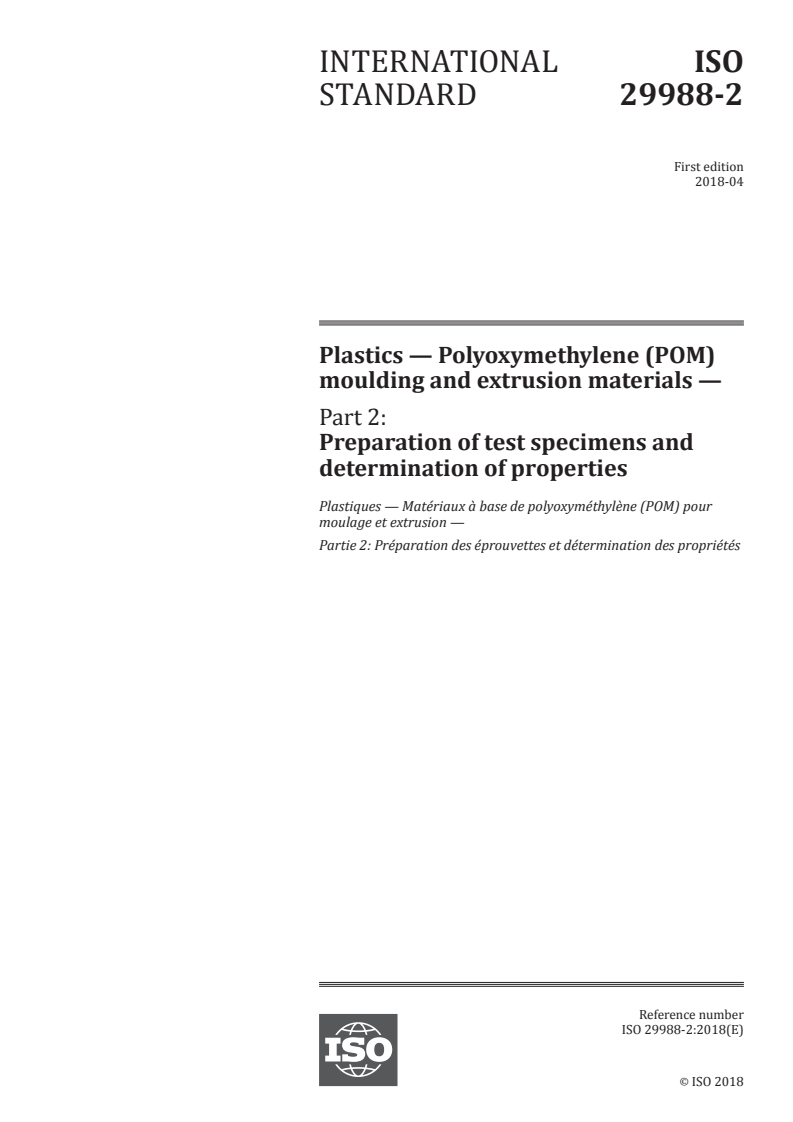
INTERNATIONAL ISO
STANDARD 29988-2
First edition
2018-04
Plastics — Polyoxymethylene (POM)
moulding and extrusion materials —
Part 2:
Preparation of test specimens and
determination of properties
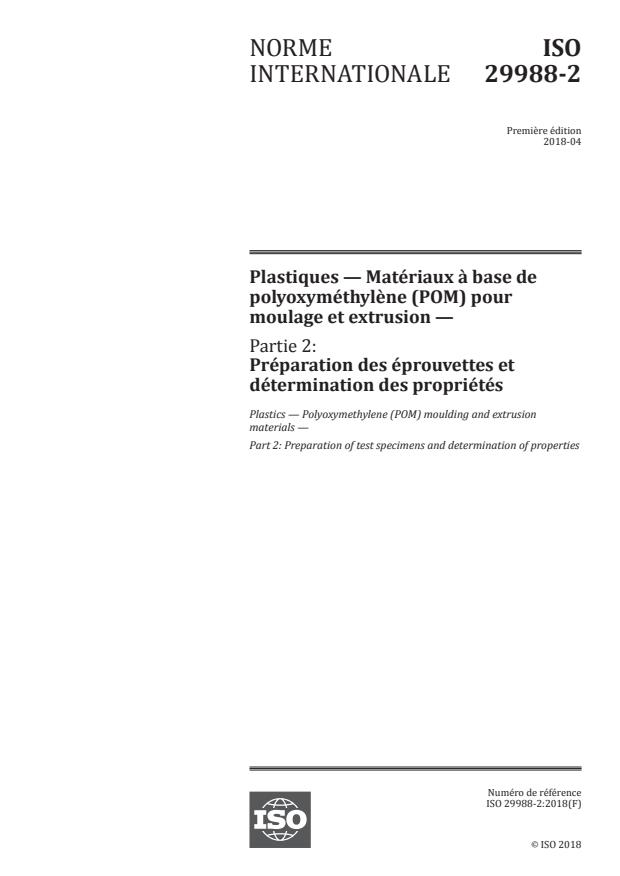
Plastiques — Matériaux à base de polyoxyméthylène (POM) pour
moulage et extrusion —
Partie 2: Préparation des éprouvettes et détermination des propriétés
Reference number
©
ISO 2018
© ISO 2018
All rights reserved. Unless otherwise specified, or required in the context of its implementation, no part of this publication may
be reproduced or utilized otherwise in any form or by any means, electronic or mechanical, including photocopying, or posting
on the internet or an intranet, without prior written permission. Permission can be requested from either ISO at the address
below or ISO’s member body in the country of the requester.
ISO copyright office
CP 401 • Ch. de Blandonnet 8
CH-1214 Vernier, Geneva
Phone: +41 22 749 01 11
Fax: +41 22 749 09 47
Email: copyright@iso.org
Website: www.iso.org
Published in Switzerland
ii © ISO 2018 – All rights reserved
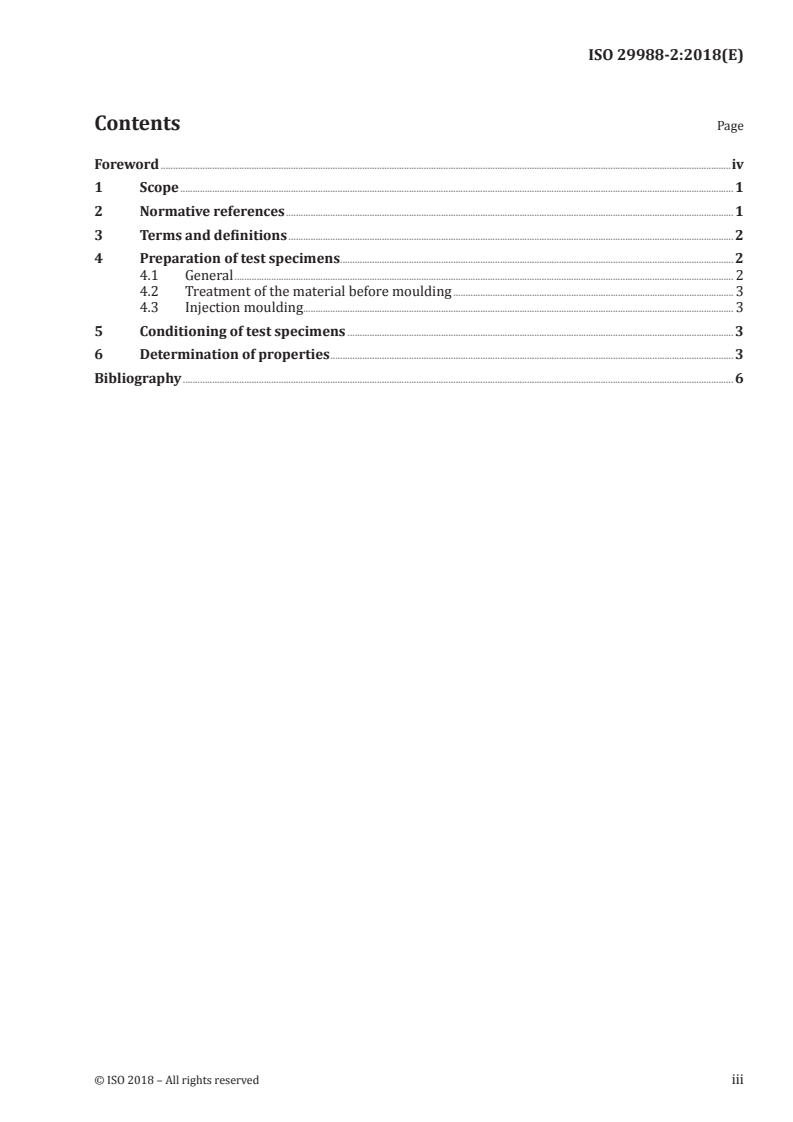
Contents Page
Foreword .iv
1 Scope . 1
2 Normative references . 1
3 Terms and definitions . 2
4 Preparation of test specimens . 2
4.1 General . 2
4.2 Treatment of the material before moulding . 3
4.3 Injection moulding . 3
5 Conditioning of test specimens . 3
6 Determination of properties . 3
Bibliography . 6
Foreword
ISO (the International Organization for Standardization) is a worldwide federation of national standards
bodies (ISO member bodies). The work of preparing International Standards is normally carried out
through ISO technical committees. Each member body interested in a subject for which a technical
committee has been established has the right to be represented on that committee. International
organizations, governmental and non-governmental, in liaison with ISO, also take part in the work.
ISO collaborates closely with the International Electrotechnical Commission (IEC) on all matters of
electrotechnical standardization.
The procedures used to develop this document and those intended for its further maintenance are
described in the ISO/IEC Directives, Part 1. In particular the different approval criteria needed for the
different types of ISO documents should be noted. This document was drafted in accordance with the
editorial rules of the ISO/IEC Directives, Part 2 (see www .iso .org/directives).
Attention is drawn to the possibility that some of the elements of this document may be the subject of
patent rights. ISO shall not be held responsible for identifying any or all such patent rights. Details of
any patent rights identified during the development of the document will be in the Introduction and/or
on the ISO list of patent declarations received (see www .iso .org/patents).
Any trade name used in this document is information given for the convenience of users and does not
constitute an endorsement.
For an explanation on the voluntary nature of standards, the meaning of ISO specific terms and
expressions related to conformity assessment, as well as information about ISO's adherence to the
World Trade Organization (WTO) principles in the Technical Barriers to Trade (TBT) see the following
URL: www .iso .org/iso/foreword .html.
This document was prepared by Technical Committee ISO/TC 61, Plastics, Subcommittee SC 9,
Thermoplastic materials.
This first edition of ISO 29988-2 cancels and replaces ISO 9988-2:2006, which has been technically
revised.
A list of all parts in the ISO 29988 series can be found on the ISO website.
iv © ISO 2018 – All rights reserved
INTERNATIONAL STANDARD ISO 29988-2:2018(E)
Plastics — Polyoxymethylene (POM) moulding and
extrusion materials —
Part 2:
Preparation of test specimens and determination of
properties
1 Scope
This document specifies the methods of preparation of test specimens and the test methods to be used
in determining the properties of polyoxymethlene (POM) moulding and extrusion materials.
Requirements for handling test materials and for conditioning both the test materials before moulding
and the specimens before testing are specified. Procedures and conditions for the preparation of test
specimens and procedures for measuring properties of the materials from which these specimens are
made are given.
Properties and test methods which are suitable and necessary to characterize POM moulding and
extrusion materials are listed. The properties have been selected from the general test methods. Other
test methods in wide use for, or of particular significance to, these moulding and extrusion materials are
also included in this document, as are the designatory properties: melt flow rate and tensile modulus.
In order to obtain reproducible and comparable test results, it is intended to use the methods of
preparation and conditioning, the specimen dimensions and the test procedures specified in this
document. Values determined will not necessarily be identical to those obtained using specimens of
different dimensions or prepared using different procedures.
2 Normative references
The following documents are referred to in the text in such a way that some or all of their content
constitutes requirements of this document. For dated references, only the edition cited applies. For
undated references, the latest edition of the referenced document (including any amendments) applies.
ISO 62, Plastics — Determination of water absorption
ISO 75-2, Plastics — Determination of temperature of deflection under load — Part 2: Plastics and ebonite
ISO 178, Plastics — Determination of flexural properties
ISO 179-1, Plastics — Determination of Charpy impact properties — Part 1: Non-instrumented impact test
ISO 179-2, Plastics — Determination of Charpy impact properties — Part 2: Instrumented impact test
ISO 294-1, Plastics — Injection moulding of test specimens of thermoplastic materials — Part 1: General
principles, and moulding of multipurpose and bar test specimens
ISO 294-3, Plastics — Injection moulding of test specimens of thermoplastic materials — Part 3: Small plates
ISO 294-4, Plastics — Injection moulding of test specimens of thermoplastic materials — Part 4:
Determination of moulding shrinkage
ISO 527-2, Plastics — Determination of tensile properties — Part 2: Test conditions for moulding and
extrusion plastics
ISO 899-1, Plastics — Det
...
INTERNATIONAL ISO
STANDARD 29988-2
First edition
2018-04
Plastics — Polyoxymethylene (POM)
moulding and extrusion materials —
Part 2:
Preparation of test specimens and
determination of properties
Plastiques — Matériaux à base de polyoxyméthylène (POM) pour
moulage et extrusion —
Partie 2: Préparation des éprouvettes et détermination des propriétés
Reference number
©
ISO 2018
© ISO 2018
All rights reserved. Unless otherwise specified, or required in the context of its implementation, no part of this publication may
be reproduced or utilized otherwise in any form or by any means, electronic or mechanical, including photocopying, or posting
on the internet or an intranet, without prior written permission. Permission can be requested from either ISO at the address
below or ISO’s member body in the country of the requester.
ISO copyright office
CP 401 • Ch. de Blandonnet 8
CH-1214 Vernier, Geneva
Phone: +41 22 749 01 11
Fax: +41 22 749 09 47
Email: copyright@iso.org
Website: www.iso.org
Published in Switzerland
ii © ISO 2018 – All rights reserved
Contents Page
Foreword .iv
1 Scope . 1
2 Normative references . 1
3 Terms and definitions . 2
4 Preparation of test specimens . 2
4.1 General . 2
4.2 Treatment of the material before moulding . 3
4.3 Injection moulding . 3
5 Conditioning of test specimens . 3
6 Determination of properties . 3
Bibliography . 6
Foreword
ISO (the International Organization for Standardization) is a worldwide federation of national standards
bodies (ISO member bodies). The work of preparing International Standards is normally carried out
through ISO technical committees. Each member body interested in a subject for which a technical
committee has been established has the right to be represented on that committee. International
organizations, governmental and non-governmental, in liaison with ISO, also take part in the work.
ISO collaborates closely with the International Electrotechnical Commission (IEC) on all matters of
electrotechnical standardization.
The procedures used to develop this document and those intended for its further maintenance are
described in the ISO/IEC Directives, Part 1. In particular the different approval criteria needed for the
different types of ISO documents should be noted. This document was drafted in accordance with the
editorial rules of the ISO/IEC Directives, Part 2 (see www .iso .org/directives).
Attention is drawn to the possibility that some of the elements of this document may be the subject of
patent rights. ISO shall not be held responsible for identifying any or all such patent rights. Details of
any patent rights identified during the development of the document will be in the Introduction and/or
on the ISO list of patent declarations received (see www .iso .org/patents).
Any trade name used in this document is information given for the convenience of users and does not
constitute an endorsement.
For an explanation on the voluntary nature of standards, the meaning of ISO specific terms and
expressions related to conformity assessment, as well as information about ISO's adherence to the
World Trade Organization (WTO) principles in the Technical Barriers to Trade (TBT) see the following
URL: www .iso .org/iso/foreword .html.
This document was prepared by Technical Committee ISO/TC 61, Plastics, Subcommittee SC 9,
Thermoplastic materials.
This first edition of ISO 29988-2 cancels and replaces ISO 9988-2:2006, which has been technically
revised.
A list of all parts in the ISO 29988 series can be found on the ISO website.
iv © ISO 2018 – All rights reserved
INTERNATIONAL STANDARD ISO 29988-2:2018(E)
Plastics — Polyoxymethylene (POM) moulding and
extrusion materials —
Part 2:
Preparation of test specimens and determination of
properties
1 Scope
This document specifies the methods of preparation of test specimens and the test methods to be used
in determining the properties of polyoxymethlene (POM) moulding and extrusion materials.
Requirements for handling test materials and for conditioning both the test materials before moulding
and the specimens before testing are specified. Procedures and conditions for the preparation of test
specimens and procedures for measuring properties of the materials from which these specimens are
made are given.
Properties and test methods which are suitable and necessary to characterize POM moulding and
extrusion materials are listed. The properties have been selected from the general test methods. Other
test methods in wide use for, or of particular significance to, these moulding and extrusion materials are
also included in this document, as are the designatory properties: melt flow rate and tensile modulus.
In order to obtain reproducible and comparable test results, it is intended to use the methods of
preparation and conditioning, the specimen dimensions and the test procedures specified in this
document. Values determined will not necessarily be identical to those obtained using specimens of
different dimensions or prepared using different procedures.
2 Normative references
The following documents are referred to in the text in such a way that some or all of their content
constitutes requirements of this document. For dated references, only the edition cited applies. For
undated references, the latest edition of the referenced document (including any amendments) applies.
ISO 62, Plastics — Determination of water absorption
ISO 75-2, Plastics — Determination of temperature of deflection under load — Part 2: Plastics and ebonite
ISO 178, Plastics — Determination of flexural properties
ISO 179-1, Plastics — Determination of Charpy impact properties — Part 1: Non-instrumented impact test
ISO 179-2, Plastics — Determination of Charpy impact properties — Part 2: Instrumented impact test
ISO 294-1, Plastics — Injection moulding of test specimens of thermoplastic materials — Part 1: General
principles, and moulding of multipurpose and bar test specimens
ISO 294-3, Plastics — Injection moulding of test specimens of thermoplastic materials — Part 3: Small plates
ISO 294-4, Plastics — Injection moulding of test specimens of thermoplastic materials — Part 4:
Determination of moulding shrinkage
ISO 527-2, Plastics — Determination of tensile properties — Part 2: Test conditions for moulding and
extrusion plastics
ISO 899-1, Plastics — Det
...
NORME ISO
INTERNATIONALE 29988-2
Première édition
2018-04
Plastiques — Matériaux à base de
polyoxyméthylène (POM) pour
moulage et extrusion —
Partie 2:
Préparation des éprouvettes et
détermination des propriétés
Plastics — Polyoxymethylene (POM) moulding and extrusion
materials —
Part 2: Preparation of test specimens and determination of properties
Numéro de référence
©
ISO 2018
DOCUMENT PROTÉGÉ PAR COPYRIGHT
© ISO 2018
Tous droits réservés. Sauf prescription différente ou nécessité dans le contexte de sa mise en oeuvre, aucune partie de cette
publication ne peut être reproduite ni utilisée sous quelque forme que ce soit et par aucun procédé, électronique ou mécanique,
y compris la photocopie, ou la diffusion sur l’internet ou sur un intranet, sans autorisation écrite préalable. Une autorisation peut
être demandée à l’ISO à l’adresse ci-après ou au comité membre de l’ISO dans le pays du demandeur.
ISO copyright office
Case postale 401 • Ch. de Blandonnet 8
CH-1214 Vernier, Geneva
Tél.: +41 22 749 01 11
Fax: +41 22 749 09 47
E-mail: copyright@iso.org
Web: www.iso.org
Publié en Suisse
ii © ISO 2018 – Tous droits réservés
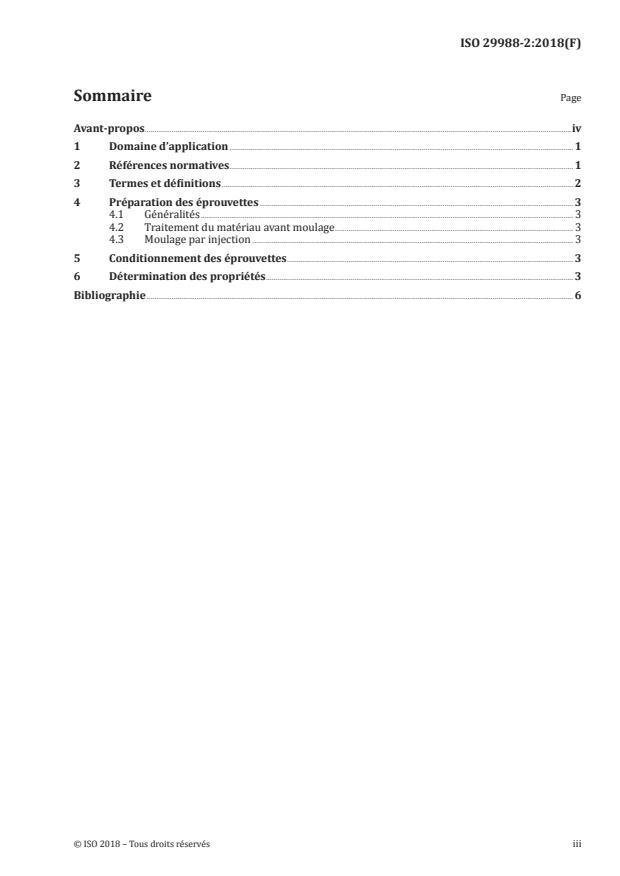
Sommaire Page
Avant-propos .iv
1 Domaine d’application . 1
2 Références normatives . 1
3 Termes et définitions . 2
4 Préparation des éprouvettes . 3
4.1 Généralités . 3
4.2 Traitement du matériau avant moulage . 3
4.3 Moulage par injection . 3
5 Conditionnement des éprouvettes . 3
6 Détermination des propriétés . 3
Bibliographie . 6
Avant-propos
L'ISO (Organisation internationale de normalisation) est une fédération mondiale d'organismes
nationaux de normalisation (comités membres de l'ISO). L'élaboration des Normes internationales est
en général confiée aux comités techniques de l'ISO. Chaque comité membre intéressé par une étude
a le droit de faire partie du comité technique créé à cet effet. Les organisations internationales,
gouvernementales et non gouvernementales, en liaison avec l'ISO participent également aux travaux.
L'ISO collabore étroitement avec la Commission électrotechnique internationale (IEC) en ce qui
concerne la normalisation électrotechnique.
Les procédures utilisées pour élaborer le présent document et celles destinées à sa mise à jour sont
décrites dans les Directives ISO/IEC, Partie 1. Il convient, en particulier de prendre note des différents
critères d'approbation requis pour les différents types de documents ISO. Le présent document a été
rédigé conformément aux règles de rédaction données dans les Directives ISO/IEC, Partie 2 (voir www
.iso .org/directives).
L'attention est attirée sur le fait que certains des éléments du présent document peuvent faire l'objet de
droits de propriété intellectuelle ou de droits analogues. L'ISO ne saurait être tenue pour responsable
de ne pas avoir identifié de tels droits de propriété et averti de leur existence. Les détails concernant
les références aux droits de propriété intellectuelle ou autres droits analogues identifiés lors de
l'élaboration du document sont indiqués dans l'Introduction et/ou dans la liste des déclarations de
brevets reçues par l'ISO (voir www .iso .org/brevets).
Les appellations commerciales éventuellement mentionnées dans le présent document sont données
pour information, par souci de commodité, à l’intention des utilisateurs et ne sauraient constituer un
engagement.
Pour une explication de la nature volontaire des normes, la signification des termes et expressions
spécifiques de l'ISO liés à l'évaluation de la conformité, ou pour toute information au sujet de l'adhésion
de l'ISO aux principes de l’Organisation mondiale du commerce (OMC) concernant les obstacles
techniques au commerce (OTC), voir le lien suivant: www .iso .org/avant -propos.
Ce document a été élaborée par le comité technique ISO/TC 61, Plastiques, Sous-comité SC 9, Matériaux
thermoplastiques.
Cette première édition de l’ISO 29988-2 annule et remplace l’ISO 9988-2:2006, qui a fait l’objet d’une
révision technique pour introduire un nouveau système de désignation.
Une liste de toutes les parties de la série ISO 29988 est disponible sur le site web de l’ISO.
iv © ISO 2018 – Tous droits réservés
NORME INTERNATIONALE ISO 29988-2:2018(F)
Plastiques — Matériaux à base de polyoxyméthylène
(POM) pour moulage et extrusion —
Partie 2:
Préparation des éprouvettes et détermination des
propriétés
1 Domaine d’application
Le présent document spécifie les méthodes de préparation des éprouvettes et les méthodes d’essai qui
doivent être utilisées pour la détermination des propriétés des matériaux pour moulage et extrusion à
base de polyoxyméthylène (POM).
Les exigences relatives à la manipulation des matériaux d’essai et au conditionnement des matériaux
d’essai avant moulage et des éprouvettes avant essai sont spécifiées. Les modes opératoires et les
conditions nécessaires à la préparation des éprouvettes, ainsi que les modes opératoires de mesure des
propriétés des matériaux à partir desquels les éprouvettes sont obtenues sont donnés.
Les propriétés et méthodes d’essai qui sont utiles et nécessaires pour caractériser les matériaux pour
moulage et extrusion à base de POM sont énumérées. Les propriétés ont été sélectionnées parmi les
méthodes d’essai générales. D’autres méthodes d’essai largement en usage ou ayant une signification
particulière pour ces matériaux pour moulage et extrusion sont aussi incluses dans le présent document,
c’est le cas des propriétés de désignation: indice de fluidité à chaud et module en traction.
Dans le but d’obtenir des résultats d’essai reproductibles et comparables, on est censé utiliser les
méthodes de préparation et de conditionnement, les dimensions d’éprouvette ainsi que les modes
opératoires d’essai spécifiés dans le présent document. Les valeurs déterminées ne seront pas
nécessairement identiques à celles obtenues en utilisant des éprouvettes de dimensions différentes ou
préparées selon des modes opératoires différents.
2 Références normatives
Les documents suivants cités dans le texte constituent, pour tout ou partie de leur contenu, des
exigences du présent document. Pour les références datées, seule l’édition citée s’applique. Pour les
références non datées, la dernière édition du document de référence s’applique (y compris les éventuels
amendements).
ISO 62, Plastiques — Détermination de l’absorption d’eau
ISO 75-2, Plastiques — Détermination de la température de fléchissement sous charge — Partie 2:
Plastiques et ébonite
ISO 178, Plastiques — Détermination des propriétés en flexion
ISO 179-1, Plastiques — Détermination des caractéristiques au choc Charpy — Partie 1: Essai de choc non
instrumenté
ISO 179-2, Plastiques — Détermination des caractéristiques au choc Charpy — Partie 2: Essai de choc
instrumenté
ISO 294-1, Plastiques — Moulage par injection des éprouvettes de matériaux thermoplastiques — Partie 1:
Principes généraux, et moulage des éprouvettes à usages multiples et des barreaux
ISO 294-3, Plastiques — Moulage par injection des éprouvettes de matériaux thermoplastiques — Partie 3:
Plaques de petites dimensions
ISO 294-4, Plastiques — Moulage par injection des éprouvettes de matériaux thermoplastiques — Partie 4:
Détermination du retrait au moulage
ISO 527-2, Plastiques — Détermination des propriétés en traction — Partie 2: Conditions d’essai des
plastiques pour moulage et extrusion
ISO 899-1, Plastiques — Détermination du comportement au fluage — Partie 1: Fluage en traction
ISO 1133-1, Plastiques — Détermination de l’indice de fluidité à chaud des thermoplastiques, en masse
(MFR) et en volume
...
NORME ISO
INTERNATIONALE 29988-2
Première édition
2018-04
Plastiques — Matériaux à base de
polyoxyméthylène (POM) pour
moulage et extrusion —
Partie 2:
Préparation des éprouvettes et
détermination des propriétés
Plastics — Polyoxymethylene (POM) moulding and extrusion
materials —
Part 2: Preparation of test specimens and determination of properties
Numéro de référence
©
ISO 2018
DOCUMENT PROTÉGÉ PAR COPYRIGHT
© ISO 2018
Tous droits réservés. Sauf prescription différente ou nécessité dans le contexte de sa mise en oeuvre, aucune partie de cette
publication ne peut être reproduite ni utilisée sous quelque forme que ce soit et par aucun procédé, électronique ou mécanique,
y compris la photocopie, ou la diffusion sur l’internet ou sur un intranet, sans autorisation écrite préalable. Une autorisation peut
être demandée à l’ISO à l’adresse ci-après ou au comité membre de l’ISO dans le pays du demandeur.
ISO copyright office
Case postale 401 • Ch. de Blandonnet 8
CH-1214 Vernier, Geneva
Tél.: +41 22 749 01 11
Fax: +41 22 749 09 47
E-mail: copyright@iso.org
Web: www.iso.org
Publié en Suisse
ii © ISO 2018 – Tous droits réservés
Sommaire Page
Avant-propos .iv
1 Domaine d’application . 1
2 Références normatives . 1
3 Termes et définitions . 2
4 Préparation des éprouvettes . 3
4.1 Généralités . 3
4.2 Traitement du matériau avant moulage . 3
4.3 Moulage par injection . 3
5 Conditionnement des éprouvettes . 3
6 Détermination des propriétés . 3
Bibliographie . 6
Avant-propos
L'ISO (Organisation internationale de normalisation) est une fédération mondiale d'organismes
nationaux de normalisation (comités membres de l'ISO). L'élaboration des Normes internationales est
en général confiée aux comités techniques de l'ISO. Chaque comité membre intéressé par une étude
a le droit de faire partie du comité technique créé à cet effet. Les organisations internationales,
gouvernementales et non gouvernementales, en liaison avec l'ISO participent également aux travaux.
L'ISO collabore étroitement avec la Commission électrotechnique internationale (IEC) en ce qui
concerne la normalisation électrotechnique.
Les procédures utilisées pour élaborer le présent document et celles destinées à sa mise à jour sont
décrites dans les Directives ISO/IEC, Partie 1. Il convient, en particulier de prendre note des différents
critères d'approbation requis pour les différents types de documents ISO. Le présent document a été
rédigé conformément aux règles de rédaction données dans les Directives ISO/IEC, Partie 2 (voir www
.iso .org/directives).
L'attention est attirée sur le fait que certains des éléments du présent document peuvent faire l'objet de
droits de propriété intellectuelle ou de droits analogues. L'ISO ne saurait être tenue pour responsable
de ne pas avoir identifié de tels droits de propriété et averti de leur existence. Les détails concernant
les références aux droits de propriété intellectuelle ou autres droits analogues identifiés lors de
l'élaboration du document sont indiqués dans l'Introduction et/ou dans la liste des déclarations de
brevets reçues par l'ISO (voir www .iso .org/brevets).
Les appellations commerciales éventuellement mentionnées dans le présent document sont données
pour information, par souci de commodité, à l’intention des utilisateurs et ne sauraient constituer un
engagement.
Pour une explication de la nature volontaire des normes, la signification des termes et expressions
spécifiques de l'ISO liés à l'évaluation de la conformité, ou pour toute information au sujet de l'adhésion
de l'ISO aux principes de l’Organisation mondiale du commerce (OMC) concernant les obstacles
techniques au commerce (OTC), voir le lien suivant: www .iso .org/avant -propos.
Ce document a été élaborée par le comité technique ISO/TC 61, Plastiques, Sous-comité SC 9, Matériaux
thermoplastiques.
Cette première édition de l’ISO 29988-2 annule et remplace l’ISO 9988-2:2006, qui a fait l’objet d’une
révision technique pour introduire un nouveau système de désignation.
Une liste de toutes les parties de la série ISO 29988 est disponible sur le site web de l’ISO.
iv © ISO 2018 – Tous droits réservés
NORME INTERNATIONALE ISO 29988-2:2018(F)
Plastiques — Matériaux à base de polyoxyméthylène
(POM) pour moulage et extrusion —
Partie 2:
Préparation des éprouvettes et détermination des
propriétés
1 Domaine d’application
Le présent document spécifie les méthodes de préparation des éprouvettes et les méthodes d’essai qui
doivent être utilisées pour la détermination des propriétés des matériaux pour moulage et extrusion à
base de polyoxyméthylène (POM).
Les exigences relatives à la manipulation des matériaux d’essai et au conditionnement des matériaux
d’essai avant moulage et des éprouvettes avant essai sont spécifiées. Les modes opératoires et les
conditions nécessaires à la préparation des éprouvettes, ainsi que les modes opératoires de mesure des
propriétés des matériaux à partir desquels les éprouvettes sont obtenues sont donnés.
Les propriétés et méthodes d’essai qui sont utiles et nécessaires pour caractériser les matériaux pour
moulage et extrusion à base de POM sont énumérées. Les propriétés ont été sélectionnées parmi les
méthodes d’essai générales. D’autres méthodes d’essai largement en usage ou ayant une signification
particulière pour ces matériaux pour moulage et extrusion sont aussi incluses dans le présent document,
c’est le cas des propriétés de désignation: indice de fluidité à chaud et module en traction.
Dans le but d’obtenir des résultats d’essai reproductibles et comparables, on est censé utiliser les
méthodes de préparation et de conditionnement, les dimensions d’éprouvette ainsi que les modes
opératoires d’essai spécifiés dans le présent document. Les valeurs déterminées ne seront pas
nécessairement identiques à celles obtenues en utilisant des éprouvettes de dimensions différentes ou
préparées selon des modes opératoires différents.
2 Références normatives
Les documents suivants cités dans le texte constituent, pour tout ou partie de leur contenu, des
exigences du présent document. Pour les références datées, seule l’édition citée s’applique. Pour les
références non datées, la dernière édition du document de référence s’applique (y compris les éventuels
amendements).
ISO 62, Plastiques — Détermination de l’absorption d’eau
ISO 75-2, Plastiques — Détermination de la température de fléchissement sous charge — Partie 2:
Plastiques et ébonite
ISO 178, Plastiques — Détermination des propriétés en flexion
ISO 179-1, Plastiques — Détermination des caractéristiques au choc Charpy — Partie 1: Essai de choc non
instrumenté
ISO 179-2, Plastiques — Détermination des caractéristiques au choc Charpy — Partie 2: Essai de choc
instrumenté
ISO 294-1, Plastiques — Moulage par injection des éprouvettes de matériaux thermoplastiques — Partie 1:
Principes généraux, et moulage des éprouvettes à usages multiples et des barreaux
ISO 294-3, Plastiques — Moulage par injection des éprouvettes de matériaux thermoplastiques — Partie 3:
Plaques de petites dimensions
ISO 294-4, Plastiques — Moulage par injection des éprouvettes de matériaux thermoplastiques — Partie 4:
Détermination du retrait au moulage
ISO 527-2, Plastiques — Détermination des propriétés en traction — Partie 2: Conditions d’essai des
plastiques pour moulage et extrusion
ISO 899-1, Plastiques — Détermination du comportement au fluage — Partie 1: Fluage en traction
ISO 1133-1, Plastiques — Détermination de l’indice de fluidité à chaud des thermoplastiques, en masse
(MFR) et en volume
...