


ISO/IEC/IEEE 29119-3:2021
(Main)Software and systems engineering - Software testing - Part 3: Test documentation
Software and systems engineering - Software testing - Part 3: Test documentation
This document specifies software test documentation templates that can be used for any organization, project or testing activity. It describes the test documentation that is an output of the processes specified in ISO/IEC/IEEE 29119-2. This document is applicable to testing in all software development lifecycle models. This document is intended for, but not limited to, testers, test managers, developers, and project managers, particularly those responsible for governing, managing, and implementing software testing.
Ingénierie du logiciel et des systèmes — Essais du logiciel — Partie 3: Documentation des essais
General Information
- Status
- Published
- Publication Date
- 27-Oct-2021
- Technical Committee
- ISO/IEC JTC 1/SC 7 - Software and systems engineering
- Drafting Committee
- ISO/IEC JTC 1/SC 7/WG 26 - Software testing
- Current Stage
- 6060 - International Standard published
- Start Date
- 28-Oct-2021
- Due Date
- 19-Apr-2022
- Completion Date
- 28-Oct-2021
Relations
- Effective Date
- 23-Apr-2020
Overview
ISO/IEC/IEEE 29119-3:2021, "Software and systems engineering - Software testing - Part 3: Test documentation," defines a comprehensive set of test documentation templates and common information elements that can be applied across any organization, project, or testing activity. The standard describes the test-document outputs aligned with the processes in ISO/IEC/IEEE 29119-2 and is applicable to testing in all software development lifecycle models. It is intended for testers, test managers, developers, project managers, and those responsible for governing and implementing software testing.
Key Topics
- Common information elements: unique identifiers, issuing organization, approval authority, change history, status, scope, references, and glossary to standardize document metadata.
- Organizational test process documentation: test policy, objectives, organizational structure, tester training and ethics, standards, metrics, test asset archiving, and test process improvement.
- Test management documentation: templates and content for test plans, test status reports, and test completion reports, including test strategy, risk register, staffing, schedule, measures, deviations, residual risks, deliverables, and lessons learned.
- Dynamic test processes: specifications for test models, test case specifications, test procedure specifications, and test data requirements, with emphasis on traceability, priorities, objectives, and ordered procedures.
- Conformance and tailoring: guidance on full and tailored conformance options and intended usage to enable consistent adoption across different organizational contexts.
- Traceability and metrics: requirements for linking test assets to requirements and for reporting test measures and progress.
Applications
ISO/IEC/IEEE 29119-3 is used to:
- Create consistent, reusable test documentation templates (test plans, cases, procedures, status and completion reports).
- Improve traceability between requirements, tests, and defects to support quality assurance and audits.
- Implement risk-based testing through risk registers and prioritized test artifacts.
- Facilitate test asset management, archiving, and reuse to reduce duplication and speed up future projects.
- Standardize reporting for stakeholders (project managers, QA leads, customers) using agreed test status and completion templates.
- Support compliance, governance, and process improvement initiatives across Agile, DevOps, V-model, waterfall, and hybrid SDLCs.
Who Should Use It
- Testers and test engineers
- Test managers and QA leads
- Project managers and development leads
- Quality assurance auditors and compliance officers
- Organizations seeking standardized test documentation and repeatable testing practices
Related Standards (if applicable)
- ISO/IEC/IEEE 29119-2 - Test processes (directly referenced by Part 3)
- ISO/IEC/IEEE 29119-1 - Concepts and vocabulary (series overview)
- ISO/IEC/IEEE 29119-4 - Test techniques
Adopting ISO/IEC/IEEE 29119-3 ensures consistent, auditable test documentation that integrates with broader testing processes and supports measurable quality outcomes.
Frequently Asked Questions
ISO/IEC/IEEE 29119-3:2021 is a standard published by the International Organization for Standardization (ISO). Its full title is "Software and systems engineering - Software testing - Part 3: Test documentation". This standard covers: This document specifies software test documentation templates that can be used for any organization, project or testing activity. It describes the test documentation that is an output of the processes specified in ISO/IEC/IEEE 29119-2. This document is applicable to testing in all software development lifecycle models. This document is intended for, but not limited to, testers, test managers, developers, and project managers, particularly those responsible for governing, managing, and implementing software testing.
This document specifies software test documentation templates that can be used for any organization, project or testing activity. It describes the test documentation that is an output of the processes specified in ISO/IEC/IEEE 29119-2. This document is applicable to testing in all software development lifecycle models. This document is intended for, but not limited to, testers, test managers, developers, and project managers, particularly those responsible for governing, managing, and implementing software testing.
ISO/IEC/IEEE 29119-3:2021 is classified under the following ICS (International Classification for Standards) categories: 35.080 - Software. The ICS classification helps identify the subject area and facilitates finding related standards.
ISO/IEC/IEEE 29119-3:2021 has the following relationships with other standards: It is inter standard links to ISO/IEC/IEEE 29119-3:2013. Understanding these relationships helps ensure you are using the most current and applicable version of the standard.
You can purchase ISO/IEC/IEEE 29119-3:2021 directly from iTeh Standards. The document is available in PDF format and is delivered instantly after payment. Add the standard to your cart and complete the secure checkout process. iTeh Standards is an authorized distributor of ISO standards.
Standards Content (Sample)
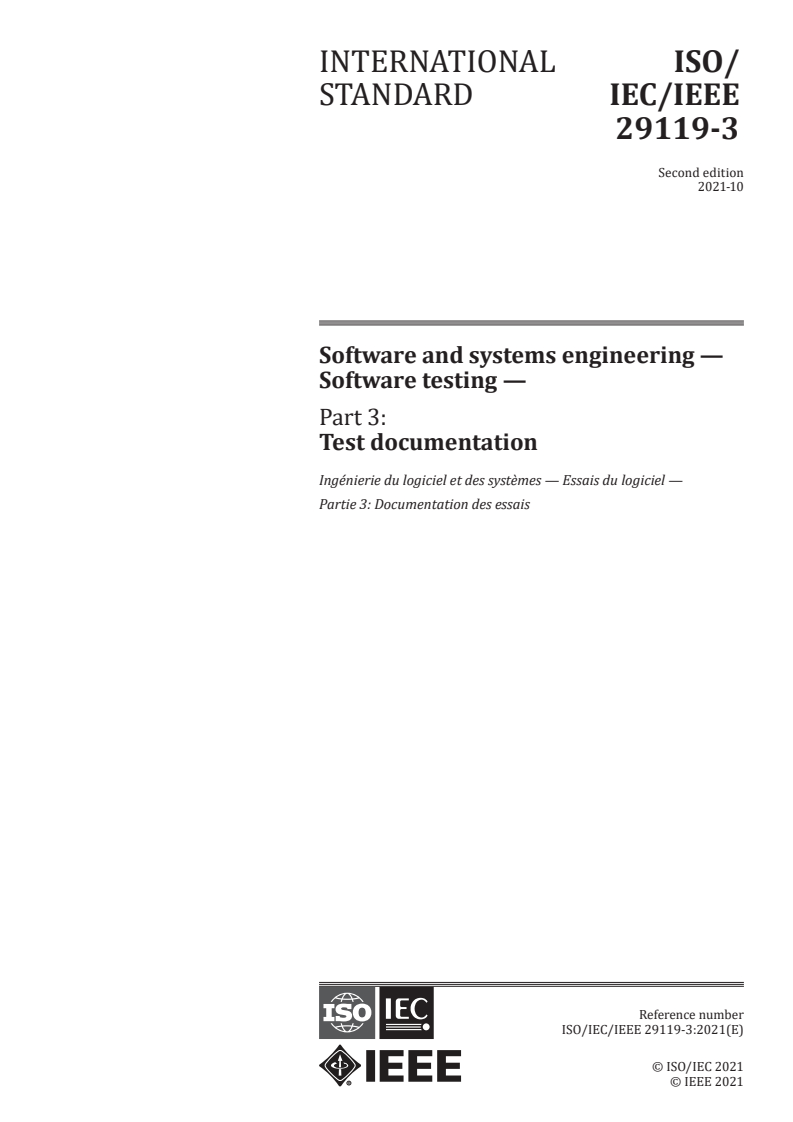
INTERNATIONAL ISO/
STANDARD IEC/IEEE
29119-3
Second edition
2021-10
Software and systems engineering —
Software testing —
Part 3:
Test documentation
Ingénierie du logiciel et des systèmes — Essais du logiciel —
Partie 3: Documentation des essais
Reference number
© ISO/IEC 2021
© IEEE 2021
© ISO/IEC 2021
© IEEE 2021
All rights reserved. Unless otherwise specified, or required in the context of its implementation, no part of this publication may
be reproduced or utilized otherwise in any form or by any means, electronic or mechanical, including photocopying, or posting
on the internet or an intranet, without prior written permission. Permission can be requested from either ISO or IEEE at the
respective address below or ISO’s member body in the country of the requester.
ISO copyright office Institute of Electrical and Electronics Engineers, Inc
CP 401 • Ch. de Blandonnet 8 3 Park Avenue, New York
CH-1214 Vernier, Geneva NY 10016-5997, USA
Phone: +41 22 749 01 11
Fax: +41 22 749 09 47
Email: copyright@iso.org Email: stds.ipr@ieee.org
Website: www.iso.org Website: www.ieee.org
Published in Switzerland
ii
© ISO/IEC 2021 – All rights reserved
© IEEE 2021 – All rights reserved
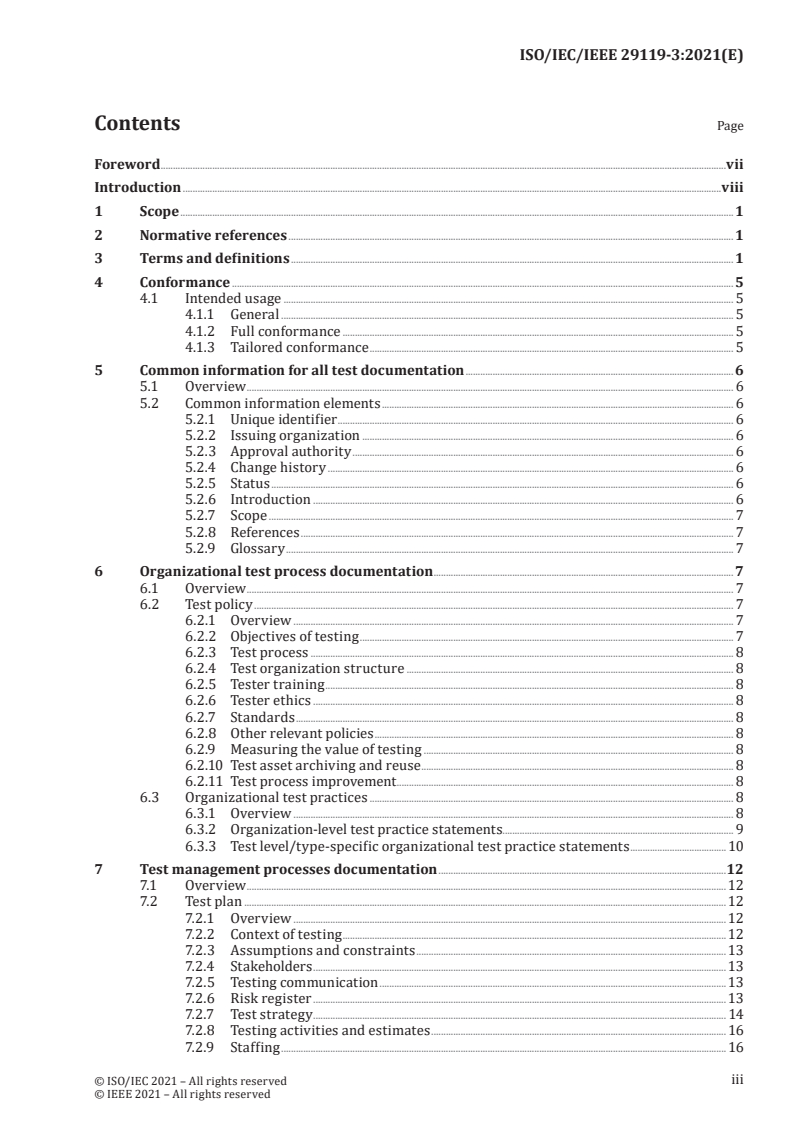
Contents Page
Foreword .vii
Introduction .viii
1 Scope . 1
2 Normative references . 1
3 Terms and definitions . 1
4 Conformance . 5
4.1 Intended usage . 5
4.1.1 General . 5
4.1.2 Full conformance . 5
4.1.3 Tailored conformance . 5
5 Common information for all test documentation . 6
5.1 Overview . 6
5.2 Common information elements . 6
5.2.1 Unique identifier . 6
5.2.2 Issuing organization . 6
5.2.3 Approval authority . 6
5.2.4 Change history . 6
5.2.5 Status . 6
5.2.6 Introduction . 6
5.2.7 Scope . 7
5.2.8 References . 7
5.2.9 Glossary . 7
6 Organizational test process documentation . 7
6.1 Overview . 7
6.2 Test policy . 7
6.2.1 Overview . 7
6.2.2 Objectives of testing . 7
6.2.3 Test process . 8
6.2.4 Test organization structure . 8
6.2.5 Tester training . 8
6.2.6 Tester ethics . 8
6.2.7 Standards . 8
6.2.8 Other relevant policies . 8
6.2.9 Measuring the value of testing . 8
6.2.10 Test asset archiving and reuse . 8
6.2.11 Test process improvement . 8
6.3 Organizational test practices . 8
6.3.1 Overview . 8
6.3.2 Organization-level test practice statements. 9
6.3.3 Test level/type-specific organizational test practice statements . 10
7 Test management processes documentation .12
7.1 Overview .12
7.2 Test plan . 12
7.2.1 Overview .12
7.2.2 Context of testing .12
7.2.3 Assumptions and constraints . 13
7.2.4 Stakeholders . 13
7.2.5 Testing communication .13
7.2.6 Risk register . 13
7.2.7 Test strategy . 14
7.2.8 Testing activities and estimates . 16
7.2.9 Staffing . 16
iii
© ISO/IEC 2021 – All rights reserved
© IEEE 2021 – All rights reserved
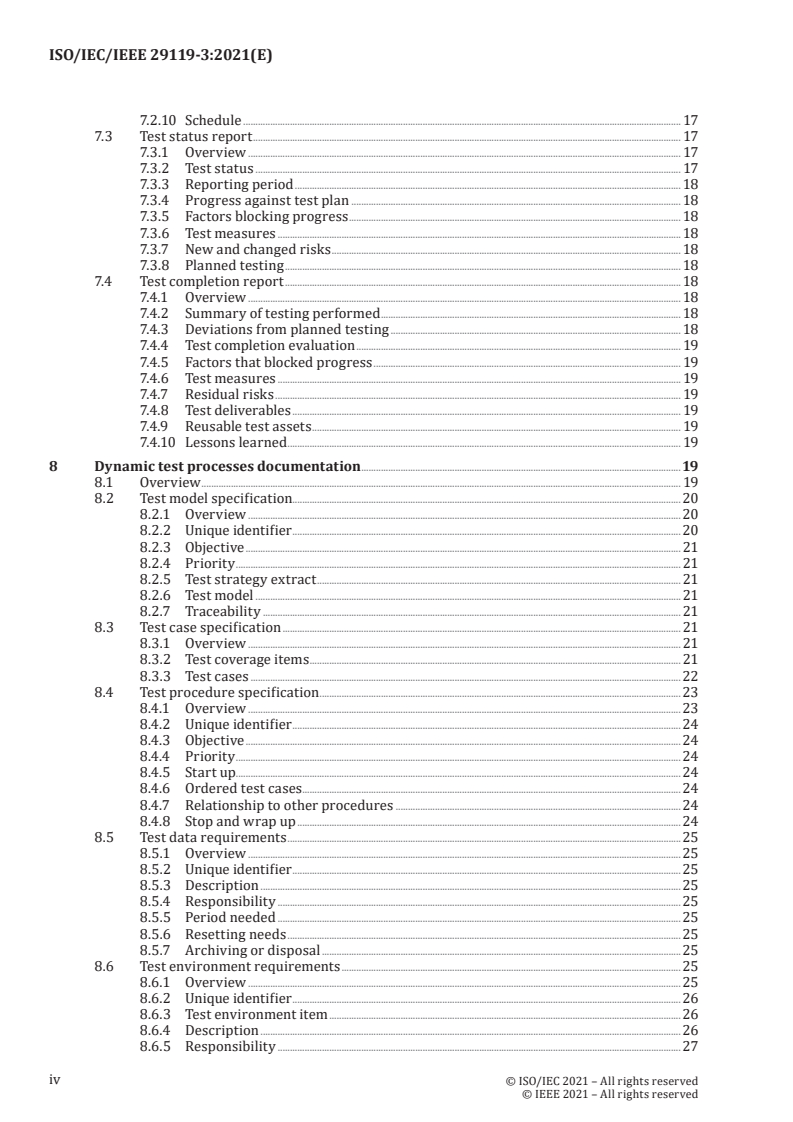
7.2.10 Schedule . 17
7.3 Test status report . 17
7.3.1 Overview . 17
7.3.2 Test status . 17
7.3.3 Reporting period . 18
7.3.4 Progress against test plan . 18
7.3.5 Factors blocking progress . 18
7.3.6 Test measures . 18
7.3.7 New and changed risks . 18
7.3.8 Planned testing . 18
7.4 Test completion report . 18
7.4.1 Overview . 18
7.4.2 Summary of testing performed . 18
7.4.3 Deviations from planned testing . 18
7.4.4 Test completion evaluation . 19
7.4.5 Factors that blocked progress . 19
7.4.6 Test measures . 19
7.4.7 Residual risks . 19
7.4.8 Test deliverables . 19
7.4.9 Reusable test assets . 19
7.4.10 Lessons learned . 19
8 Dynamic test processes documentation .19
8.1 Overview . 19
8.2 Test model specification. 20
8.2.1 Overview . 20
8.2.2 Unique identifier . 20
8.2.3 Objective . 21
8.2.4 Priority . 21
8.2.5 Test strategy extract . 21
8.2.6 Test model . 21
8.2.7 Traceability . 21
8.3 Test case specification . 21
8.3.1 Overview . 21
8.3.2 Test coverage items . 21
8.3.3 Test cases . 22
8.4 Test procedure specification . 23
8.4.1 Overview . 23
8.4.2 Unique identifier . 24
8.4.3 Objective . 24
8.4.4 Priority . 24
8.4.5 Start up. 24
8.4.6 Ordered test cases . . 24
8.4.7 Relationship to other procedures . 24
8.4.8 Stop and wrap up . 24
8.5 Test data requirements .25
8.5.1 Overview . 25
8.5.2 Unique identifier . 25
8.5.3 Description . 25
8.5.4 Responsibility . 25
8.5.5 Period needed . 25
8.5.6 Resetting needs . 25
8.5.7 Archiving or disposal .25
8.6 Test environment requirements . 25
8.6.1 Overview . 25
8.6.2 Unique identifier . 26
8.6.3 Test environment item . 26
8.6.4 Description . 26
8.6.5 Responsibility . 27
iv
© ISO/IEC 2021 – All rights reserved
© IEEE 2021 – All rights reserved
8.6.6 Period needed . 27
8.7 Test data readiness report . 27
8.7.1 Overview . 27
8.7.2 Unique identifier . 27
8.7.3 Description of status . 27
8.8 Test environment readiness report . 27
8.8.1 Overview . 27
8.8.2 Unique identifier . 27
8.8.3 Description of status . 27
8.9 Actual results and test result .28
8.9.1 General .28
8.9.2 Actual results .28
8.9.3 Test result .28
8.10 Test execution log . .28
8.10.1 Overview .28
8.10.2 Unique identifier .29
8.10.3 Date/time .29
8.10.4 Description .29
8.10.5 Impact .29
8.11 Test incident report .29
8.11.1 Overview .29
8.11.2 Timing information .30
8.11.3 Originator . 30
8.11.4 Context .30
8.11.5 Description of the incident . 30
8.11.6 Originator’s assessment of severity .30
8.11.7 Originator’s assessment of priority .30
8.11.8 Risk . 31
8.11.9 Status of the incident . 31
Annex A (normative) ISO/IEC/IEEE 29119-3 requirements, recommendations and
permissions .32
Annex B (informative) Overview of examples .37
Annex C (informative) Test policy .39
Annex D (informative) Organizational test practices .41
Annex E (informative) Test plan .46
Annex F (informative) Test status report .54
Annex G (informative) Test completion report .58
Annex H (informative) Test model specification .60
Annex I (informative) Test case specification .62
Annex J (informative) Test procedure specification .64
Annex K (informative) Test data requirements.66
Annex L (informative) Test environment requirements .67
Annex M (informative) Test data readiness report .68
Annex N (informative) Test environment readiness report .69
Annex O (informative) Actual results .70
Annex P (informative) Test result .71
Annex Q (informative) Test execution log .73
Annex R (informative) Incident report .74
Annex S (informative) Mappings to IEEE 829:2008 (superseded) .76
v
© ISO/IEC 2021 – All rights reserved
© IEEE 2021 – All rights reserved
Annex T (informative) Test models .82
Bibliography .83
IEEE Notices and Abstract.85
vi
© ISO/IEC 2021 – All rights reserved
© IEEE 2021 – All rights reserved
Foreword
ISO (the International Organization for Standardization) and IEC (the International Electrotechnical
Commission) form the specialized system for worldwide standardization. National bodies that are
members of ISO or IEC participate in the development of International Standards through technical
committees established by the respective organization to deal with particular fields of technical
activity. ISO and IEC technical committees collaborate in fields of mutual interest. Other international
organizations, governmental and non-governmental, in liaison with ISO and IEC, also take part in the
work.
The procedures used to develop this document and those intended for its further maintenance are
described in the ISO/IEC Directives, Part 1. In particular, the different approval criteria needed
for the different types of ISO/IEC documents should be noted. This document was drafted in
accordance with the rules given in the ISO/IEC Directives, Part 2 (see www.iso.org/directives or
www.iec.ch/members_experts/refdocs).
IEEE Standards documents are developed within the IEEE Societies and the Standards Coordinating
Committees of the IEEE Standards Association (IEEE-SA) Standards Board. The IEEE develops its
standards through a consensus development process, approved by the American National Standards
Institute, which brings together volunteers representing varied viewpoints and interests to achieve the
final product. Volunteers are not necessarily members of the Institute and serve without compensation.
While the IEEE administers the process and establishes rules to promote fairness in the consensus
development process, the IEEE does not independently evaluate, test, or verify the accuracy of any of
the information contained in its standards.
Attention is drawn to the possibility that some of the elements of this document may be the subject
of patent rights. ISO and IEC shall not be held responsible for identifying any or all such patent
rights. Details of any patent rights identified during the development of the document will be in the
Introduction and/or on the ISO list of patent declarations received (see www.iso.org/patents) or the IEC
list of patent declarations received (see https://patents.iec.ch).
Any trade name used in this document is information given for the convenience of users and does not
constitute an endorsement.
For an explanation of the voluntary nature of standards, the meaning of ISO specific terms and
expressions related to conformity assessment, as well as information about ISO's adherence to
the World Trade Organization (WTO) principles in the Technical Barriers to Trade (TBT), see
www.iso.org/iso/foreword.html. In the IEC, see www.iec.ch/understanding-standards.
ISO/IEC/IEEE 29119-3 was prepared by Joint Technical Committee ISO/IEC JTC 1, Information
technology, Subcommittee SC 7, Software and systems engineering, in cooperation with the Systems and
Software Engineering Standards Committee of the IEEE Computer Society, under the Partner Standards
Development Organization cooperation agreement between ISO and IEEE.
This second edition cancels and replaces the first edition (ISO/IEC/IEEE 29119-3:2013), which has been
technically revised.
The main changes compared to the previous edition are as follows:
— the concept of test conditions has been replaced by test models, as feedback on the previous edition
of this document highlighted a problem with users’ understanding of ‘test conditions’ and their use
for deriving test cases.
A list of all parts in the ISO/IEC/IEEE 29119 series can be found on the ISO and IEC websites.
Any feedback or questions on this document should be directed to the user’s national standards
body. A complete listing of these bodies can be found at www.iso.org/members.html and
www.iec.ch/national-committees.
vii
© ISO/IEC 2021 – All rights reserved
© IEEE 2021 – All rights reserved
Introduction
The purpose of ISO/IEC/IEEE 29119 (all parts) is to define an internationally-agreed set of standards for
software testing that can be used by any organization when performing any form of software testing.
ISO/IEC/IEEE 29119-1 introduces software testing concepts. This document uses the concepts of ISO/
IEC/IEEE 29119-1.
ISO/IEC/IEEE 29119-2 comprises test process descriptions that define the software testing processes
at the organisational level, test management level and dynamic test levels. It supports dynamic testing,
functional and non-functional testing, manual and automated testing and scripted and unscripted
testing, and can be utilized within any lifecycle model, including agile and traditional methodologies.
Supporting diagrams describing the processes are also provided.
ISO/IEC/IEEE 29119-4 defines software test design techniques, which can be used within any lifecycle
and for any product.
ISO/IEC/IEEE 29119-5 addresses the use of keyword-driven testing.
This document defines templates and provides examples of test documentation that are produced
during the test process. An overview of the test documentation is provided in Figure 1. The templates
are arranged within clauses reflecting the overall test process description structure in ISO/IEC/
IEEE 29119-2, i.e. by the test process in which they are being produced. Annex A contains a list of all the
information items identified in Clauses 6, 7 and 8 with the corresponding level of conformance (shall/
should/may) from ISO/IEC/IEEE 29119-2. Annex B contains an overview of the examples. Annexes C
to R contain examples of the application of the templates. Annex S provides mappings to existing
standards. Annex T explains why the concept of test conditions has been replaced by test models in this
document. A Bibliography is provided at the end of the document.
viii
© ISO/IEC 2021 – All rights reserved
© IEEE 2021 – All rights reserved
Figure 1 — Overview of test documentation
The test documentation described in this document can be on paper or in electronic form (e.g. records
in test tools, spreadsheets, mind maps, white board photos).
The nomenclature of test documentation within this document (e.g. document names, section headings)
and the contents of each document can be tailored to suit the unique needs of an organization, under
the tailoring clause (see Clause 4).
This document uses the traditional concept of organizations and projects, but some organizations,
especially those using an agile approach, do not organize their development in terms of projects; instead
they run product development based on more long-lasting product teams. Users of this document can
substitute the term ‘product’ for ‘project’, where appropriate.
ISO/IEC/IEEE 29119 (all parts) aims to provide stakeholders with the ability to manage and perform
software testing in any organization. This document can be adopted under any lifecycle methodology
including traditional (e.g. waterfall, iterative), agile or DevOps.
ix
© ISO/IEC 2021 – All rights reserved
© IEEE 2021 – All rights reserved
INTERNATIONAL STANDARD ISO/IEC/IEEE 29119-3:2021(E)
Software and systems engineering — Software testing —
Part 3:
Test documentation
1 Scope
This document specifies software test documentation templates that can be used for any organization,
project or testing activity. It describes the test documentation that is an output of the processes
specified in ISO/IEC/IEEE 29119-2.
This document is applicable to testing in all software development lifecycle models. This document is
intended for, but not limited to, testers, test managers, developers, and project managers, particularly
those responsible for governing, managing, and implementing software testing.
2 Normative references
There are no normative references in this document.
3 Terms and definitions
For the purposes of this document, the following terms and definitions apply.
ISO, IEC and IEEE maintain terminology databases for use in standardization at the following addresses:
— ISO Online browsing platform: available at https:// www .iso .org/ obp
— IEC Electropedia: available at https:// www .electropedia .org/
— IEEE Standards Dictionary Online: available at https:// ieeexplore .ieee .org/ xpls/ dictionary .jsp
NOTE For additional terms and definitions in the field of systems and software engineering, see ISO/IEC/
IEEE 24765, which is published periodically as a “snapshot” of the SEVOCAB (Systems and software Engineering
Vocabulary) database and is publicly accessible at https:// www .computer .org/ sevocab.
3.1
actual results
set of behaviours or conditions of a test item, or set of conditions of associated data or the test
environment, observed as a result of test execution
EXAMPLE Output to screen, outputs to hardware, changes to data, reports, and communication messages
sent.
3.2
expected results
observable predicted behaviour of the test item under specified conditions based on its specification or
another source
3.3
incident
anomalous or unexpected event, set of events, condition, or situation at any time during the life cycle of
a project, product, service, or system
© ISO/IEC 2021 – All rights reserved
© IEEE 2021 – All rights reserved
3.4
incident report
documentation of the occurrence, nature, and status of an incident (3.3)
Note 1 to entry: Incident reports are also known as anomaly reports, bug reports, defect reports, error reports,
issues, problem reports and trouble reports, amongst other terms.
3.5
organizational test practices
documentation that expresses the recommended approaches or methods for the testing to be performed
within an organization, providing detail on how the testing is to be performed
Note 1 to entry: The organizational test practices is aligned with the test policy (3.20).
Note 2 to entry: An organization can have more than one organizational test practices document to cover
markedly different contexts, such one for mobile apps and one for safety-critical systems.
Note 3 to entry: The organizational test practices can incorporate the context of the test policy where no separate
test policy is available.
3.6
organizational test specification
documentation that provides information about testing for an organization, i.e. information that is not
project specific
EXAMPLE The most common examples of organizational test specifications are the test policy (3.20) and
organizational test practices (3.5).
3.7
test basis
information used as the basis for designing and implementing test cases
Note 1 to entry: The test basis can take the form of documentation, such as a requirements specification, design
specification, or module specification, but can also be an undocumented understanding of the required behaviour.
3.8
test case specification
documentation of a set of one or more test cases
3.9
test completion report
test summary report
report that provides a summary of the testing that was performed
3.10
test data readiness report
documentation describing the status of each test data requirement
3.11
test environment item
element of a test environment that can be considered separately from other parts of the test environment
EXAMPLE Hardware, software, interfaces, peripherals, tools.
3.12
test environment readiness report
documentation that describes the status of each test environment requirement
Note 1 to entry: This can list the status of each of the test environment requirements (3.13).
© ISO/IEC 2021 – All rights reserved
© IEEE 2021 – All rights reserved
3.13
test environment requirements
documentation of the necessary properties of the test environment
Note 1 to entry: All or parts of the test environment requirements can reference where the information can be
found, e.g. in the appropriate organizational test practices (3.5) document, test plan (3.19) and/or test specification
(3.23).
3.14
test execution log
record of the execution of one or more test procedures
3.15
test incident
event occurring during the execution of a test that requires investigation
3.16
test model
representation of the test item, which allows the testing to
...
Questions, Comments and Discussion
Ask us and Technical Secretary will try to provide an answer. You can facilitate discussion about the standard in here.
Loading comments...