

ISO 3216:1997
(Main)Oil of cassia, Chinese type (Cinnamomum aromaticum Nees, syn. Cinnamomum cassia Nees ex Blume)
General Information
- Abstract
- Status
- Published
- Publication Date
- 04-Jun-1997
- Technical Committee
- ISO/TC 54 - Essential oils
- Drafting Committee
- ISO/TC 54 - Essential oils
- Current Stage
- 9093 - International Standard confirmed
- Start Date
- 17-Jul-2023
- Completion Date
- 29-Aug-2026
Buy Documents
ISO 3216:1997 - Oil of cassia, Chinese type (Cinnamomum aromaticum Nees, syn. Cinnamomum cassia Nees ex Blume)
ISO 3216:1997 - Oil of cassia, Chinese type (Cinnamomum aromaticum Nees, syn. Cinnamomum cassia Nees ex Blume)/5/1997
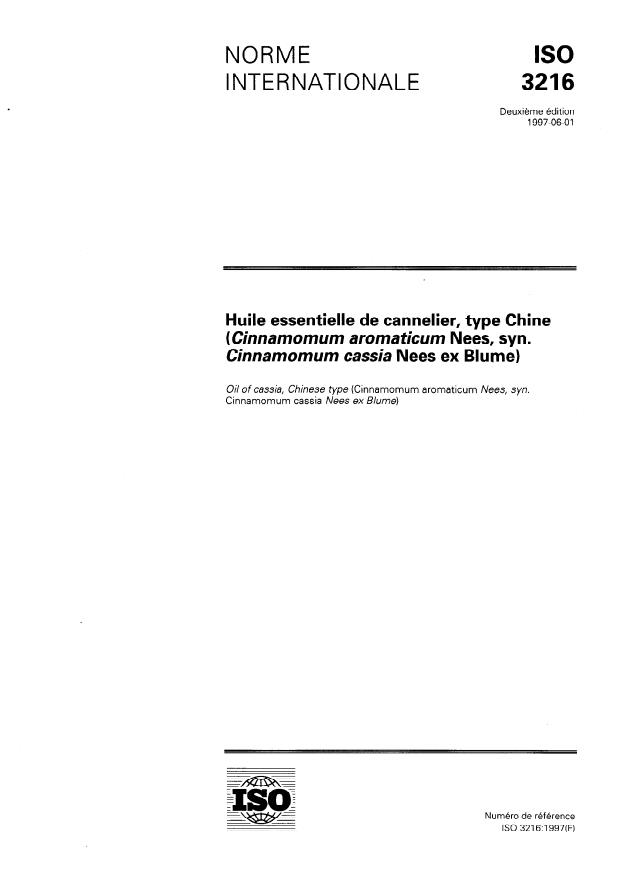
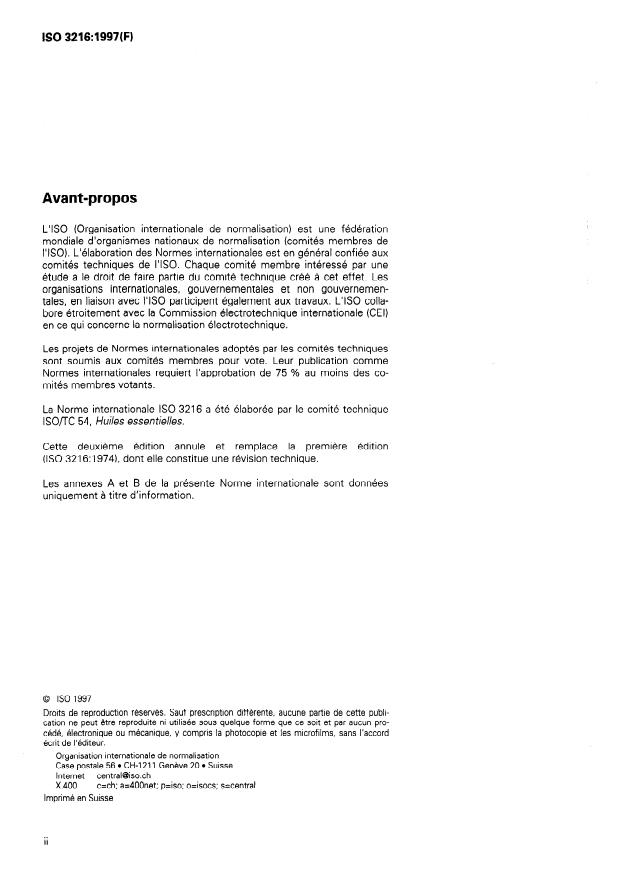
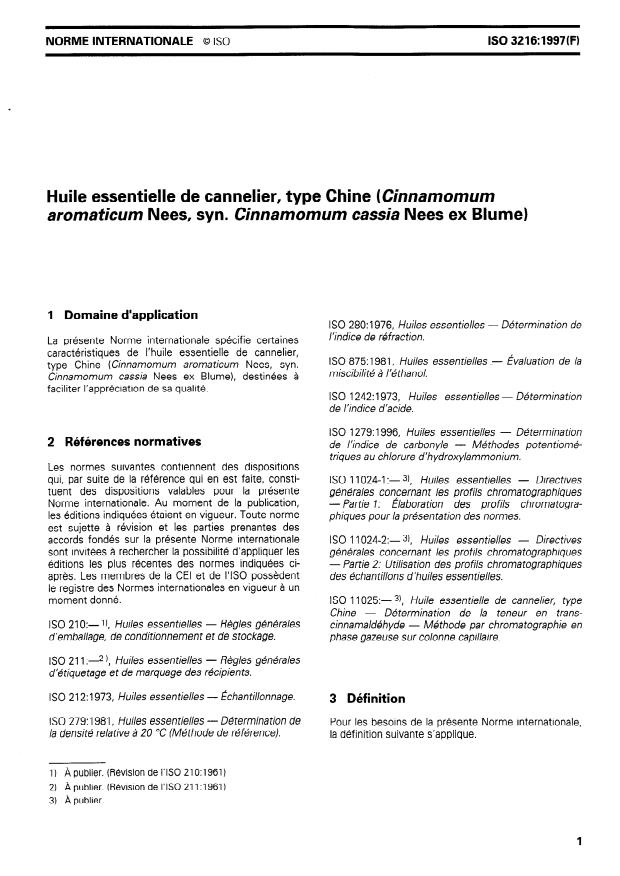
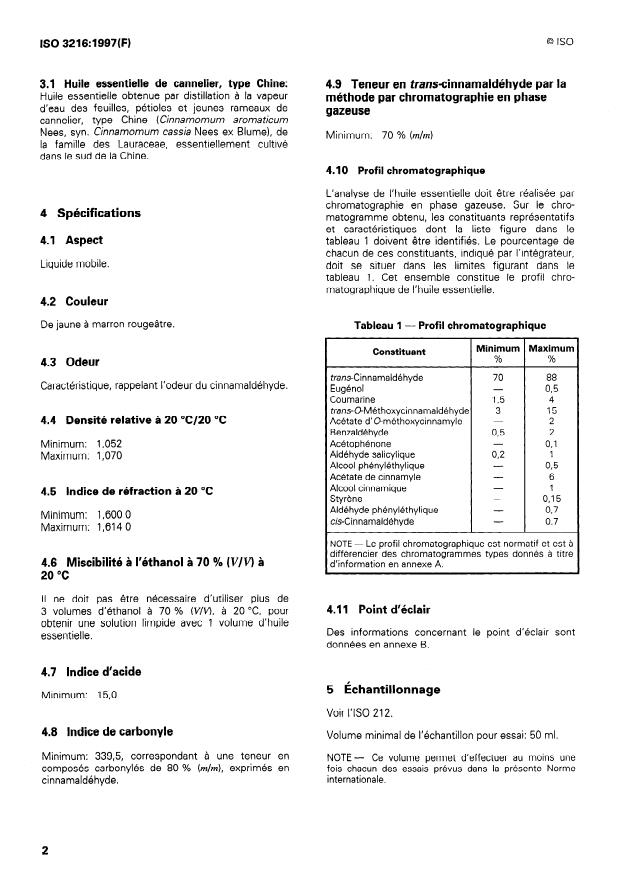
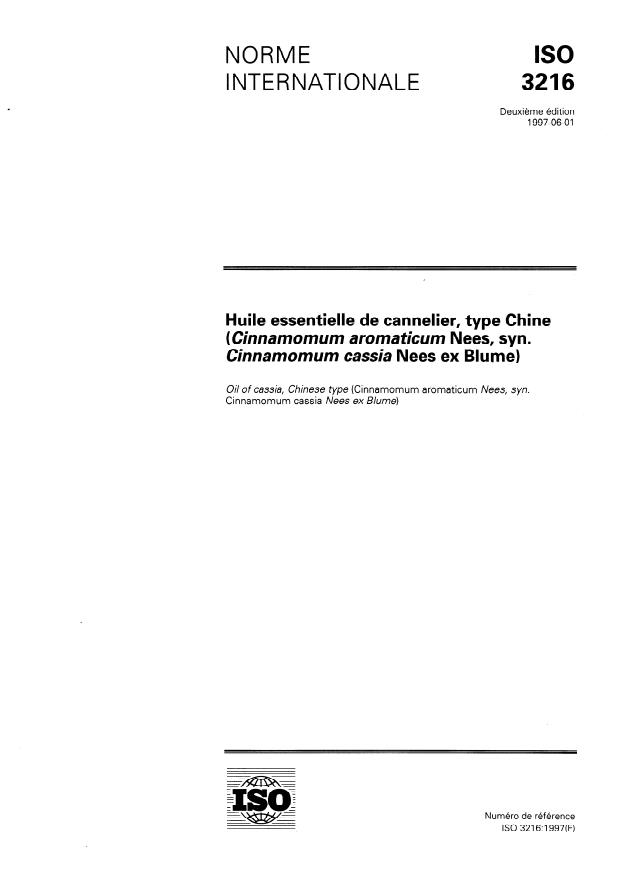
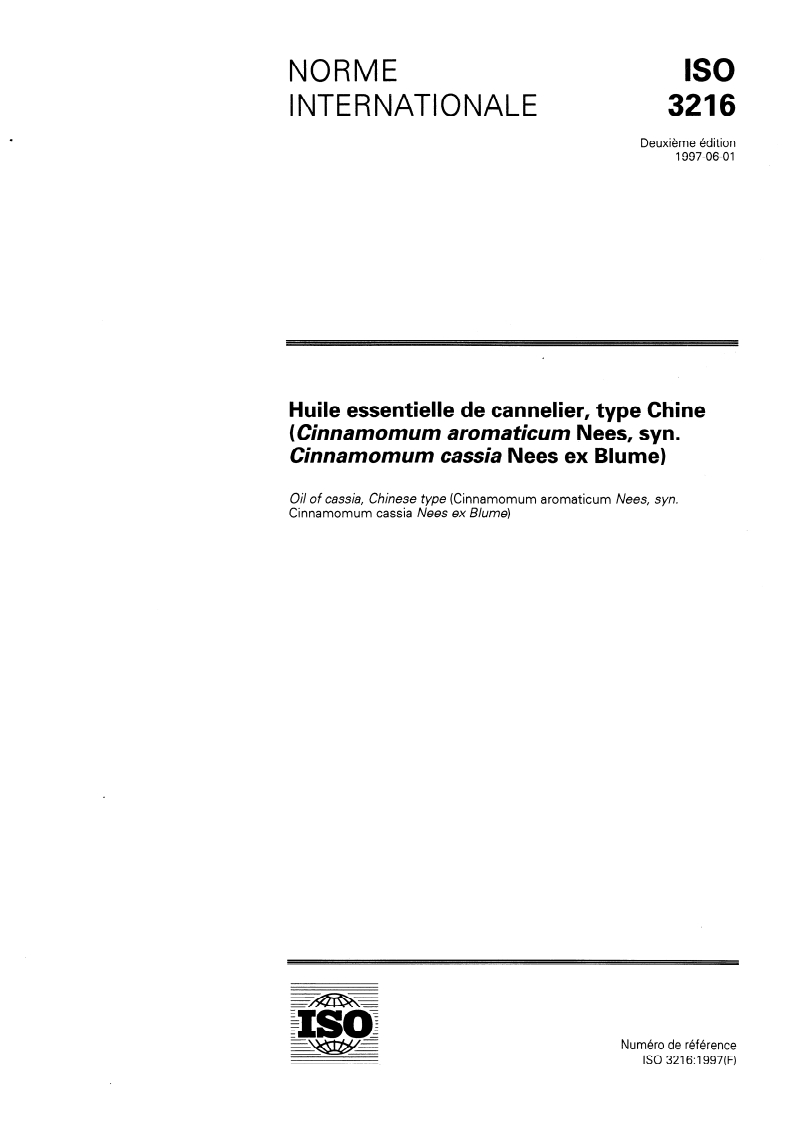
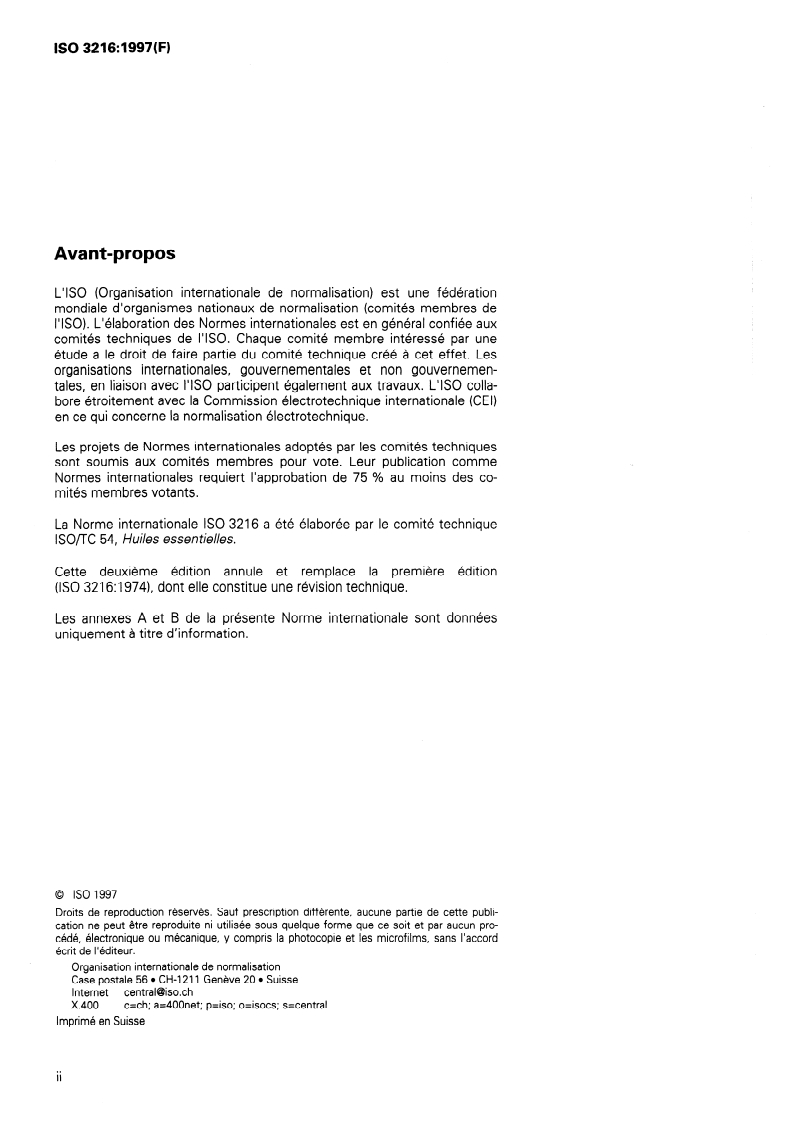
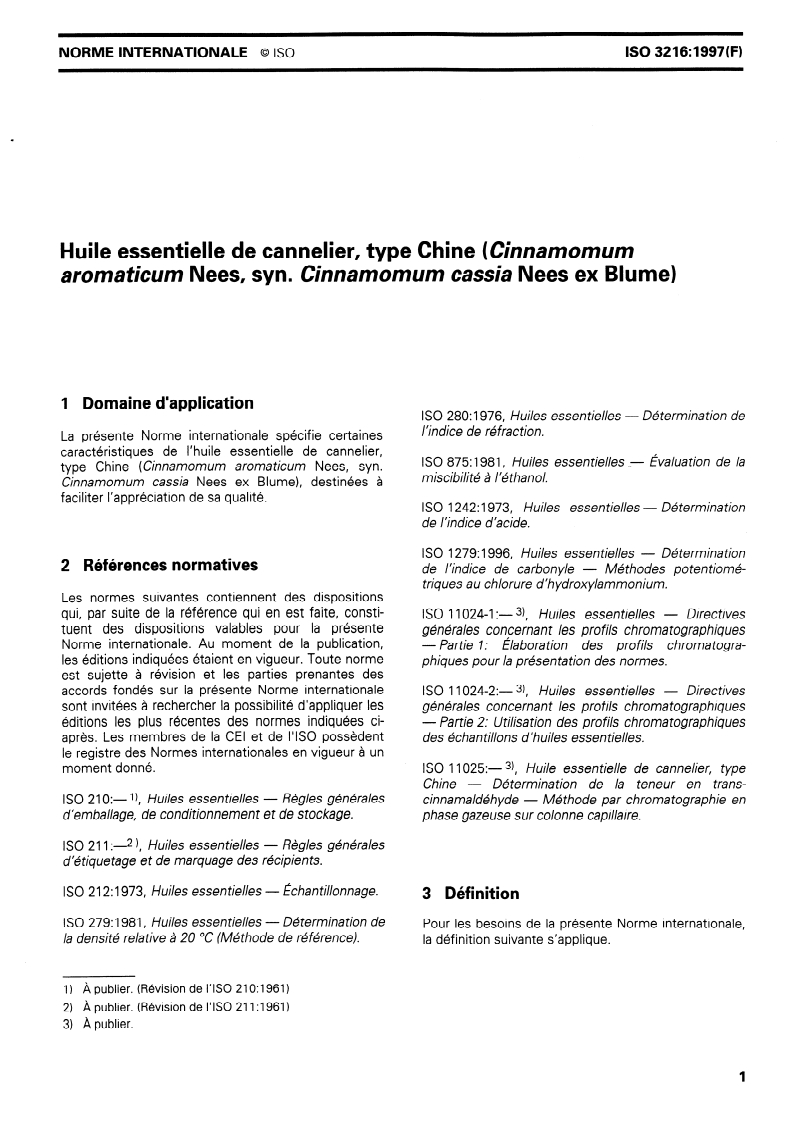
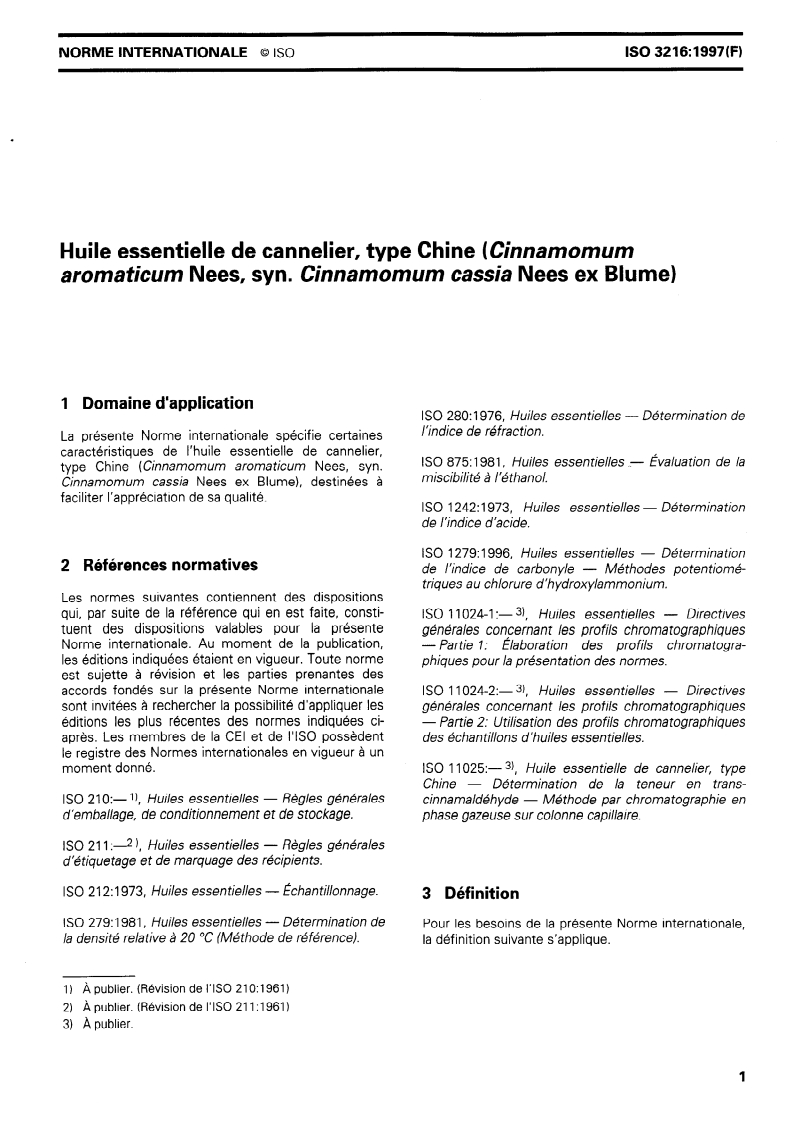
ISO 3216:1997 - Huile essentielle de cannelier type Chine (Cinnamomum aromaticum Nees, syn. Cinnamomum cassia Nees ex Blume)
ISO 3216:1997 - Huile essentielle de cannelier type Chine (Cinnamomum aromaticum Nees, syn. Cinnamomum cassia Nees ex Blume)
ISO 3216:1997 - Huile essentielle de cannelier type Chine (Cinnamomum aromaticum Nees, syn. Cinnamomum cassia Nees ex Blume)/5/1997
ISO 3216:1997 - Huile essentielle de cannelier type Chine (Cinnamomum aromaticum Nees, syn. Cinnamomum cassia Nees ex Blume)/5/1997
Overview
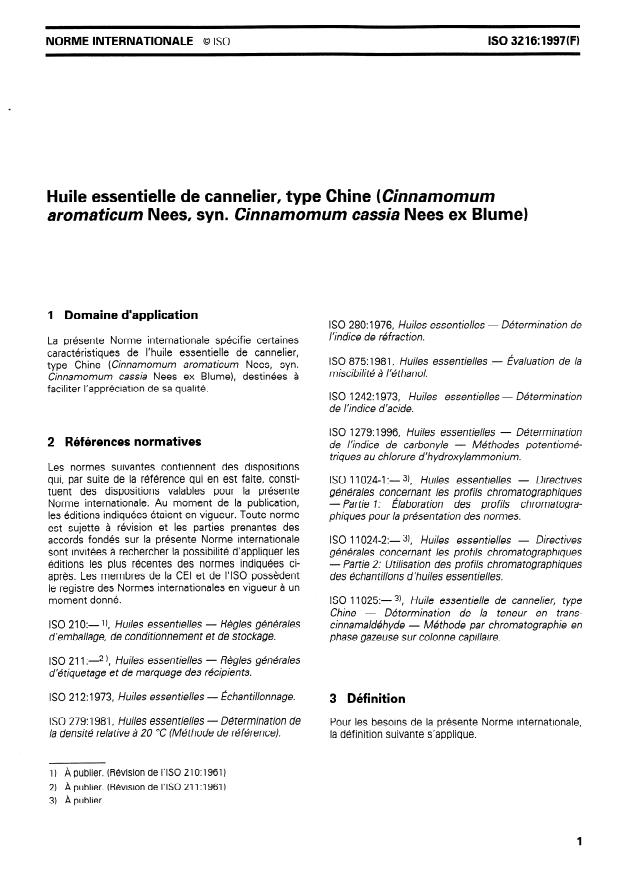
ISO 3216:1997 is an international standard established by the International Organization for Standardization (ISO) that specifies the quality characteristics and testing methods for Oil of Cassia, Chinese type (Cinnamomum aromaticum Nees, syn. Cinnamomum cassia Nees ex Blume). This essential oil is obtained by steam distillation from the leaves, petioles, and young twigs of the cassia tree, predominantly cultivated in southern China.
This second edition of the standard, published in June 1997, updates the technical requirements of the first edition from 1974. ISO 3216:1997 aims to facilitate the appraisal and quality assessment of this essential oil through well-defined analytical specifications, testing procedures, and packaging guidelines.
Key Topics
Definition and Scope
The standard defines Chinese type cassia essential oil, focusing on its production, chemical profile, and identification parameters.Physical and Chemical Specifications
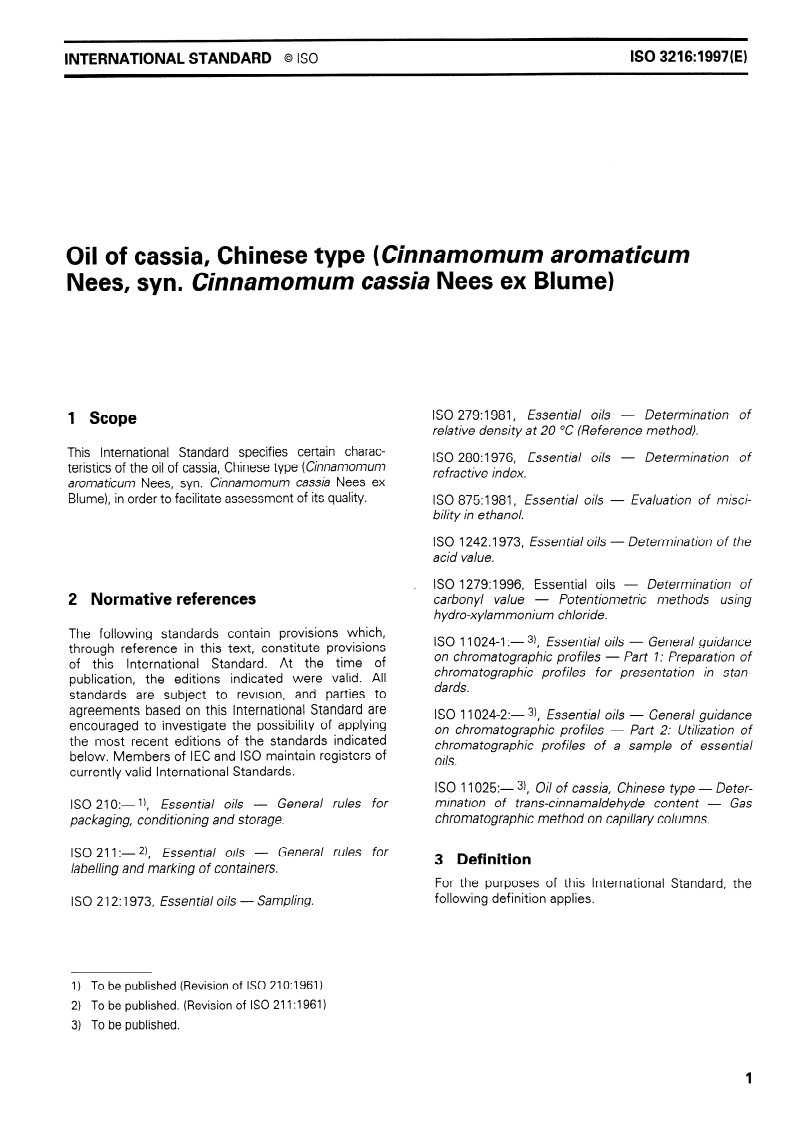
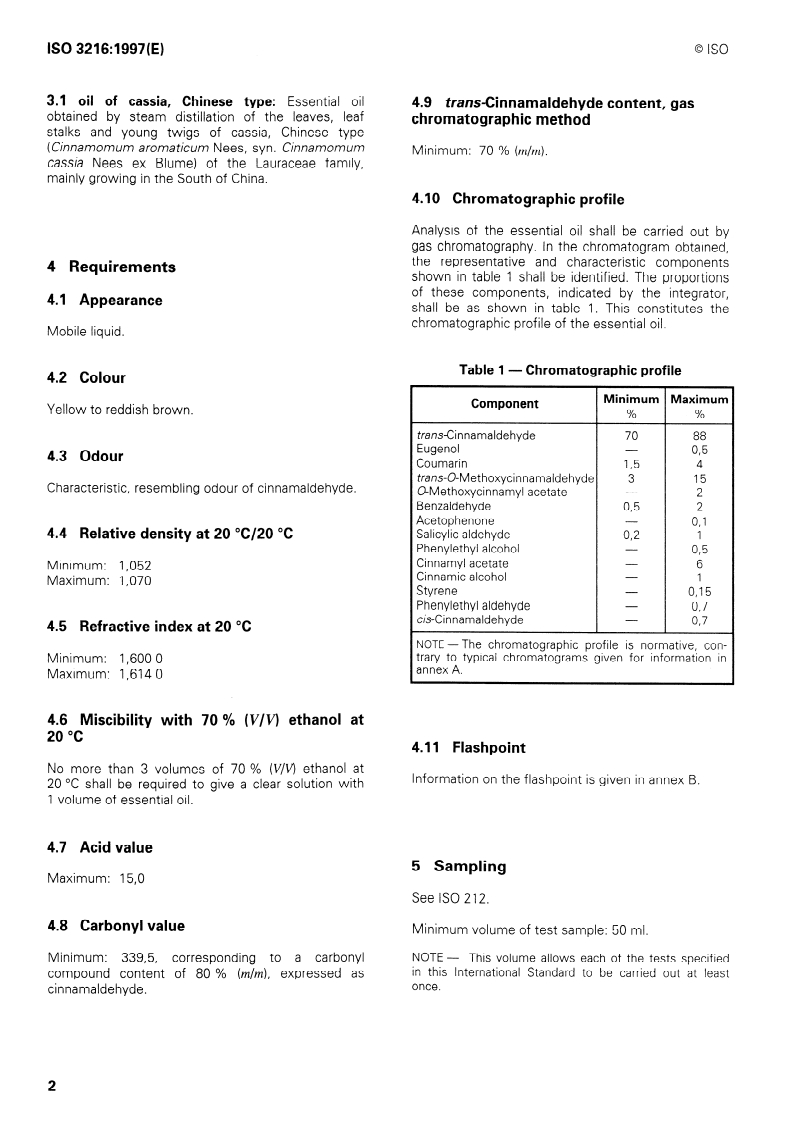
- Appearance: Mobile liquid with color ranging from yellow to reddish-brown
- Odor: Characteristic, reminiscent of cinnamaldehyde
- Density at 20 °C: Minimum 1.052, Maximum 1.070
- Refractive index at 20 °C: Minimum 1.600, Maximum 1.614
- Miscibility with 70% ethanol (v/v) at 20 °C: Clear solution with no more than three volumes of ethanol per volume of oil
- Acid value: Minimum 15.0
- Carbonyl index: Minimum 339.5, expressed as cinnamaldehyde equivalents
- Flash point: Informative average around 88–90 °C, depending on test methods
Chromatographic Profile (Gas Chromatography)
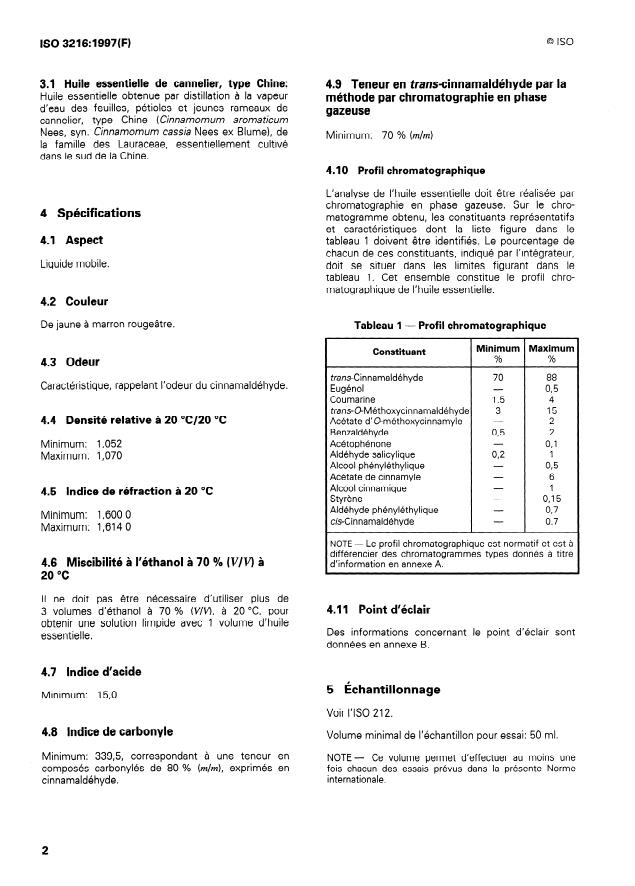
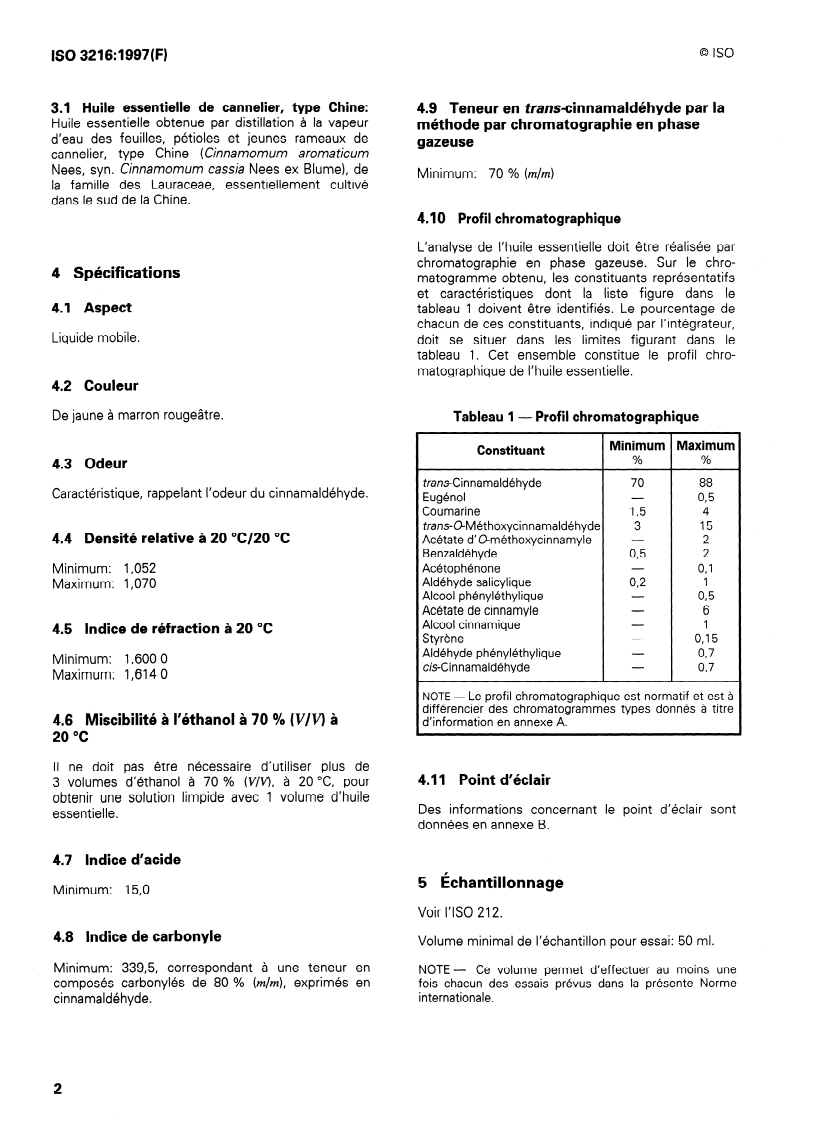
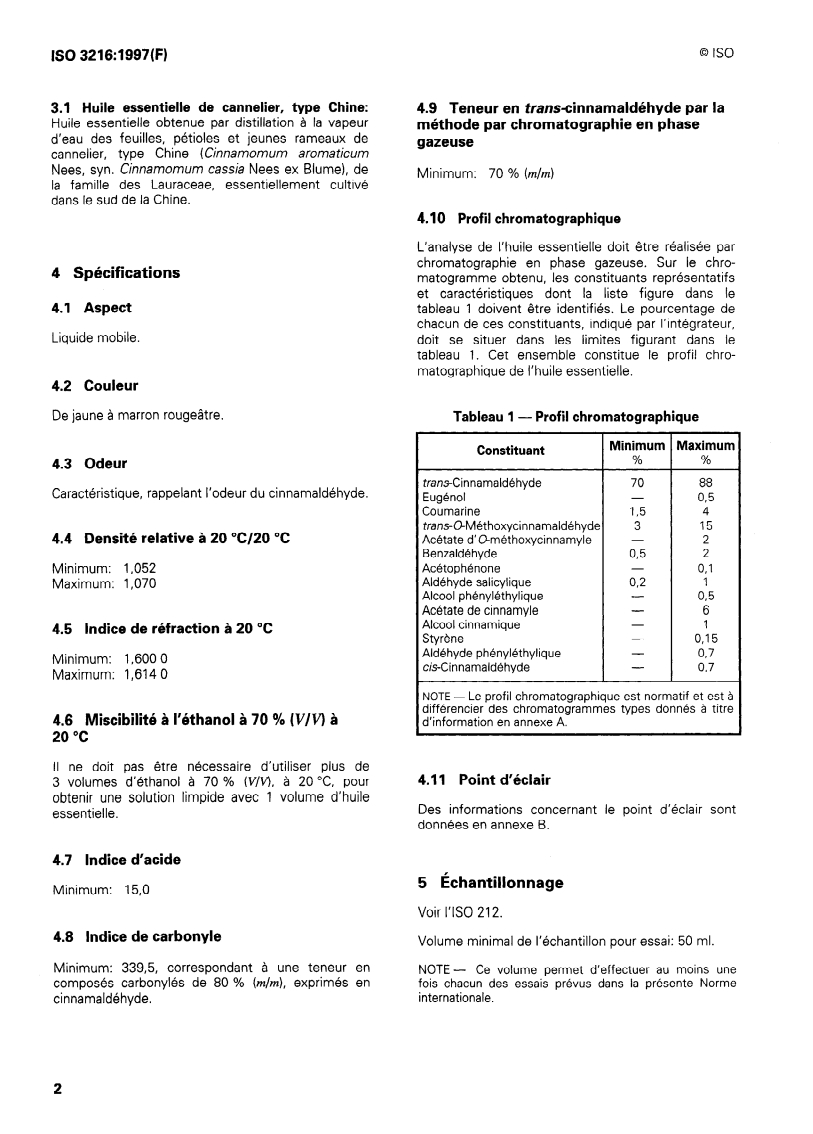
The standard requires detailed analysis through gas chromatography, specifying characteristic constituents with defined concentration ranges:- trans-Cinnamaldehyde: 70% – 88%
- Eugenol: 0.5% – 4%
- Coumarin: 1.5% – 15%
- trans-O-Methoxycinnamaldehyde: 2% – 3%
- Other compounds such as benzaldehyde, acetophenone, salicylic aldehyde, phenylethyl alcohol, cinnamyl acetate, styrene, and cinnamyl alcohol are also identified in trace amounts
Testing Methods
The document references several ISO standards for testing, ensuring reliable and harmonized evaluation:- Density: ISO 279
- Refractive index: ISO 280
- Miscibility with ethanol: ISO 875
- Acid value: ISO 1242
- Carbonyl index: ISO 1279
- Gas chromatography for cinnamaldehyde content: ISO 11025
- Chromatographic profiling: ISO 11024
Packaging and Storage
Guidelines on packaging, labeling, marking, and storage are outlined in related ISO standards (ISO 210 and ISO 211), ensuring product integrity and safety during handling and distribution.
Applications
Oil of cassia, Chinese type, standardized under ISO 3216:1997, has wide-ranging applications in various industries due to its distinctive aroma and chemical composition:
Flavor and Fragrance Industry
Used as a natural flavoring agent and fragrance material in food products, beverages, cosmetics, and perfumes. Quality assurance according to ISO 3216 guarantees consistency and safety for consumers.Pharmaceutical and Therapeutic Uses
Employed in traditional and modern medicine for its aromatic and antimicrobial properties. The standardized characterization supports efficacy and regulatory compliance.Quality Control and Trade
Facilitates international trade by providing a unified reference for buyers, suppliers, and regulators to assess product authenticity, purity, and quality, reducing disputes and enhancing market transparency.Research and Development
Supports scientific investigation into cassia oil’s chemical components, including bioactive compounds such as cinnamaldehyde, influencing innovation in natural product formulations.
Related Standards
ISO 3216:1997 should be considered alongside the following relevant ISO standards for comprehensive quality management of essential oils:
- ISO 279: Determination of relative density of essential oils
- ISO 280: Determination of refractive index
- ISO 875: Evaluation of miscibility with ethanol
- ISO 1242: Determination of acid value
- ISO 1279: Potentiometric determination of carbonyl index
- ISO 11024: Guidelines for chromatographic profiles
- ISO 11025: Gas chromatography method for cinnamaldehyde content
- ISO 210 and ISO 211: General rules for packaging, labeling, and marking of essential oils
- ISO/TR 11018: Guidelines for flash point determination of essential oils
Keywords: ISO 3216, Oil of cassia, Chinese cassia oil, Cinnamomum aromaticum, essential oil standard, cinnamaldehyde content, gas chromatography, essential oil quality, chromatographic profile, essential oil testing methods, ISO standards, essential oil packaging.
Relations
- Consolidated By
ISO 15982:2002 - Open end blind rivets with break pull mandrel and countersunk head — AIA/AIA - Effective Date
- 06-Jun-2022
- Effective Date
- 15-Apr-2008
Buy Documents
ISO 3216:1997 - Oil of cassia, Chinese type (Cinnamomum aromaticum Nees, syn. Cinnamomum cassia Nees ex Blume)
ISO 3216:1997 - Oil of cassia, Chinese type (Cinnamomum aromaticum Nees, syn. Cinnamomum cassia Nees ex Blume)/5/1997
ISO 3216:1997 - Huile essentielle de cannelier type Chine (Cinnamomum aromaticum Nees, syn. Cinnamomum cassia Nees ex Blume)
ISO 3216:1997 - Huile essentielle de cannelier type Chine (Cinnamomum aromaticum Nees, syn. Cinnamomum cassia Nees ex Blume)
ISO 3216:1997 - Huile essentielle de cannelier type Chine (Cinnamomum aromaticum Nees, syn. Cinnamomum cassia Nees ex Blume)/5/1997
ISO 3216:1997 - Huile essentielle de cannelier type Chine (Cinnamomum aromaticum Nees, syn. Cinnamomum cassia Nees ex Blume)/5/1997
Get Certified
Connect with accredited certification bodies for this standard

ECOCERT
Organic and sustainability certification.

Eurofins Food Testing Global
Global leader in food, environment, and pharmaceutical product testing.

Intertek Bangladesh
Intertek certification and testing services in Bangladesh.
Sponsored listings
Frequently Asked Questions
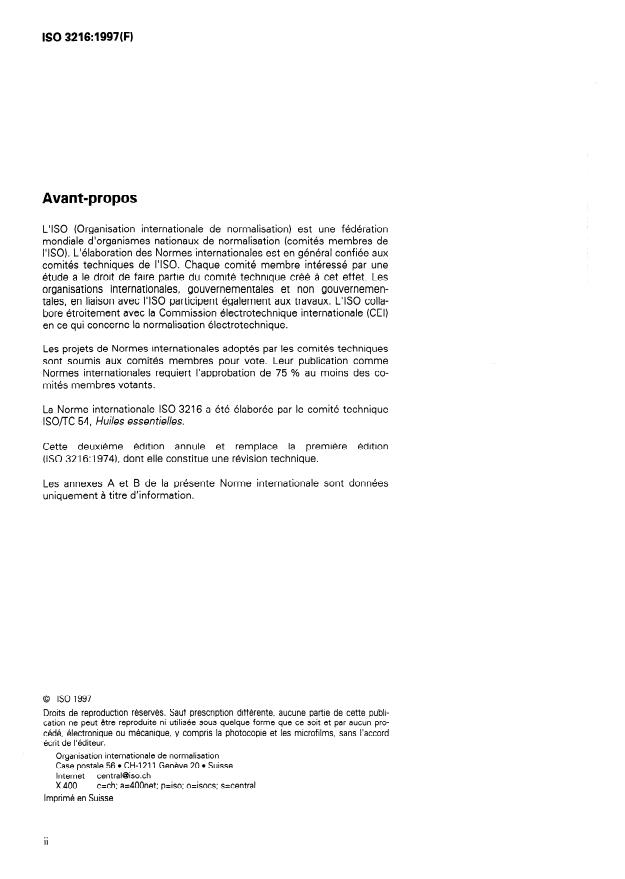
ISO 3216:1997 is a standard published by the International Organization for Standardization (ISO). Its full title is "Oil of cassia, Chinese type (Cinnamomum aromaticum Nees, syn. Cinnamomum cassia Nees ex Blume)". This standard covers: La présente Norme internationale spécifie certaines caractéristiques de l'huile essentielle de cannelier, type Chine (Cinnamomum aromaticum Nees, syn. Cinnamomum cassia Nees ex Blume), destinées à faciliter l'appréciation de sa qualité.
La présente Norme internationale spécifie certaines caractéristiques de l'huile essentielle de cannelier, type Chine (Cinnamomum aromaticum Nees, syn. Cinnamomum cassia Nees ex Blume), destinées à faciliter l'appréciation de sa qualité.
ISO 3216:1997 is classified under the following ICS (International Classification for Standards) categories: 71.100.60 - Essential oils. The ICS classification helps identify the subject area and facilitates finding related standards.
ISO 3216:1997 has the following relationships with other standards: It is inter standard links to ISO 15982:2002, ISO 3216:1974. Understanding these relationships helps ensure you are using the most current and applicable version of the standard.
ISO 3216:1997 is available in PDF format for immediate download after purchase. The document can be added to your cart and obtained through the secure checkout process. Digital delivery ensures instant access to the complete standard document.
Standards Content (Sample)
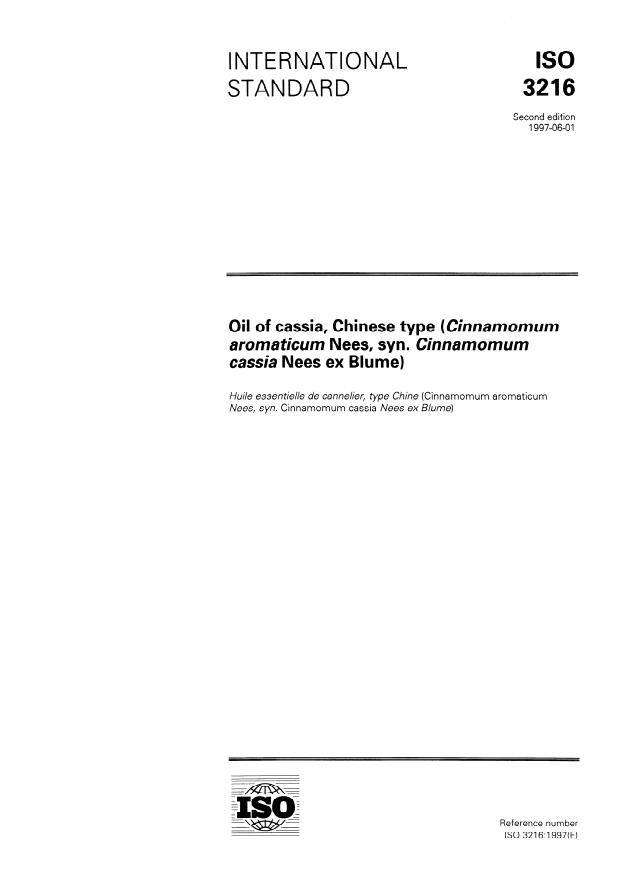
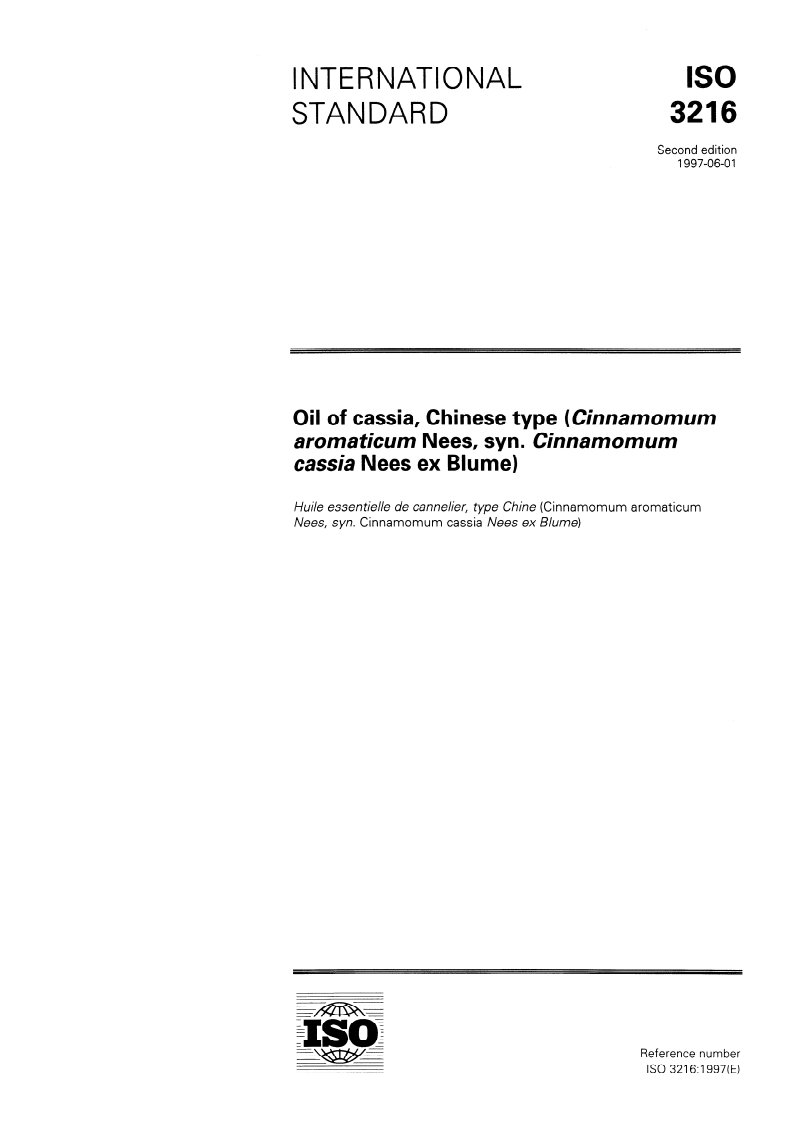
INTERNATIONAL IS0
STANDARD 3216
Second edition
1997-06-O I
Oil of cassia, Chinese type (Cinnamomum
aromaticum Nees, syn. Cinnamomum
cassia Nees ex Blume)
W/e essentjelle de canneher, type Chine (Cinnamomum aromaticurn
Nees, syn. Cinnamomum cassia Nees ex Blume)
Reference number
IS0 3216:1997(E)
ISO (the lnternational Organization for Standardization) is a worldvdide fed-
eration of national standards bodies IS0 member bodies). The work of
normally carried out through lSO
preparing International Standards is
technical committees. Each membe body interested in a subject for
which a technical committee has been established has the right to be
represented on that committee. lnternationai organizations, governmental
and non-governmental, in liaison with ISO, also take part in the work. ISO
collaborates closely with the international Electrotechnicaj Commissjon
(IEC) on all matters of electrotechnical standardization.
Draft International Standards adopted by the technical committees are
circulated to the member bodies for voting. Publication as an lnternationai
Standard requires approval by at least 75 % of the member bodies casting
a vote.
International Standard ISO 3216 was prepared by Technical Committee
ISORC 54, Essentd oils.
This second edition cancels and replaces the first edition (iSO 3216:1974),
which has been technically revised.
Annexes A and B of this International Standard are for information only.
0 IS0 1997
All rights reserved, Unless otherwise specified, no part of this publication may be
reproduced or utilized in any form or by any means, electronic or mechanical, Including
photocopying and microfilm, without permission in writing from the publisher.
International Organization for Standardization
Case Postale 56 l CH-1211 Geneve 20 e Switzerland
Internet centraI@iso.ch
x.400 c=ch; a=400net; p=iso; o=isocs; s=centraI
Printed in Switzerland
ii
IS0 3216:1997(E)
INTERNATIONAL STANDARD @ IS0
Oil of cassia, Chinese type (Cinnamomum arornaticuln
Nees, syn. Cinnamomum cassia Nees ex Blume)
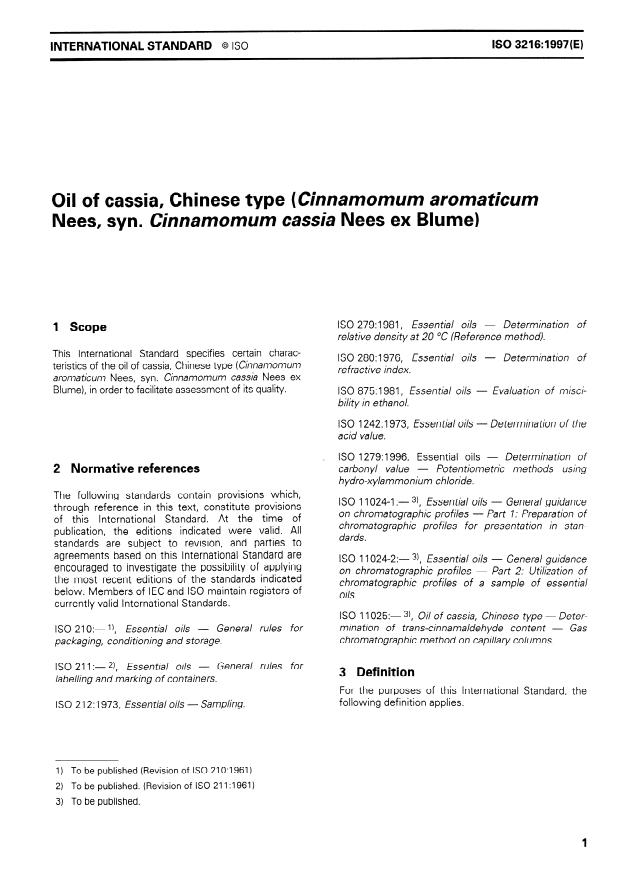
IS0 279: 1981, Essential oils - Determination of
1 Scope
relative density at 20 “C (Reference method).
This International Standard specifies certain charac-
IS0 280:197cjl Essential oils - Determination of
teristics of the oil of cassia, Chinese type (Ci~~~~rnornurn
refractive index.
aromaticum Nees, syn. Cinnamomum cassia Nees ex
Blume), in order to facilitate assessment of its quality.
IS0 875: 1981, Essential oils - Evaluation of misci-
bility in ethanol.
IS0 1242: 1973, Essential oils - Determination of the
acid value.
IS0 1279:1996, Essential oils - Determination of
2 Normative references carbonyl value - Po ten tiome tric methods using
h ydro-xylammonium chloride.
The following standards contain provisions which,
IS0 11024-I :- 3), Essential oils - General guidance
through reference in this text, constitute provisions
on chromatographic profiles - Part 1: Preparation of
of this International Standard. At the time of
chromatographic profiles for presentation in stan-
publication, the editions indicated were valid. All
dards.
standards are subject to revision, and parties to
agreements based on this International Standard are
IS0 11024-2:- 3), Essential oils - General guidance
encouraged to investigate the possibility of applying
on chromatographic profiles - Part 2: Utilization of
the most recent editions of the standards indicated
chromatographic profiles of a sample of essential
below. Members of IEC and IS0 maintain registers of
oils.
currently valid International Standards.
IS0 11025:- 3), Oil of cassia, Chinese type - Deter-
mina tion of trans-cinnamaldeh yde con tent - Gas
IS0 210:- 1), Essential oils - General rules for
chromatographic method on capillary columns.
packaging, conditioning and storage.
IS0 211:- *), Essential oils - General rules for
3 Definition
labelling and marking of containers.
For the purposes of this International Standard, the
following definition applies.
IS0 212:1973, Essential oils - Sampling.
1) To be published (Revision of IS0 210:1961)
2) To be published. (Revision of IS0 211 :I 961)
3) To be published.
0 IS0
IS0 3216:1997(E)
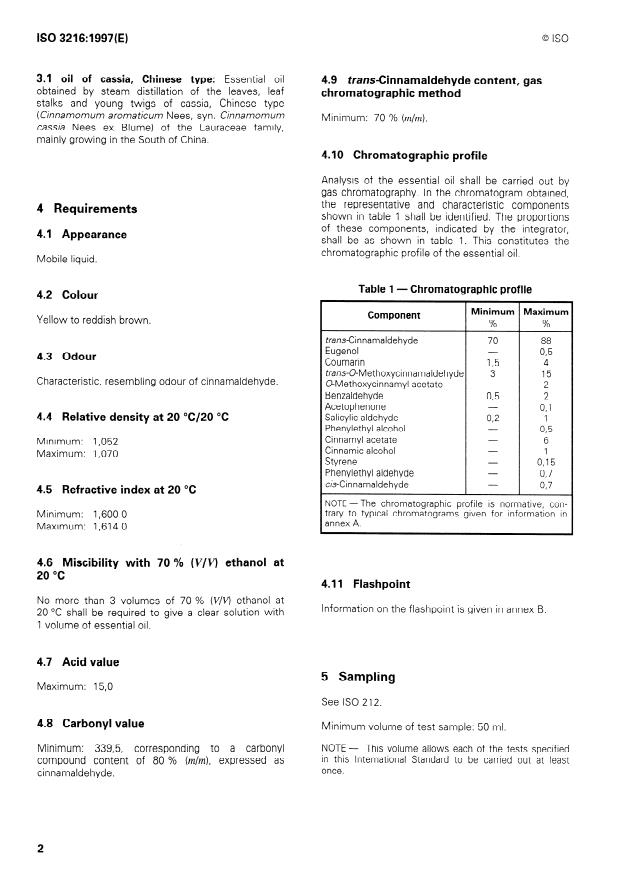
3.1 oil of cassia, Chinese type: Essential oil 4.9 franz+Cinnamaldehyde content, gas
obtained by steam distillation of the leaves, leaf
chromatographic method
stalks and young twigs of cassia, Chinese type
(Cinnamomum aromaticum Nees, syn. Cinnamomum
Minimum: 70 % (HZ/TIZ).
cassia Nees ex Blume) of the Lauraceae family,
mainly growing in the South of China.
4.10 Chromatographic profile
Analysis of the essential oil shall be carried out by
gas chromatography. In the chromatogram obtained,
the representative and characteristic components
4 Requirements
shown in table 1 shall be identified. The proportions
of these components, indicated by the integrator,
4.1 Appearance
shall be as shown in table 1. This constitutes the
chromatographic profile of the essential oil,.
Mobile liquid.
- Chromatographic profile
Table I
4.2 Colour
/ Miniym / Maxbirum
Component
Yellow to reddish brown.
transCinnamaldehyde 70 88
Eugenol
0,5
4.3 Odour
Coumarin 4
L5
trans-0Methoxycinnamaldehyde 3 15
Characteristic, resembling odour of cinnamaldehyde.
0MethoxycinnamyI acetate 2
Benzaldehyde or5 2
Acetophenone
w
Salicylic aldehyde 1
4.4 Relative density at 20 “C/20 “C 02
Phenylethyl alcohol
or5
Cinnamy
...
INTERNATIONAL IS0
STANDARD 3216
Second edition
1997-06-O I
Oil of cassia, Chinese type (Cinnamomum
aromaticum Nees, syn. Cinnamomum
cassia Nees ex Blume)
W/e essentjelle de canneher, type Chine (Cinnamomum aromaticurn
Nees, syn. Cinnamomum cassia Nees ex Blume)
Reference number
IS0 3216:1997(E)
ISO (the lnternational Organization for Standardization) is a worldvdide fed-
eration of national standards bodies IS0 member bodies). The work of
normally carried out through lSO
preparing International Standards is
technical committees. Each membe body interested in a subject for
which a technical committee has been established has the right to be
represented on that committee. lnternationai organizations, governmental
and non-governmental, in liaison with ISO, also take part in the work. ISO
collaborates closely with the international Electrotechnicaj Commissjon
(IEC) on all matters of electrotechnical standardization.
Draft International Standards adopted by the technical committees are
circulated to the member bodies for voting. Publication as an lnternationai
Standard requires approval by at least 75 % of the member bodies casting
a vote.
International Standard ISO 3216 was prepared by Technical Committee
ISORC 54, Essentd oils.
This second edition cancels and replaces the first edition (iSO 3216:1974),
which has been technically revised.
Annexes A and B of this International Standard are for information only.
0 IS0 1997
All rights reserved, Unless otherwise specified, no part of this publication may be
reproduced or utilized in any form or by any means, electronic or mechanical, Including
photocopying and microfilm, without permission in writing from the publisher.
International Organization for Standardization
Case Postale 56 l CH-1211 Geneve 20 e Switzerland
Internet centraI@iso.ch
x.400 c=ch; a=400net; p=iso; o=isocs; s=centraI
Printed in Switzerland
ii
IS0 3216:1997(E)
INTERNATIONAL STANDARD @ IS0
Oil of cassia, Chinese type (Cinnamomum arornaticuln
Nees, syn. Cinnamomum cassia Nees ex Blume)
IS0 279: 1981, Essential oils - Determination of
1 Scope
relative density at 20 “C (Reference method).
This International Standard specifies certain charac-
IS0 280:197cjl Essential oils - Determination of
teristics of the oil of cassia, Chinese type (Ci~~~~rnornurn
refractive index.
aromaticum Nees, syn. Cinnamomum cassia Nees ex
Blume), in order to facilitate assessment of its quality.
IS0 875: 1981, Essential oils - Evaluation of misci-
bility in ethanol.
IS0 1242: 1973, Essential oils - Determination of the
acid value.
IS0 1279:1996, Essential oils - Determination of
2 Normative references carbonyl value - Po ten tiome tric methods using
h ydro-xylammonium chloride.
The following standards contain provisions which,
IS0 11024-I :- 3), Essential oils - General guidance
through reference in this text, constitute provisions
on chromatographic profiles - Part 1: Preparation of
of this International Standard. At the time of
chromatographic profiles for presentation in stan-
publication, the editions indicated were valid. All
dards.
standards are subject to revision, and parties to
agreements based on this International Standard are
IS0 11024-2:- 3), Essential oils - General guidance
encouraged to investigate the possibility of applying
on chromatographic profiles - Part 2: Utilization of
the most recent editions of the standards indicated
chromatographic profiles of a sample of essential
below. Members of IEC and IS0 maintain registers of
oils.
currently valid International Standards.
IS0 11025:- 3), Oil of cassia, Chinese type - Deter-
mina tion of trans-cinnamaldeh yde con tent - Gas
IS0 210:- 1), Essential oils - General rules for
chromatographic method on capillary columns.
packaging, conditioning and storage.
IS0 211:- *), Essential oils - General rules for
3 Definition
labelling and marking of containers.
For the purposes of this International Standard, the
following definition applies.
IS0 212:1973, Essential oils - Sampling.
1) To be published (Revision of IS0 210:1961)
2) To be published. (Revision of IS0 211 :I 961)
3) To be published.
0 IS0
IS0 3216:1997(E)
3.1 oil of cassia, Chinese type: Essential oil 4.9 franz+Cinnamaldehyde content, gas
obtained by steam distillation of the leaves, leaf
chromatographic method
stalks and young twigs of cassia, Chinese type
(Cinnamomum aromaticum Nees, syn. Cinnamomum
Minimum: 70 % (HZ/TIZ).
cassia Nees ex Blume) of the Lauraceae family,
mainly growing in the South of China.
4.10 Chromatographic profile
Analysis of the essential oil shall be carried out by
gas chromatography. In the chromatogram obtained,
the representative and characteristic components
4 Requirements
shown in table 1 shall be identified. The proportions
of these components, indicated by the integrator,
4.1 Appearance
shall be as shown in table 1. This constitutes the
chromatographic profile of the essential oil,.
Mobile liquid.
- Chromatographic profile
Table I
4.2 Colour
/ Miniym / Maxbirum
Component
Yellow to reddish brown.
transCinnamaldehyde 70 88
Eugenol
0,5
4.3 Odour
Coumarin 4
L5
trans-0Methoxycinnamaldehyde 3 15
Characteristic, resembling odour of cinnamaldehyde.
0MethoxycinnamyI acetate 2
Benzaldehyde or5 2
Acetophenone
w
Salicylic aldehyde 1
4.4 Relative density at 20 “C/20 “C 02
Phenylethyl alcohol
or5
Cinnamy
...
ISO
NORME
INTERNATIONALE
Deuxième édition
1997-06-o 1
Huile essentielle de cannelier, type Chine
(Cinnamomum aromaticum Nees, syn.
Cinnamomum cassis Nees ex Blume)
Oil of cassis, Chinese type (Cinnamomum aromaticum Nees, syn.
Cinnamomum cassis Nees ex Hume)
Numéro de référence
Avant-propos
L’ISO (Organisation internationale de normalisation) est une fédération
mondiale d’organismes nationaux de normalisation (comités membres de
I’ISO). L’élaboration des Normes internationales est en général confiée aux
comités techniques de I’ISO. Chaque comité membre intéressé par une
étude a le droit de faire partie du comité technique créé à cet effet. Les
organisations internationales, gouvernementales et non gouvernemen-
tales, en liaison avec I’ISO participent également aux travaux. LYS0 colla-
bore étroitement avec la Commission électrotechnique internationale (CEI)
en ce qui concerne la normalisation électrotechnique.
Les projets de Normes internationales adoptés par les comités techniques
sont soumis aux comités membres pour vote. Leur publication comme
Normes internationales requiert l’approbation de 75 % au moins des co-
mités membres votants.
La Norme internationale ISO 3216 a été élaborée par le comité technique
I SO/TC 54, Huiles essentielles.
Cette deuxième édition annule et remplace la première édition
(ISO 3216:1974), dont elle constitue une révision technique.
Les annexes A et B de la présente Norme internationale sont données
uniquement à titre d’information.
0 ISO 1997
Droits de reproduction réservés. Sauf prescription différente, aucune partie de cette publi-
cation ne peut être reproduite ni utilisée sous quelque forme que ce soit et par aucun pro-
cédé, électronique ou mécanique, y compris la photocopie et les microfilms, sans l’accord
écrit de l’éditeur.
Organisation internationale de normalisation
Case postale 56 l CH-1 211 Genève 20 l Suisse
Internet central@iso.ch
x.400 c=ch; a=400net; p=iso; o=isocs; s=central
Imprimé en Suisse
ii
NORME INTERNATIONALE @ ISO
Huile essentielle de cannelier, type Chine (Cinnamomum
aromaticum Nees, syn. Cinnamomum cassis Nees ex Blume)
1 Domaine d’application
ISO 280: 1976, Huiles essentielles - Détermination de
l’indice de réfraction.
La présente Norme internationale spécifie certaines
caractéristiques de I’huile essentielle de cannelier,
ISO 875: 1981, Huiles essentielles .&- Évaluation de la
type Chine (Cinnamomum aromaticum Nees, syn.
miscibilité a I’é thanol.
Cinnamomum cassis Nees ex Blume), destinées à
faciliter l’appréciation de sa qualité.
ISO 1242: 1973, Huiles essentielles - Détermination
de l’indice d’acide.
ISO 1279: 1996, Huiles essentielles - Détermination
2 Références normatives
de l’indice de carbonyle - Méthodes poten tiomé-
triques au chlorure d’h ydroxyammonium.
Les normes suivantes contiennent des dispositions
qui, par suite de la référence qui en est faite, consti- 3), Huiles essentielles - Directives
ISO 11024-I :-
tuent des dispositions valables pour la présente
générales concernant les profils chroma tographiques
Norme internationale. Au moment de la publication, - Partie 1: Élaboration des profils chroma togra-
les éditions indiquées étaient en vigueur. Toute norme
phiques pour la présentation des normes.
est sujette à révision et les parties prenantes des
3), Huiles essentielles - Directives
accords fondés sur la présente Norme internationale ISO 11024-2:-
sont invitées à rechercher la possibilité d’appliquer les générales concernant les profils chroma tographiques
éditions les plus récentes des normes indiquées ci- - Partie 2: Utilisation des profils chromatographiques
après. Les membres de la CEI et de I’ISO possèdent des échantillons d ‘huiles essentielles.
le registre des Normes internationales en vigueur à un
moment donné. ISO 11025:- 3) Huile essentielle de cannelier, type
Chine - Détermination de la teneur en trans-
11, Huiles essentielles - Règles générales
ISO 210:- cinnamaldéhyde - Méthode par chroma tographie en
d’emballage, de conditionnement et de stockage. phase gazeuse sur colonne capillaire.
ISO 211:-* 1, Huiles essentielles - Règles générales
d’étiquetage et de marquage des récipients.
I SO 2 12: 1973, Huiles essentielles - Échantillonnage.
3 Définition
ISO 279: 1981, Huiles essentielles - Détermination de
Pour les besoins de la présente Norme internationale,
la densité relative à 20 “C (Méthode de référence).
la définition suivante s’applique.
1) À publier. (Révision de I’ISO 210:1961)
2) À publier. (Révision de I’ISO 211 :1961)
3) À publier.
@ ISO
3.1 Huile essentielle de cannelier, type Chine: 4.9 Teneur en trans-cinnamaldéhyde par la
Huile essentielle obtenue par distillation à la vapeur
méthode par chromatographie en phase
d’eau des feuilles, pétioles et jeunes rameaux de
gazeuse
cannelier, type Chine (Cinnamomum aromaticum
Nees, syn. Cinnamomum cassis Nees ex Blume), de
Minimum: 70 % (mlm)
la famille des Lauraceae, essentiellement cultivé
dans le sud de la Chine.
4.10 Profil chromatographique
L’analyse de I’huile essentielle doit être réalisée par
chromatographie en phase gazeuse. Sur le chro-
4 Spécifications
matogramme obtenu, les constituants représentatifs
et caractéristiques dont la liste figure dans le
4.1 Aspect tableau 1 doivent être identifiés. Le pourcentage de
chacun de ces constituants, indiqué par I’intégrateur,
Liquide mobile.
doit se situer dans les limites figurant dans le
tableau 1. Cet ensemble constitue le profil chro-
matographique de I’huile essentielle.
4.2 Couleur
Tableau 1 - Profil chromatographique
De jaune à marron rougeâtre.
Minimum Maximum
Constituant
% %
4.3 Odeur
70 88
trans-Cinnamaldéhyde
Caractéristique, rappelant l’odeur du cinnamaldéhyde.
Eugenol
0,5
Coumarine 1,5
trans-O-Méthoxycinnamaldéhyde 3
4.4 Densité relative à 20 OC/20 OC Acétate d’0méthoxycinnamyle -
Benzal
...
ISO
NORME
INTERNATIONALE
Deuxième édition
1997-06-o 1
Huile essentielle de cannelier, type Chine
(Cinnamomum aromaticum Nees, syn.
Cinnamomum cassis Nees ex Blume)
Oil of cassis, Chinese type (Cinnamomum aromaticum Nees, syn.
Cinnamomum cassis Nees ex Hume)
Numéro de référence
Avant-propos
L’ISO (Organisation internationale de normalisation) est une fédération
mondiale d’organismes nationaux de normalisation (comités membres de
I’ISO). L’élaboration des Normes internationales est en général confiée aux
comités techniques de I’ISO. Chaque comité membre intéressé par une
étude a le droit de faire partie du comité technique créé à cet effet. Les
organisations internationales, gouvernementales et non gouvernemen-
tales, en liaison avec I’ISO participent également aux travaux. LYS0 colla-
bore étroitement avec la Commission électrotechnique internationale (CEI)
en ce qui concerne la normalisation électrotechnique.
Les projets de Normes internationales adoptés par les comités techniques
sont soumis aux comités membres pour vote. Leur publication comme
Normes internationales requiert l’approbation de 75 % au moins des co-
mités membres votants.
La Norme internationale ISO 3216 a été élaborée par le comité technique
I SO/TC 54, Huiles essentielles.
Cette deuxième édition annule et remplace la première édition
(ISO 3216:1974), dont elle constitue une révision technique.
Les annexes A et B de la présente Norme internationale sont données
uniquement à titre d’information.
0 ISO 1997
Droits de reproduction réservés. Sauf prescription différente, aucune partie de cette publi-
cation ne peut être reproduite ni utilisée sous quelque forme que ce soit et par aucun pro-
cédé, électronique ou mécanique, y compris la photocopie et les microfilms, sans l’accord
écrit de l’éditeur.
Organisation internationale de normalisation
Case postale 56 l CH-1 211 Genève 20 l Suisse
Internet central@iso.ch
x.400 c=ch; a=400net; p=iso; o=isocs; s=central
Imprimé en Suisse
ii
NORME INTERNATIONALE @ ISO
Huile essentielle de cannelier, type Chine (Cinnamomum
aromaticum Nees, syn. Cinnamomum cassis Nees ex Blume)
1 Domaine d’application
ISO 280: 1976, Huiles essentielles - Détermination de
l’indice de réfraction.
La présente Norme internationale spécifie certaines
caractéristiques de I’huile essentielle de cannelier,
ISO 875: 1981, Huiles essentielles .&- Évaluation de la
type Chine (Cinnamomum aromaticum Nees, syn.
miscibilité a I’é thanol.
Cinnamomum cassis Nees ex Blume), destinées à
faciliter l’appréciation de sa qualité.
ISO 1242: 1973, Huiles essentielles - Détermination
de l’indice d’acide.
ISO 1279: 1996, Huiles essentielles - Détermination
2 Références normatives
de l’indice de carbonyle - Méthodes poten tiomé-
triques au chlorure d’h ydroxyammonium.
Les normes suivantes contiennent des dispositions
qui, par suite de la référence qui en est faite, consti- 3), Huiles essentielles - Directives
ISO 11024-I :-
tuent des dispositions valables pour la présente
générales concernant les profils chroma tographiques
Norme internationale. Au moment de la publication, - Partie 1: Élaboration des profils chroma togra-
les éditions indiquées étaient en vigueur. Toute norme
phiques pour la présentation des normes.
est sujette à révision et les parties prenantes des
3), Huiles essentielles - Directives
accords fondés sur la présente Norme internationale ISO 11024-2:-
sont invitées à rechercher la possibilité d’appliquer les générales concernant les profils chroma tographiques
éditions les plus récentes des normes indiquées ci- - Partie 2: Utilisation des profils chromatographiques
après. Les membres de la CEI et de I’ISO possèdent des échantillons d ‘huiles essentielles.
le registre des Normes internationales en vigueur à un
moment donné. ISO 11025:- 3) Huile essentielle de cannelier, type
Chine - Détermination de la teneur en trans-
11, Huiles essentielles - Règles générales
ISO 210:- cinnamaldéhyde - Méthode par chroma tographie en
d’emballage, de conditionnement et de stockage. phase gazeuse sur colonne capillaire.
ISO 211:-* 1, Huiles essentielles - Règles générales
d’étiquetage et de marquage des récipients.
I SO 2 12: 1973, Huiles essentielles - Échantillonnage.
3 Définition
ISO 279: 1981, Huiles essentielles - Détermination de
Pour les besoins de la présente Norme internationale,
la densité relative à 20 “C (Méthode de référence).
la définition suivante s’applique.
1) À publier. (Révision de I’ISO 210:1961)
2) À publier. (Révision de I’ISO 211 :1961)
3) À publier.
@ ISO
3.1 Huile essentielle de cannelier, type Chine: 4.9 Teneur en trans-cinnamaldéhyde par la
Huile essentielle obtenue par distillation à la vapeur
méthode par chromatographie en phase
d’eau des feuilles, pétioles et jeunes rameaux de
gazeuse
cannelier, type Chine (Cinnamomum aromaticum
Nees, syn. Cinnamomum cassis Nees ex Blume), de
Minimum: 70 % (mlm)
la famille des Lauraceae, essentiellement cultivé
dans le sud de la Chine.
4.10 Profil chromatographique
L’analyse de I’huile essentielle doit être réalisée par
chromatographie en phase gazeuse. Sur le chro-
4 Spécifications
matogramme obtenu, les constituants représentatifs
et caractéristiques dont la liste figure dans le
4.1 Aspect tableau 1 doivent être identifiés. Le pourcentage de
chacun de ces constituants, indiqué par I’intégrateur,
Liquide mobile.
doit se situer dans les limites figurant dans le
tableau 1. Cet ensemble constitue le profil chro-
matographique de I’huile essentielle.
4.2 Couleur
Tableau 1 - Profil chromatographique
De jaune à marron rougeâtre.
Minimum Maximum
Constituant
% %
4.3 Odeur
70 88
trans-Cinnamaldéhyde
Caractéristique, rappelant l’odeur du cinnamaldéhyde.
Eugenol
0,5
Coumarine 1,5
trans-O-Méthoxycinnamaldéhyde 3
4.4 Densité relative à 20 OC/20 OC Acétate d’0méthoxycinnamyle -
Benzal
...
ISO
NORME
INTERNATIONALE
Deuxième édition
1997-06-o 1
Huile essentielle de cannelier, type Chine
(Cinnamomum aromaticum Nees, syn.
Cinnamomum cassis Nees ex Blume)
Oil of cassis, Chinese type (Cinnamomum aromaticum Nees, syn.
Cinnamomum cassis Nees ex Hume)
Numéro de référence
Avant-propos
L’ISO (Organisation internationale de normalisation) est une fédération
mondiale d’organismes nationaux de normalisation (comités membres de
I’ISO). L’élaboration des Normes internationales est en général confiée aux
comités techniques de I’ISO. Chaque comité membre intéressé par une
étude a le droit de faire partie du comité technique créé à cet effet. Les
organisations internationales, gouvernementales et non gouvernemen-
tales, en liaison avec I’ISO participent également aux travaux. LYS0 colla-
bore étroitement avec la Commission électrotechnique internationale (CEI)
en ce qui concerne la normalisation électrotechnique.
Les projets de Normes internationales adoptés par les comités techniques
sont soumis aux comités membres pour vote. Leur publication comme
Normes internationales requiert l’approbation de 75 % au moins des co-
mités membres votants.
La Norme internationale ISO 3216 a été élaborée par le comité technique
I SO/TC 54, Huiles essentielles.
Cette deuxième édition annule et remplace la première édition
(ISO 3216:1974), dont elle constitue une révision technique.
Les annexes A et B de la présente Norme internationale sont données
uniquement à titre d’information.
0 ISO 1997
Droits de reproduction réservés. Sauf prescription différente, aucune partie de cette publi-
cation ne peut être reproduite ni utilisée sous quelque forme que ce soit et par aucun pro-
cédé, électronique ou mécanique, y compris la photocopie et les microfilms, sans l’accord
écrit de l’éditeur.
Organisation internationale de normalisation
Case postale 56 l CH-1 211 Genève 20 l Suisse
Internet central@iso.ch
x.400 c=ch; a=400net; p=iso; o=isocs; s=central
Imprimé en Suisse
ii
NORME INTERNATIONALE @ ISO
Huile essentielle de cannelier, type Chine (Cinnamomum
aromaticum Nees, syn. Cinnamomum cassis Nees ex Blume)
1 Domaine d’application
ISO 280: 1976, Huiles essentielles - Détermination de
l’indice de réfraction.
La présente Norme internationale spécifie certaines
caractéristiques de I’huile essentielle de cannelier,
ISO 875: 1981, Huiles essentielles .&- Évaluation de la
type Chine (Cinnamomum aromaticum Nees, syn.
miscibilité a I’é thanol.
Cinnamomum cassis Nees ex Blume), destinées à
faciliter l’appréciation de sa qualité.
ISO 1242: 1973, Huiles essentielles - Détermination
de l’indice d’acide.
ISO 1279: 1996, Huiles essentielles - Détermination
2 Références normatives
de l’indice de carbonyle - Méthodes poten tiomé-
triques au chlorure d’h ydroxyammonium.
Les normes suivantes contiennent des dispositions
qui, par suite de la référence qui en est faite, consti- 3), Huiles essentielles - Directives
ISO 11024-I :-
tuent des dispositions valables pour la présente
générales concernant les profils chroma tographiques
Norme internationale. Au moment de la publication, - Partie 1: Élaboration des profils chroma togra-
les éditions indiquées étaient en vigueur. Toute norme
phiques pour la présentation des normes.
est sujette à révision et les parties prenantes des
3), Huiles essentielles - Directives
accords fondés sur la présente Norme internationale ISO 11024-2:-
sont invitées à rechercher la possibilité d’appliquer les générales concernant les profils chroma tographiques
éditions les plus récentes des normes indiquées ci- - Partie 2: Utilisation des profils chromatographiques
après. Les membres de la CEI et de I’ISO possèdent des échantillons d ‘huiles essentielles.
le registre des Normes internationales en vigueur à un
moment donné. ISO 11025:- 3) Huile essentielle de cannelier, type
Chine - Détermination de la teneur en trans-
11, Huiles essentielles - Règles générales
ISO 210:- cinnamaldéhyde - Méthode par chroma tographie en
d’emballage, de conditionnement et de stockage. phase gazeuse sur colonne capillaire.
ISO 211:-* 1, Huiles essentielles - Règles générales
d’étiquetage et de marquage des récipients.
I SO 2 12: 1973, Huiles essentielles - Échantillonnage.
3 Définition
ISO 279: 1981, Huiles essentielles - Détermination de
Pour les besoins de la présente Norme internationale,
la densité relative à 20 “C (Méthode de référence).
la définition suivante s’applique.
1) À publier. (Révision de I’ISO 210:1961)
2) À publier. (Révision de I’ISO 211 :1961)
3) À publier.
@ ISO
3.1 Huile essentielle de cannelier, type Chine: 4.9 Teneur en trans-cinnamaldéhyde par la
Huile essentielle obtenue par distillation à la vapeur
méthode par chromatographie en phase
d’eau des feuilles, pétioles et jeunes rameaux de
gazeuse
cannelier, type Chine (Cinnamomum aromaticum
Nees, syn. Cinnamomum cassis Nees ex Blume), de
Minimum: 70 % (mlm)
la famille des Lauraceae, essentiellement cultivé
dans le sud de la Chine.
4.10 Profil chromatographique
L’analyse de I’huile essentielle doit être réalisée par
chromatographie en phase gazeuse. Sur le chro-
4 Spécifications
matogramme obtenu, les constituants représentatifs
et caractéristiques dont la liste figure dans le
4.1 Aspect tableau 1 doivent être identifiés. Le pourcentage de
chacun de ces constituants, indiqué par I’intégrateur,
Liquide mobile.
doit se situer dans les limites figurant dans le
tableau 1. Cet ensemble constitue le profil chro-
matographique de I’huile essentielle.
4.2 Couleur
Tableau 1 - Profil chromatographique
De jaune à marron rougeâtre.
Minimum Maximum
Constituant
% %
4.3 Odeur
70 88
trans-Cinnamaldéhyde
Caractéristique, rappelant l’odeur du cinnamaldéhyde.
Eugenol
0,5
Coumarine 1,5
trans-O-Méthoxycinnamaldéhyde 3
4.4 Densité relative à 20 OC/20 OC Acétate d’0méthoxycinnamyle -
Benzal
...
ISO
NORME
INTERNATIONALE
Deuxième édition
1997-06-o 1
Huile essentielle de cannelier, type Chine
(Cinnamomum aromaticum Nees, syn.
Cinnamomum cassis Nees ex Blume)
Oil of cassis, Chinese type (Cinnamomum aromaticum Nees, syn.
Cinnamomum cassis Nees ex Hume)
Numéro de référence
Avant-propos
L’ISO (Organisation internationale de normalisation) est une fédération
mondiale d’organismes nationaux de normalisation (comités membres de
I’ISO). L’élaboration des Normes internationales est en général confiée aux
comités techniques de I’ISO. Chaque comité membre intéressé par une
étude a le droit de faire partie du comité technique créé à cet effet. Les
organisations internationales, gouvernementales et non gouvernemen-
tales, en liaison avec I’ISO participent également aux travaux. LYS0 colla-
bore étroitement avec la Commission électrotechnique internationale (CEI)
en ce qui concerne la normalisation électrotechnique.
Les projets de Normes internationales adoptés par les comités techniques
sont soumis aux comités membres pour vote. Leur publication comme
Normes internationales requiert l’approbation de 75 % au moins des co-
mités membres votants.
La Norme internationale ISO 3216 a été élaborée par le comité technique
I SO/TC 54, Huiles essentielles.
Cette deuxième édition annule et remplace la première édition
(ISO 3216:1974), dont elle constitue une révision technique.
Les annexes A et B de la présente Norme internationale sont données
uniquement à titre d’information.
0 ISO 1997
Droits de reproduction réservés. Sauf prescription différente, aucune partie de cette publi-
cation ne peut être reproduite ni utilisée sous quelque forme que ce soit et par aucun pro-
cédé, électronique ou mécanique, y compris la photocopie et les microfilms, sans l’accord
écrit de l’éditeur.
Organisation internationale de normalisation
Case postale 56 l CH-1 211 Genève 20 l Suisse
Internet central@iso.ch
x.400 c=ch; a=400net; p=iso; o=isocs; s=central
Imprimé en Suisse
ii
NORME INTERNATIONALE @ ISO
Huile essentielle de cannelier, type Chine (Cinnamomum
aromaticum Nees, syn. Cinnamomum cassis Nees ex Blume)
1 Domaine d’application
ISO 280: 1976, Huiles essentielles - Détermination de
l’indice de réfraction.
La présente Norme internationale spécifie certaines
caractéristiques de I’huile essentielle de cannelier,
ISO 875: 1981, Huiles essentielles .&- Évaluation de la
type Chine (Cinnamomum aromaticum Nees, syn.
miscibilité a I’é thanol.
Cinnamomum cassis Nees ex Blume), destinées à
faciliter l’appréciation de sa qualité.
ISO 1242: 1973, Huiles essentielles - Détermination
de l’indice d’acide.
ISO 1279: 1996, Huiles essentielles - Détermination
2 Références normatives
de l’indice de carbonyle - Méthodes poten tiomé-
triques au chlorure d’h ydroxyammonium.
Les normes suivantes contiennent des dispositions
qui, par suite de la référence qui en est faite, consti- 3), Huiles essentielles - Directives
ISO 11024-I :-
tuent des dispositions valables pour la présente
générales concernant les profils chroma tographiques
Norme internationale. Au moment de la publication, - Partie 1: Élaboration des profils chroma togra-
les éditions indiquées étaient en vigueur. Toute norme
phiques pour la présentation des normes.
est sujette à révision et les parties prenantes des
3), Huiles essentielles - Directives
accords fondés sur la présente Norme internationale ISO 11024-2:-
sont invitées à rechercher la possibilité d’appliquer les générales concernant les profils chroma tographiques
éditions les plus récentes des normes indiquées ci- - Partie 2: Utilisation des profils chromatographiques
après. Les membres de la CEI et de I’ISO possèdent des échantillons d ‘huiles essentielles.
le registre des Normes internationales en vigueur à un
moment donné. ISO 11025:- 3) Huile essentielle de cannelier, type
Chine - Détermination de la teneur en trans-
11, Huiles essentielles - Règles générales
ISO 210:- cinnamaldéhyde - Méthode par chroma tographie en
d’emballage, de conditionnement et de stockage. phase gazeuse sur colonne capillaire.
ISO 211:-* 1, Huiles essentielles - Règles générales
d’étiquetage et de marquage des récipients.
I SO 2 12: 1973, Huiles essentielles - Échantillonnage.
3 Définition
ISO 279: 1981, Huiles essentielles - Détermination de
Pour les besoins de la présente Norme internationale,
la densité relative à 20 “C (Méthode de référence).
la définition suivante s’applique.
1) À publier. (Révision de I’ISO 210:1961)
2) À publier. (Révision de I’ISO 211 :1961)
3) À publier.
@ ISO
3.1 Huile essentielle de cannelier, type Chine: 4.9 Teneur en trans-cinnamaldéhyde par la
Huile essentielle obtenue par distillation à la vapeur
méthode par chromatographie en phase
d’eau des feuilles, pétioles et jeunes rameaux de
gazeuse
cannelier, type Chine (Cinnamomum aromaticum
Nees, syn. Cinnamomum cassis Nees ex Blume), de
Minimum: 70 % (mlm)
la famille des Lauraceae, essentiellement cultivé
dans le sud de la Chine.
4.10 Profil chromatographique
L’analyse de I’huile essentielle doit être réalisée par
chromatographie en phase gazeuse. Sur le chro-
4 Spécifications
matogramme obtenu, les constituants représentatifs
et caractéristiques dont la liste figure dans le
4.1 Aspect tableau 1 doivent être identifiés. Le pourcentage de
chacun de ces constituants, indiqué par I’intégrateur,
Liquide mobile.
doit se situer dans les limites figurant dans le
tableau 1. Cet ensemble constitue le profil chro-
matographique de I’huile essentielle.
4.2 Couleur
Tableau 1 - Profil chromatographique
De jaune à marron rougeâtre.
Minimum Maximum
Constituant
% %
4.3 Odeur
70 88
trans-Cinnamaldéhyde
Caractéristique, rappelant l’odeur du cinnamaldéhyde.
Eugenol
0,5
Coumarine 1,5
trans-O-Méthoxycinnamaldéhyde 3
4.4 Densité relative à 20 OC/20 OC Acétate d’0méthoxycinnamyle -
Benzal
...