

ISO 11043:1998
(Main)Oil of basil, methyl chavicol type (Ocimum basilicum L.)
General Information
- Abstract
- Status
- Published
- Publication Date
- 30-Sep-1998
- Technical Committee
- ISO/TC 54 - Essential oils
- Drafting Committee
- ISO/TC 54 - Essential oils
- Current Stage
- 9093 - International Standard confirmed
- Start Date
- 12-Jan-2026
- Completion Date
- 29-Aug-2026
Buy Documents
ISO 11043:1998 - Oil of basil, methyl chavicol type (Ocimum basilicum L.)
ISO 11043:1998 - Oil of basil, methyl chavicol type (Ocimum basilicum L.)/1/1998
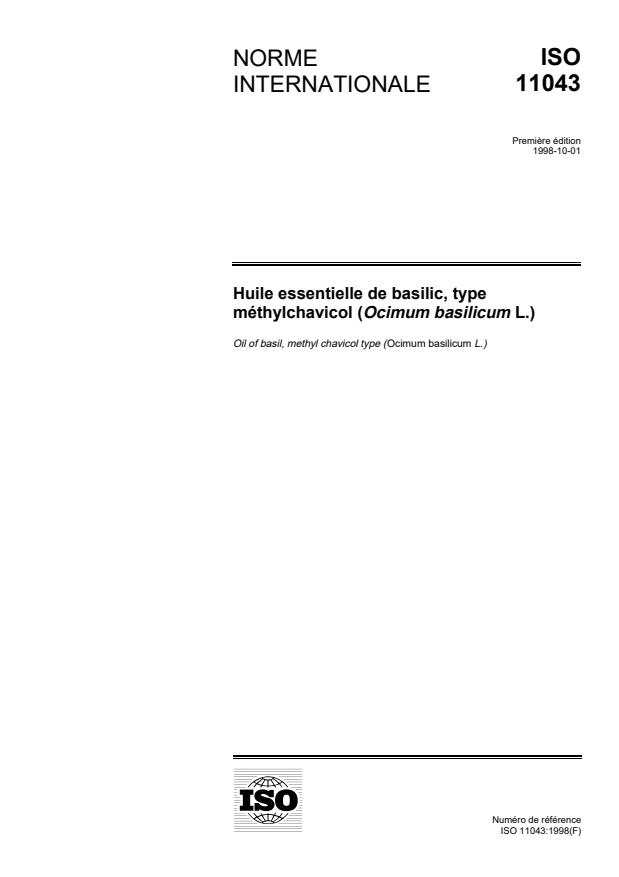
ISO 11043:1998 - Huile essentielle de basilic, type méthylchavicol (Ocimum basilicum L.)
ISO 11043:1998 - Huile essentielle de basilic, type méthylchavicol (Ocimum basilicum L.)/1/1998
Overview
ISO 11043:1998 is an international standard established by the International Organization for Standardization (ISO) that specifies the quality requirements and characteristics of oil of basil, methyl chavicol type (Ocimum basilicum L.). This essential oil is obtained by steam distillation of the leaves of the basil plant, belonging to the Lamiaceae family. The standard provides detailed specifications including physical properties, chemical composition, and testing methods to ensure consistent quality and facilitate reliable quality assessment of this essential oil in the global market.
Key Topics
ISO 11043:1998 outlines essential parameters for the oil of basil, methyl chavicol type, focusing on:
Physical Characteristics:
- Appearance: Liquid form
- Colour: Pale yellow to amber yellow
- Odour: Characteristic spicy aroma with a slightly aniseed note
Chemical and Physical Properties:
- Relative density at 20 °C: 0.948 to 0.970
- Refractive index at 20 °C: 1.5100 to 1.5200
- Optical rotation at 20 °C: Between +2° and +21°
- Miscibility in 80% ethanol at 20 °C: 1 volume oil requiring no more than 7 volumes of ethanol to form a clear solution
- Flashpoint: Mean value approximately +75 °C (informative)
Chromatographic Profile:
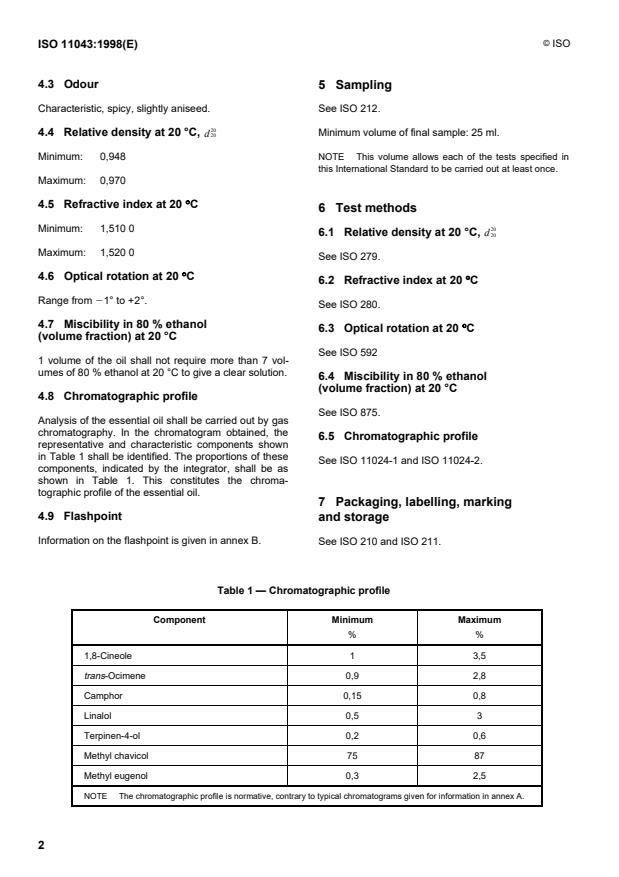
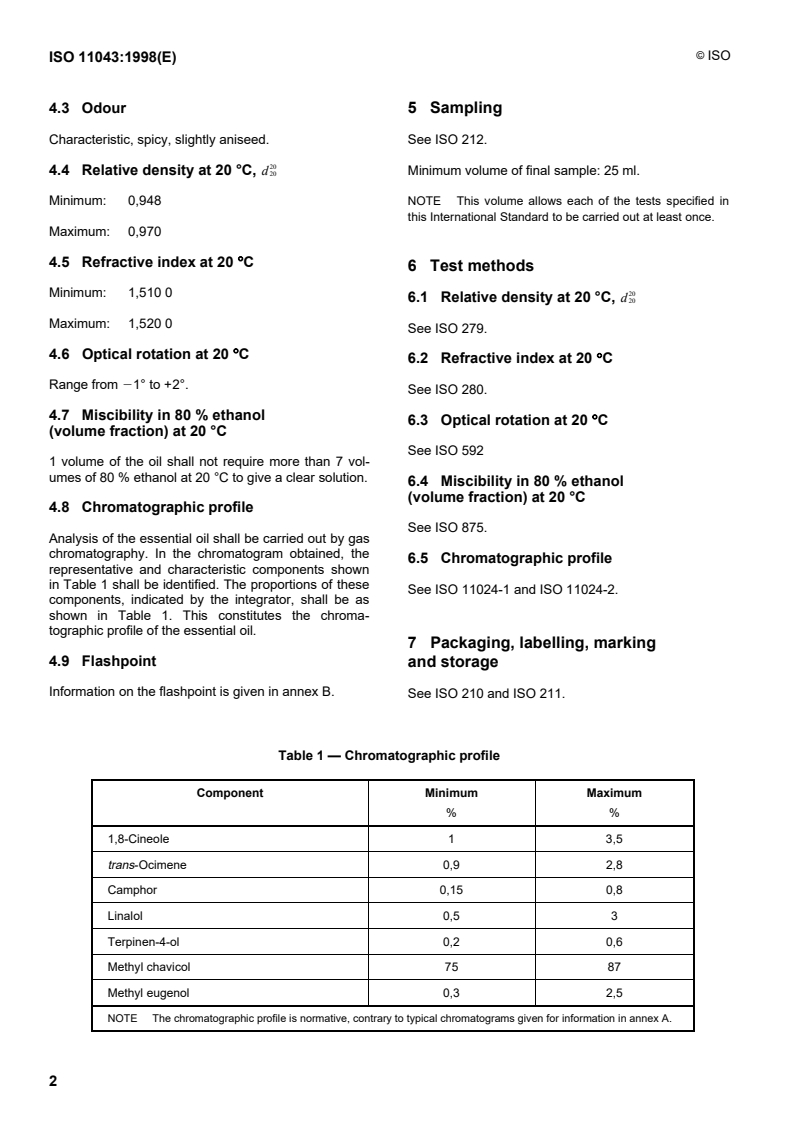
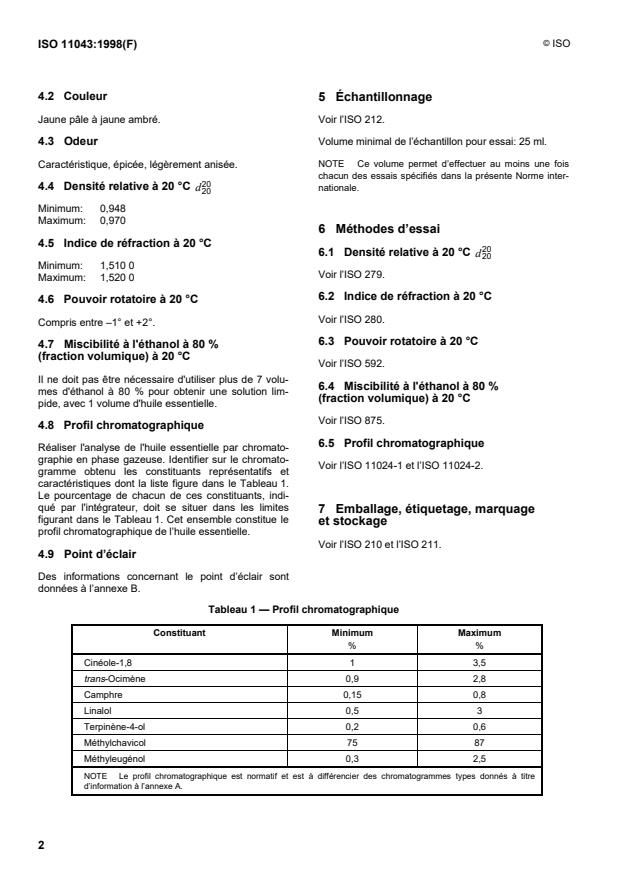
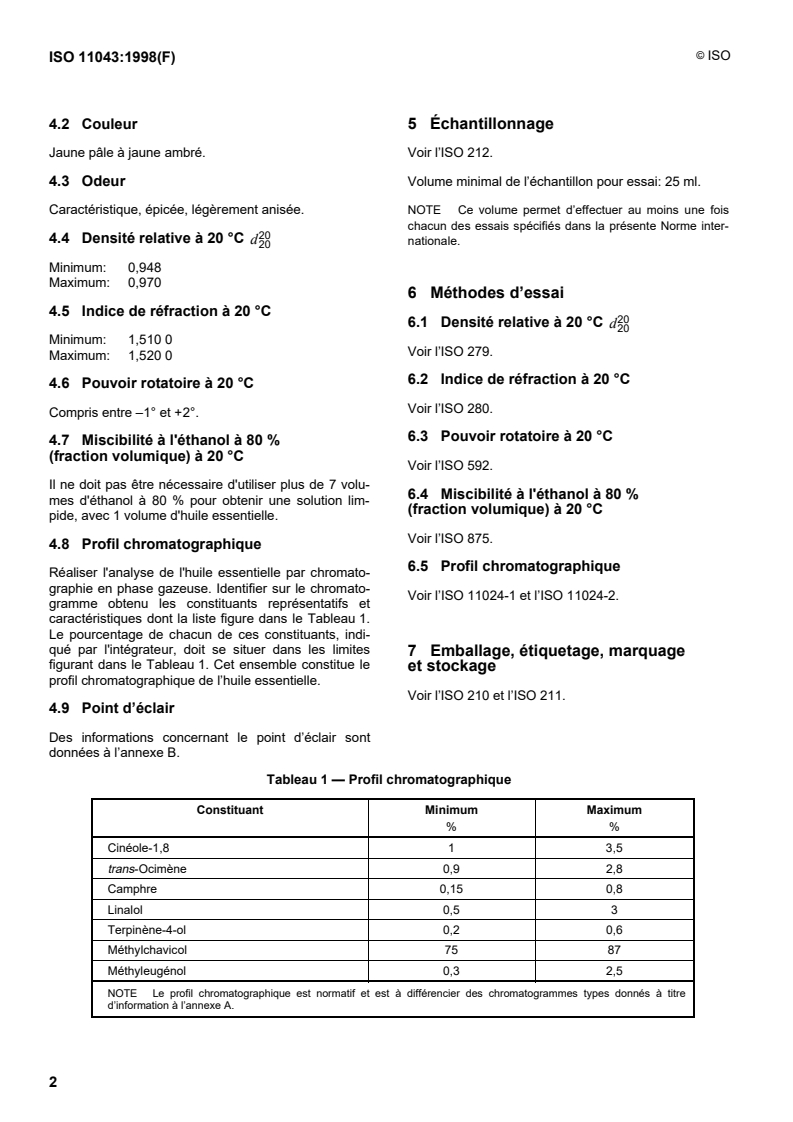
- The oil must contain a methyl chavicol content higher than 75%.
- Other key components include 1,8-cineole, trans-ocimene, camphor, linalool, terpinen-4-ol, and methyl eugenol, each within defined percentage ranges.
- The chromatographic profile is determined using gas chromatography, following ISO 11024 guidelines for preparation and utilization of chromatographic profiles.
Testing Norms and Methods:
- Determination of optical rotation per ISO 592
- Evaluation of miscibility in ethanol per ISO 875
- Determination of relative density and refractive index per ISO 279 and ISO 280, respectively
- Gas chromatography as per ISO 11024-1 and ISO 11024-2
- Sampling methods according to ISO 212
Packaging, Labelling, and Storage:
- Requirements conform to ISO 210 (packaging and conditioning) and ISO 211 (labelling and marking)
Applications
ISO 11043:1998 is critical for manufacturers, suppliers, and quality control laboratories involved with essential oils and basil oil products. Its practical applications include:
- Quality Control: Enables reliable verification of oil purity and chemical composition to meet industry and consumer expectations.
- Safety Compliance: Provides flashpoint data and physical properties to aid in safe handling, storage, and transportation.
- Trade and Export: Facilitates international trade by harmonizing product specifications and ensuring conformity to recognized quality standards.
- Product Development: Assists fragrance, flavor, and pharmaceutical industries in selecting basil oil that meets defined chemical profiles for consistent product formulation.
- Regulatory Requirements: Supports compliance with regulatory frameworks requiring standardized essential oil characterization.
Related Standards
ISO 11043:1998 should be used in conjunction with other relevant ISO standards for comprehensive essential oil evaluation and management:
- ISO 210: General rules for packaging, conditioning, and storage of essential oils
- ISO 211: Rules for labelling and marking of essential oil containers
- ISO 212: Guidelines for sampling essential oils
- ISO 279: Determination of relative density at 20 °C
- ISO 280: Determination of refractive index at 20 °C
- ISO 592: Determination of optical rotation
- ISO 875: Evaluation of miscibility in ethanol
- ISO 11024-1 and ISO 11024-2: Preparation and utilization of chromatographic profiles for essential oils
Keywords: ISO 11043, oil of basil methyl chavicol type, Ocimum basilicum, essential oil standards, basil oil quality, essential oil chromatographic profile, methyl chavicol content, essential oil testing methods, packaging and labelling essential oils, essential oil safety, flashpoint essential oils.
Buy Documents
ISO 11043:1998 - Oil of basil, methyl chavicol type (Ocimum basilicum L.)
ISO 11043:1998 - Oil of basil, methyl chavicol type (Ocimum basilicum L.)/1/1998
ISO 11043:1998 - Huile essentielle de basilic, type méthylchavicol (Ocimum basilicum L.)
ISO 11043:1998 - Huile essentielle de basilic, type méthylchavicol (Ocimum basilicum L.)/1/1998
Get Certified
Connect with accredited certification bodies for this standard

ECOCERT
Organic and sustainability certification.

Eurofins Food Testing Global
Global leader in food, environment, and pharmaceutical product testing.

Intertek Bangladesh
Intertek certification and testing services in Bangladesh.
Sponsored listings
Frequently Asked Questions
ISO 11043:1998 is a standard published by the International Organization for Standardization (ISO). Its full title is "Oil of basil, methyl chavicol type (Ocimum basilicum L.)". This standard covers: Oil of basil, methyl chavicol type (Ocimum basilicum L.)
Oil of basil, methyl chavicol type (Ocimum basilicum L.)
ISO 11043:1998 is classified under the following ICS (International Classification for Standards) categories: 71.100.60 - Essential oils. The ICS classification helps identify the subject area and facilitates finding related standards.
ISO 11043:1998 is available in PDF format for immediate download after purchase. The document can be added to your cart and obtained through the secure checkout process. Digital delivery ensures instant access to the complete standard document.
Standards Content (Sample)
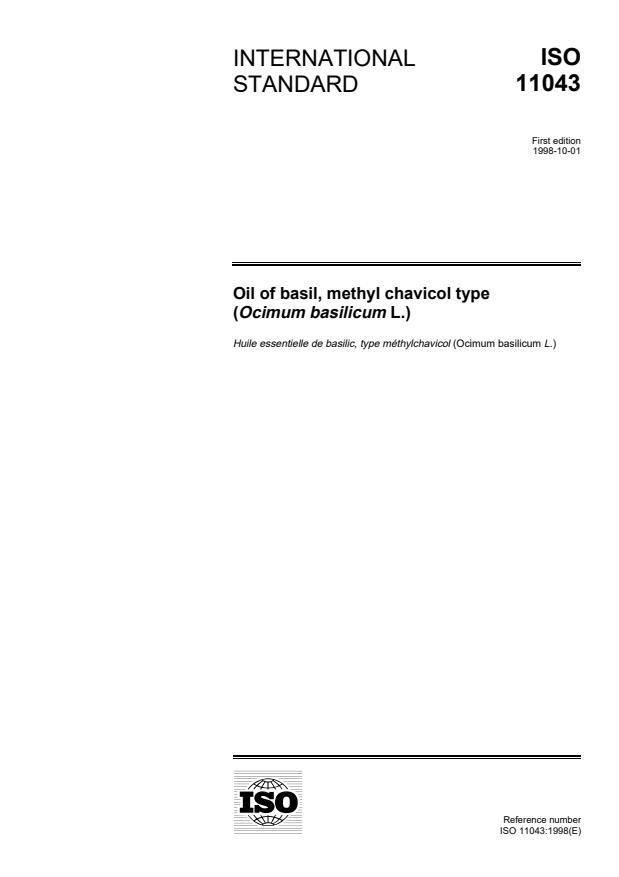
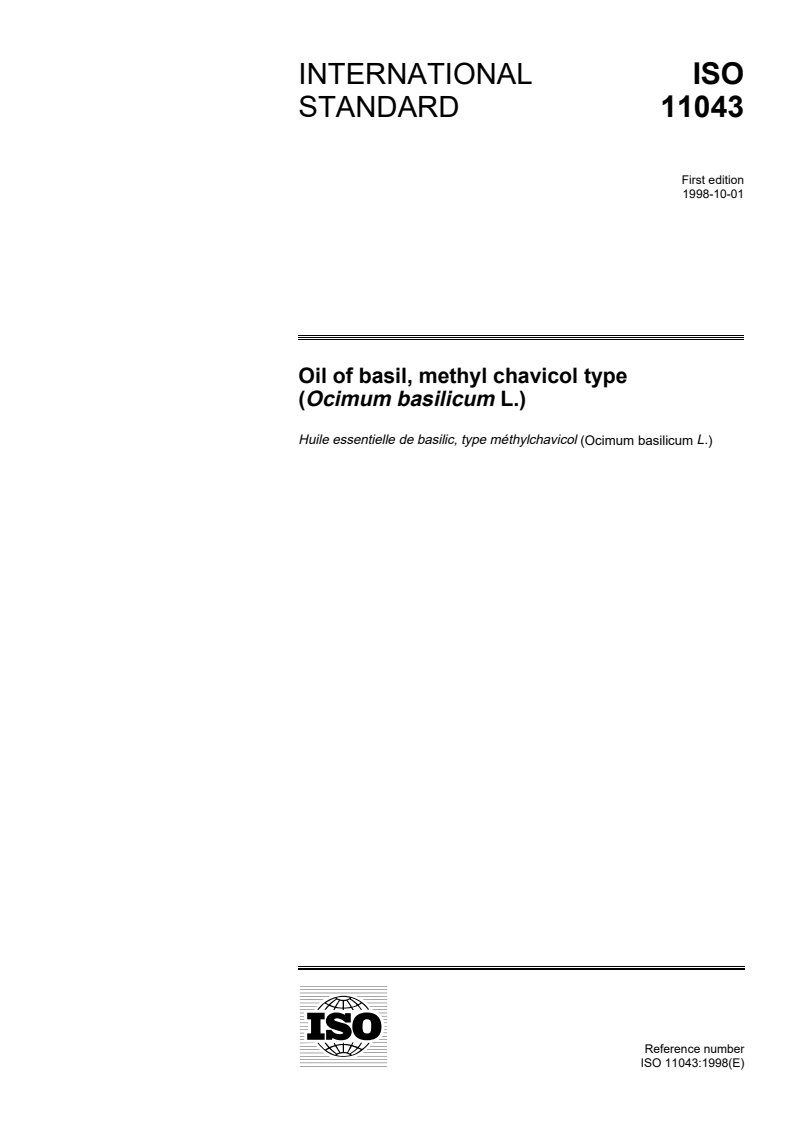
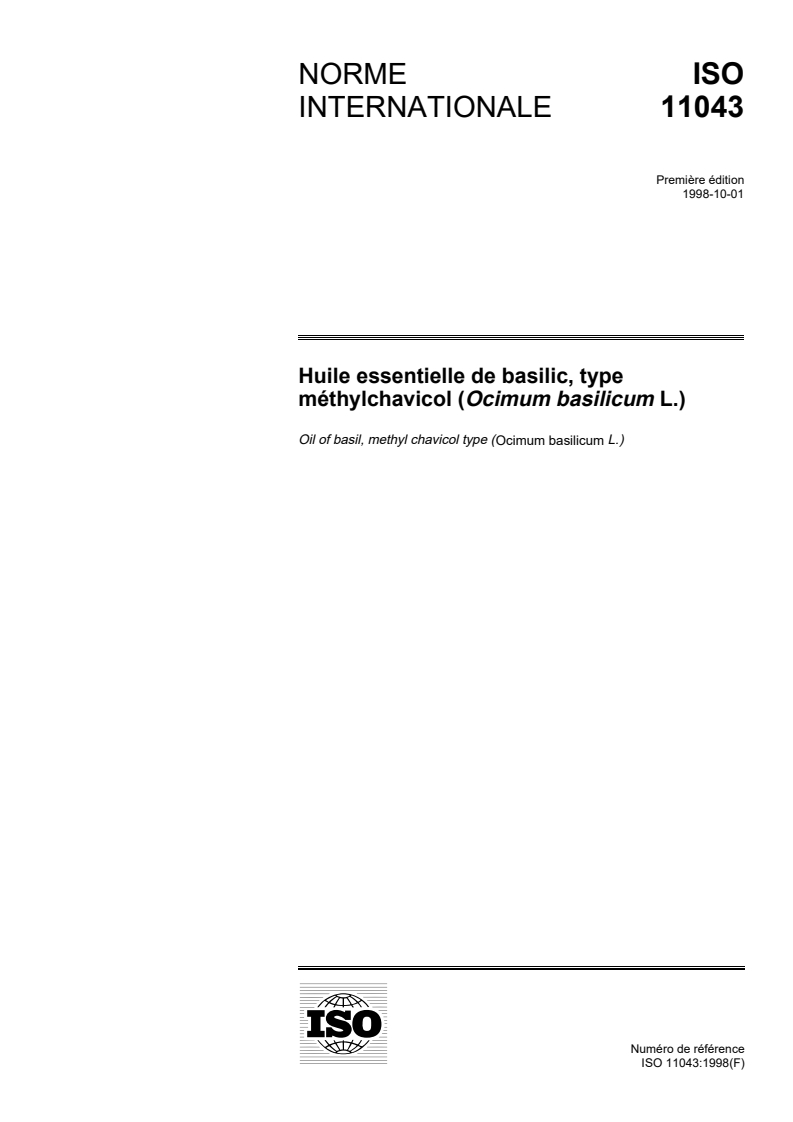
INTERNATIONAL ISO
STANDARD 11043
First edition
1998-10-01
Oil of basil, methyl chavicol type
(Ocimum basilicum L.)
Huile essentielle de basilic, type méthylchavicol (Ocimum basilicum L.)
A
Reference number
Foreword
ISO (the International Organization for Standardization) is a worldwide
federation of national standards bodies (ISO member bodies). The work of
preparing International Standards is normally carried out through ISO
technical committees. Each member body interested in a subject for which
a technical committee has been established has the right to be represented
on that committee. International organizations, governmental and non-
governmental, in liaison with ISO, also take part in the work. ISO collab-
orates closely with the International Electrotechnical Commission (IEC) on
all matters of electrotechnical standardization.
Draft International Standards adopted by the technical committees are
circulated to the member bodies for voting. Publication as an International
Standard requires approval by at least 75 % of the member bodies casting
a vote.
International Standards are drafted in accordance with the rules given in
the ISO/IEC Directives, Part 3.
International Standard ISO 11043 was prepared by Technical Committee
ISO/TC 54, Essential oils.
Annexes A and B of this International Standard are for information only.
© ISO 1998
All rights reserved. Unless otherwise specified, no part of this publication may be reproduced
or utilized in any form or by any means, electronic or mechanical, including photocopying and
microfilm, without permission in writing from the publisher.
International Organization for Standardization
Case postale 56 • CH-1211 Genève 20 • Switzerland
Internet iso@iso.ch
Printed in Switzerland
ii
©
INTERNATIONAL STANDARD ISO ISO 11043:1998(E)
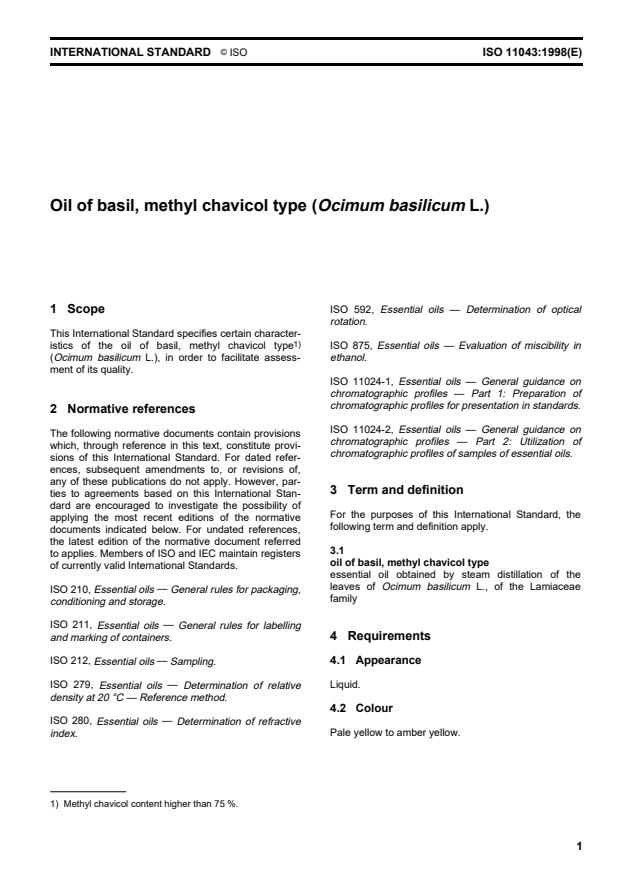
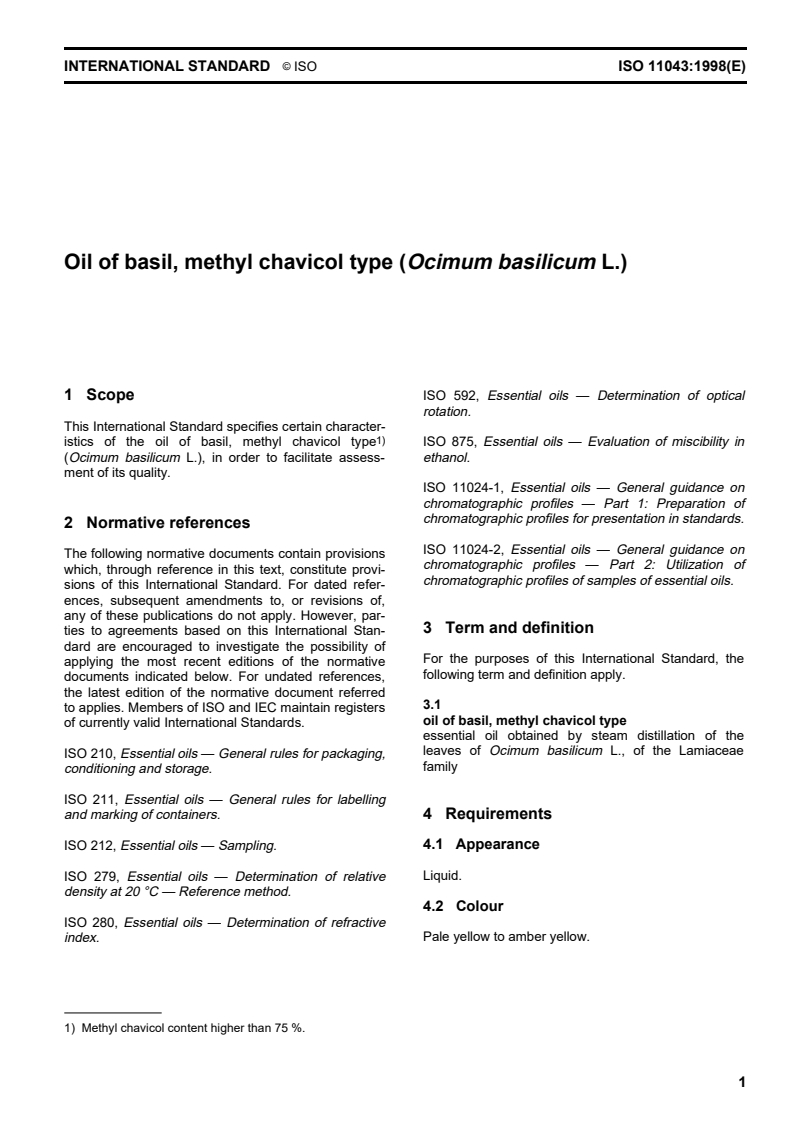
Oil of basil, methyl chavicol type (Ocimum basilicum L.)
1 Scope ISO 592, Essential oils — Determination of optical
rotation.
This International Standard specifies certain character-
1)
istics of the oil of basil, methyl chavicol type ISO 875, —
Essential oils Evaluation of miscibility in
(Ocimum basilicum L.), in order to facilitate assess- ethanol.
ment of its quality.
ISO 11024-1, Essential oils — General guidance on
chromatographic profiles — Part 1: Preparation of
chromatographic profiles for presentation in standards.
2 Normative references
ISO 11024-2, Essential oils — General guidance on
The following normative documents contain provisions
chromatographic profiles — Part 2: Utilization of
which, through reference in this text, constitute provi-
chromatographic profiles of samples of essential oils.
sions of this International Standard. For dated refer-
ences, subsequent amendments to, or revisions of,
any of these publications do not apply. However, par-
3 Term and definition
ties to agreements based on this International Stan-
dard are encouraged to investigate the possibility of
For the purposes of this International Standard, the
applying the most recent editions of the normative
following term and definition apply.
documents indicated below. For undated references,
the latest edition of the normative document referred
3.1
to applies. Members of ISO and IEC maintain registers
oil of basil, methyl chavicol type
of currently valid International Standards.
essential oil obtained by steam distillation of the
leaves of Ocimum basilicum L., of the Lamiaceae
ISO 210, Essential oils — General rules for packaging,
family
conditioning and storage.
ISO 211, Essential oils — General rules for labelling
and marking of containers. 4 Requirements
ISO 212, — 4.1 Appearance
Essential oils Sampling.
Liquid.
ISO 279, Essential oils — Determination of relative
density at 20 °C — Reference method.
4.2 Colour
ISO 280, Essential oils — Determination of refractive
Pale yellow to amber yellow.
index.
1) Methyl chavicol content higher than 75 %.
©
ISO
4.3 Odour
5 Sampling
Characteristic, spicy, slightly aniseed. See ISO 212.
4.4 Relative density at 20 °C, Minimum volume of final sample: 25 ml.
d 20
NOTE This volume allows each of the tests specified in
Minimum: 0,948
this International Standard to be carried out at least once.
Maximum: 0,970
4.5 Refractive index at 20 °C
6 Test methods
Minimum: 1,510 0
6.1 Relative density at 20 °C,
d 20
Maximum: 1,520 0
See ISO 27
...
NORME ISO
INTERNATIONALE 11043
Première édition
1998-10-01
Huile essentielle de basilic, type
méthylchavicol (Ocimum basilicum L.)
Oil of basil, methyl chavicol type (Ocimum basilicum L.)
A
Numéro de référence
Avant-propos
L'ISO (Organisation internationale de normalisation) est une fédération
mondiale d'organismes nationaux de normalisation (comités membres de
l'ISO). L'élaboration des Normes internationales est en général confiée aux
comités techniques de l'ISO. Chaque comité membre intéressé par une
étude a le droit de faire partie du comité technique créé à cet effet. Les
organisations internationales, gouvernementales et non gouvernementales,
en liaison avec l'ISO participent également aux travaux. L'ISO collabore
étroitement avec la Commission électrotechnique internationale (CEI) en
ce qui concerne la normalisation électrotechnique.
Les Normes internationales sont rédigées conformément aux règles don-
nées dans les Directives ISO/CEI, Partie 3.
Les projets de Normes internationales adoptés par les comités techniques
sont soumis aux comités membres pour vote. Leur publication comme
Normes internationales requiert l'approbation de 75 % au moins des comi-
tés membres votants.
La Norme internationale ISO 11043 a été élaborée par le comité technique
ISO/TC 54, Huiles essentielles.
Les annexes A et B de la présente Norme internationale sont données
uniquement à titre d’information.
© ISO 1998
Droits de reproduction réservés. Sauf prescription différente, aucune partie de cette publi-
cation ne peut être reproduite ni utilisée sous quelque forme que ce soit et par aucun pro-
cédé, électronique ou mécanique, y compris la photocopie et les microfilms, sans l'accord
écrit de l'éditeur.
Organisation internationale de normalisation
Case postale 56 • CH-1211 Genève 20 • Suisse
Internet iso@iso.ch
Imprimé en Suisse
ii
©
NORME INTERNATIONALE ISO ISO 11043:1998(F)
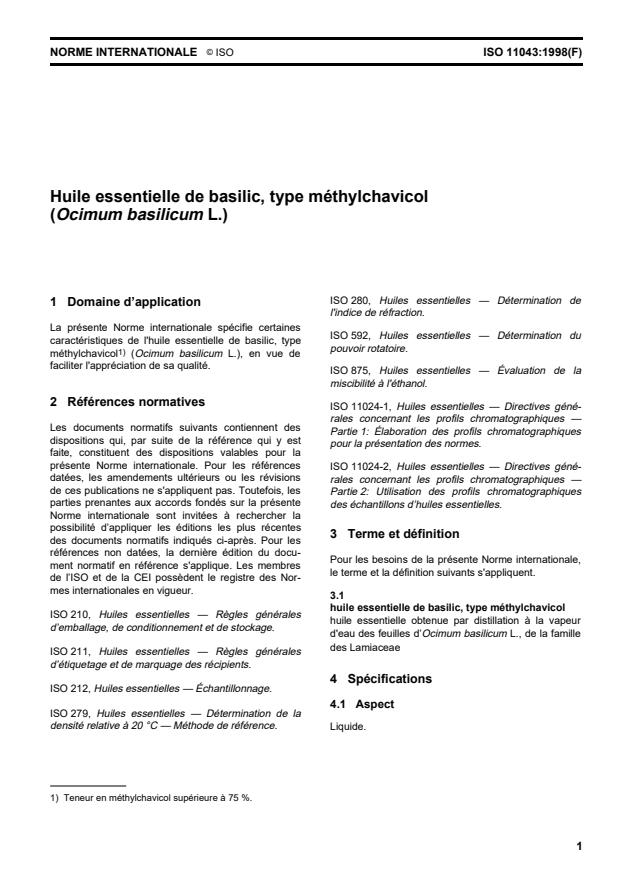
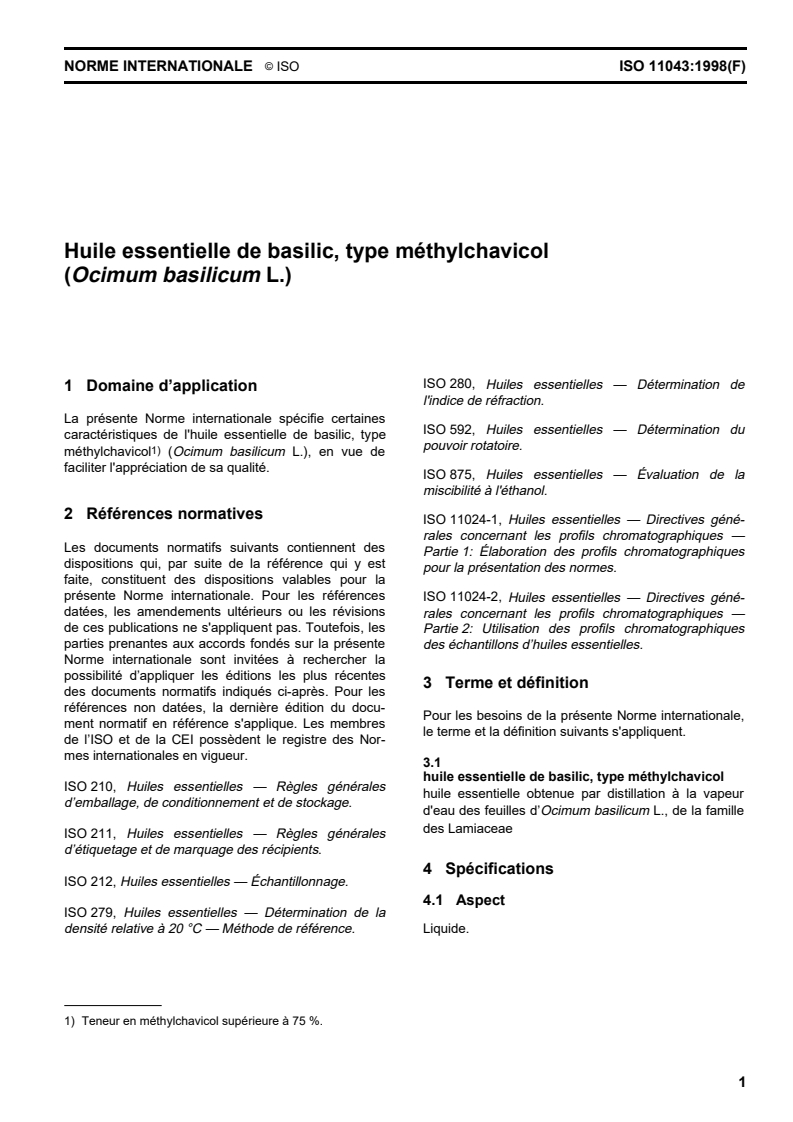
Huile essentielle de basilic, type méthylchavicol
(Ocimum basilicum L.)
ISO 280, Huiles essentielles — Détermination de
1 Domaine d’application
l'indice de réfraction.
La présente Norme internationale spécifie certaines
ISO 592, Huiles essentielles — Détermination du
caractéristiques de l'huile essentielle de basilic, type
pouvoir rotatoire.
1)
méthylchavicol (Ocimum basilicum L.), en vue de
faciliter l'appréciation de sa qualité.
ISO 875, Huiles essentielles — Évaluation de la
miscibilité à l'éthanol.
2 Références normatives
ISO 11024-1, Huiles essentielles — Directives géné-
rales concernant les profils chromatographiques —
Les documents normatifs suivants contiennent des
Partie 1: Élaboration des profils chromatographiques
dispositions qui, par suite de la référence qui y est
pour la présentation des normes.
faite, constituent des dispositions valables pour la
présente Norme internationale. Pour les références
ISO 11024-2, Huiles essentielles — Directives géné-
datées, les amendements ultérieurs ou les révisions
rales concernant les profils chromatographiques —
de ces publications ne s'appliquent pas. Toutefois, les
Partie 2: Utilisation des profils chromatographiques
parties prenantes aux accords fondés sur la présente
des échantillons d’huiles essentielles.
Norme internationale sont invitées à rechercher la
possibilité d’appliquer les éditions les plus récentes
3 Terme et définition
des documents normatifs indiqués ci-après. Pour les
références non datées, la dernière édition du docu-
Pour les besoins de la présente Norme internationale,
ment normatif en référence s'applique. Les membres
le terme et la définition suivants s'appliquent.
de l’ISO et de la CEI possèdent le registre des Nor-
mes internationales en vigueur.
3.1
huile essentielle de basilic, type méthylchavicol
ISO 210, Huiles essentielles — Règles générales
huile essentielle obtenue par distillation à la vapeur
d’emballage, de conditionnement et de stockage.
d'eau des feuilles d’Ocimum basilicum L., de la famille
des Lamiaceae
ISO 211, Huiles essentielles — Règles générales
d’étiquetage et de marquage des récipients.
4 Spécifications
ISO 212, Huiles essentielles — Échantillonnage.
4.1 Aspect
ISO 279, Huiles essentielles — Détermination de la
densité relative à 20 °C — Méthode de référence. Liquide.
1) Teneur en méthylchavicol supérieure à 75 %.
©
ISO
4.2 Couleur 5 Échantillonnage
Jaune pâle à jaune ambré. Voir l’ISO 212.
4.3 Odeur Volume minimal de l’échantillon pour essai: 25 ml.
Caractéristique, épicée, légèrement anisée. NOTE Ce volume permet d’effectuer au moins une fois
chacun des essais spécifiés dans la présente Norme inter-
4.4 Densité relative à 20 °C
d nationale.
Minimum: 0,948
Maximum: 0,970
6 Méthodes d’essai
4.5 Indice de réfraction à 20 °C
6.1 Densité relative à 20 °C
d
Minimum: 1,510 0
Voir l’ISO 279.
Max
...