

ISO 1183-1:2019
(Main)Plastics — Methods for determining the density of non-cellular plastics — Part 1: Immersion method, liquid pycnometer method and titration method
General Information
- Abstract
This document specifies three methods for the determination of the density of non-cellular plastics in the form of void-free moulded or extruded objects, as well as powders, flakes and granules. — Method A: Immersion method, for solid plastics (except for powders) in void-free form. — Method B: Liquid pycnometer method, for particles, powders, flakes, granules or small pieces of finished parts. — Method C: Titration method, for plastics in any void-free form. NOTE Density is frequently used to follow variations in physical structure or composition of plastic materials. Density can also be useful in assessing the uniformity of samples or specimens. Often, the density of plastic materials depend upon the choice of specimen preparation method. When this is the case, precise details of the specimen preparation method are intended to be included in the appropriate material specification. This note is applicable to all three methods.
- Status
- Withdrawn
- Publication Date
- 27-Feb-2019
- Technical Committee
- ISO/TC 61/SC 5 - Physical-chemical properties
- Drafting Committee
- ISO/TC 61/SC 5/WG 11 - Analytical methods
- Current Stage
- 9599 - Withdrawal of International Standard
- Start Date
- 19-Jun-2025
- Completion Date
- 29-Aug-2026
Buy Documents
ISO 1183-1:2019 - Plastics -- Methods for determining the density of non-cellular plastics
ISO 1183-1:2019 - Plastics — Methods for determining the density of non-cellular plastics — Part 1: Immersion method, liquid pycnometer method and titration method/13/2019
ISO 1183-1:2019 - Plastiques -- Méthodes de détermination de la masse volumique des plastiques non alvéolaires
ISO 1183-1:2019 - Plastiques — Méthodes de détermination de la masse volumique des plastiques non alvéolaires — Partie 1: Méthode par immersion, méthode du pycnomètre en milieu liquide et méthode par titrage/28/2019
Overview
ISO 1183-1:2019 specifies standardized laboratory methods to determine the density of non-cellular plastics. It covers three validated procedures - the immersion method (Method A), the liquid pycnometer method (Method B) and the titration method (Method C) - and applies to void-free moulded or extruded objects as well as powders, flakes and granules. The standard defines apparatus, specimen preparation, test temperatures and calculation steps used to deliver traceable density results for plastics testing and quality control.
Key Topics
- Scope and applicability: Density determination for non-cellular plastics in void-free solid form (Method A), powders/granules/flakes (Method B) and any void-free form via titration (Method C).
- Apparatus and accuracy: Typical requirements include an analytical balance accurate to ±0.1 mg, pycnometer with overflow capillary, thermostatic liquid bath, desiccator (for powders), corrosion-resistant suspension wire (≤0.5 mm) and sinkers when needed.
- Immersion liquids and handling: Use distilled or de‑ionized water or suitable certified liquids; wetting agents limited to ≤0.1 % to reduce entrapped air. The liquid must not affect the specimen.
- Test conditions: Temperatures commonly specified at 23 °C ±2 °C (or 27 °C ±2 °C), with tighter tolerances (±0.5 °C) when measuring immersion liquid density.
- Calculation principles: Density is calculated from specimen mass in air and apparent mass when immersed, using the measured or certified density of the immersion liquid; methods account for sinkers and buoyancy corrections.
- Conditioning and reproducibility: Specimens are conditioned per ISO 291 when required; density can depend on specimen preparation and should be defined in material specifications.
- Quality elements: Minimum of three specimens recommended; Clause 6 addresses correction for air buoyancy. The 2019 edition revised the buoyancy correction.
Applications
ISO 1183-1:2019 is used by:
- Plastics manufacturers for product release testing and batch verification.
- Quality control and testing laboratories to provide consistent, traceable density data.
- R&D teams monitoring formulation or processing effects on material density.
- Material specifiers and purchasers verifying supplier claims.
- Recycling and sorting operations that rely on density differences for separation.
Typical practical uses include verifying composition/uniformity, detecting processing-induced structural changes, and supporting material identification and sorting workflows.
Related Standards
- ISO 291 - Plastics: standard atmospheres for conditioning and testing
- ISO 472 - Plastics: vocabulary
- Other parts of the ISO 1183 series (for alternative density/determination methods)
Keywords: ISO 1183-1:2019, density of plastics, immersion method, liquid pycnometer, titration method, non-cellular plastics, plastic density testing, buoyancy correction, specimen conditioning.
Relations
- Effective Date
- 25-Aug-2026
- Effective Date
- 25-Aug-2026
- Effective Date
- 25-Aug-2026
- Effective Date
- 25-Aug-2026
- Effective Date
- 25-Aug-2026
- Effective Date
- 25-Aug-2026
- Effective Date
- 25-Aug-2026
- Effective Date
- 25-Aug-2026
- Effective Date
- 25-Aug-2026
- Effective Date
- 25-Aug-2026
- Effective Date
- 25-Aug-2026
- Effective Date
- 25-Aug-2026
- Effective Date
- 25-Aug-2026
- Effective Date
- 25-Aug-2026
- Effective Date
- 25-Aug-2026
Buy Documents
ISO 1183-1:2019 - Plastics -- Methods for determining the density of non-cellular plastics
ISO 1183-1:2019 - Plastics — Methods for determining the density of non-cellular plastics — Part 1: Immersion method, liquid pycnometer method and titration method/13/2019
ISO 1183-1:2019 - Plastiques -- Méthodes de détermination de la masse volumique des plastiques non alvéolaires
ISO 1183-1:2019 - Plastiques — Méthodes de détermination de la masse volumique des plastiques non alvéolaires — Partie 1: Méthode par immersion, méthode du pycnomètre en milieu liquide et méthode par titrage/28/2019
Get Certified
Connect with accredited certification bodies for this standard

DIN CERTCO
DIN Group product certification.

Smithers Quality Assessments
US management systems and product certification.
Sponsored listings
Frequently Asked Questions
ISO 1183-1:2019 is a standard published by the International Organization for Standardization (ISO). Its full title is "Plastics — Methods for determining the density of non-cellular plastics — Part 1: Immersion method, liquid pycnometer method and titration method". This standard covers: This document specifies three methods for the determination of the density of non-cellular plastics in the form of void-free moulded or extruded objects, as well as powders, flakes and granules. — Method A: Immersion method, for solid plastics (except for powders) in void-free form. — Method B: Liquid pycnometer method, for particles, powders, flakes, granules or small pieces of finished parts. — Method C: Titration method, for plastics in any void-free form. NOTE Density is frequently used to follow variations in physical structure or composition of plastic materials. Density can also be useful in assessing the uniformity of samples or specimens. Often, the density of plastic materials depend upon the choice of specimen preparation method. When this is the case, precise details of the specimen preparation method are intended to be included in the appropriate material specification. This note is applicable to all three methods.
This document specifies three methods for the determination of the density of non-cellular plastics in the form of void-free moulded or extruded objects, as well as powders, flakes and granules. — Method A: Immersion method, for solid plastics (except for powders) in void-free form. — Method B: Liquid pycnometer method, for particles, powders, flakes, granules or small pieces of finished parts. — Method C: Titration method, for plastics in any void-free form. NOTE Density is frequently used to follow variations in physical structure or composition of plastic materials. Density can also be useful in assessing the uniformity of samples or specimens. Often, the density of plastic materials depend upon the choice of specimen preparation method. When this is the case, precise details of the specimen preparation method are intended to be included in the appropriate material specification. This note is applicable to all three methods.
ISO 1183-1:2019 is classified under the following ICS (International Classification for Standards) categories: 83.080.01 - Plastics in general. The ICS classification helps identify the subject area and facilitates finding related standards.
ISO 1183-1:2019 has the following relationships with other standards: It is inter standard links to EN ISO 17855-2:2024, EN ISO 12736-1:2023, EN ISO 24025-2:2020, EN ISO 12736-3:2023, EN ISO 6721-3:2021, EN ISO 23936-1:2022, EN ISO 7823-3:2021, EN 4717:2022, EN ISO 14632:2021, EN ISO 23936-4:2024, EN ISO 24023-2:2020, EN ISO 11296-9:2022, EN ISO 16396-2:2022, EN ISO 19063-2:2020, EN ISO 11833-1:2019. Understanding these relationships helps ensure you are using the most current and applicable version of the standard.
ISO 1183-1:2019 is available in PDF format for immediate download after purchase. The document can be added to your cart and obtained through the secure checkout process. Digital delivery ensures instant access to the complete standard document.
Standards Content (Sample)
INTERNATIONAL ISO
STANDARD 1183-1
Third edition
2019-03
Corrected version
2019-05
Plastics — Methods for determining
the density of non-cellular plastics —
Part 1:
Immersion method, liquid pycnometer
method and titration method
Plastiques — Méthodes de détermination de la masse volumique des
plastiques non alvéolaires —
Partie 1: Méthode par immersion, méthode du pycnomètre en milieu
liquide et méthode par titrage
Reference number
©
ISO 2019
© ISO 2019
All rights reserved. Unless otherwise specified, or required in the context of its implementation, no part of this publication may
be reproduced or utilized otherwise in any form or by any means, electronic or mechanical, including photocopying, or posting
on the internet or an intranet, without prior written permission. Permission can be requested from either ISO at the address
below or ISO’s member body in the country of the requester.
ISO copyright office
CP 401 • Ch. de Blandonnet 8
CH-1214 Vernier, Geneva
Phone: +41 22 749 01 11
Fax: +41 22 749 09 47
Email: copyright@iso.org
Website: www.iso.org
Published in Switzerland
ii © ISO 2019 – All rights reserved
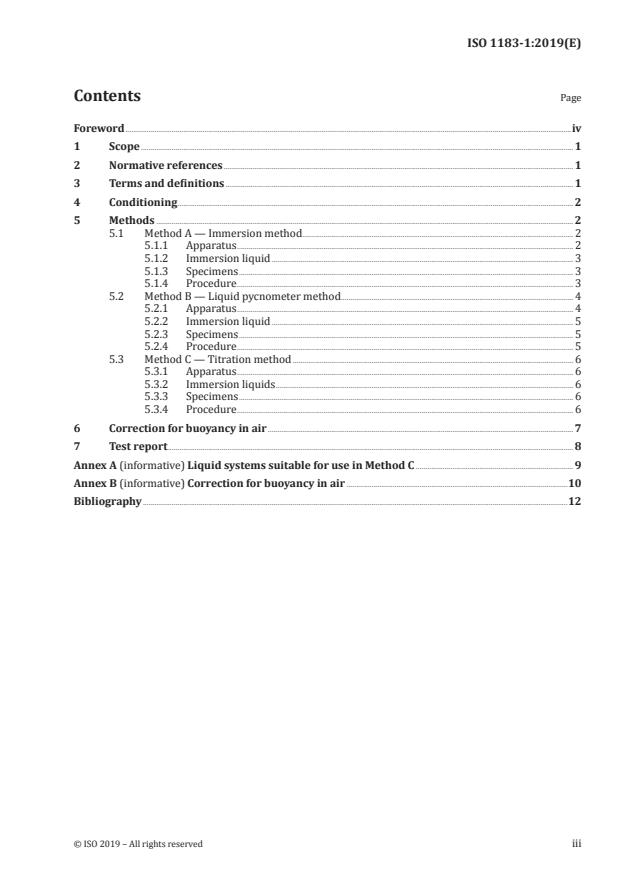
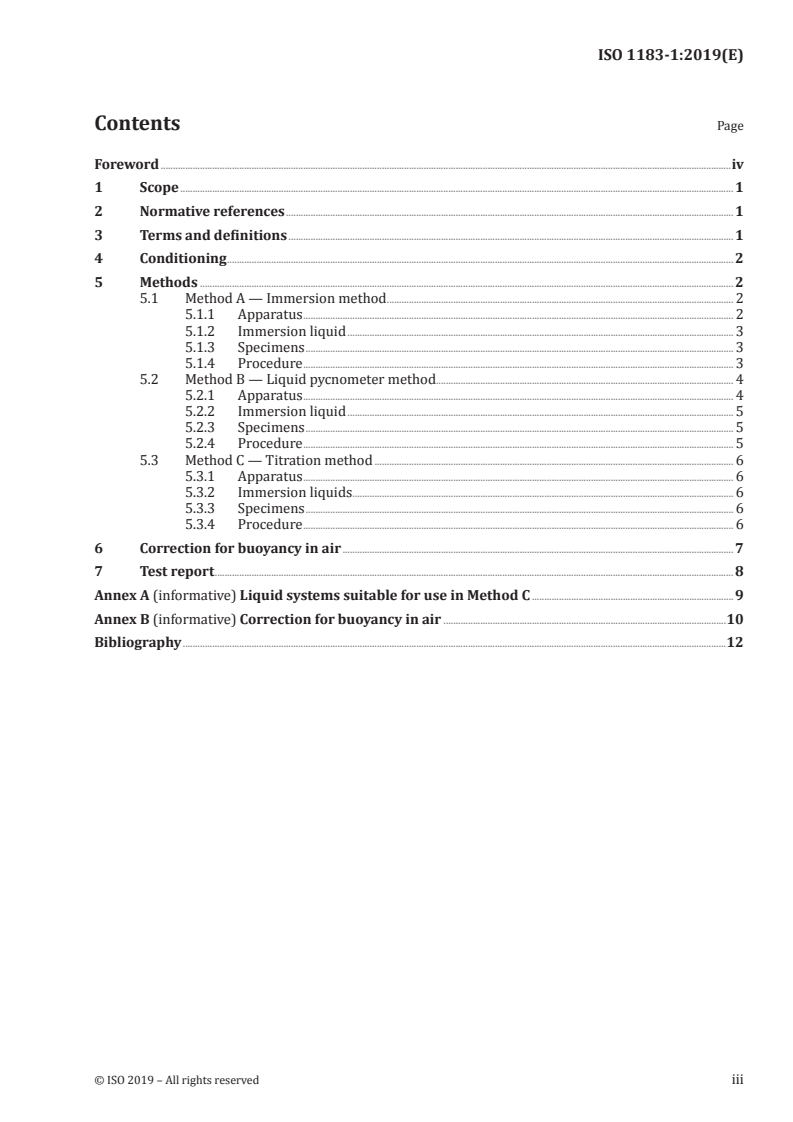
Contents Page
Foreword .iv
1 Scope . 1
2 Normative references . 1
3 Terms and definitions . 1
4 Conditioning . 2
5 Methods . 2
5.1 Method A — Immersion method . 2
5.1.1 Apparatus . 2
5.1.2 Immersion liquid . 3
5.1.3 Specimens . 3
5.1.4 Procedure . 3
5.2 Method B — Liquid pycnometer method. 4
5.2.1 Apparatus . 4
5.2.2 Immersion liquid . 5
5.2.3 Specimens . 5
5.2.4 Procedure . 5
5.3 Method C — Titration method . 6
5.3.1 Apparatus . 6
5.3.2 Immersion liquids . 6
5.3.3 Specimens . 6
5.3.4 Procedure . 6
6 Correction for buoyancy in air . 7
7 Test report . 8
Annex A (informative) Liquid systems suitable for use in Method C . 9
Annex B (informative) Correction for buoyancy in air .10
Bibliography .12
Foreword
ISO (the International Organization for Standardization) is a worldwide federation of national standards
bodies (ISO member bodies). The work of preparing International Standards is normally carried out
through ISO technical committees. Each member body interested in a subject for which a technical
committee has been established has the right to be represented on that committee. International
organizations, governmental and non-governmental, in liaison with ISO, also take part in the work.
ISO collaborates closely with the International Electrotechnical Commission (IEC) on all matters of
electrotechnical standardization.
The procedures used to develop this document and those intended for its further maintenance are
described in the ISO/IEC Directives, Part 1. In particular the different approval criteria needed for the
different types of ISO documents should be noted. This document was drafted in accordance with the
editorial rules of the ISO/IEC Directives, Part 2 (see www .iso .org/directives).
Attention is drawn to the possibility that some of the elements of this document may be the subject of
patent rights. ISO shall not be held responsible for identifying any or all such patent rights. Details of
any patent rights identified during the development of the document will be in the Introduction and/or
on the ISO list of patent declarations received (see www .iso .org/patents).
Any trade name used in this document is information given for the convenience of users and does not
constitute an endorsement.
For an explanation on the voluntary nature of standards, the meaning of ISO specific terms and
expressions related to conformity assessment, as well as information about ISO's adherence to the
World Trade Organization (WTO) principles in the Technical Barriers to Trade (TBT) see the following
URL: www .iso .org/iso/foreword .html.
This document was prepared by Technical Committee ISO/TC 61, Plastics, Subcommittee SC 5, Physical-
chemical properties.
This third edition cancels and replaces the second edition (ISO 1183-1:2012), which has been technically
revised. The main changes compared to the previous edition are as follows:
— the buoyancy correction has been revised.
A list of all parts in the ISO 1183 series can be found on the ISO website.
Any feedback or questions on this document should be directed to the user’s national standards body. A
complete listing of these bodies can be found at www .iso .org/members .html.
This corrected version of ISO 1183-1:2019 incorporates the following corrections:
— correction of the definition of Formula (2).
iv © ISO 2019 – All rights reserved
INTERNATIONAL STANDARD ISO 1183-1:2019(E)
Plastics — Methods for determining the density of non-
cellular plastics —
Part 1:
Immersion method, liquid pycnometer method and
titration method
WARNING — The use of this document might involve hazardous materials, operations or
equipment. This document does not purport to address all of the safety problems, if any,
associated with its use. It is the responsibility of the user of this document to establish
appropriate health and safety practices.
1 Scope
This document specifies three methods for the determination of the density of non-cellular plastics in
the form of void-free moulded or extruded objects, as well as powders, flakes and granules.
— Method A: Immersion method, for solid plastics (except for powders) in void-free form.
— Method B: Liquid pycnometer method, for particles, powders, flakes, granules or small pieces of
finished parts.
— Method C: Titration method, for plastics in any void-free form.
NOTE Density is frequently used to follow variations in physical structure or composition of plastic
materials. Density can also be useful in assessing the uniformity of samples or specimens. Often, the density of
plastic materials depend upon the choice of specimen preparation method. When this is the case, precise details
of the specimen preparation method are intended to be included in the appropriate material specification. This
note is applicable to all three methods.
2 Normative references
The following documents are referred to in the text in such a way that some or all of their content
constitutes requirements of this document. For dated references, only the edition cited applies. For
undated references, the latest edition of the referenced document (including any amendments) applies.
ISO 291, Plastics — Standard atmospheres for conditioning and testing
ISO 472, Plastics — Vocabulary
3 Terms and definitions
For the purposes of this document, the terms and definitions given in ISO 472 and the following apply.
ISO and IEC maintain terminological databases for use in standardization at the following addresses:
— ISO Online browsing platform: available at https: //www .iso .org/obp
— IEC Electropedia: available at http: //www .electropedia .org/
3.1
mass
m
quantity of matter contained in a body
Note 1 to entry: It is expressed in kilograms (kg) or grams (g).
3.2
apparent mass
m
APP
mass of a body obtained by measuring its weight using an appropriately calibrated balance
Note 1 to entry: It is expressed in kilograms (kg) or grams (g).
3.3
density
ρ
3 3
ratio of the mass m of a sample to its volume V (at the temperature T), expressed in kg/m , kg/dm (g/
3)
cm or kg/l (g/ml)
[1]
Note 1 to entry: The following terms, based upon ISO 80000-4 , are given in Table 1 for clarification.
Table 1 — Density terms
Term Symbol Formulation Units
kg/m
3 3
Density ρ m/V kg/dm (g/cm )
kg/l (g/ml)
m /kg
3 3
Specific volume v V/m (= 1/ρ) dm /kg (cm /g)
l/kg (ml/g)
4 Conditioning
The test atmosphere shall be in accordance with ISO 291. In general, conditioning specimens to constant
temperature is not required, because the determination itself brings the specimen to the constant
temperature of the test.
Specimens which change in density during the test to such an extent that the change is greater than the
required accuracy shall be conditioned prior to measurement in accordance with the applicable material
specification. When changes in density with time or atmospheric conditions are the primary purpose of
the measurements, the specimens shall be conditioned as described in the material specification and, if
no material specification exists, then as agreed upon by the interested parties.
5 Methods
5.1 Method A — Immersion method
5.1.1 Apparatus
5.1.1.1 Analytical balance or instrument specifically designed for measurement of density,
accurate to ±0,1 mg.
An automatically operating instrument may be used. The calculation of density may be done
automatically using a computer or software integrated into the analytical balance.
2 © ISO 2019 – All rights reserved
5.1.1.2 Immersion vessel: a beaker or other wide-mouthed container of suitable size for holding the
immersion liquid.
5.1.1.3 Stationary support, e.g. a pan straddle, to hold the immersion vessel above the balance pan.
5.1.1.4 Thermometer, graduated at 0,1 °C intervals, covering the range 0 °C to 30 °C.
5.1.1.5 Wire (if required), corrosion-resistant, of diameter not greater than 0,5 mm, for suspending
specimens in the immersion liquid.
5.1.1.6 Sinker, of suitable mass to ensure complete immersion of the specimen, for use when the
density of the specimen is less than that of the immersion liquid.
5.1.1.7 Pycnometer, with a side-arm overflow capillary, for determining the density of the immersion
liquid when this liquid is not water. The pycnometer shall be equipped with a thermometer graduated at
0,1 °C intervals from 0 °C to 30 °C.
5.1.1.8 Liquid bath, capable of being thermostatically controlled to within ±0,5 °C, for use in
determining the density of the immersion liquid.
5.1.2 Immersion liquid
Use freshly distilled or deionized water, or another suitable liquid, containing not more than 0,1 % of
a wetting agent to help in removing air bubbles. The liquid or solution with which the specimen comes
into contact during the measurement shall have no effect on the specimen.
The density of immersion liquids other than distilled water need not be measured provided they are
obtained from an accredited source and are accompanied by a certificate.
5.1.3 Specimens
Specimens may be in any void-free form except for powder. They shall be of a convenient size to give
adequate clearance between the specimen and the immersion vessel and should preferably have a mass
of at least 1 g.
When cutting specimens from larger samples, proper equipment shall be used to ensure that the
characteristics of the material do not change. The surface of the specimen shall be smooth and f
...
INTERNATIONAL ISO
STANDARD 1183-1
Third edition
2019-03
Corrected version
2019-05
Plastics — Methods for determining
the density of non-cellular plastics —
Part 1:
Immersion method, liquid pycnometer
method and titration method
Plastiques — Méthodes de détermination de la masse volumique des
plastiques non alvéolaires —
Partie 1: Méthode par immersion, méthode du pycnomètre en milieu
liquide et méthode par titrage
Reference number
©
ISO 2019
© ISO 2019
All rights reserved. Unless otherwise specified, or required in the context of its implementation, no part of this publication may
be reproduced or utilized otherwise in any form or by any means, electronic or mechanical, including photocopying, or posting
on the internet or an intranet, without prior written permission. Permission can be requested from either ISO at the address
below or ISO’s member body in the country of the requester.
ISO copyright office
CP 401 • Ch. de Blandonnet 8
CH-1214 Vernier, Geneva
Phone: +41 22 749 01 11
Fax: +41 22 749 09 47
Email: copyright@iso.org
Website: www.iso.org
Published in Switzerland
ii © ISO 2019 – All rights reserved
Contents Page
Foreword .iv
1 Scope . 1
2 Normative references . 1
3 Terms and definitions . 1
4 Conditioning . 2
5 Methods . 2
5.1 Method A — Immersion method . 2
5.1.1 Apparatus . 2
5.1.2 Immersion liquid . 3
5.1.3 Specimens . 3
5.1.4 Procedure . 3
5.2 Method B — Liquid pycnometer method. 4
5.2.1 Apparatus . 4
5.2.2 Immersion liquid . 5
5.2.3 Specimens . 5
5.2.4 Procedure . 5
5.3 Method C — Titration method . 6
5.3.1 Apparatus . 6
5.3.2 Immersion liquids . 6
5.3.3 Specimens . 6
5.3.4 Procedure . 6
6 Correction for buoyancy in air . 7
7 Test report . 8
Annex A (informative) Liquid systems suitable for use in Method C . 9
Annex B (informative) Correction for buoyancy in air .10
Bibliography .12
Foreword
ISO (the International Organization for Standardization) is a worldwide federation of national standards
bodies (ISO member bodies). The work of preparing International Standards is normally carried out
through ISO technical committees. Each member body interested in a subject for which a technical
committee has been established has the right to be represented on that committee. International
organizations, governmental and non-governmental, in liaison with ISO, also take part in the work.
ISO collaborates closely with the International Electrotechnical Commission (IEC) on all matters of
electrotechnical standardization.
The procedures used to develop this document and those intended for its further maintenance are
described in the ISO/IEC Directives, Part 1. In particular the different approval criteria needed for the
different types of ISO documents should be noted. This document was drafted in accordance with the
editorial rules of the ISO/IEC Directives, Part 2 (see www .iso .org/directives).
Attention is drawn to the possibility that some of the elements of this document may be the subject of
patent rights. ISO shall not be held responsible for identifying any or all such patent rights. Details of
any patent rights identified during the development of the document will be in the Introduction and/or
on the ISO list of patent declarations received (see www .iso .org/patents).
Any trade name used in this document is information given for the convenience of users and does not
constitute an endorsement.
For an explanation on the voluntary nature of standards, the meaning of ISO specific terms and
expressions related to conformity assessment, as well as information about ISO's adherence to the
World Trade Organization (WTO) principles in the Technical Barriers to Trade (TBT) see the following
URL: www .iso .org/iso/foreword .html.
This document was prepared by Technical Committee ISO/TC 61, Plastics, Subcommittee SC 5, Physical-
chemical properties.
This third edition cancels and replaces the second edition (ISO 1183-1:2012), which has been technically
revised. The main changes compared to the previous edition are as follows:
— the buoyancy correction has been revised.
A list of all parts in the ISO 1183 series can be found on the ISO website.
Any feedback or questions on this document should be directed to the user’s national standards body. A
complete listing of these bodies can be found at www .iso .org/members .html.
This corrected version of ISO 1183-1:2019 incorporates the following corrections:
— correction of the definition of Formula (2).
iv © ISO 2019 – All rights reserved
INTERNATIONAL STANDARD ISO 1183-1:2019(E)
Plastics — Methods for determining the density of non-
cellular plastics —
Part 1:
Immersion method, liquid pycnometer method and
titration method
WARNING — The use of this document might involve hazardous materials, operations or
equipment. This document does not purport to address all of the safety problems, if any,
associated with its use. It is the responsibility of the user of this document to establish
appropriate health and safety practices.
1 Scope
This document specifies three methods for the determination of the density of non-cellular plastics in
the form of void-free moulded or extruded objects, as well as powders, flakes and granules.
— Method A: Immersion method, for solid plastics (except for powders) in void-free form.
— Method B: Liquid pycnometer method, for particles, powders, flakes, granules or small pieces of
finished parts.
— Method C: Titration method, for plastics in any void-free form.
NOTE Density is frequently used to follow variations in physical structure or composition of plastic
materials. Density can also be useful in assessing the uniformity of samples or specimens. Often, the density of
plastic materials depend upon the choice of specimen preparation method. When this is the case, precise details
of the specimen preparation method are intended to be included in the appropriate material specification. This
note is applicable to all three methods.
2 Normative references
The following documents are referred to in the text in such a way that some or all of their content
constitutes requirements of this document. For dated references, only the edition cited applies. For
undated references, the latest edition of the referenced document (including any amendments) applies.
ISO 291, Plastics — Standard atmospheres for conditioning and testing
ISO 472, Plastics — Vocabulary
3 Terms and definitions
For the purposes of this document, the terms and definitions given in ISO 472 and the following apply.
ISO and IEC maintain terminological databases for use in standardization at the following addresses:
— ISO Online browsing platform: available at https: //www .iso .org/obp
— IEC Electropedia: available at http: //www .electropedia .org/
3.1
mass
m
quantity of matter contained in a body
Note 1 to entry: It is expressed in kilograms (kg) or grams (g).
3.2
apparent mass
m
APP
mass of a body obtained by measuring its weight using an appropriately calibrated balance
Note 1 to entry: It is expressed in kilograms (kg) or grams (g).
3.3
density
ρ
3 3
ratio of the mass m of a sample to its volume V (at the temperature T), expressed in kg/m , kg/dm (g/
3)
cm or kg/l (g/ml)
[1]
Note 1 to entry: The following terms, based upon ISO 80000-4 , are given in Table 1 for clarification.
Table 1 — Density terms
Term Symbol Formulation Units
kg/m
3 3
Density ρ m/V kg/dm (g/cm )
kg/l (g/ml)
m /kg
3 3
Specific volume v V/m (= 1/ρ) dm /kg (cm /g)
l/kg (ml/g)
4 Conditioning
The test atmosphere shall be in accordance with ISO 291. In general, conditioning specimens to constant
temperature is not required, because the determination itself brings the specimen to the constant
temperature of the test.
Specimens which change in density during the test to such an extent that the change is greater than the
required accuracy shall be conditioned prior to measurement in accordance with the applicable material
specification. When changes in density with time or atmospheric conditions are the primary purpose of
the measurements, the specimens shall be conditioned as described in the material specification and, if
no material specification exists, then as agreed upon by the interested parties.
5 Methods
5.1 Method A — Immersion method
5.1.1 Apparatus
5.1.1.1 Analytical balance or instrument specifically designed for measurement of density,
accurate to ±0,1 mg.
An automatically operating instrument may be used. The calculation of density may be done
automatically using a computer or software integrated into the analytical balance.
2 © ISO 2019 – All rights reserved
5.1.1.2 Immersion vessel: a beaker or other wide-mouthed container of suitable size for holding the
immersion liquid.
5.1.1.3 Stationary support, e.g. a pan straddle, to hold the immersion vessel above the balance pan.
5.1.1.4 Thermometer, graduated at 0,1 °C intervals, covering the range 0 °C to 30 °C.
5.1.1.5 Wire (if required), corrosion-resistant, of diameter not greater than 0,5 mm, for suspending
specimens in the immersion liquid.
5.1.1.6 Sinker, of suitable mass to ensure complete immersion of the specimen, for use when the
density of the specimen is less than that of the immersion liquid.
5.1.1.7 Pycnometer, with a side-arm overflow capillary, for determining the density of the immersion
liquid when this liquid is not water. The pycnometer shall be equipped with a thermometer graduated at
0,1 °C intervals from 0 °C to 30 °C.
5.1.1.8 Liquid bath, capable of being thermostatically controlled to within ±0,5 °C, for use in
determining the density of the immersion liquid.
5.1.2 Immersion liquid
Use freshly distilled or deionized water, or another suitable liquid, containing not more than 0,1 % of
a wetting agent to help in removing air bubbles. The liquid or solution with which the specimen comes
into contact during the measurement shall have no effect on the specimen.
The density of immersion liquids other than distilled water need not be measured provided they are
obtained from an accredited source and are accompanied by a certificate.
5.1.3 Specimens
Specimens may be in any void-free form except for powder. They shall be of a convenient size to give
adequate clearance between the specimen and the immersion vessel and should preferably have a mass
of at least 1 g.
When cutting specimens from larger samples, proper equipment shall be used to ensure that the
characteristics of the material do not change. The surface of the specimen shall be smooth and f
...
NORME ISO
INTERNATIONALE 1183-1
Troisième édition
2019-03
Plastiques — Méthodes de
détermination de la masse volumique
des plastiques non alvéolaires —
Partie 1:
Méthode par immersion, méthode
du pycnomètre en milieu liquide et
méthode par titrage
Plastics — Methods for determining the density of non-cellular
plastics —
Part 1: Immersion method, liquid pycnometer method and titration
method
Numéro de référence
©
ISO 2019
DOCUMENT PROTÉGÉ PAR COPYRIGHT
© ISO 2019
Tous droits réservés. Sauf prescription différente ou nécessité dans le contexte de sa mise en œuvre, aucune partie de cette
publication ne peut être reproduite ni utilisée sous quelque forme que ce soit et par aucun procédé, électronique ou mécanique,
y compris la photocopie, ou la diffusion sur l’internet ou sur un intranet, sans autorisation écrite préalable. Une autorisation peut
être demandée à l’ISO à l’adresse ci-après ou au comité membre de l’ISO dans le pays du demandeur.
ISO copyright office
Case postale 401 • Ch. de Blandonnet 8
CH-1214 Vernier, Genève
Tél.: +41 22 749 01 11
Fax: +41 22 749 09 47
E-mail: copyright@iso.org
Web: www.iso.org
Publié en Suisse
ii © ISO 2019 – Tous droits réservés
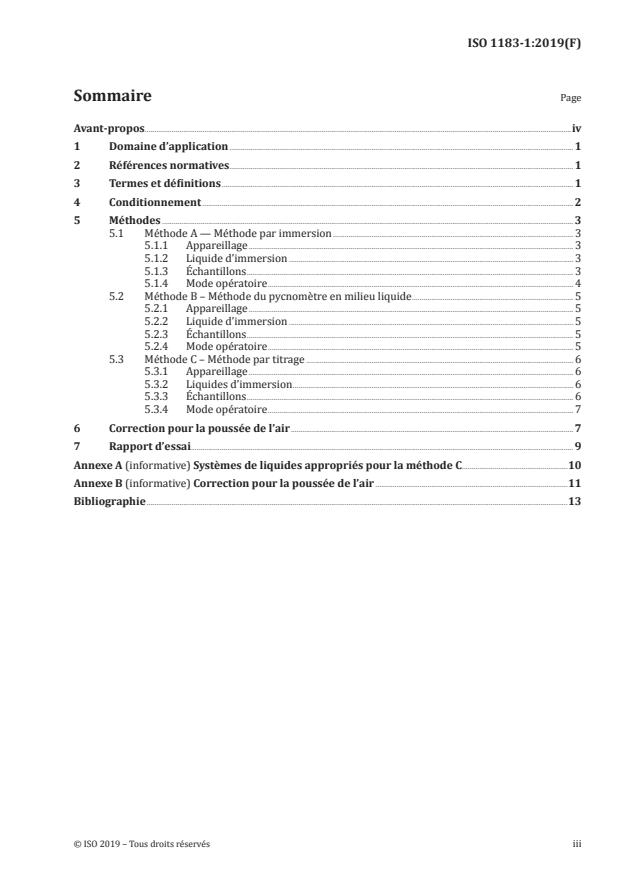
Sommaire Page
Avant-propos .iv
1 Domaine d’application . 1
2 Références normatives . 1
3 Termes et définitions . 1
4 Conditionnement . 2
5 Méthodes . 3
5.1 Méthode A — Méthode par immersion . 3
5.1.1 Appareillage . 3
5.1.2 Liquide d’immersion . 3
5.1.3 Échantillons . 3
5.1.4 Mode opératoire . 4
5.2 Méthode B – Méthode du pycnomètre en milieu liquide . 5
5.2.1 Appareillage . 5
5.2.2 Liquide d’immersion . 5
5.2.3 Échantillons . 5
5.2.4 Mode opératoire . 5
5.3 Méthode C – Méthode par titrage . 6
5.3.1 Appareillage . 6
5.3.2 Liquides d’immersion . 6
5.3.3 Échantillons . 6
5.3.4 Mode opératoire . 7
6 Correction pour la poussée de l’air . 7
7 Rapport d’essai . 9
Annexe A (informative) Systèmes de liquides appropriés pour la méthode C .10
Annexe B (informative) Correction pour la poussée de l’air .11
Bibliographie .13
Avant-propos
L'ISO (Organisation internationale de normalisation) est une fédération mondiale d'organismes
nationaux de normalisation (comités membres de l'ISO). L'élaboration des Normes internationales est
en général confiée aux comités techniques de l'ISO. Chaque comité membre intéressé par une étude
a le droit de faire partie du comité technique créé à cet effet. Les organisations internationales,
gouvernementales et non gouvernementales, en liaison avec l'ISO participent également aux travaux.
L'ISO collabore étroitement avec la Commission électrotechnique internationale (IEC) en ce qui
concerne la normalisation électrotechnique.
Les procédures utilisées pour élaborer le présent document et celles destinées à sa mise à jour sont
décrites dans les Directives ISO/IEC, Partie 1. Il convient, en particulier de prendre note des différents
critères d'approbation requis pour les différents types de documents ISO. Le présent document a été
rédigé conformément aux règles de rédaction données dans les Directives ISO/IEC, Partie 2 (voir www
.iso .org/directives).
L'attention est attirée sur le fait que certains des éléments du présent document peuvent faire l'objet de
droits de propriété intellectuelle ou de droits analogues. L'ISO ne saurait être tenue pour responsable
de ne pas avoir identifié de tels droits de propriété et averti de leur existence. Les détails concernant
les références aux droits de propriété intellectuelle ou autres droits analogues identifiés lors de
l'élaboration du document sont indiqués dans l'Introduction et/ou dans la liste des déclarations de
brevets reçues par l'ISO (voir www .iso .org/brevets).
Les appellations commerciales éventuellement mentionnées dans le présent document sont données
pour information, par souci de commodité, à l’intention des utilisateurs et ne sauraient constituer un
engagement.
Pour une explication de la nature volontaire des normes, la signification des termes et expressions
spécifiques de l'ISO liés à l'évaluation de la conformité, ou pour toute information au sujet de l'adhésion
de l'ISO aux principes de l’Organisation mondiale du commerce (OMC) concernant les obstacles
techniques au commerce (OTC), voir le lien suivant: www .iso .org/iso/fr/avant -propos.
Le présent document a été élaboré par le comité technique ISO/TC 61, Plastiques, sous-comité SC 5,
Propriétés physicochimiques.
Cette troisième édition annule et remplace la deuxième édition (ISO 1183-1:2012), qui a fait l’objet d’une
révision technique. Les principales modifications par rapport à l’édition précédente sont les suivantes:
— la correction pour la poussée de l’air a été révisée.
Une liste de toutes les parties de la série ISO 1183 se trouve sur le site web de l’ISO.
Il convient que l’utilisateur adresse tout retour d’information ou toute question concernant le présent
document à l’organisme national de normalisation de son pays. Une liste exhaustive desdits organismes
se trouve à l’adresse www .iso .org/fr/members .html.
iv © ISO 2019 – Tous droits réservés
NORME INTERNATIONALE ISO 1183-1:2019(F)
Plastiques — Méthodes de détermination de la masse
volumique des plastiques non alvéolaires —
Partie 1:
Méthode par immersion, méthode du pycnomètre en
milieu liquide et méthode par titrage
AVERTISSEMENT — L’utilisation du présent document peut impliquer l’exécution d’opérations
et l’utilisation de matières et d’équipements dangereux. Ce document n’a pas pour but de traiter
tous les problèmes de sécurité éventuels qui sont liés à son utilisation. Il incombe à l’utilisateur
du présent document de mettre en place des pratiques appropriées en matière d’hygiène et de
sécurité.
1 Domaine d’application
Le présent document spécifie trois méthodes de détermination de la masse volumique des plastiques
non alvéolaires sous forme d’objets moulés ou extrudés exempts de cavités fermées, ainsi que de
poudres, de paillettes ou de grains.
— Méthode A: méthode par immersion, pour les plastiques solides exempts de cavités fermées (excepté
les poudres).
— Méthode B: méthode du pycnomètre en milieu liquide, pour les particules telles que les poudres, les
paillettes, les grains ou les parties finies réduites en petits morceaux.
— Méthode C: méthode par titrage, pour les plastiques exempts de cavités fermées.
NOTE La masse volumique est fréquemment utilisée pour suivre les variations de la structure physique ou
de la composition des matériaux plastiques. La masse volumique peut également se révéler utile pour évaluer
l’uniformité des échantillons ou des éprouvettes. La masse volumique des matériaux plastiques dépend souvent
du choix de la méthode de préparation de l’échantillon. Lorsque cela est applicable, des détails précis de la
méthode de préparation de l’échantillon doivent être donnés dans les spécifications appropriées relatives à la
matière. Cette note s’applique à chacune des trois méthodes.
2 Références normatives
Les documents suivants cités dans le texte constituent, pour tout ou partie de leur contenu, des
exigences du présent document. Pour les références datées, seule l’édition citée s’applique. Pour les
références non datées, la dernière édition du document de référence s’applique (y compris les éventuels
amendements).
ISO 291, Plastiques — Atmosphères normales de conditionnement et d'essai
ISO 472, Plastiques — Vocabulaire
3 Termes et définitions
Pour les besoins du présent document, les termes et définitions donnés dans l’ISO 472 ainsi que les
suivants, s’appliquent.
L’ISO et l’IEC tiennent à jour des bases de données terminologiques destinées à être utilisées en
normalisation, consultables aux adresses suivantes:
— ISO Online browsing platform: disponible à l’adresse https: //www .iso .org/obp
— IEC Electropedia: disponible à l’adresse http: //www .electropedia .org/
3.1
masse
m
quantité de matière contenue dans un corps
Note 1 à l'article: Elle est exprimée en kilogrammes (kg) ou en grammes (g).
3.2
masse apparente
m
APP
masse d’un corps obtenue par la mesure de son poids en utilisant une balance étalonnée appropriée
Note 1 à l'article: Elle est exprimée en kilogrammes (kg) ou en grammes (g).
3.3
masse volumique
ρ
rapport de la masse m d’un échantillon à son volume V (à la température T), exprimé en kg/m , en kg/
3 3
dm (g/cm ) ou en kg/l (g/ml)
[1]
Note 1 à l'article: Les termes suivants, tirés de l’ISO 80000-4 , sont indiqués dans le Tableau 1 pour clarification.
Tableau 1 — Termes relatifs à la masse volumique
Terme Symbole Formule Unités
kg/m
3 3
Masse volumique ρ m/V kg/dm (g/cm )
kg/l (g/ml)
m /kg
3 3
Volume massique v V/m (= 1/ρ) dm /kg (cm /g)
l/kg (ml/g)
4 Conditionnement
L’atmosphère d’essai doit être conforme à l’ISO 291. En général, il n’est pas exigé de conditionner les
échantillons à température constante, car ils sont amenés à la température constante de l’essai au cours
de l’évaluation elle-même.
Les échantillons, dont la masse volumique varie pendant l’essai à tel point que cette variation peut
dépasser l’exactitude requise pour cette détermination, doivent être conditionnés avant le mesurage,
selon les spécifications applicables à la matière considérée. Lorsque les variations de la masse volumique
avec le temps ou les conditions atmosphériques sont le principal objet des mesurages, les échantillons
doivent être conditionnés conformément à la description donnée dans les spécifications relatives au
matériau et, en l’absence de toute spécification relative au matériau, conformément à un accord conclu
entre les parties intéressées.
2 © ISO 2019 – Tous droits réservés
5 Méthodes
5.1 Méthode A — Méthode par immersion
5.1.1 Appareillage
5.1.1.1 Balance analytique ou instrument spécifiquement conçu pour le mesurage de la masse
volumique, d’une exactitude de ± 0,1 mg.
Un appareil automatique peut être utilisé. Le calcul de la masse volumique peut s’effectuer
automatiquement en utilisant un ordinateur ou un logiciel intégré à la balance analytique.
5.1.1.2 Récipient pour liquide d’immersion: un bécher ou tout autre récipient à col large de
dimensions appropriées pouvant contenir le liquide d’immersion.
5.1.1.3 Support fixe, tel qu’un trépied destiné à être utilisé avec la balance pour maintenir le récipient
d’immersion au-dessus du plateau de la balance.
5.1.1.4 Thermomètre, gradué à intervalles de 0,1 °C, couvrant la plage de 0 °C à 30 °C.
5.1.1.5 Fil métallique (si nécessaire) résistant à la corrosion, de diamètre inférieur ou égal à 0,5 mm,
permettant de suspendre les échantillons dans le liquide d’immersion.
5.1.1.6 Plomb, de masse appropriée pour garantir l’immersion complète de l’échantillon, lorsque la
masse volumique de celui-ci est inférieure à celle du liquide d’immersion.
5.1.1.7 Pycnomètre, avec un tube capillaire latéral de trop-plein, pour déterminer la masse volumique
du liquide d’immersion lorsque ce liquide n’est pas de l’eau. Le pycnomètre doit être équipé d’un
thermomètre gradué à intervalles de 0,1 °C, de 0 °C à 30 °C.
5.1.1.8 Bain liquide, pouvant être thermorégulé à ± 0,5 °C près, pour utilisation pour la détermination
de la masse volumique du liquide d’immersion.
5.1.2 Liquide d’immersion
Utiliser de l’eau fraîchement distillée ou déionisée, ou un autre liquide convenable, contenant au plus
0,1 % d’un agent mouillant pour faciliter le départ des bulles d’air. Le liquide ou la solution dans lequel/
laquelle l’échantillon est immergé pendant le mesurage ne doit avoir aucune action sur l’échantillon.
La masse volumique des liquides d’immersion autres que l’eau distillée ne nécessite pas d’être mesurée
à condition qu’ils proviennent d’une source accréditée et qu’ils soient accompagnés d’un certificat.
5.1.3 Échantillons
Les échantillons peuvent se présenter sous toute forme exempte de cavités fermées, à l’exception des
poudres. Ils doivent être de taille convenable pour permettre un écartement suffisant entre l’échantillon
et le récipient d’immersion. Il convient que l’échantillon pèse au moins 1 g.
Des équipements adaptés doivent être utilisés pour garantir que, après la découpe à partir de grandes
pièces, les caractéristiques du matériau ne changent pas. La surface de l’échantillon doit être lisse et
exempte de cavités de façon à réduire au minimum toute rétention de bulles d’air pendant l’immersion
dans le liquide, sinon des erreurs seront introduites.
5.1.4 Mode op
...
NORME ISO
INTERNATIONALE 1183-1
Troisième édition
2019-03
Plastiques — Méthodes de
détermination de la masse volumique
des plastiques non alvéolaires —
Partie 1:
Méthode par immersion, méthode
du pycnomètre en milieu liquide et
méthode par titrage
Plastics — Methods for determining the density of non-cellular
plastics —
Part 1: Immersion method, liquid pycnometer method and titration
method
Numéro de référence
©
ISO 2019
DOCUMENT PROTÉGÉ PAR COPYRIGHT
© ISO 2019
Tous droits réservés. Sauf prescription différente ou nécessité dans le contexte de sa mise en œuvre, aucune partie de cette
publication ne peut être reproduite ni utilisée sous quelque forme que ce soit et par aucun procédé, électronique ou mécanique,
y compris la photocopie, ou la diffusion sur l’internet ou sur un intranet, sans autorisation écrite préalable. Une autorisation peut
être demandée à l’ISO à l’adresse ci-après ou au comité membre de l’ISO dans le pays du demandeur.
ISO copyright office
Case postale 401 • Ch. de Blandonnet 8
CH-1214 Vernier, Genève
Tél.: +41 22 749 01 11
Fax: +41 22 749 09 47
E-mail: copyright@iso.org
Web: www.iso.org
Publié en Suisse
ii © ISO 2019 – Tous droits réservés
Sommaire Page
Avant-propos .iv
1 Domaine d’application . 1
2 Références normatives . 1
3 Termes et définitions . 1
4 Conditionnement . 2
5 Méthodes . 3
5.1 Méthode A — Méthode par immersion . 3
5.1.1 Appareillage . 3
5.1.2 Liquide d’immersion . 3
5.1.3 Échantillons . 3
5.1.4 Mode opératoire . 4
5.2 Méthode B – Méthode du pycnomètre en milieu liquide . 5
5.2.1 Appareillage . 5
5.2.2 Liquide d’immersion . 5
5.2.3 Échantillons . 5
5.2.4 Mode opératoire . 5
5.3 Méthode C – Méthode par titrage . 6
5.3.1 Appareillage . 6
5.3.2 Liquides d’immersion . 6
5.3.3 Échantillons . 6
5.3.4 Mode opératoire . 7
6 Correction pour la poussée de l’air . 7
7 Rapport d’essai . 9
Annexe A (informative) Systèmes de liquides appropriés pour la méthode C .10
Annexe B (informative) Correction pour la poussée de l’air .11
Bibliographie .13
Avant-propos
L'ISO (Organisation internationale de normalisation) est une fédération mondiale d'organismes
nationaux de normalisation (comités membres de l'ISO). L'élaboration des Normes internationales est
en général confiée aux comités techniques de l'ISO. Chaque comité membre intéressé par une étude
a le droit de faire partie du comité technique créé à cet effet. Les organisations internationales,
gouvernementales et non gouvernementales, en liaison avec l'ISO participent également aux travaux.
L'ISO collabore étroitement avec la Commission électrotechnique internationale (IEC) en ce qui
concerne la normalisation électrotechnique.
Les procédures utilisées pour élaborer le présent document et celles destinées à sa mise à jour sont
décrites dans les Directives ISO/IEC, Partie 1. Il convient, en particulier de prendre note des différents
critères d'approbation requis pour les différents types de documents ISO. Le présent document a été
rédigé conformément aux règles de rédaction données dans les Directives ISO/IEC, Partie 2 (voir www
.iso .org/directives).
L'attention est attirée sur le fait que certains des éléments du présent document peuvent faire l'objet de
droits de propriété intellectuelle ou de droits analogues. L'ISO ne saurait être tenue pour responsable
de ne pas avoir identifié de tels droits de propriété et averti de leur existence. Les détails concernant
les références aux droits de propriété intellectuelle ou autres droits analogues identifiés lors de
l'élaboration du document sont indiqués dans l'Introduction et/ou dans la liste des déclarations de
brevets reçues par l'ISO (voir www .iso .org/brevets).
Les appellations commerciales éventuellement mentionnées dans le présent document sont données
pour information, par souci de commodité, à l’intention des utilisateurs et ne sauraient constituer un
engagement.
Pour une explication de la nature volontaire des normes, la signification des termes et expressions
spécifiques de l'ISO liés à l'évaluation de la conformité, ou pour toute information au sujet de l'adhésion
de l'ISO aux principes de l’Organisation mondiale du commerce (OMC) concernant les obstacles
techniques au commerce (OTC), voir le lien suivant: www .iso .org/iso/fr/avant -propos.
Le présent document a été élaboré par le comité technique ISO/TC 61, Plastiques, sous-comité SC 5,
Propriétés physicochimiques.
Cette troisième édition annule et remplace la deuxième édition (ISO 1183-1:2012), qui a fait l’objet d’une
révision technique. Les principales modifications par rapport à l’édition précédente sont les suivantes:
— la correction pour la poussée de l’air a été révisée.
Une liste de toutes les parties de la série ISO 1183 se trouve sur le site web de l’ISO.
Il convient que l’utilisateur adresse tout retour d’information ou toute question concernant le présent
document à l’organisme national de normalisation de son pays. Une liste exhaustive desdits organismes
se trouve à l’adresse www .iso .org/fr/members .html.
iv © ISO 2019 – Tous droits réservés
NORME INTERNATIONALE ISO 1183-1:2019(F)
Plastiques — Méthodes de détermination de la masse
volumique des plastiques non alvéolaires —
Partie 1:
Méthode par immersion, méthode du pycnomètre en
milieu liquide et méthode par titrage
AVERTISSEMENT — L’utilisation du présent document peut impliquer l’exécution d’opérations
et l’utilisation de matières et d’équipements dangereux. Ce document n’a pas pour but de traiter
tous les problèmes de sécurité éventuels qui sont liés à son utilisation. Il incombe à l’utilisateur
du présent document de mettre en place des pratiques appropriées en matière d’hygiène et de
sécurité.
1 Domaine d’application
Le présent document spécifie trois méthodes de détermination de la masse volumique des plastiques
non alvéolaires sous forme d’objets moulés ou extrudés exempts de cavités fermées, ainsi que de
poudres, de paillettes ou de grains.
— Méthode A: méthode par immersion, pour les plastiques solides exempts de cavités fermées (excepté
les poudres).
— Méthode B: méthode du pycnomètre en milieu liquide, pour les particules telles que les poudres, les
paillettes, les grains ou les parties finies réduites en petits morceaux.
— Méthode C: méthode par titrage, pour les plastiques exempts de cavités fermées.
NOTE La masse volumique est fréquemment utilisée pour suivre les variations de la structure physique ou
de la composition des matériaux plastiques. La masse volumique peut également se révéler utile pour évaluer
l’uniformité des échantillons ou des éprouvettes. La masse volumique des matériaux plastiques dépend souvent
du choix de la méthode de préparation de l’échantillon. Lorsque cela est applicable, des détails précis de la
méthode de préparation de l’échantillon doivent être donnés dans les spécifications appropriées relatives à la
matière. Cette note s’applique à chacune des trois méthodes.
2 Références normatives
Les documents suivants cités dans le texte constituent, pour tout ou partie de leur contenu, des
exigences du présent document. Pour les références datées, seule l’édition citée s’applique. Pour les
références non datées, la dernière édition du document de référence s’applique (y compris les éventuels
amendements).
ISO 291, Plastiques — Atmosphères normales de conditionnement et d'essai
ISO 472, Plastiques — Vocabulaire
3 Termes et définitions
Pour les besoins du présent document, les termes et définitions donnés dans l’ISO 472 ainsi que les
suivants, s’appliquent.
L’ISO et l’IEC tiennent à jour des bases de données terminologiques destinées à être utilisées en
normalisation, consultables aux adresses suivantes:
— ISO Online browsing platform: disponible à l’adresse https: //www .iso .org/obp
— IEC Electropedia: disponible à l’adresse http: //www .electropedia .org/
3.1
masse
m
quantité de matière contenue dans un corps
Note 1 à l'article: Elle est exprimée en kilogrammes (kg) ou en grammes (g).
3.2
masse apparente
m
APP
masse d’un corps obtenue par la mesure de son poids en utilisant une balance étalonnée appropriée
Note 1 à l'article: Elle est exprimée en kilogrammes (kg) ou en grammes (g).
3.3
masse volumique
ρ
rapport de la masse m d’un échantillon à son volume V (à la température T), exprimé en kg/m , en kg/
3 3
dm (g/cm ) ou en kg/l (g/ml)
[1]
Note 1 à l'article: Les termes suivants, tirés de l’ISO 80000-4 , sont indiqués dans le Tableau 1 pour clarification.
Tableau 1 — Termes relatifs à la masse volumique
Terme Symbole Formule Unités
kg/m
3 3
Masse volumique ρ m/V kg/dm (g/cm )
kg/l (g/ml)
m /kg
3 3
Volume massique v V/m (= 1/ρ) dm /kg (cm /g)
l/kg (ml/g)
4 Conditionnement
L’atmosphère d’essai doit être conforme à l’ISO 291. En général, il n’est pas exigé de conditionner les
échantillons à température constante, car ils sont amenés à la température constante de l’essai au cours
de l’évaluation elle-même.
Les échantillons, dont la masse volumique varie pendant l’essai à tel point que cette variation peut
dépasser l’exactitude requise pour cette détermination, doivent être conditionnés avant le mesurage,
selon les spécifications applicables à la matière considérée. Lorsque les variations de la masse volumique
avec le temps ou les conditions atmosphériques sont le principal objet des mesurages, les échantillons
doivent être conditionnés conformément à la description donnée dans les spécifications relatives au
matériau et, en l’absence de toute spécification relative au matériau, conformément à un accord conclu
entre les parties intéressées.
2 © ISO 2019 – Tous droits réservés
5 Méthodes
5.1 Méthode A — Méthode par immersion
5.1.1 Appareillage
5.1.1.1 Balance analytique ou instrument spécifiquement conçu pour le mesurage de la masse
volumique, d’une exactitude de ± 0,1 mg.
Un appareil automatique peut être utilisé. Le calcul de la masse volumique peut s’effectuer
automatiquement en utilisant un ordinateur ou un logiciel intégré à la balance analytique.
5.1.1.2 Récipient pour liquide d’immersion: un bécher ou tout autre récipient à col large de
dimensions appropriées pouvant contenir le liquide d’immersion.
5.1.1.3 Support fixe, tel qu’un trépied destiné à être utilisé avec la balance pour maintenir le récipient
d’immersion au-dessus du plateau de la balance.
5.1.1.4 Thermomètre, gradué à intervalles de 0,1 °C, couvrant la plage de 0 °C à 30 °C.
5.1.1.5 Fil métallique (si nécessaire) résistant à la corrosion, de diamètre inférieur ou égal à 0,5 mm,
permettant de suspendre les échantillons dans le liquide d’immersion.
5.1.1.6 Plomb, de masse appropriée pour garantir l’immersion complète de l’échantillon, lorsque la
masse volumique de celui-ci est inférieure à celle du liquide d’immersion.
5.1.1.7 Pycnomètre, avec un tube capillaire latéral de trop-plein, pour déterminer la masse volumique
du liquide d’immersion lorsque ce liquide n’est pas de l’eau. Le pycnomètre doit être équipé d’un
thermomètre gradué à intervalles de 0,1 °C, de 0 °C à 30 °C.
5.1.1.8 Bain liquide, pouvant être thermorégulé à ± 0,5 °C près, pour utilisation pour la détermination
de la masse volumique du liquide d’immersion.
5.1.2 Liquide d’immersion
Utiliser de l’eau fraîchement distillée ou déionisée, ou un autre liquide convenable, contenant au plus
0,1 % d’un agent mouillant pour faciliter le départ des bulles d’air. Le liquide ou la solution dans lequel/
laquelle l’échantillon est immergé pendant le mesurage ne doit avoir aucune action sur l’échantillon.
La masse volumique des liquides d’immersion autres que l’eau distillée ne nécessite pas d’être mesurée
à condition qu’ils proviennent d’une source accréditée et qu’ils soient accompagnés d’un certificat.
5.1.3 Échantillons
Les échantillons peuvent se présenter sous toute forme exempte de cavités fermées, à l’exception des
poudres. Ils doivent être de taille convenable pour permettre un écartement suffisant entre l’échantillon
et le récipient d’immersion. Il convient que l’échantillon pèse au moins 1 g.
Des équipements adaptés doivent être utilisés pour garantir que, après la découpe à partir de grandes
pièces, les caractéristiques du matériau ne changent pas. La surface de l’échantillon doit être lisse et
exempte de cavités de façon à réduire au minimum toute rétention de bulles d’air pendant l’immersion
dans le liquide, sinon des erreurs seront introduites.
5.1.4 Mode op
...