

ISO 4874:2020
(Main)Tobacco — Sampling of batches of raw material — General principles
General Information
- Abstract
This document specifies the general principles to be applied when sampling batches of raw tobacco in order to assess either — the mean value of one or more of its characteristics, or — the heterogeneity of one or more of its characteristics. Manufactured tobacco products, including products intended for sale or distribution, are specifically not included in the scope of this document. This document is applicable to the sampling of batches of raw tobacco of the following types: a) leaf tobacco: flue cured; air cured; sun cured; fire cured; b) pretreated raw tobacco: which has undergone fermentation (in packages not intended for retail or wholesale sales or distribution, in bulk, in chambers); which has been partially or completely stemmed; which is in the form of stems; which is in the form of waste and remnants; which has been reconstituted in the form of strips.
- Status
- Published
- Publication Date
- 06-Jan-2020
- Technical Committee
- ISO/TC 126/SC 2 - Leaf tobacco
- Drafting Committee
- ISO/TC 126/SC 2 - Leaf tobacco
- Current Stage
- 9093 - International Standard confirmed
- Start Date
- 25-Jun-2025
- Completion Date
- 29-Aug-2026
Buy Documents






ISO 4874:2020 - Tobacco -- Sampling of batches of raw material -- General principles

ISO 4874:2020 - Tobacco — Sampling of batches of raw material — General principles/7/2020


ISO 4874:2020 - Tabac -- Échantillonnage des lots de matieres premieres -- Principes généraux
ISO 4874:2020 - Tabac — Échantillonnage des lots de matières premières — Principes généraux/7/2020
Overview
ISO 4874:2020 - Tobacco: Sampling of batches of raw material - General principles sets out the general principles and procedures for sampling batches of raw tobacco to assess either the mean values of one or more characteristics or the heterogeneity of those characteristics. The standard applies to raw leaf and pretreated tobaccos (flue-cured, air-cured, sun-cured, fire-cured and several pretreated forms). Manufactured tobacco products (ready-for-sale items) are explicitly excluded.
Key topics and technical requirements
- Scope and purpose: Sampling aimed at estimating mean values or assessing heterogeneity of physical, chemical, botanical or organoleptic characteristics.
- Contractual arrangements: Contracts should specify sampling stages, responsible parties, characteristics to be measured, designated laboratories, and maximum time between sampling and analysis.
- Sampling units and definitions: A sampling unit is a separately packaged part of a consignment (bale, sack, case). For bulk tobacco, a consignment mass m kg can be notionally divided into m/100 sampling units.
- Selection methods:
- Random sampling - each unit has equal selection probability.
- Periodic systematic sampling - select units h, h+k, h+2k, … where nk ≤ N < n(k+1) (N = total units, n = units to sample).
- Increments and samples:
- Minimum increment: three packets tied together (hands), or 50 leaves (if untied), or 500 g for certain forms (stems, reconstituted, threshed).
- At least three increments per sampling unit, taken from upper, middle and lower thirds (or evenly distributed if more).
- Definitions: increment → single sample (all increments from one unit) → gross sample → reduced sample → laboratory/test sample.
- Equipment and containers: Use clean, dry, non-reactive sampling tools. Containers must be chemically inert, airtight, preferably opaque; samples stored cool, dry, protected from light and odour.
- Treatment of damaged units: Sample separately or exclude depending on whether damage affects the characteristic being measured.
- Reporting: Sampling report must record origin, consignment/batch numbers, masses, packing, number/position of increments, composition of single/gross/reduced/laboratory samples, signatures and date.
Applications and who uses it
- Quality control and acceptance testing for raw tobacco suppliers, processors and buyers.
- Laboratories conducting compositional, physical or organoleptic testing.
- Regulatory or contractual inspections where standardized sampling is needed to support claims about batch mean values or heterogeneity.
- Useful in procurement, inventory verification, dispute resolution and batch certification.
Related standards
- ISO 8243:2013 - sampling cigarette material (referenced for cigarettes-derived tobacco).
- ISO 3534-2 - terminology related to sampling definitions (referenced for sampling unit definition).
Keywords: ISO 4874:2020, tobacco sampling, raw tobacco sampling, sampling protocol, sampling units, sampling report, laboratory sample, heterogeneity, mean value, quality control.
Relations
- Effective Date
- 01-Jul-2023
- Effective Date
- 23-Apr-2020
Buy Documents
ISO 4874:2020 - Tobacco -- Sampling of batches of raw material -- General principles
ISO 4874:2020 - Tobacco — Sampling of batches of raw material — General principles/7/2020
ISO 4874:2020 - Tabac -- Échantillonnage des lots de matieres premieres -- Principes généraux
ISO 4874:2020 - Tabac — Échantillonnage des lots de matières premières — Principes généraux/7/2020
Get Certified
Connect with accredited certification bodies for this standard

Control Union Certifications
Global certification for agriculture and sustainability.

ECOCERT
Organic and sustainability certification.

FSC International
Forest Stewardship Council certification.
Sponsored listings
Frequently Asked Questions
ISO 4874:2020 is a standard published by the International Organization for Standardization (ISO). Its full title is "Tobacco — Sampling of batches of raw material — General principles". This standard covers: This document specifies the general principles to be applied when sampling batches of raw tobacco in order to assess either — the mean value of one or more of its characteristics, or — the heterogeneity of one or more of its characteristics. Manufactured tobacco products, including products intended for sale or distribution, are specifically not included in the scope of this document. This document is applicable to the sampling of batches of raw tobacco of the following types: a) leaf tobacco: flue cured; air cured; sun cured; fire cured; b) pretreated raw tobacco: which has undergone fermentation (in packages not intended for retail or wholesale sales or distribution, in bulk, in chambers); which has been partially or completely stemmed; which is in the form of stems; which is in the form of waste and remnants; which has been reconstituted in the form of strips.
This document specifies the general principles to be applied when sampling batches of raw tobacco in order to assess either — the mean value of one or more of its characteristics, or — the heterogeneity of one or more of its characteristics. Manufactured tobacco products, including products intended for sale or distribution, are specifically not included in the scope of this document. This document is applicable to the sampling of batches of raw tobacco of the following types: a) leaf tobacco: flue cured; air cured; sun cured; fire cured; b) pretreated raw tobacco: which has undergone fermentation (in packages not intended for retail or wholesale sales or distribution, in bulk, in chambers); which has been partially or completely stemmed; which is in the form of stems; which is in the form of waste and remnants; which has been reconstituted in the form of strips.
ISO 4874:2020 is classified under the following ICS (International Classification for Standards) categories: 65.160 - Tobacco, tobacco products and related equipment. The ICS classification helps identify the subject area and facilitates finding related standards.
ISO 4874:2020 has the following relationships with other standards: It is inter standard links to ISO 19403-3:2024, ISO 4874:2000. Understanding these relationships helps ensure you are using the most current and applicable version of the standard.
ISO 4874:2020 is available in PDF format for immediate download after purchase. The document can be added to your cart and obtained through the secure checkout process. Digital delivery ensures instant access to the complete standard document.
Standards Content (Sample)
SLOVENSKI STANDARD
01-julij-2020
Nadomešča:
SIST ISO 4874:2002
Tobak - Vzorčenje šarž surovin - Splošna načela
Tobacco - Sampling of batches of raw material - General principles
Tabac - Échantillonnage des lots de matières premières - Principes généraux
Ta slovenski standard je istoveten z: ISO 4874:2020
ICS:
65.160 Tobak, tobačni izdelki in Tobacco, tobacco products
oprema and related equipment
2003-01.Slovenski inštitut za standardizacijo. Razmnoževanje celote ali delov tega standarda ni dovoljeno.
INTERNATIONAL ISO
STANDARD 4874
Third edition
2020-01
Tobacco — Sampling of batches of raw
material — General principles
Tabac — Échantillonnage des lots de matières premières — Principes
généraux
Reference number
©
ISO 2020
© ISO 2020
All rights reserved. Unless otherwise specified, or required in the context of its implementation, no part of this publication may
be reproduced or utilized otherwise in any form or by any means, electronic or mechanical, including photocopying, or posting
on the internet or an intranet, without prior written permission. Permission can be requested from either ISO at the address
below or ISO’s member body in the country of the requester.
ISO copyright office
CP 401 • Ch. de Blandonnet 8
CH-1214 Vernier, Geneva
Phone: +41 22 749 01 11
Fax: +41 22 749 09 47
Email: copyright@iso.org
Website: www.iso.org
Published in Switzerland
ii © ISO 2020 – All rights reserved
Contents Page
Foreword .iv
1 Scope . 1
2 Normative references . 1
3 Terms and definitions . 1
4 Contractual arrangements . 3
5 Sampling . 3
5.1 General . 3
5.2 Sampling equipment . 3
5.3 Containers for samples and storage precautions . 3
6 Procedure. 3
6.1 General . 3
6.2 Treatment of damaged sampling units . 4
6.3 Selection of sampling units . 4
6.3.1 General. 4
6.3.2 Selecting the sampling units at random . 4
6.3.3 Selecting the sampling units by periodic systematic sampling . 5
6.4 Extraction of increments and constitution of single samples . 5
6.4.1 Composition . 5
6.4.2 Number of increments . 5
6.4.3 Size of single samples . 5
6.4.4 Tobacco in bulk . 5
7 Sampling report. 6
Annex A (informative) Example of sampling . 7
Bibliography . 8
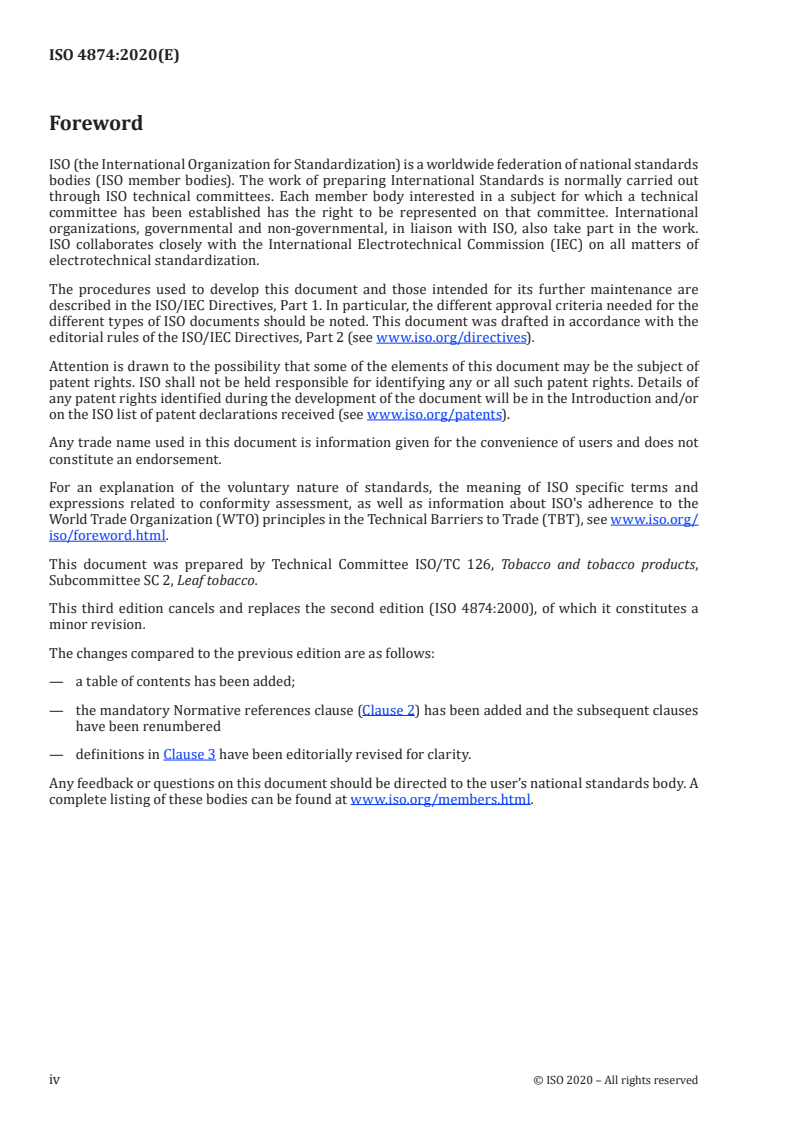
Foreword
ISO (the International Organization for Standardization) is a worldwide federation of national standards
bodies (ISO member bodies). The work of preparing International Standards is normally carried out
through ISO technical committees. Each member body interested in a subject for which a technical
committee has been established has the right to be represented on that committee. International
organizations, governmental and non-governmental, in liaison with ISO, also take part in the work.
ISO collaborates closely with the International Electrotechnical Commission (IEC) on all matters of
electrotechnical standardization.
The procedures used to develop this document and those intended for its further maintenance are
described in the ISO/IEC Directives, Part 1. In particular, the different approval criteria needed for the
different types of ISO documents should be noted. This document was drafted in accordance with the
editorial rules of the ISO/IEC Directives, Part 2 (see www .iso .org/ directives).
Attention is drawn to the possibility that some of the elements of this document may be the subject of
patent rights. ISO shall not be held responsible for identifying any or all such patent rights. Details of
any patent rights identified during the development of the document will be in the Introduction and/or
on the ISO list of patent declarations received (see www .iso .org/ patents).
Any trade name used in this document is information given for the convenience of users and does not
constitute an endorsement.
For an explanation of the voluntary nature of standards, the meaning of ISO specific terms and
expressions related to conformity assessment, as well as information about ISO's adherence to the
World Trade Organization (WTO) principles in the Technical Barriers to Trade (TBT), see www .iso .org/
iso/ foreword .html.
This document was prepared by Technical Committee ISO/TC 126, Tobacco and tobacco products,
Subcommittee SC 2, Leaf tobacco.
This third edition cancels and replaces the second edition (ISO 4874:2000), of which it constitutes a
minor revision.
The changes compared to the previous edition are as follows:
— a table of contents has been added;
— the mandatory Normative references clause (Clause 2) has been added and the subsequent clauses
have been renumbered
— definitions in Clause 3 have been editorially revised for clarity.
Any feedback or questions on this document should be directed to the user’s national standards body. A
complete listing of these bodies can be found at www .iso .org/ members .html.
iv © ISO 2020 – All rights reserved
INTERNATIONAL STANDARD ISO 4874:2020(E)
Tobacco — Sampling of batches of raw material — General
principles
1 Scope
This document specifies the general principles to be applied when sampling batches of raw tobacco in
order to assess either
— the mean value of one or more of its characteristics, or
— the heterogeneity of one or more of its characteristics.
Manufactured tobacco products, including products intended for sale or distribution, are specifically
not included in the scope of this document.
This document is applicable to the sampling of batches of raw tobacco of the following types:
a) leaf tobacco:
1) flue cured;
2) air cured;
3) sun cured;
4) fire cured;
b) pretreated raw tobacco:
1) which has undergone fermentation (in packages not intended for retail or wholesale sales or
distribution, in bulk, in chambers);
2) which has been partially or completely stemmed;
3) which is in the form of stems;
4) which is in the form of waste and remnants;
5) which has been reconstituted in the form of strips.
2 Normative references
There are no normative references in this document.
3 Terms and definitions
For the purposes of this document, the following terms and definitions apply.
ISO and IEC maintain terminological databases for use in standardization at the following addresses:
— ISO Online browsing platform: available at https:// www .iso .org/ obp
— IEC Electropedia: available at http:// www .electropedia .org/
...
INTERNATIONAL ISO
STANDARD 4874
Third edition
2020-01
Tobacco — Sampling of batches of raw
material — General principles
Tabac — Échantillonnage des lots de matières premières — Principes
généraux
Reference number
©
ISO 2020
© ISO 2020
All rights reserved. Unless otherwise specified, or required in the context of its implementation, no part of this publication may
be reproduced or utilized otherwise in any form or by any means, electronic or mechanical, including photocopying, or posting
on the internet or an intranet, without prior written permission. Permission can be requested from either ISO at the address
below or ISO’s member body in the country of the requester.
ISO copyright office
CP 401 • Ch. de Blandonnet 8
CH-1214 Vernier, Geneva
Phone: +41 22 749 01 11
Fax: +41 22 749 09 47
Email: copyright@iso.org
Website: www.iso.org
Published in Switzerland
ii © ISO 2020 – All rights reserved
Contents Page
Foreword .iv
1 Scope . 1
2 Normative references . 1
3 Terms and definitions . 1
4 Contractual arrangements . 3
5 Sampling . 3
5.1 General . 3
5.2 Sampling equipment . 3
5.3 Containers for samples and storage precautions . 3
6 Procedure. 3
6.1 General . 3
6.2 Treatment of damaged sampling units . 4
6.3 Selection of sampling units . 4
6.3.1 General. 4
6.3.2 Selecting the sampling units at random . 4
6.3.3 Selecting the sampling units by periodic systematic sampling . 5
6.4 Extraction of increments and constitution of single samples . 5
6.4.1 Composition . 5
6.4.2 Number of increments . 5
6.4.3 Size of single samples . 5
6.4.4 Tobacco in bulk . 5
7 Sampling report. 6
Annex A (informative) Example of sampling . 7
Bibliography . 8
Foreword
ISO (the International Organization for Standardization) is a worldwide federation of national standards
bodies (ISO member bodies). The work of preparing International Standards is normally carried out
through ISO technical committees. Each member body interested in a subject for which a technical
committee has been established has the right to be represented on that committee. International
organizations, governmental and non-governmental, in liaison with ISO, also take part in the work.
ISO collaborates closely with the International Electrotechnical Commission (IEC) on all matters of
electrotechnical standardization.
The procedures used to develop this document and those intended for its further maintenance are
described in the ISO/IEC Directives, Part 1. In particular, the different approval criteria needed for the
different types of ISO documents should be noted. This document was drafted in accordance with the
editorial rules of the ISO/IEC Directives, Part 2 (see www .iso .org/ directives).
Attention is drawn to the possibility that some of the elements of this document may be the subject of
patent rights. ISO shall not be held responsible for identifying any or all such patent rights. Details of
any patent rights identified during the development of the document will be in the Introduction and/or
on the ISO list of patent declarations received (see www .iso .org/ patents).
Any trade name used in this document is information given for the convenience of users and does not
constitute an endorsement.
For an explanation of the voluntary nature of standards, the meaning of ISO specific terms and
expressions related to conformity assessment, as well as information about ISO's adherence to the
World Trade Organization (WTO) principles in the Technical Barriers to Trade (TBT), see www .iso .org/
iso/ foreword .html.
This document was prepared by Technical Committee ISO/TC 126, Tobacco and tobacco products,
Subcommittee SC 2, Leaf tobacco.
This third edition cancels and replaces the second edition (ISO 4874:2000), of which it constitutes a
minor revision.
The changes compared to the previous edition are as follows:
— a table of contents has been added;
— the mandatory Normative references clause (Clause 2) has been added and the subsequent clauses
have been renumbered
— definitions in Clause 3 have been editorially revised for clarity.
Any feedback or questions on this document should be directed to the user’s national standards body. A
complete listing of these bodies can be found at www .iso .org/ members .html.
iv © ISO 2020 – All rights reserved
INTERNATIONAL STANDARD ISO 4874:2020(E)
Tobacco — Sampling of batches of raw material — General
principles
1 Scope
This document specifies the general principles to be applied when sampling batches of raw tobacco in
order to assess either
— the mean value of one or more of its characteristics, or
— the heterogeneity of one or more of its characteristics.
Manufactured tobacco products, including products intended for sale or distribution, are specifically
not included in the scope of this document.
This document is applicable to the sampling of batches of raw tobacco of the following types:
a) leaf tobacco:
1) flue cured;
2) air cured;
3) sun cured;
4) fire cured;
b) pretreated raw tobacco:
1) which has undergone fermentation (in packages not intended for retail or wholesale sales or
distribution, in bulk, in chambers);
2) which has been partially or completely stemmed;
3) which is in the form of stems;
4) which is in the form of waste and remnants;
5) which has been reconstituted in the form of strips.
2 Normative references
There are no normative references in this document.
3 Terms and definitions
For the purposes of this document, the following terms and definitions apply.
ISO and IEC maintain terminological databases for use in standardization at the following addresses:
— ISO Online browsing platform: available at https:// www .iso .org/ obp
— IEC Electropedia: available at http:// www .electropedia .org/
3.1
characteristic
physical, mechanical, dimensional, chemical, biological, botanical or organoleptic property of tobacco
EXAMPLE Leaf position, colour, ripeness, leaf length.
3.2
batch
definite quantity of tobacco that is produced under conditions that are presumed to be uniform with
respect to one or more of its characteristics (3.1)
Note 1 to entry: This noti
...
INTERNATIONAL ISO
STANDARD 4874
Third edition
2020-01
Tobacco — Sampling of batches of raw
material — General principles
Tabac — Échantillonnage des lots de matières premières — Principes
généraux
Reference number
©
ISO 2020
© ISO 2020
All rights reserved. Unless otherwise specified, or required in the context of its implementation, no part of this publication may
be reproduced or utilized otherwise in any form or by any means, electronic or mechanical, including photocopying, or posting
on the internet or an intranet, without prior written permission. Permission can be requested from either ISO at the address
below or ISO’s member body in the country of the requester.
ISO copyright office
CP 401 • Ch. de Blandonnet 8
CH-1214 Vernier, Geneva
Phone: +41 22 749 01 11
Fax: +41 22 749 09 47
Email: copyright@iso.org
Website: www.iso.org
Published in Switzerland
ii © ISO 2020 – All rights reserved
Contents Page
Foreword .iv
1 Scope . 1
2 Normative references . 1
3 Terms and definitions . 1
4 Contractual arrangements . 3
5 Sampling . 3
5.1 General . 3
5.2 Sampling equipment . 3
5.3 Containers for samples and storage precautions . 3
6 Procedure. 3
6.1 General . 3
6.2 Treatment of damaged sampling units . 4
6.3 Selection of sampling units . 4
6.3.1 General. 4
6.3.2 Selecting the sampling units at random . 4
6.3.3 Selecting the sampling units by periodic systematic sampling . 5
6.4 Extraction of increments and constitution of single samples . 5
6.4.1 Composition . 5
6.4.2 Number of increments . 5
6.4.3 Size of single samples . 5
6.4.4 Tobacco in bulk . 5
7 Sampling report. 6
Annex A (informative) Example of sampling . 7
Bibliography . 8
Foreword
ISO (the International Organization for Standardization) is a worldwide federation of national standards
bodies (ISO member bodies). The work of preparing International Standards is normally carried out
through ISO technical committees. Each member body interested in a subject for which a technical
committee has been established has the right to be represented on that committee. International
organizations, governmental and non-governmental, in liaison with ISO, also take part in the work.
ISO collaborates closely with the International Electrotechnical Commission (IEC) on all matters of
electrotechnical standardization.
The procedures used to develop this document and those intended for its further maintenance are
described in the ISO/IEC Directives, Part 1. In particular, the different approval criteria needed for the
different types of ISO documents should be noted. This document was drafted in accordance with the
editorial rules of the ISO/IEC Directives, Part 2 (see www .iso .org/ directives).
Attention is drawn to the possibility that some of the elements of this document may be the subject of
patent rights. ISO shall not be held responsible for identifying any or all such patent rights. Details of
any patent rights identified during the development of the document will be in the Introduction and/or
on the ISO list of patent declarations received (see www .iso .org/ patents).
Any trade name used in this document is information given for the convenience of users and does not
constitute an endorsement.
For an explanation of the voluntary nature of standards, the meaning of ISO specific terms and
expressions related to conformity assessment, as well as information about ISO's adherence to the
World Trade Organization (WTO) principles in the Technical Barriers to Trade (TBT), see www .iso .org/
iso/ foreword .html.
This document was prepared by Technical Committee ISO/TC 126, Tobacco and tobacco products,
Subcommittee SC 2, Leaf tobacco.
This third edition cancels and replaces the second edition (ISO 4874:2000), of which it constitutes a
minor revision.
The changes compared to the previous edition are as follows:
— a table of contents has been added;
— the mandatory Normative references clause (Clause 2) has been added and the subsequent clauses
have been renumbered
— definitions in Clause 3 have been editorially revised for clarity.
Any feedback or questions on this document should be directed to the user’s national standards body. A
complete listing of these bodies can be found at www .iso .org/ members .html.
iv © ISO 2020 – All rights reserved
INTERNATIONAL STANDARD ISO 4874:2020(E)
Tobacco — Sampling of batches of raw material — General
principles
1 Scope
This document specifies the general principles to be applied when sampling batches of raw tobacco in
order to assess either
— the mean value of one or more of its characteristics, or
— the heterogeneity of one or more of its characteristics.
Manufactured tobacco products, including products intended for sale or distribution, are specifically
not included in the scope of this document.
This document is applicable to the sampling of batches of raw tobacco of the following types:
a) leaf tobacco:
1) flue cured;
2) air cured;
3) sun cured;
4) fire cured;
b) pretreated raw tobacco:
1) which has undergone fermentation (in packages not intended for retail or wholesale sales or
distribution, in bulk, in chambers);
2) which has been partially or completely stemmed;
3) which is in the form of stems;
4) which is in the form of waste and remnants;
5) which has been reconstituted in the form of strips.
2 Normative references
There are no normative references in this document.
3 Terms and definitions
For the purposes of this document, the following terms and definitions apply.
ISO and IEC maintain terminological databases for use in standardization at the following addresses:
— ISO Online browsing platform: available at https:// www .iso .org/ obp
— IEC Electropedia: available at http:// www .electropedia .org/
3.1
characteristic
physical, mechanical, dimensional, chemical, biological, botanical or organoleptic property of tobacco
EXAMPLE Leaf position, colour, ripeness, leaf length.
3.2
batch
definite quantity of tobacco that is produced under conditions that are presumed to be uniform with
respect to one or more of its characteristics (3.1)
Note 1 to entry: This noti
...
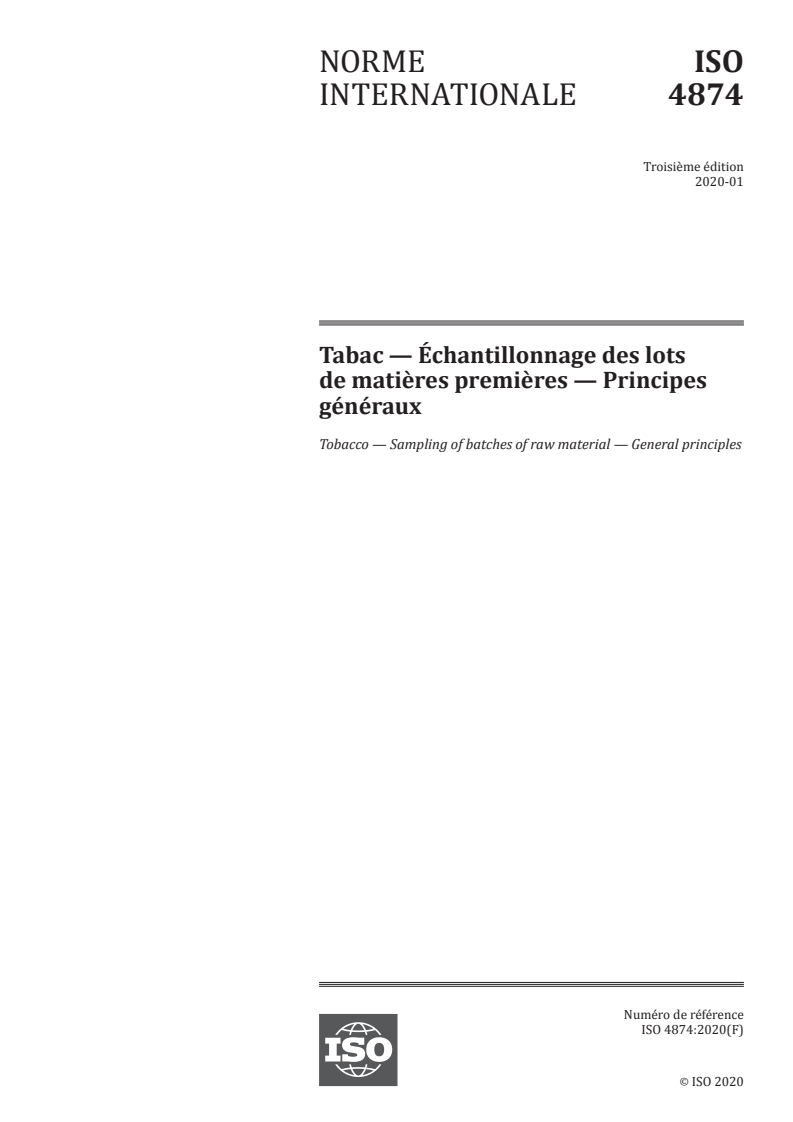
NORME ISO
INTERNATIONALE 4874
Troisième édition
2020-01
Tabac — Échantillonnage des lots
de matières premières — Principes
généraux
Tobacco — Sampling of batches of raw material — General principles
Numéro de référence
©
ISO 2020
DOCUMENT PROTÉGÉ PAR COPYRIGHT
© ISO 2020
Tous droits réservés. Sauf prescription différente ou nécessité dans le contexte de sa mise en œuvre, aucune partie de cette
publication ne peut être reproduite ni utilisée sous quelque forme que ce soit et par aucun procédé, électronique ou mécanique,
y compris la photocopie, ou la diffusion sur l’internet ou sur un intranet, sans autorisation écrite préalable. Une autorisation peut
être demandée à l’ISO à l’adresse ci-après ou au comité membre de l’ISO dans le pays du demandeur.
ISO copyright office
Case postale 401 • Ch. de Blandonnet 8
CH-1214 Vernier, Genève
Tél.: +41 22 749 01 11
Fax: +41 22 749 09 47
E-mail: copyright@iso.org
Web: www.iso.org
Publié en Suisse
ii © ISO 2020 – Tous droits réservés
Sommaire Page
Avant-propos .iv
1 Domaine d’application . 1
2 Références normatives . 1
3 Termes et définitions . 1
4 Dispositions contractuelles . 3
5 Échantillonnage . 3
5.1 Généralités . 3
5.2 Appareillage d’échantillonnage . 3
5.3 Récipients pour échantillons et précautions de stockage . . 3
6 Mode opératoire. 4
6.1 Généralités . 4
6.2 Traitement des unités d’échantillonnage endommagées . 4
6.3 Prélèvement des unités d’échantillonnage . 4
6.3.1 Généralités . 4
6.3.2 Prélèvement aléatoire des unités d’échantillonnage . 5
6.3.3 Prélèvement des unités d’échantillonnage par échantillonnage
systématique périodique . 5
6.4 Extraction des prélèvements élémentaires et constitution des échantillons élémentaires . 5
6.4.1 Composition . 5
6.4.2 Nombre de prélèvements élémentaires . 5
6.4.3 Effectif des échantillons élémentaires . 5
6.4.4 Tabac en vrac . 6
7 Rapport d’échantillonnage . 6
Annexe A (informative) Exemple d’échantillonnage . 7
Bibliographie . 8
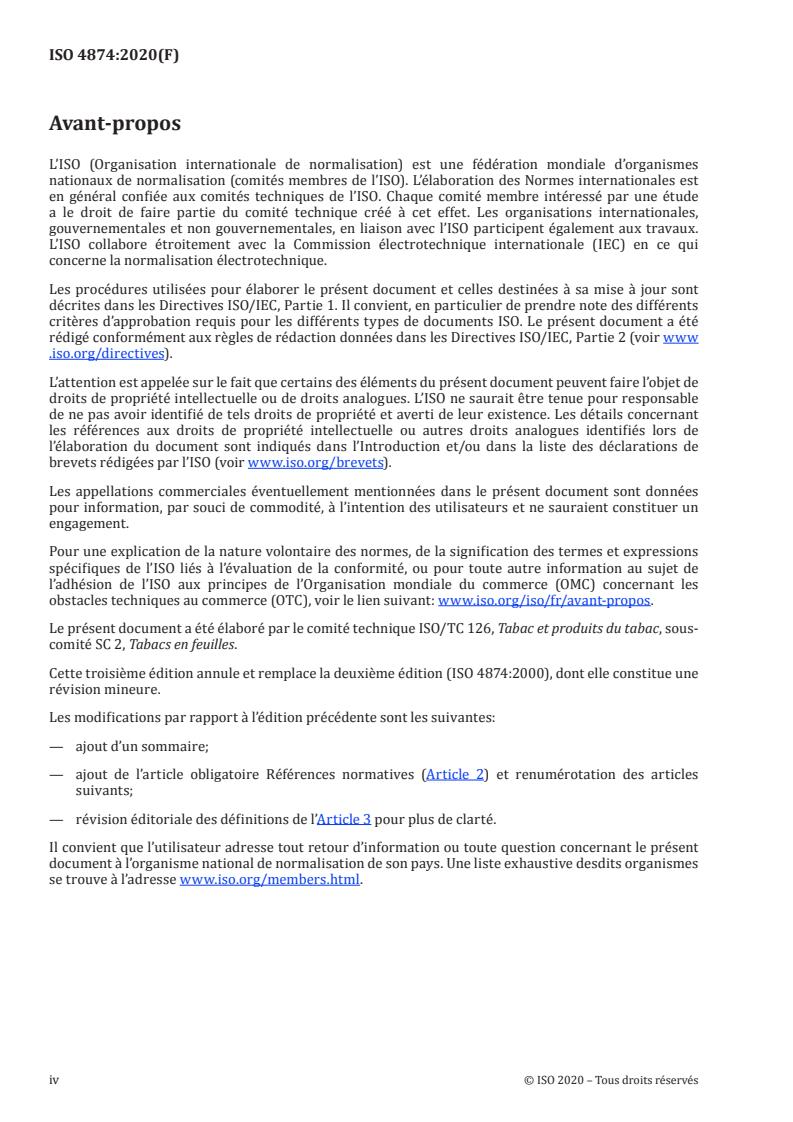
Avant-propos
L’ISO (Organisation internationale de normalisation) est une fédération mondiale d’organismes
nationaux de normalisation (comités membres de l’ISO). L’élaboration des Normes internationales est
en général confiée aux comités techniques de l’ISO. Chaque comité membre intéressé par une étude
a le droit de faire partie du comité technique créé à cet effet. Les organisations internationales,
gouvernementales et non gouvernementales, en liaison avec l’ISO participent également aux travaux.
L’ISO collabore étroitement avec la Commission électrotechnique internationale (IEC) en ce qui
concerne la normalisation électrotechnique.
Les procédures utilisées pour élaborer le présent document et celles destinées à sa mise à jour sont
décrites dans les Directives ISO/IEC, Partie 1. Il convient, en particulier de prendre note des différents
critères d’approbation requis pour les différents types de documents ISO. Le présent document a été
rédigé conformément aux règles de rédaction données dans les Directives ISO/IEC, Partie 2 (voir www
.iso .org/ directives).
L’attention est appelée sur le fait que certains des éléments du présent document peuvent faire l’objet de
droits de propriété intellectuelle ou de droits analogues. L’ISO ne saurait être tenue pour responsable
de ne pas avoir identifié de tels droits de propriété et averti de leur existence. Les détails concernant
les références aux droits de propriété intellectuelle ou autres droits analogues identifiés lors de
l’élaboration du document sont indiqués dans l’Introduction et/ou dans la liste des déclarations de
brevets rédigées par l’ISO (voir www .iso .org/ brevets).
Les appellations commerciales éventuellement mentionnées dans le présent document sont données
pour information, par souci de commodité, à l’intention des utilisateurs et ne sauraient constituer un
engagement.
Pour une explication de la nature volontaire des normes, de la signification des termes et expressions
spécifiques de l’ISO liés à l’évaluation de la conformité, ou pour toute autre information au sujet de
l’adhésion de l’ISO aux principes de l’Organisation mondiale du commerce (OMC) concernant les
obstacles techniques au commerce (OTC), voir le lien suivant: www .iso .org/ iso/ fr/ avant -propos.
Le présent document a été élaboré par le comité technique ISO/TC 126, Tabac et produits du tabac, sous-
comité SC 2, Tabacs en feuilles.
Cette troisième édition annule et remplace la deuxième édition (ISO 4874:2000), dont elle constitue une
révision mineure.
Les modifications par rapport à l’édition précédente sont les suivantes:
— ajout d’un sommaire;
— ajout de l’article obligatoire Références normatives (Article 2) et renumérotation des articles
suivants;
— révision éditoriale des définitions de l’Article 3 pour plus de clarté.
Il convient que l’utilisateur adresse tout retour d’information ou toute question concernant le présent
document à l’organisme national de normalisation de son pays. Une liste exhaustive desdits organismes
se trouve à l’adresse www .iso .org/ members .html.
iv © ISO 2020 – Tous droits réservés
NORME INTERNATIONALE ISO 4874:2020(F)
Tabac — Échantillonnage des lots de matières premières
— Principes généraux
1 Domaine d’application
Le présent document fixe les principes généraux d’échantillonnage des lots de tabac brut en vue de
l’estimation:
— soit de la valeur moyenne d’une ou plusieurs de leurs caractéristiques;
— soit de l’hétérogénéité d’une ou plusieurs de leurs caractéristiques.
Les produits du tabac manufacturé, y compris les produits destinés à la vente ou à la distribution, sont
explicitement exclus du domaine d’application du présent document.
Le présent document est applicable à l’échantillonnage des lots de tabac brut se présentant sous forme de:
a) tabac en feuilles:
1) séché en séchoir, à l’air chaud;
2) séché à l’air naturel;
3) séché au soleil;
4) séché à la fumée;
b) tabac brut prétraité:
1) ayant subi une fermentation (au sein de colis qui ne sont destinés ni à la vente de détail ou de
gros, ni à la distribution; en vrac; en chambres);
2) que l’on a partiellement ou totalement écoté;
3) qui se présente sous forme de côtes;
4) qui se présente sous forme de débris ou déchets;
5) que l’on a reconstitué sous forme de morceaux (strips).
2 Références normatives
Le présent document ne contient aucune référence normative.
3 Termes et définitions
Pour les besoins du présent document, les termes et définitions suivants s’appliquent.
L’ISO et l’IEC tiennent à jour des bases de données terminologiques destinées à être utilisées en
normalisation, consultables aux adresses suivantes:
— ISO Online browsing platform: disponible à l’adresse https:// www .iso .org/ obp
— IEC Electropedia: disponible à l’adresse http:// www .electropedia .org/
3.1
caractéristique
propriété physique, mécanique, dimensionnelle, chimique, biologique, botanique ou organoleptique
du tabac
EXEMPLE Étage foliaire, couleur, maturité, longueur des feuilles.
3.2
lot
quantité définie de tabac produite dans des conditions considérées comme uniformes pour une ou
plusieurs de ses caractéristiques (3.1)
Note 1 à l'article: Cette notion implique en général que le lot soit constitué de tabacs de même origine et
appartenant à une même variété.
3.3
livraison
quantité de tabac livrée en une seule fois
Note 1 à l'article: La livraison peut être composée d’un ou plusieurs lots (3.2) ou parties de lots.
3.4
unité d’échantillonnage
partie unitaire de la livraison (3.3)
Note 1 à l'article: Elle fait l’objet d’un emballage distinct (sous forme de balle, de caisse en bois ou en carton, de
panier ou de sac).
Note 2 à l'article: Dans le cas de tabac en vrac, il convient de considérer qu’une livraison de masse totale m kg est
composée de m/100 unités d’échantillonnage.
Note 3 à l'article: La définition de l’expression « unité d’échantillonnage » qui figure dans la présente document
est un cas parti
...
NORME ISO
INTERNATIONALE 4874
Troisième édition
2020-01
Tabac — Échantillonnage des lots
de matières premières — Principes
généraux
Tobacco — Sampling of batches of raw material — General principles
Numéro de référence
©
ISO 2020
DOCUMENT PROTÉGÉ PAR COPYRIGHT
© ISO 2020
Tous droits réservés. Sauf prescription différente ou nécessité dans le contexte de sa mise en œuvre, aucune partie de cette
publication ne peut être reproduite ni utilisée sous quelque forme que ce soit et par aucun procédé, électronique ou mécanique,
y compris la photocopie, ou la diffusion sur l’internet ou sur un intranet, sans autorisation écrite préalable. Une autorisation peut
être demandée à l’ISO à l’adresse ci-après ou au comité membre de l’ISO dans le pays du demandeur.
ISO copyright office
Case postale 401 • Ch. de Blandonnet 8
CH-1214 Vernier, Genève
Tél.: +41 22 749 01 11
Fax: +41 22 749 09 47
E-mail: copyright@iso.org
Web: www.iso.org
Publié en Suisse
ii © ISO 2020 – Tous droits réservés
Sommaire Page
Avant-propos .iv
1 Domaine d’application . 1
2 Références normatives . 1
3 Termes et définitions . 1
4 Dispositions contractuelles . 3
5 Échantillonnage . 3
5.1 Généralités . 3
5.2 Appareillage d’échantillonnage . 3
5.3 Récipients pour échantillons et précautions de stockage . . 3
6 Mode opératoire. 4
6.1 Généralités . 4
6.2 Traitement des unités d’échantillonnage endommagées . 4
6.3 Prélèvement des unités d’échantillonnage . 4
6.3.1 Généralités . 4
6.3.2 Prélèvement aléatoire des unités d’échantillonnage . 5
6.3.3 Prélèvement des unités d’échantillonnage par échantillonnage
systématique périodique . 5
6.4 Extraction des prélèvements élémentaires et constitution des échantillons élémentaires . 5
6.4.1 Composition . 5
6.4.2 Nombre de prélèvements élémentaires . 5
6.4.3 Effectif des échantillons élémentaires . 5
6.4.4 Tabac en vrac . 6
7 Rapport d’échantillonnage . 6
Annexe A (informative) Exemple d’échantillonnage . 7
Bibliographie . 8
Avant-propos
L’ISO (Organisation internationale de normalisation) est une fédération mondiale d’organismes
nationaux de normalisation (comités membres de l’ISO). L’élaboration des Normes internationales est
en général confiée aux comités techniques de l’ISO. Chaque comité membre intéressé par une étude
a le droit de faire partie du comité technique créé à cet effet. Les organisations internationales,
gouvernementales et non gouvernementales, en liaison avec l’ISO participent également aux travaux.
L’ISO collabore étroitement avec la Commission électrotechnique internationale (IEC) en ce qui
concerne la normalisation électrotechnique.
Les procédures utilisées pour élaborer le présent document et celles destinées à sa mise à jour sont
décrites dans les Directives ISO/IEC, Partie 1. Il convient, en particulier de prendre note des différents
critères d’approbation requis pour les différents types de documents ISO. Le présent document a été
rédigé conformément aux règles de rédaction données dans les Directives ISO/IEC, Partie 2 (voir www
.iso .org/ directives).
L’attention est appelée sur le fait que certains des éléments du présent document peuvent faire l’objet de
droits de propriété intellectuelle ou de droits analogues. L’ISO ne saurait être tenue pour responsable
de ne pas avoir identifié de tels droits de propriété et averti de leur existence. Les détails concernant
les références aux droits de propriété intellectuelle ou autres droits analogues identifiés lors de
l’élaboration du document sont indiqués dans l’Introduction et/ou dans la liste des déclarations de
brevets rédigées par l’ISO (voir www .iso .org/ brevets).
Les appellations commerciales éventuellement mentionnées dans le présent document sont données
pour information, par souci de commodité, à l’intention des utilisateurs et ne sauraient constituer un
engagement.
Pour une explication de la nature volontaire des normes, de la signification des termes et expressions
spécifiques de l’ISO liés à l’évaluation de la conformité, ou pour toute autre information au sujet de
l’adhésion de l’ISO aux principes de l’Organisation mondiale du commerce (OMC) concernant les
obstacles techniques au commerce (OTC), voir le lien suivant: www .iso .org/ iso/ fr/ avant -propos.
Le présent document a été élaboré par le comité technique ISO/TC 126, Tabac et produits du tabac, sous-
comité SC 2, Tabacs en feuilles.
Cette troisième édition annule et remplace la deuxième édition (ISO 4874:2000), dont elle constitue une
révision mineure.
Les modifications par rapport à l’édition précédente sont les suivantes:
— ajout d’un sommaire;
— ajout de l’article obligatoire Références normatives (Article 2) et renumérotation des articles
suivants;
— révision éditoriale des définitions de l’Article 3 pour plus de clarté.
Il convient que l’utilisateur adresse tout retour d’information ou toute question concernant le présent
document à l’organisme national de normalisation de son pays. Une liste exhaustive desdits organismes
se trouve à l’adresse www .iso .org/ members .html.
iv © ISO 2020 – Tous droits réservés
NORME INTERNATIONALE ISO 4874:2020(F)
Tabac — Échantillonnage des lots de matières premières
— Principes généraux
1 Domaine d’application
Le présent document fixe les principes généraux d’échantillonnage des lots de tabac brut en vue de
l’estimation:
— soit de la valeur moyenne d’une ou plusieurs de leurs caractéristiques;
— soit de l’hétérogénéité d’une ou plusieurs de leurs caractéristiques.
Les produits du tabac manufacturé, y compris les produits destinés à la vente ou à la distribution, sont
explicitement exclus du domaine d’application du présent document.
Le présent document est applicable à l’échantillonnage des lots de tabac brut se présentant sous forme de:
a) tabac en feuilles:
1) séché en séchoir, à l’air chaud;
2) séché à l’air naturel;
3) séché au soleil;
4) séché à la fumée;
b) tabac brut prétraité:
1) ayant subi une fermentation (au sein de colis qui ne sont destinés ni à la vente de détail ou de
gros, ni à la distribution; en vrac; en chambres);
2) que l’on a partiellement ou totalement écoté;
3) qui se présente sous forme de côtes;
4) qui se présente sous forme de débris ou déchets;
5) que l’on a reconstitué sous forme de morceaux (strips).
2 Références normatives
Le présent document ne contient aucune référence normative.
3 Termes et définitions
Pour les besoins du présent document, les termes et définitions suivants s’appliquent.
L’ISO et l’IEC tiennent à jour des bases de données terminologiques destinées à être utilisées en
normalisation, consultables aux adresses suivantes:
— ISO Online browsing platform: disponible à l’adresse https:// www .iso .org/ obp
— IEC Electropedia: disponible à l’adresse http:// www .electropedia .org/
3.1
caractéristique
propriété physique, mécanique, dimensionnelle, chimique, biologique, botanique ou organoleptique
du tabac
EXEMPLE Étage foliaire, couleur, maturité, longueur des feuilles.
3.2
lot
quantité définie de tabac produite dans des conditions considérées comme uniformes pour une ou
plusieurs de ses caractéristiques (3.1)
Note 1 à l'article: Cette notion implique en général que le lot soit constitué de tabacs de même origine et
appartenant à une même variété.
3.3
livraison
quantité de tabac livrée en une seule fois
Note 1 à l'article: La livraison peut être composée d’un ou plusieurs lots (3.2) ou parties de lots.
3.4
unité d’échantillonnage
partie unitaire de la livraison (3.3)
Note 1 à l'article: Elle fait l’objet d’un emballage distinct (sous forme de balle, de caisse en bois ou en carton, de
panier ou de sac).
Note 2 à l'article: Dans le cas de tabac en vrac, il convient de considérer qu’une livraison de masse totale m kg est
composée de m/100 unités d’échantillonnage.
Note 3 à l'article: La définition de l’expression « unité d’échantillonnage » qui figure dans la présente document
est un cas parti
...