

ISO 1234:1997
(Main)Split pins
General Information
- Abstract
- Status
- Published
- Publication Date
- 29-Oct-1997
- Technical Committee
- ISO/TC 2 - Fasteners
- Drafting Committee
- ISO/TC 2/WG 13 - Washer and non-threaded fasteners
- Current Stage
- 9093 - International Standard confirmed
- Start Date
- 13-Jun-2023
- Completion Date
- 29-Aug-2026
Overview
ISO 1234:1997 is an internationally recognized standard published by the International Organization for Standardization (ISO) that specifies the characteristics, dimensions, and requirements for split pins. This second edition replaces the first edition from 1976, reflecting technical revisions to ensure up-to-date specifications for manufacturing and usage.
Split pins, also known as cotter pins, are essential fasteners widely used in mechanical engineering and construction industries. They serve as locking devices that secure nuts or other fasteners by passing through a hole in a bolt or shaft and then bending the pin legs to prevent loosening.
The standard provides detailed guidance on dimensions, materials, surface finishes, and designations to ensure compatibility, reliability, and safety in fastening applications worldwide.
Key Topics
Scope and Purpose
ISO 1234 defines standard parameters for split pins to promote uniformity and interchangeability in engineering assemblies.Dimensions and Sizes
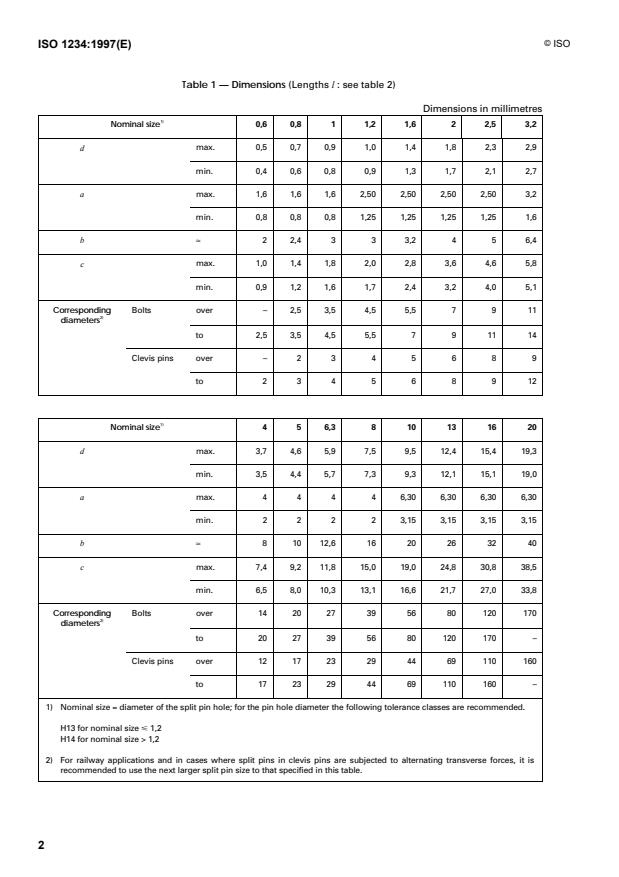
The document specifies nominal diameters ranging from 0.6 mm to 20 mm and corresponding lengths with defined minimum and maximum values. Tables provide precise measurements for pin diameter, length, and leg dimensions to accommodate various bolt and clevis pin diameters.Materials and Surface Finishes
Recommended materials include:- Steel (St)
- Copper-zinc alloys (Cu Zn)
- Copper (Cu)
- Aluminium alloys (Al)
- Austenitic stainless steel (A)
Surface treatment options include electroplated coatings (per ISO 4042) and phosphate conversion coatings (per ISO 9717), ensuring corrosion resistance and durability.
Mechanical Properties
The standard mandates that each leg of the split pin must withstand bending back upon itself without visible fracture, ensuring ductility and mechanical integrity.Workmanship and Quality
Pins must be free of burrs, irregularities, and detrimental defects with an eye as circular as possible. The combined cross-section of the two legs should also be circular. Acceptance inspection follows ISO 3269 guidelines.Designation System
A clear designation format is defined for specifying nominal size, length, and material type - for example, "Split pin ISO 1234 – 5 50 – St" represents a steel split pin with a nominal size of 5 mm and length of 50 mm.
Applications
ISO 1234 split pins are widely used across multiple sectors including:
Mechanical and Structural Engineering
Used to secure bolt assemblies, preventing components from loosening under vibrations or dynamic loads.Automotive and Aerospace
Ensuring the reliability of fasteners in safety-critical applications by locking nuts and shafts in place.Railway Systems
Specialized recommendations apply for railway clevis pins, including the use of larger pin sizes when subjected to transverse alternating forces for enhanced durability.General Manufacturing
Fastening various machinery components where reliable, tamper-resistant locking is required.
The standard supports global supply chains by enabling manufacturers, engineers, and quality control teams to adopt consistent, verified dimensions and materials for split pins.
Related Standards
- ISO 3269:1988 – Fasteners – Acceptance inspection
- ISO 4042 – Fasteners – Electroplated coatings (under revision)
- ISO 9717:1990 – Phosphate conversion coatings for metals – Requirement specifications
These referenced standards complement ISO 1234 by detailing inspection methods, coating processes, and quality assurance practices necessary to maintain split pin performance and longevity.
Keywords: ISO 1234, split pins, cotter pins, fasteners standard, mechanical fasteners, pin dimensions, split pin materials, fastener specifications, international fastener standards, bolt locking devices, quality inspection fasteners.
Relations
- Consolidates
EN ISO 1234:1997 - Split pins (ISO 1234:1997) - Effective Date
- 12-Feb-2026
- Effective Date
- 06-Jun-2022
- Effective Date
- 15-Apr-2008
Frequently Asked Questions
ISO 1234:1997 is a standard published by the International Organization for Standardization (ISO). Its full title is "Split pins". This standard covers: La présente Norme internationale prescrit les caractéristiques des goupilles fendues.
La présente Norme internationale prescrit les caractéristiques des goupilles fendues.
ISO 1234:1997 is classified under the following ICS (International Classification for Standards) categories: 21.060.50 - Pins, nails. The ICS classification helps identify the subject area and facilitates finding related standards.
ISO 1234:1997 has the following relationships with other standards: It is inter standard links to EN ISO 1234:1997, ISO 3157:1991, ISO 1234:1976. Understanding these relationships helps ensure you are using the most current and applicable version of the standard.
ISO 1234:1997 is available in PDF format for immediate download after purchase. The document can be added to your cart and obtained through the secure checkout process. Digital delivery ensures instant access to the complete standard document.
Standards Content (Sample)
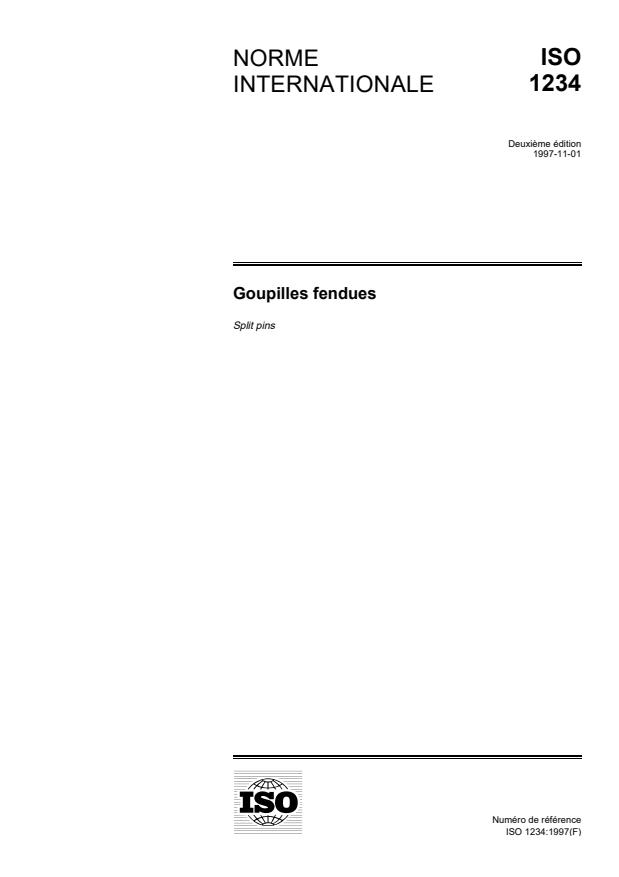
INTERNATIONAL ISO
STANDARD 1234
Second edition
1997-11-01
Split pins
Goupilles fendues
A
Reference number
Foreword
ISO (the International Organization for Standardization) is a worldwide
federation of national standards bodies (ISO member bodies). The work of
preparing International Standards is normally carried out through ISO
technical committees. Each member body interested in a subject for which
a technical committee has been established has the right to be represented
on that committee. International organizations, governmental and non-
governmental, in liaison with ISO, also take part in the work. ISO
collaborates closely with the International Electrotechnical Commission
(IEC) on all matters of electrotechnical standardization.
Draft International Standards adopted by the technical committees are
circulated to the member bodies for voting. Publication as an International
Standard requires approval by at least 75 % of the member bodies casting
a vote.
International Standard ISO 1234 was prepared by Technical Committee
ISO/TC 2, Fasteners.
This second edition cancels and replaces the first edition (ISO 1234:1976),
which has been technically revised.
© ISO 1997
All rights reserved. Unless otherwise specified, no part of this publication may be reproduced
or utilized in any form or by any means, electronic or mechanical, including photocopying and
microfilm, without permission in writing from the publisher.
International Organization for Standardization
Case postale 56 • CH-1211 Genève 20 • Switzerland
Internet central@iso.ch
X.400 c=ch; a=400net; p=iso; o=isocs; s=central
Printed in Switzerland
ii
©
INTERNATIONAL STANDARD ISO ISO 1234:1997(E)
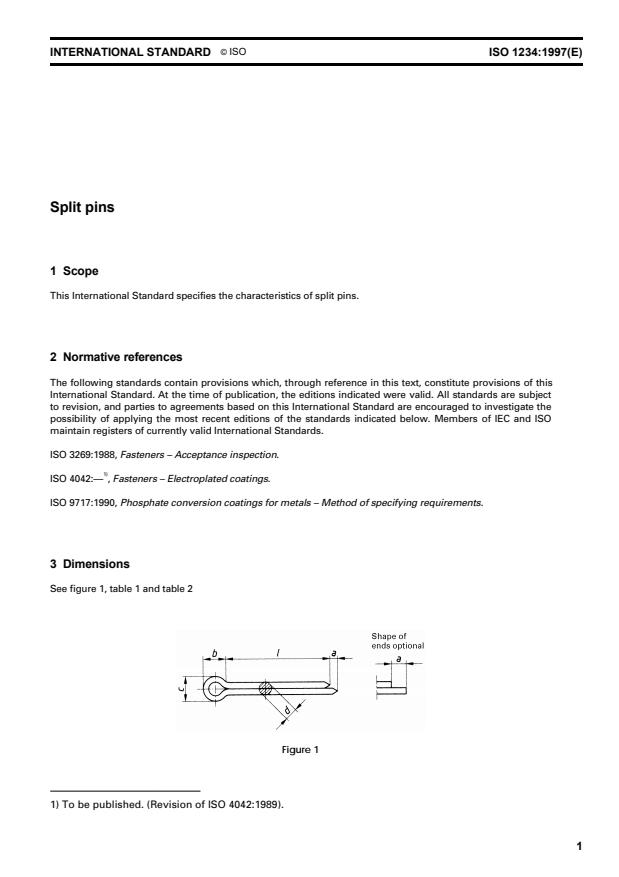
Split pins
1 Scope
This International Standard specifies the characteristics of split pins.
2 Normative references
The following standards contain provisions which, through reference in this text, constitute provisions of this
International Standard. At the time of publication, the editions indicated were valid. All standards are subject
to revision, and parties to agreements based on this International Standard are encouraged to investigate the
possibility of applying the most recent editions of the standards indicated below. Members of IEC and ISO
maintain registers of currently valid International Standards.
ISO 3269:1988, Fasteners – Acceptance inspection.
1)
ISO 4042:— , Fasteners – Electroplated coatings.
ISO 9717:1990, Phosphate conversion coatings for metals – Method of specifying requirements.
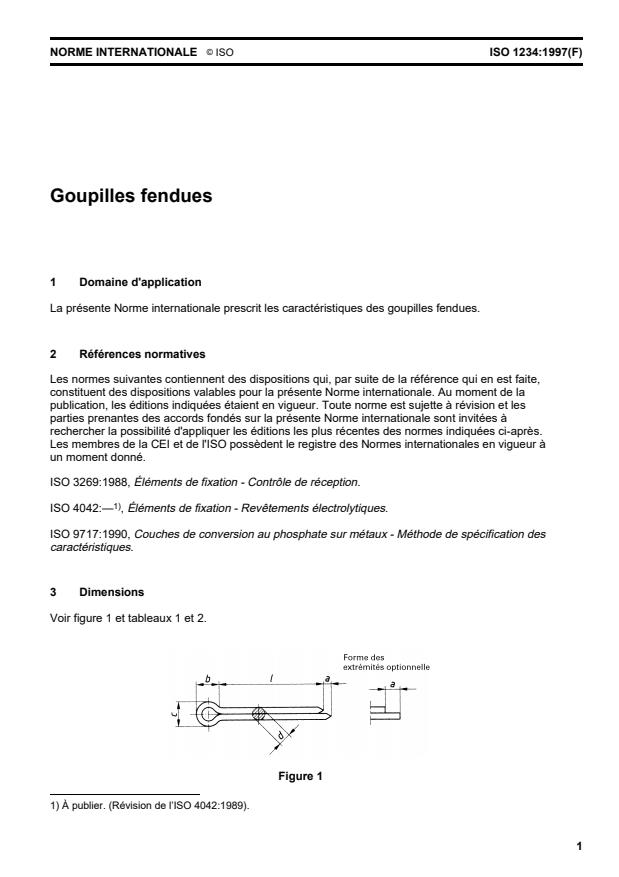
3 Dimensions
See figure 1, table 1 and table 2
Figure 1
1) To be published. (Revision of ISO 4042:1989).
© ISO
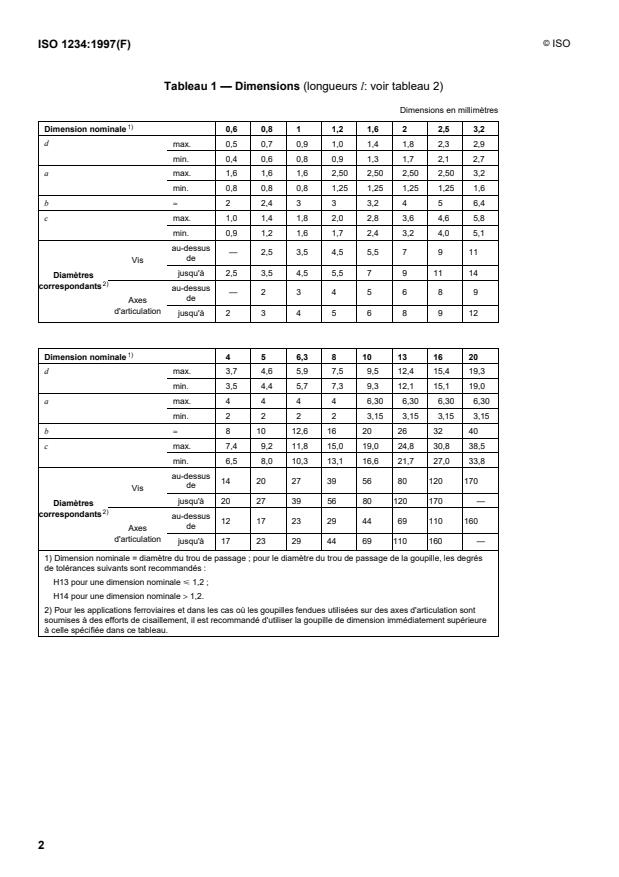
Table 1 — Dimensions (Lengths l : see table 2)
Dimensions in millimetres
1)
Nominal size 0,6 0,8 1 1,2 1,6 2 2,5 3,2
d max. 0,5 0,7 0,9 1,0 1,4 1,8 2,3 2,9
min. 0,4 0,6 0,8 0,9 1,3 1,7 2,1 2,7
max. 1,6 1,6 1,6 2,50 2,50 2,50 2,50 3,2
a
min. 0,8 0,8 0,8 1,25 1,25 1,25 1,25 1,6
b ≈ 2 2,4 3 3 3,2 4 5 6,4
c max. 1,0 1,4 1,8 2,0 2,8 3,6 4,6 5,8
min. 0,9 1,2 1,6 1,7 2,4 3,2 4,0 5,1
Corresponding Bolts over – 2,5
...
NORME ISO
INTERNATIONALE 1234
Deuxième édition
1997-11-01
Goupilles fendues
Split pins
A
Numéro de référence
Avant-propos
L'ISO (Organisation internationale de normalisation) est une fédération
mondiale d'organismes nationaux de normalisation (comités membres de
l'ISO). L'élaboration des Normes internationales est en général confiée aux
comités techniques de l'ISO. Chaque comité membre intéressé par une
étude a le droit de faire partie du comité technique créé à cet effet. Les
organisations internationales, gouvernementales et non gouvernementales,
en liaison avec l'ISO participent également aux travaux. L'ISO collabore
étroitement avec la Commission électrotechnique internationale (CEI) en
ce qui concerne la normalisation électrotechnique.
Les projets de Normes internationales adoptés par les comités techniques
sont soumis aux comités membres pour vote. Leur publication comme
Normes internationales requiert l'approbation de 75 % au moins des
comités membres votants.
La Norme internationale ISO 1234 a été élaborée par le Comité technique
ISO/TC 2, Éléments de fixation.
Cette deuxième édition annule et remplace la première édition
(ISO 1234:1976), dont elle constitue une révision technique.
© ISO 1997
Droits de reproduction réservés. Sauf prescription différente, aucune partie de cette publi-
cation ne peut être reproduite ni utilisée sous quelque forme que ce soit et par aucun pro-
cédé, électronique ou mécanique, y compris la photocopie et les microfilms, sans l'accord
écrit de l'éditeur.
Organisation internationale de normalisation
Case postale 56 • CH-1211 Genève 20 • Suisse
Internet central@iso.ch
X.400 c=ch; a=400net; p=iso; o=isocs; s=central
Imprimé en Suisse
ii
©
NORME INTERNATIONALE ISO ISO 1234:1997(F)
Goupilles fendues
1 Domaine d'application
La présente Norme internationale prescrit les caractéristiques des goupilles fendues.
2 Références normatives
Les normes suivantes contiennent des dispositions qui, par suite de la référence qui en est faite,
constituent des dispositions valables pour la présente Norme internationale. Au moment de la
publication, les éditions indiquées étaient en vigueur. Toute norme est sujette à révision et les
parties prenantes des accords fondés sur la présente Norme internationale sont invitées à
rechercher la possibilité d'appliquer les éditions les plus récentes des normes indiquées ci-après.
Les membres de la CEI et de l'ISO possèdent le registre des Normes internationales en vigueur à
un moment donné.
ISO 3269:1988, Éléments de fixation - Contrôle de réception.
1)
ISO 4042:— , Éléments de fixation - Revêtements électrolytiques.
ISO 9717:1990, Couches de conversion au phosphate sur métaux - Méthode de spécification des
caractéristiques.
3 Dimensions
Voir figure 1 et tableaux 1 et 2.
Figure 1
1) À publier. (Révision de l’ISO 4042:1989).
©
ISO
Tableau 1 — Dimensions (longueurs l: voir tableau 2)
Dimensions en millimètres
1)
Dimension nominale 0,6 0,8 1 1,2 1,6 2 2,5 3,2
d max. 0,5 0,7 0,9 1,0 1,4 1,8 2,3 2,9
min. 0,4 0,6 0,8 0,9 1,3 1,7 2,1 2,7
a max. 1,6 1,6 1,6 2,50 2,50 2,50 2,50 3,2
min. 0,8 0,8 0,8 1,25 1,25 1,25 1,25 1,6
b ≈ 2 2,4 3 3 3,2 4 5 6,4
c
max. 1,0 1,4 1,8 2,0 2,8 3,6 4,6 5,8
min. 0,9 1,2 1,6 1,7 2,4 3,2 4,0 5,1
au-dessus
— 2,5 3,5 4,5 5,5 7 9 11
de
Vis
jusq
...