

ISO/DIS 10993-6
(Main)Biological evaluation of medical devices
Biological evaluation of medical devices
Évaluation biologique des dispositifs médicaux
General Information
RELATIONS
Standards Content (sample)
DRAFT INTERNATIONAL STANDARD ISO/DIS 10993-6
ISO/TC 194 Secretariat: DIN
Voting begins on: Voting terminates on:
2004-12-23 2005-05-23
INTERNATIONAL ORGANIZATION FOR STANDARDIZATION • МЕЖДУНАРОДНАЯ ОРГАНИЗАЦИЯ ПО СТАНДАРТИЗАЦИИ • ORGANISATION INTERNATIONALE DE NORMALISATION
Biological evaluation of medical devices —Part 6:
Tests for local effects after implantation
Évaluation biologique des dispositifs médicaux —
Partie 6: Essais concernant les effets locaux après implantation
[Revision of first edition (ISO 10993-6:1994)]
ICS 11.100.20
ISO/CEN PARALLEL ENQUIRY
The CEN Secretary-General has advised the ISO Secretary-General that this ISO/DIS covers a subject
of interest to European standardization. In accordance with the ISO-lead mode of collaboration as
defined in the Vienna Agreement, consultation on this ISO/DIS has the same effect for CEN
members as would a CEN enquiry on a draft European Standard. Should this draft be accepted, a
final draft, established on the basis of comments received, will be submitted to a parallel two-month FDIS
vote in ISO and formal vote in CEN.In accordance with the provisions of Council Resolution 15/1993 this document is circulated in
the English language only.Conformément aux dispositions de la Résolution du Conseil 15/1993, ce document est distribué
en version anglaise seulement.To expedite distribution, this document is circulated as received from the committee secretariat.
ISO Central Secretariat work of editing and text composition will be undertaken at publication
stage.Pour accélérer la distribution, le présent document est distribué tel qu'il est parvenu du
secrétariat du comité. Le travail de rédaction et de composition de texte sera effectué au
Secrétariat central de l'ISO au stade de publication.THIS DOCUMENT IS A DRAFT CIRCULATED FOR COMMENT AND APPROVAL. IT IS THEREFORE SUBJECT TO CHANGE AND MAY NOT BE
REFERRED TO AS AN INTERNATIONAL STANDARD UNTIL PUBLISHED AS SUCH.IN ADDITION TO THEIR EVALUATION AS BEING ACCEPTABLE FOR INDUSTRIAL, TECHNOLOGICAL, COMMERCIAL AND USER PURPOSES, DRAFT
INTERNATIONAL STANDARDS MAY ON OCCASION HAVE TO BE CONSIDERED IN THE LIGHT OF THEIR POTENTIAL TO BECOME STANDARDS TO
WHICH REFERENCE MAY BE MADE IN NATIONAL REGULATIONS.© International Organization for Standardization, 2004
---------------------- Page: 1 ----------------------
ISO/DIS 10993-6
PDF disclaimer
This PDF file may contain embedded typefaces. In accordance with Adobe's licensing policy, this file may be printed or viewed but shall
not be edited unless the typefaces which are embedded are licensed to and installed on the computer performing the editing. In
downloading this file, parties accept therein the responsibility of not infringing Adobe's licensing policy. The ISO Central Secretariat
accepts no liability in this area.Adobe is a trademark of Adobe Systems Incorporated.
Details of the software products used to create this PDF file can be found in the General Info relative to the file; the PDF-creation
parameters were optimized for printing. Every care has been taken to ensure that the file is suitable for use by ISO member bodies. In the
unlikely event that a problem relating to it is found, please inform the Central Secretariat at the address given below.
Copyright noticeThis ISO document is a Draft International Standard and is copyright-protected by ISO. Except as permitted
under the applicable laws of the user's country, neither this ISO draft nor any extract from it may be
reproduced, stored in a retrieval system or transmitted in any form or by any means, electronic, photocopying,
recording or otherwise, without prior written permission being secured.Requests for permission to reproduce should be addressed to either ISO at the address below or ISO's
member body in the country of the requester.ISO copyright office
Case postale 56 CH-1211 Geneva 20
Tel. + 41 22 749 01 11
Fax + 41 22 749 09 47
E-mail copyright@iso.org
Web www.iso.org
Reproduction may be subject to royalty payments or a licensing agreement.
Violators may be prosecuted.
ii ISO 2004 – All rights reserved
---------------------- Page: 2 ----------------------
ISO/DIS 10993-6
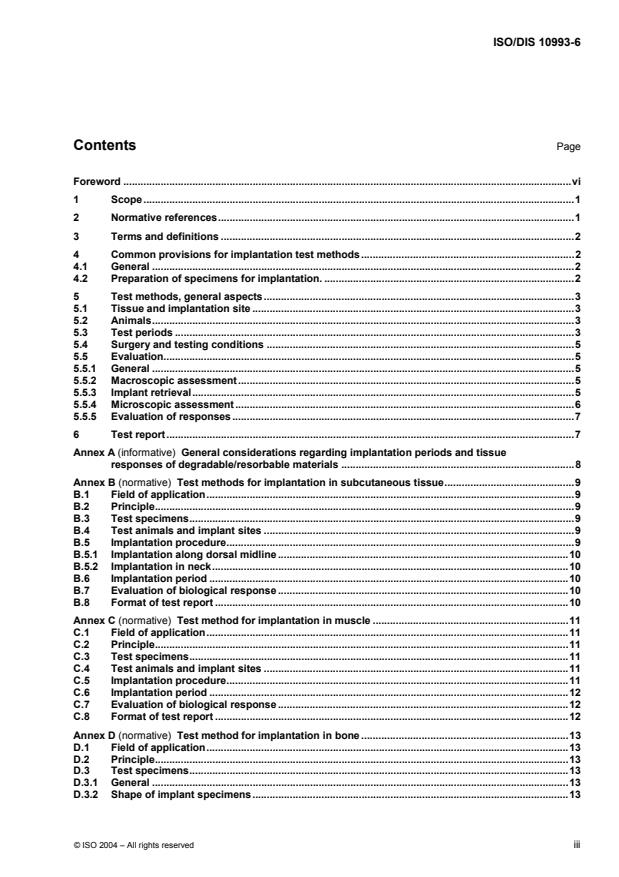
Contents Page
Foreword ............................................................................................................................................................vi
1 Scope......................................................................................................................................................1
2 Normative references............................................................................................................................1
3 Terms and definitions ...........................................................................................................................2
4 Common provisions for implantation test methods..........................................................................2
4.1 General...................................................................................................................................................2
4.2 Preparation of specimens for implantation. .......................................................................................2
5 Test methods, general aspects............................................................................................................3
5.1 Tissue and implantation site ................................................................................................................3
5.2 Animals...................................................................................................................................................3
5.3 Test periods...........................................................................................................................................3
5.4 Surgery and testing conditions ...........................................................................................................5
5.5 Evaluation...............................................................................................................................................5
5.5.1 General...................................................................................................................................................5
5.5.2 Macroscopic assessment.....................................................................................................................5
5.5.3 Implant retrieval.....................................................................................................................................5
5.5.4 Microscopic assessment......................................................................................................................6
5.5.5 Evaluation of responses.......................................................................................................................7
6 Test report..............................................................................................................................................7
Annex A (informative) General considerations regarding implantation periods and tissue
responses of degradable/resorbable materials .................................................................................8
Annex B (normative) Test methods for implantation in subcutaneous tissue.............................................9
B.1 Field of application................................................................................................................................9
B.2 Principle..................................................................................................................................................9
B.3 Test specimens......................................................................................................................................9
B.4 Test animals and implant sites ............................................................................................................9
B.5 Implantation procedure.........................................................................................................................9
B.5.1 Implantation along dorsal midline .....................................................................................................10
B.5.2 Implantation in neck............................................................................................................................10
B.6 Implantation period.............................................................................................................................10
B.7 Evaluation of biological response .....................................................................................................10
B.8 Format of test report ...........................................................................................................................10
Annex C (normative) Test method for implantation in muscle ....................................................................11
C.1 Field of application..............................................................................................................................11
C.2 Principle................................................................................................................................................11
C.3 Test specimens....................................................................................................................................11
C.4 Test animals and implant sites ..........................................................................................................11
C.5 Implantation procedure.......................................................................................................................11
C.6 Implantation period.............................................................................................................................12
C.7 Evaluation of biological response .....................................................................................................12
C.8 Format of test report ...........................................................................................................................12
Annex D (normative) Test method for implantation in bone ........................................................................13
D.1 Field of application..............................................................................................................................13
D.2 Principle................................................................................................................................................13
D.3 Test specimens....................................................................................................................................13
D.3.1 General.................................................................................................................................................13
D.3.2 Shape of implant specimens..............................................................................................................13
© ISO 2004 – All rights reserved iii---------------------- Page: 3 ----------------------
ISO/DIS 10993-6
D.3.3 Size of test specimens ........................................................................................................................13
D.4 Test animals and implant sites...........................................................................................................13
D.4.1 Test animals.........................................................................................................................................13
D.4.2 Implant sites.........................................................................................................................................14
D.5 Implantation procedure.......................................................................................................................14
D.6 Implantation period..............................................................................................................................14
D.7 Evaluation of biological response .....................................................................................................14
D.8 Format of test report ...........................................................................................................................14
Annex E (informative) Format for documentation and evaluation of local biological effects after
implantation..........................................................................................................................................15
Annex ZA (informative) Clauses of this International Standard addressing essential requirements
or other provisions of EU Directives 90/385/EEC for Active Implantable Medical Devices
and 93/42/EEC for Medical Devices ...................................................................................................17
Annex ZB (normative) Normative references to international publications with their relevant
European publications ........................................................................................................................18
Bibliography ......................................................................................................................................................19
iv © ISO 2004 – All rights reserved---------------------- Page: 4 ----------------------
ISO/DIS 10993-6
Foreword
ISO (the International Organization for Standardization) is a worldwide federation of national standards bodies
(ISO member bodies). The work of preparing International Standards is normally carried out through ISO
technical committees. Each member body interested in a subject for which a technical committee has been
established has the right to be represented on that committee. International organizations, governmental and
non-governmental, in liaison with ISO, also take part in the work. ISO collaborates closely with the
International Electrotechnical Commission (IEC) on all matters of electrotechnical standardization.
International Standards are drafted in accordance with the rules given in the ISO/IEC Directives, Part 2.
The main task of technical committees is to prepare International Standards. Draft International Standards
adopted by the technical committees are circulated to the member bodies for voting. Publication as an
International Standard requires approval by at least 75 % of the member bodies casting a vote.
Attention is drawn to the possibility that some of the elements of this document may be the subject of patent
rights. ISO shall not be held responsible for identifying any or all such patent rights.
ISO 10993-6 was prepared by Technical Committee ISO/TC 194, Biological evaluation of medical devices.
This second edition cancels and replaces the first edition (EN 30993-6:1994), which has been technically
revised.ISO 10993 consists of the following parts, under the general title Biological evaluation of medical devices:
Part 1: Evaluation and testing Part 2: Animal welfare requirements
Part 3: Tests for genotoxicity, carcinogenicity and reproductive toxicity
Part 4: Selection of tests for interactions with blood
Part 5: Tests for in vitro cytotoxicity
Part 6: Tests for local effects after implantation
Part 7: Ethylene oxide sterilization residuals
Part 9: Framework for the identification and quantification of potential degradation products
Part 10: Tests for irritation and delayed-type hypersensitivity Part 11: Tests for systemic toxicity
Part 12: Sample preparation and reference materials
Part 13: Identification and quantification of degradation products from polymeric medical devices
Part 14: Identification and quantification of degradation products from ceramics
Part 15: Identification and quantification of degradation products from metals and alloys
© ISO 2004 – All rights reserved v---------------------- Page: 5 ----------------------
ISO/DIS 10993-6
Part 16: Toxicokinetic study design for degradation products and leachables
Part 17: Method for the establishment of allowable limits for leachable substances
Part 18: Chemical characterization of materials Part 19: Physico-chemical, mechanical and morphological characterization
Part 20: Principles and methods for immunotoxicology testing of medical devices
Future parts will deal with other relevant aspects of biological evaluation.vi © ISO 2004 – All rights reserved
---------------------- Page: 6 ----------------------
DRAFT INTERNATIONAL STANDARD ISO/DIS 10993-6
Biological evaluation of medical devices — Part 6: Tests for
local effects after implantation
1 Scope
This part of the ISO 10993 specifies test methods for the assessment of the local effects after implantation of
biomaterials intended to be used in medical devices. The standard applies to solid biomaterials that are non-
degradable, degradable and/or resorbable, non-solid biomaterials, such as porous materials, and liquids,
pastes and particulates.The test specimen is implanted into a site and tissue appropriate for the evaluation of the biological safety of
the material. This implantation test is not intended to determine the performance of the test specimen in terms
of mechanical or functional loading. This standard may also be applied to medical devices which are intended
to be used on surfaces breached or intact, in order to evaluate local tissue responses.
The local effects are evaluated by a comparison of the tissue response caused by a test specimen to that
caused by materials used in medical devices of which the clinical acceptability and biocompatibility
characteristics have been established. The objective of the test methods is to characterize the history of the
tissue response after implantation of a medical device/biomaterial including final integration or resorption /
degradation of the material. In particular for degradable/resorbable materials the degradation characteristics of
the material and the resulting tissue response should be determined.This standard does not deal with systemic toxicity, carcinogenicity, teratogenicity or mutagenicity. However,
the long-term implantation studies intended for evaluation of local biological effects may provide insight into
some of these issues.NOTE For the convenience of the user of this standard a bibliography is included.
2 Normative referencesThe following referenced documents are indispensable for the application of this document. For dated
references, only the edition cited applies. For undated references, the latest edition of the referenced
document (including any amendments) applies.ISO 10993-1, Biological evaluation of medical devices – Part 1: Guidance on selection of tests
ISO 10993-2, Biological evaluation of medical devices – Part 2: Animal welfare requirements
ISO 10993-11, Biological evaluation of medical devices – Part 11: Tests for systemic toxicity
ISO 10993-12, Biological evaluation of medical devices. Part 12: Sample preparation and reference materials
ISO 10993-16, Biological evaluation of medical devices – Part 16: Toxicokinetic study design for degradation
products and leachables© ISO 2004 – All rights reserved 1
---------------------- Page: 7 ----------------------
ISO/DIS 10993-6
3 Terms and definitions
For the purposes of this document, the terms and definitions given in ISO 10993-1, ISO 10993-2, ISO 10993-
16 and the following apply.3.1
degradation
chemical breakdown or decomposition of material
4 Common provisions for implantation test methods
4.1 General
The provisions of clause 4 shall apply to the test methods described in Annex B, C and D.
All animal studies shall be performed in a facility approved by a nationally recognized organisation and in
accordance with all appropriate regulations dealing with laboratory animal welfare. These studies shall be
performed under good laboratory practices or other recognized quality assurance systems, and comply with
the requirements in ISO 10993 -2.It is important that the researcher plans the study in such detail that all relevant information can be extracted
from the use of each animal and each study (see ISO 10993-2, ISO 10993-11 and ISO 10993-16).
4.2 Preparation of specimens for implantation.Test sample and reference material preparation shall be in compliance with 10993-12. The implant size and
shape shall be documented and justified. Test specimens for various implant sites are described in Annex B to
D. Physical characteristics (such as form, density, hardness, surface) can influence the character of the tissue
response to the test material and shall be recorded.Each implant shall be manufactured, processed, cleaned of contaminants and sterilized by the method
intended for the final product and accordingly documented. After final preparation and sterilization, the implant
specimens shall be handled aseptically and in such a way as to ensure that they are not scratched, damaged
or contaminated in any way prior to or during implantation.For materials used as scaffolds for tissue engineered medical products it may be appropriate not to use the
final preparation with cells, as the immune reaction of the laboratory animal to the cellular components of such
products may interfere with the resulting local tissue response.For composite materials (e.g. bone cements, dental materials), the components may be mixed before use,
and set after varying time periods. Materials that are designed for use in devices with in situ polymerisation
shall be introduced in a manner such that in situ polymerisation occurs. For certain types of studies other
procedures may be used. The procedure used shall be documented.Non-solid materials (including powders) may be contained in tubes for the purpose of testing for local effects
after implantation (see ISO 10993-12 for the selection of materials for tubes). Prepare the test material
according to the manufacturer’s instructions and insert the material into the tube until level with the top.
Exercise the utmost care to prevent contamination of the outer surface of the tube by the test material. Avoid
entrapment of air in the tube and ensure that the end surfaces of the inserted material in the tube and the tube
ends are smooth.NOTE 1 Polyethylene (PE), polypropylene (PP), or polytetrafluoroethylene (PTFE) tubes are commonly used for this
purpose. PE tubes may be deformed by autoclaving. PTFE tubes are difficult to section in the microtome, and substitution
by PE or PP tubes of the same dimensions may be preferable when the tubes are to remain in the tissue blocks during
sectioning.2 © ISO 2004 – All rights reserved
---------------------- Page: 8 ----------------------
ISO/DIS 10993-6
Evaluation is done by comparison of the tissue reaction to that of a similar specimen/material of which the
clinical acceptability and biocompatibility characteristics have been established.
NOTE 2 For further guidance see ISO 10993-12.The physical characteristics such as shape and especially the surface condition of the control(s) shall be
similar to that of the implant test specimens as is practically possible. When the test material is contained in a
tube, the control shall be a rod of the same material as the tube and with the same diameter as the outer
diameter of the tube. In general, a positive control is not necessary.5 Test methods, general aspects
5.1 Tissue and implantation site
The test specimen shall be implanted into the tissues most relevant to the intended clinical use of the material.
The justification for the choice of tissue shall be documented. Test methods for various implantation sites are
given in Annex B to D. If other implantation sites are chosen, the general scientific principles behind the test
methods described in Annex B to D shall still be adhered to.For degradable/resorbable materials the implantation site shall be marked in a manner suitable for
identification of the site at the designated time periods. The use of a permanent skin marker and/or a template
marking the placement of the specimen is recommended. In certain circumstances an appropriate negative
control may be used as a marker for the location of the implant site. A sham surgical procedure might be used
to evaluate the impact of the procedure on the tissue involved.NOTE Markers for identification of the implant site of resorbable test specimens may be non absorbable sutures or
skin paints.5.2 Animals
Animal husbandry shall be in accordance with ISO 10993-2. In general, small laboratory animals such as mice,
rats, hamsters or rabbits are preferred. The use of larger animals may be justified based upon special
considerations of the particular biomaterial under study.Select an animal species with due considerations of the size of the implant test specimens, the number of
implants per animal, the intended duration of the test in relation to the expected lifespan of the animals, as
well as potential species differences regarding biological response.For short-term testing in subcutaneous tissue, muscle, and bone, animals such as mice, rats, guinea pigs or
rabbits are commonly used. Select one species among these.For long-term testing in subcutaneous tissue, muscle and bone, animals such as rats, guinea pigs, rabbits,
dogs, sheep, goats, pigs and other animals with a relatively long life expectancy are suitable. Select one
species among these.NOTE Especially for biodegradable materials it is recommended that a pilot study in rodents be undertaken to
determine the expected rate of degradation before embarking on studies in larger animals.
The specimens of test and control materials shall be implanted under the same conditions in the same
species of the same age, sex, and strain in corresponding anatomical sites. The number and size of implants
inserted in an animal depends on the size of the species and the anatomical location. Whenever possible, the
reference control and the test specimen should be in the same animal.5.3 Test periods
The test period shall be determined by the likely clinical exposure time or be continued until or beyond a
steady state has been reached with respect to the biological response. For non-degradable/resorbable
© ISO 2004 – All rights reserved 3---------------------- Page: 9 ----------------------
ISO/DIS 10993-6
materials the short-term responses are normally assessed from 1 week up to 4 weeks and long-term tests
exceeding 12 weeks. The local biological response to implanted materials depends both on the properties of
the materials and on the trauma of surgery. The tissue configuration found in the vicinity of an implant
changes with time elapsed after surgery. Up to two weeks, the reaction due to the surgical procedure itself
may be difficult to distinguish from the tissue reaction evoked by the implant. In muscle and connective tissue,
depending on the species, and the severity of the surgical trauma, a steady state is seen in the cell population
after 9 to 12 weeks. Implantation in bone tissue may need longer observation periods before a steady state is
reached.For degradable/resorbable materials the test period shall be related to the estimated degradation time of the
test product. See Annex A for general considerations regarding degradable/absorbable materials. Before
starting with animal studies an estimation of the degradation time shall be made. This can be done in vitro by
real time or accelerated degradation studies or in certain circumstances by mathematical modelling. In general
it is to be expected that long-term experiments (exceeding 12 weeks) are needed for the evaluation of
degradable materials.The milestones for evaluation of degradable biomaterials will depend on the degradation rate of the materials.
The following may be used for guidance: Early responses may be determined up to 2 weeks after implantation;
Short-term: local reaction to be evaluated at 2-12 weeks after implantation;
Intermediate: when it is anticipated that degradation is taking place;
Long-term: when it is estimated that degradation is nearing completion, or a steady state has been
reached.Even in the absence of complete degradation, absorption, or restoration to normal tissue structure and
function, the overall data collected may be sufficient to allow characterization of the local effects after
implantation.NOTE 1 In vivo degradation may need a rather long period of time for up to more then one year. Additional animals
may be used to extend the observation period when the implant has not been degraded completely within the expected
investigational time period.NOTE 2 Although this standard does not address the issues of systemic toxicity (ISO 10993-11), it is recommended
that the information required to meet this standard (ISO 10993-6) be obtained from any systemic toxicity studies using
implantation.For long term implantation studies, generally used observation periods are given in Table 1.
Table 1 — Selection of test periods for implantation in subcutaneous tissue, muscle and bone
Species Implantation period in weeks12 26 52 78 (104)
Rats X X X
Guinea pigs X X X
Rabbits X X X X X
Dogs X X X X X
Sheep X X X X X
Goats X X X X X
Pigs X X X X X
Depending on the intended use of the test material, not all implantation
periods may be necessary (see ISO 10993-12). An observation period of
104 weeks may be of interest in selected instances
4 © ISO 2004 – All rights reserved
---------------------- Page: 10 ----------------------
ISO/DIS 10993-6
...
Questions, Comments and Discussion
Ask us and Technical Secretary will try to provide an answer. You can facilitate discussion about the standard in here.