

ISO 10993-3:2014
(Main)Biological evaluation of medical devices — Part 3: Tests for genotoxicity, carcinogenicity and reproductive toxicity
General Information
- Abstract
ISO 10993-3:2014 specifies strategies for risk estimation, selection of hazard identification tests and risk management, with respect to the possibility of the following potentially irreversible biological effects arising as a result of exposure to medical devices: genotoxicity; carcinogenicity; reproductive and developmental toxicity. ISO 10993-3:2014 is applicable when the need to evaluate a medical device for potential genotoxicity, carcinogenicity, or reproductive toxicity has been established.
- Status
- Withdrawn
- Publication Date
- 23-Sep-2014
- Technical Committee
- ISO/TC 194 - Biological and clinical evaluation of medical devices
- Current Stage
- 9599 - Withdrawal of International Standard
- Start Date
- 06-Aug-2026
- Completion Date
- 29-Aug-2026
Buy Documents

ISO 10993-3:2014 - Biological evaluation of medical devices — Part 3: Tests for genotoxicity, carcinogenicity and reproductive toxicity Released:9/24/2014

ISO 10993-3:2014 - Évaluation biologique des dispositifs médicaux — Partie 3: Essais concernant la génotoxicité, la cancérogénicité et la toxicité sur la reproduction Released:9/24/2014
Overview
ISO 10993-3:2014 - Biological evaluation of medical devices - Part 3: Tests for genotoxicity, carcinogenicity and reproductive toxicity - provides strategies and test-selection guidance for assessing the potential of medical devices and their materials to cause genotoxicity, carcinogenicity, or reproductive/developmental toxicity. Applicable when a risk assessment indicates these hazards are relevant, the standard helps manufacturers, toxicologists and test laboratories decide what tests are necessary and how to interpret results within a device-specific risk management process.
Key technical topics and requirements
- Risk-based test strategy: Testing is required only when justified by a device-specific risk assessment that considers chemical constituents, manufacturing residues, degradation products, exposure routes and clinical use.
- Genotoxicity testing: Guidance on in vitro and in vivo genotoxicity assays, sample preparation and follow-up evaluation to maximize test sensitivity.
- Carcinogenicity testing: Evaluation strategies for long-term studies, including considerations for implantation studies and criteria for study design.
- Reproductive and developmental toxicity: Selection of appropriate reproductive toxicity tests (screening and full studies) and sample-preparation requirements.
- Sample preparation: Procedures for extracts, leachables and resuspended device-related materials consistent with ISO 10993-12 to ensure relevant exposure in test systems.
- Reporting and follow-up: Requirements for test reports and structured follow-up evaluation (flowchart guidance) when initial results indicate concern.
- Normative and informative annexes: Practical guidance (Annex A–F) on sample prep, follow-up flowcharts, rationale for test systems, implantation study considerations and in vitro embryo toxicity tests.
- Referenced test methods: Cross-references to OECD and other standard methods (e.g., OECD 471, 473, 476, 487, OECD 414/415/416/421/451/453) for validated assay protocols.
Practical applications - who uses ISO 10993-3:2014
- Medical device manufacturers performing biocompatibility and safety assessments.
- Regulatory affairs professionals preparing premarket submissions.
- GLP-certified testing laboratories designing genotoxicity, carcinogenicity or reproductive toxicity studies.
- Toxicologists and clinical safety assessors conducting device-specific risk estimation.
- Notified bodies and regulatory agencies evaluating evidence for device approval.
Related standards
- ISO 10993-1: Evaluation and testing within a risk management process
- ISO 10993-12: Sample preparation and reference materials
- ISO 10993-6, -5, -11, -18 and other parts of the ISO 10993 series for complementary biocompatibility, chemical characterization and toxicity guidance
This standard is essential when assessing irreversible biological hazards from medical devices and integrates with ISO 10993 risk management, OECD test methods and laboratory best practices for reliable genotoxicity, carcinogenicity and reproductive toxicity evaluation.
Relations
- Effective Date
- 20-Feb-2026
- Effective Date
- 09-Feb-2026
- Effective Date
- 09-Feb-2026
- Effective Date
- 09-Feb-2026
- Effective Date
- 09-Feb-2026
- Effective Date
- 09-Feb-2026
- Effective Date
- 09-Feb-2026
- Effective Date
- 09-Feb-2026
- Effective Date
- 09-Feb-2026
- Effective Date
- 09-Feb-2026
- Effective Date
- 12-Feb-2026
- Effective Date
- 04-Nov-2023
- Effective Date
- 14-Nov-2009
Buy Documents
ISO 10993-3:2014 - Biological evaluation of medical devices — Part 3: Tests for genotoxicity, carcinogenicity and reproductive toxicity Released:9/24/2014
ISO 10993-3:2014 - Évaluation biologique des dispositifs médicaux — Partie 3: Essais concernant la génotoxicité, la cancérogénicité et la toxicité sur la reproduction Released:9/24/2014
Get Certified
Connect with accredited certification bodies for this standard

BSI Group
BSI (British Standards Institution) is the business standards company that helps organizations make excellence a habit.

TÜV Rheinland
TÜV Rheinland is a leading international provider of technical services.

TÜV SÜD
TÜV SÜD is a trusted partner of choice for safety, security and sustainability solutions.
Sponsored listings
Frequently Asked Questions
ISO 10993-3:2014 is a standard published by the International Organization for Standardization (ISO). Its full title is "Biological evaluation of medical devices — Part 3: Tests for genotoxicity, carcinogenicity and reproductive toxicity". This standard covers: ISO 10993-3:2014 specifies strategies for risk estimation, selection of hazard identification tests and risk management, with respect to the possibility of the following potentially irreversible biological effects arising as a result of exposure to medical devices: genotoxicity; carcinogenicity; reproductive and developmental toxicity. ISO 10993-3:2014 is applicable when the need to evaluate a medical device for potential genotoxicity, carcinogenicity, or reproductive toxicity has been established.
ISO 10993-3:2014 specifies strategies for risk estimation, selection of hazard identification tests and risk management, with respect to the possibility of the following potentially irreversible biological effects arising as a result of exposure to medical devices: genotoxicity; carcinogenicity; reproductive and developmental toxicity. ISO 10993-3:2014 is applicable when the need to evaluate a medical device for potential genotoxicity, carcinogenicity, or reproductive toxicity has been established.
ISO 10993-3:2014 is classified under the following ICS (International Classification for Standards) categories: 11.100.20 - Biological evaluation of medical devices. The ICS classification helps identify the subject area and facilitates finding related standards.
ISO 10993-3:2014 has the following relationships with other standards: It is inter standard links to EN 60601-1:2006/A1:2013, EN ISO 7405:2025, EN ISO 10993-1:2020, EN ISO 10993-7:2008, EN ISO 25539-2:2020, EN ISO 10993-1:2025, EN ISO 21649:2023, EN ISO 7405:2018, EN ISO 25539-3:2024, EN ISO 7198:2017, EN ISO 10993-3:2014, ISO 10993-3:2026, ISO 10993-3:2003. Understanding these relationships helps ensure you are using the most current and applicable version of the standard.
ISO 10993-3:2014 is available in PDF format for immediate download after purchase. The document can be added to your cart and obtained through the secure checkout process. Digital delivery ensures instant access to the complete standard document.
Standards Content (Sample)
INTERNATIONAL ISO
STANDARD 10993-3
Third edition
2014-10-01
Biological evaluation of medical
devices —
Part 3:
Tests for genotoxicity, carcinogenicity
and reproductive toxicity
Évaluation biologique des dispositifs médicaux —
Partie 3: Essais concernant la génotoxicité, la cancérogénicité et la
toxicité sur la reproduction
Reference number
©
ISO 2014
© ISO 2014
All rights reserved. Unless otherwise specified, no part of this publication may be reproduced or utilized otherwise in any form
or by any means, electronic or mechanical, including photocopying, or posting on the internet or an intranet, without prior
written permission. Permission can be requested from either ISO at the address below or ISO’s member body in the country of
the requester.
ISO copyright office
Case postale 56 • CH-1211 Geneva 20
Tel. + 41 22 749 01 11
Fax + 41 22 749 09 47
E-mail copyright@iso.org
Web www.iso.org
Published in Switzerland
ii © ISO 2014 – All rights reserved
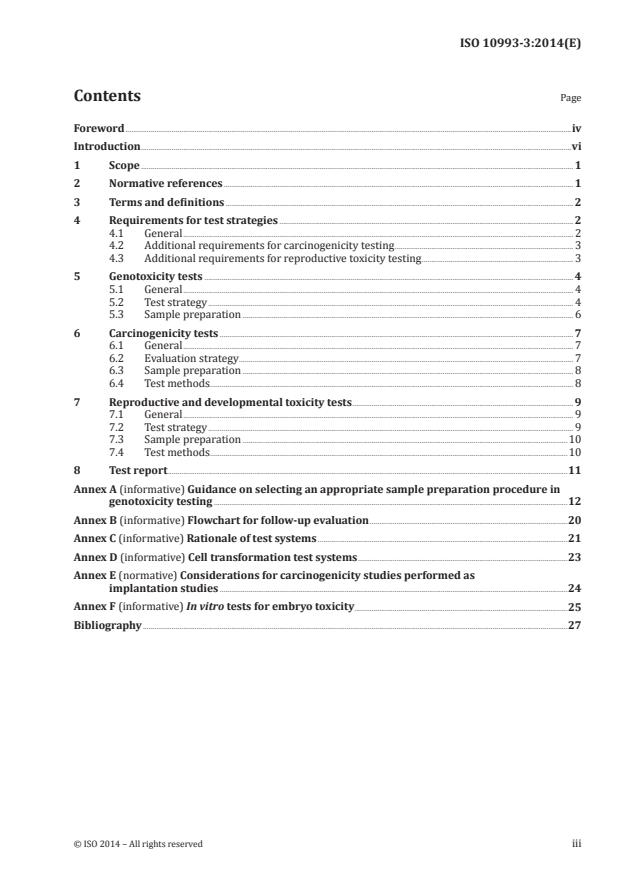
Contents Page
Foreword .iv
Introduction .vi
1 Scope . 1
2 Normative references . 1
3 Terms and definitions . 2
4 Requirements for test strategies . 2
4.1 General . 2
4.2 Additional requirements for carcinogenicity testing . 3
4.3 Additional requirements for reproductive toxicity testing . 3
5 Genotoxicity tests . 4
5.1 General . 4
5.2 Test strategy . 4
5.3 Sample preparation . 6
6 Carcinogenicity tests . 7
6.1 General . 7
6.2 Evaluation strategy . 7
6.3 Sample preparation . 8
6.4 Test methods . 8
7 Reproductive and developmental toxicity tests . 9
7.1 General . 9
7.2 Test strategy . 9
7.3 Sample preparation .10
7.4 Test methods .10
8 Test report .11
Annex A (informative) Guidance on selecting an appropriate sample preparation procedure in
genotoxicity testing .12
Annex B (informative) Flowchart for follow-up evaluation .20
Annex C (informative) Rationale of test systems .21
Annex D (informative) Cell transformation test systems .23
Annex E (normative) Considerations for carcinogenicity studies performed as
implantation studies .24
Annex F (informative) In vitro tests for embryo toxicity.25
Bibliography .27
Foreword
ISO (the International Organization for Standardization) is a worldwide federation of national standards
bodies (ISO member bodies). The work of preparing International Standards is normally carried out
through ISO technical committees. Each member body interested in a subject for which a technical
committee has been established has the right to be represented on that committee. International
organizations, governmental and non-governmental, in liaison with ISO, also take part in the work.
ISO collaborates closely with the International Electrotechnical Commission (IEC) on all matters of
electrotechnical standardization.
The procedures used to develop this document and those intended for its further maintenance are
described in the ISO/IEC Directives, Part 1. In particular the different approval criteria needed for the
different types of ISO documents should be noted. This document was drafted in accordance with the
editorial rules of the ISO/IEC Directives, Part 2. www.iso.org/directives
Attention is drawn to the possibility that some of the elements of this document may be the subject of
patent rights. ISO shall not be held responsible for identifying any or all such patent rights. Details of any
patent rights identified during the development of the document will be in the Introduction and/or on
the ISO list of patent declarations received. www.iso.org/patents
Any trade name used in this document is information given for the convenience of users and does not
constitute an endorsement.
The committee responsible for this document is ISO/TC 194.
This third edition of ISO 10993-3 cancels and replaces the second edition (ISO 10993-3:2003), which has
been technically revised.
The major technical changes are the following:
a) test strategy changed by inclusion of a in vivo test and a follow-up evaluation;
b) new Annex A ” Guidance on selecting an appropriate sample preparation procedure in genotoxicity
testing” included;
c) Inclusion of further in vitro and in vivo test for evaluating the genotoxic potential of medical devices;
d) new Annex B “Flowchart for follow-up evaluation” included;
e) Annex E changed to “Considerations for carcinogenicity studies performed as implantation studies”
and made normative;
f) new Annex F “In vitro tests for embryo toxicity” included.
ISO 10993 consists of the following parts, under the general title Biological evaluation of medical devices:
— Part 1: Evaluation and testing within a risk management process
— Part 2: Animal welfare requirements
— Part 3: Tests for genotoxicity, carcinogenicity and reproductive toxicity
— Part 4: Selection of tests for interactions with blood
— Part 5: Tests for in vitro cytotoxicity
— Part 6: Tests for local effects after implantation
— Part 7: Ethylene oxide sterilization residuals
— Part 9: Framework for identification and quantification of potential degradation products
— Part 10: Tests for irritation and skin sensitization
iv © ISO 2014 – All rights reserved
— Part 11: Tests for systemic toxicity
— Part 12: Sample preparation and reference materials
— Part 13: Identification and quantification of degradation products from polymeric medical devices
— Part 14: Identification and quantification of degradation products from ceramics
— Part 15: Identification and quantification of degradation products from metals and alloys
— Part 16: Toxicokinetic study design for degradation products and leachables
— Part 17: Establishment of allowable limits for leachable substances
— Part 18: Chemical characterization of materials
— Part 19: Physico-chemical, morphological and topographical characterization of materials [Technical
specification]
— Part 20: Principles and methods for immunotoxicology testing of medical devices [Technical
specification]
The following part is under preparation:
— Part 33: Supplement to ISO 10993-3:— Guidance on tests to evaluate genotoxicity [Technical Report]
The following definitions apply in understanding how to implement an ISO International Standard and
other normative ISO deliverables (TS, PAS, IWA):
— “shall” indicates a requirement;
— “should” indicates a recommendation;
— “may” is used to indicate that something is permitted;
— “can” is used to indicate that something is possible, for example, that an organization or individual
is able to do something.
ISO/IEC Directives, Part 2 (sixth edition, 2011), 3.3.1, defines a requirement as an “expression in the
content of a document conveying criteria to be fulfilled if compliance with the document is to be claimed
and from which no deviation is permitted.”
ISO/IEC Directives, Part 2 (sixth edition, 2011), 3.3.2, defines a recommendation as an “expression in the
content of a document conveying that among several possibilities one is recommended as particularly
suitable, without mentioning or excluding others, or that a certain course of action is preferred but not
necessarily required, or that (in the negative form) a certain possibility or course of action is deprecated
but not prohibited.”
Introduction
The basis for biological evaluation of medical devices is often empirical and driven by the relevant
concerns for human safety. The risk of serious and irreversible effects, such as cancer or second generation
abnormalities, is of particular public concern. It is inherent in the provision of safe medical devices that
such risks be minimised to the greatest extent feasible. The assessment of mutagenic, carcinogenic and
reproductive hazards is an essential component of the control of these risks. Not all test methods for the
assessment of genotoxicity, carcinogenicity or reproductive toxicity are equally well developed, nor is
their validity well established for the testing of medical devices.
Significant issues with test sample size and preparation, scientific understanding of disease processes
and test validation can be cited as limitations of available methods. For example, the biological
significance of solid state carcinogenesis is poorly understood. It is expected that on-going scientific and
medical advances will improve our understanding of and approaches to these important toxicological
effects. At the time this document was prepared, the test methods proposed were those most acceptable.
Scientifically sound alternatives to the proposed testing may be acceptable insofar as they address
relevant matters of safety assessment.
In the selection of tests needed to evaluate a particular medical device, there is no substitute for a careful
assessment of expected human uses and potential interactions of the medical device with various
biological systems. These considerations will be particularly important in such areas as reproductive
and developmental toxicology.
This part of ISO 10993 presents test methods for the detection of specific biological hazards, and
strategies for the selection of tests, where appropriate, that will assist in hazard identification. Testing
is not always necessary or helpful in managing toxicological risks associated with exposure to medical
device materials but, where it is appropriate, it is important that maximum test sensitivity is achieved.
In view of the multitude of possible outcomes and the importance of factors such as extent of exposure,
species differences and mechanical or physical considerations, risk assessment have to be performed on
a case-by-case basis.
vi © ISO 2014 – All rights reserved
INTERNATIONAL STANDARD ISO 10993-3:2014(E)
Biological evaluation of medical devices —
Part 3:
Tests for genotoxicity, carcinogenicity and reproductive
toxicity
1 Scope
This part of ISO 10993 specifies strategies for risk estimation, selection of hazard identification tests
and risk management, with respect to the possibility of the following potentially irreversible biological
effects arising as a result of exposure to medical devices:
— genotoxicity;
— carcinogenicity;
— reproductive and developmental toxicity.
This part of ISO 10993 is applicable when the need to evaluate a medical device for potential genotoxicity,
carcinogenicity, or reproductive toxicity has been established.
NOTE Guidance on selection of tests is provided in ISO 10993-1.
2 Normative references
The following documents, in whole or in part, are normatively referenced in this document and are
indispensable for its application. For dated references, only the edition cited applies. For undated
references, the latest edition of the referenced document (including any amendments) applies.
ISO 10993-1, Biological evaluation of medical devices — Part 1: Evaluation and testing within a risk
management process
ISO 10993-2, Biological evaluation of medical devices — Part 2: Animal welfare requirements
ISO 10993-6, Biological evaluation of medical devices — Part 6: Tests for local effects after implantation
ISO 10993-12, Biological evaluation of medical devices — Part 12: Sample preparation and reference
materials
ISO 10993-18, Biological evaluation of medical devices — Part 18: Chemical characterization of materials
OECD 414, Prenatal Development Toxicity Study
OECD 415, One-Generation Reproduction Toxicity Study
OECD 416, Two-generation Reproduction Toxicity
OECD 421, Reproduction/Developmental Toxicity Screening Test
OECD 451, Carcinogenicity Studies
OECD 453, Combined Chronic Toxicity/Carcinogenicity Studies
OECD 471, Bacterial Reverse Mutation Test
OECD 473, In vitro Mammalian Chromosome Aberration Test
OECD 476, In vitro Mammalian Cell Gene Mutation Test
OECD 487, In Vitro Mammalian Cell Micronucleus Test
3 Terms and definitions
For the purposes of this document, the terms and definitions given in ISO 10993-1, ISO 10993-12 and the
following apply.
3.1
carcinogenicity test
test to determine the carcinogenic potential of medical devices, materials, and/or extracts using multiple
exposures for a major portion of the life span of the test animal
3.2
energy-depositing medical device
device intended to exert its therapeutic or diagnostic effect by the delivery of electromagnetic radiation,
ionising radiation or ultrasound
Note 1 to entry: This does not include medical devices that deliver simple electrical current, such as electrocautery
medical devices, pacemakers or functional electrical stimulators.
3.3
genotoxicity test
test using mammalian or non-mammalian cells, bacteria, yeasts, fungi or whole animals to determine
whether gene mutations, changes in chromosome structure, or other DNA or gene changes are caused
by the test samples
3.4
maximum tolerated dose
MTD
maximum dose that a test animal can tolerate without any adverse effects
3.5
reproductive and developmental toxicity test
test to evaluate the potential effects of test samples on reproductive function, embryonic morphology
(teratogenicity), and prenatal and early postnatal development
3.6
test sample preparation
residual, extractables, leachables or biodegradable device materials that are resuspended in a vehicle
compatible with the test system
4 Requirements for test strategies
4.1 General
ISO 10993-1 indicates circumstances where the potential for genotoxicity, carcinogenicity and
reproductive toxicity is a relevant hazard for consideration in an overall biological safety evaluation.
Testing to investigate these hazards shall be justified on the basis of a risk assessment. In determining if
genotoxicity, carcinogenicity and reproductive toxicity testing of the device is warranted an assessment
of risk shall address the following factors
— an analysis of the chemical constituents of the device material(s), including manufacturing process
residues and degradation products or metabolites, to identify causes of concern on the basis of
structure-activity relationships or previous demonstration of relevant toxicity in the chemical
class,
— the mechanistic basis of the toxic response under consideration, if available,
2 © ISO 2014 – All rights reserved
— existing information relevant to the genotoxicity, carcinogenicity and reproductive toxicity
evaluation of the medical device,
— the extent of previous use of comparable materials in relevant applications,
— consideration of residuals from the final finished device with respect to how well they are
characterized and their potential biological activity (e.g. structure-activity relationships, or
previous demonstration of relevant outcomes).
— exposure route,
— patient population,
— extent and duration of localized (at the site of implantation or use) and systemic exposure,
— the anticipated impact of test results (or lack of testing) on risk management judgements, and
— changes in the type or amount of residuals that the patient will be exposed to, either through an
increase in device exposure, or an increase in devices size when compared to an equivalent device.
Commonly used risk assessment tools (e.g. TTC) may be helpful in evaluating these factors.
Where an analysis of the composition of device materials reveals the presence of chemical constituents
that are of concern but for which inadequate toxicity data are available, consideration shall be given to
testing individual chemical. Individual chemicals shall be tested in preference to compounded materials
or extracts, where this would improve the risk estimate. Where testing of a device material is indicated
testing shall be conducted on the final product (including sterilization if applicable), or representatives
from the final products, or materials processed in the same manner as the final product (including
sterilization if applicable). The decision to test, and the nature of the test sample, shall be justified and
documented.
Testing may be warranted for additional states of the device such as, wear debris generated from
the device or materials that cure in situ (e.g. cements, adhesives and pre-polymer mixtures) unless
toxicological risk assessment determines no cause for concern from additional device/material states.
For guidance on in situ curing devices see ISO 10993-12.
4.2 Additional requirements for carcinogenicity testing
For carcinogenicity testing, in addition to 4.1, the following factors shall be addressed:
— physical characteristics (e.g. particle size and shape, pore size, surface continuity, surface condition,
device thickness);
— results from genotoxicity, implantation and other studies.
4.3 Additional requirements for reproductive toxicity testing
For reproductive testing, in addition to 4.1, the total direct or indirect cumulative contact duration with
reproductive tissue, the embryo/foetus or the germ cells shall be addressed.
Any information from published literature on the effect of device materials on male/female reproductive
organs or from subacute/chronic study on the histopathology of reproductive system should also form
the basis before a full scale reproductive toxicity testing is performed.
5 Genotoxicity tests
5.1 General
Before a decision to perform a genotoxicity test is made, ISO 10993-1 shall be taken into account. The
rationale for a test programme, taking into consideration all relevant factors given in 4.1 to 4.3, shall be
justified and documented.
Genotoxicity tests are designed to detect the two major classes of genetic damage:
— Gene mutations (point mutations);
— Chromosomal damage [structural aberrations such as translocations, small or large deletions and
insertions, and numerical chromosomal aberrations (aneuploidy)].
5.2 Test strategy
5.2.1 General
No single test is capable of detecting all relevant genotoxic agents. Therefore, the usual approach is to
conduct a battery of in vitro and under certain circumstances also in vivo tests.
Bacterial reverse mutation assays have been shown to detect relevant genetic changes produced by
the majority of genotoxic carcinogens detected by rodent assays. Certain classes of genotoxin, e.g. alkyl
halides, are not detected.
The potential of test materials to produce DNA damage in bacterial systems might not be relevant to
their likely effects in eukaryotic cells, and therefore, testing in mammalian cell test systems shall be
performed unless otherwise justified. Several mammalian cell systems are in use: systems that detect
gross chromosomal damage (in vitro tests for structural and numerical chromosomal aberrations),
systems that detect primarily gene mutations (HPRT mutation assay), and a system that detects gene
mutations and clastogenic effects [mouse lymphoma thymidine kinase (tk) assay with both colony
number and size determination]. In vitro tests for chromosomal damage and the mouse lymphoma tk
assay yield results that are equivalent. Results from both tests have a relatively high level of congruence
for compounds that are regarded as genotoxic but yield negative results in the bacterial reverse
mutation assay. Therefore, the chromosome aberration test and the mouse lymphoma tk assay are
currently considered equally acceptable when either is used with the bacterial reverse mutation assay
in a standard battery for genotoxicity testing.
5.2.2 Test battery
When genotoxicity testing is performed, the test battery shall include
a) a test for gene mutations in bacteria (OECD 471), modified for medical devices to allow, for example,
testing with extracts from devices, see ISO/TR 10993-33:—, Clause 6, and either
b) an in vitro test with cytogenetic evaluation of chromosomal damage with mammalian cells
(OECD 473), modified for medical devices, see ISO/TR 10993-33:—, Clause 7, or
c) an in vitro mouse lymphoma tk assay (OECD 476), modified for medical devices, including detection
of small (slow growing) and large colonies, see ISO/TR 10993-33:—, Clause 9, or
d) an in vitro mammalian cell micronucleus test for chromosomal damage and aneugenicity (OECD
487), modified for medical devices, see ISO/TR 10993-33:—, Clause 8.
When additional relevant factors (such as genotoxic mechanism and pharmacokinetics) that can
influence the genotoxic activity of a compound, need to be considered an in vivo test may be performed
if justified. An in vivo test for chromosomal damage in rodent haematopoietic cells could be either an
analysis of chromosomal aberrations in bone marrow cells or an analysis of micronuclei in bone marrow
4 © ISO 2014 – All rights reserved
or peripheral blood erythrocytes [see ISO/TR 10993-33:—, Clause 10 (OECD 474) or ISO/TR 10993-
33:—, Clause 11 (OECD 475)].
Where applicable, the in vivo test for chromosomal damage in rodent haemapoietic cells shall be
performed using two extracts (see ISO 10993-12 or Annex A). The preferred application route of polar
vehicles is intravenously. The preferred application route for the non-polar vehicles is intraperitoneally.
An in vivo assay is not necessary, if the user can demonstrate that the quantities of extractables from
the test article are less than the amount of material that would induce a positive response with a potent
well-characterized in vivo micronucleus genotoxin.
An example is cisplatin (CAS no. 15663-27-1), which was shown a positive response at 0,3 mg/kg, see
[35]
Reference.
5.2.3 Follow-up evaluation
If genotoxicity testing is performed in accordance with 5.2.2 and if the results of the two in vitro tests
are negative, further genotoxicity testing in animals is unnecessary.
If any test is positive, the following step-wise procedure is applicable (see also Annex B).
Step 1: Identification of confounding factors in results from the initial set of genotoxicity tests, if
available.
a) Identification of confounding factors (e.g. non-physiological conditions, interaction of test article
with culture medium, auto-oxidation and cytotoxicity).
b) Identification of metabolic effects (e.g. nature of the exogenous metabolic system, nature of the
metabolic profile, unique metabolites).
c) Identification of impurities by chemical characterization (i.e. materials ingredient research or
analytical testing).
Step 2: Weight of evidence (WOE) assessment with mechanism and mode of action (MOA) to be
considered.
a) Direct DNA reactive versus non direct DNA reactive mode of action.
b) Aneuploidy and polyploidy issues. Is an aneuploidy mechanism involved?
Step 3: Decision point.
Determine whether the extract from the medical device or chemical of concern is a genotoxin and if,
a) the interpretation of results and WOE/MOA analysis within a toxicological risk assessment
framework present a low/negligible concern for patients under the expected usage, or
b) the interpretation of results and WOE/MOA analysis within a toxicological risk assessment
framework suggest there may be potential risks for patients under expected usage.
If the determination is a) no further additional tests or evaluation are needed.
If the decision is b), then continue to step 4.
Step 4: Perform risk management.
Either manage risks assuming a genotoxic hazard or select the appropriate in vitro and/or in vivo follow-
up testing.
Step 5: Select and run additional in vitro and/or in vivo test.
Any in vivo test shall be chosen on the basis of the most appropriate end point identified by the in vitro
tests.
in vivo tests commonly used are
— micronucleus test in rodents (OECD 474),
— metaphase analysis in rodent bone marrow (OECD 475),
— transgenic mutagenicity tests (OECD 488).
The decision as to the most appropriate test system shall be justified and documented.
NOTE Recently, a draft OECD guideline for the testing of chemicals on rodent alkaline single cell gel
electrophoresis (Comet) assay is under development for genotoxicity testing. This test might prove valuable for
medical device testing, but at the time of publication of this International Standard the OECD Guideline was not
1)
published.
An attempt shall be made to demonstrate that the test substance has reached the target organ. For
micronucleus test in rodents or metaphase analysis in rodent bone marrow, the bioavailability can be
proved by one of the following approaches
— analytical quantification of specific extract compounds in the blood or serum,
— test extract induced cytotoxicity to the bone marrow cells,
— intravenous route of exposure (for polar vehicles).
If the target organ exposure cannot be demonstrated, a second in vivo test in another target organ shall
be performed to verify the lack of in vivo genotoxicity.
Step 6: Reinterpret all of the accumulated data and determine if the test article is genotoxic.
In some cases, positive in vitro tests may not be relevant. The following should be considered in
determining the overall relevance of the in vitro results. This list is not exhaustive but is given as an aid
for decision making process.
a) Only one of the original two in vitro tests performed had a positive result.
b) Further in vitro investigation using similar mechanistic end points do not confirm the positive
result.
c) Mechanistic information indicates that positive in vitro results are not relevant to in vivo situations
(e.g. high cytotoxicity, osmolality, etc).
d) In vivo testing including evidence that the test sample reached the target organ did not demonstrate
a genotoxic effect.
The overall WOE and interpretation of the entire data set shall be documented with the final conclusion.
In some cases, site-specific or genetic end point specific tests might be necessary. In most cases, these
tests do not have internationally recognized protocols.
5.3 Sample preparation
Unless the sample can be dissolved in a solvent compatible with the test system, appropriate extraction
solvents shall be chosen on the basis of its ability to maximize extraction of the material or medical
device to a level at which the concentration of genotoxic residues would be sufficient to produce a positive
response in the test system, but without degradation of the device or the test sample. The test system
vehicle(s) shall be chosen on the basis of its compatibility with the genotoxicity test system. Tests shall
be performed on solutions, suspensions (e.g. Method A in Annex A), extracts (e.g. Method C in Annex A)
or exaggerated extracts (e.g. Method B in Annex A) of the finished device (including sterilization if
applicable), device material, device component or the individual chemicals of the device.
1) OECD Draft-Guideline for the testing of chemicals – In vivo Mammalian Alkaline Comet Assay, available at:
http://www.oecd.org/
6 © ISO 2014 – All rights reserved
Device materials should include all final formulation and processing, unless otherwise justified. It is
generally not appropriate to conduct testing on raw materials, as formulation and processing could
change the potential for toxicity of the final device.
The rationale for choosing to test individual chemicals shall be justified and documented. The rationale
shall include considerations of interactions and synergistic effects.
Where relevant, the test material should be extracted with the two solvents (see ISO 10993-12 or
Annex A).
Any decision to omit testing with one class of solvent shall be justified and documented.
6 Carcinogenicity tests
6.1 General
Before a decision to perform a carcinogenicity test is made, ISO 10993-1 shall be taken into account. The
decision to perform a test shall be justified on the basis of an assessment of the risk of carcinogenesis
arising from the use of the medical device. Carcinogenicity testing shall not be performed when risks
can be adequately assessed or managed without generating new carcinogenicity test data.
These tests may be designed to examine simultaneously in a single study both chronic toxicity and
carcinogenicity. When chronic toxicity and carcinogenicity are to be evaluated in a single study,
particular care needs to be taken at the study design stage to ensure the dose groups are appropriate.
This helps to prevent or minimize premature mortality from chronic/cumulative systemic toxicity
compromising the statistical evaluation of data derived from animals surviving to the end of the study
period (i.e. normal life-span).
NOTE In vitro cell transformation systems are available for carcinogenicity pre-screening [e.g. Syrian hamster
embryo (SHE) cell transformation assay and Balb3T3 cell transformation assay]. At the time of publication of this
International Standard an OECD Guideline was not published. Additional information on cell transformation test
systems is given in Annex D.
6.2 Evaluation strategy
Carcinogenicity testing of genotoxic materials shall be scientifically justified. In most instances for
genotoxic materials, a carcinogenic hazard can be presumed and the risk managed accordingly.
In the absence of evidence to rule out carcinogenic risks for non-genotoxic materials, situations in which
the need for carcinogenicity testing shall be considered can include the following:
— materials for which the degradation time is greater than 30 days;
— materials introduced in the body and/or its cavities with a cumulative contact of greater than 30
days.
Circumstances where testing cannot be justified include:
— materials with significant and adequate data on human use or exposure;
— materials that are expected to give rise to solid state carcinogenesis (see Annex E)
— methodological constraints or other circumstances that would limit the predictive value of a test.
To determine if a device has significant human-use history, the assessment should include an evaluation
that addresses if the device undergoes a similar manufacturing process, is used to treat a similar patient
population, at a similar treatment site and with a smaller or similar accumulated exposure. Human
use history should document whether information is available from monitoring for adverse events,
particularly cancer risk, in the human use population.
When considering whether a carcinogenicity study should be performed, the role of the study in the
evaluation of human risk shall be described, and the need for the study and the study design shall be
justified. This justification shall take into account the uncertain role implantation carcinogenicity
studies play in the evaluation of biological safety along with the significant number of animals.
If according to ISO 10993-1, chronic toxicity and carcinogenicity is considered relevant, and it is
determined that testing is necessary, testing shall be performed in accordance with OECD 453, if possible.
If according to ISO 10993-1, only a carcinogenicity study is considered relevant, and it is determined that
testing is necessary, testing shall be performed in accordance with OECD 451.
One animal species is typically sufficient for testing medical devices. The choice of species shall be in
accordance with ISO 10993-2 and shall be justified and rationale documented.
6.3 Sample preparation
When carcinogenicity tests are necessary as part of an evaluation of biological safety these studies shall
be performed with either materials, defined chemicals or characterized extracts of medical devices.
The medical device shall be tested in a form representative of the finished device state. Additional
testing may be warranted for additional states of the device such as, wear debris generated from the
device or materials that cure in situ (e.g. cements, adhesives and pre-polymer mixtures). For guidance
on in situ curing devices, see 10993-12.
The selection of the test sample (device material, device material extracts or defined chemical) shall be
justified and documented.
The highest dose used in the animals is either the maximum tolerated dose or that limited by the physical
constraints of the animals model. This dose shall be expressed as a multiple of the estimated maximum
human exposure (in weight and/or surface area per kilogram).
6.4 Test methods
If testing of an extract is considered relevant, the carcinogenicity tests shall be performed in accordance
with OECD 451 or OECD 453.
Tissues evaluated shall include relevant tissues from the list indicated in OECD 451 or OECD 453, as well
as the implantation site and adjacent tissues.
For studies using device material extracts or defined chemicals, an explanation shall address why
the material’s surface properties are not a carcinogenic consideration. The considerations for the
performance of implantation studies (see Annex E) shall be taken into account and the role of surface
properties in the evaluation of human risk shall be described and documented.
For implantation studies to evaluate carcinogenicity, the amount of material implanted shall be
representative of an exaggerated human dose which provides a sufficient margin-of-safety. The highest
dose will be limited by the physical constraints of the animal model. This dose shall be expressed as a
multiple of the estimated maximum human exposure (in weight and/or surface area per kilogram).
A 100 times safety factor is applied to the estimated maximum human exposure (in weight and/or
surface area per kilogram), however, the dose should be physiologically compatible with the model. The
negative control group will generally receive a comparable shape and form of a clinically acceptable
material or reference control material whose lack of carcinogenic potential has been documented (e.g.
polyethylene).
When appropriate, a suitably formed implant in accordance with ISO 10993-6 shall be made of the
test material(s), with appropriate consideration being given to the possibility of inducing solid state
[33]
carcinogenicity, (see Reference ).
EXAMPLE Test article: Polymer
8 © ISO 2014 – All rights reserved
Exposure scenario: A typical patient will be exposed to a maximum of 11 g of polymer in a
device.
Human dose: 0,19 g/kg (based on average female body weight of 58 kg). If device will be used
in children, 10 kg for the body weight is recommended.
Considering a 100 times safety factor, the mouse dose is equal to 19 g/kg. Thus, a typical 25 g mouse will
receive 0,475 g.
The polymer can be tested in disc form. A disc not exceeding approx. Fifteen mm in diameter and 2 mm
to 3 mm in thickness is recommended. However, for materials with high density, these dimensions may
need to be reduced to avoid tissue damage related to weight of the sample. Multiple samples may be
implanted to obtain the desired dose. Thus, in the above example, two disc-shaped implants containing
0,2 g of polymer per implant would be implanted in each mouse.
Tissues evaluated shall include relevant tissues from the list indicated in OECD 451 or OECD 453, as well
as the implantation and adjacent tissues.
In recent years, the use of transgenic animals for carcinogenicity testing has gained some acceptance,
but has not been validated for medical devices. The carcinogenicity assay in transgenic models is shorter
in duration (usually six months) and requires fewer animals than the two-year life time carcinogenicity
assays in rodents. In addition to their shorter duration, these studies offer an additional benefit of not
being complicated by the solid state tumorogenesis phenomenon. Since the transgenic model studies
last only six months, and 8 to 9 months are required for solid state tumours to develop, this phenomenon
is not a confounding factor. The rasH2 transgenic mouse model has been the primary transgenic model
used to assess the carcinogenicity risk of medical devices.
Due to limited available data, and the lack of formal validation studies with the rasH2 transgenic mouse
model, the study design with this model frequently includes a positive control along with the negative
control.
7 Reproductive and developmental toxicity tests
7.1 General
Before a decision to perform reproductive and developmental toxicity tests is made, ISO 10993-1 shall
be taken into account. The decision to perform a test shall be justified on the basis of an assessment
reproductive status of the subject population of the potential for exposure of reproductive tissues, the
embryo/foetus or nursing child to test material or leachable substances.
There is no need for reproductive toxicity testing of biodegradable medical devices or medical devices
containing leachable substances where there are adequate and reassuring data from absorption,
metabolism, distribution and excretion studies demonstrating a lack of exposure to relevant tissues or
from reproductive and developmental toxicity studies.
Reproductive and developmental toxicity testing is not required where an acceptable toxicological
risk assessment of the medical device takes into account the fact that the risk of reproductive and
developmental toxicity has been adequately mitigated.
7.2 Test strategy
Reproductive and developmental testing shall be considered for the following devices:
— prolonged or permanent contact devices with materials, or degradation byproducts or leachable
substances, likely to come into direct contact with reproductive tissues,the embryo/foetus or the
germ cells;
— energy-depositing medical devices.
In determining if reproductive toxicity testing of the device is warranted an assessment of risk shall
address the following factors:
— extent of systemic exposure from leachable compounds (if device does not directly contact the
reproductive tissue);
— device’s physical characteristics;
— metabolites of the device material;
— genotoxicity results.
Testing is indicated when there is inadequate information about one or more of the above factors and
this risk cannot be mitigated through other risk control measures (e.g. information about the lack of
reproductive toxicity data).
Testing shall be conducted on the finished device or test material.
The use of specific test material other than finished device shall be justified and rationale documented.
If testing is required, this may start with OECD 421 in order to provide initial information on possible
effects on reproduction and/or development. Positive results with these tests are useful for initial hazard
assessment and contribute to decisions with respect to the necessity for and timing of additional tests.
If additional tests are considered necessary, the
...
NORME ISO
INTERNATIONALE 10993-3
Troisième édition
2014-10-01
Évaluation biologique des dispositifs
médicaux —
Partie 3:
Essais concernant la génotoxicité, la
cancérogénicité et la toxicité sur la
reproduction
Biological evaluation of medical devices —
Part 3: Tests for genotoxicity, carcinogenicity and reproductive
toxicity
Numéro de référence
©
ISO 2014
DOCUMENT PROTÉGÉ PAR COPYRIGHT
© ISO 2014
Droits de reproduction réservés. Sauf indication contraire, aucune partie de cette publication ne peut être reproduite ni utilisée
sous quelque forme que ce soit et par aucun procédé, électronique ou mécanique, y compris la photocopie, l’affichage sur
l’internet ou sur un Intranet, sans autorisation écrite préalable. Les demandes d’autorisation peuvent être adressées à l’ISO à
l’adresse ci-après ou au comité membre de l’ISO dans le pays du demandeur.
ISO copyright office
Case postale 56 • CH-1211 Geneva 20
Tel. + 41 22 749 01 11
Fax + 41 22 749 09 47
E-mail copyright@iso.org
Web www.iso.org
Publié en Suisse
ii © ISO 2014 – Tous droits réservés
Sommaire Page
Avant-propos .iv
Introduction .vi
1 Domaine d’application . 1
2 Références normatives . 1
3 Termes et définitions . 2
4 Exigences applicables aux stratégies d’essais. 2
4.1 Généralités . 2
4.2 Exigences supplémentaires applicables aux essais de cancérogénicité . 3
4.3 Exigences supplémentaires applicables aux essais de toxicité sur la reproduction . 4
5 Essais de génotoxicité . 4
5.1 Généralités . 4
5.2 Stratégie d’essai. 4
5.3 Préparation des échantillons . 7
6 Essais de cancérogénicité . 7
6.1 Généralités . 7
6.2 Stratégie d’évaluation. 8
6.3 Préparation des échantillons . 9
6.4 Méthodes d’essai . 9
7 Essais concernant la toxicité sur la reproduction et le développement .10
7.1 Généralités .10
7.2 Stratégie d’essai.10
7.3 Préparation des échantillons .11
7.4 Méthodes d’essai .11
8 Rapport d’essai .12
Annexe A (informative) Lignes directrices pour le choix d’un mode opératoire de préparation des
échantillons pour essai appropriés pour les essais de génotoxicité .13
Annexe B (informative) Logigramme relatif à l’évaluation de suivi .23
Annexe C (informative) Justification des systèmes d’essai .24
Annexe D (informative) Systèmes d’essai de transformation cellulaire .26
Annexe E (normative) Prise en compte des études de cancérogénicité effectuées en tant
qu’études d’implantation .27
Annexe F (informative) Essais d’embryotoxicité in vitro .28
Bibliographie .30
Avant-propos
L’ISO (Organisation internationale de normalisation) est une fédération mondiale d’organismes
nationaux de normalisation (comités membres de l’ISO). L’élaboration des Normes internationales est
en général confiée aux comités techniques de l’ISO. Chaque comité membre intéressé par une étude
a le droit de faire partie du comité technique créé à cet effet. Les organisations internationales,
gouvernementales et non gouvernementales, en liaison avec l’ISO participent également aux travaux.
L’ISO collabore étroitement avec la Commission électrotechnique internationale (IEC) en ce qui concerne
la normalisation électrotechnique.
Les procédures utilisées pour élaborer le présent document et celles destinées à sa mise à jour sont
décrites dans les Directives ISO/IEC, Partie 1. Il convient, en particulier de prendre noter des différents
critères d’approbation requis pour les différents types de documents ISO. Le présent document a été
rédigé conformément aux règles de rédaction données dans les Directives ISO/IEC, Partie 2 (voir www.
iso.org/directives).
L’attention est appelée sur le fait que certains des éléments du présent document peuvent faire l’objet de
droits de propriété intellectuelle ou de droits analogues. L’ISO ne saurait être tenue pour responsable
de ne pas avoir identifié de tels droits de propriété et averti de leur existence. Les détails concernant les
références aux droits de propriété intellectuelle ou autres droits analogues identifiés lors de l’élaboration
du document sont indiqués dans l’Introduction et/ou dans la liste des déclarations de brevets reçues par
l’ISO (voir www.iso.org/patents).
Les appellations commerciales éventuellement mentionnées dans le présent document sont données
pour information, par souci de commodité à l’intention des utilisateurs et ne sauraient constituer un
engagement.
Le comité chargé de l’élaboration du présent document est l’ISO/TC 194.
Cette troisième édition de l’ISO 10993-3 annule et remplace la deuxième édition (ISO 10993-3:2003), qui
a fait l’objet d’une révision technique.
Les principales modifications techniques sont les suivantes:
a) modification de la stratégie d’essai à laquelle s’ajoutent un essai in vivo et une évaluation de suivi;
b) ajout d’une nouvelle Annexe A «Lignes directrices pour le choix d’un mode opératoire de préparation
des échantillons pour essai appropriée pour les essais de génotoxicité»;
c) ajout d’un autre essai in vitro et in vivo pour évaluer le potential génotoxique de dispositifs médicaux;
d) ajout d’une nouvelle Annexe B «Logigramme relatif à l’évaluation de suivi»;
e) Modification du titre de l’Annexe E par «Prise en compte des études de cancérogénicité effectuées
en tant qu’études d’implantation» et de sa portée (normative);
f) ajout d’une nouvelle Annexe F «Essais d’embryotoxicité in vitro».
L’ISO 10993 comprend les parties suivantes, présentées sous le titre général Évaluation biologique des
dispositifs médicaux:
— Partie 1: Évaluation et essais au sein d’un processus de gestion du risque
— Partie 2: Exigences concernant la protection des animaux
— Partie 3: Essais concernant la génotoxicité, la cancérogénicité et la toxicité sur la reproduction
— Partie 4: Choix des essais pour les interactions avec le sang
— Partie 5: Essais concernant la cytotoxicité in vitro
— Partie 6: Essais concernant les effets locaux après implantation
iv © ISO 2014 – Tous droits réservés
— Partie 7: Résidus de stérilisation à l’oxyde d’éthylène
— Partie 9: Cadre pour l’identification et la quantification des produits potentiels de dégradation
— Partie 10: Essais d’irritation et de sensibilisation cutanée
— Partie 11: Essais de toxicité systémique
— Partie 12: Préparation des échantillons et matériaux de référence
— Partie 13: Identification et quantification de produits de dégradation de dispositifs médicaux à base de
polymères
— Partie 14: Identification et quantification des produits de dégradation des céramiques
— Partie 15: Identification et quantification des produits de dégradation issus des métaux et alliages
— Partie 16: Conception des études toxicocinétiques des produits de dégradation et des substances
relargables
— Partie 17: Établissement des limites admissibles des substances relargables
— Partie 18: Caractérisation chimique des matériaux
— Partie 19: Caractérisations physicochimique, morphologique et topographique des matériaux
[Spécification technique]
— Partie 20: Principes et méthodes relatifs aux essais d’immunotoxicologie des dispositifs médicaux
[Spécification technique]
La partie suivante est en cours de préparation:
— Partie 33: Complément à l’ISO 10993-3:— Lignes directrices relatives aux essais d’évaluation de la
génotoxicité [Rapport technique]
Les définitions suivantes s’appliquent afin de comprendre comment mettre en œuvre une Norme
internationale ISO et d’autres documents normatifs ISO (TS, PAS, IWA):
— «doit» indique une exigence;
— «il convient que» indique une recommandation;
— «il est admis que» sert à indiquer que quelque chose est autorisé;
— «il est possible que» indique que quelque chose est possible, par exemple, qu’un organisme ou un
individu peut faire quelque chose.
Le paragraphe 3.3.1 des Directives ISO/IEC, Partie 2 (sixième édition, 2011) définit une exigence comme
une «expression dans le contenu d’un document véhiculant des critères à remplir si la conformité avec
le document doit être requise sans écart possible».
Le paragraphe 3.3.2 des Directives ISO/IEC, Partie 2 (sixième édition, 2011) définit une recommandation
comme une «expression dans le contenu d’un document véhiculant que, parmi plusieurs possibilités,
une seule est recommandée comme étant particulièrement appropriée, sans mentionner ou exclure les
autres, ou qu’une certaine ligne de conduite est préférable mais pas forcément requise, ou que (sous une
forme négative) une certaine possibilité ou ligne de conduite est déconseillée mais pas interdite».
Introduction
La base de l’évaluation biologique des dispositifs médicaux est souvent empirique et guidée par les
conditions requises pour la sécurité des personnes. Le risque d’effets graves et irréversibles, tels que
le cancer ou des anomalies de deuxième génération, est une préoccupation publique importante. La
fourniture de dispositifs médicaux sûrs implique que de tels risques soient réduits autant que possible.
L’évaluation des risques mutagènes, cancérogènes et sur la reproduction est une composante essentielle
du contrôle de ces risques. Toutes les méthodes d’évaluation de la génotoxicité, de la cancérogénicité ou
de la toxicité sur la reproduction ne sont pas développées de façon égale et leur validité n’est pas établie
de façon suffisante pour les essais des dispositifs médicaux.
Des aspects importants concernant la taille et la préparation des échantillons pour essai, la connaissance
scientifique des étapes de la maladie et la validation des essais peuvent être cités en tant que limitations
des méthodes disponibles. Par exemple, la signification biologique de la cancérogenèse à l’état solide est
peu connue. On s’attend à ce que l’évolution scientifique et les progrès médicaux en cours améliorent
notre compréhension et notre approche de ces effets toxicologiques importants. Au moment où le présent
document a été élaboré, les méthodes d’essai proposées étaient les plus acceptables. Des alternatives
scientifiquement raisonnables aux essais proposés peuvent être acceptables dans la mesure où elles
abordent les aspects adéquats de l’évaluation de la sécurité.
Lors de la sélection des essais nécessaires à l’évaluation d’un dispositif médical particulier, rien n’est
plus pertinent qu’une évaluation minutieuse des utilisations prévues chez l’Homme et des interactions
potentielles du dispositif médical avec les différents systèmes biologiques. Ces considérations
sont particulièrement importantes dans des domaines tels que la toxicité sur la reproduction et le
développement.
La présente partie de l’ISO 10993 présente des méthodes d’essai pour la détection de risques biologiques
spécifiques et des stratégies pour le choix des essais, le cas échéant, qui contribueront à l’identification
des risques. Des essais ne sont pas toujours nécessaires ou utiles pour gérer les risques toxicologiques
associés à l’exposition aux matériaux des dispositifs médicaux mais, lorsque cela est approprié, il est
important d’obtenir une sensibilité d’essai maximale.
Étant donné la multiplicité des résultats possibles et l’importance de certains facteurs tels que le degré
d’exposition, les différences interespèces et les considérations mécaniques ou physiques, l’évaluation du
risque doit être effectuée au cas par cas.
vi © ISO 2014 – Tous droits réservés
NORME INTERNATIONALE ISO 10993-3:2014(F)
Évaluation biologique des dispositifs médicaux —
Partie 3:
Essais concernant la génotoxicité, la cancérogénicité et la
toxicité sur la reproduction
1 Domaine d’application
La présente partie de l’ISO 10993 spécifie les stratégies pour l’estimation des risques, le choix des
essais d’identification des risques et la gestion des risques, en fonction du risque d’apparition des effets
biologiques potentiellement irréversibles suivants résultant de l’exposition à des dispositifs médicaux:
— génotoxicité;
— cancérogénicité;
— toxicité sur la reproduction et le développement.
La présente partie de l’ISO 10993 est applicable lorsque le besoin d’évaluer un dispositif médical dont le
risque de génotoxicité, de cancérogénicité ou de toxicité sur la reproduction a été identifié.
NOTE Des lignes directrices relatives au choix des essais sont données dans l’ISO 10993-1.
2 Références normatives
Les documents ci-après, dans leur intégralité ou non, sont des références normatives indispensables à
l’application du présent document. Pour les références datées, seule l’édition citée s’applique. Pour les
références non datées, la dernière édition du document de référence s’applique (y compris les éventuels
amendements).
ISO 10993-1, Évaluation biologique des dispositifs médicaux — Partie 1: Évaluation et essais au sein d’un
processus de gestion du risque
ISO 10993-2, Évaluation biologique des dispositifs médicaux — Partie 2: Exigences concernant la protection
des animaux
ISO 10993-6, Évaluation biologique des dispositifs médicaux — Partie 6: Essais concernant les effets locaux
après implantation
ISO 10993-12, Évaluation biologique des dispositifs médicaux — Partie 12: Préparation des échantillons et
matériaux de référence
ISO 10993-18, Évaluation biologique des dispositifs médicaux — Partie 18: Caractérisation chimique des
matériaux
OCDE 414, Etude de la toxicité pour le développement prénatal
OCDE 415, Etude de toxicité pour la reproduction sur une génération
OCDE 416, Etude de toxicité pour la reproduction sur deux générations
OCDE 421, Essai de dépistage de la toxicité pour la reproduction et le développement
OCDE 451, Etudes de cancérogénèse
OCDE 453, Etudes combinées de toxicité chronique et de cancérogénèse
OCDE 471, Essai de mutation réverse sur des bactéries
OCDE 473, Essai d’aberration chromosomique in vitro chez les mammifères
OCDE 476, Essai in vitro de mutation génique sur des cellules de mammifères
OCDE 487, Essai in vitro de micronoyaux sur cellules de mammifères
3 Termes et définitions
Pour les besoins du présent document, les termes et définitions donnés dans l’ISO 10993-1 et
l’ISO 10993-12, ainsi que les suivants s’appliquent.
3.1
essai de cancérogénicité
essai destiné à déterminer le potentiel cancérogène des dispositifs médicaux, des matériaux et/ou
d’extraits à l’aide d’expositions répétées durant la majeure partie de la vie des animaux d’expérimentation
3.2
dispositif médical émetteur d’énergie
dispositif destiné à exercer un effet thérapeutique ou diagnostique par émission de radiations
électromagnétiques, ioniques ou ultrasoniques
Note 1 à l’article: Cela n’inclut pas les dispositifs médicaux qui délivrent un simple courant électrique, tels que les
électrocautères, les stimulateurs cardiaques ou les stimulateurs électriques fonctionnels.
3.3
essai de génotoxicité
essai qui utilise des cellules de mammifères ou de non-mammifères, des bactéries, des levures, des
champignons ou des animaux afin de déterminer si des mutations géniques, des changements de
structure chromosomique ou d’autres lésions de l’ADN ou des gènes sont causés par les échantillons
pour essai
3.4
dose maximale tolérable
DMT
dose maximale qu’un animal de laboratoire peut tolérer sans effet indésirable
3.5
essai de toxicité sur la reproduction et le développement
essai destiné à évaluer les effets potentiels des échantillons pour essai sur la fonction de reproduction,
la morphologie embryonnaire (tératogenèse) et le développement prénatal et postnatal précoce
3.6
préparation des échantillons pour essai
matériaux résiduels, extractibles, relargables ou biodégradables de dispositifs qui sont remis en
suspension dans un excipient compatible avec le système d’essai
4 Exigences applicables aux stratégies d’essais
4.1 Généralités
L’ISO 10993-1 indique les circonstances dans lesquelles le potentiel de génotoxicité, de cancérogénicité
et de toxicité sur la reproduction constitue un risque pertinent à prendre en compte dans une évaluation
de sécurité biologique globale. Les essais de recherche de ces risques doivent être justifiés par une
évaluation des risques. Pour déterminer si les essais de génotoxicité, de cancérogénicité et de toxicité
2 © ISO 2014 – Tous droits réservés
sur la reproduction du dispositif sont garantis, une évaluation du risque doit prendre en compte les
facteurs suivants:
— analyse des constituants chimiques du ou des matériaux du dispositif, notamment des résidus du
processus de fabrication et des produits de dégradation ou des métabolites, pour identifier les
causes des problèmes d’après les relations structure/activité ou la démonstration antérieure de
toxicité dans la classe chimique;
— bases mécanistiques de la réaction toxique à l’étude, le cas échéant;
— informations existantes pertinentes relatives à l’évaluation de la génotoxicité, de la cancérogénicité
et de la toxicité sur la reproduction du dispositif médical;
— degré d’utilisation antérieure de matériaux comparables dans des applications pertinentes;
— prise en compte des résidus du dispositif fini final en fonction de leur degré de caractérisation et
de leur activité biologique potentielle (par exemple, relations structure/activité ou démonstration
antérieure de résultats pertinents).
— voie d’exposition;
— population de patients;
— degré et durée d’exposition localisée (au niveau du site d’implantation ou de l’utilisation) et
systémique;
— impact anticipé des résultats des essais (ou absence d’essais) sur les décisions de gestion des risques;
et
— modifications du type ou de la quantité de résidus auxquels le patient sera exposé, soit par une
exposition de l’exposition au dispositif soit par une augmentation de la taille du dispositif par
rapport à un dispositif équivalent.
Les outils d’évaluation des risques couramment utilisés (par exemple, SPT (seuil de préoccupation
toxicologique)) peuvent être utiles pour évaluer ces facteurs.
Lorsqu’une analyse de la composition des matériaux du dispositif révèle la présence de constituants
chimiques préoccupants mais pour lesquels les données de toxicité sont inadéquates, il faut envisager
de soumettre à essai chaque produit chimique. Chaque produit chimique doit être soumis à essai en
priorité par rapport aux matériaux ou extraits composés, ce qui améliorerait l’estimation du risque.
Lorsque des essais sont indiqués pour un matériau de dispositif, ils doivent être conduits sur le produit
final (y compris la stérilisation le cas échéant), des échantillons représentatifs des produits finaux ou
des matériaux traités de la même manière que le produit final (y compris la stérilisation, le cas échéant).
La décision d’effectuer des essais et la nature de l’échantillon pour essai doivent être justifiées et
documentées.
Les essais peuvent être garantis pour les états supplémentaires du dispositif tels que des débris d’usure
provenant du dispositif ou des matériaux qui durcissent in situ (par exemple, ciments, adhésifs et
mélanges de prépolymères) sauf si l’évaluation des risques toxicologiques ne détermine aucune cause
pour le problème venant des états supplémentaires du dispositif/matériau. Pour des lignes directrices
sur les dispositifs de durcissement in situ, voir l’ISO 10993-12.
4.2 Exigences supplémentaires applicables aux essais de cancérogénicité
Pour les essais de cancérogénicité, outre le paragraphe 4.1, les facteurs suivants doivent être pris en
compte:
— caractéristiques physiques (par exemple, taille et forme des particules, tailles des pores, continuité
de la surface, état de la surface, épaisseur du dispositif);
— résultats des études de génotoxicité, d’implantation et d’autres études.
4.3 Exigences supplémentaires applicables aux essais de toxicité sur la reproduction
Pour les essais sur la reproduction, outre le paragraphe 4.1, la durée totale de contact direct ou la durée
cumulée de contact indirect avec le tissu de l’appareil reproducteur, l’embryon/le fœtus ou les cellules
germinales doivent être prises en compte.
Il convient que les informations provenant de publications sur l’effet des matériaux du dispositif sur
les organes reproducteurs mâles/femelles ou d’études subaiguës/chroniques sur l’histopathologie du
système reproducteur soient également utilisées comme base avant d’effectuer des essais de toxicité sur
la reproduction à grande échelle.
5 Essais de génotoxicité
5.1 Généralités
Avant de prendre la décision d’effectuer un essai de génotoxicité, l’ISO 10993-1 doit être prise en compte.
La justification d’un programme d’essai, tenant compte de tous les facteurs pertinents spécifiés en 4.1 à
4.3, doit être motivée et documentée.
Les essais de génotoxicité sont conçus pour détecter les deux principales catégories de lésion génétique:
— les mutations géniques (mutations ponctuelles);
— la lésion chromosomique [aberrations structurelles telles que des translocations, des petites ou
grandes délétions et insertions et des aberrations chromosomiques (aneuploïdie)].
5.2 Stratégie d’essai
5.2.1 Généralités
Aucun essai n’est en mesure, à lui seul, de détecter tous les agents génotoxiques pertinents. Par
conséquent, l’approche habituelle consiste à effectuer une batterie d’essais in vitro et également dans
certaines circonstances des essais in vivo.
Des essais sur la mutation réverse sur des bactéries ont permis de détecter des modifications génétiques
pertinentes générées par la majorité des cancérigènes génotoxiques détectés par des essais sur des
rongeurs. Certaines catégories de génotoxines (par exemple les halogénoalcanes) ne sont pas détectées.
Le potentiel des matériaux d’essai à générer des lésions de l’ADN dans les systèmes bactériens pourrait
ne pas être déterminant pour leurs effets possibles sur les cellules eucaryotes, et par conséquent, des
essais sur des systèmes cellulaires de mammifères doivent être effectués, sauf indication contraire.
Plusieurs systèmes cellulaires de mammifères sont utilisés: certains servent à détecter les lésions
chromosomiques macroscopiques (essais in vitro mettant en évidence les aberrations structurelles
et chromosomiques), d’autres sont surtout utilisés pour rechercher les mutations géniques (essai
de mutation HPRT) et un dernier permet de mettre en évidence les mutations géniques et les effets
clastogènes [essai de kinase de thymidine (tk) du lymphome murin avec une détermination du nombre
et de la taille des colonies]. Les essais in vitro pour les lésions chromosomiques et l’essai de kinase
de thymidine (tk) du lymphome murin génèrent des résultats équivalents. Les résultats issus des
deux essais ont un niveau de coïncidence relativement élevé pour les composants considérés comme
génotoxiques mais qui génèrent des résultats négatifs pour l’essai de mutation réverse sur des bactéries.
Par conséquent, l’essai d’aberration chromosomique et l’essai de kinase de thymidine (tk) du lymphome
murin sont actuellement considérés comme tout aussi acceptables l’un que l’autre s’ils sont utilisés
avec l’essai de mutation réverse sur des bactéries dans le cadre d’une batterie d’essais standard sur la
génotoxicité.
4 © ISO 2014 – Tous droits réservés
5.2.2 Batterie d’essais
Lorsque des essais de génotoxicité sont effectués, la batterie d’essais doit inclure:
a) un essai de mutations géniques dans les bactéries (OCDE 471) modifié pour les dispositifs
médicaux de façon à pouvoir effectuer, par exemple, des essais avec des extraits de dispositifs, voir
l’ISO/TR 10993-33:—, article 6, et soit
b) un essai in vitro avec une évaluation cytogénétique des lésions chromosomiques de cellules de
mammifères (OCDE 473) modifié pour les dispositifs médicaux, voir l’ISO/TR 10993-33:—, Article 7,
soit
c) un essai de kinase de thymidine du lymphome murin in vitro (OCDE 476) modifié pour les dispositifs
médicaux, comprenant la détection de petites colonies (à croissance lente) et grandes colonies, voir
l’ISO/TR 10993-33:—, Article 9, soit
d) un essai in vitro de micronoyaux sur cellules de mammifères relatif aux lésions chromosomiques et
au pouvoir aneugène (OCDE 487) modifié pour les dispositifs médicaux, voir l’ISO/TR 10993-33:—,
Article 8.
Lorsque d’autres facteurs pertinents (par exemple, le mécanisme génotoxique et la pharmacocinétique)
susceptibles d’influencer l’activité génotoxique d’un composé doivent être pris en compte, un essai in
vivo peut être effectué s’il est justifié. Un essai in vivo sur les lésions chromosomiques dans les cellules
hématopoïétiques de rongeurs peut être soit une analyse des aberrations chromosomiques dans les
cellules de moelle osseuse soit une analyse des micronoyaux dans la moelle osseuse ou les érythrocytes
du sang périphérique [voir l’ISO/TR 10993-33:—, Article 10 (OCDE 474) ou l’ISO/TR 10993-33:—,
Article 11 (OCDE 475)].
Le cas échéant, l’essai in vivo sur les lésions chromosomiques dans les cellules hématopoïétiques
de rongeurs doit être effectué en utilisant deux extraits (voir l’ISO 10993-12 ou l’Annexe A). La voie
d’application conseillée des véhicules polaires est la voie intraveineuse. La voie d’application conseillée
des véhicules non polaires est la voie intrapéritonéale.
Un essai in vivo n’est pas nécessaire si l’utilisateur peut démontrer que les quantités de composés
extractibles provenant du produit à soumettre à essai sont inférieures à la quantité de matériau qui
induirait une réponse positive avec une génotoxine de micronoyau in vivo puissante et bien définie.
Un exemple est le cisplatine (n° CAS 15663-27-1), qui a présenté une réponse positive à 0,3 mg/kg, voir
[35]
la Référence
5.2.3 Évaluation de suivi
Si des essais de génotoxicité sont effectués conformément à 5.2.2 et si les résultats des deux essais in
vitro sont négatifs, il est inutile de réaliser d’autres essais de génotoxicité sur des animaux.
Si l’un des essais est positif, le mode opératoire par étapes suivant est applicable (voir également
l’Annexe B).
Étape 1: Identifier les facteurs parasites dans les résultats de la série initiale d’essais de génotoxicité, le
cas échéant.
a) Identification des facteurs parasites (par exemple, conditions non physiologiques, interaction du
produit à soumettre à essai avec le milieu de culture, auto-oxydation et cytotoxicité).
b) Identification des effets métaboliques (par exemple, nature du système métabolique exogène,
nature du profil métabolique, métabolites uniques).
c) Identification des impuretés par caractérisation chimique (c’est-à-dire, recherche de composants de
matériaux ou essais analytiques).
Étape 2: Évaluer le poids de la preuve avec mécanisme et mode d’action à considérer.
a) Mode d’action du réactif d’ADN direct contre mode d’action du réactif d’ADN non direct.
b) Problèmes d’aneuploïdie et de polyploïdie. Un mécanisme d’aneuploïdie est-il impliqué ?
Étape 3: Point de décision.
Déterminer si l’extrait du dispositif médical ou si la substance chimique en question est une génotoxine
et si:
a) l’interprétation des résultats et l’analyse du poids de la preuve/mode d’action dans le cadre d’une
évaluation des risques toxicologiques présentent un niveau de préoccupation faible/négligeable
pour les patients respectant l’utilisation prévue; ou
b) si l’interprétation des résultats et l’analyse du poids de la preuve/mode d’action dans le cadre d’une
évaluation des risques toxicologiques suggèrent l’existence possible de risques pour les patients
respectant l’utilisation prévue.
Si le résultat de détermination est a), aucun essai ni aucune évaluation supplémentaire n’est nécessaire.
Si la décision est b), passer alors à l’étape 4.
Étape 4: Gérer les risques.
Gérer les risques en supposant un risque génotoxique ou sélectionner les essais potentiels de suivi in
vitro et/ou in vivo appropriés.
Étape 5: Sélectionner et effectuer des essais in vitro et/ou in vivo supplémentaires.
Un essai in vivo doit être choisi sur la base du critère le plus approprié identifié par les essais in vitro.
Les essais in vivo couramment utilisés sont:
— l’essai du micronoyau chez les rongeurs (OCDE 474),
— l’analyse des métaphases de la moelle osseuse de rongeurs (OCDE 475),
— les essais de mutagénicité chez des rongeurs transgéniques (OCDE 488).
Le choix du système d’essai le plus adapté doit être justifié et documenté.
NOTE Un projet de ligne directrice de l’OCDE pour les essais de produits chimiques par électrophorèse en
gel de cellules simples alcalines de rongeurs (essai Comet) est en cours de développement pour les essais de
génotoxicité. Cet essai pourrait s’avérer utile pour les essais de dispositifs médicaux, mais la ligne directrice de
1)
l’OCDE n’était pas encore publiée lors de la publication de la présente Norme internationale.
Une tentative doit être faite pour démontrer que la substance d’essai a atteint l’organe cible. Pour l’essai
du micronoyau chez les rongeurs ou pour l’analyse des métaphases dans la moelle osseuse de rongeurs,
la biodisponibilité peut être prouvée via l’une des approches suivantes:
— quantification analytique de composants extraits particuliers dans le sang ou le sérum;
— cytotoxicité induite par l’extrait d’essai sur les cellules de moelle osseuse;
— voie d’administration par intraveineuse (pour les véhicules polaires).
Si l’exposition de l’organe cible ne peut pas être démontrée, un deuxième essai in vivo doit être effectué
sur un autre organe cible pour vérifier l’absence de génotoxicité in vivo.
1) Projet de ligne directrice de l’OCDE pour les essais de produits chimiques – Essai in vivo Comet de cellules
alcalines de mammifères, disponible à l’adresse: http://www.oecd.org/
6 © ISO 2014 – Tous droits réservés
Étape 6: Réinterpréter toutes les données accumulées et déterminer si le produit soumis à essai est
génotoxique.
Dans certains cas, les essais in vitro positifs peuvent ne pas être pertinents. Il convient de prendre ce
point en considération lors de la détermination de la pertinence globale des résultats in vitro. Cette liste
n’est pas exhaustive mais est donné à titre d’aide pour le processus de prise de décision.
a) Seul l’un des deux essais in vitro originaux effectués présente un résultat positif:
b) Une investigation in vitro supplémentaire utilisant les mêmes critères sur le mécanisme ne confirme
pas le résultat positif:
c) Des informations sur le mécanisme indiquent que les résultats in vitro positifs ne sont pas pertinents
dans des situations in vivo (par exemple, cytotoxicité élevée, osmolalité, etc.);
d) Les essais in vivo incluant la preuve que l’échantillon pour essai a atteint l’organe cible n’ont pas
démontré d’effet génotoxique.
Le poids total des preuves et l’interprétation de l’ensemble des données doivent être documentés avec
une conclusion finale. Dans certains cas, des essais propres au site ou propres au critère génétique
peuvent être nécessaires. Dans la plupart des cas, ces essais ne comportent pas de protocoles reconnus
internationalement.
5.3 Préparation des échantillons
À moins que l’échantillon puisse être dissous dans un solvant compatible avec le système d’essai, des
solvants d’extraction appropriés doivent être choisis pour leur capacité à optimiser l’extraction du
matériau ou du dispositif médical à un niveau tel que la concentration en résidus génotoxiques serait
suffisante pour produire une réponse positive dans le système d’essai, mais sans dégrader le dispositif
ou l’échantillon pour essai. Le ou les véhicules du système d’essai doivent être choisis sur la base de leur
compatibilité avec le système d’essai de génotoxicité. Les essais doivent être effectués sur des solutions,
suspensions (par exemple, Méthode A à l’Annexe A), extraits (par exemple, Méthode C à l’Annexe A) ou
extraits concentrés (par exemple, Méthode B à l’Annexe A) du dispositif fini (y compris la stérilisation, le
cas échéant), du matériau du dispositif, du composant du dispositif ou des produits chimiques individuels
du dispositif.
Sauf indication contraire, il convient que les matériaux du dispositif incluent l’ensemble de la formulation
finale et du traitement. Il n’est généralement pas approprié d’effectuer des essais sur des matières
premières car la formulation et le traitement peuvent modifier le potentiel de toxicité du dispositif final.
Les motifs du choix des produits chimiques individuels doivent être justifiés et documentés. Les motifs
doivent inclure les considérations des interactions et des effets coopératifs.
Si nécessare, il convient d’extraire le matériau d’essai avec deux solvants (voir l’ISO 10993-12 ou
l’Annexe A).
Toute décision qui consiste à omettre les essais avec une catégorie de solvant doit être justifiée et
documentée.
6 Essais de cancérogénicité
6.1 Généralités
Avant de prendre la décision d’effectuer un essai de cancérogénicité, l’ISO 10993-1 doit être prise en
compte. La décision d’effectuer un essai doit être justifiée sur la base d’une évaluation du risque de
cancérogenèse lié à l’utilisation du dispositif médical. Les essais de cancérogénicité ne doivent pas
être effectués lorsque les risques peuvent être évalués ou gérés de manière adéquate sans générer de
nouvelles données d’essai de cancérogénicité.
Ces essais peuvent être conçus pour étudier à la fois la toxicité chronique et la cancérogénicité dans une
seule étude. Lorsque la toxicité chronique et la cancérogénicité doivent être évaluées dans une seule
étude, des précautions spéciales doivent être prises lors de la conception de l’étude afin de garantir
que les groupes de dose sont appropriés. Cela permet d’éviter ou de réduire au maximum le risque
que la mortalité prématurée provenant de la toxicité systémique chronique/cumulative compromette
l’évaluation statistique des données issues des animaux qui survivent jusqu’à la fin de la période d’étude
(c’est-à-dire la durée de vie normale).
NOTE Des systèmes de transformation cellulaire in vitro sont disponibles pour le prédépistage de la
cancérogénicité [par exemple, essai de transformation cellulaire d’embryon de hamster syrien (SHE) et essai de
transformation cellulaire Balb3T3]. La ligne directrice de l’OCDE n’était pas encore publiée lors de la publication de
la présente Norme internationale. Des informations complémentaires sur les systèmes d’essai de transformation
cellulaire sont données à l’Annexe D.
6.2 Stratégie d’évaluation
Les essais de cancérogénicité de matériaux génotoxiques doivent être justifiés de manière scientifique.
Dans la plupart des cas, pour les matériaux génotoxiques, un risque cancérogène peut être supposé et le
risque géré en conséquence.
En l’absence d’éléments excluant les risques cancérogènes de matériaux qui en sont pas génotoxiques,
les situations dans lesquelles des essais de cancérogénicité sont nécessaires doivent être considérées et
peuvent concerner:
— les matériaux dont la durée de dégradation est supérieure à 30 jours;
— les matériaux introduits dans le corps et/ou ses cavités avec une durée de contact cumulée de plus
de 30 jours.
Il existe des cas où les essais ne peuvent pas être justifiés, par exemple:
— les matériaux dont les données sur l’utilisation ou l’exposition chez l’Homme sont significatives et
appropriées;
— les matériaux qui sont censés induire une cancérogenèse à l’état solide (voir l’Annexe E).
— les contraintes méthodologiques ou d’autres circonstances limitant la valeur prédictive d’un essai.
Afin de déterminer si un dispositif comporte un historique de l’utilisation chez l’Homme suffisant,
il convient d’ajouter à l’évaluation une estimation permettant de déterminer si le dispositif subit un
processus de fabrication similaire, et s’il est utilisé pour traiter une population de patients similaire,
sur un site de traitement similaire et avec une exposition accumulée inférieure ou similaire. Il convient
que l’historique d’utilisation chez l’Homme indique si des informations sont disponibles pour surveiller
les événements indésirables, en particulier les risques de cancer, au sein de la population d’utilisation.
Pour déterminer s’il convient d’effectuer une étude de cancérogénicité ou non, le rôle de l’étude dans
l’évaluation du risque chez l’Homme doit être défini, et la nécessité de l’étude et de sa conception doit être
justifiée. Cette justification doit prendre en compte le rôle incertain que les études de cancérogénicité
par implantation jouent dans l’évaluation de la sécurité biologique ainsi que le nombre significatif
d’animaux.
Si, conformément à l’ISO 10993-1, une toxicité chronique et la cancérogénicité ont été considérées
pertinentes et qu’il a été établi que les essais sont nécessaires, les essais doivent être réalisés
conformément à l’OCDE 453, si possible.
Si, conformément à l’ISO 10993-1, seule une étude de la cancérogénicité est considérée pertinente et qu’il
a été établi que les essais sont nécessaires, les essais doivent être réalisés conformément à l’OCDE 451.
Une espèce animale est en général suffisante pour soumettre à essai des dispositifs médicaux. Le choix
de l’espèce doit être conforme à l’ISO 10993-2, justifiée et documentée.
8 © ISO 2014 – Tous droits réservés
6.3 Préparation des échantillons
Si les essais de cancérogénicité sont nécessaires pour l’évaluation de la sûreté biologique, ces études
doivent être effectuées avec des matériaux, des produits chimiques définis ou des extraits caractérisés
de dispositifs médicaux.
Le dispositif médical doit être soumis à essai sous une forme représentative de son état fini. Les essais
complémentaires peuvent être garantis pour les états supplémentaires du dispositif tels que des débris
d’usure provenant du dispositif ou des matériaux qui durcissent in situ (par exemple, ciments, adhésifs
et mélanges de prépolymères). Pour des lignes directrices sur les dispositifs de durcissement in situ, voir
l’ISO 10993-12.
Le choix de l’échantillon pour essai (matériau du dispositif, extraits du matériau du dispositif ou produit
chimique défini) doit être justifié et documenté.
La dose la plus élevée utilisée chez les animaux est la dose tolérée maximale ou celle limitée par les
contraintes physiques du modèle animal. Cette dose doit être exprimée sous la forme d’un multiple de
l’exposition humaine maximale estimée (en masse et/ou en superficie par kilogramme).
6.4 Méthodes d’essai
Lorsque les essais sur des extraits sont jugés opportuns, les essais de cancérogénicité doivent être
effectués conformément à l’OCDE 451 ou à l’OCDE 453.
Les tissus évalués doivent comprendre les tissus appropriés de la liste indiquée dans l’OCDE 451 ou dans
l’OCDE 453, ainsi que le site d’implantation et les tissus environnants.
Pour les études utilisant des extraits de matériaux de dispositif ou des produits chimiques définis, il doit
être expliqué pourquoi les propriétés de surface du matériau n’entrent pas en ligne de compte du point
de vue de la cancérogénicité. Les sujets de préoccupation des résultats des études d’implantation (voir
l’Annexe E) doivent être pris en compte et leur rôle des propriétés de surface dans l’évaluation du risque
chez l’Homme doit être décrit et documenté.
Pour les études d’implantation visant à évaluer la cancérogénicité, la quantité de matériau implanté
...