

ISO/PRF 6376
(Main)Carbonaceous materials for the production of aluminium — Pitch for electrodes — Determination of content of toluene-insoluble material
- Abstract
Specifies a gravimetric method, the principle of which consists in weighing the fraction of a test portion of pitch which is insoluble in toluene after boiling for a specified period.
- Status
- Not Published
- Technical Committee
- ISO/TC 226 - Materials for the production of primary aluminium
- Drafting Committee
- ISO/TC 226/WG 1 - Carbonaceous binders, including pitch
- Current Stage
- 5020 - FDIS ballot initiated: 2 months. Proof sent to secretariat
- Start Date
- 11-Sep-2026
- Completion Date
- 10-Oct-2026
Buy Documents
ISO/PRF 6376 - Carbonaceous materials for the production of aluminium — Pitch for electrodes — Determination of content of toluene-insoluble material
REDLINE ISO/PRF 6376 - Carbonaceous materials for the production of aluminium — Pitch for electrodes — Determination of content of toluene-insoluble material
ISO/PRF 6376 is an ISO standard for carbonaceous materials for the production of aluminium, specifically pitch for electrodes. It specifies a gravimetric method for determining the content of toluene-insoluble material by weighing the residue left after boiling a test portion in toluene for a specified period. Laboratories, producers, and quality teams use it when they need a comparable result for pitch used in aluminium production.
What does ISO/PRF 6376 specify?
ISO/PRF 6376 specifies one test method for pitch for electrodes used in aluminium production. The document focuses on the amount of material that does not dissolve in toluene, because that fraction is used as an indicator in analysis of this pitch.
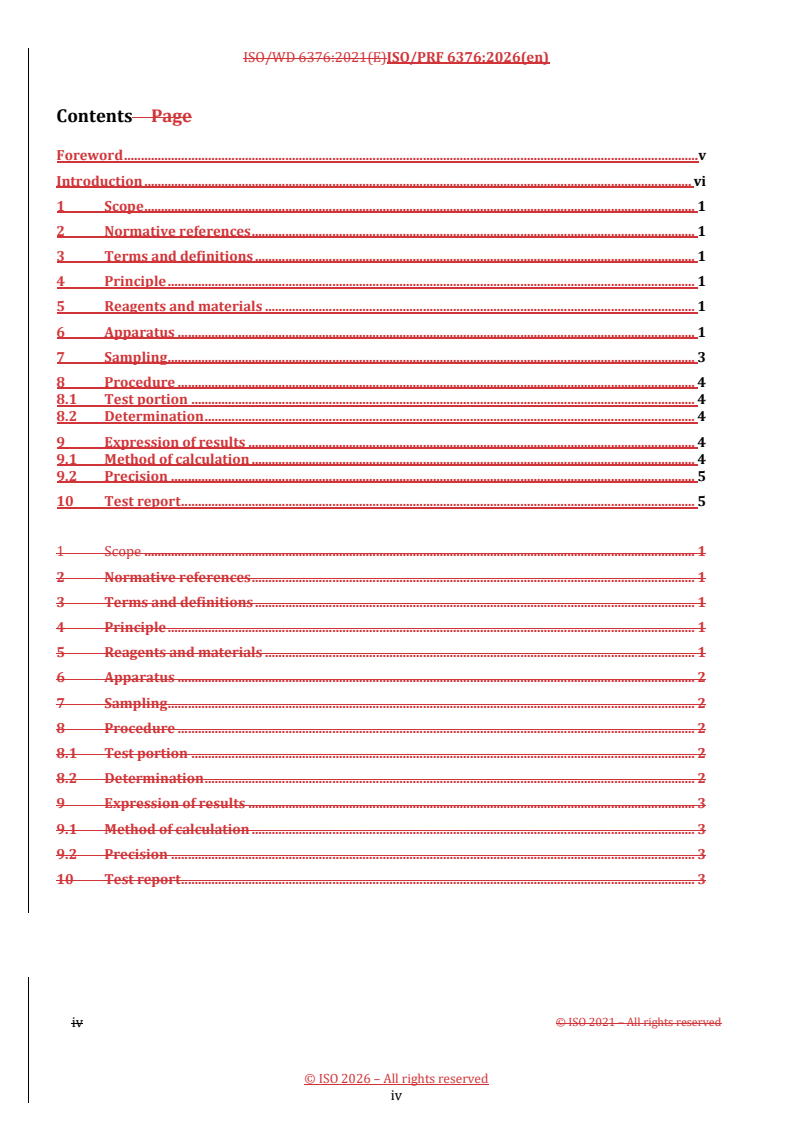
The document is organized into these main clauses:
- Scope
- Normative references
- Terms and definitions
- Principle
- Reagents and materials
- Apparatus
- Sampling
- Procedure
- Expression of results
- Test report
The method is a laboratory procedure, so the practical emphasis is on sample handling, controlled boiling under reflux, filtration, drying, weighing, and reporting the result in a consistent way.
What are the key requirements of ISO/PRF 6376?
ISO/PRF 6376 sets out a complete workflow from sampling to reporting. The main requirement is to measure the insoluble fraction gravimetrically, so each preparation and weighing step affects the final result.
Principle and reagents
Clause 4 states that the result comes from weighing the fraction of the pitch that remains insoluble in toluene after boiling. In practice, that means the method does not estimate the content indirectly - it measures the residue directly after extraction.
Clause 5 limits the analysis to reagents of recognized analytical grade. It also warns that toluene and acetone are flammable and harmful by inhalation, so the work needs ignition control, static precautions, safe disposal, and good ventilation.
Apparatus
Clause 6 identifies the apparatus needed for a comparable test: a 500 mL conical flask, a reflux condenser, a glass filter crucible with a sintered disc, a Hartley funnel, and an oven controlled between 105 °C and 110 °C. In practice, the specified setup supports boiling, filtering, and drying under the same conditions from one laboratory to another.
Sampling and test portion
Clause 7 requires sampling in accordance with ISO 6257. It also distinguishes between hard and soft pitches: hard pitches are crushed and ground to pass a 212 µm sieve, while soft pitches are used as received. This matters because the sample form influences how well the pitch can be mixed, dissolved, and filtered.
Clause 8.1 requires a test portion of about 1 g, weighed to the nearest 0.001 g. That level of weighing control is important because the final result is calculated from mass differences.
Determination and calculation
Clause 8.2 gives the extraction and filtration sequence. The test portion is mixed with toluene, boiled under reflux for 30 min ± 2 min with gentle swirling, then filtered immediately through the dried and weighed crucible. The residue is washed with toluene until the filtrate is colourless, then washed with acetone, dried again, and reweighed.
Clause 9 expresses the result as a percentage by mass of toluene-insoluble material. The document also states precision in terms of repeatability and reproducibility, which helps laboratories judge whether their results are consistent enough for routine use or inter-laboratory comparison.
Test report
Clause 10 specifies what the report has to record: sample identification, a reference to the document, the test date, the calculated result, any deviations from the procedure, and any unusual features observed. This is the part that supports traceability in quality control and technical review.
Who uses ISO/PRF 6376?
ISO/PRF 6376 is used by laboratories that test pitch for electrodes, by aluminium producers and suppliers, and by quality staff who need a standard method for comparing batches. It is also useful for buyers and technical auditors who rely on test results when assessing material quality and likely performance in aluminium production.
What changed in ISO/PRF 6376 from the previous edition?
ISO/PRF 6376 replaces ISO 6376:1980. The foreword states that this second edition adds analysis procedure details to help run the test, corrects the text to formal SI formatting, and updates the test report description.
Which standards are used with ISO/PRF 6376?
ISO 6257, Carbonaceous materials used in the production of aluminium - Pitch for electrodes - Sampling, is the normative reference. It provides the sampling method that this document relies on before the laboratory determination begins.
What does the ISO/PRF 6376 document contain?
ISO/PRF 6376 contains a defined laboratory method, the apparatus list, sampling instructions, a step-by-step extraction and filtration procedure, the calculation approach for the insoluble fraction, and the reporting items to record. It also includes a figure showing details of the Hartley funnel and a warning on handling toluene and acetone safely.
The document is intended for analytical work, especially where results need to be repeatable across laboratories. Its structure supports routine testing, quality control, and technical reporting for pitch used in aluminium electrode production.
Relations
- Effective Date
- 04-Nov-2023
Buy Documents
ISO/PRF 6376 - Carbonaceous materials for the production of aluminium — Pitch for electrodes — Determination of content of toluene-insoluble material
REDLINE ISO/PRF 6376 - Carbonaceous materials for the production of aluminium — Pitch for electrodes — Determination of content of toluene-insoluble material
Get Certified
Connect with accredited certification bodies for this standard

ECOCERT
Organic and sustainability certification.

Eurofins Food Testing Global
Global leader in food, environment, and pharmaceutical product testing.

Intertek Bangladesh
Intertek certification and testing services in Bangladesh.
Sponsored listings
Frequently Asked Questions
ISO/PRF 6376 is a draft published by the International Organization for Standardization (ISO). Its full title is "Carbonaceous materials for the production of aluminium — Pitch for electrodes — Determination of content of toluene-insoluble material". This standard covers: Specifies a gravimetric method, the principle of which consists in weighing the fraction of a test portion of pitch which is insoluble in toluene after boiling for a specified period.
Specifies a gravimetric method, the principle of which consists in weighing the fraction of a test portion of pitch which is insoluble in toluene after boiling for a specified period.
ISO/PRF 6376 is classified under the following ICS (International Classification for Standards) categories: 71.100.10 - Materials for aluminium production. The ICS classification helps identify the subject area and facilitates finding related standards.
ISO/PRF 6376 has the following relationships with other standards: It is inter standard links to ISO 6376:1980. Understanding these relationships helps ensure you are using the most current and applicable version of the standard.
ISO/PRF 6376 is available in PDF format for immediate download after purchase. The document can be added to your cart and obtained through the secure checkout process. Digital delivery ensures instant access to the complete standard document.
Standards Content (Sample)
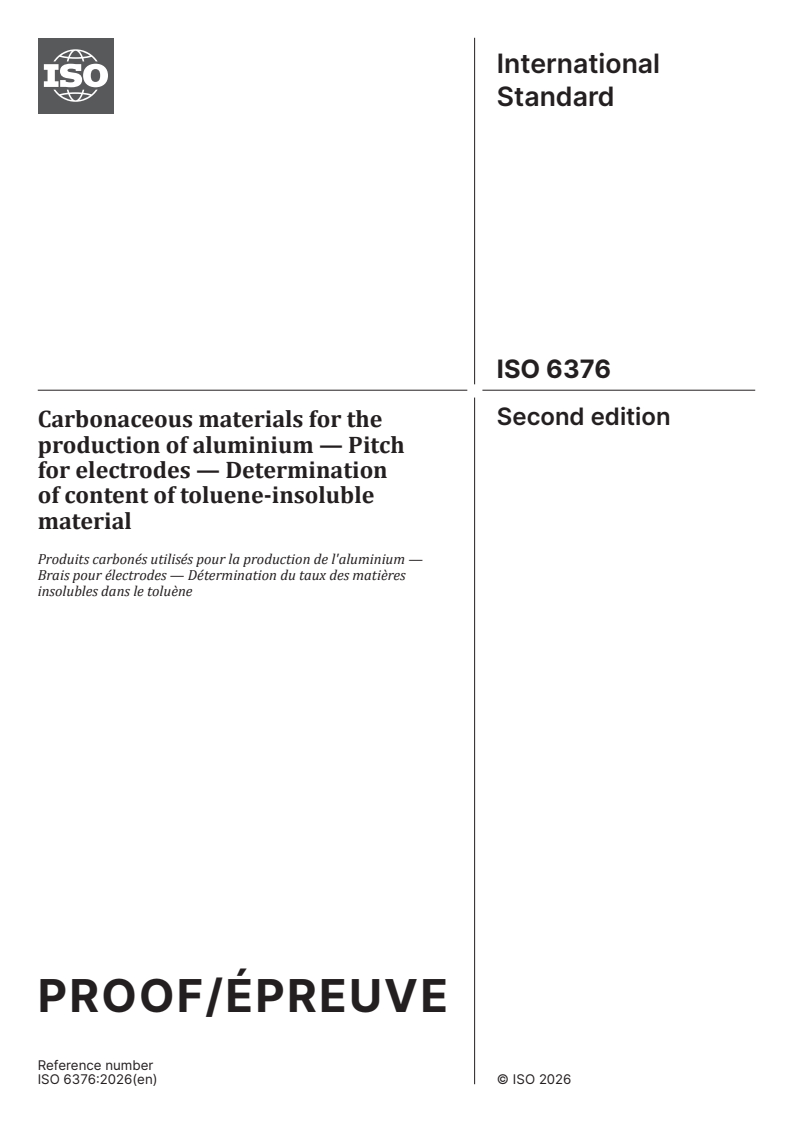
International
Standard
ISO 6376
Second edition
Carbonaceous materials for the
production of aluminium — Pitch
for electrodes — Determination
of content of toluene-insoluble
material
Produits carbonés utilisés pour la production de l'aluminium —
Brais pour électrodes — Détermination du taux des matières
insolubles dans le toluène
PROOF/ÉPREUVE
Reference number
ISO 6376:2026(en) © ISO 2026
ISO 6376:2026(en)
© ISO 2026
All rights reserved. Unless otherwise specified, or required in the context of its implementation, no part of this publication may
be reproduced or utilized otherwise in any form or by any means, electronic or mechanical, including photocopying, or posting on
the internet or an intranet, without prior written permission. Permission can be requested from either ISO at the address below
or ISO’s member body in the country of the requester.
ISO copyright office
CP 401 • Ch. de Blandonnet 8
CH-1214 Vernier, Geneva
Phone: +41 22 749 01 11
Email: copyright@iso.org
Website: www.iso.org
Published in Switzerland
PROOF/ÉPREUVE
ii
ISO 6376:2026(en)
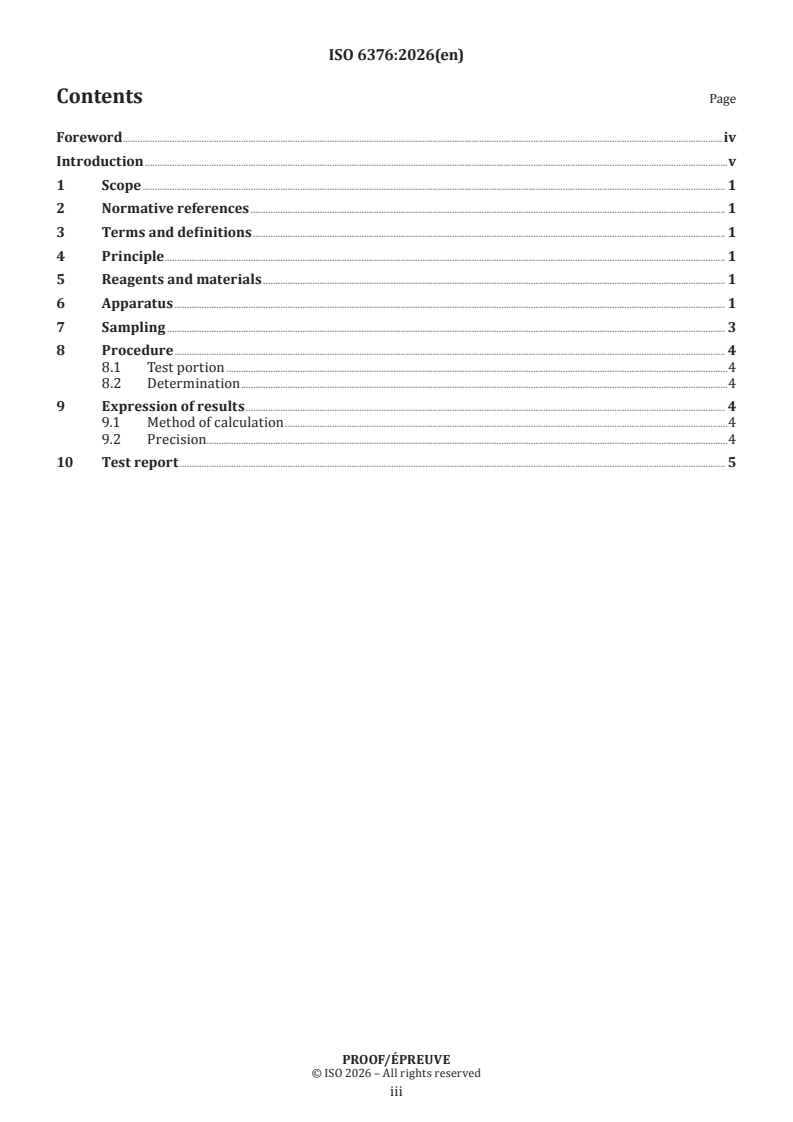
Contents Page
Foreword .iv
Introduction .v
1 Scope . 1
2 Normative references . 1
3 Terms and definitions . 1
4 Principle . 1
5 Reagents and materials . 1
6 Apparatus . 1
7 Sampling . 3
8 Procedure . 4
8.1 Test portion .4
8.2 Determination .4
9 Expression of results . 4
9.1 Method of calculation .4
9.2 Precision . . .4
10 Test report . 5
PROOF/ÉPREUVE
iii
ISO 6376:2026(en)
Foreword
ISO (the International Organization for Standardization) is a worldwide federation of national standards
bodies (ISO member bodies). The work of preparing International Standards is normally carried out through
ISO technical committees. Each member body interested in a subject for which a technical committee
has been established has the right to be represented on that committee. International organizations,
governmental and non-governmental, in liaison with ISO, also take part in the work. ISO collaborates closely
with the International Electrotechnical Commission (IEC) on all matters of electrotechnical standardization.
The procedures used to develop this document and those intended for its further maintenance are described
in the ISO/IEC Directives, Part 1. In particular, the different approval criteria needed for the different types
of ISO document should be noted. This document was drafted in accordance with the editorial rules of the
ISO/IEC Directives, Part 2 (see www.iso.org/directives).
ISO draws attention to the possibility that the implementation of this document may involve the use of (a)
patent(s). ISO takes no position concerning the evidence, validity or applicability of any claimed patent
rights in respect thereof. As of the date of publication of this document, ISO had not received notice of (a)
patent(s) which may be required to implement this document. However, implementers are cautioned that
this may not represent the latest information, which may be obtained from the patent database available at
www.iso.org/patents. ISO shall not be held responsible for identifying any or all such patent rights.
Any trade name used in this document is information given for the convenience of users and does not
constitute an endorsement.
For an explanation of the voluntary nature of standards, the meaning of ISO specific terms and expressions
related to conformity assessment, as well as information about ISO's adherence to the World Trade
Organization (WTO) principles in the Technical Barriers to Trade (TBT), see www.iso.org/iso/foreword.html.
This document was prepared by Technical Committee ISO/TC 226, Materials for the primary production of
aluminium.
This second edition cancels and replaces the first edition (ISO 6376:1980), which has been technically
revised.
The main changes are as follows:
— added analysis procedure details to help run t
...
ISO/TC 226/SC /WG 1
Secretariat: SNV
Date: 2026-07-1709-11
Carbonaceous materials for the production of aluminium — Pitch
for electrodes — Determination of content of toluene-insoluble
material
Copyright notice
ThisProduits carbonés utilisés pour la production de l'aluminium — Brais pour électrodes — Détermination du
taux des matières insolubles dans le toluène
PROOF
© ISO document is a working draft2026
All rights reserved. Unless otherwise specified, or committee draft and is copyright-protected by ISO. While required in
the reproductioncontext of working drafts or committee drafts in any form for use by participants in the ISO standards
development process is permitted without prior permission from ISO, neither its implementation, no part of this
document nor any extract from itpublication may be reproduced, stored or utilized otherwise in any form or transmitted
in any form for any other purposeby any means, electronic or mechanical, including photocopying, or posting on the
internet or an intranet, without prior written permission from ISO. Permission can be requested from either ISO at the
address below or ISO’s member body in the country of the requester.
Requests for permission to reproduce this document for the purpose of selling it should be addressed as shown below or
to ISO's member body in the country of the requester:
[Indicate the full address, telephone number, fax number, telex number, and electronic mail address, as appropriate, of
the Copyright Manager of the ISO member body responsible for the secretariat of the TC or SC within the framework of
which the working document has been prepared.]
Reproduction for sales purposes may be subject to royalty payments or a licensing agreement.
Violators may be prosecuted.
ISO copyright office
CP 401 • Ch. de Blandonnet 8
CH-1214 Vernier, Geneva
Phone: + 41 22 749 01 11
E-mail: copyright@iso.org
Website: www.iso.org
Published in Switzerland
iii
ISO/WD 6376:2021(E)ISO/PRF 6376:2026(en)
Contents Page
Foreword . v
Introduction . vi
1 Scope . 1
2 Normative references . 1
3 Terms and definitions . 1
4 Principle . 1
5 Reagents and materials . 1
6 Apparatus . 1
7 Sampling . 3
8 Procedure . 4
8.1 Test portion . 4
8.2 Determination . 4
9 Expression of results . 4
9.1 Method of calculation . 4
9.2 Precision . 5
10 Test report . 5
1 Scope . 1
2 Normative references . 1
3 Terms and definitions . 1
4 Principle . 1
5 Reagents and materials . 1
6 Apparatus . 2
7 Sampling . 2
8 Procedure . 2
8.1 Test portion . 2
8.2 Determination . 2
9 Expression of results . 3
9.1 Method of calculation . 3
9.2 Precision . 3
10 Test report . 3
iv
iv
Foreword
ISO (the International Organization for Standardization) is a worldwide federation of national standards
bodies (ISO member bodies). The work of preparing International Standards is normally carried out through
ISO technical committees. Each member body interested in a subject for which a technical committee has been
established has the right to be represented on that committee. International organizations, governmental and
non-governmental, in liaison with ISO, also take part in the work. ISO collaborates closely with the
International Electrotechnical Commission (IEC) on all matters of electrotechnical standardization.
The procedures used to develop this document and those intended for its further maintenance are described
in the ISO/IEC Directives, Part 1. In particular, the different approval criteria needed for the different types of
ISO document should be noted. This document was drafted in accordance with the editorial rules of the
ISO/IEC Directives, Part 2 (see www.iso.org/directives).
ISO draws attention to the possibility that the implementation of this document may involve the use of (a)
patent(s). ISO takes no position concerning the evidence, validity or applicability of any claimed patent rights
in respect thereof. As of the date of publication of this document, ISO had not received notice of (a) patent(s)
which may be required to implement this document. However, implementers are cautioned t
...