

ISO/IEC 23009-1:2026
(Main)Information technology — Dynamic adaptive streaming over HTTP (DASH) — Part 1: Media presentation description and segment formats
- Abstract
This document primarily specifies formats for the Media Presentation Description and Segments for dynamic adaptive streaming delivery of MPEG media over HTTP. It is applicable to streaming services over the Internet.
- Status
- Published
- Publication Date
- 13-Jul-2026
- Technical Committee
- ISO/IEC JTC 1/SC 29 - Coding of audio, picture, multimedia and hypermedia information
- Drafting Committee
- ISO/IEC JTC 1/SC 29/WG 3 - MPEG Systems
- Current Stage
- 6060 - International Standard published
- Start Date
- 14-Jul-2026
- Due Date
- 08-Feb-2026
- Completion Date
- 14-Jul-2026

ISO/IEC 23009-1:2026 is an ISO/IEC International Standard from ISO for Dynamic adaptive streaming over HTTP (DASH). It specifies the Media Presentation Description (MPD) and segment formats used to deliver MPEG media over HTTP, mainly for Internet streaming services. In practice, it gives DASH clients and content authors a common way to describe what media to fetch, when it becomes available, and how segments fit together for playback.
What does ISO/IEC 23009-1:2026 specify?
ISO/IEC 23009-1:2026 specifies the data formats for a DASH Media Presentation, not the detailed procedures of a client or server. Its focus is on MPD syntax and semantics, segment formats, and the rules that let a DASH Client retrieve media from standard HTTP servers and cache systems.
The document is organized around the media model and then the delivery formats that support it. Clause 4 gives the overview, client model, data model, protocols, brands, and scheme identifiers. Clause 5 covers the Media Presentation Description, clause 6 covers segment formats, clause 7 explains how MPD and segment formats work together, and clause 8 defines profiles.
| Annex | What it covers |
|---|---|
| Annex A | Example DASH Client behaviour |
| Annex B | MPD schema |
| Annex C | MIME type registration for MPD and other resources |
| Annex D | DASH Metrics |
| Annex E | Byte range requests with regular HTTP GET methods |
| Annex F | Guidelines for extending DASH with other delivery formats |
| Annex G | MPD Examples and MPD Usage |
| Annex H | Spatial Relationship Description |
| Annex I | Flexible Insertion of URL Parameters |
| Annex J | Open GOP resolution change |
| Annex K | DASH Service Description |
| Annex L | Implementation of Nonlinear Playback |
| Annex M | Addressable Resource Index Track |
What are the key requirements of ISO/IEC 23009-1:2026?
ISO/IEC 23009-1:2026 is built around a hierarchy that lets a client discover, select, and switch media streams during playback. The key requirements and signaling rules are spread across Clauses 5 to 8 and the normative annexes.
MPD and Segment addressing - Clause 5.2 and Clause 6 define the MPD and the Segment resources it points to. The MPD uses HTTP-URLs, byte ranges, or data URLs to identify what the client should request. In practice, a packager must publish reliable resource identifiers, and a client must use them to fetch the right media at the right time.
Hierarchical media model - Clause 5.3 organizes a Media Presentation into Periods, Adaptation Sets, Representations, and Segments. That hierarchy matters because it is how DASH separates time-based structure from format choices such as language, viewpoint, or bitrate.
Representation switching and access points - Clause 5.3.3 and Clause 5.3.5 define interchangeable Representations inside an Adaptation Set and the switching rules around stream access points. This is the basis for bitrate adaptation and for avoiding visible or audible glitches when the client changes representation.
Segment types and segment formats - Clause 6 defines Initialization Segments, Media Segments, Index Segments, Bitstream Switching Segments, and Missing Content Segments, then specializes them for the ISO base media file format and for MPEG-2 transport streams. For implementers, this tells them how the on-wire objects must be packaged for playback and random access.
Timing, availability, and low-latency structure - Clause 5 and Clause 7 distinguish the Media Presentation timeline from Segment availability times in wall-clock time. Clause 5.3.9.6.5 adds segment duration patterns, and Clause 5.3.9.7 defines Segment Sequences. These mechanisms matter for live services and low-latency delivery because the client needs to know both presentation order and when each Segment can be requested.
Descriptors, events, and service signaling - Clause 5.8 defines descriptors such as role, accessibility, rating, viewpoint, content protection, UTC timing, output protection, and supplementary video services. Clause 5.10 defines MPD Events, inband event signaling, and DASH-specific events. In practice, these sections carry the metadata that drives language selection, accessibility handling, timing sync, ad signaling, updates, and application events.
Updates, chaining, patching, and alternative presentations - Clause 5.4 covers MPD updates, Clause 5.5 covers MPD Assembly, Clause 5.11 covers MPD chaining, Clause 5.15 defines the MPD Patch Framework, and Clause 5.16 defines Alternative Media Presentations. These parts matter when a stream changes over time, when a server patches an MPD instead of replacing it, or when an event triggers a replacement or insertion of another presentation.
Profiles and conformance points - Clause 8 defines the profile identifiers for Full, ISO Base media file format On Demand, live, main, MPEG-2 TS main and simple, extended live, extended On Demand, common, broadcast TV, CMAF content, Advanced Linear, List, and Single-Period Static profiles. Profiles matter because they narrow the general DASH model to specific deployment agreements that are easier to implement consistently.
What terms does ISO/IEC 23009-1:2026 define?
- Media Presentation Description (MPD) - The formal description of a Media Presentation used by the DASH Client to discover and schedule media access.
- Media Presentation - The collection of data that establishes a bounded or unbounded media presentation.
- Period - A time interval of the Media Presentation that forms part of the overall timeline.
- Adaptation Set - A set of interchangeable encoded versions of one or several media content components.
- Representation - A deliverable encoded version of one or several media content components.
- Segment - A unit of data associated with an HTTP-URL or a data URL and specified by the MPD.
- stream access point (SAP) - A position in a Representation where playback can start using the data from that point onward, plus initialization data if needed.
- DASH Client - The client that receives the MPD, requests Segments, and uses the media and timing information for playback.
Who uses ISO/IEC 23009-1:2026?
ISO/IEC 23009-1:2026 is used by people who package, deliver, and play DASH media services. That includes streaming platform architects, encoder and packager vendors, DASH Client and player developers, CDN and HTTP server operators, and teams that validate interoperability.
It is relevant for Internet streaming services, including on-demand, live, broadcast-style, and CMAF-based deployments. Quality managers and buyers use it when they need to check whether a product supports a specific DASH profile, MPD feature, event signaling model, or segment format.
What changed in ISO/IEC 23009-1:2026 from the previous edition?
ISO/IEC 23009-1:2026 cancels and replaces ISO/IEC 23009-1:2022 and is technically revised. The main changes stated in the document are:
- Introduction of Media Presentation Insertion events.
- Introduction of List MPDs.
- Significant overhaul of segment sequences for low-latency and low-delay applications.
- Introduction of segment duration patterns.
- Updates to Annex I, including new pre-defined parameters.
- Introduction of Content Steering.
- Introduction of reporting using CTA-5004 (CMCD).
- Introduction of ARI (Addressable Resource Index) Tracks.
- Introduction of supplemental video services.
- Introduction of non-linear timelines.
Which standards are used with ISO/IEC 23009-1:2026?
| Reference | What it contributes |
|---|---|
| ISO/IEC 13818-1 | Systems model for MPEG-2 transport streams |
| ISO/IEC 14496-12 | ISO base media file format used for BMFF-based segments |
| ISO/IEC 23000-19 | CMAF terms and segmented media vocabulary |
| ISO/IEC 23091-2 | Coding-independent code points for video |
| ISO/IEC 23091-3 | Coding-independent code points for audio |
| IETF RFC 2397 | data URL scheme |
| IETF RFC 3629 | UTF-8 encoding |
| IETF RFC 3986 | URI syntax |
| IETF RFC 4337 | MIME Type Registration for MPEG-4 |
| IETF RFC 4648 | Base16, Base32, and Base64 data encodings |
| IETF RFC 5234 | ABNF syntax notation |
| IETF RFC 5261 | XML Patch Operations Framework |
| IETF RFC 5646 | Language tags |
| IETF RFC 6381 | codecs and profiles parameters for media types |
| IETF RFC 6838 | media type specifications and registration |
| IETF RFC 8141 | URN syntax |
| IETF RFC 8673 | HTTP random access and live content |
| IETF RFC 9110 | HTTP semantics |
| IETF RFC 9562 | UUIDs |
| HTML 4.01 Specification | HTML-based signaling and related references |
| ETSI TS 103 998 | Content Steering for DASH |
| W3C Canonical XML 1.1 | XML canonicalization |
| W3C XML 1.0 | XML syntax foundation |
| W3C XML Linking Language 1.1 | XLink references for remote elements |
| W3C Media Fragments URI 1.0 | media fragment addressing |
| CTA-5004 | Common Media Client Data (CMCD) reporting |
What does the ISO/IEC 23009-1:2026 document contain?
ISO/IEC 23009-1:2026 contains system overviews, a DASH Client model, a hierarchical media data model, and detailed XML syntax and semantics for the MPD. It also contains tables of brands and scheme identifiers, plus clause-level definitions for descriptors, events, patching, chaining, alternative presentations, and profile signaling.
The technical body includes procedures and models for MPD updates, Base URL processing, segment timing, segment sequence handling, and segment alignment across representations. Annex B provides the MPD schema, Annex D provides DASH Metrics, and Annex E covers byte-range requests with regular HTTP GET methods.
The annexes also add worked examples and specialized extensions for spatial relationships, URL parameter insertion, open GOP resolution change, service description, nonlinear playback, and ARI tracks. Together, those parts support authoring, packaging, client implementation, and interoperability testing.
Relations
- Effective Date
- 10-Feb-2024
Get Certified
Connect with accredited certification bodies for this standard

BSI Group
BSI (British Standards Institution) is the business standards company that helps organizations make excellence a habit.

NYCE
Mexican standards and certification body.
Sponsored listings
Frequently Asked Questions
ISO/IEC 23009-1:2026 is a standard published by the International Organization for Standardization (ISO). Its full title is "Information technology — Dynamic adaptive streaming over HTTP (DASH) — Part 1: Media presentation description and segment formats". This standard covers: This document primarily specifies formats for the Media Presentation Description and Segments for dynamic adaptive streaming delivery of MPEG media over HTTP. It is applicable to streaming services over the Internet.
This document primarily specifies formats for the Media Presentation Description and Segments for dynamic adaptive streaming delivery of MPEG media over HTTP. It is applicable to streaming services over the Internet.
ISO/IEC 23009-1:2026 is classified under the following ICS (International Classification for Standards) categories: 35.040.40 - Coding of audio, video, multimedia and hypermedia information. The ICS classification helps identify the subject area and facilitates finding related standards.
ISO/IEC 23009-1:2026 has the following relationships with other standards: It is inter standard links to ISO/IEC 23009-1:2022. Understanding these relationships helps ensure you are using the most current and applicable version of the standard.
ISO/IEC 23009-1:2026 is available in PDF format for immediate download after purchase. The document can be added to your cart and obtained through the secure checkout process. Digital delivery ensures instant access to the complete standard document.
Standards Content (Sample)
International
Standard
ISO/IEC 23009-1
Sixth edition
Information technology — Dynamic
adaptive streaming over HTTP
2026-07
(DASH) —
Part 1:
Media presentation description and
segment formats
Technologies de l'information — Diffusion en flux adaptatif
dynamique sur HTTP (DASH) —
Partie 1: Description de la présentation et formats de remise des
médias
Reference number
© ISO/IEC 2026
All rights reserved. Unless otherwise specified, or required in the context of its implementation, no part of this publication may
be reproduced or utilized otherwise in any form or by any means, electronic or mechanical, including photocopying, or posting on
the internet or an intranet, without prior written permission. Permission can be requested from either ISO at the address below
or ISO’s member body in the country of the requester.
ISO copyright office
CP 401 • Ch. de Blandonnet 8
CH-1214 Vernier, Geneva
Phone: +41 22 749 01 11
Email: copyright@iso.org
Website: www.iso.org
Published in Switzerland
© ISO/IEC 2026 – All rights reserved
ii
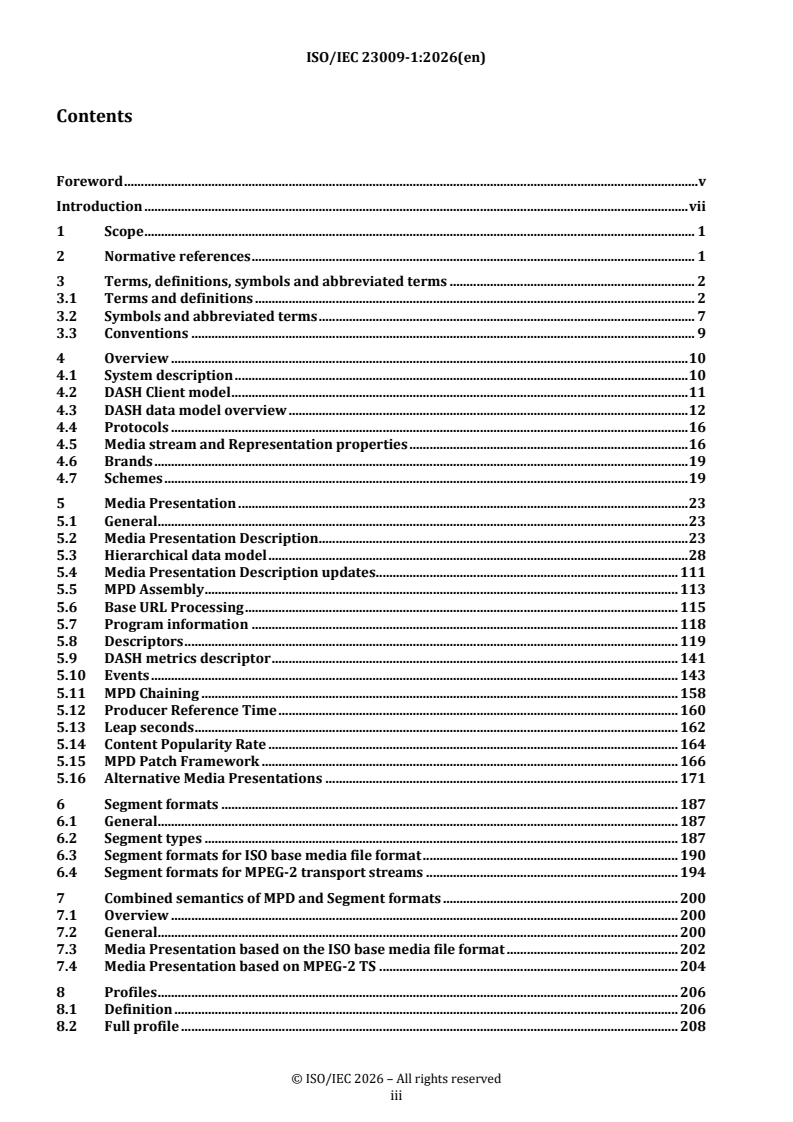
Contents
Foreword . v
Introduction . vii
1 Scope . 1
2 Normative references . 1
3 Terms, definitions, symbols and abbreviated terms . 2
3.1 Terms and definitions . 2
3.2 Symbols and abbreviated terms . 7
3.3 Conventions . 9
4 Overview . 10
4.1 System description . 10
4.2 DASH Client model . 11
4.3 DASH data model overview . 12
4.4 Protocols . 16
4.5 Media stream and Representation properties . 16
4.6 Brands . 19
4.7 Schemes . 19
5 Media Presentation . 23
5.1 General . 23
5.2 Media Presentation Description . 23
5.3 Hierarchical data model . 28
5.4 Media Presentation Description updates . 111
5.5 MPD Assembly . 113
5.6 Base URL Processing . 115
5.7 Program information . 118
5.8 Descriptors . 119
5.9 DASH metrics descriptor . 141
5.10 Events . 143
5.11 MPD Chaining . 158
5.12 Producer Reference Time . 160
5.13 Leap seconds . 162
5.14 Content Popularity Rate . 164
5.15 MPD Patch Framework . 166
5.16 Alternative Media Presentations . 171
6 Segment formats . 187
6.1 General . 187
6.2 Segment types . 187
6.3 Segment formats for ISO base media file format . 190
6.4 Segment formats for MPEG-2 transport streams . 194
7 Combined semantics of MPD and Segment formats . 200
7.1 Overview . 200
7.2 General . 200
7.3 Media Presentation based on the ISO base media file format . 202
7.4 Media Presentation based on MPEG-2 TS . 204
8 Profiles . 206
8.1 Definition . 206
8.2 Full profile . 208
© ISO/IEC 2026 – All rights reserved
iii
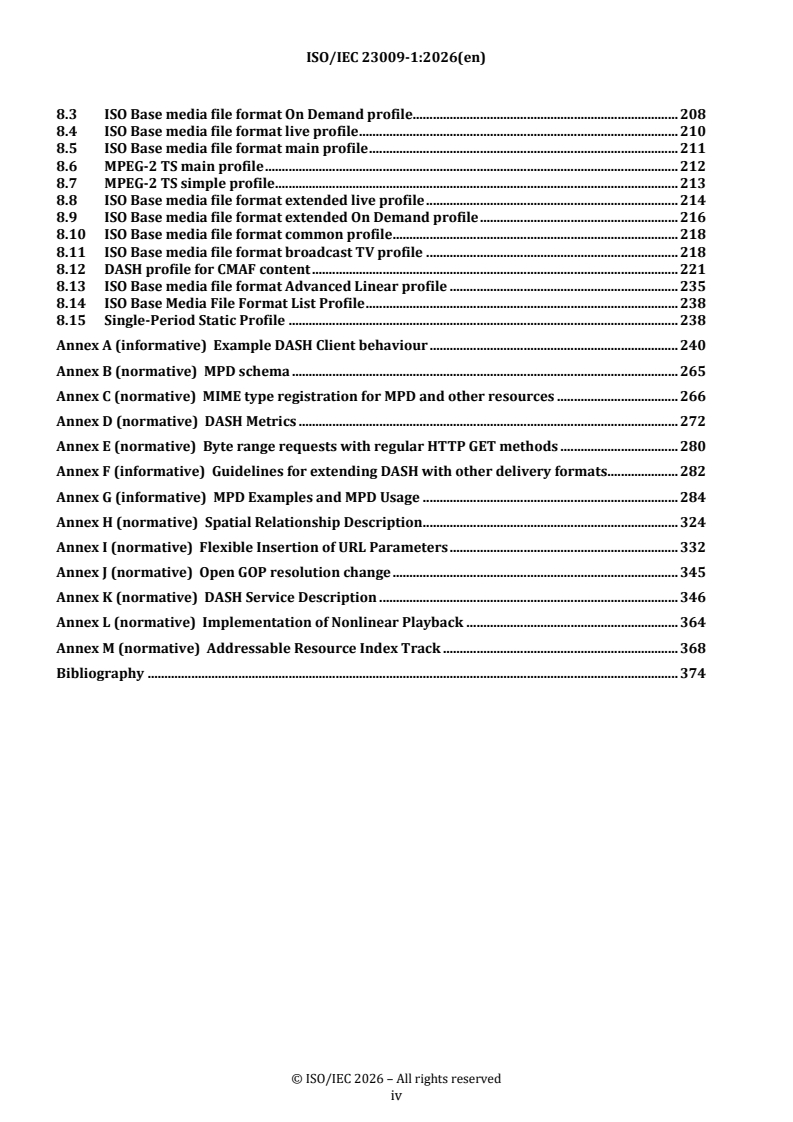
8.3 ISO Base media file format On Demand profile. 208
8.4 ISO Base media file format live profile . 210
8.5 ISO Base media file format main profile . 211
8.6 MPEG-2 TS main profile . 212
8.7 MPEG-2 TS simple profile . 213
8.8 ISO Base media file format extended live profile . 214
8.9 ISO Base media file format extended On Demand profile . 216
8.10 ISO Base media file format common profile . 218
8.11 ISO Base media file format broadcast TV profile . 218
8.12 DASH profile for CMAF content . 221
8.13 ISO Base media file format Advanced Linear profile . 235
8.14 ISO Base Media File Format List Profile . 238
8.15 Single-Period Static Profile . 238
Annex A (informative) Example DASH Client behaviour . 240
Annex B (normative) MPD schema . 265
Annex C (normative) MIME type registration for MPD and other resources . 266
Annex D (normative) DASH Metrics . 272
Annex E (normative) Byte range requests with regular HTTP GET methods . 280
Annex F (informative) Guidelines for extending DASH with other delivery formats. 282
Annex G (informative) MPD Examples and MPD Usage . 284
Annex H (normative) Spatial Relationship Description . 324
Annex I (normative) Flexible Insertion of URL Parameters . 332
Annex J (normative) Open GOP resolution change . 345
Annex K (normative) DASH Service Description . 346
Annex L (normative) Implementation of Nonlinear Playback . 364
Annex M (normative) Addressable Resource Index Track . 368
Bibliography . 374
© ISO/IEC 2026 – All rights reserved
iv
Foreword
ISO (the International Organization for Standardization) and IEC (the International Electrotechnical
Commission) form the specialized system for worldwide standardization. National bodies that are members
of ISO or IEC participate in the development of International Standards through technical committees
established by the respective organization to deal with particular fields of technical activity. ISO and IEC
technical committees collaborate in fields of mutual interest. Other international organizations, governmental
and non-governmental, in liaison with ISO and IEC, also take part in the work.
The procedures used to develop this document and those intended for its further maintenance are described
in the ISO/IEC Directives, Part 1. In particular, the different approval criteria needed for the different types of
document should be noted. This document was drafted in accordance with the editorial rules of the ISO/IEC
Directives, Part 2 (see www.iso.org/directives or www.iec.ch/members_experts/refdocs).
ISO and IEC draw attention to the possibility that the implementation of this document may involve the use of
(a) patent(s). ISO and IEC take no position concerning the evidence, validity or applicability of any claimed
patent rights in respect thereof. As of the date of publication of this document, ISO and IEC had received notice
of (a) patent(s) which may be required to implement this document. However, implementers are cautioned
that this may not represent the latest information, which may be obtained from the patent database available
at www.iso.org/patents and https://patents.iec.ch. ISO and IEC shall not be held responsible for identifying
any or all such patent rights.
Any trade name used in this document is information given for the convenience of users and does not
constitute an endorsement.
For an explanation of the voluntary nature of standards, the meaning of ISO specific terms and expressions
related to conformity assessment, as well as information about ISO's adherence to the World Trade
Organization (WTO) principles in the Technical Barriers to Trade (TBT) see www.iso.org/iso/foreword.html.
In the IEC, see www.iec.ch/understanding-standards.
This document was prepared by Joint Technical Committee ISO/IEC JTC 1, Subcommittee SC 29, Coding of
audio, picture, multimedia and hypermedia information.
This sixth edition cancels and replaces the fifth edition (ISO/IEC 23009-1:2022), which has been technically
revised.
The main changes are as follows:
— Introduction of Media Presentation Insertion events.
— Introduction of List MPDs.
— Significant overhaul of segment sequences, offering new functionality for low-latency and low-delay
applications.
— Introduction of segment duration patterns.
— Updates to Annex I, including new pre-defined parameters.
— Introduction of Content Steering.
— Introduction of reporting using CTA-5004 (CMCD).
— Introduction of ARI (Addressable Resource Index) Tracks.
© ISO/IEC 2026 – All rights reserved
v
— Introduction of supplemental video services.
— Introduction of non-linear timelines.
A list of all parts in the ISO/IEC 23009 series can be found on the ISO and IEC websites.
Any feedback or questions on this document should be directed to the user’s national standards body. A
complete listing of these bodies can be found at www.iso.org/members.html and www.iec.ch/national-
committees.
© ISO/IEC 2026 – All rights reserved
vi
Introduction
Dynamic adaptive streaming over HTTP (DASH) is intended to support a media-streaming model for delivery
of media content in which control lies primarily with the client. Clients may request data using the HTTP
protocol from standard web servers that have no DASH-specific capabilities. Consequently, this document
focuses not on client or server procedures but on the data formats used to provide a DASH Media Presentation.
© ISO/IEC 2026 – All rights reserved
vii
INTERNATIONAL STANDARD ISO/IEC 23009-1:2026(en)
Information technology — Dynamic adaptive streaming over HTTP
(DASH) —
Part 1:
Media presentation description and segment formats
1 Scope
This document primarily specifies formats for the Media Presentation Description and Segments for dynamic
adaptive streaming delivery of MPEG media over HTTP. It is applicable to streaming services over the Internet.
2 Normative references
The following documents are referred to in the text in such a way that some or all of their content constitutes
requirements of this document. For dated references, only the edition cited applies. For undated references,
the latest edition of the referenced document (including any amendments) applies.
ISO/IEC 13818-1, Information technology — Generic coding of moving pictures and associated audio
information — Part 1: Systems
ISO/IEC 14496-12, Information technology — Coding of audio-visual objects — Part 12: ISO base media file
format
ISO/IEC 23000-19, Information technology — Multimedia application format (MPEG-A) — Part 19: Common
media application format (CMAF) for segmented media
ISO/IEC 23091-2, Information technology — Coding-independent code points — Part 2: Video
ISO/IEC 23091-3, Information technology — Coding-independent code points — Part 3: Audio
IETF RFC 2397, The “data” URL scheme
IETF RFC 3629, UTF-8, a transformation format of ISO 10646
IETF RFC 3986, Uniform Resource Identifier (URI): Generic Syntax
IETF RFC 4337, MIME Type Registration for MPEG-4
IETF RFC 4648, The Base16, Base32, and Base64 Data Encodings
IETF RFC 5234, Augmented BNF for Syntax Specifications: ABNF
IETF RFC 5261, An Extensible Markup Language (XML) Patch Operations Framework Utilizing XML Path
Language (XPath) Selectors
IETF RFC 5646, Tags for Identifying Languages
IETF RFC 6381, The ‘Codecs’ and ‘Profiles’ Parameters for “Bucket” Media Types
IETF RFC 6838, Media Type Specifications and Registration Procedures
© ISO/IEC 2026 – All rights reserved
IETF RFC 8141, URN Syntax
IETF RFC 8673, HTTP Random Access and Live Content
IETF RFC 9110, HTTP Semantics
IETF RFC 9562, Universally Unique IDentifiers (UUIDs)
HTML 4.01 Specification, W3C Recommendation, 24 December 1999
ETSI TS 103 998, DASH-IF: Content Steering for DASH
W3C, Canonical XML, Version 1.1
W3C, Extensible Markup Language (XML), Version 1.0
W3C, XML Linking Language (XLink), Version 1.1
W3C, Media Fragments URI, Version 1.0
CTA-5004, Web Application Video Ecosystem, Common Media Client Data (CMCD)
3 Terms, definitions, symbols and abbreviated terms
3.1 Terms and definitions
For the purposes of this document, the terms and definitions given in ISO/IEC 23000-19 and the following
apply.
ISO and IEC maintain terminology databases for use in standardization at the following addresses:
— ISO Online browsing platform: available at https://www.iso.org/obp
— IEC Electropedia: available at https://www.electropedia.org/
3.1.1
access unit
unit of a media stream (3.1.31) with an assigned Media Presentation time
3.1.2
accessibility
degree to which a media content or certain media content components (3.1.23) are available to as many people
as possible
3.1.3
Adaptation Set
set of interchangeable encoded versions of one or several media content components (3.1.23)
3.1.4
asset
content including media and metadata together with the rights to use the content by the content provider
3.1.5
associated Representation
Representation (3.1.43) which provides supplemental or descriptive information for at least one other
Representation
© ISO/IEC 2026 – All rights reserved
3.1.6
available Segment
Segment (3.1.45) that is accessible at its assigned HTTP-URL (3.1.17) and a possibly assigned byte range that
is the request with an HTTP GET results in a reply of the Segment and 2xx status code
3.1.7
Bitstream Switching Segment
Segment (3.1.45) that if present contains essential data to switch to the Representation (3.1.43) it is assigned
to
3.1.8
complementary Representation
Representation (3.1.43) which complements at least one dependent Representation (3.1.12)
3.1.9
continuous media
media with an inherent notion of time
EXAMPLE Speech, audio, video, timed text or timed metadata.
3.1.10
DASH metric
metric computed by the DASH Client and uniquely identified by a key
3.1.11
data URL
URL with a fixed scheme “data”
3.1.12
dependent Representation
Representation (3.1.43) for which Segments (3.1.45) from its complementary Representations (3.1.8) are
necessary for presentation and/or decoding of the contained media content components (3.1.23)
3.1.13
earliest presentation time
smallest presentation time (3.1.41) of any access unit (3.1.1) of a Media Segment (3.1.30) or Subsegment
(3.1.57) for a media stream (3.1.31)
3.1.14
event
aperiodic sparse media-time related auxiliary information to the DASH Client or to an application
3.1.15
event stream
sequence of related events (3.1.14)
3.1.16
group
collection of Adaptation Sets (3.1.3) that are not expected to be presented simultaneously
3.1.17
HTTP-URL
URL with a fixed scheme of “http” or “https”
3.1.18
Index Segment
Segment (3.1.45) that primarily contains indexing information for Media Segments (3.1.30)
© ISO/IEC 2026 – All rights reserved
3.1.19
Initialization Segment
Segment (3.1.45) containing metadata that is necessary to present the media streams (3.1.31) encapsulated in
Media Segments (3.1.30)
3.1.20
Listen Mode
mode of operation where media time elapses (i.e. playhead moves normally), certain operational data is
processed, but no media is rendered
3.1.21
Main Adaptation Set
Adaptation Set (3.1.3) in a Preselection (3.1.40) that contains the Initialization Segment (3.1.19) for the
complete experience
3.1.22
media content
single media content period (3.1.25) or contiguous sequence of media content periods
3.1.23
media content component
single continuous component of the media content (3.1.22) with an assigned media content component type
(3.1.24)
3.1.24
media content component type
single type of media content (3.1.22)
EXAMPLE Audio, video, or text.
3.1.25
media content period
set of media content components (3.1.23) that have a common timeline as well as relationships on how they
can be presented
3.1.26
Media Presentation
collection of data that establishes a bounded or unbounded presentation of media content (3.1.21)
3.1.27
Media Presentation Description
MPD
formalized description for a Media Presentation (3.1.26) for the purpose of providing a streaming service
3.1.28
Media Presentation Insertion
Insertion of media content from a second Media Presentation (3.1.26) in the timeline of a first Media
Presentation (3.1.26)
3.1.29
Media Presentation timeline
concatenation of the timeline of all Periods (3.1.37) which itself is common to all Representations (3.1.43) in
the Period
© ISO/IEC 2026 – All rights reserved
3.1.30
Media Segment
Segment (3.1.45) that complies with media format in use and enables playback when combined with zero or
more preceding Segments and an Initialization Segment (3.1.19) (if any)
3.1.31
media stream
encoded version of a media content component (3.1.23)
3.1.32
Media Subsegment
Subsegment (3.1.57) that only contains media data but no Segment Index (3.1.49)
3.1.33
message
part of an event (3.1.14) containing information that is exclusively handled by the event handler
3.1.34
MPD start time
approximate presentation start time of a Media Segment (3.1.30) signalled in MPD (3.1.26)
3.1.35
MPD duration
approximate presentation duration of a Media Segment (3.1.30) signalled in MPD (3.1.26)
3.1.36
Partial Segment
Media Segment (3.1.30) included in a Segment Sequence Representation
3.1.37
Period
interval of the Media Presentation (3.1.24), where a contiguous sequence of all Periods constitutes the Media
Presentation
3.1.38
playhead
current media time provided by the media engine that can be mapped to a time on the Media Presentation
timeline
3.1.39
Preroll
on-demand content which is played before start of playback of a live content
3.1.40
Preselection
set of media content components (3.1.23) that are intended to be consumed jointly
3.1.41
presentation time
time associated to an access unit (3.1.1) that maps it to the Media Presentation timeline (3.1.29)
3.1.42
remote element entity
entity that contains one or more elements and is referenced in the MPD (3.1.27) with an HTTP-URL (3.1.17)
contained in an @xlink:href attribute, referred to as "remote resource" by XLink
© ISO/IEC 2026 – All rights reserved
3.1.43
Representation
collection and encapsulation of one or more media streams (3.1.31) in a delivery format and associated with
descriptive metadata
3.1.44
Resynchronization Point
point within a Segment from which it is possible to start processing the Representation
3.1.45
Segment
unit of data associated with an HTTP-URL (3.1.17) and optionally a byte range that are specified by an MPD
(3.1.27), or with a data URL (3.1.11)
3.1.46
Segment availability start time
latest time instant in wall-clock time (3.1.60) at which a Segment (3.1.45) becomes an available Segment (3.1.6)
3.1.47
adjusted Segment availability start time
time instant in wall-clock time (3.1.60) at which a Segment (3.1.45) becomes an available Segment (3.1.6)
3.1.48
Segment availability end time
time instant in wall-clock time (3.1.60) at which a Segment (3.1.45) ceases to be an available Segment (3.1.6)
3.1.49
Segment Index
compact index of the time range to byte range mapping within a Media Segment (3.1.30) separately from the
MPD (3.1.27)
3.1.50
Segment Sequence
sequence of all Partial Segments (3.1.36) that are sharing a common address prefix
3.1.51
Segment Sequence Representation
Representation (3.1.43) using Segment Sequences (3.1.50)
3.1.52
Segment Track
concatenation of Segments (3.1.45) forming a track with potential conformance properties
3.1.53
Service Location
collection of network resources that share commonalities and can be referred to by a common label
3.1.54
spatial object
media content component (3.1.23) corresponding to a region in a coordinate system associated to this media
content component
© ISO/IEC 2026 – All rights reserved
3.1.55
stream access point
SAP
position in a Representation (3.1.43) enabling playback of a media stream (3.1.31) to be started using only the
information contained in Representation data starting from that position onwards preceded by initializing
data in the Initialization Segment (3.1.19), if any
3.1.56
sub-asset
media content component (3.1.23) (or part thereof) identified as corresponding to a part of an asset (3.1.4)
3.1.57
Sub-Representation
part of a Representation (3.1.43) described in the MPD (3.1.27) that is present in the entire Period (3.1.37)
3.1.58
Subsegment
unit within Media Segments (3.1.30) that is indexed by a Segment Index (3.1.49)
3.1.59
valid Segment URL
HTTP-URL (3.1.17) that is promised to reference a Segment (3.1.45) during its Segment availability period
3.1.60
wall-clock time
time as stated by UTC
3.2 Symbols and abbreviated terms
4CC four character code
ABNF augmented Backus-Naur form
ACK acknowledgement message in TCP
AEMS application event or metadata streams
API application programming interface
ARI addressable resource index
AVC advanced video coding
CAT conditional access table
CDN content delivery network
CMAF common media application format
CMCD common media client data
DASH dynamic adaptive streaming over HTTP
DCSM DASH Content Steering Manifest
DM DASH metrics
DOM document object model
DRM digital rights management
ECM entitlement control message
EDRAP extended dependent random access point
© ISO/IEC 2026 – All rights reserved
EIDR entertainment identifier registry
EME encrypted media extensions
EMIO event/metadata internal object
EMM entitlement management message
EPT earliest presentation time
ESR external stream Representation
GAA generic authentication architecture
GBA generic bootstrapping architecture
GDR gradual decoding refresh
GMT Greenwich Mean Time
GOP group of pictures
GPS global positioning system
HDCP high-bandwidth digital content protection
HDMI high definition multimedia interface
HEVC high efficiency video coding
HLS HTTP Live Streaming
HTML hypertext markup language
HTTP hypertext transfer protocol
HTTPS secure hypertext transfer protocol
IAB interactive advertising bureau
IDR instantaneous decoding refresh
IP internet protocol
ISO BMFF ISO base media file format
KPI Key Performance Indicator
LAT Latest Arrival Time
LL-DASH Low Latency DASH
MBT minimum buffer time
MIME multipurpose internet mail extensions
MPD media presentation description
MPP MPD patch
MSR main stream Representation
MVC multi-view video coding
NGA next generation audio
NTP network time protocol
OATC open authentication technical committee
OAuth open standard for authorization
OMAP online multimedia authorization protocol
© ISO/IEC 2026 – All rights reserved
OTT over-the-top
PAT program association table
PCR program clock reference
PES packetized elementary stream
PID packet identifier
PMT program map table
PR popularity rate
PSI program specific information
PTS presentation time stamp
QoE Quality of Service
QoS Quality of Service
RAP random access point
SAML security assertion markup language
SAP stream access point
SEI supplementary enhancement information
SNTP simple NTP
SPS sequence parameter set
SRD spatial relationship description
SSR Segment Sequence Representation
SVC scalable video coding
TCP transmission control protocol
TLS transport layer security
TS transport stream
URI uniform resource identifier
URL uniform resource locator
URN uniform resource name
UTC coordinated universal time
UUID universally unique identifier
VAST video ad serving template
VOD video-on-demand
VVC Versatile Video Coding
XML extensible mark-up language
3.3 Conventions
The following naming conventions apply in this document.
— Elements in an XML document are identified by an upper-case first letter and in bold face as Element. To
express that an element Element1 is contained in another element Element2, the following format is
© ISO/IEC 2026 – All rights reserved
used: Element2.Element1. If an element's name consists of two or more combined words, camel-
casing is typically used, e.g. ImportantElement. Elements may be present either exactly once, or the
minimum and maximum occurrence is defined by . .
— Attributes in an XML document are identified by a lower-case first letter as well as they are preceded by
an '@'-sign, e.g. @attribute. To point to a specific attribute @attribute contained in an element
Element, one may write Element@attribute. If an attribute's name consists of two or more combined
words, camel-casing is typically used after the first word, e.g. @veryImportantAttribute. Attributes
may have assigned a status in the XML as mandatory (M), optional (O), optional with default value (OD)
and conditionally mandatory (CM).
— Namespace qualification of elements and attributes is used as per XML standards, in the form of
namespace:Element or @namespace:attribute. The fully qualified namespace is provided in the
schema fragment associated with the declaration. External specifications extending the namespace of
DASH are expected to document the element name in the semantic table with an extension namespace
prefix.
— Variables defined in the context of this document are specifically highlighted with italics, e.g.
InternalVariable.
— Structures that are defined as part of the hierarchical data model are identified by an upper-case first
letter, e.g. Period, Adaptation Set, Representation, Segment, etc.
— The term "this clause" refers to the entire clause included within the same first heading number. The term
"this subclause" refers to all text contained in the subclause with the lowest hierarchy heading.
— For improved interoperability, this document uses ABNF notation according to IETF RFC 5234 to specify
certain underdefined values of XML attributes and elements.
4 Overview
4.1 System description
Dynamic adaptive streaming over HTTP (DASH) specifies XML and binary formats that enable delivery of
continuous media content from standard HTTP servers to HTTP clients and enable caching of content by
standard HTTP caches.
This document primarily defines two formats:
— The Media Presentation Description (MPD) describes a Media Presentation, i.e. a bounded or unbounded
presentation of continuous media content. In particular, it defines formats to announce resource
identifiers for Segments and to provide the context for these identified resources within a Media
Presentation. These resource identifiers are HTTP-URLs possibly combined with a byte range, or with a
data URL.
— The Segment formats specify the formats of the entity body of the HTTP response to an HTTP GET request
or a partial HTTP GET with the indicated byte range using HTTP as defined in IETF RFC 9110 to a resource
identified in the MPD. Segments typically contain efficiently coded media data and metadata conforming
to or at least closely aligned with common media formats.
The MPD provides sufficient information for a client to provide a streaming service to the user by accessing
the Segments through the protocol specified in the scheme of the defined resources. In the context of this
document, the assumed protocol is HTTP. Such a client is referred to as a DASH Client in the remainder of this
document. However, this document does not provide a normative specification for such a client.
© ISO/IEC 2026 – All rights reserved
Figure 1 shows a possible deployment architecture in which the formats defined in this document may be
used. Boxes with solid lines indicate devices that are mentioned in this document as they host or process the
formats defined in this document whereas dashed boxes are conceptual or transparent. This document deals
with the definition of formats that are accessible on the interface to the DASH Client, indicated by the solid
lines. Any other formats or interfaces are outside the scope of this document. In the considered deployment
scenario, it is assumed that the DASH Client has access to an MPD. The MPD provides sufficient information
for the DASH Client to provide a streaming service to the user by requesting Segments from an HTTP server
and demultiplexing, decoding and rendering the included media streams.
Figure 1 — Example system for DASH formats
Although the formats are initially designed to be used in the above deployment scenario, their application is
obviously not restricted to this scenario. The particular aspect on "HTTP" in DASH is the usage of HTTP-URLs
in the MPD for the purpose to refer to Segments. The usage of HTTP-URLs enables unique location information,
and it provides well-defined methods to access the resources, in particular HTTP GET and HTTP partial GET.
4.2 DASH Client model
The design of the formats defined in this document is based on the informative client model as shown in
Figure 2. The figure illustrates the logical components of a conceptual DASH Client model and the relation to
other components in a media streaming application.
In this figure, the DASH access engine receives the Media Presentation Description (MPD), constructs and
issues requests and receives Segments or parts of Segments. In addition, the DASH access engine may also
receive and extract Events that are related to the media time. The events may be processed in the DASH Client
or may be forwarded to an event processing application in the execution environment of the DASH Client.
The DASH Client may use metadata provided in the MPD for the selection of media components by
communication with the media streaming application. Such metadata may for example include codec
capability information, language codes, accessibility information and other information for the selection of
media components.
The DASH access engine outputs media and timing information to a media engine. The media engine uses the
information in the media to move the playhead according to the time provided in the media and the DASH
access client uses this time to control the media presentation timeline.
Unless instructed otherwise, it is assumed that the playhead moves at a normal playback time. However, the
media time and the corresponding playhead can change, for example, if the media engine is instructed with
seek or pause operations, or playback other than normal is instructed.
© ISO/IEC 2026 – All rights reserved
The access engine may be in either the regular or the listen mode. The access engine in regular mode outputs
media and timing information to the media engine for decoding and rendering. Playhead moves (and time
elapses) at the same speed, and events are processed when the access engine is in the listen mode, however it
does not output media to the media engine.
In case Alternative Media Presentations are used, there are two instances of DASH access engine, main and
the alternative, both working as described above. For the duration of the alternative media presentation, the
alternative access engine outputs media to the media engine, while the main client will be paused or be in a
listen mode. Alternative Media Presentation is triggered by an event embedded in the main Media
Presentation. Clause 5.16 provides details and processing model for alternative presentations.
Annex A provides an example of a DASH Client implementation
In the context of this document, the output of the DASH access engine consists of media in MPEG container
formats (ISO/IEC 14496-12 ISO base media file format or ISO/IEC 13818-1 MPEG-2 Transport Stream), or
parts thereof, together with timing information that maps the internal timing of the continuous media to the
timeline of the Media Presentation. In Annex F, guidance on enabling the use of this document with other
container formats is provided
Figure 2 — DASH Client model
Furthermore, Annex K defines the Service Description to support and guide DASH Client operations.
4.3 DASH data model overview
DASH is intended to support a media-streaming model for delivery of continuous media content in which
control lies primarily with the client. Clients may request data using the HTTP protocol from standard web
© ISO/IEC 2026 – All rights reserved
servers that have no DASH-specific capabilities. Consequently, this document focuses not on client or server
procedures but on the data formats used to provide a DASH Media Presentation.
The collection of encoded and deliverable versions of continuous media content and the appropriate
description of these form a Media Presentation. Media content is composed of a single or multiple contiguous
media content periods in time. Content in different media content periods may be completely independent or
certain periods of a Media Presentation may belong to the same Asset, for example a Media Presentation is a
collection of a main program composed of multiple periods, each assigned to the same Asset, and interleaved
with inserted advertisement periods. Each media content period is composed of one or multiple media
content components, for example audio components in various languages, different video components
providing different views of the same program, subtitles in different languages, etc. Each media content
component has an assigned media content component type, for example audio or video. The same asset
over multiple periods may be identified by a DASH descriptor enabling DASH Clients to maintain the continuity
across periods' boundaries. Furthermore, sub-assets composing the same asset may also be identified using a
similar method. For instance, if an asset is composed of multiple video components, sub-assets enable
selecting the previously selected video component after an ad insertion.
Each media content component may have several encoded versions, referred to as media streams. Each
media stream inherits the properties of the media content, the media content period, the media content
component from which it was encoded, and, in addition, it gets assigned the properties of the encoding process
such as sub-sampling, codec parameters, encoding bitrate, etc. This descriptive metadata is relevant for static
and dynamic selection of media content components and media streams.
Figure 3 — DASH High-Level Data Model
DASH is based on a hierarchical data model aligned with the presentation in Figure 3. In the horizontal domain,
this shows the sequence in time of the Media Presentation, and in the vertical domain it shows the choices
© ISO/IEC 2026 – All rights reserved
offered in a Media Presentation, to be selected by the DASH Client in a static and dynamic manner. A DASH
Media Presentation is described by a Media Presentation Description document. This describes the sequence
of Periods (see subclause 5.3.2) in time that make up the Media Presentation. A Period typically represents a
media content period during which a consistent set of encoded versions of the media content is available i.e.
the set of available bitrates, languages, captions, subtitles etc. does not change during a Period.
Within a Period, material is arranged into Adaptation Sets (see subclause 5.3.3). An Adaptation Set
represents a set of interchangeable encoded versions of one or several media content components (see
subclause 5.3.4). For example, there may be one Adaptation Set for the main video component and a separate
one for the main audio component. If there is other material available, for example captions or audio
descriptions, then these may each have a separate Adaptation Set. Material may also be provided in
multiplexed form, in which case interchangeable versions of the multiplex may be described as a single
Adaptation Set, for example an Adaptation Set containing both the main audio and main video for a Period.
Each of the multiplexed components may be described individually by a media content component
description. On top, the concept of Preselections (see subclause 5.3.11) is introduced in order to enable the
combination of different Adaptation Sets into a single decoding instance and user experience.
An Adaptation Set contains a set of Representations (see subclause 5.3.5). A Representation describes a
deliverable encoded version of one or several media content components. A Representation includes one or
more media streams (one for each media content component in the multiplex). Any single Representation
within an Adaptation Set is sufficient to render the contained media content components. By collecting
different Representations in one Adaptation Set, the Media Presentation author exp
...