


ISO/IEC 14143-1:1998
(Main)Information technology — Software measurement — Functional size measurement — Part 1: Definition of concepts
Information technology — Software measurement — Functional size measurement — Part 1: Definition of concepts
Technologies de l'information — Mesurage du logiciel — Mesurage de la taille fonctionnelle — Partie 1: Définition des concepts
General Information
- Status
- Withdrawn
- Publication Date
- 10-Jun-1998
- Withdrawal Date
- 10-Jun-1998
- Technical Committee
- ISO/IEC JTC 1/SC 7 - Software and systems engineering
- Drafting Committee
- ISO/IEC JTC 1/SC 7 - Software and systems engineering
- Current Stage
- 9599 - Withdrawal of International Standard
- Start Date
- 01-Feb-2007
- Completion Date
- 14-Feb-2026
Relations
- Effective Date
- 15-Apr-2008
Get Certified
Connect with accredited certification bodies for this standard

BSI Group
BSI (British Standards Institution) is the business standards company that helps organizations make excellence a habit.

BSCIC Certifications Pvt. Ltd.
Established 2006, accredited by NABCB, JAS-ANZ, EIAC, IAS. CDSCO Notified Body.

Intertek India Pvt. Ltd.
Delivers Assurance, Testing, Inspection & Certification since 1993 with 26 labs and 32 offices.
Sponsored listings
Frequently Asked Questions
ISO/IEC 14143-1:1998 is a standard published by the International Organization for Standardization (ISO). Its full title is "Information technology — Software measurement — Functional size measurement — Part 1: Definition of concepts". This standard covers: Information technology — Software measurement — Functional size measurement — Part 1: Definition of concepts
Information technology — Software measurement — Functional size measurement — Part 1: Definition of concepts
ISO/IEC 14143-1:1998 is classified under the following ICS (International Classification for Standards) categories: 35.080 - Software. The ICS classification helps identify the subject area and facilitates finding related standards.
ISO/IEC 14143-1:1998 has the following relationships with other standards: It is inter standard links to ISO/IEC 14143-1:2007. Understanding these relationships helps ensure you are using the most current and applicable version of the standard.
ISO/IEC 14143-1:1998 is available in PDF format for immediate download after purchase. The document can be added to your cart and obtained through the secure checkout process. Digital delivery ensures instant access to the complete standard document.
Standards Content (Sample)
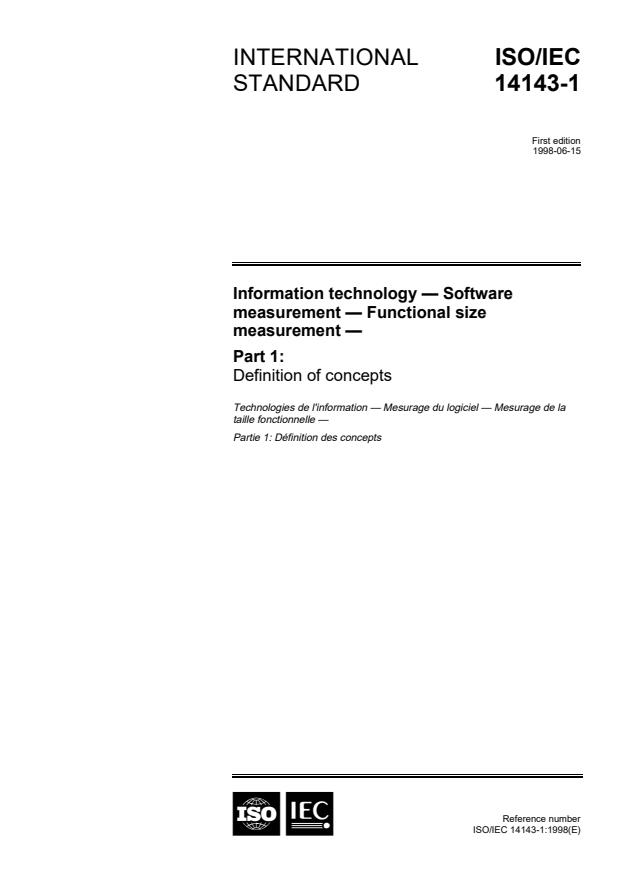
INTERNATIONAL ISO/IEC
STANDARD 14143-1
First edition
1998-06-15
Information technology — Software
measurement — Functional size
measurement —
Part 1:
Definition of concepts
Technologies de l'information — Mesurage du logiciel — Mesurage de la
taille fonctionnelle —
Partie 1: Définition des concepts
Reference number
B C
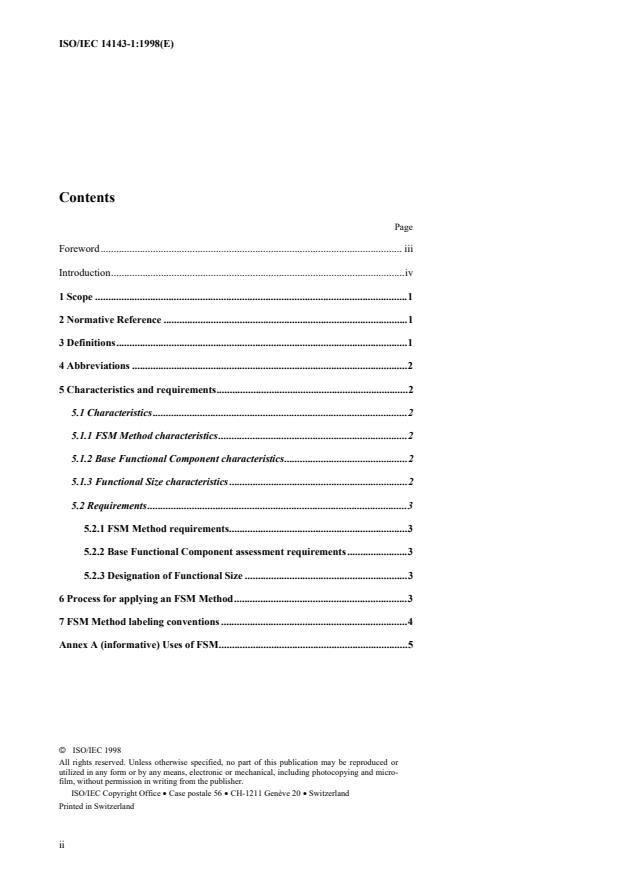
Contents
Page
Foreword. iii
Introduction.iv
1 Scope .1
2 Normative Reference .1
3 Definitions.1
4 Abbreviations .2
5 Characteristics and requirements.2
5.1 Characteristics.2
5.1.1 FSM Method characteristics.2
5.1.2 Base Functional Component characteristics.2
5.1.3 Functional Size characteristics .2
5.2 Requirements.3
5.2.1 FSM Method requirements.3
5.2.2 Base Functional Component assessment requirements.3
5.2.3 Designation of Functional Size .3
6 Process for applying an FSM Method.3
7 FSM Method labeling conventions .4
Annex A (informative) Uses of FSM.5
© ISO/IEC 1998
All rights reserved. Unless otherwise specified, no part of this publication may be reproduced or
utilized in any form or by any means, electronic or mechanical, including photocopying and micro-
film, without permission in writing from the publisher.
ISO/IEC Copyright Office • Case postale 56 • CH-1211 Genève 20 • Switzerland
Printed in Switzerland
ii
© ISO/IEC ISO/IEC 14143-1:1998(E)
Foreword
ISO (the International Organization for Standardization) and IEC (the International
Electrotechnical Commission) form the specialized system for worldwide
standardization. National bodies that are members of ISO or IEC participate in the
development of International Standards through technical committees established by
the respective organizations to deal with particular fields of technical activity. ISO
and IEC technical committees collaborate in fields of mutual interest. Other
international organizations, governmental and non-governmental, in liaison with ISO
and IEC, also take part in the work.
In the field of information technology, ISO and IEC have established a joint
technical committee, ISO/IEC JTC 1. Draft International Standards adopted by the
Joint Technical Committee are circulated to national bodies for voting. Publication
as an International Standard requires approval by at least 75% of the national bodies
casting a vote.
International Standard ISO/IEC 14143-1 was prepared by Joint Technical
Committee ISO/IEC JTC 1, Information technology, Subcommittee SC 7, Software
engineering.
ISO/IEC 14143 consists of the following part, under the general title Information
technology - Software measurement - Functional size measurement:
Part 1: Definition of concepts
Further parts may follow.
Annex A of this part of ISO/IEC 14143 is for information only.
iii
Introduction
Organizations engaged in software engineering have struggled for years in search of
acceptable quantitative methods for measuring process efficiency and effectiveness,
and for managing software costs, for the systems they acquire, develop, enhance or
maintain. One critical, and particularly elusive, aspect of this measurement
requirement has been the need to determine software size. Numerous software sizing
methods have been proposed in the past. These included numbers of source lines of
program code and various measures derived from the technical characteristics of the
software.
These methods can have limitations in that they;
- cannot always be applied early in the software development process,
- cannot always be applied uniformly throughout the software's life time, or
- cannot always be meaningfully understood by users of the software.
The concepts of Functional Size Measurement (FSM) are designed to overcome
these limitations by shifting the focus away from measuring how the software is
implemented, to measuring size in terms of the functions required by the user.
Since the public release of Function Point Analysis, many sizing methods have been
developed based on Albrecht’s and other concepts. As these various sizing methods
were developed without common agreement of the fundamental concepts of FSM, it
was natural that inconsistencies amongst the methods would develop. These
inconsistencies lessen the ability and attractiveness of any of these methods to be
used as a standard method for the functional sizing of software.
This part of ISO/IEC 14143 defines the fundamental concepts of FSM, thereby
promoting the consistent interpretation of FSM principles.
The text in this part of ISO/IEC 14143 has been formatted in order to facilitate the
checking of a candidate software sizing method for conformance to this part of
ISO/IEC 14143.
iv
INTERNATIONAL STANDARD ©ISO/IEC ISO/IEC 14143-1:1998(E)
Information technology — Software measurement — Functional size
measurement —
Part 1:
Definition of concepts
3 Definitions
1 Scope
For the purposes of this part of ISO/IEC 14143, the
This part of ISO/IEC 14143 defines the fundamental
following definitions apply.
concepts of Functional Size Measurement (FSM) and
describes the general principles for applying an FSM
3.1
Method. This part of ISO/IEC 14143 does NOT
Base Functional Component (BFC)
provide detailed rules on how to:
an elementary unit of Functional User Requirements
defined by and used by an FSM Method for
- measure Functional Size of software using a
measurement purposes
particular method,
NOTE - Example, a Functional User Requirement could be
- use the results obtained from a particular method, or
"Maintain Customers" which may consist of the following
BFCs: "Add a new customer", "Report Customer Purchases",
- select a particular method.
and "Change Customer Details". Another example might
include a collection of logically related business data
NOTE - Guidelines on the uses of FSM are in Annex A.
maintained by the software under study such as "Customer
Details". There are many other examples.
This part of ISO/IEC 14143 is applicable when
determining if a method for sizing software is an FSM
3.2
Method. It does not prevent the development of various
BFC Type
methods, but rather provides a basis for assessing
a defined category of BFCs
whether a particular method conforms to FSM.
NOTE - Examples of BFC Types are 'External Inputs',
'External Outputs' and 'Logical Transactions', and data stores
This part of ISO/IEC 14143 is intended for use by those
such as 'Internal Logical Files'.
persons associated with the acquisition, development,
use, support, maintenance and audit of software.
3.3
boundary
a conceptual interface between the software under study
2 Normative Reference
and its users
The following standard contains provisions which,
3.4
through reference in this text, constitute provisions of
FSM Method
this part of ISO/IEC 14143. At the time of publication,
a specific implementation of FSM defined by a set of
the edition indicated was valid. All standards are
rules, which conforms to the mandatory features of this
subject to revision, and parties to agreements based on
part of ISO/IEC 14143
this part of ISO/IEC 14143 are encouraged to
investigate the possibility of applying the most recent
3.5
edition of the standard indicated below. Members of
Functional Domain
IEC and ISO maintain registers of currently valid
a class of software based on the characteristics of
International Standards.
Functional User Requirements which are pertinent to
FSM
1)
ISO/IEC 9126:1991 , Information technology -
Software product evaluation - Quality characteristics
3.6
and guidelines for their use.
Functional Size
a size of the software derived by quantifying the
Functional User Requirements
1)
Currently under revision.
3.7
5 Characteristics and requirements
Functional Size Measurement (FSM)
the process of measuring Functional Size
5.1 Characteristics
3.8
5.1.1 FSM Method characteristics
Functional User Requirements
a sub-set of the user requirements. The Functional User
5.1.1.1 An FSM Method shall have the following
Requirements represent the user practices and
characteristics:
procedures that the software must perform to fulfil the
users’ needs. They exclude Quality Requirements and
a) it is based on a representation of the Functional User
any Technical Requirements
Requirements from the perspective of the users;
3.9
b) it can be applied as soon as any Functional User
local customization
Requirements have been defined and while they are
an FSM Method that has been modified for local use,
available;
such that it might produce different Functional Sizes
from those obtained prior to modification
c) it derives a Functional Size through the assessment
(refer to 5.2.2) of Base Functional Components.
3.10
Quality Requirements
5.1.1.2 An FSM Method should be as independent as
any requirements relating to software quality as defined
possible of particular software development methods or
in ISO 9126:1991
technologies.
3.11
NOTE - This will facilitate a broader use of the FSM Method.
Scope of the FSM
the set of Functional User Requirements to be included
5.1.2 Base Functional Component characteristics
in a specific FSM instance
A BFC shall have the following characteristics:
NOTE - The Scope of the FSM is determined by the purpose
for measuring the software. For example, if an organization
a) it expresses only Functional User Requirements;
needs to know the size of its software portfolio, then the
Scope of the FSM will include all the Functional User
b) it does not express Technical Requirements;
Requirements currently utilized. However, if a project
manager is seeking to determine the size of a particular release
of software, then the scope will include only those Functional c) it does not express Quality Requirements;
User Requirements impacted by the project.
d) it is classified as one, and only one BFC Type.
3.12
Technical Requirements
5.1.3 Functional Size characteristics
requirements relating to the technology and
environment, for the development, maintenance, support
Functional Size shall have the following characteristics:
and execution of the software
a) it is not derived from the effort required to develop
NOTE - Examples of Technical Requirements include
the software being measured;
programming language, testing tools, operating systems,
database techn
...
Questions, Comments and Discussion
Ask us and Technical Secretary will try to provide an answer. You can facilitate discussion about the standard in here.
Loading comments...