

ISO/IEC 14143-1:2007
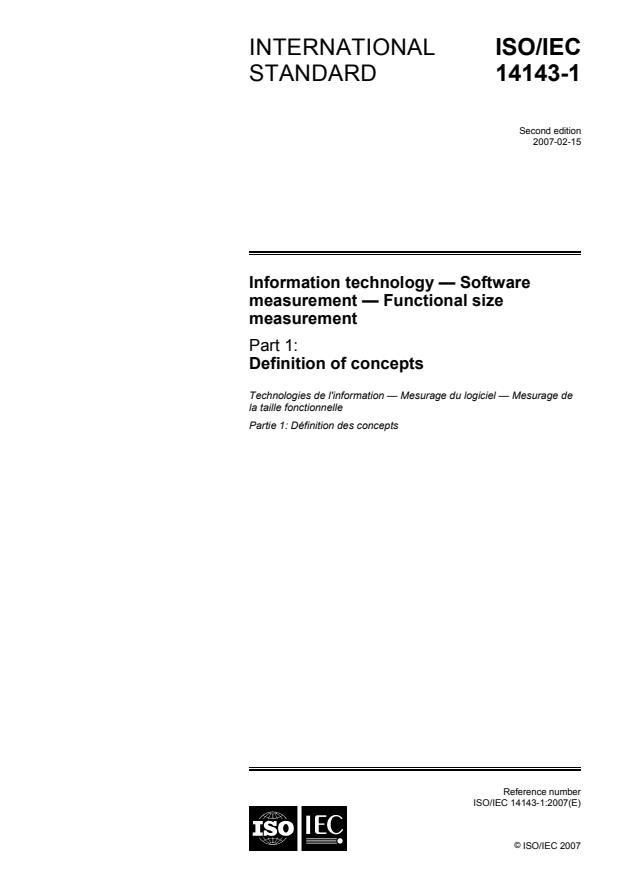
(Main)Information technology — Software measurement — Functional size measurement — Part 1: Definition of concepts
General Information
- Abstract
ISO/IEC 14143-1:2007 defines the concepts of FSM (Functional Size Measurement). The concepts of Functional Size Measurement (FSM) are designed to overcome the limitations of earlier methods of sizing software by shifting the focus away from measuring how the software is implemented to measuring size in terms of the functions required by the user.
- Status
- Published
- Publication Date
- 31-Jan-2007
- Technical Committee
- ISO/IEC JTC 1/SC 7 - Software and systems engineering
- Drafting Committee
- ISO/IEC JTC 1/SC 7 - Software and systems engineering
- Current Stage
- 9093 - International Standard confirmed
- Start Date
- 09-Aug-2024
- Completion Date
- 29-Aug-2026
Overview
ISO/IEC 14143-1:2007 defines the fundamental concepts of Functional Size Measurement (FSM). The standard shifts sizing focus from implementation details to the functions required by users, enabling size measurement early in the lifecycle and across the software lifetime. It establishes terminology and high-level requirements so that different FSM Methods can be compared and evaluated for conformance.
The document is intended for professionals involved in acquisition, development, maintenance, support and audit of software. It does not prescribe a specific measurement algorithm or rules for using results, but provides the conceptual basis for assessing whether a sizing method qualifies as an FSM Method.
Key Topics
- Core definitions: Functional Size, Functional Size Measurement (FSM), Functional User Requirements (FUR), Base Functional Component (BFC), BFC Type, boundary, Functional Domain, Scope of the FSM.
- Purpose of FSM: Measure software size in terms of user-required functions rather than lines of code or implementation effort.
- Characteristics of an FSM Method:
- Based on a user-perspective representation of Functional User Requirements.
- Applicable as soon as Functional User Requirements are defined.
- Derives Functional Size by assessing Base Functional Components.
- Should be independent of development methods, technology and physical components.
- BFC and BFC Types: A BFC expresses only Functional User Requirements and is classified into a single BFC Type (examples include inputs, outputs, logical transactions, and logical data stores).
- Requirements for an FSM Method:
- Define BFC attributes and assessment rules.
- Specify units for Functional Size (for example, Function Points as an illustrative unit).
- Describe applicable Functional Domain(s) and intended uses.
- State convertibility to other sizing measures where applicable.
- Process to apply an FSM Method (high-level):
- Determine the Scope of the FSM.
- Identify Functional User Requirements in scope.
- Identify and classify BFCs.
- Assign numeric values to BFCs and calculate Functional Size.
Applications
ISO/IEC 14143-1:2007 is valuable for:
- Early sizing during requirements and acquisition phases.
- Portfolio sizing and benchmarking across projects.
- Cost estimation and vendor selection when combined with productivity metrics.
- Audits and conformance checks of candidate FSM Methods.
- Supporting consistent communication between stakeholders about software functional size.
Related Standards
This part is the conceptual foundation of the ISO/IEC 14143 series. Related parts include:
- ISO/IEC 14143-2 - Conformity evaluation of software size measurement methods
- ISO/IEC 14143-3 - Verification of FSM methods (Technical Report)
- ISO/IEC 14143-4 - Reference model (Technical Report)
- ISO/IEC 14143-5 - Determination of functional domains (Technical Report)
- ISO/IEC 14143-6 - Guide for use of the series and related standards
For organizations seeking consistent, technology-independent functional sizing, ISO/IEC 14143-1:2007 provides the essential concepts and structure to evaluate and apply FSM methods reliably.
Relations
- Effective Date
- 25-Aug-2026
- Effective Date
- 15-Apr-2008
Get Certified
Connect with accredited certification bodies for this standard

BSI Group
BSI (British Standards Institution) is the business standards company that helps organizations make excellence a habit.

BSCIC Certifications Pvt. Ltd.
Established 2006, accredited by NABCB, JAS-ANZ, EIAC, IAS. CDSCO Notified Body.

Intertek India Pvt. Ltd.
Delivers Assurance, Testing, Inspection & Certification since 1993 with 26 labs and 32 offices.
Sponsored listings
Frequently Asked Questions
ISO/IEC 14143-1:2007 is a standard published by the International Organization for Standardization (ISO). Its full title is "Information technology — Software measurement — Functional size measurement — Part 1: Definition of concepts". This standard covers: ISO/IEC 14143-1:2007 defines the concepts of FSM (Functional Size Measurement). The concepts of Functional Size Measurement (FSM) are designed to overcome the limitations of earlier methods of sizing software by shifting the focus away from measuring how the software is implemented to measuring size in terms of the functions required by the user.
ISO/IEC 14143-1:2007 defines the concepts of FSM (Functional Size Measurement). The concepts of Functional Size Measurement (FSM) are designed to overcome the limitations of earlier methods of sizing software by shifting the focus away from measuring how the software is implemented to measuring size in terms of the functions required by the user.
ISO/IEC 14143-1:2007 is classified under the following ICS (International Classification for Standards) categories: 35.080 - Software. The ICS classification helps identify the subject area and facilitates finding related standards.
ISO/IEC 14143-1:2007 has the following relationships with other standards: It is inter standard links to CEN/CLC/TR 17602-80-04:2021, ISO/IEC 14143-1:1998. Understanding these relationships helps ensure you are using the most current and applicable version of the standard.
ISO/IEC 14143-1:2007 is available in PDF format for immediate download after purchase. The document can be added to your cart and obtained through the secure checkout process. Digital delivery ensures instant access to the complete standard document.
Standards Content (Sample)
INTERNATIONAL ISO/IEC
STANDARD 14143-1
Second edition
2007-02-15
Information technology — Software
measurement — Functional size
measurement
Part 1:
Definition of concepts
Technologies de l'information — Mesurage du logiciel — Mesurage de
la taille fonctionnelle
Partie 1: Définition des concepts
Reference number
©
ISO/IEC 2007
PDF disclaimer
This PDF file may contain embedded typefaces. In accordance with Adobe's licensing policy, this file may be printed or viewed but
shall not be edited unless the typefaces which are embedded are licensed to and installed on the computer performing the editing. In
downloading this file, parties accept therein the responsibility of not infringing Adobe's licensing policy. The ISO Central Secretariat
accepts no liability in this area.
Adobe is a trademark of Adobe Systems Incorporated.
Details of the software products used to create this PDF file can be found in the General Info relative to the file; the PDF-creation
parameters were optimized for printing. Every care has been taken to ensure that the file is suitable for use by ISO member bodies. In
the unlikely event that a problem relating to it is found, please inform the Central Secretariat at the address given below.
© ISO/IEC 2007
All rights reserved. Unless otherwise specified, no part of this publication may be reproduced or utilized in any form or by any means,
electronic or mechanical, including photocopying and microfilm, without permission in writing from either ISO at the address below or
ISO's member body in the country of the requester.
ISO copyright office
Case postale 56 • CH-1211 Geneva 20
Tel. + 41 22 749 01 11
Fax + 41 22 749 09 47
E-mail copyright@iso.org
Web www.iso.org
Published in Switzerland
ii © ISO/IEC 2007 – All rights reserved
Foreword
ISO (the International Organization for Standardization) and IEC (the International Electrotechnical
Commission) form the specialized system for worldwide standardization. National bodies that are members of
ISO or IEC participate in the development of International Standards through technical committees
established by the respective organization to deal with particular fields of technical activity. ISO and IEC
technical committees collaborate in fields of mutual interest. Other international organizations, governmental
and non-governmental, in liaison with ISO and IEC, also take part in the work. In the field of information
technology, ISO and IEC have established a joint technical committee, ISO/IEC JTC 1.
International Standards are drafted in accordance with the rules given in the ISO/IEC Directives, Part 2.
The main task of the joint technical committee is to prepare International Standards. Draft International
Standards adopted by the joint technical committee are circulated to national bodies for voting. Publication as
an International Standard requires approval by at least 75 % of the national bodies casting a vote.
Attention is drawn to the possibility that some of the elements of this document may be the subject of patent
rights. ISO and IEC shall not be held responsible for identifying any or all such patent rights.
ISO/IEC 14143-1 was prepared by Joint Technical Committee ISO/IEC JTC 1, Information technology,
Subcommittee SC 7, Software and system engineering.
This second edition cancels and replaces the first edition (ISO/IEC 14143-1:1998), of which it constitutes a
minor revision.
ISO/IEC 14143 consists of the following parts, under the general title Information technology — Software
measurement — Functional size measurement:
⎯ Part 1: Definition of concepts
⎯ Part 2: Conformity evaluation of software size measurement methods to ISO/IEC 14143-1:1998
⎯ Part 3: Verification of functional size measurement methods [Technical Report]
⎯ Part 4: Reference model [Technical Report]
⎯ Part 5: Determination of functional domains for use with functional size measurement [Technical Report]
⎯ Part 6: Guide for use of ISO/IEC 14143 series and related International Standards
© ISO/IEC 2007 – All rights reserved iii
Introduction
Organizations engaged in software engineering have struggled for years in search of acceptable quantitative
methods for measuring process efficiency and effectiveness, and for managing software costs, for the
systems they acquire, develop, enhance or maintain. One critical, and particularly elusive, aspect of this
measurement requirement has been the need to determine software size. Numerous software sizing methods
have been proposed in the past. These included numbers of source lines of program code and various
measures derived from the technical characteristics of the software.
These methods can have limitations in that they:
⎯ cannot always be applied early in the software development process;
⎯ cannot always be applied uniformly throughout the software’s lifetime; or
⎯ cannot always be meaningfully understood by users of the software.
The concepts of Functional Size Measurement (FSM) are designed to overcome these limitations by shifting
the focus away from measuring how the software is implemented to measuring size in terms of the functions
required by the user. In 1979, Allan J. Albrecht of IBM was the first to publicly release a method based on
such concepts, known as Function Point Analysis.
Since the public release of Function Point Analysis, many sizing methods have been developed based on
Albrecht’s and other concepts. As these various sizing methods were developed without common agreement
of the fundamental concepts of FSM, it was natural that inconsistencies amongst the methods would develop.
These inconsistencies lessen the ability and attractiveness of any of these methods to be used as a standard
method for the functional sizing of software.
This part of ISO/IEC 14143 defines the fundamental concepts of FSM, thereby promoting the consistent
interpretation of FSM principles.
The text in this part of ISO/IEC 14143 has been formatted in order to facilitate the checking of a candidate
software sizing method for conformance to this part of ISO/IEC 14143.
iv © ISO/IEC 2007 – All rights reserved
INTERNATIONAL STANDARD ISO/IEC 14143-1:2007(E)
Information technology — Software measurement — Functional
size measurement
Part 1:
Definition of concepts
1 Scope
This part of ISO/IEC 14143 defines the fundamental concepts of Functional Size Measurement (FSM). This
part of ISO/IEC 14143 does NOT provide detailed rules on how to:
⎯ measure Functional Size of software using a particular method;
⎯ use the results obtained from a particular method;
⎯ select a particular method.
This part of ISO/IEC 14143 is applicable when determining if a method for sizing software is an FSM Method.
It does not prevent the development of various methods, but rather provides a basis for assessing whether a
particular method conforms to FSM.
This part of ISO/IEC 14143 is intended for use by those persons associated with the acquisition, development,
use, support, maintenance and audit of software.
2 Normative Reference
There are no normative references.
3 Definitions
For the purposes of this document, the following definitions apply.
3.1
Base Functional Component
BFC
elementary unit of Functional User Requirements defined by and used by an FSM Method for measurement
purposes
EXAMPLES A Functional User Requirement could be “Maintain Customers” which may consist of the following BFCs:
“Add a new customer”, “Report Customer Purchases”, and “Change Customer Details”. Another example might include a
collection of logically related business data maintained by the software under study such as “Customer Details”. There are
many other examples.
3.2
BFC Type
defined category of BFCs
EXAMPLES These include “External Inputs”, “External Outputs” and “Logical Transactions”, and data stores such as
“Internal Logical Files”.
© ISO/IEC 2007 – All rights reserved 1
3.3
boundary
conceptual interface between the software under study and its users
3.4
FSM Method
specific implementation of FSM defined by a set of rules, which conforms to the mandatory features of this
part of ISO/IEC 14143
3.5
Functional Domain
class of software based on the characteristics of Functional User Requirements which are pertinent to FSM
...