


ISO 11759:1999
(Main)Rubber hoses and hose assemblies for dispensing liquefied petroleum gases (LPGs) - Specification
Rubber hoses and hose assemblies for dispensing liquefied petroleum gases (LPGs) - Specification
This International Standard specifies the requirements for flexible rubber hoses and hose assemblies used for the transfer of metered quantities of liquified petroleum gases (LPGs) from dispensing equipment to motor vehicles. The hoses and hose assemblies specified in this International Standard are intended for use "wet", i.e. permanently filled with liquid, in the temperature range from ? 40 °C to + 60 °C. The maximum working pressure is 20 bar (2 MPa).
Tuyaux et flexibles en caoutchouc destinés à la fourniture de gaz de pétrole liquéfiés (GPL) — Spécifications
General Information
Relations
Overview
ISO 11759:1999 specifies requirements for flexible rubber hoses and hose assemblies used to dispense liquefied petroleum gases (LPGs) from dispensing equipment to motor vehicles. Intended for permanent “wet” service (filled with liquid), the standard covers hoses that operate in the temperature range –40 °C to +60 °C with a maximum working pressure of 20 bar (2 MPa). It defines materials, construction, dimensions, performance tests and marking needed to ensure safe, reliable LPG transfer.
Key Topics and Requirements
- Scope & use: Hoses for metered transfer of LPG from dispensers to vehicles; designed for continuous liquid fill.
- Classification:
- Type 1 - textile reinforcement with a metallic bonding element (braided bonding wires); suitable for reeling or single-loop draping.
- Type 2 - fine wire reinforcement; suitable for reeling or single-loop draping.
- Materials & construction: Smooth fuel-resistant rubber lining, one or more reinforcement layers (textile or corrosion‑resistant wire), electrically conductive element (Type 1), abrasion- and weather‑resistant rubber cover. Covers may be pricked to relieve trapped gas.
- Pressure ratings (ISO 1402):
- Maximum working pressure: 20 bar
- Proof test pressure: 40 bar
- Minimum burst pressure: 100 bar
- Dimensions & tolerances: Nominal bores and permitted diameter tolerances (16, 19, 20, 25 mm) and minimum lining/cover thickness (lining ≥ 1.6 mm; cover ≥ 1.0 mm).
- Physical & performance tests: Tensile strength, elongation, accelerated ageing, liquid resistance, hydrostatic proof and burst, volumetric expansion, flexibility (ambient and low temperature), ozone and abrasion resistance, adhesion, electrical continuity/resistance, LPG permeability, and an Annex A reverse-bending flex test.
- Marking & traceability: Durable marking at least every metre with manufacturer ID, ISO number, hose type, nominal bore, max working pressure and manufacturing/assembly date.
- Testing frequency: Approval (full) tests and production/routine tests defined; many performance tests are required as approval tests while dimensional and proof tests are required for each production length.
Applications and Users
- Primary users: Hose manufacturers, LPG dispenser OEMs, fuel station operators, inspection and testing laboratories, procurement and quality assurance teams.
- Applications: Vehicle refuelling hoses at LPG service stations, dispenser system assemblies, and replacement hose assemblies where compliance with safety, pressure and low-temperature performance is required.
- Practical value: Ensures compatibility with LPG fluids, electrical continuity for safety, mechanical durability for reeling and repeated flexing, and traceability for maintenance and regulatory compliance.
Related Standards
Normative references cited include ISO 1402 (hydrostatic testing), ISO 37 (tensile tests), ISO 188 (accelerated ageing), ISO 4080 (gas permeability), ISO 1746 (bending/flexibility) and ISO 8031 (electrical resistance), among others - useful for implementing full test programs and quality systems.
Frequently Asked Questions
ISO 11759:1999 is a standard published by the International Organization for Standardization (ISO). Its full title is "Rubber hoses and hose assemblies for dispensing liquefied petroleum gases (LPGs) - Specification". This standard covers: This International Standard specifies the requirements for flexible rubber hoses and hose assemblies used for the transfer of metered quantities of liquified petroleum gases (LPGs) from dispensing equipment to motor vehicles. The hoses and hose assemblies specified in this International Standard are intended for use "wet", i.e. permanently filled with liquid, in the temperature range from ? 40 °C to + 60 °C. The maximum working pressure is 20 bar (2 MPa).
This International Standard specifies the requirements for flexible rubber hoses and hose assemblies used for the transfer of metered quantities of liquified petroleum gases (LPGs) from dispensing equipment to motor vehicles. The hoses and hose assemblies specified in this International Standard are intended for use "wet", i.e. permanently filled with liquid, in the temperature range from ? 40 °C to + 60 °C. The maximum working pressure is 20 bar (2 MPa).
ISO 11759:1999 is classified under the following ICS (International Classification for Standards) categories: 75.200 - Petroleum products and natural gas handling equipment; 83.140.40 - Hoses. The ICS classification helps identify the subject area and facilitates finding related standards.
ISO 11759:1999 has the following relationships with other standards: It is inter standard links to ISO 642:1999, ISO/FDIS 11759, ISO/FDIS 11759. Understanding these relationships helps ensure you are using the most current and applicable version of the standard.
You can purchase ISO 11759:1999 directly from iTeh Standards. The document is available in PDF format and is delivered instantly after payment. Add the standard to your cart and complete the secure checkout process. iTeh Standards is an authorized distributor of ISO standards.
Standards Content (Sample)
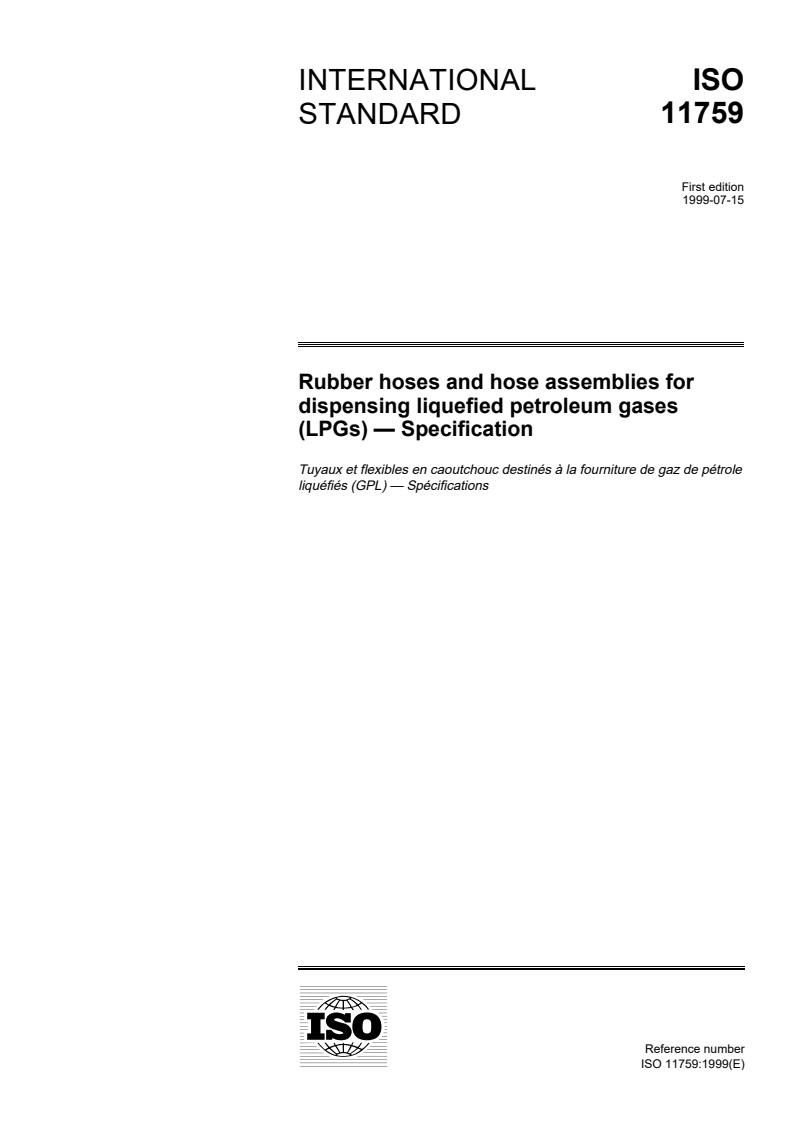
INTERNATIONAL ISO
STANDARD 11759
First edition
1999-07-15
Rubber hoses and hose assemblies for
dispensing liquefied petroleum gases
(LPGs) — Specification
Tuyaux et flexibles en caoutchouc destinés à la fourniture de gaz de pétrole
liquéfiés (GPL) — Spécifications
A
Reference number
Foreword
ISO (the International Organization for Standardization) is a worldwide federation of national standards bodies (ISO
member bodies). The work of preparing International Standards is normally carried out through ISO technical
committees. Each member body interested in a subject for which a technical committee has been established has
the right to be represented on that committee. International organizations, governmental and non-governmental, in
liaison with ISO, also take part in the work. ISO collaborates closely with the International Electrotechnical
Commission (IEC) on all matters of electrotechnical standardization.
International Standards are drafted in accordance with the rules given in the ISO/IEC Directives, Part 3.
Draft International Standards adopted by the technical committees are circulated to the member bodies for voting.
Publication as an International Standard requires approval by at least 75 % of the member bodies casting a vote.
International Standard ISO 11759 was prepared by Technical Committee ISO/TC 45, Rubber and rubber products,
Subcommittee SC 1, Hoses (rubber and plastics).
Annex A forms a normative part of this International Standard.
© ISO 1999
All rights reserved. Unless otherwise specified, no part of this publication may be reproduced or utilized in any form or by any means, electronic
or mechanical, including photocopying and microfilm, without permission in writing from the publisher.
International Organization for Standardization
Case postale 56 • CH-1211 Genève 20 • Switzerland
Internet iso@iso.ch
Printed in Switzerland
ii
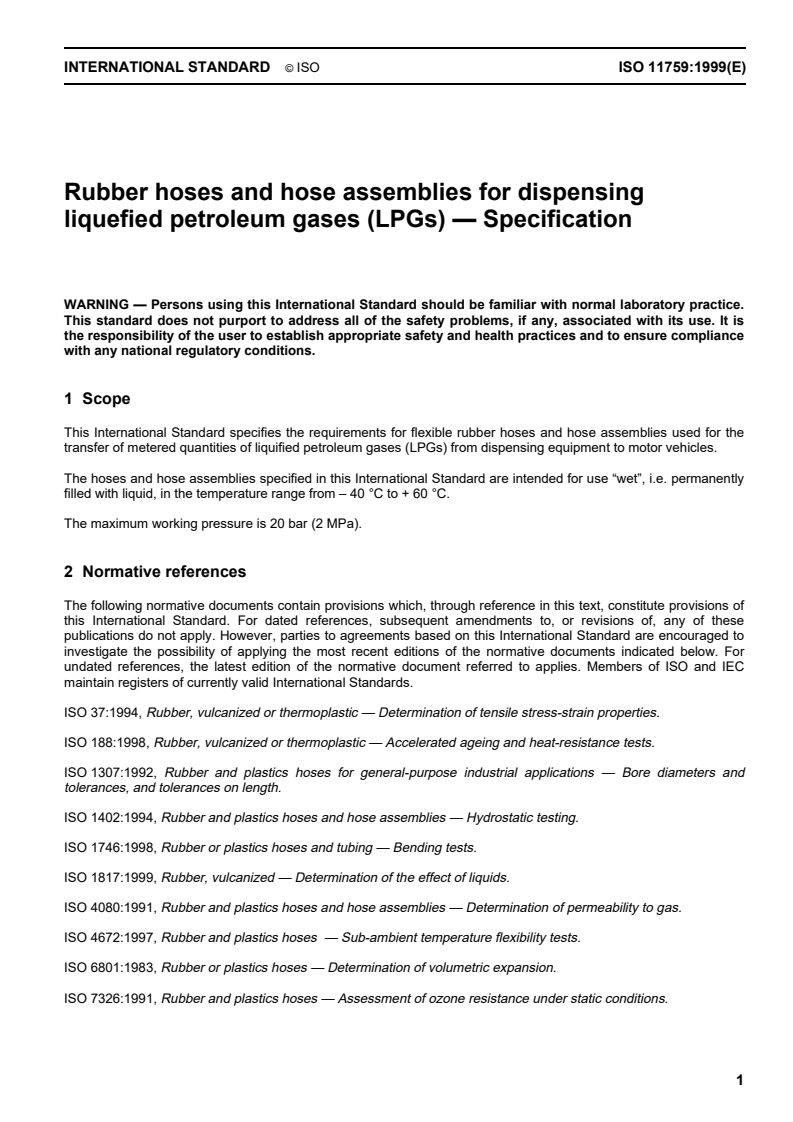
INTERNATIONAL STANDARD © ISO ISO 11759:1999(E)
Rubber hoses and hose assemblies for dispensing
liquefied petroleum gases (LPGs) — Specification
WARNING — Persons using this International Standard should be familiar with normal laboratory practice.
This standard does not purport to address all of the safety problems, if any, associated with its use. It is
the responsibility of the user to establish appropriate safety and health practices and to ensure compliance
with any national regulatory conditions.
1 Scope
This International Standard specifies the requirements for flexible rubber hoses and hose assemblies used for the
transfer of metered quantities of liquified petroleum gases (LPGs) from dispensing equipment to motor vehicles.
The hoses and hose assemblies specified in this International Standard are intended for use “wet”, i.e. permanently
filled with liquid, in the temperature range from – 40 °C to + 60 °C.
The maximum working pressure is 20 bar (2 MPa).
2 Normative references
The following normative documents contain provisions which, through reference in this text, constitute provisions of
this International Standard. For dated references, subsequent amendments to, or revisions of, any of these
publications do not apply. However, parties to agreements based on this International Standard are encouraged to
investigate the possibility of applying the most recent editions of the normative documents indicated below. For
undated references, the latest edition of the normative document referred to applies. Members of ISO and IEC
maintain registers of currently valid International Standards.
ISO 37:1994, Rubber, vulcanized or thermoplastic — Determination of tensile stress-strain properties.
ISO 188:1998, Rubber, vulcanized or thermoplastic — Accelerated ageing and heat-resistance tests.
ISO 1307:1992, Rubber and plastics hoses for general-purpose industrial applications — Bore diameters and
tolerances, and tolerances on length.
ISO 1402:1994,
Rubber and plastics hoses and hose assemblies — Hydrostatic testing.
ISO 1746:1998, Rubber or plastics hoses and tubing — Bending tests.
ISO 1817:1999, Rubber, vulcanized — Determination of the effect of liquids.
ISO 4080:1991, Rubber and plastics hoses and hose assemblies — Determination of permeability to gas.
ISO 4672:1997, Rubber and plastics hoses — Sub-ambient temperature flexibility tests.
ISO 6801:1983, Rubber or plastics hoses — Determination of volumetric expansion.
ISO 7326:1991, Rubber and plastics hoses — Assessment of ozone resistance under static conditions.
© ISO
ISO 8031:1993,
Rubber and plastics hoses and hose assemblies — Determination of electrical resistance.
ISO 8033:1991, Rubber and plastics hoses — Determination of adhesion between components.
ISO 8330: 1998, Rubber and plastics hoses and hose assemblies — Vocabulary.
3 Terms and definitions
For the purposes of this International Standard, the terms and definitions in ISO 8330:1998 apply.
4 Classification
Two types of hose are specified, as follows:
Type 1: Hoses with textile reinforcement, incorporating a metallic bonding element, suitable for reeling on a
drum or draping in a single loop.
Type 2: Hoses with a fine wire reinforcement, suitable for reeling on a drum or draping in a single loop.
5 Materials and construction
Hoses shall consist of the following:
a smooth, fuel-resistant lining of rubber;
one or more layers of textile or corrosion-resistant wires, for example stainless steel or tinned copper;
an electrically conductive element (Type 1) typically consisting of not less than two bonding wires of a braided
construction each containing a minimum of nine strands of corrosion-resistant metal;
an abrasion- and weather-resistant rubber cover.
The hose cover can be pricked to release trapped gases.
6 Hydrostatic requirements
When the hose or hose assembly is tested in accordance with ISO 1402, the pressure rating shall comply with the
values given in Table 1.
Table 1 — Pressure ratings
Property Pressure rating
a
bar
Maximum working pressure 20
Proof test pressure 40
Minimum burst pressure 100
a
1 bar = 0,1 MPa
© ISO
7 Dimensions and tolerances
7.1 When measured by the method described in ISO 4671, the internal and outside diameters of the hose shall
comply with the dimensions and tolerances given in Table 2.
The tolerances on cut lengths
...
Questions, Comments and Discussion
Ask us and Technical Secretary will try to provide an answer. You can facilitate discussion about the standard in here.
Loading comments...