

ISO/IEC 15940:2013
(Main)Systems and software engineering — Software Engineering Environment Services
General Information
- Abstract
ISO/IEC 15940:2013 aims to update ISO/IEC 15940:2006 to take into account the changes of ISO/IEC 12207:2008 and to add/complete the set of Software Engineering Environment services for software and system processes. Software engineering environments services, or SEE services, refers to a collection of services, partially or fully automated by software tools, that are used to support the execution of human activities in systems and software engineering. ISO/IEC 12207:2008 describes a comprehensive set of processes, activities and tasks to be performed when acquiring or developing a system/software. It does not address their implementation or their automation. These activities are usually carried out within a software or system development/maintenance project, and cover such areas as the specification, development, re-engineering or maintenance of systems. ISO/IEC 15940:2013 describes SEE services and relates them to ISO/IEC 12207:2008 in a manner applicable to a range of organizations. In defining a life cycle process for an organization, the user needs to find the appropriate level of automation provided by a software engineering environment. This may result in establishing a new SEE service or improving an existing one. The suite of SEE services described supports the process definitions in ISO/IEC 12207:2008. The purpose is to define a set of SEE services that are compatible with ISO/IEC 12207:2008, and that can be used either as a general reference, or to define an automated software and system process.
- Status
- Published
- Publication Date
- 20-Feb-2013
- Technical Committee
- ISO/IEC JTC 1/SC 7 - Software and systems engineering
- Drafting Committee
- ISO/IEC JTC 1/SC 7/WG 4 - Tools and environment
- Current Stage
- 9092 - International Standard to be revised
- Start Date
- 19-Nov-2025
- Completion Date
- 29-Aug-2026
Overview
ISO/IEC 15940:2013 - Systems and software engineering: Software Engineering Environment Services (SEE services) defines a reference model and a suite of services used to support systems and software engineering activities. This second edition updates ISO/IEC 15940:2006 to align with ISO/IEC 12207:2008 and completes the set of services that can be partially or fully automated by software tools. The standard helps organizations decide the appropriate level of tool automation for life cycle processes and provides a common vocabulary and structure for SEE services.
Key topics
- Reference model and service categories: a structured classification of SEE services and the format for describing each service.
- Comprehensive service catalogue: software engineering services (requirements, design, modelling, compilation, debugging, static/dynamic analysis, testing, verification, integration, re-engineering, reuse management) and systems engineering services (system modelling, architectural design, simulation, integration, testing).
- Support services and infrastructure: configuration/change/quality assurance, SEE repository and data management, cooperative work support, administration, policy enforcement, traceability, documentation.
- Project and process management services: project planning/estimation/risk management, process definition/usage/monitoring, process improvement support.
- Techniques and analyses: trade-off, value, effectiveness and technology maturity analyses.
- Mappings and guidance: informative annexes that map SEE services to ISO/IEC 12207:2008, ISO/IEC 15288, and provide examples of automated support and application guidance.
Practical applications
- Standardizes how tool vendors, integrators and organizations describe and implement automation in software engineering environments.
- Guides selection and integration of toolchains (IDE, CI/CD, repositories, modelling and testing tools) to support life cycle activities.
- Supports development of automated or assisted processes for requirements engineering, testing, verification, configuration management, and process improvement.
- Aids procurement and compliance by providing clear service descriptions for SEE capability requirements and acceptance criteria.
Who should use this standard
- Tool vendors and platform providers designing SEE products or integrations.
- Systems and software engineering architects defining toolchain automation and lifecycle support.
- Process engineers, quality managers, and configuration managers aligning tool support with ISO/IEC 12207 processes.
- Organizations seeking to standardize engineering tool services, improve traceability, and automate lifecycle tasks.
Related standards
- ISO/IEC 12207:2008 - Software life cycle processes (primary alignment).
- ISO/IEC 15288 - Systems life cycle processes (mappings included).
- ISO/IEC 15940:2013 provides the SEE service layer to implement and automate processes defined by these standards.
Relations
- Effective Date
- 23-Jul-2011
Get Certified
Connect with accredited certification bodies for this standard

BSI Group
BSI (British Standards Institution) is the business standards company that helps organizations make excellence a habit.

BSCIC Certifications Pvt. Ltd.
Established 2006, accredited by NABCB, JAS-ANZ, EIAC, IAS. CDSCO Notified Body.

Intertek India Pvt. Ltd.
Delivers Assurance, Testing, Inspection & Certification since 1993 with 26 labs and 32 offices.
Sponsored listings
Frequently Asked Questions
ISO/IEC 15940:2013 is a standard published by the International Organization for Standardization (ISO). Its full title is "Systems and software engineering — Software Engineering Environment Services". This standard covers: ISO/IEC 15940:2013 aims to update ISO/IEC 15940:2006 to take into account the changes of ISO/IEC 12207:2008 and to add/complete the set of Software Engineering Environment services for software and system processes. Software engineering environments services, or SEE services, refers to a collection of services, partially or fully automated by software tools, that are used to support the execution of human activities in systems and software engineering. ISO/IEC 12207:2008 describes a comprehensive set of processes, activities and tasks to be performed when acquiring or developing a system/software. It does not address their implementation or their automation. These activities are usually carried out within a software or system development/maintenance project, and cover such areas as the specification, development, re-engineering or maintenance of systems. ISO/IEC 15940:2013 describes SEE services and relates them to ISO/IEC 12207:2008 in a manner applicable to a range of organizations. In defining a life cycle process for an organization, the user needs to find the appropriate level of automation provided by a software engineering environment. This may result in establishing a new SEE service or improving an existing one. The suite of SEE services described supports the process definitions in ISO/IEC 12207:2008. The purpose is to define a set of SEE services that are compatible with ISO/IEC 12207:2008, and that can be used either as a general reference, or to define an automated software and system process.
ISO/IEC 15940:2013 aims to update ISO/IEC 15940:2006 to take into account the changes of ISO/IEC 12207:2008 and to add/complete the set of Software Engineering Environment services for software and system processes. Software engineering environments services, or SEE services, refers to a collection of services, partially or fully automated by software tools, that are used to support the execution of human activities in systems and software engineering. ISO/IEC 12207:2008 describes a comprehensive set of processes, activities and tasks to be performed when acquiring or developing a system/software. It does not address their implementation or their automation. These activities are usually carried out within a software or system development/maintenance project, and cover such areas as the specification, development, re-engineering or maintenance of systems. ISO/IEC 15940:2013 describes SEE services and relates them to ISO/IEC 12207:2008 in a manner applicable to a range of organizations. In defining a life cycle process for an organization, the user needs to find the appropriate level of automation provided by a software engineering environment. This may result in establishing a new SEE service or improving an existing one. The suite of SEE services described supports the process definitions in ISO/IEC 12207:2008. The purpose is to define a set of SEE services that are compatible with ISO/IEC 12207:2008, and that can be used either as a general reference, or to define an automated software and system process.
ISO/IEC 15940:2013 is classified under the following ICS (International Classification for Standards) categories: 35.080 - Software. The ICS classification helps identify the subject area and facilitates finding related standards.
ISO/IEC 15940:2013 has the following relationships with other standards: It is inter standard links to ISO/IEC 15940:2006. Understanding these relationships helps ensure you are using the most current and applicable version of the standard.
ISO/IEC 15940:2013 is available in PDF format for immediate download after purchase. The document can be added to your cart and obtained through the secure checkout process. Digital delivery ensures instant access to the complete standard document.
Standards Content (Sample)
INTERNATIONAL ISO/IEC
STANDARD 15940
Second edition
2013-03-15
Systems and software engineering —
Software Engineering Environment
Services
Ingénierie du logiciel et des systèmes — Services d'environnement en
ingénierie du logiciel
Reference number
©
ISO/IEC 2013
© ISO/IEC 2013
All rights reserved. Unless otherwise specified, no part of this publication may be reproduced or utilized otherwise in any form or by any
means, electronic or mechanical, including photocopying, or posting on the internet or an intranet, without prior written permission.
Permission can be requested from either ISO at the address below or ISO’s member body in the country of the requester.
ISO copyright office
Case postale 56 CH-1211 Geneva 20
Tel. + 41 22 749 01 11
Fax + 41 22 749 09 47
E-mail copyright@iso.org
Web www.iso.org
Published in Switzerland
ii © ISO/IEC 2013 – All rights reserved
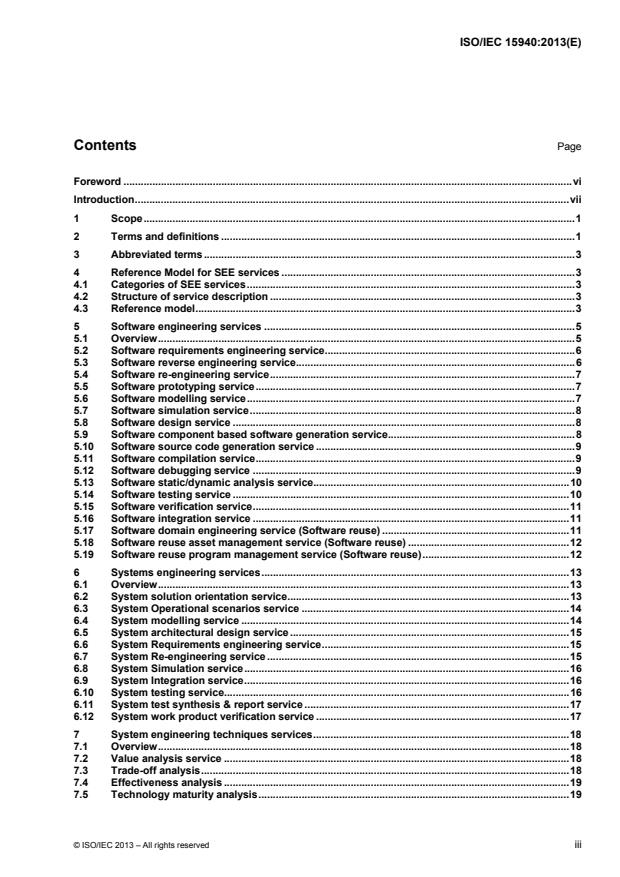
Contents Page
Foreword . vi
Introduction . vii
1 Scope . 1
2 Terms and definitions . 1
3 Abbreviated terms . 3
4 Reference Model for SEE services . 3
4.1 Categories of SEE services . 3
4.2 Structure of service description . 3
4.3 Reference model . 3
5 Software engineering services . 5
5.1 Overview . 5
5.2 Software requirements engineering service. 6
5.3 Software reverse engineering service . 6
5.4 Software re-engineering service . 7
5.5 Software prototyping service . 7
5.6 Software modelling service . 7
5.7 Software simulation service . 8
5.8 Software design service . 8
5.9 Software component based software generation service . 8
5.10 Software source code generation service . 9
5.11 Software compilation service . 9
5.12 Software debugging service . 9
5.13 Software static/dynamic analysis service . 10
5.14 Software testing service . 10
5.15 Software verification service . 11
5.16 Software integration service . 11
5.17 Software domain engineering service (Software reuse) . 11
5.18 Software reuse asset management service (Software reuse) . 12
5.19 Software reuse program management service (Software reuse) . 12
6 Systems engineering services . 13
6.1 Overview . 13
6.2 System solution orientation service . 13
6.3 System Operational scenarios service . 14
6.4 System modelling service . 14
6.5 System architectural design service . 15
6.6 System Requirements engineering service . 15
6.7 System Re-engineering service . 15
6.8 System Simulation service . 16
6.9 System Integration service . 16
6.10 System testing service . 16
6.11 System test synthesis & report service . 17
6.12 System work product verification service . 17
7 System engineering techniques services . 18
7.1 Overview . 18
7.2 Value analysis service . 18
7.3 Trade-off analysis . 18
7.4 Effectiveness analysis . 19
7.5 Technology maturity analysis . 19
© ISO/IEC 2013 – All rights reserved iii
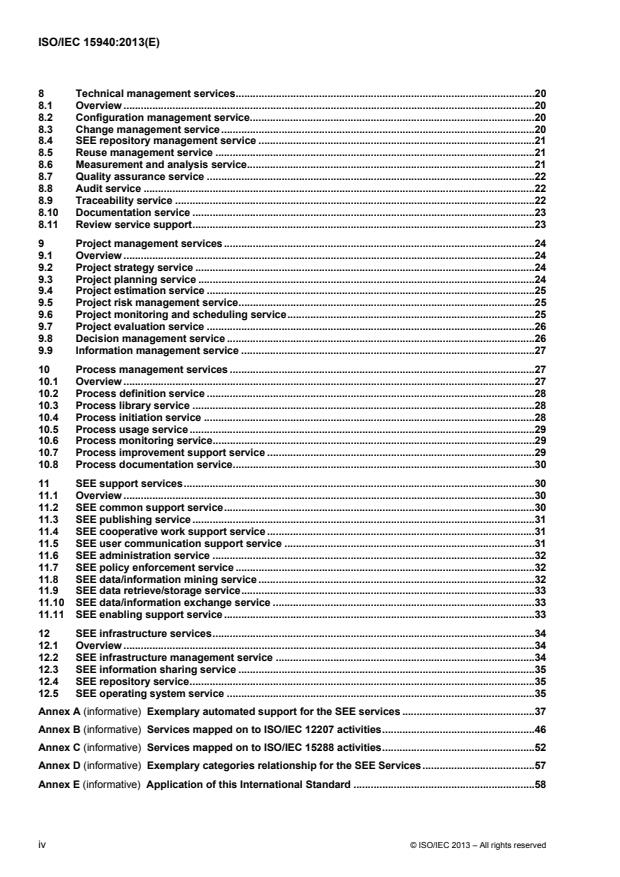
8 Technical management services .20
8.1 Overview .20
8.2 Configuration management service.20
8.3 Change management service .20
8.4 SEE repository management service .21
8.5 Reuse management service .21
8.6 Measurement and analysis service.21
8.7 Quality assurance service .22
8.8 Audit service .22
8.9 Traceability service .22
8.10 Documentation service .23
8.11 Review service support .23
9 Project management services .24
9.1 Overview .24
9.2 Project strategy service .24
9.3 Project planning service .24
9.4 Project estimation service .25
9.5 Project risk management service .25
9.6 Project monitoring and scheduling service .25
9.7 Project evaluation service .26
9.8 Decision management service .26
9.9 Information management service .27
10 Process management services .27
10.1 Overview .27
10.2 Process definition service .28
10.3 Process library service .28
10.4 Process initiation service .28
10.5 Process usage service .29
10.6 Process monitoring service .29
10.7 Process improvement support service .29
10.8 Process documentation service .30
11 SEE support services .30
11.1 Overview .30
11.2 SEE common support service .30
11.3 SEE publishing service .31
11.4 SEE cooperative work support service .31
11.5 SEE user communication support service .31
11.6 SEE administration service .32
11.7 SEE policy enforcement service .32
11.8 SEE data/information mining service .32
11.9 SEE data retrieve/storage service .33
11.10 SEE data/information exchange service .33
11.11 SEE enabling support service .33
12 SEE infrastructure services .34
12.1 Overview .34
12.2 SEE infrastructure management service .34
12.3 SEE information sharing service .35
12.4 SEE repository service .35
12.5 SEE operating system service .35
Annex A (informative) Exemplary automated support for the SEE services .37
Annex B (informative) Services mapped on to ISO/IEC 12207 activities .46
Annex C (informative) Services mapped on to ISO/IEC 15288 activities .52
Annex D (informative) Exemplary categories relationship for the SEE Services .57
Annex E (informative) Application of this International Standard .58
iv © ISO/IEC 2013 – All rights reserved
Annex F (informative) Traceability between ISO 15940:2006 and “ISO-15940 for Systems and
Software engineering” . 59
Bibliography . 63
© ISO/IEC 2013 – All rights reserved v
Foreword
ISO (the International Organization for Standardization) and IEC (the International Electrotechnical
Commission) form the specialized system for worldwide standardization. National bodies that are members of
ISO or IEC participate in the development of International Standards through technical committees
established by the respective organization to deal with particular fields of technical activity. ISO and IEC
technical committees collaborate in fields of mutual interest. Other international organizations, governmental
and non-governmental, in liaison with ISO and IEC, also take part in the work. In the field of information
technology, ISO and IEC have established a joint technical committee, ISO/IEC JTC 1.
International Standards are drafted in accordance with the rules given in the ISO/IEC Directives, Part 2.
The main task of the joint technical committee is to prepare International Standards. Draft International
Standards adopted by the joint technical committee are circulated to national bodies for voting. Publication as
an International Standard requires approval by at least 75 % of the national bodies casting a vote.
Attention is drawn to the possibility that some of the elements of this document may be the subject of patent
rights. ISO and IEC shall not be held responsible for identifying any or all such patent rights.
ISO/IEC 15940 was prepared by Joint Technical Committee ISO/IEC JTC 1, Information technology,
Subcommittee SC 7, Software and systems engineering.
This second edition cancels and replaces the first edition (ISO/IEC 15940:2006), which has been technically
revised.
vi © ISO/IEC 2013 – All rights reserved
Introduction
Software engineering environments, or “SEEs” refer to a collection of services, partially or fully automated by
software tools, that are used to support the execution of human activities in systems and software engineering.
These activities are usually carried out within a software or system development/maintenance project, and
cover such areas as the specification, development, re-engineering or maintenance of systems.
ISO/IEC 12207 describes in a comprehensive manner all of the processes, activities and tasks performed
during the software life cycle.
The term “Software Engineering Environment” may cover several situations; from the mere juxtaposition of a
few tools running on the same operating system, to the fully integrated environment, able to handle, monitor,
and even control all the data, processes, and activities in the systems and software engineering life cycle. A
SEE provides support to human activities through a series of services that describe the capabilities of the
environment. The software process supported by a SEE becomes an assisted or automated software process.
This International Standard describes SEE services and relates them to ISO/IEC 12207:2008 in a manner
applicable to a range of organizations. In defining a life cycle process for an organization, the user needs to
find the appropriate level of automation provided by a software engineering environment. This may result in
establishing a new SEE or improving an existing one.
Through the automation of activities, either partially or fully, the SEE provides benefits to an organization
through reduced cost (higher productivity), improved management and from the higher product quality that
can result. For example, the automation of repetitive activities such as the execution of test cases provides not
only productivity gains, but can also help to ensure completeness and consistency in the testing activities
This International Standard defines the SEE services conceptually in a reference model that can be adapted
to any SEEs to automate one or more software and system engineering activities.
For a user interested in a specific process, this International Standard describes the relationship between
given systems and software engineering processes, the software engineering services, and the corresponding
exemplary software engineering tools.
The suite of SEE services described supports the process definitions in ISO/IEC 12207. The purpose is to
define a set of SEE Services that are compatible with ISO/IEC 12207:2008, and that can be used either as a
general reference, or to define an automated software and system process.
© ISO/IEC 2013 – All rights reserved vii
INTERNATIONAL STANDARD ISO/IEC 15940:2013(E)
Systems and software engineering — Software Engineering
Environment Services
1 Scope
This International Standard provides a description of SEE services that supports all of the software and
system life cycle processes defined in ISO/IEC 12207.
The services are intended as a complete set and can be used in any systems and software engineering
development or support organization where there is a need to select one or more SEE services. Such an
organization may or may not have systems and software projects that use the ISO/IEC 12207 process
framework.
A reference model for SEE Services is provided within this International Standard. This reference model has
been produced starting from References [8] and [9]. This International Standard was produced using material
originally published by the Software engineering Institute (Carnegie Mellon University, USA), NIST and ECMA,
which finally resulted in a joint effort from ECMA and NIST indicating a broad consensus at the time of
publication. In addition to this background process, structure from ISO/IEC 12207:2008 has been used as a
baseline.
SEE Services for System Engineering and Software Reuse have been added to the revision of this
International Standard. The list of changes between the previous version (ISO/IEC 15940:2006) and this
version is given in Annex F.
2 Terms and definitions
For the purposes of this document, the following terms and definitions apply.
2.1
life cycle model
framework containing the processes, activities and tasks involved in the development operation and
maintenance of a software and system product, spanning the life of the system from the definition of its
requirements to the termination of its use
[ISO/IEC 12207:2008]
2.2
CASE
computer-aided software engineering
use of computers to aid in the software engineering process
[ISO/IEC/IEEE 24765:2010]
2.3
CASE tool
software product that can assist software and system engineers by providing automated support for software
and system engineering life-cycle activities as defined in ISO/IEC 12207:2008
[ISO/IEC 14102:2008]
© ISO/IEC 2013 – All rights reserved 1
2.4
organization
group of people and facilities with an arrangement of responsibilities, authorities and relationships
[ISO 9000:2005]
2.5
work product
any artefact produced by a process
NOTE This may include files, documents, part of the product, services, processes, specifications, and invoices.
[ISO/IEC/IEEE 24765:2010]
2.6
systems engineering
interdisciplinary approach governing the total technical and managerial effort required to transform a set of
customer needs, expectations, and constraints into a solution and to support that solution throughout its life
NOTE This may include the definition of technical performance measures; the integration of engineering specialties
toward the establishment of an architecture; and the definition of supporting lifecycle processes that balance cost,
performance and schedule objectives
[ISO/IEC/IEEE 24765:2010]
2.7
software engineering environment
SEE
provides automated system context services and software specific services for the engineering of software
systems and related domains (e.g., project management, process management, etc.)
NOTE It includes the platform, system software, utilities, and CASE tools installed.
2.8
SEE Service
consists in one or more service operations to support life cycle activities for the SEE
NOTE A SEE Service supplier provides a SEE Service for a SEE Service acquirer.
2.9
automated or assisted systems or software process
systems or software process that is performed either fully or partially supported by CASE tools
2.10
actor
organization or CASE tool that supplies and/or acquires SEE Services
2.11
operation
action needed to perform an Activity
NOTE One or more operations are necessary to execute an Activity. An operation may consist of other operations.
2.12
SEE Service acquirer
actor that acquires a SEE Service
2.13
SEE Service supplier
actor that supplies a SEE Service
2 © ISO/IEC 2013 – All rights reserved
3 Abbreviated terms
CASE – Computer Aided Software Engineering
SEE – Software Engineering Environment.
4 Reference Model for SEE services
4.1 Categories of SEE services
This International Standard provides a reference model for SEE services. As a reference model, this
International Standard uses a set of conceptual descriptions to describe each service used in a software
engineering environment. The “conceptual description” indicates that the description is from a reference
viewpoint, and does not deal with any specific implementation. The description is therefore general and does
not assume any specific application domain, life cycle model, or tool in a project. In this way, this International
Standard can be applied to any defined organizational environment.
An actual environment is one that is built from a reference model containing conceptual descriptions.
Therefore, an actual description of a specific environment would reflect a particular activity with its tools and
standards. The services described in this International Standard are grouped into eight categories that reflect
broad functional activities within a typical systems and software engineering organization. The eight
categories are:
- Software engineering services (e.g., Software Modelling );
- Systems engineering services (e.g., System Modelling);
- Systems engineering techniques services (e.g. Value analysis);
- Technical management services (e.g., Reuse, Configuration management);
- Project management services (e.g., Estimation, Project monitoring);
- Process management services (e.g., Process Monitoring, Process improvement);
- SEE Support services (e.g., Publishing, Policy enforcement);
- SEE infrastructure services (e.g., Repository, Communication, Operating System services).
4.2 Structure of service description
Each service is defined under two headings:
- Service Concept, to provide a description of the service in terms that are not related to a specific
implementation;
- Service Operations, to list those operations that may be included in a service. These lists of operational
capabilities represent, in most cases, primary services only and are not intended to be complete.
Exemplary automated supports for each SEE Services are listed in Annex A, it includes lists of corresponding
service operations to help readers understand SEE.
4.3 Reference model
SEE services can be identified within a Reference model. This section presents those concepts that are part
of this reference model (see Fig.1 SEE Reference Model described in UML). The reference model is made of
the following concepts:
- Software and system engineering Environment (model itself);
- SEE Service;
- SEE Service Operation;
© ISO/IEC 2013 – All rights reserved 3
- CASE Tool;
- Actor;
- Activity;
- Organization.
While engineering software and systems and in related domains (e.g. project management), a life cycle
Activity is achieved by one or more Operations. SEE Service operations satisfy target life cycle activities.
Actor provides and/or consumes SEE Service.
ISOISO--9009000::O0::Orrgganianizzationation
SEE ServSEE Servicice e ssupplierupplier
**
AcActortor
**
ISOISO/IEC 14/IEC 14102::CASE tool102::CASE tool
SSEEEE S Serviervicce ace acquiquirerrer
SEE SerSEE Servvicicee
**
SerServvicice opee operraationtion
** **
** **
ISOISO/IEC 12207::Ac/IEC 12207::Acttivitivityy OOperperationation
**
NOTE Actor itself can be acquirer and/or supplier of a SEE service that is provided by an association of Actors.
SEE Service can not exist alone without Actor.
NOTE brief usages of UML notation are described here for readers benefit
4 © ISO/IEC 2013 – All rights reserved
class: A class is drawn as a solid-outline rectangle
with a class name. A class name proceeding
package names separated by double colons (::)
indicate a class defined in another package
association class: An association that also has class
properties (or a class that has association properties)
shown as a class symbol (rectangle) attached by a
dashed line to an association path
association: Binary associations are shown as lines
connecting two class symbols
inheritance: A subclass "inherits" from the
superclass, ("is a" relationship)It is represented in the
image with a line starting at the subclass and ending
in a white arrow at the superclass
aggregation: A superclass instance "uses a" subclass
instance (or more than one)It is represented in the
images with a line starting at the superclass with a
white diamond and ending in the subclass
rolename: A name string near the end of the line
indicates the role played by the class attached, if
rolename
specified
navigability: An arrow may be attached to the end of
the line to indicate that navigation is supported
toward the classifier attached to the arrow. Normally
one-way navigability is shown and two-way
navigability is suppressed (no-way navigability is rare
in practice)
* multiplicity: specifies the number of target instances
that may be associated with a single source instance
across the given Association. A single star ‘*’ denotes
*
the unlimited nonnegative integer range multiplicity
that means many
Figure 1 — SEE Reference Model described in UML
5 Software engineering services
5.1 Overview
The services in this section support activities related to software life cycle specific services. The following
services are defined and grouped in this section:
* Software requirements engineering services;
* Software reverse engineering service;
* Software re-engineering service;
* Software prototyping service;
* Software design service;
* Software modelling service;
* Software simulation service;
* Software component based software generation service;
© ISO/IEC 2013 – All rights reserved 5
* Software source code generation service;
* Software compilation service;
* Software debugging service;
* Software static/dynamic analysis service;
* Software testing services;
* Software verification service;
* Software integration services;
* Software domain engineering service (Software reuse);
* Software reuse asset management service (Software reuse);
* Software reuse program management service (Software reuse).
5.2 Software requirements engineering service
5.2.1 Service concept
This service provides the ability to capture, represent, analyse, validate, and refine those system requirements
that fulfil operational needs and are allocated to software components.
5.2.2 Service operations
This service provides the ability to:
- Elicit and capture software and business requirements;
- Structure the software requirements;
- Create, modify, browse, and present software requirements;
- Group and prioritise software requirements;
- Check consistency of software requirements;
- Allocate software requirements for each software component;
- Conduct impact analysis for the addition, subtraction, or modification in a requirement against the
project , value, resources, and timeline;
- Validate and baseline the document specs based on stakeholders and developers.
5.3 Software reverse engineering service
5.3.1 Service concept
This service provides the ability to capture design information from source or object code, and produce
structure charts, call graphs, and other design documentation to provide new functionality or support a new
environment.
5.3.2 Service operations
This service provides the ability to:
- Generate design from source code;
- Generate source program from object code;
6 © ISO/IEC 2013 – All rights reserved
- Generating design metrics (complexity metrics etc) (so that they can be considered for decision for
reengineering or rewrite);
- Identifying unused code so that it can be removed if necessary.
5.4 Software re-engineering service
5.4.1 Service concept
This service provides the ability to take a new or a modified set of software requirements and the existing
design as input and produce a new or modified design.
5.4.2 Service operations
This service provides the ability to:
- Revise or restructure existing design, components and/or code;
- Perform impact analysis of new design on existing software components;
- Translate from one notation or language into another;
- Check that the new set of requirements is consistent with the existing system;
- Determine the impact of the altered design on the existing set of components;
- Creating reusable modules from existing code;
- Creating wrappers for existing modules.
5.5 Software prototyping service
5.5.1 Service concept
This service provides the ability to enable the production of a software system that reproduces the user
interface and emulates the functionality and behaviour of the final system to be built.
5.5.2 Service operations
This service provides the ability to:
- Build a prototype from requirements;
- Develop reusable or throw away prototype;
- Document the findings from prototype;
- Develop sample prototype of reports required;
- Invoke software modelling service if necessary and available;
- Produce a user interface from requirements;
- Execute a prototype : Also include capture user feedback on prototype;
- Conduct simulations if necessary and available.
5.6 Software modelling service
5.6.1 Service concept
This service provides the ability to model requirements and/or design in order to determine the effectiveness
of alternative designs with respect to such attributes as user interface characteristics or execution flow.
© ISO/IEC 2013 – All rights reserved 7
5.6.2 Service operations
This service provides the ability to:
- Build a software model (graphical, logical, mathematical, formal, etc.) from requirements;
- Validate a software model; it can be based on completeness and correctness with respect to the
requirements;
- Map and/or transform one software model into another;
- Analyse a software model.
5.7 Software simulation service
5.7.1 Service concept
This service provides the ability to validate a software model by simulation in order to determine the
effectiveness of alternative designs with respect to such attributes as user interface characteristics or
execution flow.
5.7.2 Service operations
This service provides the ability to:
- Build a simulation model by invoking the software modelling service if necessary and available;
- Execute a software model;
- Capture simulation results of software models.
5.8 Software design service
5.8.1 Service concept
This service provides the ability to capture, represent, create, analyse, and refine the design attributes of the
software components of a system or subsystem. The outcome of the software design service includes the
definition of the software components and sub-components.
5.8.2 Service operations
This service provides the ability to:
- Translate requirements into architecture and design elements;
- Create and modify software architecture and design representation;
- Validate architecture and design artefacts to requirements;
- Produce structure charts, graphs, screens or other design information from a design representation;
- Structure design specifications;
- Architecture and design documentation;
- Evaluate architecture and design representations.
5.9 Software component based software generation service
5.9.1 Service concept
This service provides the ability to produce automatically and semi-automatically software components using
existing components or component templates.
8 © ISO/IEC 2013 – All rights reserved
5.9.2 Service operations
This service provides the ability to:
- Generate a parser from a syntactic language description;
- Generate a script for the composition and interconnection of software components;
- Generate a rule-based system from a set of rules;
- Generate a user interface component for a software system.
5.10 Software source code generation service
5.10.1 Service concept
This service provides the ability to generate modules from design specifications.
5.10.2 Service operations
This service provides the ability to:
- Generate modules from design specifications;
- Invoke the software static/dynamic analysis service and work-through source code;
- Provide for traceability to design specifications.
5.11 Software compilation service
5.11.1 Service concept
This service provides the ability to support the translation (e.g., build, compile or interpretation) and linking of
software components written in various programming languages. The principal outputs from this service are
executable programs supporting the implementation of some target system.
5.11.2 Service operations
This service provides the ability to:
- Find code and inheritance dependencies among a set of software components;
- Pre-process source code to produce modified source code;
- Apply macro expansions to source code;
- Translate a source program into some target object code language;
- Produce report on the translation; this may include source listings of various complexity, including
cross-reference data, compilation speeds, CPU usage, etc.;
- Link the object code into executable images. When intended for use on a remote target, link code into
loadable/bootable images;
- Update the compiled system incrementally to reflect new changes.
5.12 Software debugging service
5.12.1 Service concept
This service provides the ability to locate and repair source code errors in individual software components by
controlled or monitored execution of the code to track down errors and replace code.
© ISO/IEC 2013 – All rights reserved 9
5.12.2 Service operations
This service provides the ability to:
- Instrument source programs by inserting breakpoints, instruction traps, printing out data values, and
modifying source text;
- Execute programs incrementally;
- Monitor and save execution output;
- Log and measure debugging results;
- Analyse properties of programs and their current data values.
5.13 Software static/dynamic analysis service
5.13.1 Service concept
This service provides for the static analysis, or source code analysis, of software components in order to
determine execution structure within the component and for the dynamic analysis, or code in execution
analysis, in order to determine execution behaviour characteristics.
5.13.2 Service operations
This service provides the ability to:
- Collect raw statistics from a software module and/or component;
- Compute complexity measures from a software module and/or component;
- Produce and graphically represent cross reference lists;
- Collect raw statistics from a software module and/or component in execution;
- Produce and graphically represent characteristics of the execution behaviour;
- Produce findings according predefined template or rules.
5.14 Software testing service
5.14.1 Service concept
This service provides test software systems at the levels of individual software components (unit testing), on
collections of software components (integration testing), and on complete software systems (system testing).
5.14.2 Service operations
This service provides the ability to:
- Develop test strategy : top down or bottom up integration testing, black box and white box testing;
- Estimate the testing required based on various defect models like error injection models etc and
accordingly to testing plan;
- Develop test cases from requirements (e.g. from use cases);
- Determine test coverage of the code;
- Develop stubs for unit testing;
- Develop test data using test data generation tools for unit testing, integration testing and regression
testing with consideration of boundary values, high volume or representative data;
- Keep track of defects found during the testing; Categorize defects based on priority, severity, module
etc. Develop defect statistics reports for project management and status tracking;
10 © ISO/IEC 2013 – All rights reserved
- Generate test cases;
- Analyse source programs and generate reports;
- Enable traceability to requirements;
- Perform appropriate types of testing (e.g., functional, operational, security, performance etc.);
- Perform non-regression testing of required previous test cases on the object under test;
- Simulate the overall working environment and perform system load testing;
- Compare test results with expected results.
5.15 Software verification service
5.15.1 Service concept
This service provides the ability to confirm by examination and provision of evidence that the specified
requirements have been fulfilled.
5.15.2 Service operations
This service provides the ability to:
- Analyse specifications for consistency;
- Review and inspect source component (either source programming language or design language);
- Identify errors (between specifications and verified object);
- Produce summary report.
5.16 Software integration service
5.16.1 Service concept
This service provides the ability to support the integration of software modules and/or components to make up
the final integrated software system.
5.16.2 Service operations
This service provides the ability to:
- Prepare software modules and/or components to be integrated;
- Manage module and/or component repository and libraries;
- Integrate modules and/or components according to a predefined architecture and model;
- Monitor integration and produce a status report.
5.17 Software domain engineering service (Software reuse)
5.17.1 Service concept
This service provides the ability to develop and maintain domain models, domain architectures and domain
assets.
5.17.2 Service operations
This service provides the ability to:
- Create and execute a domain engineering plan;
© ISO/IEC 2013 – All rights reserved 11
- Select the form(s) of representation to be used for domain architecture and model;
- Define the boundaries of the domain and the relationships between domains;
- Identify the needs of stakeholders;
- Construct a vocabulary;
- Classify and document the domain models and architecture;
- Evaluate the domain models, domain vocabulary, and domain architecture;
- Conduct domain analysis and domain asset review;
- Develop and document an domain asset specification;
- Analyse the impact on the changes of domain asset.
5.18 Software reuse asset management service (Software reuse)
5.18.1 Service concept
This service provides the a
...