


ISO 10426-1:2005
(Main)Petroleum and natural gas industries — Cements and materials for well cementing — Part 1: Specification
Petroleum and natural gas industries — Cements and materials for well cementing — Part 1: Specification
ISO 10426-1:2005 specifies requirements and gives recommendations for eight classes of well cements, including their chemical and physical requirements and procedures for physical testing. ISO 10426-1:2005 is applicable to well cement classes A, B, C, D, E and F, which are the products obtained by grinding Portland cement clinker and, if needed, calcium sulfate as an interground additive. Processing additives can be used in the manufacture of cement of these classes. Suitable set-modifying agents can be interground or blended during manufacture of classes D, E and F. ISO 10426-1:2005 is also applicable to well cement classes G and H, which are the products obtained by grinding Portland cement clinker with no additives other than calcium sulfate or water.
Industries du pétrole et du gaz naturel — Ciments et matériaux pour la cimentation des puits — Partie 1: Spécifications
L'ISO 10426-1:2005 traite des exigences et des recommandations relatives aux huit classes de ciments pour puits. Elle comprend les exigences chimiques et physiques, ainsi que les modes opératoires d'essais physiques. L'ISO 10426-1:2005 s'applique aux classes de ciments pour puits A, B, C, D, E et F qui sont des produits obtenus par broyage d'un clinker de ciment Portland, additionnés, si nécessaire, de sulfate de calcium. Des additions de traitement peuvent être utilisées dans la fabrication de ciment de ces classes. Les additifs adaptés peuvent être soit broyés, soit mélangés pour la fabrication des ciments de classe D, E et F. L'ISO 10426-1:2005 s'applique également aux classes G et H qui sont des produits obtenus en broyant un clinker de ciment Portland sans aucune addition autre que du sulfate de calcium ou de l'eau.
General Information
- Status
- Withdrawn
- Publication Date
- 12-Dec-2005
- Withdrawal Date
- 12-Dec-2005
- Technical Committee
- ISO/TC 67/SC 3 - Drilling and completion fluids, well cements and treatment fluids
- Drafting Committee
- ISO/TC 67/SC 3/WG 2 - Cementing
- Current Stage
- 9599 - Withdrawal of International Standard
- Start Date
- 07-Dec-2009
- Completion Date
- 14-Feb-2026
Relations
- Effective Date
- 15-Apr-2008
- Effective Date
- 15-Apr-2008
- Effective Date
- 15-Apr-2008
- Effective Date
- 15-Apr-2008
Buy Documents
ISO 10426-1:2005 - Petroleum and natural gas industries -- Cements and materials for well cementing
ISO 10426-1:2005 - Industries du pétrole et du gaz naturel -- Ciments et matériaux pour la cimentation des puits
Get Certified
Connect with accredited certification bodies for this standard

ABS Quality Evaluations Inc.
American Bureau of Shipping quality certification.

Element Materials Technology
Materials testing and product certification.

ICC Evaluation Service
Building products evaluation and certification.
Sponsored listings
Frequently Asked Questions
ISO 10426-1:2005 is a standard published by the International Organization for Standardization (ISO). Its full title is "Petroleum and natural gas industries — Cements and materials for well cementing — Part 1: Specification". This standard covers: ISO 10426-1:2005 specifies requirements and gives recommendations for eight classes of well cements, including their chemical and physical requirements and procedures for physical testing. ISO 10426-1:2005 is applicable to well cement classes A, B, C, D, E and F, which are the products obtained by grinding Portland cement clinker and, if needed, calcium sulfate as an interground additive. Processing additives can be used in the manufacture of cement of these classes. Suitable set-modifying agents can be interground or blended during manufacture of classes D, E and F. ISO 10426-1:2005 is also applicable to well cement classes G and H, which are the products obtained by grinding Portland cement clinker with no additives other than calcium sulfate or water.
ISO 10426-1:2005 specifies requirements and gives recommendations for eight classes of well cements, including their chemical and physical requirements and procedures for physical testing. ISO 10426-1:2005 is applicable to well cement classes A, B, C, D, E and F, which are the products obtained by grinding Portland cement clinker and, if needed, calcium sulfate as an interground additive. Processing additives can be used in the manufacture of cement of these classes. Suitable set-modifying agents can be interground or blended during manufacture of classes D, E and F. ISO 10426-1:2005 is also applicable to well cement classes G and H, which are the products obtained by grinding Portland cement clinker with no additives other than calcium sulfate or water.
ISO 10426-1:2005 is classified under the following ICS (International Classification for Standards) categories: 75.020 - Extraction and processing of petroleum and natural gas; 91.100.10 - Cement. Gypsum. Lime. Mortar. The ICS classification helps identify the subject area and facilitates finding related standards.
ISO 10426-1:2005 has the following relationships with other standards: It is inter standard links to ISO 10426-1:2009, ISO 10426-1:2000, ISO 10426-1:2000/Amd 1:2002, ISO 10426-1:2000/FDAmd 2. Understanding these relationships helps ensure you are using the most current and applicable version of the standard.
ISO 10426-1:2005 is available in PDF format for immediate download after purchase. The document can be added to your cart and obtained through the secure checkout process. Digital delivery ensures instant access to the complete standard document.
Standards Content (Sample)
INTERNATIONAL ISO
STANDARD 10426-1
Second edition
2005-12-15
Petroleum and natural gas industries —
Cements and materials for well
cementing —
Part 1:
Specification
Industries du pétrole et du gaz naturel — Ciments et matériaux pour la
cimentation des puits —
Partie 1: Spécifications
Reference number
©
ISO 2005
PDF disclaimer
This PDF file may contain embedded typefaces. In accordance with Adobe's licensing policy, this file may be printed or viewed but
shall not be edited unless the typefaces which are embedded are licensed to and installed on the computer performing the editing. In
downloading this file, parties accept therein the responsibility of not infringing Adobe's licensing policy. The ISO Central Secretariat
accepts no liability in this area.
Adobe is a trademark of Adobe Systems Incorporated.
Details of the software products used to create this PDF file can be found in the General Info relative to the file; the PDF-creation
parameters were optimized for printing. Every care has been taken to ensure that the file is suitable for use by ISO member bodies. In
the unlikely event that a problem relating to it is found, please inform the Central Secretariat at the address given below.
© ISO 2005
All rights reserved. Unless otherwise specified, no part of this publication may be reproduced or utilized in any form or by any means,
electronic or mechanical, including photocopying and microfilm, without permission in writing from either ISO at the address below or
ISO's member body in the country of the requester.
ISO copyright office
Case postale 56 • CH-1211 Geneva 20
Tel. + 41 22 749 01 11
Fax + 41 22 749 09 47
E-mail copyright@iso.org
Web www.iso.org
Published in Switzerland
ii © ISO 2005 – All rights reserved
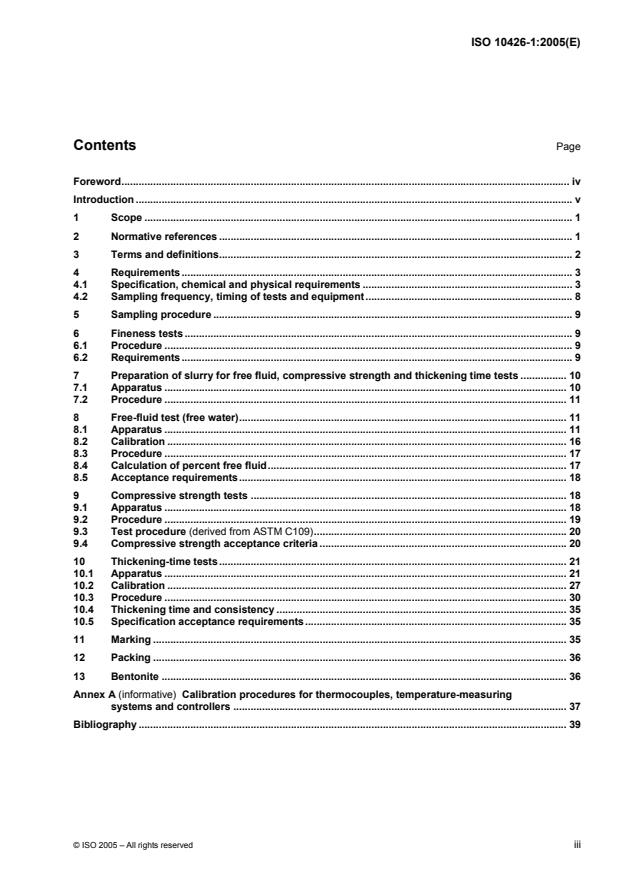
Contents Page
Foreword. iv
Introduction . v
1 Scope . 1
2 Normative references . 1
3 Terms and definitions. 2
4 Requirements . 3
4.1 Specification, chemical and physical requirements . 3
4.2 Sampling frequency, timing of tests and equipment. 8
5 Sampling procedure . 9
6 Fineness tests . 9
6.1 Procedure . 9
6.2 Requirements . 9
7 Preparation of slurry for free fluid, compressive strength and thickening time tests . 10
7.1 Apparatus . 10
7.2 Procedure . 11
8 Free-fluid test (free water). 11
8.1 Apparatus . 11
8.2 Calibration . 16
8.3 Procedure . 17
8.4 Calculation of percent free fluid. 17
8.5 Acceptance requirements. 18
9 Compressive strength tests . 18
9.1 Apparatus . 18
9.2 Procedure . 19
9.3 Test procedure (derived from ASTM C109). 20
9.4 Compressive strength acceptance criteria . 20
10 Thickening-time tests. 21
10.1 Apparatus . 21
10.2 Calibration . 27
10.3 Procedure . 30
10.4 Thickening time and consistency . 35
10.5 Specification acceptance requirements.35
11 Marking . 35
12 Packing . 36
13 Bentonite . 36
Annex A (informative) Calibration procedures for thermocouples, temperature-measuring
systems and controllers . 37
Bibliography . 39
Foreword
ISO (the International Organization for Standardization) is a worldwide federation of national standards bodies
(ISO member bodies). The work of preparing International Standards is normally carried out through ISO
technical committees. Each member body interested in a subject for which a technical committee has been
established has the right to be represented on that committee. International organizations, governmental and
non-governmental, in liaison with ISO, also take part in the work. ISO collaborates closely with the
International Electrotechnical Commission (IEC) on all matters of electrotechnical standardization.
International Standards are drafted in accordance with the rules given in the ISO/IEC Directives, Part 2.
The main task of technical committees is to prepare International Standards. Draft International Standards
adopted by the technical committees are circulated to the member bodies for voting. Publication as an
International Standard requires approval by at least 75 % of the member bodies casting a vote.
Attention is drawn to the possibility that some of the elements of this document may be the subject of patent
rights. ISO shall not be held responsible for identifying any or all such patent rights.
ISO 10426-1 was prepared by Technical Committee ISO/TC 67, Materials, equipment and offshore structures
for petroleum, petrochemical and natural gas industries, Subcommittee SC 3, Drilling and completion fluids,
and well cements.
This second edition cancels and replaces the first edition (ISO 10426-1:2000), of which has it constitutes a
minor revision. It also incorporates the Amendment ISO 10426-1:2000/Amd.1:2002.
ISO 10426 consists of the following parts, under the general title Petroleum and natural gas industries —
Cements and materials for well cementing:
⎯ Part 1: Specification
⎯ Part 2: Testing of well cement
⎯ Part 3: Testing of deepwater well cement formulations
⎯ Part 4: Preparation and testing of foamed cement slurries at atmospheric pressure
⎯ Part 5: Determination of shrinkage and expansion of well cement formulations at atmospheric pressure
A future Part 6, describing methods for determining the static gel strength of cement formulations, is under
preparation.
iv © ISO 2005 – All rights reserved
Introduction
The first edition of this part of ISO 10426 was based on API Specification 10A, 22nd edition, January 1995.
This was in turn adopted by API as API Specification 10A, 23rd edition, April 2002. This second edition of this
part of ISO 10426 incorporates ISO 10426-1:2000/Amendment 1:2002 with the intent that the 24th edition of
API Specification 10A will be identical to this part of ISO 10426.
Users of this part of ISO 10426 should be aware that further or differing requirements may be needed for
individual applications. This part of ISO 10426 is not intended to inhibit a vendor from offering, or the
purchaser from accepting, alternative equipment or engineering solutions for the individual application. This
may be particularly applicable where there is innovative or developing technology. Where an alternative is
offered, the vendor should identify any variations from this part of ISO 10426 and provide details.
In this part of ISO 10426, where practical, U.S. Customary units are included in brackets for information.
INTERNATIONAL STANDARD ISO 10426-1:2005(E)
Petroleum and natural gas industries — Cements and materials
for well cementing —
Part 1:
Specification
1 Scope
This part of ISO 10426 specifies requirements and gives recommendations for eight classes of well cements,
including their chemical and physical requirements and procedures for physical testing.
This part of ISO 10426 is applicable to well cement classes A, B, C, D, E and F, which are the products
obtained by grinding Portland cement clinker and, if needed, calcium sulfate as an interground additive.
Processing additives can be used in the manufacture of cement of these classes. Suitable set-modifying
agents can be interground or blended during manufacture of classes D, E and F.
This part of ISO 10426 is also applicable to well cement classes G and H, which are the products obtained by
grinding Portland cement clinker with no additives other than calcium sulfate or water.
2 Normative references
The following referenced documents are indispensable for the application of this document. For dated
references, only the edition cited applies. For undated references, the latest edition of the referenced
document (including any amendments) applies.
ISO 3310-1, Test sieves — Technical requirements and testing — Part 1: Test sieves of metal wire cloth
ISO 13500, Petroleum and natural gas industries — Drilling fluid materials — Specifications and tests
ASTM C109/C109M, Standard Test Method for Compressive Strength of Hydraulic Cement Mortars
(Using 2-in or [50-mm] Cube Specimens)
ASTM C114, Standard Test Methods for Chemical Analysis of Hydraulic Cement
ASTM C115, Standard Test Methods for Fineness of Portland Cement by the Turbidimeter
ASTM C183, Standard Practice for Sampling and the Amount of Testing of Hydraulic Cement
ASTM C204, Standard Test Method for Fineness of Hydraulic Cement by Air Permeability Apparatus
ASTM C465, Standard Specification for Processing Additions for Use in the Manufacture of Hydraulic
Cements
ASTM E220, Standard Test Method for Calibration of Thermocouples by Comparison Techniques
ASTM E1404, Standard Specification for Laboratory Class Conical Flasks
DIN 12385, Laboratory glassware, conical flasks, wide neck
EN 196-2, Methods of testing cement — Part 2: Chemical analysis of cement
EN 196-6, Methods of testing cement — Part 6: Determination of fineness
EN 196-7, Methods of testing cement — Part 7: Methods of taking and preparing samples of cement
3 Terms and definitions
For the purposes of this document, the following terms and definitions apply.
3.1
additive
material added to a cement slurry to modify or enhance some desired property
NOTE Properties that are commonly modified include: setting time (by use of retarders or accelerators), fluid loss,
viscosity, etc.
3.2
Bearden unit of consistency
B
c
measure of the consistency of a cement slurry when determined on a pressurized consistometer
3.3
bulk density
mass per unit volume of a dry material containing entrained air
3.4
cement
Portland cement
ground clinker generally consisting of hydraulic calcium silicates and aluminates and usually containing one or
more forms of calcium sulfate as an interground additive
3.5
cement class
designation achieved using the ISO system of classification of well cement according to its intended use
3.6
cement grade
designation achieved using the ISO system for denoting the sulfate resistance of a particular cement
3.7
cement blend
mixture of dry cement and other dry materials
3.8
clinker
fused materials from the kiln in cement manufacturing that are interground with calcium sulfate to make
cement
3.9
compressive strength
force per unit area required to crush a set cement sample
3.10
consistometer
device used to measure the thickening time of a cement slurry under temperature and pressure
2 © ISO 2005 – All rights reserved
3.11
filtrate
liquid that is forced out of a cement slurry during a fluid loss test
3.12
free fluid
coloured or colourless liquid which has separated from a cement slurry
3.13
neat cement slurry
cement slurry consisting of only cement and water
3.14
pressure vessel
vessel in a consistometer into which the slurry container is placed for the thickening time test
3.15
slurry container
slurry cup
container in a pressurized consistometer used to hold the slurry for conditioning purposes or for the thickening
time test
3.16
thickening time
time for a cement slurry to develop a selected B
c
NOTE The results of a thickening time test provide an indication of the length of time a cement slurry remains
pumpable under the test conditions.
4 Requirements
4.1 Specification, chemical and physical requirements
4.1.1 Classes and grades
Well cement shall be specified using the following Classes (A, B, C, D, E, F, G and H) and Grades (O, MSR
and HSR).
A processing additive or set-modifying agent shall not prevent a well cement from performing its intended
functions.
a) Class A
The product obtained by grinding Portland cement clinker, consisting essentially of hydraulic calcium
silicates, usually containing one or more forms of calcium sulfate as an interground additive. At the option
of the manufacturer, processing additives may be used in the manufacture of Class A cement, provided
such materials in the amounts used have been shown to meet the requirements of ASTM C465.
This product is intended for use when special properties are not required and is available only in ordinary
(O) grade (similar to ASTM C150, Type I).
b) Class B
The product obtained by grinding Portland cement clinker, consisting essentially of hydraulic calcium
silicates, usually containing one or more forms of calcium sulfate as an interground additive. At the option
of the manufacturer, processing additives may be used in the manufacture of Class B cement, provided
such materials in the amounts used have been shown to meet the requirements of ASTM C465.
This product is intended for use when conditions require moderate or high sulfate-resistance and is
available in both moderate sulfate-resistant (MSR) and high sulfate-resistant (HSR) grades (similar to
ASTM C150, Type II).
c) Class C
The product obtained by grinding Portland cement clinker, consisting essentially of hydraulic calcium
silicates, usually containing one or more forms of calcium sulfate as an interground additive. At the option
of the manufacturer, processing additives may be used in the manufacture of Class C cement, provided
such materials in the amounts used have been shown to meet the requirements of ASTM C465.
This product is intended for use when conditions require high early strength and is available in ordinary
(O), moderate sulfate-resistant (MSR) and high sulfate-resistant (HSR) grades (similar to ASTM C150,
Type III).
d) Class D
The product obtained by grinding Portland cement clinker, consisting essentially of hydraulic calcium
silicates, usually containing one or more forms of calcium sulfate as an interground additive. At the option
of the manufacturer, processing additives may be used in the manufacture of Class D cement, provided
such materials in the amounts used have been shown to meet the requirements of ASTM C465. Further,
at the option of the manufacturer, suitable set-modifying agents may be interground or blended during
manufacture.
This product is intended for use under conditions of moderately high temperatures and pressures and is
available in moderate sulfate-resistant (MSR) and high sulfate-resistant (HSR) grades.
e) Class E
The product obtained by grinding Portland cement clinker, consisting essentially of hydraulic calcium
silicates, usually containing one or more forms of calcium sulfate as an interground additive. At the option
of the manufacturer, processing additives may be used in the manufacture of Class E cement, provided
such materials in the amounts used have been shown to meet the requirements of ASTM C465. Further,
at the option of the manufacturer, suitable set-modifying agents may be interground or blended during
manufacture.
This product is intended for use under conditions of high temperatures and pressures and is available in
moderate sulfate-resistant (MSR) and high sulfate-resistant (HSR) grades.
f) Class F
The product obtained by grinding Portland cement clinker, consisting essentially of hydraulic calcium
silicates, usually containing one or more forms of calcium sulfate as an interground additive. At the option
of the manufacturer, processing additives may be used in the manufacture of Class F cement, provided
such materials in the amounts used have been shown to meet the requirements of ASTM C465. Further,
at the option of the manufacturer, suitable set-modifying agents may be interground or blended during
manufacture.
This product is intended for use under conditions of extremely high temperatures and pressures and is
available in moderate sulfate-resistant (MSR) and high sulfate-resistant (HSR) grades.
4 © ISO 2005 – All rights reserved
g) Class G
The product obtained by grinding Portland cement clinker, consisting essentially of hydraulic calcium
silicates, usually containing one or more forms of calcium sulfate as an interground additive. No additives
other than calcium sulfate or water, or both, shall be interground or blended with the clinker during
manufacture of Class G well cement, with the following exception. In order to comply with Directive
2003/53/EC of the European Parliament and of the Council, it is permitted until 2009-12-31 to include
chemical additives, as required, for chromium(VI) reduction, provided that such additives do not prevent
the well cement from performing its intended purpose.
This product is intended for use as a basic well cement and is available in moderate sulfate-resistant
(MSR) and high sulfate-resistant (HSR) grades.
h) Class H
The product obtained by grinding Portland cement clinker, consisting essentially of hydraulic calcium
silicates, usually containing one or more forms of calcium sulfate as an interground additive. No additives
other than calcium sulfate or water, or both, shall be interground or blended with the clinker during
manufacture of Class H well cement, with the following exception. In order to comply with Directive
2003/53/EC of the European Parliament and of the Council, it is permitted until 2009-12-31 to include
chemical additives, as required, for chromium(VI) reduction, provided that such additives do not prevent
the well cement from performing its intended purpose.
This product is intended for use as a basic well cement and is available in moderate sulfate-resistant
(MSR) and high sulfate-resistant (HSR) grades.
A well cement which has been manufactured and supplied in accordance with this part of ISO 10426 may be
mixed and placed in the field using water ratios or additives at the user’s discretion. It is not intended that
manufacturing compliance with this part of ISO 10426 be based on such field conditions.
4.1.2 Chemical requirements
Well cements shall conform to the respective chemical requirements of classes and grades referenced in
Table 1.
Chemical analyses of hydraulic cements shall be carried out as specified in ASTM C114 (or EN 196-2).
4.1.3 Physical and performance requirements
Well cement shall conform to the respective physical and performance requirements referenced in Table 2
and specified in Clauses 6, 7, 8, 9 and 10.
Table 1 — Chemical requirements
Cement class
A B C D, E, F G H
Ordinary grade (O)
Magnesium oxide (MgO), maximum, % 6,0 NA 6,0 NA NA NA
a
Sulfur trioxide (SO ), maximum, % 3,5 NA 4,5 NA NA NA
Loss on ignition, maximum, % 3,0 NA 3,0 NA NA NA
Insoluble residue, maximum, % 0,75 NA 0,75 NA NA NA
Tricalcium aluminate (C A), maximum, % NR NA 15 NA NA NA
Moderate sulfate-resistant grade (MSR)
Magnesium oxide (MgO), maximum, % NA 6,0 6,0 6,0 6,0 6,0
Sulfur trioxide (SO), maximum, % NA 3,0 3,5 3,0 3,0 3,0
Loss on ignition, maximum, % NA 3,0 3,0 3,0 3,0 3,0
Insoluble residue, maximum, % NA 0,75 0,75 0,75 0,75 0,75
b b
Tricalcium silicate (CS) maximum, % NA NR NR NR 58 58
b b
minimum, % NA NR NR NR 48 48
Tricalcium aluminate (CA), maximum % NA 8 8 8 8 8
Total alkali content, expressed as sodium oxide
c c
NA NR NR NR 0,75 0,75
(Na O) equivalent, maximum, %
High sulfate-resistant grade (HSR)
Magnesium oxide (MgO), maximum, % NA 6,0 6,0 6,0 6,0 6,0
Sulfur trioxide (SO), maximum, % NA 3,0 3,5 3,0 3,0 3,0
Loss on ignition, maximum, % NA 3,0 3,0 3,0 3,0 3,0
Insoluble residue, maximum, % NA 0,75 0,75 0,75 0,75 0,75
b b
Tricalcium silicate (CS) maximum, % NA NR NR NR 65 65
b b
minimum, % NA NR NR NR 48 48
b b b b b
Tricalcium aluminate (C A), maximum, % NA 3 3 3 3 3
Tetracalcium aluminoferrite (C AF) plus twice the
4 b b b b b
NA 24 24 24 24 24
tricalcium aluminate (C A), maximum, %
Total alkali content expressed as sodium oxide (Na O)
2 c c
NA NR NR NR 0,75 0,75
equivalent, maximum, %
NR = No Requirement; NA = Not Applicable
a
When the tricalcium aluminate content (expressed as C A) of the cement is 8 % or less, the maximum SO content shall be 3 %.
3 3
b
The expressing of chemical limitations by means of calculated assumed compounds does not necessarily mean that the oxides are
actually or entirely present as such compounds. When the ratio of the percentages of Al O to Fe O is 0,64 or less, the C A content is
2 3 2 3 3
zero. When the Al O to Fe O ratio is greater than 0,64, the compounds shall be calculated as follows:
2 3 2 3
C A = (2,65 × % Al O ) – (1,69 × % Fe O )
3 2 3 2 3
C AF = 3,04 × % Fe O
4 2 3
C S = (4,07 × % CaO) – (7,60 × % SiO ) – (6,72 × % Al O ) – (1,43 × % Fe O ) – (2,85 × % SO )
3 2 2 3 2 3 3
When the ratio of Al O to Fe O is less than 0,64, the C S shall be calculated as follows:
2 3 2 3 3
C S = (4,07 × % CaO) – (7,60 × % SiO ) – (4,48 × % Al O ) – (2,86 × % Fe O ) – (2,85 × % SO )
3 2 2 3 2 3 3
c
The sodium oxide equivalent (expressed as Na O equivalent) shall be calculated by the formula:
Na O equivalent = (0,658 × % K O) + (% Na O).
2 2 2
6 © ISO 2005 – All rights reserved
Table 2 — Summary of physical and performance requirements
Well cement class A B C D E F G H
Mix water, % mass fraction of cement (Table 5)
46 46 56 38 38 38 44 38
Fineness tests (alternative methods) (Clause 6)
Turbidimeter (specified surface, minimum 150 160 220 NR NR NR NR NR
m /kg)
Air permeability (specified surface, minimum 280 280 400 NR NR NR NR NR
m /kg)
Free fluid content, maximum % (Clause 8) NR NR NR NR NR NR 5,9 5,9
Compressive Schedule Final Final Minimum compressive strength
strength test number, curing curing
MPa (psi)
temp. pressure
(8-h curing Table 6
time) °C (°F) MPa (psi)
(Clause 9)
NA 38 (100) atm. 1,7 1,4 2,1 NR NR NR 2,1 2,1
(250) (200) (300) (300) (300)
NA 60 (140) atm. NR NR NR NR NR NR 10,3 10,3
(1 500) (1 500)
6S 110 (230) 20,7 NR NR NR 3,4 NR NR NR NR
(3 000) (500)
8S 143 (290) 20,7 NR NR NR NR 3,4 NR NR NR
(3 000) (500)
9S 160 (320) 20,7 NR NR NR NR NR 3,4 NR NR
(3 000) (500)
Compressive Schedule Final Final Minimum compressive strength
strength test number, curing curing
MPa (psi)
temp. pressure
(24-h curing Table 6
time) °C (°F) MPa (psi)
(Clause 9)
NA 38 (100) Atm. 12,4 10,3 13,8 NR NR NR NR NR
(1 800) (1 500) (2 000)
4S 77 (170) 20,7 NR NR NR 6,9 6,9 NR NR NR
(3 000) (1 000) (1 000)
6S 110 (230) 20,7 NR NR NR 13,8 NR 6,9 NR NR
(3 000) (2 000) (1 000)
8S 143 (290) 20,7 NR NR NR NR 13,8 NR NR NR
(3 000) (2 000)
9S 160 (320) 20,7 NR NR NR NR NR 6,9 NR NR
(3 000) (1 000)
Table 2 (continued)
Well cement Class A B C D E F G H
Pressure Specifi- Maximum Thickening time (min./max.)
temperature cation test consistency
min
thickening Schedule
(15 min
time test number
to 30 min
(Clause 10) Tables 9 stirring
a
through 13 period) B
c
4 30 — 90 90 90 90 NR NR NR NR
min. min. min. min.
5 30 — NR NR NR NR NR NR 90 90
min. min.
5 30 — NR NR NR NR NR NR 120 120
max. max.
6 30 — NR NR NR 100 100 100 NR NR
min. min. min.
8 30 — NR NR NR NR 154 NR NR NR
min.
9 30 — NR NR NR NR NR 190 NR NR
min.
a
Bearden units of consistency (B ) obtained on a pressurized consistometer as defined in Clause 10 and calibrated as per the same
c
clause.
NR = No Requirement.
4.2 Sampling frequency, timing of tests and equipment
4.2.1 Sampling frequency
For well cement Classes C, D, E, F, G and H, a sample for testing shall be taken by either method (1) over a
24-h interval or method (2) on a 1 000 ton (maximum) production run.
For well cement Classes A and B, a sample for testing shall be taken by either method (1) over a 14-day
interval or method (2) on a 25 000 ton (maximum) production run.
These samples shall represent the product as produced. At the choice of the manufacturer, either method (1)
or method (2) may be used.
4.2.2 Time from sampling to testing
Each sample shall be tested for conformance to this part of ISO 10426. All tests shall be completed within
seven working days after sampling.
4.2.3 Specified equipment
Equipment used for testing well cements shall comply with Table 3. Dimensions shown in Figures 5, 6, 10
and 11 are for cement specification test equipment manufacturing purposes. Dimensional recertification shall
not be required.
8 © ISO 2005 – All rights reserved
Table 3 — Specification test equipment for well-cement manufacturers
Test or preparation Well cement Clause Required equipment
classes reference
Sampling All Clause 5 Apparatus specified in ASTM C 183 (or EN 196-7).
Fineness A, B, C Clause 6 Turbidimeter and auxiliary equipment as specified in ASTM C 115 or
air permeability apparatus and auxiliary equipment as specified in
ASTM C 204 (or EN 196-6)
Slurry preparation All Clause 7 Apparatus specified in 7.1
Free fluid G, H Clause 8 Apparatus specified in 8.1
Atmospheric pressure A, B, C, G, H Clause 9 Apparatus specified in 9.1, except pressure vessel of 9.1.3.2
compressive strength
Pressure cured D, E, F Clause 9 Apparatus specified in 9.1
compressive strength
Thickening time All Clause 10 Pressurized consistometer specified in 10.1
4.2.4 Calibration
Equipment calibrated to the requirements of this part of ISO 10426 is considered to be accurate if calibration
is within the specified limits.
5 Sampling procedure
One or more of the procedures outlined in ASTM C183 (or EN 196-7) shall be used to secure a sample of well
cement for specification testing purposes.
6 Fineness tests
6.1 Procedure
Tests for fineness of well cement shall be carried out in accordance with either the procedure in ASTM C115
for the turbidimeter test or the procedure in ASTM C204 (or EN 196-6) by air permeability apparatus for the air
permeability test.
6.2 Requirements
Acceptance requirements for the fineness test are a minimum specific surface area (expressed in square
metres per kilogram) and are as given in Table 2. Cement Classes D, E, F, G and H have no fineness
requirement.
Either of the two fineness test methods (turbidimeter or air permeability test) shall be used, at the discretion of
the manufacturer, to determine the fineness.
7 Preparation of slurry for free fluid, compressive strength and thickening time
tests
7.1 Apparatus
7.1.1 Scales
The indicated load on scales shall be accurate within 0,1 % of the indicated load. Annual calibration is
required.
7.1.2 Masses
Masses shall be accurate within the tolerance shown in Table 4. On beam-type scales where the masses are
on the beam, the indicated masses shall conform to the requirements given in 7.1.1.
Table 4 — Permissible variation in weights
Mass Permissible variation
g g
1 000 ± 0,5
500 ± 0,35
300 ± 0,30
200 ± 0,20
100 ± 0,15
50 ± 0,10
7.1.3 Sieves
A No. 20 wire cloth sieve (openings 850 µm), meeting the requirements given in ISO 3310-1, shall be used for
sieving cement prior to slurry preparation.
7.1.4 Mixing devices
The mixing device for preparation of well cement slurries shall be a one litre (or one quart) size, bottom-drive,
blade type mixer.
Examples of mixing devices in common use are shown in Figure 1. The mixing blade and mixing container
shall be constructed of durable corrosion-resistant material. The mixing assembly shall be constructed in such
a manner that the blade can be removed for weighing and changing. The mixing blade shall be weighed prior
to use and replaced with an unused blade when a 10 % mass loss has occurred. If water leakage occurs
around the bearings, the entire blade and container assembly should be replaced.
Figure 1 — Examples of typical cement-mixing devices
10 © ISO 2005 – All rights reserved
7.2 Procedure
7.2.1 Sieving
Prior to mixing, the cement shall be sieved as described in ASTM C183.
7.2.2 Temperature of water and cement
The temperature of the mix water in the container within 60 s prior to mixing shall be 23 °C ± 1 °C
(73 °F ± 2 °F) and that of the cement within 60 s prior to mixing shall be 23 °C ± 1 °C (73 °F ± 2 °F).
7.2.3 Mix water
Distilled or deionized water shall be used for testing. The mix water shall be weighed directly into a clean, dry
mixing container. No water shall be added to compensate for evaporation, wetting, etc.
7.2.4 Mixing quantities
Slurry component quantities shown in Table 5 shall be used for testing. The use of the quantities of
components shown in Table 5 will result in mix-water percentages (based on the mass of dry cement)
consistent with water percentages shown in Table 2.
Table 5 — Slurry requirements
Components Classes A and B Class C Classes D, E, F, H Class G
g g g g
Mix water 355 ± 0,5 383 ± 0,5 327 ± 0,5 349 ± 0,5
Cement
772 ± 0,5 684 ± 0,5 860 ± 0,5 792 ± 0,5
7.2.5 Mixing cement and water
The mixing container with the required mass of mix water, as specified in Table 5, shall be placed on the
mixer base, the motor turned on and maintained at 4 000 r/min ± 200 r/min (66,7 r/s ± 3,3 r/s) while the
cement sample is added at a uniform rate in not more than 15 s. After all of the cement has been added to the
mix water, the cover shall be placed on the mixing container and mixing shall be continued at
12 000 r/min ± 500 r/min(200 r/s ± 8,3 r/s) for 35 s ±1 s.
8 Free-fluid test (free water)
8.1 Apparatus
8.1.1 Consistometer
The atmospheric pressure consistometer or the pressurized consistometer described in 10.1 (run at
atmospheric pressure) shall be used for stirring and conditioning the cement slurry for determination of free-
fluid content. The atmospheric consistometer consists of a rotating cylindrical slurry container, equipped with
an essentially stationary paddle assembly, in a temperature controlled liquid bath. It shall be capable of
maintaining the temperature of the bath at 27 °C ± 1,7 °C (80 °F ± 3 °F) and of rotating the slurry container at
a speed of 150 r/min ±15 r/min (2,5 r/s ± 0,25 r/s) during the stirring and conditioning period for the slurry. The
paddle and all parts of the slurry container exposed to the slurry shall be constructed of corrosion-resistant
materials. See Figures 2, 3, 4 and 5.
NOTE The paddle may be used to drive a “potentiometer” (see Figures 2 and 3) to measure slurry viscosity.
Key
1 cap lock nut
2 centre lock reverse jam nut
3 dial
4 pointer
5 dial and base assembly
6 spring
7 collar
8 bearing
9 retaining ring
10 lid
11 roll pin
12 shaft
Figure 2 — Typical potentiometer mechanism for atmospheric pressure consistometer
12 © ISO 2005 – All rights reserved
Key
1 lid (see Figure 2)
2 fill indicating groove
3 slurry container (see Figure 4)
4 paddle (see Figure 5)
Figure 3 — Container assembly for typical atmospheric pressure consistometer
Dimensions in millimetres (inches)
Key
1 2 slots 180° apart
2 fill-level indicating groove
3 pivot bearing
Figure 4 — Container for typical atmospheric pressure consistometer
14 © ISO 2005 – All rights reserved
Dimensions in millimetres (inches)
NOTE 1 Paddle material: type 302 stainless steel 1,0 mm × 7,9 mm (0,04 in × 0,313 in) cold-rolled strip.
NOTE 2 Shaft material: type 416 steel 6,4 mm × 211,1 mm (0,25 in × 8,313 in) annealed and ground.
Figure 5 — Paddle for typical atmospheric pressure consistometer
8.1.2 Scales
Scales shall meet the requirements of 7.1.1.
8.1.3 Test flask
A 500 ml conical flask in accordance with ASTM E1404, Type I, Class 2 or DIN 12385 shall be used. See
Figure 6.
Dimensions in millimetres
Key
1 ASTM conical flask (Type 1, Class 2), capacity 500 ml
a
Wall thickness.
b
OD (at widest point).
Figure 6 — Conical flask for measurement of free fluid
8.2 Calibration
8.2.1 Temperature-measuring system
The temperature of the bath shall be measured by thermometer (glass or digital) and/or thermocouple with
digital indicator which are accurate to ± 1,7 °C (± 3 °F). Thermocouples shall be ASTM E220 classification
“special” Type J. Thermocouples with digital indicators and thermometers shall be checked for accuracy
against a certified thermometer, traceable to the reference of the national body responsible for standards of
temperature measurement, no less frequently than monthly. Thermocouples with digital indicators and
thermometers found outside the acceptable ± 1,7 °C (± 3 °F) range shall be corrected or replaced. See
Annex A.
8.2.2 Slurry container rotational speed
The rotational speed shall be 150 r/min ± 15 r/min (2,5 r/s ± 0,25 r/s). The rotational speed of the slurry
container shall be checked no less frequently than quarterly, and corrected if found to be inaccurate.
8.2.3 Timer
The timer shall be accurate to within ± 30 s per hour. It shall be checked for accuracy no less frequently than
semi-annually, and corrected or replaced if found to be inaccurate.
16 © ISO 2005 – All rights reserved
8.3 Procedure
8.3.1 Prepare the slurry according to the procedure in Clause 7.
8.3.2 Fill a clean and dry consistometer slurry container to the proper level.
8.3.3 Assemble the slurry container and associated parts, place them in the consistometer and start the
motor according to the operating instructions of the manufacturer. The interval between completion of mixing
and starting of the consistometer shall not exceed 1 min.
8.3.4 Stir the slurry in the consistometer for a period of 20 min ± 30 s. Maintain the bath temperature at
27 °C ± 1,7 °C (80 °F ± 3 °F) throughout the stirring period.
8.3.5 Transfer 790 g ± 5 g of Class H slurry or 760 g ± 5 g of Class G slurry directly into the clean, dry
500 ml conical flask within 1 min. Record the actual mass transferred. Seal the flask with a self-sealing film to
prevent evaporation.
8.3.6 Set the slurry-filled flask on a surface that is nominally level and vibration-free. The air temperature to
which the slurry-filled flask is exposed shall be 22,8 °C ± 2,8 °C (73 °F ± 5 °F). The temperature sensor for
measuring air temperature shall meet the requirements of 8.2.1. Let the slurry-filled flask remain undisturbed
for a period of 2 h ± 5 min.
8.3.7 At the end of 2 h, remove the supernatant fluid that has developed with a pipet or syringe. Measure
the volume of supernatant fluid to an accuracy of ± 0,1 ml and record it as millilitres free fluid.
8.3.8 Convert the millilitres free fluid to a percentage of starting slurry volume (∼ 400 ml depending on
recorded initial mass) and express that value as percent free fluid.
8.4 Calculation of percent free fluid
Free fluid shall be calculated as a percentage, using the following formula:
V ⋅ρ
FF
% FF=× 100
m
S
where
% FF is the free fluid content of the slurry, in percent;
V is the volume of free fluid (supernatant fluid) collected, expressed in millilitres;
FF
ρ is the specific gravity (expressed in grams per cubic centimetre) of slurry; equal to 1,98 for
Class H at 38 % water; 1,90 for Class G at 44 % water; (If ρ of the base cement is other than 3,14,
the actual ρ of slurry should be calculated and used.)
m is the initially recorded (starting) mass of slurry, expressed in grams.
S
EXAMPLE Calculation of percent free fluid:
m = 791,7 g
S
V = 15,1 ml
FF
ρ = 1,98 g/cm (Class H)
% FF = 15,1 × (1,98) × 100/791,7
% FF = 3,78
NOTE cm and ml are assumed to be equal for purposes of calculation.
8.5 Acceptance requirements
The % FF for well cement of Classes G and H shall not exceed 5,9 %.
9 Compressive strength tests
9.1 Apparatus
9.1.1 Cube moulds and compressive strength-testing machine
Moulds and testing machine for compressive strength tests shall conform to the requirements in ASTM C109,
except that the moulds may be separable into more than two parts. The moulds shall be checked for
tolerances and the testing machine shall be calibrated within ± 1 % of the load range to be measured, at least
once every two years.
9.1.2 Cube mould base and cover plates
Generally, plate glass, brass or stainless steel plates having a minimum thickness of 6 mm (1/4 inch) are used.
Cover plates may be grooved on the surface which contacts the top of the cement.
9.1.3 Water curing bath
A curing bath or tank having dimensions allowing the complete immersion of a compressive strength mould(s)
in water and capable of maintaining the prescribed test temperatures within ± 2 °C (± 3 °F) shall be employed.
The two types of water curing baths are as follows:
a) Atmospheric pressure curing bath: A vessel for curing specimens at atmospheric pressure and
temperatures of 66 °C (150 °F) or less, having an agitator or circulating system;
b) Pressurized curing bath: A vessel suitable for curing specimens at temperatures u 160 °C (320 °F) and
at pressures that can be controlled at 20,7 MPa ± 0,345 MPa (3 000 psi ± 50 psi). The vessel shall be
capable of fulfilling the appropriate specification schedule given in Table 6.
9.1.4 Cooling bath
The cooling bath dimensions shall be such that the specimen to be cooled from the curing temperature can be
completely submerged in water maintained at 27 °C ± 3 °C (80 °F ± 5 °F).
9.1.5 Temperature-measuring system
The temperature-measuring system shall be calibrated to an accuracy of ± 2 °C (± 3 °F) no less frequently
than monthly. The procedure described in Annex A is commonly used. Two commonly used temperature-
measuring systems are:
9.1.5.1 Thermometer
A thermometer with a range including 21 °C to 82 °C (70 °F to 180 °F), with minimum scale divisions not
exceeding 1 °C (2 °F) may be used.
9.1.5.2 Thermocouple
A thermocouple system with the appropriate range may be used.
18 © ISO 2005 – All rights reserved
Table 6 — Specification schedules for pressurized curing of specimens
Schedule Final Elapsed time from first application of heat and pressure
number curing
h: min (± 2 min)
a
pressure
MPa (psi)
0:00 0:30 0:45 1:00 1:15 1:30 2:00 2:30 3:00 3:30 4:00
Temperature
°C (°F)
4S 20,7 27 47 49 51 53 55 59 64 68 72 77
(3 000) (80) (116) (120) (124) (128) (131) (139) (147) (155) (162) (170)
6S 20,7 27 56 64 68 72 75 82 89 96 103 110
(3 000) (80) (133) (148) (154) (161) (167) (180) (192) (205) (218) (230)
8S 20,7 27 67 87 99 103 106 113 121 128 136 143
(3 000) (80) (153) (189) (210) (216) (223) (236) (250) (263) (277) (290)
9S 20,7 27 73 97 120 123 127 133 140 147 153 160
(3 000) (80) (164) (206) (248) (254) (260) (272) (284) (296) (308) (320)
a
The test pressure shall be applied as soon as specimens are placed in the pressure vessel and maintained at the given pressure
within the following limits for the duration of the curing period: Schedules 4S through 9S: at 20,7 MPa ± 3,4 MPa (3 000 psi ± 500 psi).
9.1.6 Puddling rod
Typically, a corrosion-resistant puddling rod of nominal diameter 6 mm (1/4 inch) is used.
9.1.7 Sealant
Co
...
NORME ISO
INTERNATIONALE 10426-1
Deuxième édition
2005-12-15
Industries du pétrole et du gaz naturel —
Ciments et matériaux pour la cimentation
des puits —
Partie 1:
Spécifications
Petroleum and natural gas industries — Cements and materials for well
cementing —
Part 1: Specification
Numéro de référence
©
ISO 2005
PDF – Exonération de responsabilité
Le présent fichier PDF peut contenir des polices de caractères intégrées. Conformément aux conditions de licence d'Adobe, ce fichier
peut être imprimé ou visualisé, mais ne doit pas être modifié à moins que l'ordinateur employé à cet effet ne bénéficie d'une licence
autorisant l'utilisation de ces polices et que celles-ci y soient installées. Lors du téléchargement de ce fichier, les parties concernées
acceptent de fait la responsabilité de ne pas enfreindre les conditions de licence d'Adobe. Le Secrétariat central de l'ISO décline toute
responsabilité en la matière.
Adobe est une marque déposée d'Adobe Systems Incorporated.
Les détails relatifs aux produits logiciels utilisés pour la création du présent fichier PDF sont disponibles dans la rubrique General Info
du fichier; les paramètres de création PDF ont été optimisés pour l'impression. Toutes les mesures ont été prises pour garantir
l'exploitation de ce fichier par les comités membres de l'ISO. Dans le cas peu probable où surviendrait un problème d'utilisation,
veuillez en informer le Secrétariat central à l'adresse donnée ci-dessous.
© ISO 2005
Droits de reproduction réservés. Sauf prescription différente, aucune partie de cette publication ne peut être reproduite ni utilisée sous
quelque forme que ce soit et par aucun procédé, électronique ou mécanique, y compris la photocopie et les microfilms, sans l'accord écrit
de l'ISO à l'adresse ci-après ou du comité membre de l'ISO dans le pays du demandeur.
ISO copyright office
Case postale 56 • CH-1211 Geneva 20
Tel. + 41 22 749 01 11
Fax. + 41 22 749 09 47
E-mail copyright@iso.org
Web www.iso.org
Publié en Suisse
ii © ISO 2005 – Tous droits réservés
Sommaire Page
Avant-propos. iv
Introduction . v
1 Domaine d'application. 1
2 Références normatives . 1
3 Termes et définitions. 2
4 Exigences . 3
4.1 Spécifications, exigences chimiques et physiques . 3
4.2 Fréquence d'échantillonnage, programmation des essais et équipement. 8
5 Échantillonnage . 9
6 Essais de finesse. 9
6.1 Méthode . 9
6.2 Exigences . 9
7 Préparation du laitier pour les essais de fluide libre, de résistance à la compression et du
temps de pompabilité. 10
7.1 Appareillage . 10
7.2 Mode opératoire . 11
8 Test du fluide libre (eau libre). 11
8.1 Appareillage . 11
8.2 Étalonnage. 16
8.3 Mode opératoire . 17
8.4 Calcul du pourcentage de fluide libre. 17
8.5 Exigences d'acceptation . 18
9 Essais de résistance à la compression. 18
9.1 Appareillage . 18
9.2 Mode opératoire . 19
9.3 Mode opératoire d'essai (à partir de l'ASTM C 109) . 21
9.4 Critères d'acceptation de la résistance à la compression . 21
10 Test du temps de pompabilité . 22
10.1 Appareillage . 22
10.2 Étalonnage. 28
10.3 Mode opératoire . 31
10.4 Temps de pompabilité et consistance. 36
10.5 Exigences d'acceptation relatives aux spécifications. 36
11 Marquage . 36
12 Conditionnement . 37
13 Bentonite . 37
Annexe A (informative) Procédure d'étalonnage des thermocouples, des systèmes de mesurage
de la température et des régulateurs. 38
Bibliographie . 40
Avant-propos
L'ISO (Organisation internationale de normalisation) est une fédération mondiale d'organismes nationaux de
normalisation (comités membres de l'ISO). L'élaboration des Normes internationales est en général confiée
aux comités techniques de l'ISO. Chaque comité membre intéressé par une étude a le droit de faire partie du
comité technique créé à cet effet. Les organisations internationales, gouvernementales et non
gouvernementales, en liaison avec l'ISO participent également aux travaux. L'ISO collabore étroitement avec
la Commission électrotechnique internationale (CEI) en ce qui concerne la normalisation électrotechnique.
Les Normes internationales sont rédigées conformément aux règles données dans les Directives ISO/CEI,
Partie 2.
La tâche principale des comités techniques est d'élaborer les Normes internationales. Les projets de Normes
internationales adoptés par les comités techniques sont soumis aux comités membres pour vote. Leur
publication comme Normes internationales requiert l'approbation de 75 % au moins des comités membres
votants.
L'attention est appelée sur le fait que certains des éléments du présent document peuvent faire l'objet de
droits de propriété intellectuelle ou de droits analogues. L'ISO ne saurait être tenue pour responsable de ne
pas avoir identifié de tels droits de propriété et averti de leur existence.
L'ISO 10426-1 a été élaborée par le comité technique ISO/TC 67, Matériel, équipement et structures en mer
pour les industries pétrolière, pétrochimique et du gaz naturel, sous-comité SC 3, Fluides de forage et de
complétion, et ciments à puits.
Cette deuxième édition annule et remplace la première édition (ISO 10426-1:2000), qui a fait l'objet d'une
révision technique. Elle incorpore également l'amendement ISO 10426-1:2000/Amd.1:2002.
L'ISO 10426 comprend les parties suivantes, présentées sous le titre général Industries du pétrole et du gaz
naturel — Ciments et matériaux pour la cimentation des puits:
⎯ Partie 1: Spécifications
⎯ Partie 2: Essais de ciment pour puits
⎯ Partie 3: Essais de formulations de ciment pour puits en eau profonde
⎯ Partie 4: Préparation et essais en conditions ambiantes des laitiers de ciment mousse
⎯ Partie 5: Détermination du retrait et de l'expansion à la pression atmosphérique des formulations de
ciments pour puits
Une future Partie 6, portant sur les méthodes de détermination de la force statique du gel des formulations de
ciment, est en cours de préparation.
iv © ISO 2005 – Tous droits réservés
Introduction
e
La première édition de la présente partie de l’ISO 10426 était basée sur la spécification API 10A, 22 édition,
e
janvier 1995, et avait, par la suite, été adoptée par l’API en tant que spécification API 10A, 23 édition,
avril 2002. Cette deuxième édition de la présente partie de l’ISO 10426 incorpore
e
l’ISO 10426-1:2000/Amendement 1:2002. La 24 édition de la spécification API 10A est censée être identique
à la présente partie de l’ISO 10426.
Il est recommandé que les utilisateurs de la présente partie de l'ISO 10426 soient informés que des exigences
différentes ou complémentaires peuvent être nécessaires pour des applications particulières. La présente
partie de l'ISO 10426 n'a pas pour intention d'empêcher un vendeur d'offrir, ou un acheteur d'accepter, des
équipements ou des solutions d'ingénierie alternatifs dans le cas de cette application particulière. Ceci pourra
particulièrement s'appliquer lorsqu'on se trouve en présence d'une technologie innovante ou en cours de
développement. Lorsqu'une autre solution est offerte, il est recommandé que le vendeur identifie toutes les
différences avec la présente partie de l'ISO 10426 et fournisse des détails.
Dans la présente partie de l'ISO 10426, pour plus de commodité, les unités couramment utilisées aux États-
Unis sont données entre parenthèses, pour information.
NORME INTERNATIONALE ISO 10426-1:2005(F)
Industries du pétrole et du gaz naturel — Ciments et matériaux
pour la cimentation des puits —
Partie 1:
Spécifications
1 Domaine d'application
La présente partie de l'ISO 10426 traite des exigences et des recommandations relatives aux huit classes de
ciments pour puits. Elle comprend les exigences chimiques et physiques, ainsi que les modes opératoires
d'essais physiques.
La présente partie de l'ISO 10426 s'applique aux classes de ciments pour puits A, B, C, D, E et F qui sont des
produits obtenus par broyage d'un clinker de ciment Portland, additionnés, si nécessaire, de sulfate de
calcium. Des additions de traitement peuvent être utilisées dans la fabrication de ciment de ces classes. Les
additifs adaptés peuvent être soit broyés, soit mélangés pour la fabrication des ciments de classe D, E et F.
La présente partie de l'ISO 10426 s'applique également aux classes G et H qui sont des produits obtenus en
broyant un clinker de ciment Portland sans aucune addition autre que du sulfate de calcium ou de l'eau.
2 Références normatives
Les documents de référence suivants sont indispensables pour l'application du présent document. Pour les
références datées, seule l'édition citée s'applique. Pour les références non datées, la dernière édition du
document de référence s'applique (y compris les éventuels amendements).
ISO 3310-1, Tamis de contrôle — Exigences techniques et vérifications — Partie 1: Tamis de contrôle en
tissus métalliques
ISO 13500, Industries du pétrole et du gaz naturel — Produits pour fluides de forage — Spécifications et
essais
ASTM C 109/C 109M, Standard Test Method for Compressive Strength of Hydraulic Cement Mortars (Using
2-in or [50-mm] Cube Specimens)
ASTM C 114, Standard Test Methods for Chemical Analysis of Hydraulic Cement
ASTM C 115, Standard Test Method for Fineness of Portland Cement by the Turbidimeter
ASTM C 183, Standard Practice for Sampling and the Amount of Testing of Hydraulic Cement
ASTM C 204, Standard Test Method for Fineness of Hydraulic Cement by Air Permeability Apparatus
ASTM C 465, Standard Specification for Processing Additions for Use in the Manufacture of Hydraulic
Cements
ASTM E 220, Standard Test Method for Calibration of Thermocouples by Comparison Techniques
ASTM E 1404, Standard Specification for Laboratory Glass Conical Flasks
DIN 12385, Laboratory glassware, conical flasks, wide neck
EN 196-2, Méthodes d'essais des ciments — Partie 2: Analyse chimique des ciments
EN 196-6, Méthodes d'essais des ciments — Partie 6: Détermination de la finesse
EN 196-7, Méthodes d'essais des ciments — Partie 7: Méthodes de prélèvement et d'échantillonnage du
ciment
3 Termes et définitions
Pour les besoins du présent document, les termes et définitions suivants s'appliquent.
3.1
additif
matériau ajouté au laitier de ciment pour en modifier ou en améliorer certaines propriétés souhaitables
NOTE Les propriétés communes qui sont modifiées comprennent: modification du temps de vieillissement (grâce à
l'utilisation de retardateurs ou d'accélérateurs), contrôle du filtrat, modification de la viscosité, etc.
3.2
unité de consistance Bearden
B
c
mesure de la consistance du laitier de ciment lorsqu'elle est déterminée sur un consistomètre pressurisé
3.3
masse volumique apparente
masse par unité de volume d'un matériau sec contenant de l'air entraîné
3.4
ciment
ciment Portland
clinker broyé, composé généralement de silicates de calcium hydrauliques et d'aluminates, contenant
généralement une ou plusieurs formes de sulfate de calcium en addition aux produits broyés
3.5
classe de ciment
désignation ISO destinée à définir les différentes classifications des ciments conformément à leur utilisation
prévue
3.6
qualité de ciment
désignation ISO destinée à définir la résistance aux sulfates d'un ciment particulier
3.7
mélange de ciment
mélange de ciment sec et d'autres matériaux secs
3.8
clinker
dans la fabrication du ciment, matériaux fondus au four et broyés avec du sulfate de calcium pour fabriquer du
ciment
3.9
résistance à la compression
force par unité de surface nécessaire pour écraser un échantillon de ciment donné
2 © ISO 2005 – Tous droits réservés
3.10
consistomètre
appareillage utilisé pour mesurer le temps de pompabilité d'un laitier de ciment soumis à une pression et à
une température
3.11
filtrat
liquide provenant d'un laitier de ciment pendant un essai de filtration
3.12
fluide libre
liquide coloré ou non, séparé du laitier de ciment
3.13
laitier de ciment pur
laitier de ciment composé uniquement de ciment et d'eau
3.14
récipient sous pression
partie du consistomètre dans lequel est placé le bol contenant le laitier à tester
3.15
cellule
bol
dans un consistomètre pressurisé, cellule qui contient le laitier à conditionner ou pour la mesure du temps de
pompabilité
3.16
temps de pompabilité
durée nécessaire à un laitier de ciment pour atteindre la B sélectionnée
c
NOTE Les résultats de l'essai du temps de pompabilité donnent une indication sur la durée de pompabilité d'un laitier
de ciment dans les conditions d'essai.
4 Exigences
4.1 Spécifications, exigences chimiques et physiques
4.1.1 Classes et qualités
Le ciment pour puits doit être spécifié dans les classes (A, B, C, D, E, F, G et H) et dans les qualités (O, MSR
et HSR) suivantes.
L'addition de traitement adapté ou l'utilisation d'additifs ne doit pas empêcher un ciment pour puits de remplir
les fonctions auxquelles il est destiné.
a) Classe A
Produit obtenu par broyage d'un clinker de ciment Portland, composé essentiellement de silicates de
calcium hydrauliques, contenant généralement une ou plusieurs formes de sulfate de calcium en
adjuvants de fabrication. Au choix du fabricant, des additions de traitement peuvent être utilisées dans la
fabrication du ciment de classe A, à condition qu'il a été prouvé que la quantité utilisée de ce type de
matériaux a satisfait aux exigences de l'ASTM C 465.
Ce produit est destiné à être utilisé lorsque des propriétés spécifiques ne sont pas requises. Il est
disponible uniquement en qualité «ordinaire» (O) (semblable au type I de l'ASTM C 150).
b) Classe B
Produit obtenu par broyage d'un clinker de ciment Portland, composé essentiellement de silicates de
calcium hydrauliques, contenant généralement une ou plusieurs formes de sulfate de calcium en
adjuvants de fabrication. Au choix du fabricant, des additions de traitement peuvent être utilisées dans la
fabrication du ciment de classe B, à condition qu'il a été prouvé que la quantité utilisée de ce type de
matériaux satisfait aux exigences de l'ASTM C 465.
Ce produit est destiné à être utilisé lorsque les conditions nécessitent une résistance forte ou moyenne
aux sulfates. Il est disponible en qualité «résistance moyenne aux sulfates» (MSR) et en qualité
«résistance forte aux sulfates» (HSR) (semblables au type II de l'ASTM C 150).
c) Classe C
Produit obtenu par broyage d'un clinker de ciment Portland, composé essentiellement de silicates de
calcium hydrauliques, contenant généralement une ou plusieurs formes de sulfate de calcium en
adjuvants de fabrication. Au choix du fabricant, des additions de traitement peuvent être utilisées dans la
fabrication du ciment de classe C, à condition qu'il a été prouvé que la quantité utilisée de ce type de
matériaux satisfait aux exigences de l'ASTM C 465.
Ce produit est destiné à être utilisé lorsque les conditions nécessitent une résistance initiale élevée. Il est
disponible en qualité «ordinaire» (O), en qualité «résistance moyenne aux sulfates» (MSR) et en qualité
«résistance forte aux sulfates» (HSR) (semblable au type III de l'ASTM C 150).
d) Classe D
Produit obtenu par broyage d'un clinker de ciment Portland, composé essentiellement de silicates de
calcium hydrauliques, contenant généralement une ou plusieurs formes de sulfate de calcium en
adjuvants de fabrication. Au choix du fabricant, des additions de traitement peuvent être utilisées dans la
fabrication du ciment de classe D, à condition qu'il a été prouvé que la quantité utilisée de ce type de
matériaux satisfait aux exigences de l'ASTM C 465.
De plus, au choix du fabricant, des additifs adaptés peuvent être broyés ou mélangés durant la
fabrication. Ce produit est destiné à être utilisé dans des conditions de températures et de pression
modérées. Il est disponible en qualité «résistance moyenne aux sulfates» (MSR) et «résistance forte aux
sulfates» (HSR).
e) Classe E
Produit obtenu par broyage d'un clinker de ciment Portland, composé essentiellement de silicates de
calcium hydrauliques, contenant généralement une ou plusieurs formes de sulfate de calcium en
adjuvants de fabrication. Au choix du fabricant, des additions de traitement peuvent être utilisées dans la
fabrication du ciment de classe E, à condition qu'il a été prouvé que la quantité utilisée de ce type de
matériaux satisfait aux exigences de l'ASTM C 465.
De plus, au choix du fabricant, des additifs adaptés peuvent être broyés ou mélangés durant la
fabrication. Ce produit est destiné à être utilisé dans des conditions de températures et de pression
élevées. Il est disponible en qualité «résistance moyenne aux sulfates» (MSR) et «résistance forte aux
sulfates» (HSR).
f) Classe F
Produit obtenu par broyage d'un clinker de ciment Portland, composé essentiellement de silicates de
calcium hydrauliques, contenant généralement une ou plusieurs formes de sulfate de calcium en
adjuvants de fabrication. Au choix du fabricant, des additions de traitement peuvent être utilisées dans la
fabrication du ciment, à condition qu'il a été prouvé que la quantité utilisée de ce type de matériaux
satisfait aux exigences de l'ASTM C 465.
4 © ISO 2005 – Tous droits réservés
De plus, au choix du fabricant, des additifs adaptés peuvent être broyés ou mélangés durant la
fabrication. Ce produit est destiné à être utilisé dans des conditions de températures et de pression
extrêmement élevées. Il est disponible en qualité «résistance moyenne aux sulfates» (MSR) et
«résistance forte aux sulfates» (HSR).
g) Classe G
Produit obtenu par broyage d'un clinker de ciment Portland, composé essentiellement de silicates de
calcium hydrauliques, contenant généralement une ou plusieurs formes de sulfate de calcium en
adjuvants de fabrication. Aucune addition autre que du sulfate de calcium ou de l'eau, ou un mélange des
deux, ne doit être broyée ou mélangée avec le clinker pendant la fabrication du ciment pour puits de
classe G, avec l'exception suivante. Afin de se conformer avec la Directive 2003/53/CE du Parlement
européen et du Conseil, il est autorisé jusqu'au 2009-12-31 d'ajouter des additifs chimiques, le cas
échéant, pour réduire la présence de chrome (VI), pour autant que de tels aditifs n'empêchent pas le
ciment pour puits de remplir les fonctions auxquelles il est destiné.
Ce produit est destiné à être utilisé comme ciment pour puits de base. Il est disponible en qualité
«résistance moyenne aux sulfates» (MSR) et «résistance forte aux sulfates» (HSR).»
h) Classe H
Produit obtenu par broyage d'un clinker de ciment Portland, composé essentiellement de silicates de
calcium hydrauliques, contenant généralement une ou plusieurs formes de sulfate de calcium en
adjuvants de fabrication. Aucune addition autre que du sulfate de calcium ou de l'eau, ou un mélange des
deux, ne doit être broyée ou mélangée avec le clinker pendant la fabrication du ciment pour puits de
classe H, avec l'exception suivante. Afin de se conformer avec la Directive 2003/53/CE du Parlement
européen et du Conseil, il est autorisé jusqu'au 2009-12-31 d'ajouter des additifs chimiques, le cas
échéant, pour réduire la présence de chrome (VI), pour autant que de tels aditifs n'empêchent pas le
ciment pour puits de remplir les fonctions auxquelles il est destiné.
Ce produit est destiné à être utilisé comme ciment pour puits de base. Il est disponible en qualité
«résistance moyenne aux sulfates» (MSR) et «résistance forte aux sulfates» (HSR).»
Un ciment pour puits fabriqué et fourni conformément à la présente partie de l'ISO 10426 peut être mélangé
et mis en place sur chantier en utilisant des quantités d'eau ou d'additifs qui sont laissées au choix de
l'utilisateur. Il n'est pas prévu que la conformité de fabrication avec la présente partie de l'ISO 10426 soit
basée sur les conditions de mise en place sur chantier.
4.1.2 Exigences chimiques
Les matériaux pour la cimentation des puits doivent être conformes aux exigences chimiques en fonction de
leur classe et de leur qualité données en référence dans le Tableau 1.
Les analyses chimiques des ciments hydrauliques doivent être effectuées comme spécifié dans l'ASTM C 114
(ou EN 196-2).
4.1.3 Exigences physiques et relatives aux performances
Le ciment pour puits doit être conforme aux exigences physiques et à celles relatives aux performances
données dans le Tableau 2 et spécifiées dans les Articles 6, 7, 8, 9 et 10.
Tableau 1 — Exigences chimiques
Classe de ciment
A B C D, E, F G H
Qualité ordinaire (O)
Oxyde de magnésium (MgO), maximum, % 6,0 NA 6,0 NA NA NA
a
Trioxyde de soufre (SO ), maximum, % 3,5 NA 4,5 NA NA NA
Perte au feu, maximum, % 3,0 NA 3,0 NA NA NA
Résidu insoluble, maximum, % 0,75 NA 0,75 NA NA NA
Aluminate tricalcique (C A), maximum, % NR NA 15 NA NA NA
Qualité «résistance moyenne aux sulfates» (MSR)
Oxyde de magnésium (MgO), maximum, % NA 6,0 6,0 6,0 6,0 6,0
Trioxyde de soufre (SO), maximum, % NA 3,0 3,5 3,0 3,0 3,0
Perte au feu, maximum, % NA 3,0 3,0 3,0 3,0 3,0
Résidu insoluble, maximum, % NA 0,75 0,75 0,75 0,75 0,75
b b
Silicate tricalcique (C S), maximum, % NA NR NR NR 58 58
b b
minimum, % NA NR NR NR 48 48
Aluminate tricalcique (CA), maximum, % NA 8 8 8 8 8
c c
Teneur totale en alcalis exprimée en équivalent d'oxyde de NA NR NR NR 0,75 0,75
sodium (Na O), maximum, %
Qualité «résistance forte aux sulfates» (HSR)
Oxyde de magnésium (MgO), maximum, % NA 6,0 6,0 6,0 6,0 6,0
Trioxyde de soufre (SO), maximum, % NA 3,0 3,5 3,0 3,0 3,0
Perte au feu, maximum, % NA 3,0 3,0 3,0 3,0 3,0
Résidu insoluble, maximum, % NA 0,75 0,75 0,75 0,75 0,75
b b
Silicate tricalcique (C S), maximum, % NA NR NR NR 65 65
b b
minimum, % NA NR NR NR 48 48
b b b b b
Aluminate tricalcique (C A), maximum, % NA 3 3 3 3 3
b b b b b
Aluminoferrite tétracalcique (C AF) plus deux fois l'aluminate NA 24 24 24 24 24
tricalcique (C A), maximum, %
c c
Teneur totale en alcalis exprimée en équivalent d'oxyde de NA NR NR NR 0,75 0,75
sodium (Na O), maximum, %
NR = pas d'exigences; NA = non applicable.
a
Lorsque la teneur en aluminate tricalcique (C A) du ciment est inférieure ou égale à 8 %, la teneur maximale en SO doit être de 3 %.
3 3
b
L'expression des limites chimiques au moyen de calculs de composés ne signifie pas forcément que les oxydes sont effectivement
ou complètement présents en tant que tels. Lorsque le rapport des pourcentages d'Al O sur Fe O est inférieur ou égal à 0,64, la
2 3 2 3
teneur en C A est égale à zéro. Lorsque le rapport d'Al O sur Fe O est supérieur à 0,64, les composés doivent être calculés de la
3 2 3 2 3
manière suivante:
C A = (2,65 × % Al O ) – (1,69 × % Fe O )
3 2 3 2 3
C AF = 3,04 × % Fe O
4 2 3
C S = (4,07 × % CaO) – (7,60 × % SiO ) – (6,72 × Al O ) – (1,43 × % Fe O ) – (2,85 × %SO ).
3 2 2 3 2 3 3
Lorsque le rapport d'Al O sur Fe O est inférieur à 0,64, la teneur en C S doit être calculée comme suit:
2 3 2 3 3
C S = (4,07 × % CaO) – (7,60 × % SiO ) – (4,48 × % Al O ) – (2,86 × % Fe O ) – (2,85 × % SO ).
3 2 2 3 2 3 3
c
L'équivalent de l'oxyde de sodium (équivalent Na O) doit être calculé avec la formule suivante:
équivalent Na O = (0,658 × % K O) + (% Na O).
2 2 2
6 © ISO 2005 – Tous droits réservés
Tableau 2 — Récapitulatif des exigences physiques et relatives aux performances
Classe de ciment pour puits A B C D E F G H
Eau de gâchage, % de la masse du ciment
46 46 56 38 38 38 44 38
(Tableau 5)
Essais de finesse (différentes méthodes) (Article 6)
Turbidimètre (surface spécifique minimale, en
150 160 220 NR NR NR NR NR
m /kg)
Perméabilité à l'air (surface spécifique minimale, 280 280 400 NR NR NR NR NR
en m /kg)
Teneur en fluide libre, maximum en % (Article 8) NR NR NR NR NR NR 5,9 5,9
Essai de Numéro de Température Pression
résistance programme, de fin de de fin de
à la vieillisse- vieillis-
Résistance minimale à la compression
Tableau 6
compression, ment, sement,
MPa (psi)
(temps de
°C (°F) MPa
vieillissement:
(psi)
8 h) (Article 9)
NA 38 (100) Atm. 1,7 1,4 2,1 NR NR NR 2,1 2,1
(250) (200) (300) (300) (300)
NA 60 (140) Atm. NR NR NR NR NR NR 10,3 10,3
(1 500) (1 500)
6S 110 (230) 20,7 NR NR NR 3,4 NR NR NR NR
(3 000) (500)
8S 143 (290) 20,7 NR NR NR NR 3,4 NR NR NR
(3 000)
(500)
9S 160 (320) 20,7 NR NR NR NR NR 3,4 NR NR
(3 000) (500)
Essai de Numéro de Température Pression
résistance programme, de fin de de fin de
à la vieillisse- vieillis-
Tableau 6
Résistance minimale à la compression
compression, ment, sement,
(temps de
MPa (psi)
°C (°F) MPa (psi)
vieillissement:
24 h)
(Article 9)
NA 38 (100) Atm. 12,4 10,3 13,8 NR NR NR NR NR
(1 800) (1 500) (2 000)
4S 77 (170) 20,7 NR NR NR 6,9 6,9 NR NR NR
(3 000) (1 000) (1 000)
6S 110 (230) 20,7 NR NR NR 13,8 NR 6,9 NR NR
(3 000) (2 000) (1 000)
8S 143 (290) 20,7 NR NR NR NR 13,8 NR NR NR
(3 000) (2 000)
9S 160 (320) 20,7 NR NR NR NR NR 6,9 NR NR
(3 000) (1 000)
Tableau 2 (suite)
Classe de ciment pour puits A B C D E F G H
Pression Essai de Consistance
température spécifi- maximale,
pour cation: durée de
Temps de pompabilité (min./max.)
l'essai de numéro de mélange:
min
pompabilité programme 15 min
a
(Article 10) Tableaux 9 à 30 min B
c
à 13
4 30 — 90 90 90 90 NR NR NR NR
min. min. min. min.
5 30 — NR NR NR NR NR NR 90 90
min. min.
5 30 — NR NR NR NR NR NR 120 120
max. max.
6 30 — NR NR NR 100 100 100 NR NR
min. min. min.
8 30 — NR NR NR NR 154 NR NR NR
min.
9 30 — NR NR NR NR NR 190 NR NR
min.
a
Unités Bearden de consistance (B ) obtenues sur un consistomètre pressurisé, conforme à la définition de l'Article 10, et étalonné
c
conformément à ce même article.
NR = pas d'exigences.
4.2 Fréquence d'échantillonnage, programmation des essais et équipement
4.2.1 Fréquence d'échantillonnage
Dans le cas des ciments appartenant aux classes C, D, E, F, G et H, un échantillon destiné aux essais doit
être prélevé en utilisant soit la méthode (1) sur 24 h, soit la méthode (2) dans une production maximale de
1 000 t.
Dans le cas des ciments appartenant aux classes A ou B, l'échantillon doit être prélevé en utilisant soit la
méthode (1) sur 14 jours, soit la méthode (2) dans une production maximale de 25 000 t.
Ces échantillons doivent représenter le produit tel qu'il a été produit. Le choix de la méthode (1) ou (2) est
laissé à la discrétion du fabricant.
4.2.2 Période entre l'échantillonnage et l'essai
Chaque échantillon doit être soumis à essai conformément à la présente partie de l'ISO 10426. Tous les
essais doivent être achevés dans les sept jours ouvrables qui suivent l'échantillonnage.
4.2.3 Équipement prescrit
L'équipement utilisé pour tester les ciments pour puits doit être conforme au Tableau 3. Les dimensions
données dans les Figures 5, 6, 10 et 11 sont destinées à la fabrication d'un équipement d'essai de
spécification. Une nouvelle certification des dimensions ne doit pas être exigée.
8 © ISO 2005 – Tous droits réservés
Tableau 3 — Équipement d'essai de spécification pour les fabricants de ciments pour puits
Essai ou préparation Classes de ciments Référence de Équipement nécessaire
pour puits l'article
Échantillonnage Toutes Article 5 Appareillage prescrit dans l'ASTM C 183 (ou dans
l'EN 196-7)
Finesse A, B, C Article 6 Turbidimètre et équipement auxiliaire comme
prescrit dans l'ASTM C 115 ou appareillage de
perméabilité à l'air et équipement auxiliaire comme
prescrit dans l'ASTM C 204 (ou l'EN 196-6)
Préparation du laitier Toutes Article 7 Appareillage prescrit en 7.1
Fluide libre G, H Article 8 Appareillage prescrit en 8.1
Pression atmosphérique A, B, C, G, H Article 9 Appareillage prescrit en 9.1, à l'exception du
Résistance à la compression récipient sous pression de 9.1.3.2
Vieillissement en pression D, E, F Article 9 Appareillage prescrit en 9.1
Résistance à la compression
Temps de pompabilité Toutes Article 10 Consistomètre pressurisé prescrit en 10.1
4.2.4 Étalonnage
Les équipements étalonnés conformément aux exigences de la présente partie de l'ISO 10426 sont
considérés comme exacts si l'étalonnage se situe dans les limites spécifiées.
5 Échantillonnage
Au moins l'un des modes opératoires décrits dans l'ASTM C 183 (ou l'EN 196-7) doit être utilisé pour obtenir
un échantillon de ciment pour puits approprié aux essais de spécification.
6 Essais de finesse
6.1 Méthode
Les essais de finesse relatifs au ciment pour puits doivent être réalisés conformément soit au mode opératoire
décrit dans l'ASTM C 115 qui utilise l'essai au turbidimètre, soit à celui décrit dans l'ASTM C 204 (ou
l'EN 196-6) qui utilise un appareillage permettant de procéder à l'essai de perméabilité à l'air.
6.2 Exigences
Les exigences d'acceptation relatives à l'essai de finesse consistent en une surface minimale spécifique
(exprimée en mètres carrés par kilogramme) et sont données dans le Tableau 2. Les classes de ciment D, E,
F, G et H n'ont pas d'exigences de finesse.
Afin de satisfaire aux exigences de l'essai de finesse, le choix de l'une des deux méthodes d'essai de finesse
(turbidimètre ou essai de perméabilité à l'air) est laissé à la discrétion du fabricant.
7 Préparation du laitier pour les essais de fluide libre, de résistance à la compression
et du temps de pompabilité
7.1 Appareillage
7.1.1 Balance
La charge indiquée sur la balance doit être exacte à 0,1 % près de la charge indiquée. Un étalonnage annuel
est nécessaire.
7.1.2 Masses
Les masses doivent être exactes dans la limite des tolérances représentées dans le Tableau 4. Sur une
balance de type balance à fléau où les poids se trouvent sur le fléau, les masses indiquées doivent être
conformes aux exigences données en 7.1.1.
Tableau 4 — Variation autorisée pour les masses
Masse Variation autorisée
g g
1 000 ± 0,5
500 ± 0,35
300 ± 0,30
200 ± 0,20
100 ± 0,15
50 ± 0,10
7.1.3 Tamis
Un tamis en toile métallique N° 20 (850 µm d'ouverture), conforme aux exigences de l'ISO 3310-1, doit être
utilisé pour tamiser le ciment avant de préparer le laitier.
7.1.4 Mélangeurs
Utiliser comme mélangeur destiné à la préparation des laitiers de ciment pour puits un mélangeur d'une
contenance d'un litre (ou un quart), entraîné par le bas et à palette.
La Figure 1 représente des exemples de mélangeurs communément utilisés. La palette et le bol du
mélangeur doivent être construits en matériau durable, résistant à la corrosion. L'ensemble du mélangeur doit
être construit de telle manière que la palette puisse être retirée pour être pesée et changée. La palette du
mélangeur doit être pesée avant utilisation et remplacée par une palette neuve, dès qu'une perte de masse
de 10 % est constatée. Si une fuite d'eau a lieu autour du roulement, la palette et l'ensemble du mélangeur
doivent être remplacés.
Figure 1 — Exemples de mélangeurs pour ciments
10 © ISO 2005 – Tous droits réservés
7.2 Mode opératoire
7.2.1 Tamisage
Avant de procéder à l'opération de mélange, le ciment doit être tamisé comme décrit dans l'ASTM C 183.
7.2.2 Température de l'eau et du ciment
La température de l'eau de gâchage dans le récipient, dans les 60 s qui précèdent le mélange, doit être de
23 °C ± 1 °C (73 °F ± 2 °F) et celle du ciment dans les 60 s qui précèdent le mélange doit être de 23 °C ± 1 °C
(73 °F ± 2 °F).
7.2.3 Eau de gâchage
Pour les essais, utiliser de l'eau distillée ou déionisée. Peser l'eau de gâchage directement dans un récipient
propre et sec. Ne pas ajouter d'eau pour compenser l'évaporation, l'humidification, etc.
7.2.4 Quantités du mélange
Le Tableau 5 indique les quantités des composants qui doivent être utilisées dans le laitier pour les essais.
L'utilisation des quantités de composants telles qu'elles sont données dans le Tableau 5 aura pour résultat
des pourcentages d'eau de gâchage (par rapport à la masse du ciment sec) en rapport avec les pourcentages
d'eau donnés dans le Tableau 2.
Tableau 5 — Exigences relatives au laitier
Composants Classes A et B Classe C Classes D, E, F, H Classe G
g g g g
Eau de gâchage 355 ± 0,5 383 ± 0,5 327 ± 0,5 349 ± 0,5
Ciment 772 ± 0,5 684 ± 0,5 860 ± 0,5 792 ± 0,5
7.2.5 Mélange de l'eau et du ciment
Placer le récipient dans lequel se trouve la masse nécessaire d'eau de gâchage (voir Tableau 5) sur la base
du mélangeur, démarrer le moteur et le faire tourner à 4 000 tr/min ± 200 tr/min (66,7 tr/s ± 3,3 tr/s) pendant
que l'échantillon de ciment est ajouté à une vitesse régulière en moins de 15 s. Une fois que tout le ciment a
été ajouté à l'eau de gâchage, poser le couvercle sur le récipient et continuer l'opération de mélange à
12 000 tr/min ± 500 tr/min (200 tr/s ± 8,3 tr/s) pendant 35 s ± 1 s.
8 Test du fluide libre (eau libre)
8.1 Appareillage
8.1.1 Consistomètre
Un consistomètre à pression atmosphérique ou un consistomètre pressurisé tel que décrit en 10.1
(fonctionnant sous la pression atmosphérique) doit être utilisé pour remuer et conditionner le laitier pour la
détermination du fluide libre. Le consistomètre à pression atmosphérique consiste en un récipient cylindrique
rotatif, muni de palettes fixes, et placé dans un bain à température contrôlée. Il doit être possible de maintenir
la température du bain à 27 °C ± 1,7 °C (80 °F ± 3 °F) et de faire tourner le bol de laitier à une vitesse de
150 tr/min ± 15 tr/min (2,5 tr/s ± 0,25 tr/s) pendant le temps d'agitation et de conditionnement du laitier. La
palette et tous les éléments du récipient en contact avec le laitier doivent être construits en matériaux
résistant à la corrosion. Voir Figures 2, 3, 4 et 5.
NOTE On peut se servir de la palette pour entraîner un «potentiomètre» (voir Figures 2 et 3) pour mesurer la
viscosité du laitier.
Légende
1 écrou de fermeture
2 contre-écrou de centrage
3 cadran
4 curseur
5 ensemble cadran/base
6 ressort
7 palier
8 tourillon
9 clip de blocage
10 couvercle
11 manchon
12 arbre
Figure 2 — Exemple de mécanisme de potentiomètre pour un consistomètre à pression atmosphérique
12 © ISO 2005 – Tous droits réservés
Légende
1 couvercle (voir Figure 2)
2 encoche pour niveau de remplissage
3 bol (voir Figure 4)
4 palette (voir Figure 5)
Figure 3 — Exemple d'assemblage du bol du consistomètre à pression atmosphérique
Dimensions en millimètres (inches)
Légende
1 2 encoches à 180°
2 encoche pour niveau d'emplissage
3 crapaudine
Figure 4 — Exemple de bol pour consistomètre à pression atmosphérique
14 © ISO 2005 – Tous droits réservés
Dimensions en millimètres (inches)
NOTE 1 Palette: type 302, feuillard laminé à froid en acier inoxydable de 1,0 mm × 7,9 mm (0,04 in × 0,313 in).
NOTE 2 Arbre: type 416 de 6,4 mm × 211,1 mm (0,25 in × 8,313 in) recuit et meulé.
Figure 5 — Exemple de palette pour consistomètre à pression atmosphérique
8.1.2 Balances
Les balances doivent être conformes aux exigences de 7.1.1.
8.1.3 Récipient d'essai
Utiliser une fiole Erlenmeyer de 500 ml conforme à l'ASTM E 1404, Type 1, classe 2 ou à la DIN 12385. Voir
Figure 6.
Dimensions en millimètres
Légende
1 fiole Erlenmeyer ASTM (Type 1, classe 2), d'une capacité de 500 ml
a
Épaisseur de la paroi.
b
Diamètre extérieur (au point le plus éloigné).
Figure 6 — Fiole Erlenmeyer pour mesurage du fluide libre
8.2 Étalonnage
8.2.1 Système de mesurage de la température
La température du bain doit être déterminée au moyen d'un thermomètre (en verre ou digital) et/ou d'un
thermocouple avec indicateur digital exact à ± 1,7 °C (± 3 °F). Les thermocouples doivent être conformes à la
classification «spécial» type J, de l'ASTM E 220. Vérifier la précision des thermocouples à indicateur digital et
des thermomètres par rapport à un thermomètre certifié, portant l'estampille de l'organisme national en charge
des normes de mesure de température, au moins une fois par mois. Les thermocouples à indicateur digital et
les thermomètres qui s'avèrent en dehors de l'échelle acceptable de ± 1,7 °C (± 3 °F) doivent être corrigés ou
remplacés. Voir l'Annexe A.
8.2.2 Vitesse de rotation du bol de laitier
La vitesse de rotation du récipient doit être de 150 tr/min ± 15 tr/min (2,5 tr/s ± 0,25 tr/s). La vitesse de rotation
du bol de laitier doit être vérifiée au moins une fois par trimestre et corrigée si incorrecte.
8.2.3 Chronomètre
Les chronomètres doivent être exacts à ± 30 s près par heure. Leur exactitude doit être vérifiée tous les six
mois et corrigée si incorrecte ou le chronomètre doit être remplacé.
16 © ISO 2005 – Tous droits réservés
8.3 Mode opératoire
8.3.1 Préparer le laitier conformément au mode opératoire décrit dans l'Article 7.
8.3.2 Remplir le bol du consistomètre préalablement propre et sec jusqu'à son niveau.
8.3.3 Assembler le récipient et ses parties, placer le tout dans le consistomètre et démarrer le moteur
conformément aux instructions de fonctionnement du fabricant. L'intervalle de temps entre la mise en marche
de l'appareillage et la fin du mélange ne doit pas excéder 1 min.
8.3.4 Agiter le laitier dans le consistomètre pendant 20 min ± 30 s. Maintenir la température du bain à
27 °C ± 1,1 °C (80 °F ± 2 °F) pendant toute la durée de l'agitation.
8.3.5 Transférer 790 g ± 5 g de laitier de classe H ou 760 g ± 5 g de laitier de classe G dans une éprouvette
propre et sèche, graduée à 500 ml, en 1 min. Enregistrer la masse réelle transférée. Fermer l'éprouvette à
l'aide d'un film étanche pour éviter toute évaporation.
8.3.6 Placer l'éprouvette remplie de laitier perpendiculairement au niveau nominal et sur une surface
exempte de vibration. La température d'exposition de l'éprouvette graduée doit être de 22,8 °C ± 2,8 °C
(73 °F ± 5 °F). Le capteur de température pour mesurer la température de l'air doit remplir les exigences de
8.2.1. Laisser reposer l'éprouvette remplie de laitier pendant une durée de 2 h ± 5 min.
8.3.7 Après la période de 2 h, retirer le fluide surnageant qui est apparu à l'aide d'une pipette ou d'une
seringue. Mesurer le volume du fluide surnageant à ± 0,1 ml près; consigner son volume en millilitres et
l'identifier comme fluide libre.
8.3.8 Convertir les millilitres de fluide libre en un pourcentage du volume initial de laitier (∼ 400 ml selon la
masse initiale enregistrée) et exprimer cette valeur comme pourcentage de fluide libre.
8.4 Calcul du pourcentage de fluide libre
La valeur du fluide libre en pourcentage doit être calculée à l'aide de la formule suivante:
V ⋅ρ
FF
%FF=×100
m
S
où
...
МЕЖДУНАРОДНЫЙ ISO
СТАНДАРТ 10426-1
Второе издание
2005-12-15
Промышленность нефтяная и газовая.
Цементы и материалы для
цементирования скважин.
Часть 1.
Технические условия
Petroleum and natural gas industries — Cements and materials for well
cementing —
Part 1: Specification
Ответственность за подготовку русской версии несёт GOST R
(Российская Федерация) в соответствии со статьёй 18.1 Устава ISO
Ссылочный номер
©
ISO 2005
Отказ от ответственности при работе в PDF
Настоящий файл PDF может содержать интегрированные шрифты. В соответствии с условиями лицензирования, принятыми
фирмой Adobe, этот файл можно распечатать или смотреть на экране, но его нельзя изменить, пока не будет получена
лицензия на установку интегрированных шрифтов в компьютере, на котором ведется редактирование. В случае загрузки
настоящего файла заинтересованные стороны принимают на себя ответственность за соблюдение лицензионных условий
фирмы Adobe. Центральный секретариат ISO не несет никакой ответственности в этом отношении.
Adobe - торговый знак Adobe Systems Incorporated.
Подробности, относящиеся к программным продуктам, использованным для создания настоящего файла PDF, можно найти в
рубрике General Info файла; параметры создания PDF оптимизированы для печати. Были приняты во внимание все меры
предосторожности с тем, чтобы обеспечить пригодность настоящего файла для использования комитетами – членами ISO. В
редких случаях возникновения проблемы, связанной со сказанным выше, просим информировать Центральный секретариат
по адресу, приведенному ниже.
ДОКУМЕНТ ЗАЩИЩЕН АВТОРСКИМ ПРАВОМ
© ISO 2005
Все права сохраняются. Если не указано иное, никакую часть настоящей публикации нельзя копировать или использовать в
какой-либо форме или каким-либо электронным или механическим способом, включая фотокопии и микрофильмы, без
предварительного письменного согласия ISO по адресу ниже или членов ISO в стране регистрации пребывания.
ISO copyright office
Case postale 56 • CH-1211 Geneva 20
Tel. + 41 22 749 01 11
Fax + 41 22 749 09 47
E-mail copyright@iso.org
Web www.iso.org
Опубликовано в Швейцарии
ii © ISO 2005 — Все права сохраняются
Содержание Страница
Предисловие .iv
Введение .v
1 Область применения .1
2 Нормативные ссылки .1
3 Термины и определения .2
4 Требования .4
4.1 Спецификация, химические и физические требования .4
4.2 Частота отбора проб, продолжительность испытаний и оборудование.9
5 Процедура отбора проб .10
6 Испытания на тонкость помола.10
6.1 Методика .10
6.2 Требования .10
7 Подготовка цементного раствора для испытаний на несвязную жидкость
(свободный флюид), прочность при сжатии и время загустевания.11
7.1 Аппаратура.11
7.2 Методика .12
8 Определение несвязной воды (свободного флюида).12
8.1 Аппаратура.12
8.2 Калибровка .17
8.3 Методика .18
8.4 Расчет процента несвязной воды.18
8.5 Требования к приемке .19
9 Испытания на прочность при сжатии.19
9.1 Аппаратура.19
9.2 Методика .20
9.3 Методика испытания (взята из ASTM C 109) .22
9.4 Критерии приемки прочности на растяжение.22
10 Определение времени загустевания .23
10.1 Аппаратура.23
10.2 Калибровка .29
10.3 Методика .32
10.4 Время загустевания и консистенция .37
10.5 Требования к приемке .37
11 Маркировка .37
12 Упаковка .38
13 Бентонит.38
Приложение А (информативное) Методы калибровки термопар, систем для измерения
температуры и контролирующих устройств .39
Библиография.41
Предисловие
ISO (Международная организация по стандартизации) представляет собой всемирную федерацию
национальных организаций по стандартам (организации – члены ISO). Работа по подготовке
международных стандартов обычно выполняется через технические комитеты ISO. Каждая
организация – член ISO, заинтересованная в теме, по которой создан тот или иной технический
комитет, имеет право быть представленной в этом комитете. В этой работе также принимают участие
международные правительственные и неправительственные организации, связанные с ISO. ISO тесно
сотрудничает с Международной электротехнической комиссией (IEC) по всем вопросам
стандартизации электротехники.
Проекты международных стандартов разрабатываются в соответствии с Директивами ISO/IEC, Часть 2.
Основной задачей технических комитетов является разработка международных стандартов. Проекты
международных стандартов, принятые техническими комитетами, рассылаются членам ISO для
голосования. Для публикации документа в качестве международного стандарта требуется не менее
75 % голосов членов ISO, участвующих в голосовании
Следует иметь в виду, что некоторые элементы данной части международного стандарта ISO 10426-1
могут быть объектом патентных прав. ISO не должна нести ответственность за идентификацию какого-
либо одного или всех патентных прав.
Международный стандарт ISO 10426-1 был подготовлен Техническим комитетом ISO/ТС 67,
Материалы, оборудование и прибрежные конструкции для нефтяной и газовой промышленности,
Подкомитетом SC 3 Буровые растворы и растворы для заканчивания скважин.
Настоящее второе издание отменяет и заменяет первое издание (ISO 10426-1:2000), которое прошло
незначительный технический пересмотр. Оно также включает Изменение ISO 10426-1:2000/Amd.1:2002.
ISO 10426 состоит из следующих частей под общим названием Промышленность нефтяная и газовая.
Цементы и материалы для цементирования скважин:
⎯ Часть 1. Технические условия
⎯ Часть 2. Испытания цемента для скважин
⎯ Часть 3. Испытания цементов специального состава для подводных скважин
⎯ Часть 4. Подготовка и испытания вспененных цементных растворов при атмосферном
давлении
⎯ Часть 5. Определение усадки и расширения составов на основе цемента при атмосферном
давлении
Готовится к публикации Часть 6, описывающая методы определения предельного статического
напряжения сдвига.
iv © ISO 2005 — Все права сохраняются
Введение
Первое издание данной части ISO 10426 основано на Технических условиях API 10А, 22-е издание,
январь 1995. Оно было принято API как API Specification 10A, 23-е издание, апрель 2002. Настоящее
второе издание данной части ISO 10426 включает ISO 10426-1:2000/Изменение 1:2002 с тем, чтобы 24-е
издание API Specification 10A было идентично данной части ISO 10426.
Пользователи данной части ISO 10426 должны иметь в виду, что для конкретных применений могут
потребоваться дополнительные или другие требования. Данная часть ISO 10426 не предполагает
запретить продавцу предлагать, а покупателю приобретать альтернативное оборудование или
использовать иные технические решения для конкретных приложений. Это, в частности, касается
случаев существования новой или разрабатываемой технологии. Там где предлагается альтернатива,
продавцу рекомендуется идентифицировать все варианты из данной части ISO 10426 и предоставить
подробности.
В данной части ISO 10426, где необходимо, включены традиционные единицы измерения США и
приведены в скобках для информации.
МЕЖДУНАРОДНЫЙ СТАНДАРТ ISO 10426-1:2005(R)
Промышленность нефтяная и газовая.
Цементы и материалы для цементирования скважин.
Часть 1.
Технические условия
1 Область применения
Данная часть стандарта ISO 10426 устанавливает требования и дает рекомендации по восьми классам
тампонажных цементов, включая химические и физические требования и методики физических
испытаний.
Данная часть ISO 10426 применима к цементам классов A, B, C, D, E и F, которые включают продукцию,
полученную путем размола клинкера портландцемента и, если необходимо, сульфата кальция в
качестве добавки, введенной при дроблении. Технологические добавки можно использовать при
производстве цементов указанных классов. Можно вводить при дроблении или примешивать в
процессе производства цементов классов D, E и F подходящие вещества для регулирования
схватывания или твердения.
Данная часть ISO 10426 также применима к цементу классов G и Н, который является продукцией,
получаемой путем размола клинкера Портландцемента без добавок, кроме сульфата кальция и воды.
2 Нормативные ссылки
Следующие ссылочные документы обязательны для применения данного документа. Для жестких
ссылок применяется только указанное издание. Для плавающих ссылок применяется самое последнее
издание ссылочного документа, (включая все изменения).
ISO 3310-1, Сита контрольные. Технические требования и испытания. Часть 1. Контрольные сита
из проволочной ткани
ISO 13500, Промышленность нефтяная и газовая. Материалы для приготовления буровых
растворов. Технические требования и испытания
ASTM C109/C109M, Стандартный метод испытания раствора гидравлического цемента на прочность
при сжатии (используя образцы для испытания в форме кубиков со стороной 2 дюйма или [50 мм])
ASTM C114, Стандартные методы химического анализа гидравлического цемента
ASTM C115, Стандартные методы определения тонкости помола портландцемента с помощью
турбидиметра
ASTM C183, Стандартные методы отбора проб и количество гидравлического цемента, взятого
для испытания
ASTM C204, Стандартные методы определения тонкости помола портландцемента с помощью
установки для определения воздухопроницаемости
ASTM C465, Стандартные технические условия на технологические добавки для применения в
производстве гидравлического цемента
ASTM E220, Стандартные методы калибровки термопар по методу сравнения
ASTM E1404, Стандартные технические условия на лабораторные конические колбы
DIN 12385, Лабораторная стеклянная посуда, широкогорлые конические колбы
EN 196-2, Методы испытания цемента. Часть 2. Химический анализ цемента
EN 196-6, Методы испытания цемента. Часть 6. Определение тонкости помола
EN 196-7, Методы испытания цемента. Часть 7. Методы отбора и подготовки проб цемента
3 Термины и определения
Применительно к целям данной части стандарта ISO 10426 применяются следующие термины и
определения.
3.1
добавка
additive
материал, вводимый в цементный раствор для модификации или усиления желаемого свойства
ПРИМЕЧАНИЕ Обычно модифицируют следующие свойства: срок схватывания (с помощью замедлителей или
ускорителей), водоотдача (фильтрация), вязкость и т.д.
3.2
единица консистенции Бердена
Bearden unit of consistency
B
c
мера консистенции цементного раствора при определении на консистометре под давлением
3.3
насыпная плотность
bulk density
масса на единицу объема сухого материала, содержащего захваченный воздух
3.4
цемент
Портландцемент
cement
Portland cement
грунтовой клинкер, обычно состоящий из гидравлических силикатов и алюминатов кальция, а также
одну или несколько форм сульфата кальция в качестве материала, добавляемого при дроблении
3.5
класс цемента
cement class
обозначение, присваиваемое по системе классификации ISO, тампонажного цемента в соответствии с
его назначением
3.6
тип цемента
cement grade
обозначение, присваиваемое по системе классификации ISO, для указания сульфатостойкости
2 © ISO 2005 — Все права сохраняются
3.7
цементная смесь
cement blend
смесь сухого цемента с другими сухими материалами
3.8
клинкер
clinker
расплавленные материалы после обжиговой печи при производстве цемента, которые наряду с
сульфатом кальция добавляют при дроблении для изготовления цемента
3.9
прочность при сжатии
compressive strength
усилие на единицу площади, требуемое для разрушения затвердевшей пробы цемента
3.10
консистометр
consistometer
устройство для измерения времени загустевания цементного раствора под действием температуры и
давления
3.11
фильтрат
filtrate
жидкость, выводимая из цементного раствора во время испытания на водоотделение
3.12
несвязная жидкость (свободный флюид)
free fluid
окрашенная или бесцветная жидкость, которая отделяется от цементного раствора
3.13
чистый цементный раствор
neat cement slurry
цементный раствор, состоящий только из цемента и воды
3.14
сосуд для работы под давлением
pressure vessel
сосуд в консистометре, в который помещают контейнер с цементным раствором для определения
времени загустевания
3.15
контейнер для цементного раствора
чаша (стакан) для цементного раствора
slurry container
slurry cup
контейнер в консистометре, работающем под давлением, используемый для выдержки цементного
раствора с целью кондиционирования или для определения времени загустевания
3.16
время загустевания цементного раствора
thickening time
время, в течение которого цементный раствор приобретает консистенцию заданного значения В
с
ПРИМЕЧАНИЕ Результаты определения времени загустевания обеспечивают указание времени, в течение
которого цементный раствор сохраняет способность к прокачиванию насосом в условиях испытания.
4 Требования
4.1 Спецификация, химические и физические требования
4.1.1 Классы и типы
Тампонажный цемент должен задаваться техническими условиями, применяющими следующие классы
(A, B, C, D, E, F, G и Н) и типы (О, MSR и HSR).
Технологическая добавка или добавка-регулятор схватывания или твердения не должны
препятствовать выполнению цементом назначенных функций.
a) Класс A
Продукция, полученная при размоле клинкера портландцемента, состоящая, в основном, из
гидравлических силикатов кальция, обычно содержащая одну или несколько форм сульфата
кальция в качестве добавки, введенной при дроблении. На выбор изготовителя можно
использовать технологические добавки в производстве цемента класса А, при условии, что такие
материалы в применяемых количествах будут выполнять требования ASTM C 465.
Данный цемент предназначен для применения в тех случаях, когда не требуется специальных
свойств. Имеется только обычного типа (О) (аналогично ASTM C 150, Тип I).
b) Класс В
Продукция, полученная при размоле клинкера портландцемента, состоящая, в основном, из
гидравлических силикатов кальция, обычно содержащая одну или несколько форм сульфата
кальция в качестве добавки, введенной при дроблении. На выбор изготовителя можно
использовать технологические добавки в производстве цемента класса В, при условии, что такие
материалы в применяемых количествах будут выполнять требования ASTM C465.
Данный цемент предназначен для применения в тех случаях, когда условия требуют умеренной или
повышенной сульфатостойкости. Имеется двух типов: умеренной сульфатостойкости (MSR) (moderate
sulfate resistance) и высокой стойкости к сульфатам (HSR) (high sulfate resistance) (аналогично
ASTM C 150, Тип II).
c) Класс C
Продукция, полученная при размоле клинкера портландцемента, состоящая, в основном, из
гидравлических силикатов кальция, обычно содержащая одну или несколько форм сульфата
кальция в качестве добавки, введенной при дроблении. На выбор изготовителя можно
использовать технологические добавки в производстве цемента класса С, при условии, что такие
материалы в применяемых количествах будут выполнять требования ASTM C465.
Данный цемент предназначен для применения в тех случаях, когда условия требуют раннего
нарастания прочности (быстрого твердения). Имеется обычного типа (О), типа с умеренной
сульфатостойкостью (MSR) и высокой сульфатостойкостью (HSR) (аналогично ASTM C 150, Тип III).
d) Класс D
Продукция, полученная при размоле клинкера портландцемента, состоящая, в основном, из
гидравлических силикатов кальция, обычно содержащая одну или несколько форм сульфата
кальция в качестве добавки, введенной при дроблении. На выбор изготовителя можно
использовать технологические добавки в производстве цемента класса D, при условии, что такие
материалы в применяемых количествах будут выполнять требования ASTM C 465. Далее, по
выбору изготовителя, можно ввести при дроблении или смешать в процессе производства с
цементом подходящие добавки для регулировки схватывания или твердения.
4 © ISO 2005 — Все права сохраняются
Данный цемент предназначен для применения в условиях умеренно повышенной температуры и
давления. Имеется двух типов с умеренной сульфатостойкостью (MSR) и высокой
сульфатостойкостью (HSR).
e) Класс E
Продукция, полученная при размоле клинкера портландцемента, состоящая, в основном, из
гидравлических силикатов кальция, обычно содержащая одну или несколько форм сульфата
кальция в качестве добавки, введенной при дроблении. На выбор изготовителя можно
использовать технологические добавки в производстве цемента класса Е, при условии, что такие
материалы в применяемых количествах будут выполнять требования ASTM C 465. Далее, по
выбору изготовителя, можно ввести при дроблении или смешать в процессе производства с
цементом подходящие добавки для регулировки схватывания или твердения.
Данный цемент предназначен для применения в условиях высоких температур и давления.
Имеется двух типов с умеренной сульфатостойкостью (MSR) и высокой сульфатостойкостью
(HSR).
f) Класс F
Продукция, полученная при размоле клинкера портландцемента, состоящая, в основном, из
гидравлических силикатов кальция, обычно содержащая одну или несколько форм сульфата
кальция в качестве добавки, введенной при дроблении. На выбор изготовителя можно
использовать технологические добавки в производстве цемента класса F, при условии, что такие
материалы в применяемых количествах будут выполнять требования ASTM C 465. Далее, по
выбору изготовителя, можно ввести при дроблении или смешать в процессе производства с
цементом подходящие добавки для регулировки схватывания или твердения.
Данный цемент предназначен для применения в условиях экстремально высоких температур и
давлений. Имеется двух типов с умеренной сульфатостойкостью (MSR) и высокой
сульфатостойкостью (HSR).
g) Класс G
Продукция, полученная при размоле клинкера портландцемента, состоящая, в основном, из
гидравлических силикатов кальция, обычно содержащая одну или несколько форм сульфата
кальция в качестве добавки, введенной при дроблении. Кроме сульфата кальция или воды, или
того и другого вместе, никаких других добавок в качестве введенных при дроблении или
примешанных к клинкеру в процессе производства цемента класса G, быть не должно, однако
имеется исключение. Для соответствия с директивой 2003/53/EC Европейского парламента и
Совета разрешается до 2009-12-31 включать химические добавки, по мере требования, для
восстановления хрома (VI), при условии, что такие добавки не помешают применять тампонажный
цемент по назначению.
Данный цемент предназначен для применения в качестве цемента для первичного
цементирования скважин. Имеется двух типов с умеренной сульфатостойкостью (MSR) и высокой
сульфатостойкостью (HSR).
h) Класс H
Продукция, полученная при размоле клинкера портландцемента, состоящая, в основном, из
гидравлических силикатов кальция, обычно содержащая одну или несколько форм сульфата
кальция в качестве добавки, введенной при дроблении. Кроме сульфата кальция или воды, или
того и другого вместе, никаких других добавок в качестве введенных при дроблении или
примешанных к клинкеру в процессе производства цемента класса Н, быть не должно, однако
имеется исключение. Для соответствия с директивой 2003/53/EC Европейского парламента и
Совета разрешается до 2009-12-31 включать химические добавки, по мере требования, для
восстановления хрома (VI), при условии, что такие добавки не помешают применять тампонажный
цемент по назначению.
Данный цемент предназначен для применения в качестве цемента для первичного
цементирования скважин. Имеется двух типов с умеренной сульфатостойкостью (MSR) и высокой
сульфатостойкостью (HSR).
Тампонажный цемент, который производится в соответствии с данной частью стандарта ISO 10426,
можно смешать и поставлять на площадку, используя смеси с водой в определенных отношениях или
с добавками на усмотрение пользователя. Не предполагается, что соответствие данной части
стандарта ISO 10426 при производстве цемента было основано на подобных полевых условиях.
4.1.2 Химические требования
Тампонажные цементы должны соответствовать химическим требованиям, предъявляемым к
соответствующим классам и типам, приведенным в Таблице 1.
Химический анализ гидравлических цементов должен выполняться в соответствии с ASTM C 114 (или
EN 196-2).
4.1.3 Физические требования и рабочие показатели
Тампонажные цементы должны соответствовать физическим требованиям и рабочим характеристикам,
приведенным в Таблице 2 и заданным в Разделах 6, 7, 8, 9 и 10.
6 © ISO 2005 — Все права сохраняются
Таблица 1 — Требования к химическому составу
Класс цемента
A B C D, E, F G H
Обычный тип (O)
Оксид магния (MgO), макс., % 6,0 NA 6,0 NA NA NA
a
Триоксид серы (SO ), макс., % 3,5 NA 4,5 NA NA NA
Потери при прокаливании, макс., % 3,0 NA 3,0 NA NA NA
Нерастворимый остаток, макс., % 0,75 NA 0,75 NA NA NA
Алюминат кальция (C A), макс., % NR NA 15 NA NA NA
Тип MSR (c умеренной сульфатостойкостью)
Оксид магния (MgO), макс., % NA 6,0 6,0 6,0 6,0 6,0
Триоксид серы (SO ), макс., % NA 3,0 3,5 3,0 3,0 3,0
Потери при прокаливании, макс., % NA 3,0 3,0 3,0 3,0 3,0
Нерастворимый остаток, макс., % NA 0,75 0,75 0,75 0,75 0,75
b b
Силикат кальция (C S) макс., % NA NR NR NR 58 58
b b
мин., % NA NR NR NR 48 48
Алюминат кальция (C A), макс. % NA 8 8 8 8 8
Общее содержание щелочей, в пересчете на оксид
c c
NA NR NR NR 0,75 0,75
натрия (Na O) t, макс., %
Тип HSR (c высокой сульфатостойкостью)
Оксид магния (MgO), макс., % NA 6,0 6,0 6,0 6,0 6,0
Триоксид серы (SO ), макс., % NA 3,0 3,5 3,0 3,0 3,0
Потери при прокаливании, макс., % NA 3,0 3,0 3,0 3,0 3,0
Нерастворимый остаток, макс., % NA 0,75 0,75 0,75 0,75 0,75
b b
Силикат кальция (C S) макс., % NA NR NR NR 65 65
b b
мин., % NA NR NR NR 48 48
b b b b b
Алюминат кальция (C A), макс., % NA 3 3 3 3 3
Алюмоферрит кальция (C AF) плюс дважды
b b b b b
NA 24 24 24 24 24
трикальций-алюминат (C A), макс., %
Общее содержание щелочей, выраженное в
c c
NA NR NR NR 0,75 0,75
пересчете на оксид натрия (Na O) t, макс., %
NR = Не нормировано; NA = не применимо
a
Если содержание трикальций-алюмината (выраженного как C A) в цементе составляет 8 % или меньше, максимальное
содержание SO должно быть 3 %.
b
Выражение химических ограничений посредством рассчитанного содержания допускаемых соединений не обязательно
означает, что оксиды действительно или целиком присутствуют как такие соединения. Если отношение процентов Al O к Fe O
2 3 2 3
равно 0,64 или меньше, то содержание СА равно 0. Если отношение процентов Al O к Fe O больше 0,64, эти соединения
3 2 3 2 3
можно рассчитать следующим образом:
C A = (2,65 × % Al O ) – (1,69 × % Fe O )
3 2 3 2 3
C AF = 3,04 × % Fe O
4 2 3
C S = (4,07 × % CaO) – (7,60 × % SiO ) – (6,72 × % Al O ) – (1,43 × % Fe O ) – (2,85 × % SO )
3 2 2 3 2 3 3
Если отношение процентов Al O к Fe O меньше 0,64, то содержание С S можно рассчитать следующим образом:
2 3 2 3 3
C S = (4,07 × % CaO) – (7,60 × % SiO ) – (4,48 × % Al O ) – (2,86 × % Fe O ) – (2,85 × % SO )
3 2 2 3 2 3 3
c
Эквивалент оксида натрия (выраженный в эквивалентах Na O) должен быть рассчитан по следующей формуле:
Эквивалент Na O = (0,658 × % K O) + (% Na O).
2 2 2
Таблица 2 — Краткое описание физических требований и требований к рабочим характеристикам
Класс цемента A B C D E F G H
Вода затворенная, % по массе от цемента 46 46 56 38 38 38 44 38
(Таблица 5)
испытания на тонкость помола
(альтернативные методы) (Раздел 6)
Турбидиметр (заданная поверхность, 150 160 220 NR NR NR NR NR
минимум м /кг)
Воздухопроницаемость (заданная 280 280 400 NR NR NR NR NR
поверхность, минимум м /кг)
Содержание несвязной воды, макс. % NR NR NR NR NR NR 5,9 5,9
(Раздел 8)
Минимальная прочность при сжатии
Испытание на Схема Конечная Конечное
прочность номер, температура давление
MPa (фунт на кв. дюйм)
обработки.
при сжатии обработки
Таблица 6
(время °C (°F) MПa
обработки 8 ч) (фунт на
(Раздел 9) кв.дюйм))
NA 38 (100) атм. 1,7 1,4 2,1 NR NR NR 2,1 2,1
(250) (200) (300) (300) (300)
NA 60 (140) атм. NR NR NR NR NR NR 10,3 10,3
(1 500) (1 500)
6S 110 (230) 20,7 NR NR NR 3,4 NR NR NR NR
(3 000) (500)
8S 143 (290) 20,7 NR NR NR NR 3,4 NR NR NR
(3 000) (500)
9S 160 (320) 20,7 NR NR NR NR NR 3,4 NR NR
(3 000) (500)
Испытание на Схема Конечная Конечное Минимальная прочность при сжатии
прочность номер, температура давление
MPa (фунт на кв. дюйм)
при сжатии обработки обработки
Таблица 6
(время °C (°F) MПa
обработки (фунт на
24 ч) кв.дюйм)
(Раздел 9)
NA 38 (100) атм. 12,4 10,3 13,8 NR NR NR NR NR
(1 800) (1 500) (2 000)
4S 77 (170) 20,7 NR NR NR 6,9 6,9 NR NR NR
(3 000) (1 000) (1 000)
6S 110 (230) 20,7 NR NR NR 13,8 NR 6,9 NR NR
(3 000) (2 000) (1 000)
8S 143 (290) 20,7 NR NR NR NR 13,8 NR NR NR
(3 000) (2 000)
9S 160 (320) 20,7 NR NR NR NR NR 6,9 NR NR
(3 000) (1 000)
8 © ISO 2005 — Все права сохраняются
Таблица 2 (продолжение)
Класс цемента A B C D E F G H
Давление, Схема Максимальная Время загустевания (мин./макс.)
температура номер консистенция
мин
определения специфика
(период
времени ционного
перемешивания
загустевания испытания
от 15 мин
a
(Раздел 10) Таблицы до 30 мин) B
c
9 -13
4 30 — 90 90 90 90 NR NR NR NR
мин. мин. мин. мин.
5 30 — NR NR NR NR NR NR 90 90
мин. мин.
5 30 — NR NR NR NR NR NR 120 120
макс. макс.
6 30 — NR NR NR 100 100 100 NR NR
мин. мин. мин.
8 30 — NR NR NR NR 154 NR NR NR
мин.
9 30 — NR NR NR NR NR 190 NR NR
мин.
a
Единицы консистенции Бердена (B ), полученные на калиброванном в соответствии с Разделом 10 консистометре под
c
давлением по методике Раздела 10.
NR = Не нормировано.
4.2 Частота отбора проб, продолжительность испытаний и оборудование
4.2.1 Частота отбора проб
Для тампонажных цементов классов C, D, E, F, G и Н отбор проб для испытания должен производиться
либо по методу (1): через интервал в 24 ч, либо по методу (2): на 1 000 тонн (максимум)
производственного цикла.
Для тампонажных цементов классов А и В отбор проб для испытания должен производиться либо по
методу (1): через интервал в 14 дней, либо по методу (2): на 25 000 тонн (максимум)
производственного цикла.
Эти выборки должны представлять продукцию в состоянии непосредственно после производства. По
выбору изготовителя можно использовать любой метод (1) или (2).
4.2.2 Время от момента взятия проб до испытания
Каждую пробу необходимо испытывать на соответствие данной части ISO 10426. Все испытания
должны быть завершены в течение 7 рабочих дней с момента отбора проб.
4.2.3 Оборудование, соответствующее техническим условиям
Оборудование, используемое для испытания тампонажных цементов, должно соответствовать
Таблице 3. Размеры, показанные на Рисунках 5, 6, 10 и 11, приведены для целей производства
испытательного оборудования для испытаний цемента. Повторной сертификации размеров не
требуется.
Таблица 3 — Спецификация испытательного оборудования
для изготовителей тампонажного цемента
Испытание или Классы Ссылка
Требуемое оборудование
подготовка цемента на Раздел
Отбор проб Все Раздел 5 Установка, приведенная в ASTM C 183 (или EN 196-7)
Тонкость помола А, В, С Раздел 6 Турбидиметр и вспомогательное оборудование в соответствии
с ASTM C 115 или установка для определения
воздухопроницаемости и вспомогательное оборудование в
соответствии с ASTM C 204 (или EN 196-6)
Подготовка Все Раздел 7 Установка, приведенная в Разделе 7.1
цементного раствора
Несвязная вода G, H Раздел 8 Установка, приведенная в Разделе 8.1
Прочность при А, В, С, G, H Раздел 9 Установка, приведенная в Разделе 9.1.3.2
сжатии,
атмосферное
давление
Прочность при D, E, F Раздел 9 Установка, приведенная в Разделе 9.1
сжатии после
выдержки под
давлением
Время загустевания Все Раздел 10 Консистометр, работающий под давлением, в соответствии с
Разделом 10.1
4.2.4 Калибровка
Оборудование, калиброванное в соответствии с требованиями данной части ISO 10426, считается
точным, если калибровка выполнялась в заданных пределах.
5 Процедура отбора проб
Чтобы проба цемента соответствовала целям испытаний, приведенным в технических условиях,
необходимо использовать одну или несколько процедур, описанных в ASTM C 183 (или EN 196-7).
6 Испытания на тонкость помола
6.1 Методика
Определение тонкости помола тампонажного цемента должно выполняться в соответствии либо с
методикой ASTM C 115 для турбидиметра, либо методикой ASTM C 204 (или EN 196-6) на установке по
определению воздухопроницаемости.
6.2 Требования
Приемочные испытания на тонкость помола дают в результате минимальную удельную площадь
поверхности (выраженную в квадратных метрах на килограмм), значения которой приведены в
Таблице 2. Для цементов класса D, E, F, G и Н требования к тонкости помола не нормированы.
Чтобы определить тонкость помола цемента, необходимо использовать любой из двух методов
определения тонкости помола (с помощью турбидиметра или воздухопроницаемости), на выбор
изготовителя.
10 © ISO 2005 — Все права сохраняются
7 Подготовка цементного раствора для испытаний на несвязную жидкость
(свободный флюид), прочность при сжатии и время загустевания
7.1 Аппаратура
7.1.1 Весы
Показание нагрузки на весах должно быть точным в пределах 0,1 % от указанной нагрузки. Требуется
ежегодная калибровка весов
7.1.2 Разновесы
Разновесы должны быть точными в пределах допуска, установленного в Таблице 4. На весах с
коромыслом, в которых грузы расположены на коромысле, указанные массы должны соответствовать
требованиям 7.1.1.
Таблица 4 — Допустимые отклонения массы разновесов
Масса Допустимое отклонение
г г
1 000 ± 0,5
500 ± 0,35
300 ± 0,30
200 ± 0,20
100 ± 0,15
50 ± 0,10
7.1.3 Сита
Сита из проволочной ткани № 20 (размер отверстий 850 мкм), выполняющие требования, приведенные
в стандарте ISO 3310-1, должны использоваться для просеивания цемента перед приготовлением
цементного раствора.
7.1.4 Смесители
Смеситель для приготовления цементных растворов должен иметь объем 1 литр (или одна кварта),
привод к донной части, и мешалку лопастного типа.
Примеры обычно используемых смесителей приведены на Рисунке 1. Перемешивающая лопасть и
контейнер должны быть сконструированы из прочного коррозионно-стойкого материала. Конструкция
смесителя в сборе должна позволять снимать лопасть для взвешивания и замены. Прежде чем
использовать, лопасть необходимо взвесить, и если потери массы составили 10 %, лопасть
необходимо заменить на новую. Если возле подшипников происходит утечка воды, лопасть и
контейнер в сборе рекомендуется заменить.
Рисунок 1 — Примеры обычных смесителей для цемента
7.2 Методика
7.2.1 Просеивание
До перемешивания цемент должен быть просеян в соответствии с описанием в ASTM C 183.
7.2.2 Температура воды и цемента
Температура воды затворения в контейнере должна в течение 60 с перед перемешиванием быть
23 °С ± 1 °С (73 °F ± 2 °F). Это же касается цемента: температура в течение 60 с перед перемешиванием
должна быть 23 °С ± 1 °С (73 °F ± 2 °F).
7.2.3 Вода затворения
Для испытания необходимо использовать дистиллированную или деионизованную воду. Вода для
перемешивания должна взвешиваться непосредственно в чистом, просушенном контейнере для
перемешивания. Для компенсации испарения, смачивания и т.д. воды добавлять нельзя.
7.2.4 Смешиваемые пропорции
Количества компонентов цементного раствора, которые следует брать для испытания, показаны в
Таблице 5. Применение компонентов в количествах, указанных в Таблице 5, приведет к проценту воды
затворения (на основе массы сухого цемента), согласующемуся с процентами воды, указанными в
Таблице 2.
Таблица 5 — Требования к цементному раствору
Компоненты Классы А и В Класс С Классы D, E, F, H Класс G
г г г г
Вода затворения
355 ± 0,5 383 ± 0,5 327 ± 0,5 349 ± 0,5
Цемент
772 ± 0,5 684 ± 0,5 860 ± 0,5 792 ± 0,5
7.2.5 Перемешивание цемента и воды
Контейнер для перемешивания с требуемой массой воды в соответствии с Таблицей 5 необходимо
поместить на основание смесителя, включить привод и установить вращение на 4 000 об/мин ± 200 об/мин
(66,7 об/с ± 3,3 об/с), и добавлять цемент с равномерной скоростью в течение не более 15 с. После
того, как весь цемент добавлен к воде, контейнер для перемешивания необходимо закрыть крышкой и
перемешивание продолжать при скорости 12 000 об/мин ± 500 об/мин (200 об/с ± 8,3 об/с) в течение
35 с ± 1 с.
8 Определение несвязной воды (свободного флюида)
8.1 Аппаратура
8.1.1 Консистометр
Консистометр, работающий при атмосферном давлении или при повышенном давлении, описанный в
10.1 (прогон при атмосферном давлении) должен применяться для перемешивания и
кондиционирования цементного раствора для определения содержания несвязной воды. Консистометр
атмосферного давления состоит из вращающегося цилиндра с цементным раствором, оснащенного
достаточно стационарным лопастным устройством, помещают в жидкостную ванну с контролируемой
температурой. Должна иметься возможность поддержания температуры в ванне на уровне 27 °С ± 1,7 °С
(80 °F ± 3 °F) и вращения контейнера с цементным раствором со скоростью 150 об/мин ± 15 об/мин
12 © ISO 2005 — Все права сохраняются
(2,5 об/с ± 0,25 об/с) во время перемешивания и кондиционирования цементного раствора. Лопасти и
все части контейнера, контактирующего с цементным раствором, должны быть изготовлены из
коррозионно-стойкого материала. См. Рисунки 2, 3, 4 и 5.
ПРИМЕЧАНИЕ Можно использовать лопасть для привода “потенциометра” (см. Рисунки 2 и 3), чтобы
измерить вязкость цементного раствора.
Обозначение
1 запорная гайка колпачка
2 центральная запорная контргайка
3 круговая шкала
4 стрелка
5 круговая шкала и подставка в сборе
6 пружина
7 манжета
8 подшипник
9 стопорное кольцо
10 колпак
11 цилиндрический штифт
12 ось
Рисунок 2 — Типичный механизм потенциометра для консистометра,
работающего при атмосферном давлении
Обозначение
1 колпак (см. Рисунок 2)
2 канавка- индикатор заполнения
3 контейнер для цементного раствора (см. Рисунок 4)
4 лопасть (см. Рисунок 5)
Рисунок 3 — Контейнер в сборе для типичного консистометра,
работающего при атмосферном давлении
14 © ISO 2005 — Все права сохраняются
Размеры в миллиметрах (дюймах)
Обозначение
1 две прорези под углом 180°
2 канавка – индикатор заполнения
3 шарнирная опора
Рисунок 4 — Контейнер для типичного консистометра,
работающего при атмосферном давлении
Размеры даны в миллиметрах (дюймах)
ПРИМЕЧАНИЕ 1 Материал лопасти: холоднокатанная полосовая нержавеющая сталь, тип 302, 1,0 мм × 7,9 мм
(0,04 × 0,313 дюйма).
ПРИМЕЧАНИЕ 2 Материал оси: сталь, тип 416, отожженная, 6,4 мм × 211,1 мм (0,25 × 8,313 дюйма).
Рисунок 5 — Лопасть для типичного консистометра, работающего при атмосферном давлении
16 © ISO 2005 — Все права сохраняются
8.1.2 Весы
Весы должны выполнять требования 7.1.1.
8.1.3 Испытательная колба
Необходимо использовать коническую колбу вместимостью 500 мл в соответствии с ASTM E 1404, Тип I,
класс 2 или DIN 12385. См. Рисунок 6.
Размеры даны в миллиметрах
Обозначение
1 коническая колба ASTM (Тип I, класс 2), вместимость 500 мл
a
толщина стенки.
b
наружный диаметр (в самом широком месте)
Рисунок 6 — Коническая колба для измерения несвязной жидкости
8.2 Калибровка
8.2.1 Система измерения температуры
Температуру ванны необходимо измерять термометром (стеклянным или цифровым) и/или
термопарой с цифровым индикатором точностью ± 1,7 °С (±3 °F). Термопары должны соответствовать
классификации ASTM E 220 “специальный” Тип J. Термопары с цифровыми индикаторами и
термометры должны проверяться на точность против сертифицированного термометра,
прослеживаемого со ссылкой на национальный орган, ответственный за стандарты измерения
температуры, не реже чем 1 раз в месяц. Термопары с цифровыми индикаторами и термометры,
выпадающие за интервал ±1,7 °С (± 3 °F), должны быть скорректированы или заменены. См.
Приложение А.
8.2.2 Скорость вращения контейнера для цементного раствора
Скорость вращения должна быть 150 об/мин ± 15 об/мин (2,5 об/с ± 0,25 об/с). Скорость вращения
контейнера для цементного раствора должна проверяться не реже чем ежеквартально, и
корректироваться, если обнаружена неточность.
8.2.3 Таймер
Таймер должен быть точным в пределах ± 30 с на час. Он должен проверяться на точность не реже
одного раза в полгода и корректироваться или заменяться, если будет обнаружена неточность.
8.3 Методика
8.3.1 Готовят цементный раствор в соответствии с методикой Раздела 7.
8.3.2 Наполняют чистый и сухой контейнер для цементного раствора в консистометре до указанного
уровня.
8.3.3 Собирают контейнер для цементного раствора и соответствующие части, помещают их в
консистометр и включают привод согласно рабочим инструкциям изготовителя. Интервал между
завершением перемешивания и включением консистометра не должен превышать 1 мин.
8.3.4 Перемешивают цементный раствор в консистометре в течение 20 мин ± 30 с. Поддерживают
температуру ванны на уровне 27 °С ± 1,7 °С (80 °F ± 3 °F) в течение всего периода перемешивания.
8.3.5 Переносят 790 г ± 5 г цементного раствора класса Н или 760 г ± 5 г цементного раствора класса
G непосредственно в чистую сухую коническую колбу вместимостью 500 мл в течение 1 мин.
Записывают фактическую массу перенесенного раствора. Закупоривают колбу самоклеящейся
пленкой, чтобы предотвратить испарение.
8.3.6 Устанавливают заполненную цементным раствором колбу на номинально горизонтальную
поверхность, на которой отсутствует вибрация. Температура воздуха, в котором находится колба,
заполненная цементным раствором, должна быть 22 °С ± 2,8 °С (73 °F ± 5 °F). Датчик температуры,
измеряющий температуру воздуха, должен выполнять требования 8.2.1. Дают колбе с цементным
раствором постоять в течение 2 ч ± 5 мин.
8.3.7 По истечение 2-часового периода удаляют надосадочную жидкость, которая образовалась, с
помощью пипетки или шприца. Измеряют объем надосадочной жидкости с точностью до ± 0,1 мл и
записывают как миллилитры несвязной воды.
8.3.8 Преобразуют миллилитры несвязной воды в процент от начального объема цементного
раствора (~400 мл в зависимости от записанной исходной массы) и выражают это значение как
процент несвязной воды.
8.4 Расчет процента несвязной воды
Несвязная вода должна быть рассчитана в процентах по следующей формуле:
V ⋅ρ
FF
%FF=×100
m
S
где
% FF содержание несвязной воды в цементном растворе, в процентах;
V объем собранной несвязной воды (надосадочной жидкости), выраженный в миллилитрах;
FF
ρ удельная масса (выраженная в граммах на кубический сантиметр) цементного раствора;
эквивалентна 1,98 для класса Н при 38 % воды; 1,90 для класса G при 44 % воды
m первоначально записанная (стартовая) масса цементного раствора, выраженная в граммах.
S
18 © ISO 2005 — Все права сохраняются
ПРИМЕР Расчет процента несвязной воды:
m = 791,7 г
...
Questions, Comments and Discussion
Ask us and Technical Secretary will try to provide an answer. You can facilitate discussion about the standard in here.
Loading comments...