


ISO 10426-1:2009/Cor 2:2012
(Corrigendum)Petroleum and natural gas industries — Cements and materials for well cementing — Part 1: Specification — Technical Corrigendum 2
Petroleum and natural gas industries — Cements and materials for well cementing — Part 1: Specification — Technical Corrigendum 2
Industries du pétrole et du gaz naturel — Ciments et matériaux pour la cimentation des puits — Partie 1: Spécification — Rectificatif technique 2
General Information
- Status
- Published
- Publication Date
- 16-Apr-2012
- Technical Committee
- ISO/TC 67/SC 3 - Drilling and completion fluids, well cements and treatment fluids
- Drafting Committee
- ISO/TC 67/SC 3/WG 2 - Cementing
- Current Stage
- 6060 - International Standard published
- Start Date
- 17-Apr-2012
- Due Date
- 23-Feb-2015
- Completion Date
- 23-Feb-2015
Relations
- Effective Date
- 12-Feb-2026
- Effective Date
- 06-Jun-2022
- Effective Date
- 12-Oct-2020


Get Certified
Connect with accredited certification bodies for this standard

ABS Quality Evaluations Inc.
American Bureau of Shipping quality certification.

Element Materials Technology
Materials testing and product certification.

ICC Evaluation Service
Building products evaluation and certification.
Sponsored listings
Frequently Asked Questions
ISO 10426-1:2009/Cor 2:2012 is a standard published by the International Organization for Standardization (ISO). Its full title is "Petroleum and natural gas industries — Cements and materials for well cementing — Part 1: Specification — Technical Corrigendum 2". This standard covers: Petroleum and natural gas industries — Cements and materials for well cementing — Part 1: Specification — Technical Corrigendum 2
Petroleum and natural gas industries — Cements and materials for well cementing — Part 1: Specification — Technical Corrigendum 2
ISO 10426-1:2009/Cor 2:2012 is classified under the following ICS (International Classification for Standards) categories: 75.020 - Extraction and processing of petroleum and natural gas; 91.100.10 - Cement. Gypsum. Lime. Mortar. The ICS classification helps identify the subject area and facilitates finding related standards.
ISO 10426-1:2009/Cor 2:2012 has the following relationships with other standards: It is inter standard links to EN ISO 10426-1:2009/AC:2018, ISO 13216-1:1999/Amd 3:2006, ISO 10426-1:2009. Understanding these relationships helps ensure you are using the most current and applicable version of the standard.
ISO 10426-1:2009/Cor 2:2012 is available in PDF format for immediate download after purchase. The document can be added to your cart and obtained through the secure checkout process. Digital delivery ensures instant access to the complete standard document.
Standards Content (Sample)
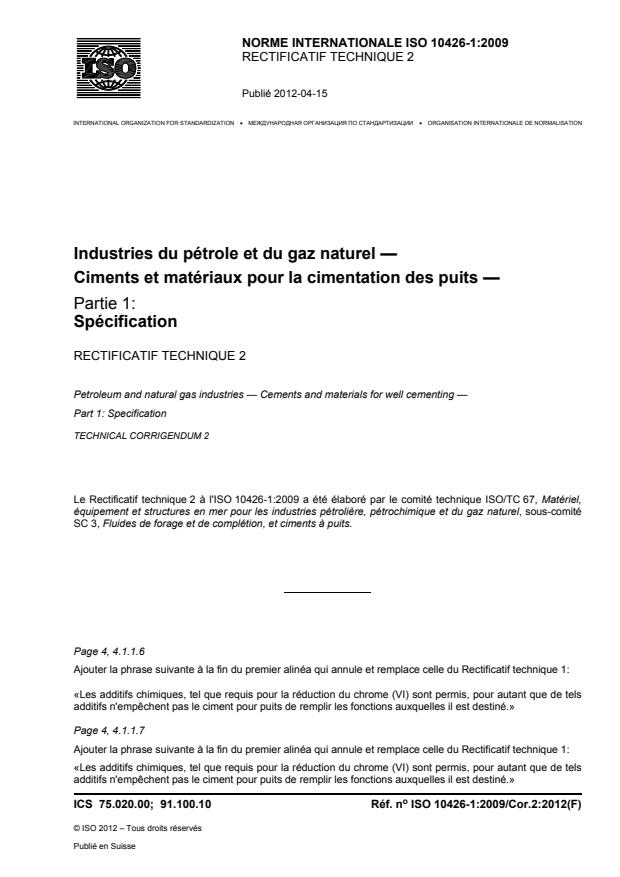
NORME INTERNATIONALE ISO 10426-1:2009
RECTIFICATIF TECHNIQUE 2
Publié 2012-04-15
INTERNATIONAL ORGANIZATION FOR STANDARDIZATION МЕЖДУНАРОДНАЯ ОРГАНИЗАЦИЯ ПО СТАНДАРТИЗАЦИИ ORGANISATION INTERNATIONALE DE NORMALISATION
Industries du pétrole et du gaz naturel —
Ciments et matériaux pour la cimentation des puits —
Partie 1:
Spécification
RECTIFICATIF TECHNIQUE 2
Petroleum and natural gas industries — Cements and materials for well cementing —
Part 1: Specification
TECHNICAL CORRIGENDUM 2
Le Rectificatif technique 2 à l'ISO 10426-1:2009 a été élaboré par le comité technique ISO/TC 67, Matériel,
équipement et structures en mer pour les industries pétrolière, pétrochimique et du gaz naturel, sous-comité
SC 3, Fluides de forage et de complétion, et ciments à puits.
Page 4, 4.1.1.
...
Questions, Comments and Discussion
Ask us and Technical Secretary will try to provide an answer. You can facilitate discussion about the standard in here.
Loading comments...