

ISO/FDIS 22584
(Main)Traditional Chinese medicine — Angelica sinensis root
General Information
- Abstract
This document specifies minimum requirements and test methods for Angelica sinensis root that is derived from Angelica sinensis (Oliv.) Diels. It is applicable to Angelica sinensis root that is sold and used as a natural medicine in international trade, including Chinese materia medica (whole medicinal materials) and decoction pieces derived from this plant.
- Status
- Not Published
- Technical Committee
- SC 1 - ISO/TC 249/SC 1
- Current Stage
- 5020 - FDIS ballot initiated: 2 months. Proof sent to secretariat
- Start Date
- 04-Aug-2026
- Completion Date
- 04-Aug-2026
Buy Documents
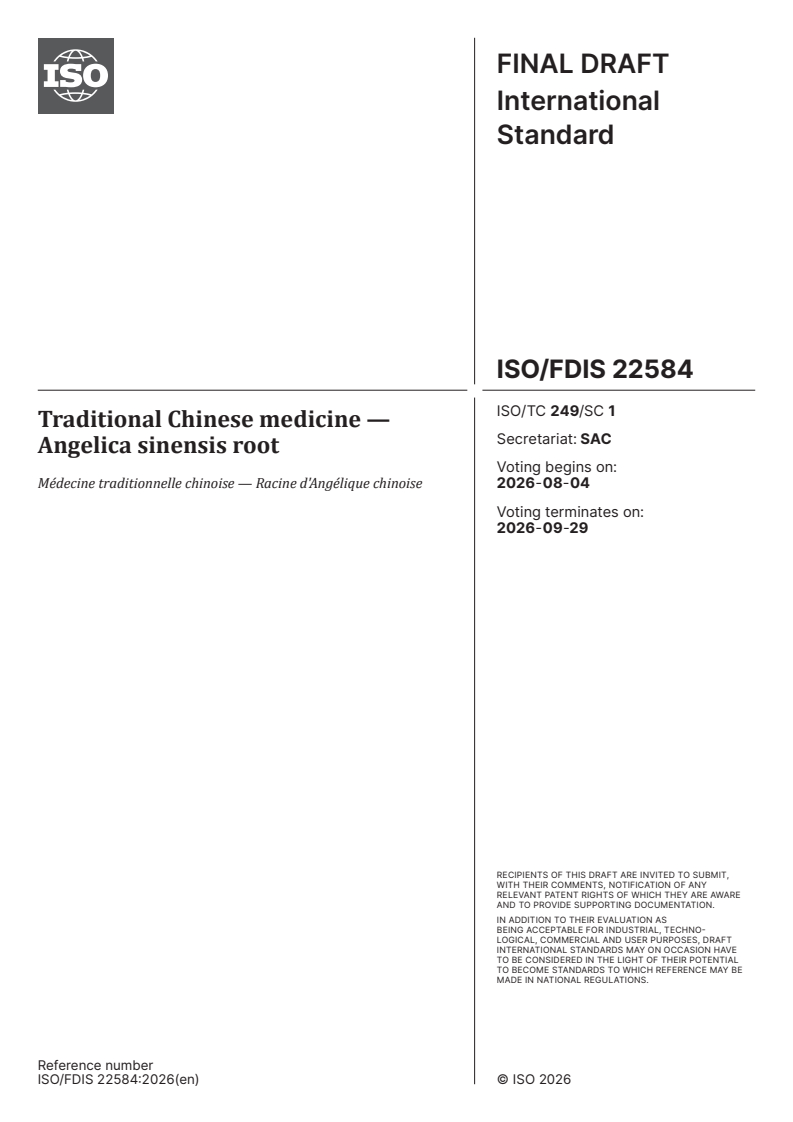
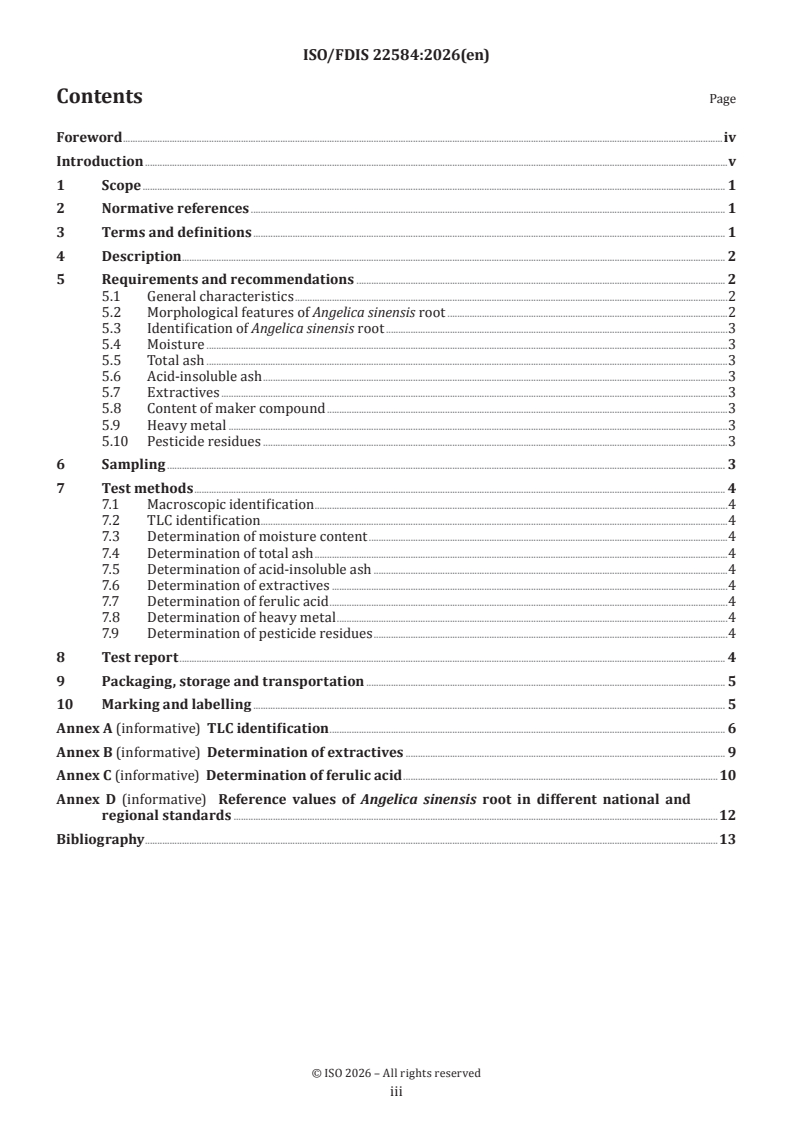
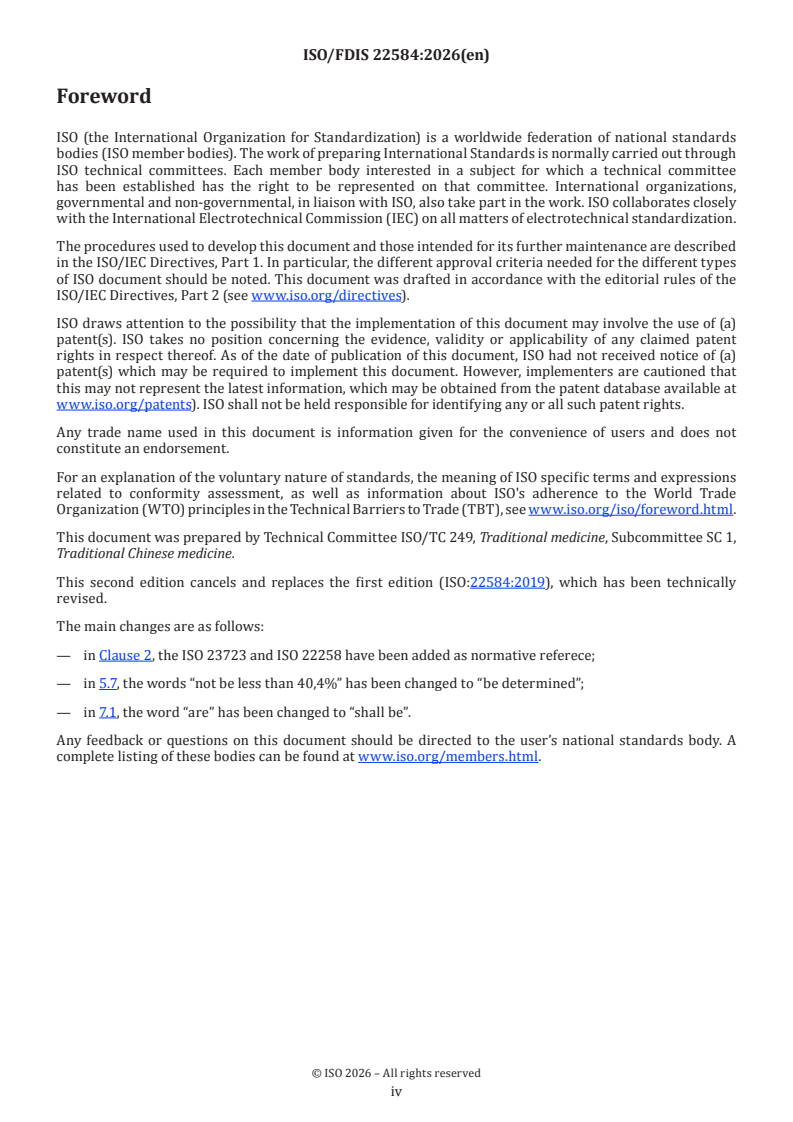
ISO/FDIS 22584 - Traditional Chinese medicine — Angelica sinensis root
REDLINE ISO/FDIS 22584 - Traditional Chinese medicine — Angelica sinensis root
Overview
ISO/FDIS 22584, Traditional Chinese medicine - Angelica sinensis root, is an international standard developed by the International Organization for Standardization (ISO) to define the minimum requirements and test methods for Angelica sinensis root used in traditional Chinese medicine. This standard is applicable to Angelica sinensis root derived from Angelica sinensis (Oliv.) Diels, sold and used globally as a natural medicine, including as Chinese materia medica (whole medicinal material) and as decoction pieces. It provides guidance for the quality, identity, safety, and proper handling of Angelica sinensis products in international trade and ensures consistency for manufacturers, traders, and regulatory bodies worldwide.
Key Topics
Scope and Coverage
- Applies to Angelica sinensis root for use as traditional medicine in international markets
- Covers both whole medicinal roots (Chinese materia medica) and decoction pieces
- Specifies requirements for identification, quality control, and safety
Product Quality Requirements
- Must be clean, free from foreign matter and visible contaminants such as insects or mold
- Describes morphological features for accurate identification
- Defines limits for moisture, total ash, and acid-insoluble ash content
- Requires testing for extractives and key marker compounds, such as ferulic acid
Safety and Contaminant Controls
- Mandates determination of heavy metals (arsenic, mercury, lead, cadmium) and pesticide residues (including DDT, benzex, quintozene)
- Provides specific test methods and references related ISO standards for reliable results
Testing and Documentation
- Outlines sampling methods and detailed test procedures, including macroscopic and TLC (thin-layer chromatography) identification
- Requires comprehensive test reporting, including product identification, analysis methods, results, and any anomalies
Packaging, Storage, and Labelling
- Requires packaging that protects product integrity and does not introduce health risks
- Specifies storage in cool, dry conditions, protected from light, moisture, and contamination
- Stipulates clear labelling: product and botanical names, origin, quality features, batch information, and storage instructions
Applications
Angelica sinensis root plays a significant role in both traditional Chinese medicine (TCM) and modern herbal practices worldwide. ISO/FDIS 22584 supports reliable and safe usage in several key areas:
Healthcare and Natural Medicine
- Used in herbal formulations for its purported health benefits, especially for issues related to blood circulation and women's health
- Serves as a raw material for decoction and herbal product manufacturing adhering to global quality and safety requirements
International Trade
- Facilitates smooth cross-border transactions by harmonizing product specifications and testing protocols
- Assists suppliers and exporters in meeting import country regulations and requirements
Pharmaceutical and Cosmetic Sectors
- Provides a foundation for sourcing high-quality Angelica sinensis root for pharmaceutical formulations and cosmetic ingredients
Quality Assurance and Regulatory Compliance
- Helps regulatory bodies and industry comply with standardized sampling, testing, and labelling processes
- Reduces risk of adulteration and substandard material entering supply chains
Related Standards
For comprehensive quality assurance in traditional Chinese medicine products, references to these standards are crucial:
- ISO 18664 - Determination of heavy metals in herbal medicines
- ISO 21371 - Labelling requirements for TCM products intended for oral or topical use
- ISO 22217 - Storage requirements for raw materials and decoction pieces
- ISO 22258 - Determination of pesticide residues by gas chromatography
- ISO 23723 - General requirements for herbal raw material and materia medica
By following ISO/FDIS 22584, organizations involved in the production, export, import, or distribution of Angelica sinensis root can ensure a high standard of quality, safety, and compliance in line with international best practices for traditional Chinese medicinal materials.
Relations
- Effective Date
- 07-Jun-2025
Buy Documents
ISO/FDIS 22584 - Traditional Chinese medicine — Angelica sinensis root
REDLINE ISO/FDIS 22584 - Traditional Chinese medicine — Angelica sinensis root
Get Certified
Connect with accredited certification bodies for this standard

BSI Group
BSI (British Standards Institution) is the business standards company that helps organizations make excellence a habit.

TÜV Rheinland
TÜV Rheinland is a leading international provider of technical services.

TÜV SÜD
TÜV SÜD is a trusted partner of choice for safety, security and sustainability solutions.
Sponsored listings
Frequently Asked Questions
ISO/FDIS 22584 is a draft published by the International Organization for Standardization (ISO). Its full title is "Traditional Chinese medicine — Angelica sinensis root". This standard covers: This document specifies minimum requirements and test methods for Angelica sinensis root that is derived from Angelica sinensis (Oliv.) Diels. It is applicable to Angelica sinensis root that is sold and used as a natural medicine in international trade, including Chinese materia medica (whole medicinal materials) and decoction pieces derived from this plant.
This document specifies minimum requirements and test methods for Angelica sinensis root that is derived from Angelica sinensis (Oliv.) Diels. It is applicable to Angelica sinensis root that is sold and used as a natural medicine in international trade, including Chinese materia medica (whole medicinal materials) and decoction pieces derived from this plant.
ISO/FDIS 22584 is classified under the following ICS (International Classification for Standards) categories: 11.120.10 - Medicaments. The ICS classification helps identify the subject area and facilitates finding related standards.
ISO/FDIS 22584 has the following relationships with other standards: It is inter standard links to ISO 22584:2019. Understanding these relationships helps ensure you are using the most current and applicable version of the standard.
ISO/FDIS 22584 is available in PDF format for immediate download after purchase. The document can be added to your cart and obtained through the secure checkout process. Digital delivery ensures instant access to the complete standard document.
Standards Content (Sample)
FINAL DRAFT
International
Standard
ISO/TC 249/SC 1
Traditional Chinese medicine —
Secretariat: SAC
Angelica sinensis root
Voting begins on:
Médecine traditionnelle chinoise — Racine d'Angélique chinoise 2026-08-04
Voting terminates on:
2026-09-29
RECIPIENTS OF THIS DRAFT ARE INVITED TO SUBMIT,
WITH THEIR COMMENTS, NOTIFICATION OF ANY
RELEVANT PATENT RIGHTS OF WHICH THEY ARE AWARE
AND TO PROVIDE SUPPOR TING DOCUMENTATION.
IN ADDITION TO THEIR EVALUATION AS
BEING ACCEPTABLE FOR INDUSTRIAL, TECHNO
LOGICAL, COMMERCIAL AND USER PURPOSES, DRAFT
INTERNATIONAL STANDARDS MAY ON OCCASION HAVE
TO BE CONSIDERED IN THE LIGHT OF THEIR POTENTIAL
TO BECOME STAN DARDS TO WHICH REFERENCE MAY BE
MADE IN NATIONAL REGULATIONS.
Reference number
FINAL DRAFT
International
Standard
ISO/TC 249/SC 1
Traditional Chinese medicine —
Secretariat: SAC
Angelica sinensis root
Voting begins on:
Médecine traditionnelle chinoise — Racine d'Angélique chinoise
Voting terminates on:
RECIPIENTS OF THIS DRAFT ARE INVITED TO SUBMIT,
WITH THEIR COMMENTS, NOTIFICATION OF ANY
RELEVANT PATENT RIGHTS OF WHICH THEY ARE AWARE
AND TO PROVIDE SUPPOR TING DOCUMENTATION.
© ISO 2026
IN ADDITION TO THEIR EVALUATION AS
All rights reserved. Unless otherwise specified, or required in the context of its implementation, no part of this publication may
BEING ACCEPTABLE FOR INDUSTRIAL, TECHNO
LOGICAL, COMMERCIAL AND USER PURPOSES, DRAFT
be reproduced or utilized otherwise in any form or by any means, electronic or mechanical, including photocopying, or posting on
INTERNATIONAL STANDARDS MAY ON OCCASION HAVE
the internet or an intranet, without prior written permission. Permission can be requested from either ISO at the address below
TO BE CONSIDERED IN THE LIGHT OF THEIR POTENTIAL
or ISO’s member body in the country of the requester.
TO BECOME STAN DARDS TO WHICH REFERENCE MAY BE
MADE IN NATIONAL REGULATIONS.
ISO copyright office
CP 401 • Ch. de Blandonnet 8
CH-1214 Vernier, Geneva
Phone: +41 22 749 01 11
Email: copyright@iso.org
Website: www.iso.org
Published in Switzerland Reference number
ii
Contents Page
Foreword .iv
Introduction .v
1 Scope . 1
2 Normative references . 1
3 Terms and definitions . 1
4 Description . . 2
5 Requirements and recommendations . 2
5.1 General characteristics .2
5.2 Morphological features of Angelica sinensis root .2
5.3 Identification of Angelica sinensis root .3
5.4 Moisture .3
5.5 Total ash .3
5.6 Acid-insoluble ash .3
5.7 Extractives .3
5.8 Content of maker compound .3
5.9 Heavy metal .3
5.10 Pesticide residues .3
6 Sampling . 3
7 Test methods . 4
7.1 Macroscopic identification .4
7.2 TLC identification . .4
7.3 Determination of moisture content .4
7.4 Determination of total ash .4
7.5 Determination of acid-insoluble ash .4
7.6 Determination of extractives .4
7.7 Determination of ferulic acid .4
7.8 Determination of heavy metal .4
7.9 Determination of pesticide residues .4
8 Test report . 4
9 Packaging, storage and transportation . 5
10 Marking and labelling . 5
Annex A (informative) TLC identification . 6
Annex B (informative) Determination of extractives . 9
Annex C (informative) Determination of ferulic acid . 10
Annex D (informative) Reference values of Angelica sinensis root in different national and
regional standards .12
Bibliography .13
iii
Foreword
ISO (the International Organization for Standardization) is a worldwide federation of national standards
bodies (ISO member bodies). The work of preparing International Standards is normally carried out through
ISO technical committees. Each member body interested in a subject for which a technical committee
has been established has the right to be represented on that committee. International organizations,
governmental and non-governmental, in liaison with ISO, also take part in the work. ISO collaborates closely
with the International Electrotechnical Commission (IEC) on all matters of electrotechnical standardization.
The procedures used to develop this document and those intended for its further maintenance are described
in the ISO/IEC Directives, Part 1. In particular, the different approval criteria needed for the different types
of ISO document should be noted. This document was drafted in accordance with the editorial rules of the
ISO/IEC Directives, Part 2 (see www.iso.org/directives).
ISO draws attention to the possibility that the implementation of this document may involve the use of (a)
patent(s). ISO takes no position concerning the evidence, validity or applicability of any claimed patent
rights in respect thereof. As of the date of publication of this document, ISO had not received notice of (a)
patent(s) which may be required to implement this document. However, implementers are cautioned that
this may not represent the latest information, which may be obtained from the patent database available at
www.iso.org/patents). ISO shall not be held responsible for identifying any or all such patent rights.
Any trade name used in this document is information given for the convenience of users and does not
constitute an endorsement.
For an explanation of the voluntary nature of standards, the meaning of ISO specific terms and expressions
related to conformity assessment, as well as information about ISO's adherence to the World Trade
Organization (WTO) principles in the Technical Barriers to Trade (TBT), see www.iso.org/iso/foreword.html.
This document was prepared by Technical Committee ISO/TC 249, Traditional medicine, Subcommittee SC 1,
Traditional Chinese medicine.
This second edition cancels and replaces the first edition (ISO:22584:2019), which has been technically
revised.
The main changes are as follows:
— in Clause 2, the ISO 23723 and ISO 22258 have been added as normative referece;
— in 5.7, the words “not be less than 40,4%” has been changed to “be determined”;
— in 7.1, the word “are” has been changed to “shall be”.
Any feedback or questions on this document should be directed to the user’s national standards body. A
complete listing of these bodies can be found at www.iso.org/members.html.
iv
Introduction
Angelica root is a traditional herbal remedy derived from the dried root of Angelica sinensis (Oliv.) Diels,
Angelica acutiloba (Sieb. et Zucc.) Kitagawa and Angelica gigas Nakai, which belong to the Umbelliferae
[1]
family. These three sources of Angelica root are respectively recorded in the Chinese Pharmacopoeia ,
[2] [3]
the Japanese Pharmacopoeia and the Korean Pharmacopoeia and have a long history of medicinal use.
However, there are certain difference among the three sources in term of the characteristics of medicinal
root, chemical composition, and therapeutic effects. The root of Angelica sinensis is flexible, cylindrical,
slightly curved, and branched. It contains a higher amount of volatile oil components, mainly lactones such
[1]
as Z-Ligustilide and butylidenephthalide . Angelica sinensis is known for its significant effects in promoting
[4]
blood circulation, replenishing blood, and providing anti-inflammatory and analgesic actions . The root of
Angelica acutiloba is thick and soft, with a short and thick root head and main root, and numerous branches.
It is rich in coumarin component and primarily has antibacterial, anti-inflammatory, sedative, and calming
[5]
effects . The root of Angelica gigas is conical or cylindrical, robust, and hard in texture. It has a higher
content of butylidenephthalide in its volatile oil and contains various phenolic and alkaloid component. It
[6]
mainly has anti-tumor and anti-platelet aggregation effects . Among these, Angelica sinensis has long been
one of the most commonly used herbs by traditional Chinese medicine practitioners in Asia, North America
and Europe. It is commonly referred to as “female ginseng” and is widely used to invigorate blood circulation
and replenish blood, especially in the treatment of women's reproductive problems such as dysmenorrhea,
amenorrhoea and menopause symptoms. Additionally, it has been widely applied in the pharmaceutical and
cosmetic fields in over 20 countries due to its remarkable therapeutic effects.
The quality of Angelica sinensis root is crucial for efficacy and safety for consumers. Until now, there have
been no unique requirements for Angelica sinensis root, although Angelica sinensis root has also been
recorded by the American Herbal Pharmacopoeia, the European Pharmacopoeia, the British Pharmacopoeia
and the Hong Kong Chinese Materia Medica Standards. It is therefore important to standardize the quality
of Angelica sinensis root globally in order to benefit farmers, enterprises and companies involved in the
planting, management and trade of Angelica sinensis root.
As national implementation may differ, national standards bodies are invited to modify the values given
in 5.4, 5.5, 5.6 and 5.8 in their national standards. Examples of national and regional values are given in
Annex D.
v
FINAL DRAFT International Standard ISO/FDIS 22584:2026(en)
Traditional Chinese medicine — Angelica sinensis root
1 Scope
This document specifies the minimum requirements and test methods for Angelica sinensis root that is
derived from Angelica sinensis (Oliv.) Diels.
It is applicable to Angelica sinensis root that is sold and used as a natural medicine in international trade,
including Chinese materia medica (whole medicinal materials) and decoction pieces derived from this plant.
2 Normative references
The following documents are referred to in the text in such a way that some or all of their content constitutes
requirements of this document. For dated references, only the edition cited applies. For undated references,
the latest edition of the referenced document (including any amendments) applies.
ISO 18664, Traditional Chinese Medicine — Determination of heavy metals in herbal medicines used in
Traditional Chinese Medicine
ISO 21371, Traditional Chinese medicine — Labelling requirements of products intended for oral or topical use
ISO 22217:2020, Traditional Chinese medicine —Storage requirements for raw materials and decoction pieces
ISO 22258, Traditional Chinese medicine — Determination of pesticide residues in natural products by gas
chromatography
ISO 23723, Traditional Chinese medicine — General requirements for herbal raw material and materia medica
3 Terms and definitions
For the purpos
...
Style Definition: Heading 1: Indent: Left: 0 cm, First
ISO/DISFDIS 22584
line: 0 cm
ISO/TC 249/SC 1
Style Definition: Heading 2: Font: Bold, Indent: Left: 0
cm, First line: 0 cm
Secretariat: SAC
Style Definition: Heading 3: Font: Bold, Indent: Left: 0
cm, First line: 0 cm
Date: 2026-06-0807-20
Style Definition: Heading 4: Font: Bold, Indent: Left: 0
cm, First line: 0 cm
Style Definition: Heading 5: Font: Bold, Indent: Left: 0
cm, First line: 0 cm
Style Definition: Heading 6: Font: Bold
Style Definition: IntroHeading1: Font: Bold, Indent:
Traditional Chinese medicine — Angelica sinensis root
Left: 0 cm, First line: 0 cm
Style Definition: IntroHeading2: Font: Bold, Indent:
Médecine traditionnelle chinoise — Racine d'Angélique chinoise
Left: 0 cm, First line: 0 cm
Style Definition: IntroHeading3: Font: Bold, Indent:
Left: 0 cm, First line: 0 cm
Style Definition: IntroHeading4: Font: Bold, Indent:
Left: 0 cm, First line: 0 cm
Style Definition: IntroHeading5: Font: Bold, Indent:
Left: 0 cm, First line: 0 cm
Style Definition: IntroHeading6
Style Definition: IntroHeading7
DISFDIS stage
Style Definition: IntroHeading8
Style Definition: IntroHeading9
Style Definition: ANNEX
Style Definition: Key Text
Style Definition: Key Title
Style Definition: List Continue 1
Style Definition: TermNum2: Font: Bold, Indent: Left: 0
cm, First line: 0 cm
Style Definition
...
Style Definition
...
Style Definition
...
Style Definition: TermNum6: Font: Bold
Style Definition: Body Text
Style Definition: boxedText
Style Definition: Boxed List Continue 1
Style Definition: boxedTitle
Style Definition: FooterCentered
Style Definition: FooterPageNumber
VVoottiing bng beegiginsns o on:n: 202 20255--1212--2929
Style Definition: FooterPageRomanNumber
VoVotintingg t tererminminatateses o onn:: 22002266--0033--2323
Style Definition: FooterCenteredContinued
Style Definition: TPS Markup Base
Formatted: French (France)
Formatted: French (France)
Formatted: French (France)
Formatted: French (France)
ISO/DISFDIS 22584:2026(en)
All rights reserved. Unless otherwise specified, or required in the context of its implementation, no part of this publication
may be reproduced or utilized otherwise in any form or by any means, electronic or mechanical, including photocopying,
or posting on the internet or an intranet, without prior written permission. Permission can be requested from either ISO
at the address below or ISO’s member body in the country of the requester.
ISO copyright office
CP 401 • Ch. de Blandonnet 8
CH-1214 Vernier, Geneva
Phone: + 41 22 749 01 11
Formatted: French (France)
E-mail: copyright@iso.org
Website: www.iso.org
Published in Switzerland
ii
ISO/DISFDIS 22584:2026(en)
Contents
Foreword . iii
Introduction . iii
Scope . iii
Normative references . iii
Terms and definitions . iii
Description . iii
Requirements and recommendations . iii
General characteristics . iii
Morphological features of Angelica sinensis root . iii
Identification of Angelica sinensis root . iii
Moisture . iii
Total ash . iii
Acid-insoluble ash . iii
Extractives . iii
Content of maker compound . iii
Heavy metal . iii
Pesticide residues . iii
Sampling . iii
Test methods . iii
Macroscopic identification . iii
TLC identification . iii
Determination of moisture content . iii
Determination of total ash . iii
Determination of acid-insoluble ash . iii
Determination of extractives . iii
Determination of ferulic acid . iii
Determination of heavy metal . iii
Determination of pesticide residues . iii
Test report . iii
Packaging, storage and transportation . iii
Marking and labelling . iii
(informative) TLC identification . iii
(informative) Determination of extractives . iii
(informative) Determination of ferulic acid . iii
(informative) Reference values of Angelica sinensis root in different national and regional
standards . iii
(normative) . iii
Bibliography . iii
Foreword . v
Introduction . vi
1 Scope . 1
2 Normative references . 1
iii
ISO/DISFDIS 22584:2026(en)
3 Terms and definitions . 1
4 Description . 2
5 Requirements and recommendations . 4
5.1 General characteristics . 4
5.2 Morphological features of Angelica sinensis root . 4
5.3 Identification of Angelica sinensis root . 4
5.4 Moisture . 5
5.5 Total ash . 5
5.6 Acid-insoluble ash . 5
5.7 Extractives . 5
5.8 Content of maker compound . 5
5.9 Heavy metal . 5
5.10 Pesticide residues . 5
6 Sampling . 5
7 Test methods . 5
7.1 Macroscopic identification . 5
7.2 TLC identification. 5
7.3 Determination of moisture content . 5
7.4 Determination of total ash . 5
7.5 Determination of acid-insoluble ash . 5
7.6 Determination of extractives . 6
7.7 Determination of ferulic acid . 6
7.8 Determination of heavy metal . 6
7.9 Determination of pesticide residues . 6
8 Test report . 6
9 Packaging, storage and transportation . 6
10 Marking and labelling . 6
Annex A (informative) TLC identification . 8
Annex B (informative) Determination of extractives . 12
Annex C (informative) Determination of ferulic acid . 13
Annex D (informative) Reference values of Angelica sinensis root in different national and
regional standards . 16
Bibliography . 18
iv
ISO/DISFDIS 22584:2026(en)
Foreword
ISO (the International Organization for Standardization) is a worldwide federation of national standards
bodies (ISO member bodies). The work of preparing International Standards is normally carried out through
ISO technical committees. Each member body interested in a subject for which a technical committee has been
established has the right to be represented on that committee. International organizations, governmental and
non-governmental, in liaison with ISO, also take part in the work. ISO collaborates closely with the
International Electrotechnical Commission (IEC) on all matters of electrotechnical standardization.
The procedures used to develop this document and those intended for its further maintenance are described
in the ISO/IEC Directives, Part 1. In particular, the different approval criteria needed for the different types of
ISO document should be noted. This document was drafted in accordance with the editorial rules of the
ISO/IEC Directives, Part 2 (see www.iso.org/directives).
ISO draws attention to the possibility that the implementation of this document may involve the use of (a)
patent(s). ISO takes no position concerning the evidence, validity or applicability of any claimed patent rights
in respect thereof. As of the date of publication of this document, ISO had not received notice of (a) patent(s)
which may be required to implement this document. However, implementers are cautioned that this may not
represent the latest information, which may be obtained from the patent database available at
www.iso.org/patents). ISO shall not be held responsible for identifying any or all such patent rights.
Any trade name used in this document is information given for the convenience of users and does not
constitute an endorsement.
For an explanation of the voluntary nature of standards, the meaning of ISO specific terms and expressions
related to conformity assessment, as well as information about ISO's adherence to the World Trade
Organization (WTO) principles in the Technical Barriers to Trade (TBT), see www.iso.org/iso/foreword.html.
This document was prepared by Technical Committee ISO/TC 249, Traditional medicine, Subcommittee SC 1,
Traditional Chinese medicine.
This second cancels and replaces the first edition includes the following significant(ISO:22584:2019), which
has been technically revised.
The main changes compared with the previous edition:are as follows
— — In Clause 2,in Clause 2, the ISO 23723 and ISO 22258 have been added as normative referece;
Formatted: List Continue 1
— — in 5.7 ,in 5.7, the words “not be less than 40,4%” has been changed to “be determined”.”;
— — In 7.1,in 7.1, the word “are” has been changed to “shall be”.
Any feedback or questions on this document should be directed to the user’s national standards body. A
complete listing of these bodies can be found at www.iso.org/members.html.
v
ISO/DISFDIS 22584:2026(en)
Introduction
Angelica root is a traditional herbal remedy derived from the dried root of Angelica sinensis (Oliv.) Diels,
Angelica acutiloba (Sieb. et Zucc.) Kitagawa and Angelica gigas Nakai, which belong to the Umbelliferae family.
[1]
These three sources of Angelica root are respectively recorded in the Chinese Pharmacopoeia , the Japanese
[2] [3]
Pharmacopoeia and the Korean Pharmacopoeia and have a long history of medicinal use . However, there
are certain difference among the three sources in term of the characteristics of medicinal root, chemical
composition, and therapeutic effects. The root of Angelica sinensis is flexible, cylindrical, slightly curved, and
branched. It contains a higher amount of volatile oil components, mainly lactones such as Z-Ligustilide and
[1]
butylidenephthalide . Angelica sinensis is known for its significant effects in promoting blood circulation,
[4]
replenishing blood, and providing anti-inflammatory and analgesic actions . The root of Angelica acutiloba is
thick and soft, with a short and thick root head and main root, and numerous branches. It is rich in coumarin
[5]
component and primarily has antibacterial, anti-inflammatory, sedative, and calming effects . The root of
Angelica gigas is conical or cylindrical, robust, and hard in texture. It has a higher content of
butylidenephthalide in its volatile oil and contains various phenolic and alkaloid component. It mainly has
[6]
anti-tumor and anti-platelet aggregation effects . Among these, Angelica sinensis has long been one of the
most commonly used herbs by traditional Chinese medicine practitioners in Asia, North America and Europe.
It is commonly referred to as “female ginseng” and is widely used to invigorate blood circulation and replenish
blood, especially in the treatment of women's reproductive problems such as dysmenorrhea, amenorrhoea
and menopause symptoms. Additionally, it has been widely applied in the pharmaceutical and cosmetic fields
in over 20 countries due to its remarkable therapeutic effects.
The quality of Angelica sinensis root is crucial for efficacy and safety for consumers. Until now, there have been
no unique requirements for Angelica sinensis root, although Angelica sinensis root has also been recorded by
the American Herbal Pharmacopoeia, the European Pharmacopoeia, the British Pharmacopoeia and the Hong
Kong Chinese Materia Medica Standards. It is therefore important to standardize the quality of Angelica
sinensis root globally in order to benefit farmers, enterprises and companies involved in the planting,
management and trade of Angelica sinensis root.
As national implementation may differ, national standards bodies are invited to modify the values given in 5.4,
5.5, 5.6 and 5.8 in their national standards. Examples of national and regional values are given in Annex D.
vi
ISO/DISFDIS 22584:2026(en)
Traditional Chinese medicine — Angelica sinensis root
1 Scope
This document specifies the minimum requirements and test methods for Angelica sinensis root that is derived
from Angelica sinensis (Oliv.) Diels.
It is applicable to Angelica sinensis root that is sold and used as a natural medicine in international trade,
including Chinese materia medica (whole medicinal materials) and decoction pieces derived from this plant.
2 Normative references
The following documents are referred to in the text in such a way that some or all of their content constitutes
requirements of this document. For dated references, only the edition cited applies. For undated references,
the latest edition of the referenced document (including any amendments) applies.
ISO 18664, Traditional Chinese Medicine — Determination of heavy metals in herbal medicines used in
Traditional Chinese Medicine
ISO 21371, Traditional Chinese medicine — Labelling requirements of products intended for oral or topical use
ISO 22217:2020, Traditional Chinese medicine —Storage requirements for raw materials and decoction pieces
ISO 22258, Traditional Chinese medicine — Determination of pesticide residues in natural
...