

ISO 23851:2026
(Main)Chicken tissue and eggs — Determination of marker residues of nicarbazin — Liquid chromatography tandem mass spectrometry method
General Information
- Abstract
This document specifies a liquid chromatography tandem mass spectrometry (LC-MS/MS) method for the determination of marker residues of nicarbazin (4,4-dinitrocarbanilide) in chicken tissue and eggs. This document is applicable to the determination of marker residues of nicarbazin (4,4-dinitrocarbanilide) in chicken tissue (including muscle, liver and kidney) and eggs.
- Status
- Published
- Publication Date
- 14-May-2026
- Technical Committee
- ISO/TC 34/SC 6 - Meat, poultry, fish, eggs and their products
- Drafting Committee
- ISO/TC 34/SC 6 - Meat, poultry, fish, eggs and their products
- Current Stage
- 6060 - International Standard published
- Start Date
- 15-May-2026
- Due Date
- 30-Nov-2026
- Completion Date
- 15-May-2026
Overview
ISO 23851:2026 specifies an analytical method using liquid chromatography tandem mass spectrometry (LC-MS/MS) for the determination of marker residues of nicarbazin, specifically 4,4-dinitrocarbanilide, in chicken tissue and eggs. This international standard, developed by ISO Technical Committee 34, Subcommittee 6, is designed for application to a range of chicken tissue matrices-including muscle, liver, and kidney-as well as whole eggs.
Nicarbazin is a common veterinary drug used in poultry production as a coccidiostat. Accurate quantification of nicarbazin residues in food products is essential for food safety, regulatory compliance, and international trade. ISO 23851:2026 enables laboratories to consistently determine these residues and supports efforts to monitor and control veterinary drug residues in poultry products.
Key Topics
Analytical Scope
- Applicable to chicken muscle, liver, kidney, and eggs
- Focuses on the measurement of nicarbazin marker residue (4,4-dinitrocarbanilide) levels
Sample Preparation
- Instructions on homogenization and preservation of samples to prevent degradation
- Storage guidelines to maintain sample integrity until analysis
LC-MS/MS Methodology
- Extraction of analyte using acetonitrile and purification via phase separation or solid phase extraction
- Detailed parameters for chromatographic separation and mass spectrometric detection
- Calibration using internal standards for accurate quantification
Quality Assurance
- Guidance on conducting blank tests to monitor contamination
- Instructions for calculating results, including limits of quantification and repeatability
- Reporting criteria to ensure traceability and transparency
Precision and Interlaboratory Comparisons
- Data outlined in annexes to inform expected repeatability and reproducibility for various matrices
Applications
ISO 23851:2026 provides practical value to a variety of stakeholders in the food and animal products industry. Its applications include:
Regulatory Compliance
- Ensures adherence to food safety standards by accurately monitoring nicarbazin residue levels in poultry products
- Facilitates compliance with domestic and international residue limits
Food Safety Monitoring
- Used by testing laboratories, quality control departments, and inspectors to verify the safety of chicken and egg products
- Supports public health initiatives by enabling detection of veterinary drug residues
International Trade
- Harmonizes laboratory practices for importing and exporting countries, reducing trade barriers associated with residue testing in poultry products
Research and Development
- Supports academic and private sector research focused on residue analysis, method validation, and the effects of veterinary drugs in food animals
Risk Assessment
- Provides reliable data for risk assessment studies evaluating human exposure to veterinary residues in foods of animal origin
Related Standards
For comprehensive residue analysis and laboratory practices, the following standards are frequently referenced alongside ISO 23851:2026:
- ISO 3696: Water for analytical laboratory use - Specification and test methods
- ISO 5725-1: Accuracy (trueness and precision) of measurement methods and results - Part 1: General principles and definitions
- ISO 5725-2: Accuracy (trueness and precision) of measurement methods and results - Part 2: Basic method for the determination of repeatability and reproducibility of a standard measurement method
- CAC/GL 50-2004: General guidelines on sampling
Summary
ISO 23851:2026 establishes a reliable, standardized LC-MS/MS method for detecting and quantifying marker residues of nicarbazin in chicken and eggs. By ensuring high accuracy, precision, and consistency in residue measurement, this standard plays a critical role in food safety, regulatory compliance, and the facilitation of fair international trade in poultry products.
Get Certified
Connect with accredited certification bodies for this standard

BSI Group
BSI (British Standards Institution) is the business standards company that helps organizations make excellence a habit.

Bureau Veritas
Bureau Veritas is a world leader in laboratory testing, inspection and certification services.

DNV
DNV is an independent assurance and risk management provider.
Sponsored listings
Frequently Asked Questions
ISO 23851:2026 is a standard published by the International Organization for Standardization (ISO). Its full title is "Chicken tissue and eggs — Determination of marker residues of nicarbazin — Liquid chromatography tandem mass spectrometry method". This standard covers: This document specifies a liquid chromatography tandem mass spectrometry (LC-MS/MS) method for the determination of marker residues of nicarbazin (4,4-dinitrocarbanilide) in chicken tissue and eggs. This document is applicable to the determination of marker residues of nicarbazin (4,4-dinitrocarbanilide) in chicken tissue (including muscle, liver and kidney) and eggs.
This document specifies a liquid chromatography tandem mass spectrometry (LC-MS/MS) method for the determination of marker residues of nicarbazin (4,4-dinitrocarbanilide) in chicken tissue and eggs. This document is applicable to the determination of marker residues of nicarbazin (4,4-dinitrocarbanilide) in chicken tissue (including muscle, liver and kidney) and eggs.
ISO 23851:2026 is classified under the following ICS (International Classification for Standards) categories: 11.120.10 - Medicaments; 67.050 - General methods of tests and analysis for food products; 67.120.20 - Poultry and eggs. The ICS classification helps identify the subject area and facilitates finding related standards.
ISO 23851:2026 is available in PDF format for immediate download after purchase. The document can be added to your cart and obtained through the secure checkout process. Digital delivery ensures instant access to the complete standard document.
Standards Content (Sample)
International
Standard
ISO 23851
First edition
Chicken tissue and eggs —
2026-05
Determination of marker
residues of nicarbazin — Liquid
chromatography tandem mass
spectrometry method
Tissu de poulet et œufs — Détermination des résidus marqueurs
de la nicarbazine — Méthode par chromatographie en phase
liquide couplée à un spectromètre de masse en tandem
Reference number
© ISO 2026
All rights reserved. Unless otherwise specified, or required in the context of its implementation, no part of this publication may
be reproduced or utilized otherwise in any form or by any means, electronic or mechanical, including photocopying, or posting on
the internet or an intranet, without prior written permission. Permission can be requested from either ISO at the address below
or ISO’s member body in the country of the requester.
ISO copyright office
CP 401 • Ch. de Blandonnet 8
CH-1214 Vernier, Geneva
Phone: +41 22 749 01 11
Email: copyright@iso.org
Website: www.iso.org
Published in Switzerland
ii
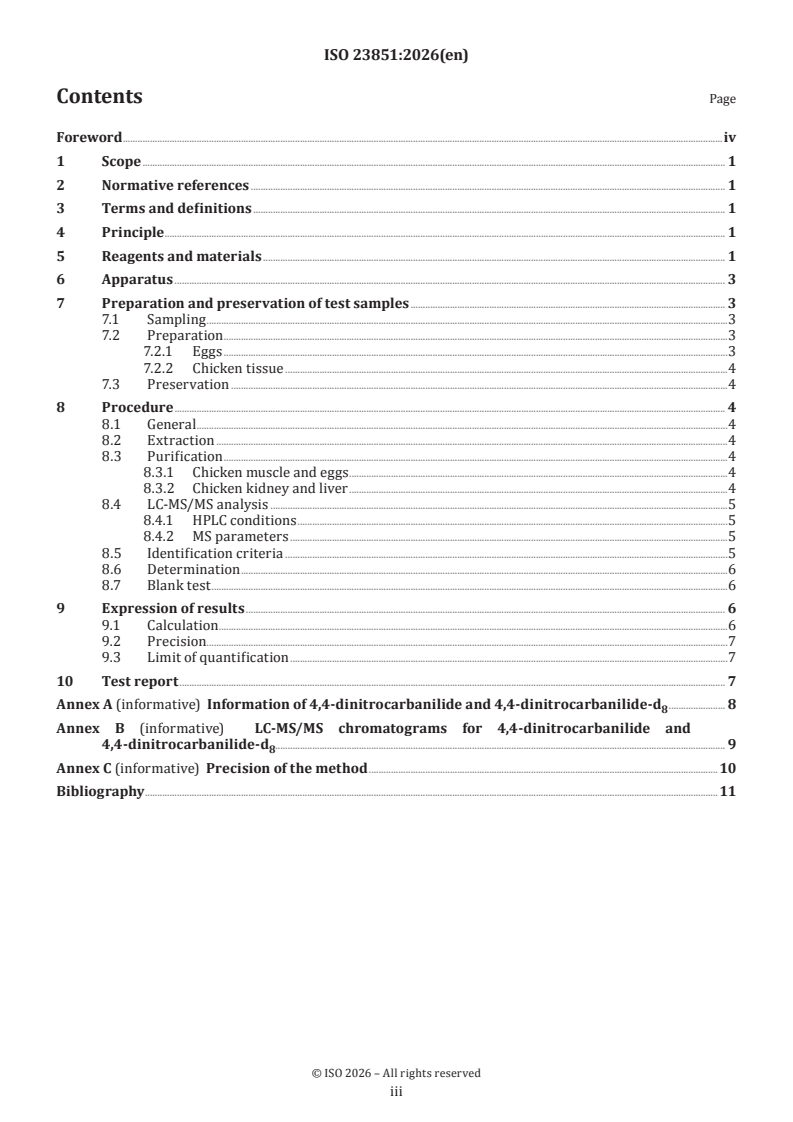
Contents Page
Foreword .iv
1 Scope . 1
2 Normative references . 1
3 Terms and definitions . 1
4 Principle . 1
5 Reagents and materials . 1
6 Apparatus . 3
7 Preparation and preservation of test samples . 3
7.1 Sampling .3
7.2 Preparation .3
7.2.1 Eggs .3
7.2.2 Chicken tissue .4
7.3 Preservation .4
8 Procedure . 4
8.1 General .4
8.2 Extraction .4
8.3 Purification .4
8.3.1 Chicken muscle and eggs .4
8.3.2 Chicken kidney and liver .4
8.4 LC-MS/MS analysis .5
8.4.1 HPLC conditions .5
8.4.2 MS parameters .5
8.5 Identification criteria .5
8.6 Determination .6
8.7 Blank test .6
9 Expression of results . 6
9.1 Calculation .6
9.2 Precision . . .7
9.3 Limit of quantification .7
10 Test report . 7
Annex A (informative) Information of 4,4-dinitrocarbanilide and 4,4-dinitrocarbanilide-d . 8
Annex B (informative) LC-MS/MS chromatograms for 4,4-dinitrocarbanilide and
4,4-dinitrocarbanilide-d . 9
Annex C (informative) Precision of the method . 10
Bibliography .11
iii
Foreword
ISO (the International Organization for Standardization) is a worldwide federation of national standards
bodies (ISO member bodies). The work of preparing International Standards is normally carried out through
ISO technical committees. Each member body interested in a subject for which a technical committee
has been established has the right to be represented on that committee. International organizations,
governmental and non-governmental, in liaison with ISO, also take part in the work. ISO collaborates closely
with the International Electrotechnical Commission (IEC) on all matters of electrotechnical standardization.
The procedures used to develop this document and those intended for its further maintenance are described
in the ISO/IEC Directives, Part 1. In particular, the different approval criteria needed for the different types
of ISO document should be noted. This document was drafted in accordance with the editorial rules of the
ISO/IEC Directives, Part 2 (see www.iso.org/directives).
ISO draws attention to the possibility that the implementation of this document may involve the use of (a)
patent(s). ISO takes no position concerning the evidence, validity or applicability of any claimed patent
rights in respect thereof. As of the date of publication of this document, ISO had not received notice of (a)
patent(s) which may be required to implement this document. However, implementers are cautioned that
this may not represent the latest information, which may be obtained from the patent database available at
www.iso.org/patents. ISO shall not be held responsible for identifying any or all such patent rights.
Any trade name used in this document is information given for the convenience of users and does not
constitute an endorsement.
For an explanation of the voluntary nature of standards, the meaning of ISO specific terms and expressions
related to conformity assessment, as well as information about ISO’s adherence to the World Trade
Organization (WTO) principles in the Technical Barriers to Trade (TBT), see www.iso.org/iso/foreword.html.
This document was prepared by Technical Committee ISO/TC 34, Food products, Subcommittee SC 6, Meat,
poultry, fish, eggs and their products.
Any feedback or questions on this document should be directed to the user’s national standards body. A
complete listing of these bodies can be found at www.iso.org/members.html.
iv
International Standard ISO 23851:2026(en)
Chicken tissue and eggs — Determination of marker residues
of nicarbazin — Liquid chromatography tandem mass
spectrometry method
1 Scope
This document specifies a liquid chromatography tandem mass spectrometry (LC-MS/MS) method for the
determination of marker residues of nicarbazin (4,4-dinitrocarbanilide) in chicken tissue and eggs.
This document is applicable to the determination of marker residues of nicarbazin (4,4-dinitrocarbanilide)
in chicken tissue (including muscle, liver and kidney) and eggs.
2 Normative references
The following documents are referred to in the text in such a way that some or all of their content constitutes
requirements of this document. For dated references, only the edition cited applies. For undated references,
the latest edition of the referenced document (including any amendments) applies.
ISO 3696, Water for analytical laboratory use — Specification and test methods
3 Terms and definitions
No terms and definitions are listed in this document.
ISO and IEC maintain terminology databases for use in standardization at the following addresses:
— ISO Online browsing platform: available at https:// www .iso .org/ obp
— IEC Electropedia: available at https:// www .electropedia .org/
4 Principle
The test portion is extracted with acetonitrile and then purified by acetonitrile-saturated n-hexane or solid
phase extraction column. The 4,4-dinitrocarbanilide is determined and confirmed by LC-MS/MS, and is
quantified with an internal standard method.
5 Reagents and materials
Use only reagents of recognized analytical grade, unless otherwise specified.
5.1 Water, at least grade 1 conforming to ISO 3696.
5.2 Acetonitrile, HPLC grade.
5.3 Formic acid, HPLC grade.
5.4 Ammonium acetate, HPLC grade.
5.5 N,N-Dimethylformamide.
5.6 n-hexane.
5.7 Anhydrous sodium sulfate.
5.8 Formic acid solution, 1 ml/l.
Pipette 1,0 ml formic acid (5.3) into a 1 000 ml one-mark volumetric flask. Dilute to the mark with water
(5.1) and mix well.
5.9 Ammonium acetate-formic acid solution, c(CH COONH ) = 5 mmol/l.
3 4
Weigh 0,38 g of ammonium acetate (5.4), dissolve and dilute to 1 000 ml with 1 ml/l formic acid solution
(5.8), and mix well.
5.10 Acetonitrile-saturated n-hexane.
Add 20 ml of acetonitrile (5.2) to 100 ml of n-hexane (5.6) and mix well. Allow the mixture to stand for a
sufficient period to enable phase separation, and then collect the supernatant.
5.11 4,4-dinitrocarbanilide, purity ≥ 98 %, see Annex A.
5.12 4,4-dinitrocarbanilide-d , purity ≥ 98 %, see Annex A.
5.13 4,4-dinitrocarbanilide stock standard solution, 100 mg/l.
Weigh, to the nearest 0,1 mg, 10 mg of 4,4-dinitrocarbanilide (5.11) and transfer it to a 100 ml one-mark
volumetric flask. Dilute to the mark with N,N-Dimethylformamide (5.5), and mix well.
This stock solution is stable for three months when stored in the dark at −18 °C.
5.14 4,4-dinitrocarbanilide intermediate standard solution, 1 mg/l.
Pipette 1,0 ml of the 4,4-dinitrocarbanilide stock
...