


ISO/FDIS 22702
(Main)Utility lighters — Safety specifications
General Information
- Abstract
This document specifies requirements for utility lighters to ensure a reasonable degree of safety for normal use or reasonably foreseeable misuse of such lighters by users. This document applies to all flame-producing consumer products commonly known as utility lighters (also known as grill lighters, fireplace lighters, lighting rods or gas matches), and similar devices. It does not apply to matches and flame-producing products intended for igniting cigars, pipes and cigarettes.
- Status
- Not Published
- Technical Committee
- ISO/TC 61/SC 4 - Burning behaviour
- Drafting Committee
- ISO/TC 61/SC 4/WG 10 - Lighters
- Current Stage
- 5020 - FDIS ballot initiated: 2 months. Proof sent to secretariat
- Start Date
- 27-Jul-2026
- Completion Date
- 27-Jul-2026
Buy Documents
ISO/FDIS 22702 - Utility lighters — Safety specifications
REDLINE ISO/FDIS 22702 - Utility lighters — Safety specifications
ISO/FDIS 22702 - Briquets utilitaires — Spécifications de sécurité
Overview
ISO/FDIS 22702: Utility Lighters - Safety Specifications is an international standard developed by the International Organization for Standardization (ISO). This document establishes crucial safety requirements for utility lighters, including common types such as grill lighters, fireplace lighters, lighting rods, and gas matches. The primary objective is to reduce safety hazards associated with the use or reasonably foreseeable misuse of these flame-producing consumer products.
ISO/FDIS 22702 covers utility lighters designed to ignite fuel for fireplaces, grills, camp stoves, lanterns, fuel-fired appliances, or pilot lights. It does not apply to matches or products intended for lighting cigars, pipes, or cigarettes. The standard details safety, structural, and performance specifications to help manufacturers, suppliers, and consumers ensure safe use of utility lighters.
Key Topics
Functional Requirements:
- Lighters must require deliberate, positive action by the user to ignite and maintain a flame.
- Maximum flame heights are specified for different lighter types (adjustable, non-adjustable, premixing, or postmixing burners).
- Flame extinction must occur within prescribed times for safety.
- Flame-height adjustment features must require deliberate user action and clear, permanent marking for adjustment directions.
Structural Integrity:
- Lighters must withstand three separate drops from 1.5 meters without excessive fuel leakage or self-ignition.
- Resistance to elevated temperatures: Lighters must endure exposure to 65°C for four hours.
- Durability during burning: Devices must withstand direct flame for 10 seconds in vertical and angled positions, continuous burning for two minutes, and repeated cyclic ignitions.
Fuel and Containment:
- The volume of liquid fuel must not exceed 85% of the reservoir's capacity.
- Fuel mass is limited-no more than 10 grams for gas utility lighters.
- Resistance to internal pressure is required, above double the vapor pressure at 55°C.
Instructions and Warnings:
- Clear, visible warnings must accompany each lighter, either on the product, packaging, or via documentation (brochure or pamphlet).
- Key warnings: “WARNING,” “KEEP AWAY FROM CHILDREN,” flame dangers, proper extinguishing, and safe storage and use.
Applications
ISO/FDIS 22702 plays a vital role in assuring the safety and reliability of utility lighters across various consumer and commercial contexts:
- Consumer Product Safety: Manufacturers and retailers use the standard to ensure products meet minimum safety criteria before reaching the market.
- Quality Assurance & Testing: Third-party laboratories and product testers use these specifications as benchmarks during evaluation and certification processes.
- Product Design & Engineering: The requirements influence the construction of safer, more user-friendly utility lighters.
- Import/Export Compliance: Regulatory authorities or customs may reference this ISO standard for product acceptance in international trade.
- Retail and Distribution: Stores-especially those selling to households or outdoor enthusiasts-rely on ISO-compliant products to minimize liability and improve customer trust.
Related Standards
- ISO 9994 – Lighters - Safety specification (focuses on pocket lighters rather than utility lighters)
- ISO 7941 – Commercial propane and butane - Analysis by gas chromatography
- UL 1439 – Tests for Sharpness of Edges on Equipment
- ISO/IEC Directives, Part 2 – Editorial rules and requirements for international standards
Manufacturers and professionals involved with utility lighters should familiarize themselves with ISO/FDIS 22702 and related standards to ensure consistent global safety practices and compliance with industry regulations. By adhering to ISO standards, organizations promote safer consumer products and reduce risks associated with flame-producing devices.
Relations
- Effective Date
- 21-Oct-2023
Buy Documents
ISO/FDIS 22702 - Utility lighters — Safety specifications
REDLINE ISO/FDIS 22702 - Utility lighters — Safety specifications
ISO/FDIS 22702 - Briquets utilitaires — Spécifications de sécurité
Frequently Asked Questions
ISO/FDIS 22702 is a draft published by the International Organization for Standardization (ISO). Its full title is "Utility lighters — Safety specifications". This standard covers: This document specifies requirements for utility lighters to ensure a reasonable degree of safety for normal use or reasonably foreseeable misuse of such lighters by users. This document applies to all flame-producing consumer products commonly known as utility lighters (also known as grill lighters, fireplace lighters, lighting rods or gas matches), and similar devices. It does not apply to matches and flame-producing products intended for igniting cigars, pipes and cigarettes.
This document specifies requirements for utility lighters to ensure a reasonable degree of safety for normal use or reasonably foreseeable misuse of such lighters by users. This document applies to all flame-producing consumer products commonly known as utility lighters (also known as grill lighters, fireplace lighters, lighting rods or gas matches), and similar devices. It does not apply to matches and flame-producing products intended for igniting cigars, pipes and cigarettes.
ISO/FDIS 22702 is classified under the following ICS (International Classification for Standards) categories: 97.180 - Miscellaneous domestic and commercial equipment. The ICS classification helps identify the subject area and facilitates finding related standards.
ISO/FDIS 22702 has the following relationships with other standards: It is inter standard links to ISO 22702:2018. Understanding these relationships helps ensure you are using the most current and applicable version of the standard.
ISO/FDIS 22702 is available in PDF format for immediate download after purchase. The document can be added to your cart and obtained through the secure checkout process. Digital delivery ensures instant access to the complete standard document.
Standards Content (Sample)
FINAL DRAFT
International
Standard
ISO/TC 61/SC 4
Utility lighters — Safety
Secretariat: BSI
specifications
Voting begins on:
Briquets utilitaires — Spécifications de sécurité 2026-07-27
Voting terminates on:
2026-09-21
RECIPIENTS OF THIS DRAFT ARE INVITED TO SUBMIT,
WITH THEIR COMMENTS, NOTIFICATION OF ANY
RELEVANT PATENT RIGHTS OF WHICH THEY ARE AWARE
AND TO PROVIDE SUPPOR TING DOCUMENTATION.
IN ADDITION TO THEIR EVALUATION AS
BEING ACCEPTABLE FOR INDUSTRIAL, TECHNO
LOGICAL, COMMERCIAL AND USER PURPOSES, DRAFT
INTERNATIONAL STANDARDS MAY ON OCCASION HAVE
TO BE CONSIDERED IN THE LIGHT OF THEIR POTENTIAL
TO BECOME STAN DARDS TO WHICH REFERENCE MAY BE
MADE IN NATIONAL REGULATIONS.
Reference number
FINAL DRAFT
International
Standard
ISO/TC 61/SC 4
Utility lighters — Safety
Secretariat: BSI
specifications
Voting begins on:
Briquets utilitaires — Spécifications de sécurité
Voting terminates on:
RECIPIENTS OF THIS DRAFT ARE INVITED TO SUBMIT,
WITH THEIR COMMENTS, NOTIFICATION OF ANY
RELEVANT PATENT RIGHTS OF WHICH THEY ARE AWARE
AND TO PROVIDE SUPPOR TING DOCUMENTATION.
© ISO 2026
IN ADDITION TO THEIR EVALUATION AS
All rights reserved. Unless otherwise specified, or required in the context of its implementation, no part of this publication may
BEING ACCEPTABLE FOR INDUSTRIAL, TECHNO
LOGICAL, COMMERCIAL AND USER PURPOSES, DRAFT
be reproduced or utilized otherwise in any form or by any means, electronic or mechanical, including photocopying, or posting on
INTERNATIONAL STANDARDS MAY ON OCCASION HAVE
the internet or an intranet, without prior written permission. Permission can be requested from either ISO at the address below
TO BE CONSIDERED IN THE LIGHT OF THEIR POTENTIAL
or ISO’s member body in the country of the requester.
TO BECOME STAN DARDS TO WHICH REFERENCE MAY BE
MADE IN NATIONAL REGULATIONS.
ISO copyright office
CP 401 • Ch. de Blandonnet 8
CH-1214 Vernier, Geneva
Phone: +41 22 749 01 11
Email: copyright@iso.org
Website: www.iso.org
Published in Switzerland Reference number
ii
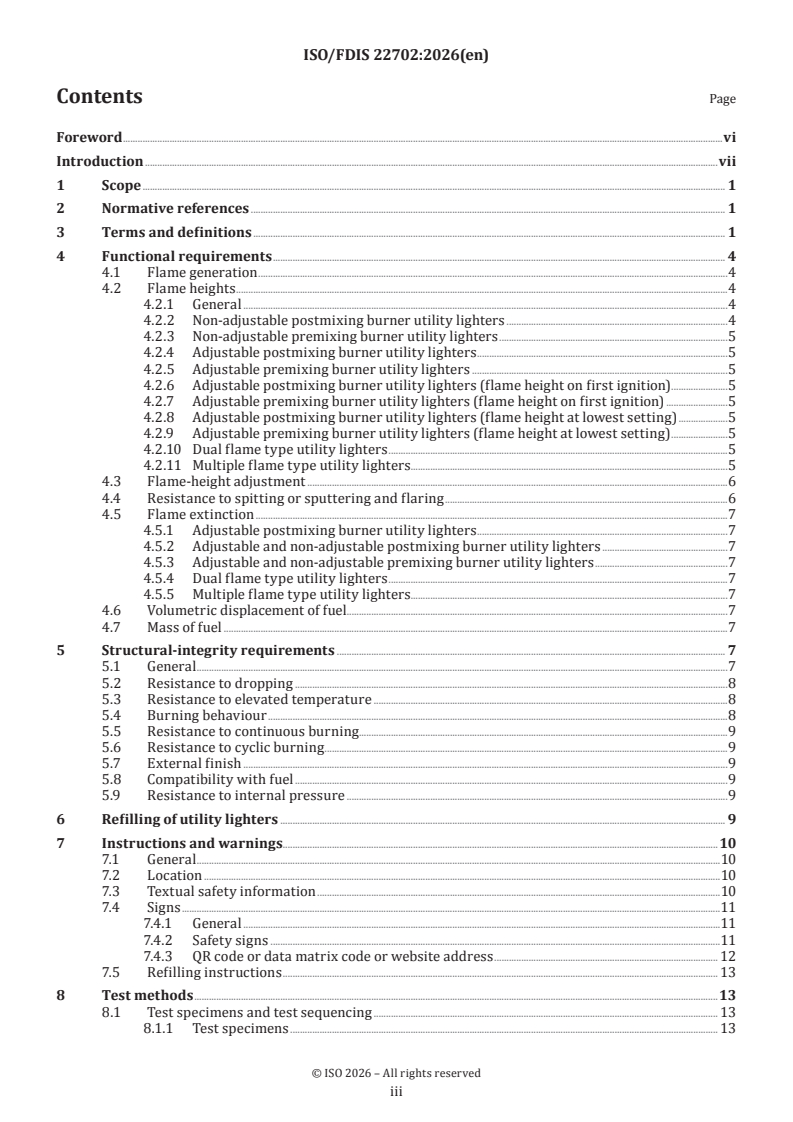
Contents Page
Foreword .vi
Introduction .vii
1 Scope . 1
2 Normative references . 1
3 Terms and definitions . 1
4 Functional requirements . 4
4.1 Flame generation .4
4.2 Flame heights .4
4.2.1 General .4
4.2.2 Non-adjustable postmixing burner utility lighters .4
4.2.3 Non-adjustable premixing burner utility lighters .5
4.2.4 Adjustable postmixing burner utility lighters .5
4.2.5 Adjustable premixing burner utility lighters .5
4.2.6 Adjustable postmixing burner utility lighters (flame height on first ignition) .5
4.2.7 Adjustable premixing burner utility lighters (flame height on first ignition) .5
4.2.8 Adjustable postmixing burner utility lighters (flame height at lowest setting) .5
4.2.9 Adjustable premixing burner utility lighters (flame height at lowest setting) .5
4.2.10 Dual flame type utility lighters .5
4.2.11 Multiple flame type utility lighters.5
4.3 Flame-height adjustment .6
4.4 Resistance to spitting or sputtering and flaring .6
4.5 Flame extinction .7
4.5.1 Adjustable postmixing burner utility lighters .7
4.5.2 Adjustable and non-adjustable postmixing burner utility lighters .7
4.5.3 Adjustable and non-adjustable premixing burner utility lighters .7
4.5.4 Dual flame type utility lighters .7
4.5.5 Multiple flame type utility lighters.7
4.6 Volumetric displacement of fuel . .7
4.7 Mass of fuel .7
5 Structural-integrity requirements . 7
5.1 General .7
5.2 Resistance to dropping .8
5.3 Resistance to elevated temperature .8
5.4 Burning behaviour .8
5.5 Resistance to continuous burning.9
5.6 Resistance to cyclic burning .9
5.7 External finish .9
5.8 Compatibility with fuel .9
5.9 Resistance to internal pressure .9
6 Refilling of utility lighters . 9
7 Instructions and warnings . .10
7.1 General .10
7.2 Location .10
7.3 Textual safety information .10
7.4 Signs .11
7.4.1 General .11
7.4.2 Safety signs .11
7.4.3 QR code or data matrix code or website address . 12
7.5 Refilling instructions . 13
8 Test methods .13
8.1 Test specimens and test sequencing . 13
8.1.1 Test specimens . 13
iii
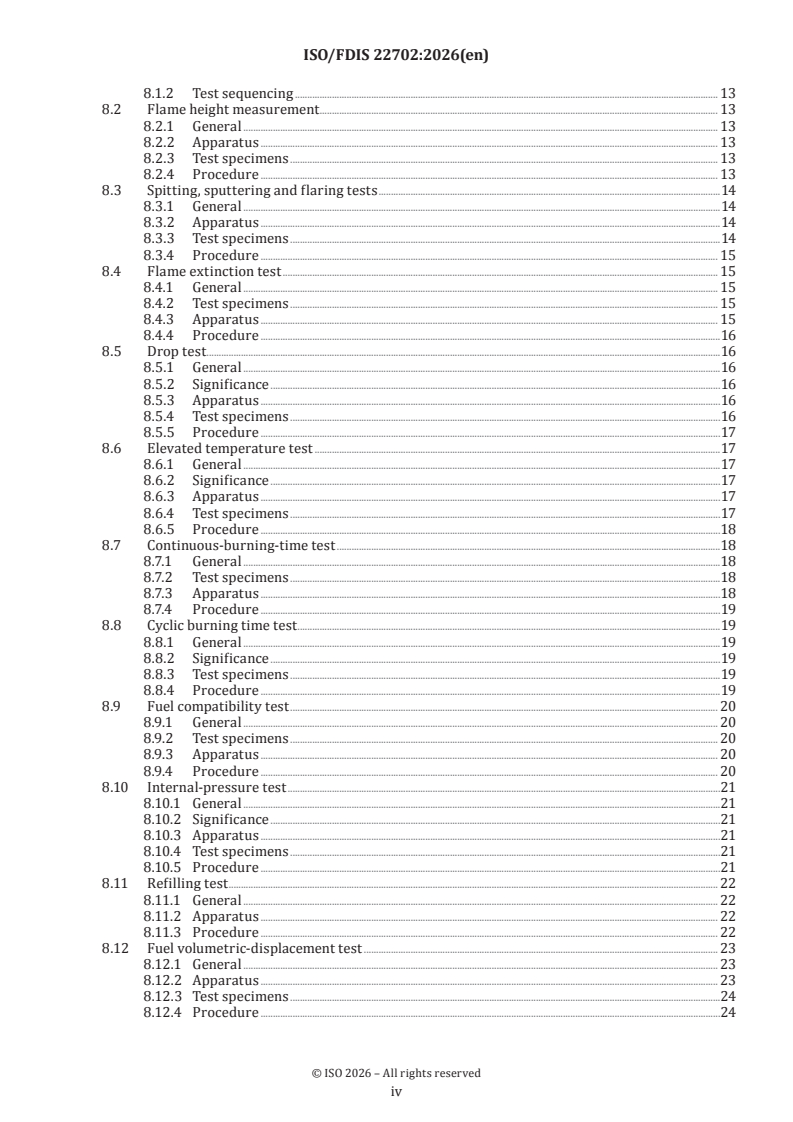
8.1.2 Test sequencing . 13
8.2 Flame height measurement . 13
8.2.1 General . 13
8.2.2 Apparatus . 13
8.2.3 Test specimens . 13
8.2.4 Procedure . 13
8.3 Spitting, sputtering and flaring tests .14
8.3.1 General .14
8.3.2 Apparatus .14
8.3.3 Test specimens .14
8.3.4 Procedure . 15
8.4 Flame extinction test . 15
8.4.1 General . 15
8.4.2 Test specimens . 15
8.4.3 Apparatus . 15
8.4.4 Procedure .16
8.5 Drop test .16
8.5.1 General .16
8.5.2 Significance .16
8.5.3 Apparatus .16
8.5.4 Test specimens .16
8.5.5 Procedure .17
8.6 Elevated temperature test .17
8.6.1 General .17
8.6.2 Significance .17
8.6.3 Apparatus .17
8.6.4 Test specimens .17
8.6.5 Procedure .18
8.7 Continuous-burning-time test .18
8.7.1 General .18
8.7.2 Test specimens .18
8.7.3 Apparatus .18
8.7.4 Procedure .19
8.8 Cyclic burning time test .19
8.8.1 General .19
8.8.2 Significance .19
8.8.3 Test specimens .19
8.8.4 Procedure .19
8.9 Fuel compatibility test . 20
8.9.1 General . 20
8.9.2 Test specimens . 20
8.9.3 Apparatus . 20
8.9.4 Procedure . 20
8.10 Internal-pressure test .21
8.10.1 General .21
8.10.2 Significance .21
8.10.3 Apparatus .21
8.10.4 Test specimens .21
8.10.5 Procedure .21
8.11 Refilling test . 22
8.11.1 General . 22
8.11.2 Apparatus . 22
8.11.3 Procedure . 22
8.12 Fuel volumetric-displacement test . 23
8.12.1 General . 23
8.12.2 Apparatus . 23
8.12.3 Test specimens .24
8.12.4 Procedure .24
iv
9 Product marking .25
Annex A (normative) Test sequencing and minimum sampling size .26
Bibliography .28
v
Foreword
ISO (the International Organization for Standardization) is a worldwide federation of national standards
bodies (ISO member bodies). The work of preparing International Standards is normally carried out through
ISO technical committees. Each member body interested in a subject for which a technical committee
has been established has the right to be represented on that committee. International organizations,
governmental and non-governmental, in liaison with ISO, also take part in the work. ISO collaborates closely
with the International Electrotechnical Commission (IEC) on all matters of electrotechnical standardization.
The procedures used to develop this document and those intended for its further maintenance are described
in the ISO/IEC Directives, Part 1. In particular, the different approval criteria needed for the different types
of ISO documents should be noted. This document was drafted in accordance with the editorial rules of the
ISO/IEC Directives, Part 2 (see www.iso.org/directives).
ISO draws attention to the possibility that the implementation of this document may involve the use of (a)
patent(s). ISO takes no position concerning the evidence, validity or applicability of any claimed patent
rights in respect thereof. As of the date of publication of this document, ISO had not received notice of (a)
patent(s) which may be required to implement this document. However, implementers are cautioned that
this may not represent the latest information, which may be obtained from the patent database available at
www.iso.org/patents. ISO shall not be held responsible for identifying any or all such patent rights.
Any trade name used in this document is information given for the convenience of users and does not
constitute an endorsement.
For an explanation of the voluntary nature of standards, the meaning of ISO specific terms and expressions
related to conformity assessment, as well as information about ISO's adherence to the World Trade
Organization (WTO) principles in the Technical Barriers to Trade (TBT), see www.iso.org/iso/foreword.html.
This document was prepared by Technical Committee ISO/TC ISO/TC 61, Plastics, Subcommittee SC 4,
Burning behaviour.
This third edition cancels and replaces the second edition (ISO 22702:2018), which has been technically
revised.
The main changes are as follows:
— 3.22, 3.23, 3.24 and 3.25, subclause 6.3, subclause 8.2.2.2, subclause 8.2.2.3, subclause 8.11.2,
subclause 8.11.3.1 and subclause 8.11.3.2, Figure 9, Figure A.1 and Figure A.2 and the Bibliography have
been added;
— 3.3, 3.4, 3.6, 3.11 and 3.16, subclauses 4.7, subclauses 5.2.1 and subclauses 6.2, Clause 7, subclause 8.1.1,
subclause 8.1.2, subclause 8.2.2.1, subclause 8.2.4, subclause 8.3, subclause 8.5.3, subclause 8.5.5,
subclause 8.6.3, subclause 8.6.5, subclause 8.9.3, subclause 8.9.4, subclause 8.10.5.3 and subclause 8.12.3,
Figure 4, Figure 5, Figure 6, Figure 7, Figure 8 and Annex A have been modified.
Any feedback or questions on this document should be directed to the user’s national standards body. A
complete listing of these bodies can be found at www.iso.org/members.html.
vi
Introduction
Utility lighters, being flame-producing articles, can, as do all flame sources, present a potential hazard to
the user. The safety specifications given in this document cannot eliminate all hazards, but are intended to
minimize potential hazards of utility lighters to users.
vii
FINAL DRAFT International Standard ISO/FDIS 22702:2026(en)
Utility lighters — Safety specifications
WARNING — This document does not purport to address all the safety concerns, if any, associated
with its use. It is the responsibility of the user of this document to establish appropriate safety and
health practices and to determine the applicability of any other restrictions.
1 Scope
This document specifies requirements for utility lighters to ensure a reasonable degree of safety for normal
use or reasonably foreseeable misuse of such lighters by users.
This document applies to all flame-producing consumer products commonly known as utility lighters (also
known as grill lighters, fireplace lighters, lighting rods or gas matches), and similar devices.
It does not apply to matches and flame-producing products intended for igniting cigars, pipes and cigarettes.
2 Normative references
The following documents are referred to in the text in such a way that some or all of their content constitutes
requirements of this document. For dated references, only the edition cited applies. For undated references,
the latest edition of the referenced document (including any amendments) applies.
ISO 7941, Commercial propane and butane — Analysis by gas chromatography
UL 1439, Tests for Sharpness of Edges on Equipment
3 Terms and definitions
For the purposes of this document, the following terms and definitions apply.
ISO and IEC maintain terminology databases for use in standardization at the following addresses:
— ISO Online browsing platform: available at https:// www .iso .org/ obp
— IEC Electropedia: available at https:// www .electropedia .org/
3.1
valve
component of a utility lighter (3.6) that controls the input or release of fuel (3.9)
3.2
nozzle
end of the fuel discharge system
3.3
flame height
linear distance from the tip of the visible flame (3.19) to the end of the shield (3.12)
Note 1 to entry: Flame height as observed by the naked eye.
3.4
flaring
variation of flame height (3.3) from the steady-state flame condition
Note 1 to entry: Flaring as observed by the naked eye.
3.5
ignite
produce a flame (3.19) with a utility lighter (3.6) by activating the self-contained ignition and fuel release
systems of that utility lighter (3.6) in the intended manner
3.6
utility lighter
hand-held, flame-producing article (3.22) with a manually-operated ignition system, 100 mm or greater
in length when in the fully extended position, employing a fuel (3.9), used primarily to ignite items such
as candles, fuel for fireplaces, charcoal- or gas-fired grills, camp stoves, lanterns, fuel-fired appliances or
devices and/or pilot lights
Note 1 to entry: Utility lighters are not considered substances (3.23), mixtures (3.24), a container with a substance or a
mixture, or a combination of article and substance/mixture.
Note 2 to entry: Utility lighters are not considered aerosol dispensers (3.25).
3.7
adjustable utility lighter
utility lighter (3.6) that is received by the consumer with a mechanism for the user to manually vary the
flame height (3.3)
3.8
non-refillable utility lighter
disposable utility lighter
utility lighter (3.6) that is received by the user with a supply of fuel and that is not intended to be refuelled
3.9
fuel
butane, isobutane, propane or other liquefied hydrocarbon, or a mixture containing any of these, whose
vapour pressure at 24 °C exceeds a gauge pressure of 103 kPa
3.10
non-adjustable utility lighter
utility lighter (3.6) that has a flame height (3.3) preset by the manufacturer and is not provided with a
mechanism to adjust the flame height (3.3)
3.11
refillable utility lighter
utility lighter (3.6) that is intended to be refuelled either by transferring fuel (3.9) from an external container
or by inserting a new prefilled fuel reservoir
3.12
shield
structure that totally or partially surrounds the nozzle (3.2) of the utility lighter (3.6)
3.13
sustained self-ignition
propagation of a flame (3.19) by other than deliberate manual operation, such as by dropping the utility
lighter (3.6), so as to cause the ignition system (3.16) to be activated and the flame to continue to burn
3.14
spitting
sputtering
flame phenomenon of a utility lighter (3.6) wherein the escape of non-evaporated or liquid fuel produces a
shower of burning liquid droplets which separate from the main flame
3.15
fuel reservoir
structure that stores the fuel (3.9) prior to release
3.16
ignition system
system that generates a spark to ignite the fuel (3.9), such as a piezo mechanism, battery or flint
3.17
premixing burner utility lighter
gas utility lighter (3.6) in which fuel (3.9) and air are mixed before being supplied for combustion
3.18
postmixing burner utility lighter
gas utility lighter (3.6) in which fuel (3.9) is supplied for combustion and air is supplied at the point of
combustion
3.19
flame
result of combustion of fuel (3.9) that produces heat and often light which can be visible to the naked eye
under normal or subdued lighting conditions
3.20
dual flame type utility lighter
utility lighter (3.6) that employs a burner valve system(s) that produces more than one type of flame
(premixing and postmixing), which can be produced independently and separately (one flame type at a
time), or dependently and concurrently (multiple flames types at a time)
3.21
multiple flame type utility lighter
utility lighter (3.6) that employs a burner valve system(s) that produces more than one flame of the same
type of flame (premixing or postmixing), which could be produced independently and separately (one flame
at a time), or dependently and concurrently (multiple flames at a time)
3.22
article
object which during production is given a special shape, surface or design which determines its function to a
greater degree than does its chemical composition
3.23
substance
chemical element and its compounds in the natural state or obtained by any manufacturing process,
including any additive necessary to preserve its stability and any impurity deriving from the process
used, but excluding any solvent which may be separated without affecting the stability of the substance or
changing its composition
3.24
mixture
solution composed of two or more substances (3.23)
3.25
aerosol dispenser
non-reusable container made of metal, glass or plastic and containing a gas compressed, liquefied or
dissolved under pressure, with or without a liquid, paste or powder, and fitted with a release device allowing
the contents to be ejected as solid or liquid particles in suspension in a gas, as a foam, paste or powder or in
a liquid state
4 Functional requirements
4.1 Flame generation
In order to minimize the possibility of inadvertent ignition or self-ignition, utility lighters shall require a
deliberate manual operation to produce a flame. These operations shall conform to at least one of the
following requirements:
a) a system such that positive action on the part of the user is required to generate and maintain a flame;
b) a system that requires two or more independent actions by the user to generate a flame;
c) a system that requires an actuating force equal to or greater than 15 N to generate a flame (see Figure 1
for an example of test equipment).
Figure 1 — Block diagram showing a typical example of test equipment for measuring the flame
generation actuating force
4.2 Flame heights
4.2.1 General
The maximum attainable flame height for utility lighters shall be limited with a setting or by product design,
or both. For adjustable-flame-height utility lighters, the maximum flame height that a user will obtain on
first activating the utility lighter without adjustment shall also be limited. These limits shall conform to the
following requirements when tested in accordance with 8.2.
4.2.2 Non-adjustable postmixing burner utility lighters
Non-adjustable postmixing burner utility lighters, as defined in 3.10 and 3.18, shall have, in the user’s hands,
a maximum attainable flame height of no more than 100 mm when the flame is directed vertically upward
when tested in accordance with 8.2.
4.2.3 Non-adjustable premixing burner utility lighters
Non-adjustable premixing burner utility lighters, as defined in 3.10 and 3.17, shall have, in the user’s hands,
a maximum attainable flame height of no more than 75 mm when the flame is directed vertically upward
when tested in accordance with 8.2.
4.2.4 Adjustable postmixing burner utility lighters
Adjustable postmixing burner utility lighters, as defined in 3.7 and 3.18, shall not be capable of producing a
flame height greater than 150 mm when the flame is directed vertically upward, when deliberately adjusted
by the user to the manufacturer’s design limit for maximum flame height and when tested in accordance
with 8.2.
4.2.5 Adjustable premixing burner utility lighters
Adjustable premixing burner utility lighters, as defined in 3.7 and 3.17, shall not be capable of producing a
flame height greater than 75 mm when the flame is directed vertically upward, when deliberately adjusted
by the user to the manufacturer’s design limit for maximum flame height and when tested in accordance
with 8.2.
4.2.6 Adjustable postmixing burner utility lighters (flame height on first ignition)
Adjustable postmixing burner utility lighters, as defined in 3.7 and 3.18, shall have the flame height adjusted
by the manufacturer in such a manner that the utility lighter, when first ignited by the user without changing
the adjustment, will not produce a flame height in excess of 100 mm when the flame is directed vertically
upward and when tested in accordance with 8.2.
4.2.7 Adjustable premixing burner utility lighters (flame height on first ignition)
Adjustable premixing burner utility lighters, as defined in 3.7 and 3.17, shall have the flame height adjusted
by the manufacturer in such a manner that the utility lighter, when first ignited by the user without changing
the adjustment, will not produce a flame height in excess of 60 mm when the flame is directed vertically
upward and when tested in accordance with 8.2.
4.2.8 Adjustable postmixing burner utility lighters (flame height at lowest setting)
Adjustable postmixing burner utility lighters, as defined in 3.7 and 3.18, shall be capable of producing a
flame not in excess of 75 mm with the flame directed vertically upward, when set at the lowest possible
flame height and tested in accordance with 8.2.
4.2.9 Adjustable premixing burner utility lighters (flame height at lowest setting)
Adjustable premixing burner utility lighters, as defined in 3.7 and 3.17, shall be capable of producing a flame
not in excess of 50 mm with the flame directed vertically upward, when set at the lowest possible flame
height and tested in accordance with 8.2.
4.2.10 Dual flame type utility lighters
Dual flame type utility lighters for each type of flame of a dual flame type utility lighter, each flame height
shall conform to the corresponding requirement for that type of flame provided in 4.2.1 to 4.2.9.
4.2.11 Multiple flame type utility lighters
Multiple flame type utility lighters for each flame of a multiple flame type utility lighter, the flame shall
conform to the corresponding requirement for that type of flame provided in 4.2.1 to 4.2.9.
4.3 Flame-height adjustment
4.3.1 Adjustable utility lighters shall require a deliberate action on the part of the user either to decrease
or to increase the flame height when the utility lighter is used in the normal fashion.
4.3.2 If flame-height adjustment features protrude from the body of the utility lighter, it shall require a
minimum actuating force of 1 N applied over the entire range of adjustment in a tangential direction (see
Figure 2 for an example of test equipment).
Figure 2 — Block diagram showing a typical example of test equipment for measuring the flame-
height adjustment feature actuating force
4.3.3 Adjustable utility lighters having rotary movement flame-height adjustment features approximately
at right angles to the flame shall perform as follows.
a) When the flame-height adjustment feature of the utility lighter is held so the flame is oriented vertically
upward, and the user is facing the flame-height adjustment feature, moving the actuator to the left shall
produce a decrease in flame height.
b) Adjustable utility lighters requiring motion of the flame-height adjustment feature approximately
parallel to the flame axis shall decrease or increase the flame height according to the direction of the
movement.
c) When the flame control actuator is at the bottom of the utility lighter, and the utility lighter is held so
that the user is facing the actuator, a clockwise movement shall produce a decrease in flame height.
Adjustable utility lighters shall indicate the direction of movement to produce a higher or lower flame height.
On utility lighters, the direction of movement shall be permanently imprinted or engraved on the utility
lighter. Such information shall be placed on the utility lighter in the vicinity of the flame-height adjustment
feature and be readily visible and understandable.
4.4 Resistance to spitting or sputtering and flaring
Utility lighters when set at the maximum flame height, shall exhibit no spitting or sputtering or flaring when
tested in accordance with 8.3.
4.5 Flame extinction
4.5.1 Adjustable postmixing burner utility lighters
Adjustable postmixing burner utility lighters, after a 10 s burn at maximum flame height, when extinguished
in the intended manner such as by releasing a button or lever, shall have any exposed flame completely
extinguished within 3 s after such action is completed, when tested in accordance with 8.4. In the case of
postmixing burner utility lighters that have shields, an additional 3 s afterburn is acceptable if the flame
height during this additional 3 s period does not extend above the shield.
4.5.2 Adjustable and non-adjustable postmixing burner utility lighters
Adjustable postmixing burner utility lighters when set at a flame height of 100 mm (or the maximum height
the adjustment allows if lower than 100 mm), or non-adjustable postmixing burner utility lighters at their
permanently set flame heights, after a 20 s burn, when extinguished in the intended manner such as by
releasing a button or lever, shall have any exposed flame completely extinguished within 3 s after such action
is completed, when tested in accordance with 8.4. In the case of postmixing burner utility lighters that have
shields, an additional 3 s afterburn is acceptable if the flame height during this additional 3 s period does not
extend above the shield.
4.5.3 Adjustable and non-adjustable premixing burner utility lighters
Adjustable premixing burner utility lighters when set at a flame height of 75 mm (or the maximum height
the adjustment allows if lower than 75 mm), or non-adjustable premixing burner utility lighters at their
permanently set flame heights, after a 20 s burn, when extinguished in the intended manner, such as by
releasing a button or lever, shall have any exposed flame completely extinguished in no more than 6 s, when
tested in accordance with 8.4.
NOTE The total afterburn time of 6 s is intended to be reconsidered periodically with a view to gradual reduction
in line with technological progress.
4.5.4 Dual flame type utilit
...
ISO/DISFDIS 22702:2026(en)
ISO/TC 61/SC 04/WG 10 4
Secretariat: BSI
Date: 2026-06-0907-13
Utility lighters — Safety specifications
Briquets utilitaires — Spécifications de sécurité
FDIS stage
All rights reserved. Unless otherwise specified, or required in the context of its implementation, no part of this publication
may be reproduced or utilized otherwise in any form or by any means, electronic or mechanical, including photocopying,
or posting on the internet or an intranet, without prior written permission. Permission can be requested from either ISO
at the address below or ISO’s member body in the country of the requester.
ISO copyright office
CP 401 • Ch. de Blandonnet 8
CH-1214 Vernier, Geneva
Phone: + 41 22 749 01 11
EmailE-mail: copyright@iso.org
Website: www.iso.org
Published in Switzerland
ii
Contents
Foreword . iv
Introduction . vi
1 Scope . 1
2 Normative references . 1
3 Terms and definitions . 1
4 Functional requirements . 4
4.1 Flame generation . 4
4.2 Flame heights . 5
4.3 Flame-height adjustment . 7
4.4 Resistance to spitting or sputtering and flaring . 9
4.5 Flame extinction . 9
4.6 Volumetric displacement of fuel . 10
4.7 Mass of fuel . 10
5 Structural-integrity requirements . 10
5.1 General. 10
5.2 Resistance to dropping . 10
5.3 Resistance to elevated temperature . 10
5.4 Burning behaviour . 10
5.5 Resistance to continuous burning . 11
5.6 Resistance to cyclic burning . 11
5.7 External finish . 11
5.8 Compatibility with fuel . 12
5.9 Resistance to internal pressure . 12
6 Refilling of utility lighters . 12
7 Instructions and warnings . 12
7.1 General. 12
7.2 Location . 12
7.3 Textual safety information . 13
7.4 Signs . 13
7.5 Refilling instructions . 16
8 Test methods . 16
8.1 Test specimens and test sequencing . 16
8.2 Flame height measurement . 17
8.3 Spitting, sputtering and flaring tests . 17
8.4 Flame extinction test . 19
8.5 Drop test . 20
8.6 Elevated temperature test . 21
8.7 Continuous-burning-time test . 22
8.8 Cyclic burning time test . 23
8.9 Fuel compatibility test . 24
8.10 Internal-pressure test . 25
8.11 Refilling test . 26
8.12 Fuel volumetric-displacement test . 27
9 Product marking . 29
Annex A (normative) Test sequencing and minimum sampling size . 30
Bibliography . 35
iii
Foreword
ISO (the International Organization for Standardization) is a worldwide federation of national standards
bodies (ISO member bodies). The work of preparing International Standards is normally carried out through
ISO technical committees. Each member body interested in a subject for which a technical committee has been
established has the right to be represented on that committee. International organizations, governmental and
non-governmental, in liaison with ISO, also take part in the work. ISO collaborates closely with the
International Electrotechnical Commission (IEC) on all matters of electrotechnical standardization.
The procedures used to develop this document and those intended for its further maintenance are described
in the ISO/IEC Directives, Part 1. In particular, the different approval criteria needed for the different types of
ISO documents should be noted. This document was drafted in accordance with the editorial rules of the
ISO/IEC Directives, Part 2 (see www.iso.org/directives).
ISO draws attention to the possibility that the implementation of this document may involve the use of (a)
patent(s). ISO takes no position concerning the evidence, validity or applicability of any claimed patent rights
in respect thereof. As of the date of publication of this document, ISO had not received notice of (a) patent(s)
which may be required to implement this document. However, implementers are cautioned that this may not
represent the latest information, which may be obtained from the patent database available at
www.iso.org/patents. ISO shall not be held responsible for identifying any or all such patent rights.
Any trade name used in this document is information given for the convenience of users and does not
constitute an endorsement.
For an explanation of the voluntary nature of standards, the meaning of ISO specific terms and expressions
related to conformity assessment, as well as information about ISO's adherence to the World Trade
Organization (WTO) principles in the Technical Barriers to Trade (TBT), see www.iso.org/iso/foreword.html.
This document was prepared by Technical Committee ISO/TC ISO/TC 61, Plastics, Subcommittee SC 4, Burning
behaviour.
This third edition cancels and replaces the second edition (ISO 22702:2018), which has been technically
revised.
The main changes are as follows:
— 3.22, 3.233.22, 3.23, 3.24, 3.24 and 3.25, subclause 6.3, subclause 8.2.2.2, subclause 8.2.2.3,
subclause 8.11.23.25, subclause 6.3, subclause 8.2.2.2, subclause 8.2.2.3, subclause 8.11.2, subclause
8.11.3.1, subclause 8.11.3.1 and subclause 8.11.3.2, Figure 9subclause 8.11.3.2, Figure 9, Figure
A.1 , Figure A.1 and Figure A.2 Figure A.2 and the Bibliography have been added;
3.3, 3.4, 3.6, 3.11 and 3.16, subclauses 4.7, subclauses 5.2.1 and subclauses 6.2, Clause 7, subclause 8.1.1,
subclause 8.1.2, subclause 8.2.2.1, subclause 8.2.4, subclause 8.3, subclause 8.5.3, subclause 8.5.5,
subclause 8.6.3, subclause 8.6.5, subclause 8.9.3, subclause 8.9.4, subclause 8.10.5.3 and subclause 8.12.3,
Figure 4, Figure 5, Figure 6, Figure 7, Figure 8 and Annex A3.3, 3.4, 3.6, 3.11 and 3.16, subclauses
4.7, subclauses 5.2.1 and subclauses 6.2, Clause 7, subclause 8.1.1, subclause 8.1.2, subclause 8.2.2.1,
subclause 8.2.4, subclause 8.3, subclause 8.5.3, subclause 8.5.5, subclause 8.6.3, subclause 8.6.5,
subclause 8.9.3, subclause 8.9.4, subclause 8.10.5.3 and subclause 8.12.3, Figure 4, Figure 5, Figure
6, Figure 7, Figure 8 and Annex A have been modified.
— .
— have been modified.
iv
Any feedback or questions on this document should be directed to the user’s national standards body. A
complete listing of these bodies can be found at www.iso.org/members.html.
v
Introduction
Utility lighters, being flame-producing articles, can, as do all flame sources, present a potential hazard to the
user. The safety specifications given in this document cannot eliminate all hazards, but are intended to
minimize potential hazards of utility lighters to users.
vi
Utility lighters — Safety specifications
WARNING — This document does not purport to address all the safety concerns, if any, associated with
its use. It is the responsibility of the user of this document to establish appropriate safety and health
practices and to determine the applicability of any other restrictions.
1 Scope
This document specifies requirements for utility lighters to ensure a reasonable degree of safety for normal
use or reasonably foreseeable misuse of such lighters by users.
This document applies to all flame-producing consumer products commonly known as utility lighters (also
known as grill lighters, fireplace lighters, lighting rods or gas matches), and similar devices.
It does not apply to matches and flame-producing products intended for igniting cigars, pipes and cigarettes.
2 Normative references
The following documents are referred to in the text in such a way that some or all of their content constitutes
requirements of this document. For dated references, only the edition cited applies. For undated references,
the latest edition of the referenced document (including any amendments) applies.
ISO 7941, Commercial propane and butane — Analysis by gas chromatography
UL 1439, Tests for Sharpness of Edges on Equipment
3 Terms and definitions
For the purposes of this document, the following terms and definitions apply.
ISO and IEC maintain terminology databases for use in standardization at the following addresses:
— — ISO Online browsing platform: available at https://www.iso.org/obp
— — IEC Electropedia: available at https://www.electropedia.org/
3.1 3.1
valve
component of a utility lighter (3.6(3.6)) that controls the input or release of fuel (3.9(3.9))
3.2 3.2
nozzle
end of the fuel discharge system
3.3 3.3
flame height
linear distance from the tip of the visible flame (3.19(3.19)) to the end of the shield (3.12(3.12))
Note 1 to entry: Flame height as observed by the naked eye.
3.4 3.4
flaring
variation of flame height (3.3(3.3)) from the steady-state flame condition
Note 1 to entry: Flaring as observed by the naked eye.
3.5 3.5
ignite
produce a flame (3.19(3.19)) with a utility lighter (3.6(3.6)) by activating the self-contained ignition and fuel
release systems of that utility lighter (3.6(3.6)) in the intended manner
3.6 3.6
utility lighter
hand-held, flame-producing article (3.22(3.22)) with a manually-operated ignition system, 100 mm or greater
in length when in the fully extended position, employing a fuel (3.9(3.9),), used primarily to ignite items such
as candles, fuel for fireplaces, charcoal- or gas-fired grills, camp stoves, lanterns, fuel-fired appliances or
devices and/or pilot lights
Note 1 to entry: Utility lighters are not considered substances (3.23(3.23),), mixtures (3.24(3.24),), a container with a
substance or a mixture, or a combination of article and substance/mixture.
Note 2 to entry: Utility lighters are not considered aerosol dispensers (3.25(3.25).).
3.7 3.7
adjustable utility lighter
utility lighter (3.6(3.6)) that is received by the consumer with a mechanism for the user to manually vary the
flame height (3.3(3.3))
3.8 3.8
non-refillable utility lighter
disposable utility lighter
utility lighter (3.6(3.6)) that is received by the user with a supply of fuel and that is not intended to be refuelled
3.9 3.9
fuel
butane, isobutane, propane or other liquefied hydrocarbon, or a mixture containing any of these, whose
vapour pressure at 24 °C exceeds a gauge pressure of 103 kPa
3.10 3.10
non-adjustable utility lighter
utility lighter (3.6(3.6)) that has a flame height (3.3(3.3)) preset by the manufacturer and is not provided with
a mechanism to adjust the flame height (3.3(3.3))
3.11 3.11
refillable utility lighter
utility lighter (3.6(3.6)) that is intended to be refuelled either by transferring fuel (3.9(3.9)) from an external
container or by inserting a new prefilled fuel reservoir
3.12 3.12
shield
structure that totally or partially surrounds the nozzle (3.2(3.2)) of the utility lighter (3.6(3.6))
3.13 3.13
sustained self-ignition
propagation of a flame (3.19(3.19)) by other than deliberate manual operation, such as by dropping the utility
lighter (3.6(3.6),), so as to cause the ignition system (3.16(3.16)) to be activated and the flame to continue to
burn
3.14 3.14
spitting
sputtering
flame phenomenon of a utility lighter (3.6(3.6)) wherein the escape of non-evaporated or liquid fuel produces
a shower of burning liquid droplets which separate from the main flame
3.15 3.15
fuel reservoir
structure that stores the fuel (3.9(3.9)) prior to release
3.16 3.16
ignition system
system that generates a spark to ignite the fuel (3.9(3.9),), such as a piezo mechanism, battery or flint
3.17 3.17
premixing burner utility lighter
gas utility lighter (3.6(3.6)) in which fuel (3.9(3.9)) and air are mixed before being supplied for combustion
3.18 3.18
postmixing burner utility lighter
gas utility lighter (3.6(3.6)) in which fuel (3.9(3.9)) is supplied for combustion and air is supplied at the point
of combustion
3.19 3.19
flame
result of combustion of fuel (3.9(3.9)) that produces heat and often light which can be visible to the naked eye
under normal or subdued lighting conditions
3.20 3.20
dual flame type utility lighter
utility lighter (3.6(3.6)) that employs a burner valve system(s) that produces more than one type of flame
(premixing and postmixing), which can be produced independently and separately (one flame type at a time),
or dependently and concurrently (multiple flames types at a time)
3.21 3.21
multiple flame type utility lighter
utility lighter (3.6(3.6)) that employs a burner valve system(s) that produces more than one flame of the same
type of flame (premixing or postmixing), which could be produced independently and separately (one flame
at a time), or dependently and concurrently (multiple flames at a time)
3.22 3.22
article
object which during production is given a special shape, surface or design which determines its function to a
greater degree than does its chemical composition
3.23 3.23
substance
chemical element and its compounds in the natural state or obtained by any manufacturing process, including
any additive necessary to preserve its stability and any impurity deriving from the process used, but excluding
any solvent which may be separated without affecting the stability of the substance or changing its
composition
3.24 3.24
mixture
solution composed of two or more substances (3.23(3.23))
3.25 3.25
aerosol dispenser
non-reusable container made of metal, glass or plastic and containing a gas compressed, liquefied or dissolved
under pressure, with or without a liquid, paste or powder, and fitted with a release device allowing the
contents to be ejected as solid or liquid particles in suspension in a gas, as a foam, paste or powder or in a
liquid state
4 Functional requirements
4.1 Flame generation
In order to minimize the possibility of inadvertent ignition or self-ignition, utility lighters shall require a
deliberate manual operation to produce a flame. These operations shall conform to at least one of the following
requirements:
a) a) a system such that positive action on the part of the user is required to generate and maintain
a flame;
b) b) a system that requires two or more independent actions by the user to generate a flame;
c) c) a system that requires an actuating force equal to or greater than 15 N to generate a flame
(see Figure 1Figure 1 for an example of test equipment).
Figure 1 — Block diagram showing a typical example of test equipment for measuring the flame
generation actuating force
4.2 Flame heights
4.2.1 General
The maximum attainable flame height for utility lighters shall be limited with a setting or by product design,
or both. For adjustable-flame-height utility lighters, the maximum flame height that a user will obtain on first
activating the utility lighter without adjustment shall also be limited. These limits shall conform to the
following requirements when tested in accordance with 8.28.2.
4.2.2 Non-adjustable postmixing burner utility lighters
Non-adjustable postmixing burner utility lighters, as defined in 3.103.10 and 3.183.18,, shall have, in the user’s
hands, a maximum attainable flame height of no more than 100 mm when the flame is directed vertically
upward when tested in accordance with 8.28.2.
4.2.3 Non-adjustable premixing burner utility lighters
Non-adjustable premixing burner utility lighters, as defined in 3.103.10 and 3.173.17,, shall have, in the user’s
hands, a maximum attainable flame height of no more than 75 mm when the flame is directed vertically
upward when tested in accordance with 8.28.2.
4.2.4 Adjustable postmixing burner utility lighters
Adjustable postmixing burner utility lighters, as defined in 3.73.7 and 3.183.18,, shall not be capable of
producing a flame height greater than 150 mm when the flame is directed vertically upward, when
deliberately adjusted by the user to the manufacturer’s design limit for maximum flame height and when
tested in accordance with 8.28.2.
4.2.5 Adjustable premixing burner utility lighters
Adjustable premixing burner utility lighters, as defined in 3.73.7 and 3.173.17,, shall not be capable of
producing a flame height greater than 75 mm when the flame is directed vertically upward, when deliberately
adjusted by the user to the manufacturer’s design limit for maximum flame height and when tested in
accordance with 8.28.2.
4.2.6 Adjustable postmixing burner utility lighters (flame height on first ignition)
Adjustable postmixing burner utility lighters, as defined in 3.73.7 and 3.183.18,, shall have the flame height
adjusted by the manufacturer in such a manner that the utility lighter, when first ignited by the user without
changing the adjustment, will not produce a flame height in excess of 100 mm when the flame is directed
vertically upward and when tested in accordance with 8.28.2.
4.2.7 Adjustable premixing burner utility lighters (flame height on first ignition)
Adjustable premixing burner utility lighters, as defined in 3.73.7 and 3.173.17,, shall have the flame height
adjusted by the manufacturer in such a manner that the utility lighter, when first ignited by the user without
changing the adjustment, will not produce a flame height in excess of 60 mm when the flame is directed
vertically upward and when tested in accordance with 8.28.2.
4.2.8 Adjustable postmixing burner utility lighters (flame height at lowest setting)
Adjustable postmixing burner utility lighters, as defined in 3.73.7 and 3.183.18,, shall be capable of producing
a flame not in excess of 75 mm with the flame directed vertically upward, when set at the lowest possible flame
height and tested in accordance with 8.28.2.
4.2.9 Adjustable premixing burner utility lighters (flame height at lowest setting)
Adjustable premixing burner utility lighters, as defined in 3.73.7 and 3.173.17,, shall be capable of producing
a flame not in excess of 50 mm with the flame directed vertically upward, when set at the lowest possible flame
height and tested in accordance with 8.28.2.
4.2.10 Dual flame type utility lighters
Dual flame type utility lighters for each type of flame of a dual flame type utility lighter, each flame height shall
conform to the corresponding requirement for that type of flame provided in 4.2.14.2.1 to 4.2.94.2.9.
4.2.11 Multiple flame type utility lighters
4.2.111.1.1 Multiple flame type utility lighters
Multiple flame type utility lighters for each flame of a multiple flame type utility lighter, the flame shall
conform to the corresponding requirement for that type of flame provided in 4.2.14.2.1 to 4.2.94.2.9.
4.3 Flame-height adjustment
4.3.1 4.3.1 Adjustable utility lighters shall require a deliberate action on the part of the user either to
decrease or to increase the flame height when the utility lighter is used in the normal fashion.
4.3.2 4.3.2 If flame-height adjustment features protrude from the body of the utility lighter, it shall require
a minimum actuating force of 1 N applied over the entire range of adjustment in a tangential direction (see
Figure 2Figure 2 for an example of test equipment).
Figure 2 — Block diagram showing a typical example of test equipment for measuring the flame-
height adjustment feature actuating force
4.3.3 4.3.3 Adjustable utility lighters having rotary movement flame-height adjustment features
approximately at right angles to the flame shall perform as follows.
a) a) When the flame-height adjustment feature of the utility lighter is held so the flame is oriented
vertically upward, and the user is facing the flame-height adjustment feature, moving the actuator to the
left shall produce a decrease in flame height.
b) b) Adjustable utility lighters requiring motion of the flame-height adjustment feature
approximately parallel to the flame axis shall decrease or increase the flame height according to the
direction of the movement.
c) c) When the flame control actuator is at the bottom of the utility lighter, and the utility lighter is
held so that the user is facing the actuator, a clockwise movement shall produce a decrease in flame height.
Adjustable utility lighters shall indicate the direction of movement to produce a higher or lower flame height.
On utility lighters, the direction of movement shall be permanently imprinted or engraved on the utility
lighter. Such information shall be placed on the utility lighter in the vicinity of the flame-height adjustment
feature and be readily visible and understandable.
4.4 Resistance to spitting or sputtering and flaring
Utility lighters when set at the maximum flame height, shall exhibit no spitting or sputtering or flaring when
tested in accordance with 8.38.3.
4.5 Flame extinction
4.5.1 Adjustable postmixing burner utility lighters
Adjustable postmixing burner utility lighters, after a 10 s burn at maximum flame height, when extinguished
in the intended manner such as by releasing a button or lever, shall have any exposed flame completely
extinguished within 3 s after such action is completed, when tested in accordance with 8.48.4. In the case of
postmixing burner utility lighters that have shields, an additional 3 s afterburn is acceptable if the flame height
during this additional 3 s period does not extend above the shield.
4.5.2 Adjustable and non-adjustable postmixing burner utility lighters
Adjustable postmixing burner utility lighters when set at a flame height of 100 mm (or the maximum height
the adjustment allows if lower than 100 mm), or non-adjustable postmixing burner utility lighters at their
permanently set flame heights, after a 20 s burn, when extinguished in the intended manner such as by
releasing a button or lever, shall have any exposed flame completely extinguished within 3 s after such action
is completed, when tested in accordance with 8.48.4. In the case of postmixing burner utility lighters that have
shields, an additional 3 s afterburn is acceptable if the flame height during this additional 3 s period does not
extend above the shield.
4.5.3 Adjustable and non-adjustable premixing burner utility lighters
Adjustable premixing burner utility lighters when set at a flame height of 75 mm (or the maximum height the
adjustment allows if lower than 75 mm), or non-adjustable premixing burner utility lighters at their
permanently set flame heights, after a 20 s burn, when extinguished in the intended manner, such as by
releasing a button or lever, shall have any exposed flame completely extinguished in no more than 6 s, when
tested in accordance with 8.48.4.
NOTE The total afterburn time of 6 s is intended to be reconsidered periodically with a view to gradual reduction in
line with technological progress.
4.5.4 Dual flame type utility lighters
In the case of dual flame type utility lighters, the extinction time of each type of flame shall conform to the
corresponding requirement for that type of flame provided in 4.54.5.
4.5.5 Multiple flame type utility lighters
4.5.5 Multiple flame type utility lighters
In the case of multiple flame type utility lighters, the extinction time of each flame shall conform to the
corresponding requirement for that type of flame provided in 4.54.5.
4.6 Volumetric displacement of fuel
For utility lighters shipped with fuel, the liquid portion of the fuel shall not exceed 85 % of the volumetric
capacity of the fuel chamber when tested in accordance with 8.128.12.
4.7 Mass of fuel
For gas utility lighters shipped with fuel, the mass of the liquefied fuel shall not exceed 10 g, when tested in
accordance with 8.12.4.28.12.4.2.
5 Structural-integrity requirements
5.1 General
Utility lighters shall have structural integrity as specified in 5.25.2 to 5.95.9.
5.2 Resistance to dropping
5.2.1 5.2.1 Utility lighters shall be capable of withstanding three separate (1,5 ± 0,1) m drops, conducted
in accordance with 8.58.5,, without fuel reservoir fragmentation causing fuel leakage, sustained self-ignition,
a leakage rate exceeding 15 mg/min and without impairing the subsequent safe operation of the utility lighter.
5.2.2 5.2.2 Utility lighters that meet the requirements of 5.2.15.2.1,, and those that are able to be ignited
in the intended manner, shall subsequently meet the applicable requirements of 4.1 4.1 to 4.54.5 inclusive.
5.2.3 5.2.3 Utility lighters that are not able to be ignited in the intended manner do not constitute a failure.
5.3 Resistance to elevated temperature
5.3.1 5.3.1 Utility lighters shall be capable of withstanding a temperature of 65 °C for 4 h when tested in
accordance with 8.68.6.
5.3.2 5.3.2 Utility lighters that meet the requirements of 5.3.15.3.1 and that are still able to be ignited in
the intended manner after stabilization at (23 ± 2) °C shall subsequently meet all the applicable requirements
of 4.1 4.1 to 4.54.5,, inclusive.
5.4 Burning behaviour
5.4.1 5.4.1 Adjustable utility lighters with the flame height set at maximum, or non-adjustable utility
lighters at their permanently set flame heights, shall be capable of withstanding a burning time of 10 s in
2 different attitudes:
a) a) with the flame directed vertically upward;
b) b) with the flame directed 45° ± 5° below horizontal.
5.4.2 5.4.2 First test the utility lighter with the flame directed vertically upward. There shall be no
evidence of any burning or distortion of components so as to cause a hazardous condition.
5.4.3 5.4.3 Utility lighters that meet the requirements of 5.4.25.4.2 and that are still able to be ignited in
the intended manner after stabilization for 5 min at (23 ± 2) °C shall be tested in the same manner with the
flame directed 45° ± 5° below horizontal, as shown in Figure 3Figure 3. There shall be no evidence of any
burning or distortion of components so as to cause a hazardous condition.
5.4.4 5.4.4 Utility lighters that do not fail the test and are able to be ignited in the intended manner shall
subsequently meet all the applicable requirements of 4.14.1 to 4.54.5 inclusive.
Figure 3 — Position of specimen for the burning test
5.5 Resistance to continuous burning
All utility lighters shall be capable of withstanding a continuous-burning time of 2 min when tested in
accordance with 8.78.7.
5.6 Resistance to cyclic burning
All utility lighters shall be capable of withstanding a burning time of 20 s, repeated 10 times, when tested in
accordance with 8.88.8.
5.7 External finish
Utility lighters shall have no external sharp edges that could cause accidental cuts or abrasions to the user
when handled or used in the intended manner. If a potential sharp edge is found it shall be tested according
to UL 1439.
NOTE UL refers to Underwriters Laboratories.
5.8 Compatibility with fuel
Components of utility lighters, that come in contact with the fuel supplied with the utility lighter or
recommended by the manufacturer shall not deteriorate, after exposure to the fuel, so as to cause the utility
lighter to fail any of the criteria contained in this specification or allow a leakage rate exceeding 15 mg/min,
when tested in accordance with 8.98.9.
5.9 Resistance to internal pressure
Utility lighter fuel chambers shall be capable of withstanding an internal pressure of two times the vapour
pressure occurring at 55 °C of the fuel recommended by the manufacturer, when tested in accordance with
8.108.10.
6 Refilling of utility lighters
6.1 6.1 Refillable utility lighters shall include specific instructions and warnings as applicable in
accordance with Clause 7Clause 7.
6.2 6.2 The refilling valve in a refillable utility lighter refueled by transferring fuel from an external
container shall be secure so as not to allow a leakage rate exceeding 15 mg/min, when tested in accordance
with 8.118.11.
6.3 6.3 Refillable utility lighters refuelled by inserting a new prefilled fuel reservoir (with or without
ignition system) shall have a secure sealing mechanism so as not to allow a leakage rate exceeding 15 mg/min,
when tested in accordance with 8.118.11.
7 Instructions and warnings
7.1 General
All utility lighters shall be accompanied by appropriate safety information (instructions or warnings, or both),
either in text form or in the form of signs that would replace all existing textual instructions (7.3(7.3,, including
the word “WARNING”) and warnings, or both, communicating to the user the proper method of usage.
This information shall emphasize the warnings that are most appropriate to the type of utility lighter. The
safety information shall be conspicuously placed, with a contrasting background, colour, type size or style
distinct from other information.
NOTE There is no specific sign for every statement defined in 7.3.17.3.1 and 7.3.27.3.2 a to h (e.g. 7.3.17.3.1 “Ignite
utility lighter away from face and clothing”, and 7.3.27.3.2 a- "Be sure flame is out after use"). When all of the signs
provided in 7.47.4 are used, they are deemed to cover all statements defined in 7.3.17.3.1 and 7.3.27.3.2 a to h, even those
that do not have a dedicated sign.
7.2 Location
Utility lighters sold in consumer product packaging shall have the safety information (instructions or
warnings, or both) placed either on the utility lighter itself or on the consumer product packaging or in a
separate brochure or pamphlet included with the consumer product packaging.
Utility lighters not sold in consumer product packaging, but for sale from trays, displays or other multi-unit
formats shall have the safety information (instructions or warnings, or both) placed either on the utility lighter
itself, or in a separate brochure or pamphlet or on the trays, displays or other multi-unit formats visible to the
consumer purchasing the utility lighter, thus eliminating the necessity of having the safety information
(instructions or warnings, or both) accompanying the consumer after purchasing the product.
7.3 Textual safety information
7.3.1 7.3.1 For all utility lighters, the following safety information shall be provided:
a) a) “WARNING”
b) b) “KEEP AWAY FROM CHILDREN” or “KEEP OUT OF REACH OF CHILDREN”(” (The statement
used shall be emphasized and distinctive)
c) c) “Ignite utility lighter away from face and clothing.”
d) d) “Do not use to light cigarettes, cigars or pipes.”
7.3.2 7.3.2 For all utility lighters, the safety information shall include the following as appropriate to the
type of utility lighter:
a) a) “Be sure flame is out after use.” (This shall apply to all types of utility lighters)
b) b) “Never expose to heat above 50 °C or to prolonged sunlight.”(This shall apply to all types of
utility lighters)
c) c) “Never puncture or put in fire.” (This shall apply to all types of utility lighters)
d) d) “Extreme heat is present above the visible flame. Extra care should be taken to prevent burn,
injury or fire.” (This shall apply to all premixing burner utility lighters)
e) e) “Follow all instructions and warnings provided by manufacturer of appliance or any other item
when using this product.” (This shall apply to all types of utility lighters)
f) f) “Do not keep lit for more than 30 seconds.” (This shall apply to all types of utility lighters)
g) g) “After refilling, wait 2 minutes before using lighter.” (This shall apply to all refillable utility
lighters)
h) h) “Contains flammable gas under pressure” or “when filled will contain flammable gas under
pressure.” (This shall apply to all types of utility lighters)
7.4 Signs
7.4.1 General
As permitted in 7.17.1,, if signs are used to replace the textual safety information (as defined in 7.37.3)) one
of the following options shall be used:
a) a) the safety signs as defined in 7.4.27.4.2;;
b) b) the safety signs defined in 7.4.27.4.2 a and 7.4.27.4.2 b accompanied by a QR code or a data
matrix code or by a website address (as defined in 7.4.37.4.3)) from which it would be possible to access
the safety information.
7.4.2 Safety signs
If safety signs are used, the following safety signs may be used.
a) a) “Warning: Flammable material”
Sign proportions: same as those in Figure 4Figure 4.
Figure 4 — Warning; flammable material (ISO 7010-W021)
b) b) “Keep out of reach of children”
Sign proportions: same as those in Figure 5Figure 5.
Figure 5 — Keep out of reach of children (IEC 60417-6091)
c) c) “Do not expose to direct sunlight or hot surface”
Sign proportions: same as those in Figure 6Figure 6.
Figure 6 — Do not expose to direct sunlight or hot surface (ISO 7010-P068)
d) d) Warning; General warning sign
Sign proportions: same as those in Figure 7Figure 7.
Figure 7 — Warning; General warning sign (ISO 7010-W001)
7.4.3 QR code or data matrix code or website address
After scanning the QR code or the data matrix code or accessing the website through the dedicated website
address, the appropriate safety information (as defined in 7.37.3 or 7.47.4)) shall be readily accessible.
Safety information (as defined in 7.37.3 or 7.47.4)) and any applicable refilling instructions (as defined in
7.57.5)) shall be prominently displayed. Additional information may be included following the safety
information.
The QR code or data matrix code or website address shall be in close proximity to the safety signs (as defined
in 7.4.17.4.1.b).
When using a website address, the website address and the safety signs (as defined in 7.4.17.4.1.b) shall be
contained within a solid line border of contrasting colour in any shape (see examples in Figure 8Figure 8).).
The website address shall be easily readable.
b) Example
a) Example
Key
A , indicates the website address placeholder (e.g.,. www…).
NOTE The dotted lines surrounding the website address placeholder are provided solely to illustrate possible
locations where it maycan be placed. They are not a design requirement: the website address does not need to be framed
by dotted lines.
Figure 8 — Examples when using a website address to display safety information
7.5 Refilling instructions
Refillable utility lighters shall be accompanied by specific instructions and warnings as to the correct
procedure to accomplish the refill operation by inserting a prefilled fuel reservoir or by refilling with an
external container. These instructions shall indicate the fuel recommended by the manufacturer and include
the appropriate information to ensure the proper mating between the external container or the prefilled fuel
reservoir and the utility lighter.
8 Test methods
8.1 Test specimens and test sequencing
8.1.1 Test specimens
Unless otherwise specified in the test methods described hereafter, test specimens shall consist of new,
complete, normally fuelled utility lighters and shall be initially free of mechanical damage.
Refillable utility lighters that are sold empty of fuel shall be fuelled according to the method prescribed by the
manufacturer before starting any test.
8.1.2 Test sequencing
The test sequencing shall be carried out in accordance with Annex AAnnex A.
Upon receipt and before any testing commences, all samples shall be weighed to an accuracy of 0,1 mg. The
heaviest utility lighter shall be tested according to 8.128.12.
8.2 Flame height measurement
8.2.1 General
The purpose of this procedure is to define the method of measurement of utility lighter flame height.
8.2.2 Apparatus
8.2.2.1 8.2.2.1 Vertically supported non-flammable board, marked horizontally in 5 mm
increments. The board shall be fitted with a standoff at the base point that positions the utility lighter at least
25 mm from the board.
8.2.2.2 8.2.2.2 Draught-free chamber, constructed from non-flammable materials.
8.2.2.3 8.2.2.3 Stopwatch/metronome/timer or any alternative device, capable of
emitting an audible and/or visual signal at 1 s interval.
8.2.3 Test specimens
The test specimens shall consist of utility lighters that are fuelled in accordance with the manufacturer’s
specifications.
8.2.4 Procedure
8.2.4.1 8.2.4.1 Tests shall be conducted inside the draught-free chamber.
8.2.4.2 8.2.4.2 Standardize the utility lighter flame height measurements by stabilizing all
utility lighters at (23 ± 2) °C for at least 10 h prior to each flame height measurement.
8.2.4.3 8.2.4.3 Place the utility lighter against the standoff so that the flame will be directed
vertically upward.
8.2.4.4 8.2.4.4 Ignite the utility lighter, allow the flame to stabilize for approximately 1 s, then
during the next 5 s of the burn measured with a stopwatch/metronome/timer or any alternative device,
determine the flame height by naked eye, as defined in 3.33.3,, to the nearest 5 mm by determining where the
tip of the visible flame registers in relation to the scribed marks on the board
...
PROJET FINAL
Norme
internationale
ISO/TC 61/SC 4
Briquets utilitaires — Spécifications
Secrétariat: BSI
de sécurité
Début de vote:
Utility lighters — Safety specifications 2026-07-27
Vote clos le:
2026-09-21
LES DESTINATAIRES DU PRÉSENT PROJET SONT
INVITÉS À PRÉSENTER, AVEC LEURS OBSERVATIONS,
NOTIFICATION DES DROITS DE PROPRIÉTÉ DONT ILS
AURAIENT ÉVENTUELLEMENT CONNAISSANCE ET À
FOURNIR UNE DOCUMENTATION EXPLICATIVE.
OUTRE LE FAIT D’ÊTRE EXAMINÉS POUR
ÉTABLIR S’ILS SONT ACCEPTABLES À DES FINS
INDUSTRIELLES, TECHNOLOGIQUES ET COM-MERCIALES,
AINSI QUE DU POINT DE VUE DES UTILISATEURS, LES
PROJETS DE NORMES
INTERNATIONALES DOIVENT PARFOIS ÊTRE CONSIDÉRÉS
DU POINT DE VUE DE LEUR POSSI BILITÉ DE DEVENIR DES
NORMES POUVANT
SERVIR DE RÉFÉRENCE DANS LA RÉGLEMENTATION
NATIONALE.
Numéro de référence
PROJET FINAL
Norme
internationale
ISO/TC 61/SC 4
Briquets utilitaires — Spécifications
Secrétariat: BSI
de sécurité
Début de vote:
Utility lighters — Safety specifications
2026-07-27
Vote clos le:
2026-09-21
LES DESTINATAIRES DU PRÉSENT PROJET SONT
INVITÉS À PRÉSENTER, AVEC LEURS OBSERVATIONS,
NOTIFICATION DES DROITS DE PROPRIÉTÉ DONT ILS
AURAIENT ÉVENTUELLEMENT CONNAISSANCE ET À
FOURNIR UNE DOCUMENTATION EXPLICATIVE.
DOCUMENT PROTÉGÉ PAR COPYRIGHT
OUTRE LE FAIT D’ÊTRE EXAMINÉS POUR
ÉTABLIR S’ILS SONT ACCEPTABLES À DES FINS
© ISO 2026 INDUSTRIELLES, TECHNOLOGIQUES ET COM-MERCIALES,
AINSI QUE DU POINT DE VUE DES UTILISATEURS, LES
Tous droits réservés. Sauf prescription différente ou nécessité dans le contexte de sa mise en œuvre, aucune partie de cette
PROJETS DE NORMES
INTERNATIONALES DOIVENT PARFOIS ÊTRE CONSIDÉRÉS
publication ne peut être reproduite ni utilisée sous quelque forme que ce soit et par aucun procédé, électronique ou mécanique,
DU POINT DE VUE DE LEUR POSSI BILITÉ DE DEVENIR DES
y compris la photocopie, ou la diffusion sur l’internet ou sur un intranet, sans autorisation écrite préalable. Une autorisation peut
NORMES POUVANT
être demandée à l’ISO à l’adresse ci-après ou au comité membre de l’ISO dans le pays du demandeur.
SERVIR DE RÉFÉRENCE DANS LA RÉGLEMENTATION
NATIONALE.
ISO copyright office
Case postale 401 • Ch. de Blandonnet 8
CH-1214 Vernier, Genève
Tél.: +41 22 749 01 11
E-mail: copyright@iso.org
Web: www.iso.org
Publié en Suisse Numéro de référence
ii
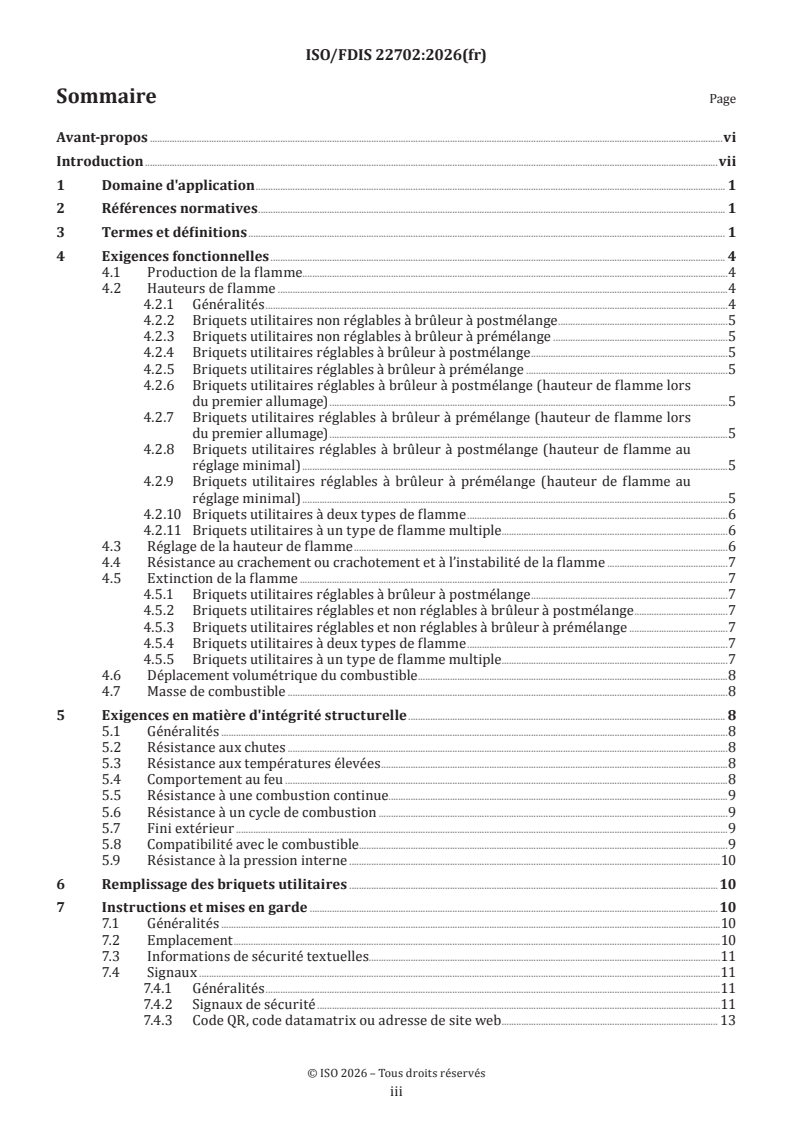
Sommaire Page
Avant-propos .vi
Introduction .vii
1 Domaine d'application . 1
2 Références normatives . 1
3 Termes et définitions . 1
4 Exigences fonctionnelles . 4
4.1 Production de la flamme.4
4.2 Hauteurs de flamme .4
4.2.1 Généralités .4
4.2.2 Briquets utilitaires non réglables à brûleur à postmélange .5
4.2.3 Briquets utilitaires non réglables à brûleur à prémélange .5
4.2.4 Briquets utilitaires réglables à brûleur à postmélange .5
4.2.5 Briquets utilitaires réglables à brûleur à prémélange .5
4.2.6 Briquets utilitaires réglables à brûleur à postmélange (hauteur de flamme lors
du premier allumage) .5
4.2.7 Briquets utilitaires réglables à brûleur à prémélange (hauteur de flamme lors
du premier allumage) .5
4.2.8 Briquets utilitaires réglables à brûleur à postmélange (hauteur de flamme au
réglage minimal) .5
4.2.9 Briquets utilitaires réglables à brûleur à prémélange (hauteur de flamme au
réglage minimal) .5
4.2.10 Briquets utilitaires à deux types de flamme .6
4.2.11 Briquets utilitaires à un type de flamme multiple .6
4.3 Réglage de la hauteur de flamme .6
4.4 Résistance au crachement ou crachotement et à l’instabilité de la flamme .7
4.5 Extinction de la flamme .7
4.5.1 Briquets utilitaires réglables à brûleur à postmélange .7
4.5.2 Briquets utilitaires réglables et non réglables à brûleur à postmélange .7
4.5.3 Briquets utilitaires réglables et non réglables à brûleur à prémélange .7
4.5.4 Briquets utilitaires à deux types de flamme .7
4.5.5 Briquets utilitaires à un type de flamme multiple .7
4.6 Déplacement volumétrique du combustible .8
4.7 Masse de combustible .8
5 Exigences en matière d'intégrité structurelle . 8
5.1 Généralités .8
5.2 Résistance aux chutes .8
5.3 Résistance aux températures élevées .8
5.4 Comportement au feu .8
5.5 Résistance à une combustion continue . .9
5.6 Résistance à un cycle de combustion .9
5.7 Fini extérieur .9
5.8 Compatibilité avec le combustible.9
5.9 Résistance à la pression interne .10
6 Remplissage des briquets utilitaires .10
7 Instructions et mises en garde . 10
7.1 Généralités .10
7.2 Emplacement .10
7.3 Informations de sécurité textuelles.11
7.4 Signaux .11
7.4.1 Généralités .11
7.4.2 Signaux de sécurité .11
7.4.3 Code QR, code datamatrix ou adresse de site web . 13
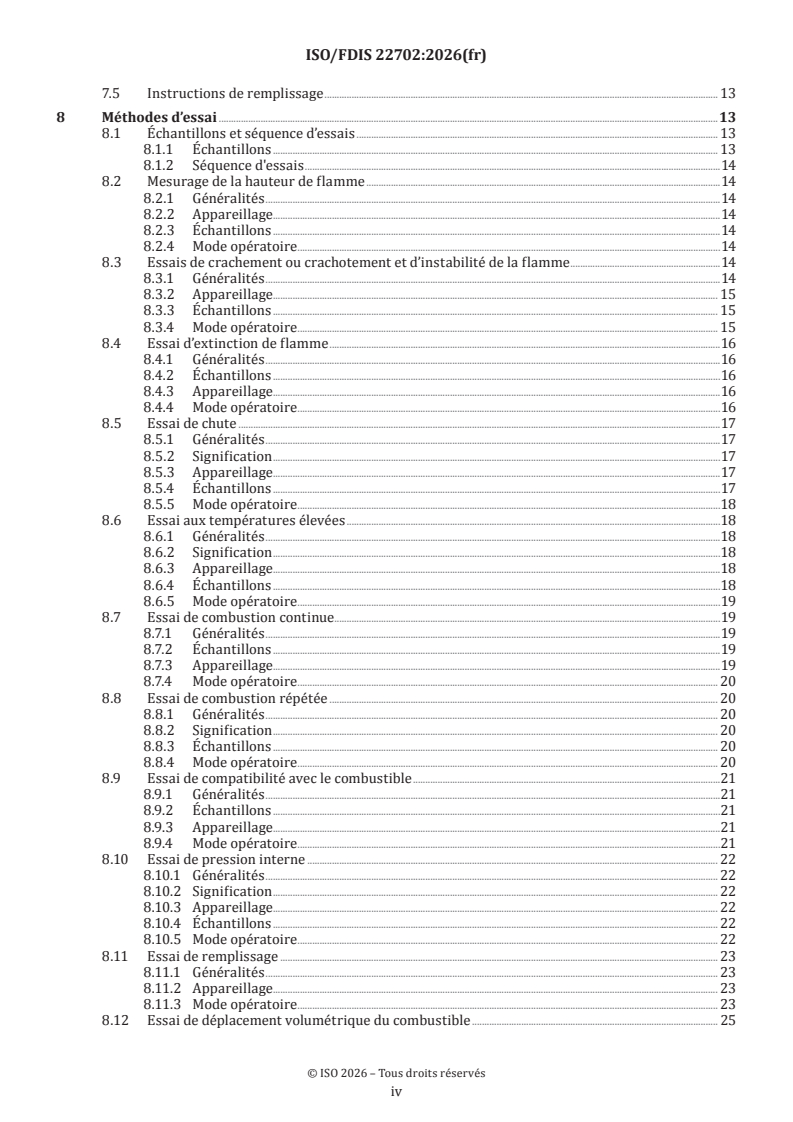
iii
7.5 Instructions de remplissage . 13
8 Méthodes d’essai .13
8.1 Échantillons et séquence d’essais . 13
8.1.1 Échantillons . 13
8.1.2 Séquence d'essais .14
8.2 Mesurage de la hauteur de flamme .14
8.2.1 Généralités .14
8.2.2 Appareillage.14
8.2.3 Échantillons .14
8.2.4 Mode opératoire . .14
8.3 Essais de crachement ou crachotement et d’instabilité de la flamme .14
8.3.1 Généralités .14
8.3.2 Appareillage. 15
8.3.3 Échantillons . 15
8.3.4 Mode opératoire . . 15
8.4 Essai d’extinction de flamme .16
8.4.1 Généralités .16
8.4.2 Échantillons .16
8.4.3 Appareillage.16
8.4.4 Mode opératoire . .16
8.5 Essai de chute .17
8.5.1 Généralités .17
8.5.2 Signification .17
8.5.3 Appareillage.17
8.5.4 Échantillons .17
8.5.5 Mode opératoire . .18
8.6 Essai aux températures élevées .18
8.6.1 Généralités .18
8.6.2 Signification .18
8.6.3 Appareillage.18
8.6.4 Échantillons .18
8.6.5 Mode opératoire . .19
8.7 Essai de combustion continue . .19
8.7.1 Généralités .19
8.7.2 Échantillons .19
8.7.3 Appareillage.19
8.7.4 Mode opératoire . . 20
8.8 Essai de combustion répétée . 20
8.8.1 Généralités . 20
8.8.2 Signification . 20
8.8.3 Échantillons . 20
8.8.4 Mode opératoire . . 20
8.9 Essai de compatibilité avec le combustible .21
8.9.1 Généralités .21
8.9.2 Échantillons .21
8.9.3 Appareillage.21
8.9.4 Mode opératoire . .21
8.10 Essai de pression interne . 22
8.10.1 Généralités . 22
8.10.2 Signification . 22
8.10.3 Appareillage. 22
8.10.4 Échantillons . 22
8.10.5 Mode opératoire . . 22
8.11 Essai de remplissage . 23
8.11.1 Généralités . 23
8.11.2 Appareillage. 23
8.11.3 Mode opératoire . . 23
8.12 Essai de déplacement volumétrique du combustible . 25
iv
8.12.1 Généralités . 25
8.12.2 Appareillage. 25
8.12.3 Échantillons . 25
8.12.4 Mode opératoire . . 25
9 Marquage du produit .26
Annexe A (informative) Séquence d’essais et taille minimale d’échantillonnage .27
Bibliographie .29
v
Avant-propos
L'ISO (Organisation internationale de normalisation) est une fédération mondiale d'organismes nationaux
de normalisation (comités membres de l'ISO). L'élaboration des Normes internationales est en général
confiée aux comités techniques de l'ISO. Chaque comité membre intéressé par une étude a le droit de faire
partie du comité technique créé à cet effet. Les organisations internationales, gouvernementales et non
gouvernementales, en liaison avec l'ISO participent également aux travaux. L'ISO collabore étroitement avec
la Commission électrotechnique internationale (IEC) en ce qui concerne la normalisation électrotechnique.
Les procédures utilisées pour élaborer le présent document et celles destinées à sa mise à jour sont
décrites dans les Directives ISO/IEC, Partie 1. Il convient, en particulier, de prendre note des différents
critères d’approbation requis pour les différents types de documents ISO. Le présent document
a été rédigé conformément aux règles de rédaction données dans les Directives ISO/IEC, Partie 2
(voir https://www.iso.org/directives).
L'ISO attire l'attention sur le fait que la mise en application du présent document peut entraîner l'utilisation
d'un ou de plusieurs brevets. L'ISO ne prend pas position quant à la preuve, à la validité et à l'applicabilité de
tout droit de brevet revendiqué à cet égard. À la date de publication du présent document, l'ISO n'avait pas
reçu notification qu'un ou plusieurs brevets pouvaient être nécessaires à sa mise en application. Toutefois,
il y a lieu d'avertir les responsables de la mise en application du présent document que des informations
plus récentes sont susceptibles de figurer dans la base de données de brevets, disponible à l'adresse
www.iso.org/brevets. L'ISO ne saurait être tenue pour responsable de ne pas avoir identifié tout ou partie de
tels droits de brevet.
Les appellations commerciales éventuellement mentionnées dans le présent document sont données pour
information, par souci de commodité, à l'intention des utilisateurs et ne sauraient constituer un engagement.
Pour une explication de la nature volontaire des normes, la signification des termes et expressions
spécifiques de l'ISO liés à l'évaluation de la conformité, ou pour toute information au sujet de l'adhésion de
l'ISO aux principes de l'Organisation mondiale du commerce (OMC) concernant les obstacles techniques au
commerce (OTC), voir le lien suivant: www.iso.org/avant-propos.
Le présent document a été élaboré par le comité technique ISO/TC 61, Plastiques, sous-comité SC 4,
Comportement au feu.
Cette troisième édition annule et remplace la deuxième édition (ISO 22702:2018), qui a fait l’objet d’une
révision technique.
Les principales modifications sont les suivantes:
— les articles terminologiques 3.22, 3.23, 3.24 et 3.25, les paragraphes 6.3, 8.2.2.2, 8.2.2.3, 8.11.2, 8.11.3.1
et 8.11.3.2, la Figure 9, la Figure A.1 et la Figure A.2 ainsi que la Bibliographie ont été ajoutés;
— les articles terminologiques 3.3, 3.4, 3.6, 3.11 et 3.16, le paragraphe 6.2, l’Article 7, les paragraphes 8.1.1,
8.2.4, 8.3, 8.5.3, 8.5.5, 8.6.3, 8.6.5, 8.9.3, 8.9.4, 8.10.5.3 et 8.12.3, la Figure 4, la Figure 5, la Figure 6, la
Figure 7, la Figure 8 ainsi que l’Annexe A ont été modifiés.
Il convient que l'utilisateur adresse tout retour d'information ou toute question concernant le présent
document à l'organisme national de normalisation de son pays. Une liste exhaustive desdits organismes se
trouve à l'adresse www.iso.org/members.html.
vi
Introduction
En tant qu'articles producteurs de flamme, les briquets utilitaires peuvent, comme n’importe quelle source
de feu, présenter un risque potentiel pour les utilisateurs. Les spécifications de sécurité données dans le
présent document ne sont pas à même d’éliminer tous les risques mais sont plutôt destinées à réduire les
risques potentiels encourus par les utilisateurs des briquets utilitaires.
vii
PROJET FINAL Norme internationale ISO/FDIS 22702:2026(fr)
Briquets utilitaires — Spécifications de sécurité
AVERTISSEMENT — Le présent document ne prétend pas aborder la totalité des problèmes de
sécurité qui pourraient découler de son utilisation. Il incombe à l’utilisateur d’établir des pratiques
d’hygiène et de sécurité appropriées et de déterminer l’applicabilité d’autres restrictions.
1 Domaine d'application
Le présent document spécifie les exigences relatives aux briquets utilitaires qui permettent d’assurer aux
utilisateurs un niveau de sécurité raisonnable lors de leur usage normal ou anormal mais raisonnablement
prévisible.
Le présent document s’applique à tous les produits de consommation produisant une flamme, communément
désignés sous l’appellation de briquets utilitaires (également connus sous le nom d’allume-barbecue, allume-
feu ou allume-gaz) et dispositifs similaires.
Il ne s’applique pas aux allumettes ni aux dispositifs produisant une flamme destinée à allumer des cigares,
des pipes et des cigarettes.
2 Références normatives
Les documents suivants sont cités dans le texte de sorte qu'ils constituent, pour tout ou partie de leur
contenu, des exigences du présent document. Pour les références datées, seule l'édition citée s'applique. Pour
les références non datées, la dernière édition du document de référence s'applique (y compris les éventuels
amendements).
ISO 7941, Propanes et butanes commerciaux — Analyse par chromatographie en phase gazeuse
UL 1439, Tests for Sharpness of Edges on Equipment
3 Termes et définitions
Pour les besoins du présent document, les termes et définitions suivants s'appliquent.
L'ISO et l'IEC tiennent à jour des bases de données terminologiques destinées à être utilisées en normalisation,
consultables aux adresses suivantes:
— ISO Online browsing platform: disponible à l'adresse https:// www .iso .org/ obp
— IEC Electropedia: disponible à l'adresse https:// www .electropedia .org/
3.1
valve
composant d’un briquet utilitaire (3.6) qui commande le remplissage ou la propagation du combustible (3.9)
3.2
buse
extrémité de l’organe d’échappement du combustible
3.3
hauteur de flamme
distance linéaire séparant l’extrémité supérieure visible de la flamme (3.19) du sommet de l’écran protecteur
(3.12)
Note 1 à l'article: Hauteur de flamme telle qu'observée à l'œil nu.
3.4
instabilité de la flamme
variation de la hauteur de flamme (3.3) par rapport à une hauteur préétablie
Note 1 à l'article: Instabilité de la flamme telle qu'observée à l'œil nu.
3.5
allumer
produire une flamme (3.19) au moyen d’un briquet utilitaire (3.6) en actionnant, de la manière prévue, les
dispositifs d’allumage et de propagation du combustible intégrés au briquet utilitaire (3.6)
3.6
briquet utilitaire
article (3.22) portatif de production de flamme, d’au moins 100 mm de long en position complètement
déployée, équipé d’un système d’allumage manuel, utilisant un combustible (3.9), dont on se sert
essentiellement pour allumer bougies, brûleurs de cheminée ou poêles à pétrole, barbecue à gaz ou à
charbon, feux de camp, lanternes, installations ou dispositifs à combustible, et/ou veilleuses
Note 1 à l'article: Les briquets utilitaires ne sont pas considérés comme des substances (3.23), des mélanges (3.24), un
récipient contenant une substance ou un mélange, ni comme une combinaison d'un article et d'une substance ou d'un
mélange.
Note 2 à l'article: Les briquets utilitaires ne sont pas considérés comme des générateurs d'aérosols (3.25).
3.7
briquet utilitaire réglable
briquet utilitaire (3.6) pourvu d’un mécanisme permettant au consommateur de faire varier la hauteur de
flamme (3.3) manuellement
3.8
briquet utilitaire non rechargeable
briquet utilitaire jetable
briquet utilitaire (3.6) disposant d’une provision de combustible incorporée et qui est conçu pour ne pas être
rechargé
3.9
combustible
butane, isobutane, propane ou autre hydrocarbure liquéfié, ou un mélange contenant l’un de ceux-ci dont la
pression de vapeur à 24 °C est supérieure à 103 kPa
3.10
briquet utilitaire non réglable
briquet utilitaire (3.6) dépourvu de mécanisme d’ajustement de la hauteur de flamme (3.3) et dont la hauteur
de flamme (3.3) est préalablement réglée par le fabricant
3.11
briquet utilitaire rechargeable
briquet utilitaire (3.6) conçu pour être rechargé soit par transvasement du combustible (3.9) à partir d’un
contenant extérieur, soit par insertion d’un réservoir de combustible prérempli
3.12
écran protecteur
structure qui entoure complètement ou partiellement la buse (3.2) du briquet utilitaire (3.6)
3.13
autoallumage avec flamme durable
création d’une flamme (3.19) par des moyens autres que ceux résultant d’une opération manuelle délibérée,
tels que la chute du briquet utilitaire (3.6), qui entraînent la mise en fonctionnement du dispositif d’allumage
(3.16) et provoquent l’apparition d’une flamme qui brûle durablement
3.14
crachement
crachotement
phénomène occasionné par de fines gouttelettes de gaz liquéfié ou non évaporé qui, en se séparant de la
flamme principale d’un briquet utilitaire (3.6), s’échappent en brûlant
3.15
réservoir de combustible
structure contenant le combustible (3.9) avant sa propagation
3.16
système d’allumage
système générant une étincelle qui va enflammer le combustible (3.9), tel qu’un mécanisme piézo-électrique,
une pile ou une pierre
3.17
briquet utilitaire à brûleur à prémélange
briquet utilitaire (3.6) à gaz dans lequel le combustible (3.9) et l’air sont mélangés avant d’être soumis à
combustion
3.18
briquet utilitaire à brûleur à postmélange
briquet utilitaire (3.6) à gaz dans lequel le combustible (3.9) est soumis à combustion et l’alimentation en air
se fait au point de combustion
3.19
flamme
résultat de la combustion de combustible (3.9) qui produit de la chaleur et souvent une lumière qui peut être
visible à l’œil nu dans des conditions d’éclairage normal ou réduit
3.20
briquet utilitaire à deux types de flamme
briquet utilitaire (3.6) qui emploie un ou plusieurs systèmes de valve du brûleur qui produisent plusieurs
types de flamme (prémélange et postmélange), qui peuvent être produites indépendamment et séparément
(un seul type de flamme à la fois) ou de façon dépendante et simultanée (plusieurs types de flamme à la fois)
3.21
briquet utilitaire à un type de flamme multiple
briquet utilitaire (3.6) qui emploie un ou plusieurs systèmes de valve du brûleur qui produisent plusieurs
flammes du même type (prémélange ou postmélange), qui peuvent être produites indépendamment et
séparément (une seule flamme à la fois) ou de façon dépendante et simultanée (plusieurs flammes à la fois)
3.22
article
objet auquel sont donnés, au cours du processus de fabrication, une forme, une surface ou un dessin
particuliers qui sont plus déterminants pour sa fonction que sa composition chimique
3.23
substance
élément chimique et ses composés à l'état naturel ou obtenus par un processus de fabrication, y compris
tout additif nécessaire pour en préserver la stabilité et toute impureté résultant du processus mis en œuvre,
mais à l'exclusion de tout solvant qui peut être séparé sans affecter la stabilité de la substance ou modifier sa
composition
3.24
mélange
solution composée de deux substances ou plus (3.23)
3.25
générateur d’aérosol
ensemble constitué par un récipient non réutilisable en métal, en verre ou en plastique contenant un gaz
comprimé, liquéfié ou dissous sous pression, avec ou sans liquide, pâte ou poudre et pourvu d'un dispositif
de prélèvement permettant la sortie du contenu sous forme de particules solides ou liquides en suspension
dans un gaz, ou sous forme de mousse, de pâte ou de poudre, ou à l'état liquide
4 Exigences fonctionnelles
4.1 Production de la flamme
Afin de réduire le plus possible le risque d’un allumage involontaire ou d’un autoallumage, les briquets
utilitaires doivent demander une opération manuelle délibérée pour produire une flamme. Cette opération
doit satisfaire à au moins l’une des exigences suivantes:
a) un mécanisme nécessitant une action positive de la part de l’utilisateur pour produire et maintenir une
flamme;
b) un mécanisme nécessitant au moins deux mouvements indépendants l’un de l’autre, de la part de
l’utilisateur, pour produire une flamme;
c) un mécanisme dont la mise en œuvre nécessite une force supérieure ou égale à 15 N pour produire une
flamme (voir un exemple d’équipement d’essai à la Figure 1).
Figure 1 — Schéma illustrant un exemple type d'équipement d’essai de mesurage de la force mise en
œuvre pour produire une flamme
4.2 Hauteurs de flamme
4.2.1 Généralités
La hauteur de flamme maximale atteignable par les briquets utilitaires doit être limitée par réglage, par
la conception même du produit ou par les deux à la fois. Les briquets utilitaires réglables doivent avoir une
hauteur de flamme réglée avant leur mise à disposition de l’utilisateur, de sorte qu’au premier allumage, sans
modification du réglage, le briquet utilitaire produise une flamme dont la hauteur maximale doit également
être limitée. Lors des essais conduits selon 8.2, ces limites doivent satisfaire aux exigences ci-après.
4.2.2 Briquets utilitaires non réglables à brûleur à postmélange
Lors de l’essai conduit selon 8.2, les briquets utilitaires non réglables à brûleur à postmélange, tels que
définis aux 3.10 et 3.18, mis à disposition de l’utilisateur, doivent avoir une hauteur de flamme maximale
atteignable ne dépassant pas 100 mm lorsque la flamme est dirigée verticalement vers le haut.
4.2.3 Briquets utilitaires non réglables à brûleur à prémélange
Lors de l’essai conduit selon 8.2, les briquets utilitaires non réglables à brûleur à prémélange, tels que définis
aux 3.10 et 3.17, mis à disposition de l’utilisateur, doivent avoir une hauteur de flamme maximale atteignable
ne dépassant pas 75 mm lorsque la flamme est dirigée verticalement vers le haut.
4.2.4 Briquets utilitaires réglables à brûleur à postmélange
Lors de l’essai conduit selon 8.2, avec la hauteur de flamme réglée intentionnellement à la limite maximale
autorisée par le fabricant, les briquets utilitaires réglables à brûleur à postmélange, tels que définis aux 3.7
et 3.18, ne doivent pas produire une flamme dont la hauteur est supérieure à 150 mm lorsque la flamme est
dirigée verticalement vers le haut.
4.2.5 Briquets utilitaires réglables à brûleur à prémélange
Lors de l’essai conduit selon 8.2, avec la hauteur de flamme réglée intentionnellement à la limite maximale
autorisée par le fabricant, les briquets utilitaires réglables à brûleur à prémélange, tels que définis aux 3.7
et 3.17, ne doivent pas produire une flamme dont la hauteur est supérieure à 75 mm lorsque la flamme est
dirigée verticalement vers le haut.
4.2.6 Briquets utilitaires réglables à brûleur à postmélange (hauteur de flamme lors du premier
allumage)
Lors de l’essai conduit selon 8.2, les briquets utilitaires réglables à brûleur à postmélange, tels que définis
aux 3.7 et 3.18, doivent avoir une hauteur de flamme réglée par le fabricant de manière que le briquet
utilitaire, au premier allumage, sans modification du réglage, produise une flamme dont la hauteur n’est pas
supérieure à 100 mm lorsque la flamme est dirigée verticalement vers le haut.
4.2.7 Briquets utilitaires réglables à brûleur à prémélange (hauteur de flamme lors du premier
allumage)
Lors de l’essai conduit selon 8.2, les briquets utilitaires réglables à brûleur à prémélange, tels que définis aux
3.7 et 3.17, doivent avoir une hauteur de flamme réglée par le fabricant de manière que le briquet utilitaire, au
premier allumage, sans modification du réglage, produise une flamme dont la hauteur n’est pas supérieure à
60 mm lorsque la flamme est dirigée verticalement vers le haut.
4.2.8 Briquets utilitaires réglables à brûleur à postmélange (hauteur de flamme au réglage
minimal)
Lors de l’essai conduit selon 8.2, les briquets utilitaires réglables à brûleur à postmélange, tels que définis
aux 3.7 et 3.18, réglés à la hauteur minimale de flamme autorisée par le fabricant, doivent produire une
flamme dont la hauteur n’est pas supérieure à 75 mm lorsque la flamme est dirigée verticalement vers le
haut.
4.2.9 Briquets utilitaires réglables à brûleur à prémélange (hauteur de flamme au réglage
minimal)
Lors de l’essai conduit selon 8.2, les briquets utilitaires réglables brûleur à prémélange, tels que définis aux
3.7 et 3.17, réglés à la hauteur minimale de flamme autorisée par le fabricant, doivent produire une flamme
dont la hauteur n’est pas supérieure à 50 mm lorsque la flamme est dirigée verticalement vers le haut.
4.2.10 Briquets utilitaires à deux types de flamme
Pour chaque type de flamme d’un briquet utilitaire à deux types de flamme, la hauteur de flamme doit être
conforme à l’exigence correspondante pour ce type de flamme, donnée du 4.2.1 au 4.2.9.
4.2.11 Briquets utilitaires à un type de flamme multiple
Pour chaque type de flamme d’un briquet utilitaire à un type de flamme multiple, la hauteur de flamme doit
être conforme à l’exigence correspondante pour ce type de flamme, donnée du 4.2.1 au 4.2.9.
4.3 Réglage de la hauteur de flamme
4.3.1 Lors d’une utilisation normale, les briquets utilitaires réglables doivent faire appel à une action
délibérée de la part de l’utilisateur soit pour diminuer, soit pour augmenter la hauteur de flamme.
4.3.2 Si le dispositif de réglage de la flamme fait saillie par rapport au corps du briquet utilitaire, la force
tangentielle requise pour le mouvoir sur la totalité de la plage de réglage doit être au minimum égale à 1 N
(voir l’exemple d’équipement d’essai à la Figure 2).
Figure 2 — Schéma illustrant un exemple type d'équipement d’essai de mesurage de la force de
réglage de la hauteur de flamme
4.3.3 Les briquets utilitaires réglables comportant un dispositif de réglage de la flamme dont le mouvement
est rotatif et sensiblement perpendiculaire à l’axe de la flamme, doivent remplir les conditions suivantes.
a) Lorsque le dispositif de réglage de la flamme du briquet utilitaire est maintenu en position verticale,
de manière que la flamme soit orientée vers le haut, l’utilisateur faisant face au dispositif de réglage, un
déplacement de celui-ci vers la gauche doit avoir pour effet de réduire la hauteur de la flamme.
b) Les briquets utilitaires réglables dont le dispositif de réglage de la hauteur de flamme nécessite une
action dirigée à peu près parallèlement à l’axe de la flamme doivent produire une flamme dont la hauteur
augmente ou diminue en fonction de la direction du mouvement.
c) Quand le mécanisme de contrôle de la flamme se situe au bas du briquet utilitaire et que ce dernier est
tenu de sorte que l’utilisateur fait face au mécanisme, un mouvement dans le sens des aiguilles d’une
montre doit provoquer la diminution de la hauteur de flamme.
...