

ISO 23273:2013
(Main)Fuel cell road vehicles — Safety specifications — Protection against hydrogen hazards for vehicles fuelled with compressed hydrogen
General Information
- Abstract
ISO 23273:2013 specifies the essential requirements for fuel cell vehicles (FCV) with respect to the protection of persons and the environment inside and outside the vehicle against hydrogen-related hazards. It applies only to such FCV where compressed hydrogen is used as fuel for the fuel cell system. ISO 23273:2013 does not apply to manufacturing, maintenance, and repair. The requirements of ISO 23273:2013 address both normal operating (fault-free) and single-fault conditions of the vehicles.
- Status
- Published
- Publication Date
- 02-Jun-2013
- Technical Committee
- ISO/TC 22/SC 37 - Electrically propelled vehicles
- Drafting Committee
- ISO/TC 22/SC 37 - Electrically propelled vehicles
- Current Stage
- 9060 - Close of review
- Completion Date
- 02-Dec-2029
Buy Documents



ISO 23273:2013 - Fuel cell road vehicles -- Safety specifications -- Protection against hydrogen hazards for vehicles fuelled with compressed hydrogen
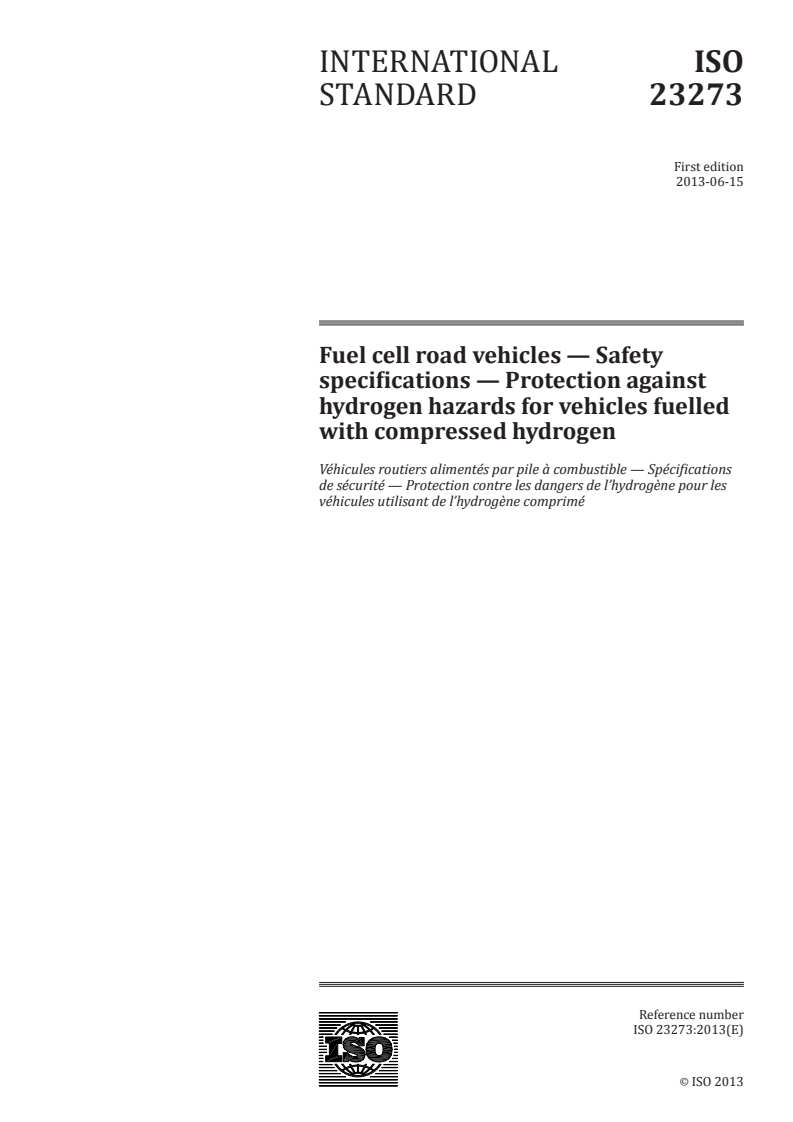

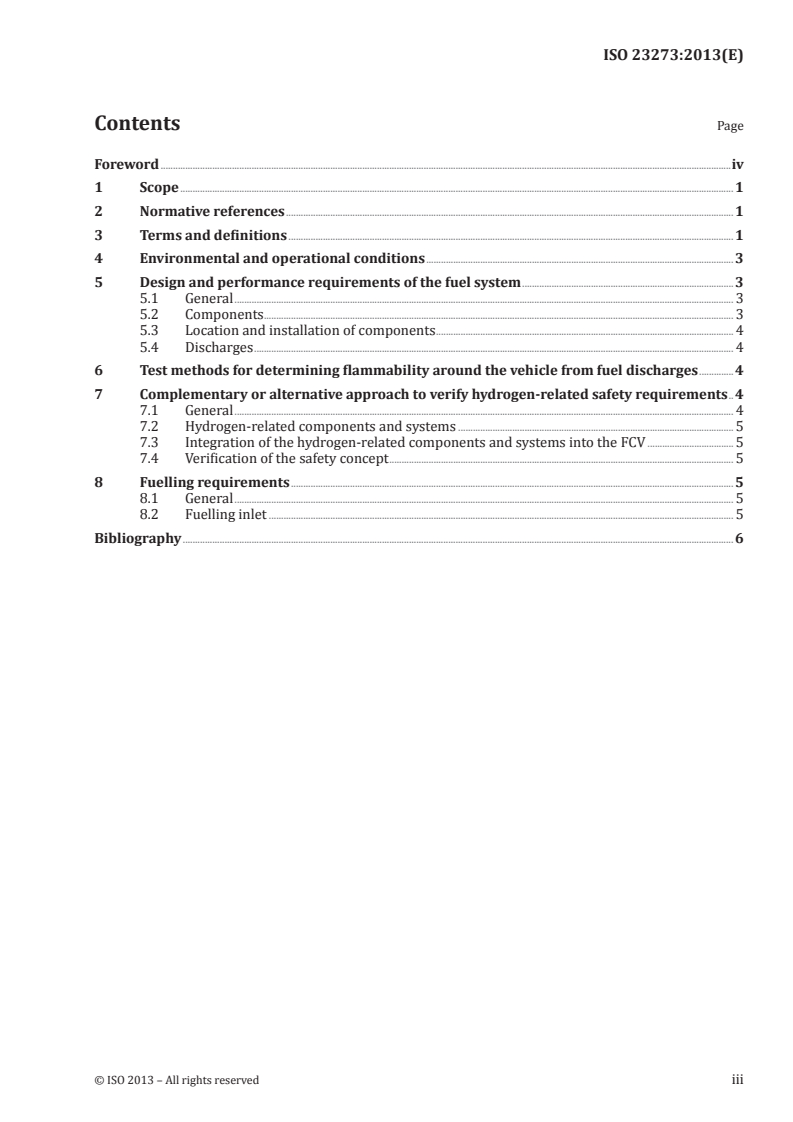
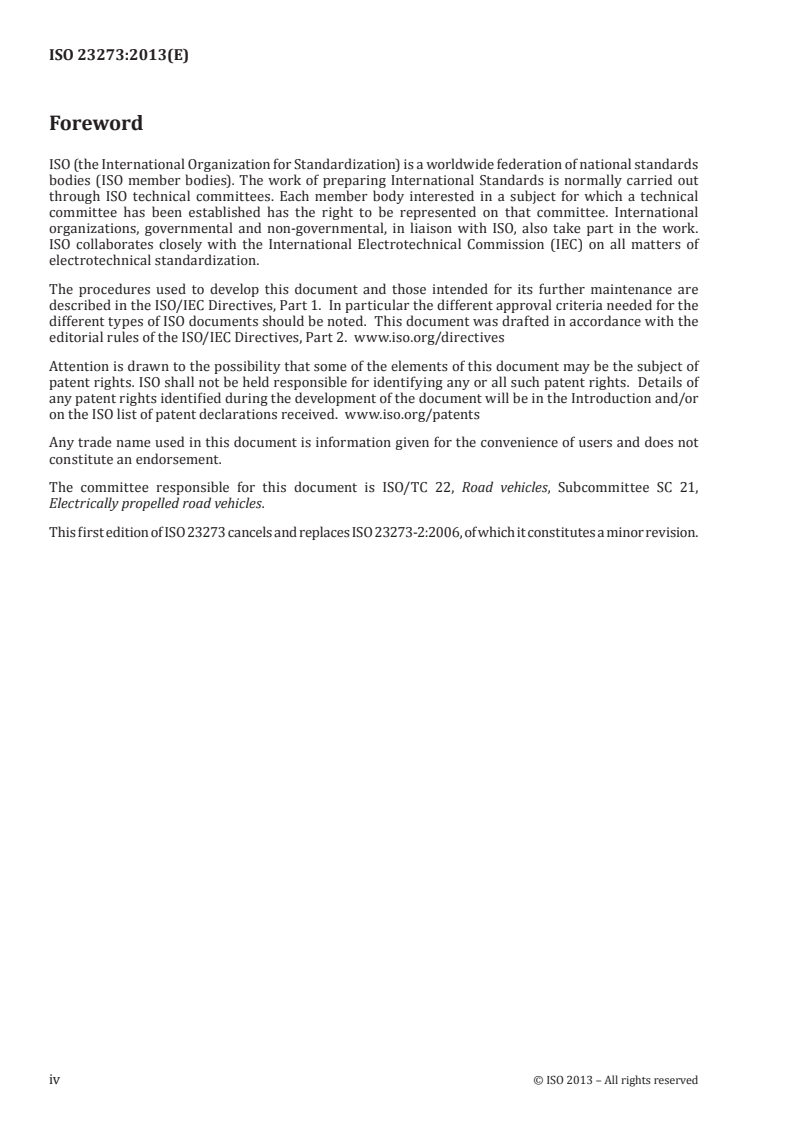
ISO 23273:2013 - Fuel cell road vehicles — Safety specifications — Protection against hydrogen hazards for vehicles fuelled with compressed hydrogen/3/2013
Overview
ISO 23273:2013 sets forth essential safety specifications for fuel cell road vehicles (FCVs) powered by compressed hydrogen. This International Standard focuses on protecting both persons and the environment from hydrogen-related hazards inside and outside the vehicle during normal and single-fault conditions. Its primary scope applies exclusively to FCVs using compressed hydrogen as fuel for the onboard fuel cell system, excluding manufacturing, maintenance, and repair activities.
The standard ensures that hydrogen fuel systems-critical components of FCVs-are designed and integrated to minimize risks such as leaks, fires, and explosions. By adhering to ISO 23273:2013, manufacturers can deliver safer hydrogen fuel cell vehicles compliant with global expectations.
Key Topics
Fuel System Design and Performance
The standard details design requirements for the high-pressure hydrogen fuel system, including mandatory fire protection devices such as temperature-triggered pressure relief devices (PRDs) and main hydrogen shut-off valves. Components must be pressure-rated appropriately, securely mounted to resist damage, and electrically bonded to prevent ignition from stray electrical discharges.Safety Components
Critical components include excess flow valves to limit unintended hydrogen release, hydrogen shut-off systems to isolate fuel supply upon power loss or vehicle inactivity, and pressure relief devices to prevent container rupture during fire exposure.Hydrogen Hazard Protection
Safety considerations address hydrogen venting and purging during normal vehicle operation, ensuring discharges are non-flammable and safely directed outside the vehicle. The standard mandates that no hydrogen discharges lead to hazardous conditions in vehicle compartments under both normal and single-fault scenarios.Environmental and Operational Conditions
The standard requires the fuel system and its components to perform safely within the full range of environmental conditions specified by the vehicle manufacturer, including vibration resistance and temperature tolerance.Testing and Verification
ISO 23273:2013 calls for appropriate testing methods to evaluate flammability risks from hydrogen discharges. Additionally, it offers a complementary approach where safety can be verified via hazard analysis methods such as FMEA or FTA combined with testing to demonstrate equivalence to standard requirements.Fuelling Infrastructure Interface
The specification references ISO 17268 for hydrogen refueling connections and mandates design features to prevent gas accumulation, ingress of contaminants, and electrostatic discharges at the fueling inlet. It also requires mechanisms to prevent vehicle movement during refueling for added safety.
Applications
Hydrogen Fuel Cell Vehicle Manufacturing
Manufacturers designing FCVs powered by compressed hydrogen must implement the fuel system safety and protective measures outlined in ISO 23273 to meet international safety benchmarks.Fuel System Component Design
Component suppliers for high-pressure hydrogen systems-such as valves, PRDs, piping, and refueling receptacles-can utilize the requirements to ensure products meet stringent safety criteria for use in FCVs.Vehicle Safety Assessment
OEMs and certification bodies can apply the standard’s test methods and hazard analysis procedures to assess fuel system safety and vehicle compliance with regulatory demands.Refueling Station Compatibility
The standard’s fueling inlet specifications guide the interface design between vehicles and hydrogen refueling infrastructure, facilitating safe and reliable hydrogen filling operations worldwide.Regulatory Compliance and Legal Frameworks
ISO 23273 supports harmonized regulatory development by providing clearly defined safety requirements specific to hydrogen-fueled road vehicles, thereby facilitating market adoption of clean fuel technologies.
Related Standards
ISO 17268 – Gaseous Hydrogen Land Vehicle Refuelling Connection Devices: Specifies the requirements for hydrogen refueling nozzles and receptacles that interface with FCVs.
ISO 6469-2 – Electrically Propelled Road Vehicles - Safety Specifications: Addresses operational safety and protection against electrical failures in electrically powered vehicles.
SAE J2578 – Recommended Practice for General Fuel Cell Vehicle Safety: Provides guidance and test procedures relevant to hydrogen fuel system safety, referenced within ISO 23273.
ISO/IEC Directives – Guidelines for drafting and maintaining International Standards, applicable for ongoing compliance and updates.
Adherence to ISO 23273:2013 ensures comprehensive safety management of hydrogen hazards in fuel cell road vehicles. This standard enables manufacturers and stakeholders to confidently advance hydrogen mobility technologies while prioritizing occupant and environmental safety.
Relations
- Effective Date
- 08-Jun-2013
- Effective Date
- 08-Jun-2013
Buy Documents
ISO 23273:2013 - Fuel cell road vehicles -- Safety specifications -- Protection against hydrogen hazards for vehicles fuelled with compressed hydrogen
ISO 23273:2013 - Fuel cell road vehicles — Safety specifications — Protection against hydrogen hazards for vehicles fuelled with compressed hydrogen/3/2013
Get Certified
Connect with accredited certification bodies for this standard

TÜV Rheinland
TÜV Rheinland is a leading international provider of technical services.

TÜV SÜD
TÜV SÜD is a trusted partner of choice for safety, security and sustainability solutions.

DEKRA Certification Inc.
DEKRA US certification services.
Sponsored listings
Frequently Asked Questions
ISO 23273:2013 is a standard published by the International Organization for Standardization (ISO). Its full title is "Fuel cell road vehicles — Safety specifications — Protection against hydrogen hazards for vehicles fuelled with compressed hydrogen". This standard covers: ISO 23273:2013 specifies the essential requirements for fuel cell vehicles (FCV) with respect to the protection of persons and the environment inside and outside the vehicle against hydrogen-related hazards. It applies only to such FCV where compressed hydrogen is used as fuel for the fuel cell system. ISO 23273:2013 does not apply to manufacturing, maintenance, and repair. The requirements of ISO 23273:2013 address both normal operating (fault-free) and single-fault conditions of the vehicles.
ISO 23273:2013 specifies the essential requirements for fuel cell vehicles (FCV) with respect to the protection of persons and the environment inside and outside the vehicle against hydrogen-related hazards. It applies only to such FCV where compressed hydrogen is used as fuel for the fuel cell system. ISO 23273:2013 does not apply to manufacturing, maintenance, and repair. The requirements of ISO 23273:2013 address both normal operating (fault-free) and single-fault conditions of the vehicles.
ISO 23273:2013 is classified under the following ICS (International Classification for Standards) categories: 43.120 - Electric road vehicles. The ICS classification helps identify the subject area and facilitates finding related standards.
ISO 23273:2013 has the following relationships with other standards: It is inter standard links to ISO/FDIS 23273-2, ISO 23273-2:2006. Understanding these relationships helps ensure you are using the most current and applicable version of the standard.
ISO 23273:2013 is available in PDF format for immediate download after purchase. The document can be added to your cart and obtained through the secure checkout process. Digital delivery ensures instant access to the complete standard document.
Standards Content (Sample)
INTERNATIONAL ISO
STANDARD 23273
First edition
2013-06-15
Fuel cell road vehicles — Safety
specifications — Protection against
hydrogen hazards for vehicles fuelled
with compressed hydrogen
Véhicules routiers alimentés par pile à combustible — Spécifications
de sécurité — Protection contre les dangers de l’hydrogène pour les
véhicules utilisant de l’hydrogène comprimé
Reference number
©
ISO 2013
© ISO 2013
All rights reserved. Unless otherwise specified, no part of this publication may be reproduced or utilized otherwise in any form
or by any means, electronic or mechanical, including photocopying, or posting on the internet or an intranet, without prior
written permission. Permission can be requested from either ISO at the address below or ISO’s member body in the country of
the requester.
ISO copyright office
Case postale 56 • CH-1211 Geneva 20
Tel. + 41 22 749 01 11
Fax + 41 22 749 09 47
E-mail copyright@iso.org
Web www.iso.org
Published in Switzerland
ii © ISO 2013 – All rights reserved
Contents Page
Foreword .iv
1 Scope . 1
2 Normative references . 1
3 Terms and definitions . 1
4 Environmental and operational conditions . 3
5 Design and performance requirements of the fuel system . 3
5.1 General . 3
5.2 Components . 3
5.3 Location and installation of components . 4
5.4 Discharges . 4
6 Test methods for determining flammability around the vehicle from fuel discharges .4
7 Complementary or alternative approach to verify hydrogen-related safety requirements .4
7.1 General . 4
7.2 Hydrogen-related components and systems . 5
7.3 Integration of the hydrogen-related components and systems into the FCV . 5
7.4 Verification of the safety concept . 5
8 Fuelling requirements . 5
8.1 General . 5
8.2 Fuelling inlet . 5
Bibliography . 6
Foreword
ISO (the International Organization for Standardization) is a worldwide federation of national standards
bodies (ISO member bodies). The work of preparing International Standards is normally carried out
through ISO technical committees. Each member body interested in a subject for which a technical
committee has been established has the right to be represented on that committee. International
organizations, governmental and non-governmental, in liaison with ISO, also take part in the work.
ISO collaborates closely with the International Electrotechnical Commission (IEC) on all matters of
electrotechnical standardization.
The procedures used to develop this document and those intended for its further maintenance are
described in the ISO/IEC Directives, Part 1. In particular the different approval criteria needed for the
different types of ISO documents should be noted. This document was drafted in accordance with the
editorial rules of the ISO/IEC Directives, Part 2. www.iso.org/directives
Attention is drawn to the possibility that some of the elements of this document may be the subject of
patent rights. ISO shall not be held responsible for identifying any or all such patent rights. Details of
any patent rights identified during the development of the document will be in the Introduction and/or
on the ISO list of patent declarations received. www.iso.org/patents
Any trade name used in this document is information given for the convenience of users and does not
constitute an endorsement.
The committee responsible for this document is ISO/TC 22, Road vehicles, Subcommittee SC 21,
Electrically propelled road vehicles.
This first edition of ISO 23273 cancels and replaces ISO 23273-2:2006, of which it constitutes a minor revision.
iv © ISO 2013 – All rights reserved
INTERNATIONAL STANDARD ISO 23273:2013(E)
Fuel cell road vehicles — Safety specifications —
Protection against hydrogen hazards for vehicles fuelled
with compressed hydrogen
1 Scope
This International Standard specifies the essential requirements for fuel cell vehicles (FCV) with respect
to the protection of persons and the environment inside and outside the vehicle against hydrogen-
related hazards.
It applies only to such FCV where compressed hydrogen is used as fuel for the fuel cell system.
This International Standard does not apply to manufacturing, maintenance, and repair.
The requirements of this International Standard address both normal operating (fault-free) and single-
fault conditions of the vehicles.
2 Normative references
The following documents, in whole or in part, are normatively referenced in this document and are
indispensable for its application. For dated references, only the edition cited applies. For undated
references, the latest edition of the referenced document (including any amendments) applies.
ISO 17268, Gaseous hydrogen land vehicle refuelling connection devices
ISO 6469-2, Electrically propelled road vehicles — Safety specifications — Part 2: Vehicle operational safety
means and protection against failures
3 Terms and definitions
For the purposes of this document, the following terms and definitions apply.
3.1
air processing system
system that processes (i.e. that filters, meters, conditions, and pressurizes) the incoming air for the
fuel cell system
3.2
contaminant
substances within raw fuel, such as sulphur, that, at or above a specified concentration level, may poison
reaction catalysts
3.3
electric chassis
conductive mechanical structure of the vehicle, including all associated electric and electronic
components, whose parts are electrically connected and whose potential is taken as reference
3.4
excess flow valve
valve which automatically shuts off or limits the gas flow when the flow exceeds a set design value
3.5
fuel cell
electrochemical device that generates electricity by the conversion of fuel and an oxidant without any
physical or chemical consumption of the electrodes or electrolyte
3.6
fuel cell stack
assembly of two or more fuel cells, which are electrically connected
3.7
fuel cell system
system typically containing the following subsystems: fuel cell stack, air processing system, fuel
processing system, thermal management, water management, and their control system
3.8
fuel cell vehicle
FCV
vehicle that receives propulsion power from an on-board fuel cell power system
Note 1 to entry: The general term FCV also includes vehicles with an additional other source of propulsion power.
3.9
fuel processing system
system that converts (if necessary) and/or conditions the fuel as stored in the on-board fuel storage into
fuel suitable for operation in the fuel cell stack
3.10
fuel system
combination of the on-board fuel storage, the fuel processing system, and the fuel cell stack
3.11
main hydrogen shut-off valve
valve designed to automatically isolate the high-pressure hydrogen source
3.12
maximum allowable working pressure
MAWP
maximum
...
INTERNATIONAL ISO
STANDARD 23273
First edition
2013-06-15
Fuel cell road vehicles — Safety
specifications — Protection against
hydrogen hazards for vehicles fuelled
with compressed hydrogen
Véhicules routiers alimentés par pile à combustible — Spécifications
de sécurité — Protection contre les dangers de l’hydrogène pour les
véhicules utilisant de l’hydrogène comprimé
Reference number
©
ISO 2013
© ISO 2013
All rights reserved. Unless otherwise specified, no part of this publication may be reproduced or utilized otherwise in any form
or by any means, electronic or mechanical, including photocopying, or posting on the internet or an intranet, without prior
written permission. Permission can be requested from either ISO at the address below or ISO’s member body in the country of
the requester.
ISO copyright office
Case postale 56 • CH-1211 Geneva 20
Tel. + 41 22 749 01 11
Fax + 41 22 749 09 47
E-mail copyright@iso.org
Web www.iso.org
Published in Switzerland
ii © ISO 2013 – All rights reserved
Contents Page
Foreword .iv
1 Scope . 1
2 Normative references . 1
3 Terms and definitions . 1
4 Environmental and operational conditions . 3
5 Design and performance requirements of the fuel system . 3
5.1 General . 3
5.2 Components . 3
5.3 Location and installation of components . 4
5.4 Discharges . 4
6 Test methods for determining flammability around the vehicle from fuel discharges .4
7 Complementary or alternative approach to verify hydrogen-related safety requirements .4
7.1 General . 4
7.2 Hydrogen-related components and systems . 5
7.3 Integration of the hydrogen-related components and systems into the FCV . 5
7.4 Verification of the safety concept . 5
8 Fuelling requirements . 5
8.1 General . 5
8.2 Fuelling inlet . 5
Bibliography . 6
Foreword
ISO (the International Organization for Standardization) is a worldwide federation of national standards
bodies (ISO member bodies). The work of preparing International Standards is normally carried out
through ISO technical committees. Each member body interested in a subject for which a technical
committee has been established has the right to be represented on that committee. International
organizations, governmental and non-governmental, in liaison with ISO, also take part in the work.
ISO collaborates closely with the International Electrotechnical Commission (IEC) on all matters of
electrotechnical standardization.
The procedures used to develop this document and those intended for its further maintenance are
described in the ISO/IEC Directives, Part 1. In particular the different approval criteria needed for the
different types of ISO documents should be noted. This document was drafted in accordance with the
editorial rules of the ISO/IEC Directives, Part 2. www.iso.org/directives
Attention is drawn to the possibility that some of the elements of this document may be the subject of
patent rights. ISO shall not be held responsible for identifying any or all such patent rights. Details of
any patent rights identified during the development of the document will be in the Introduction and/or
on the ISO list of patent declarations received. www.iso.org/patents
Any trade name used in this document is information given for the convenience of users and does not
constitute an endorsement.
The committee responsible for this document is ISO/TC 22, Road vehicles, Subcommittee SC 21,
Electrically propelled road vehicles.
This first edition of ISO 23273 cancels and replaces ISO 23273-2:2006, of which it constitutes a minor revision.
iv © ISO 2013 – All rights reserved
INTERNATIONAL STANDARD ISO 23273:2013(E)
Fuel cell road vehicles — Safety specifications —
Protection against hydrogen hazards for vehicles fuelled
with compressed hydrogen
1 Scope
This International Standard specifies the essential requirements for fuel cell vehicles (FCV) with respect
to the protection of persons and the environment inside and outside the vehicle against hydrogen-
related hazards.
It applies only to such FCV where compressed hydrogen is used as fuel for the fuel cell system.
This International Standard does not apply to manufacturing, maintenance, and repair.
The requirements of this International Standard address both normal operating (fault-free) and single-
fault conditions of the vehicles.
2 Normative references
The following documents, in whole or in part, are normatively referenced in this document and are
indispensable for its application. For dated references, only the edition cited applies. For undated
references, the latest edition of the referenced document (including any amendments) applies.
ISO 17268, Gaseous hydrogen land vehicle refuelling connection devices
ISO 6469-2, Electrically propelled road vehicles — Safety specifications — Part 2: Vehicle operational safety
means and protection against failures
3 Terms and definitions
For the purposes of this document, the following terms and definitions apply.
3.1
air processing system
system that processes (i.e. that filters, meters, conditions, and pressurizes) the incoming air for the
fuel cell system
3.2
contaminant
substances within raw fuel, such as sulphur, that, at or above a specified concentration level, may poison
reaction catalysts
3.3
electric chassis
conductive mechanical structure of the vehicle, including all associated electric and electronic
components, whose parts are electrically connected and whose potential is taken as reference
3.4
excess flow valve
valve which automatically shuts off or limits the gas flow when the flow exceeds a set design value
3.5
fuel cell
electrochemical device that generates electricity by the conversion of fuel and an oxidant without any
physical or chemical consumption of the electrodes or electrolyte
3.6
fuel cell stack
assembly of two or more fuel cells, which are electrically connected
3.7
fuel cell system
system typically containing the following subsystems: fuel cell stack, air processing system, fuel
processing system, thermal management, water management, and their control system
3.8
fuel cell vehicle
FCV
vehicle that receives propulsion power from an on-board fuel cell power system
Note 1 to entry: The general term FCV also includes vehicles with an additional other source of propulsion power.
3.9
fuel processing system
system that converts (if necessary) and/or conditions the fuel as stored in the on-board fuel storage into
fuel suitable for operation in the fuel cell stack
3.10
fuel system
combination of the on-board fuel storage, the fuel processing system, and the fuel cell stack
3.11
main hydrogen shut-off valve
valve designed to automatically isolate the high-pressure hydrogen source
3.12
maximum allowable working pressure
MAWP
maximum
...