

ISO 5533:2023
(Main)Textiles — Quantification of carbon fibre constituent element — Elemental analyser method
General Information
- Abstract
This document specifies a quantitative measurement of chemical constituent element on carbon fibre and its textile by an elemental analyser.
- Status
- Published
- Publication Date
- 10-Oct-2023
- Technical Committee
- ISO/TC 38 - Textiles
- Drafting Committee
- ISO/TC 38 - Textiles
- Current Stage
- 6060 - International Standard published
- Start Date
- 11-Oct-2023
- Due Date
- 29-Sep-2023
- Completion Date
- 11-Oct-2023
Overview
ISO 5533:2023 is an international standard that specifies a precise quantitative method for measuring the chemical constituent elements of carbon fibre and its textile forms using an elemental analyser (EA). Published in October 2023 by the International Organization for Standardization (ISO), this standard addresses the need for reliable quantification of carbon content in carbon fibres, including PAN-based fibres. This method combines elemental analysis with gas chromatography and thermal conductive detection to provide accurate readings of carbon (C), hydrogen (H), nitrogen (N), and sulfur (S) contents.
Accurate measurement of carbon fibre constituents is crucial for industries relying on carbon fibre’s excellent mechanical strength, stiffness, and anti-corrosion properties, such as the automotive, aerospace, and textile industries. ISO 5533:2023 facilitates consistent product quality assessment and enhances traceability in manufacturing processes.
Key Topics
- Scope and Purpose: Defines the quantitative elemental analysis of carbon fibre and textiles using elemental analyser methodology.
- Principle: The method involves oxidative combustion of samples in a high-purity oxygen environment, followed by separation of gaseous combustion products via gas chromatography and detection with a thermal conductive detector.
- Sample Preparation: Guidelines for sample cutting, desizing with toluene, drying under vacuum oven conditions, and precise weighing to prepare test specimens.
- Test Procedure: Step-by-step instructions for placing sample material into tin boats, operation of the elemental analyser, and procedures to obtain reproducible results through multiple dosing.
- Calculation Method: Uses peak areas derived from chromatogram signals to calculate element percentages based on calibration standards and K-Factor references.
- Reagents and Apparatus: Specifies the use of ultra-pure gases (helium and oxygen), analytical-grade reagents, and specialized equipment including oxygen reactors, GC columns, and thermal detectors.
- Reporting: Detailed requirements for documenting test conditions, results, and any deviations for traceability and certification.
Applications
ISO 5533:2023 has practical value across multiple domains where precise knowledge of carbon fibre composition is critical:
- Aerospace and Automotive Manufacturing: Ensures carbon fibre composites meet stringent performance and safety specifications by validating carbon content quantitatively.
- Textile Industry: Verifies fibre quality in advanced textiles containing carbon fibre to optimize material properties for industrial and consumer products.
- Quality Assurance Laboratories: Provides standardized, replicable methods for accredited testing labs assessing material compliance and conformity.
- Research & Development: Facilitates innovation by enabling researchers to precisely monitor element levels in new carbon fibre materials and composites.
- Environmental & Sustainability Assessments: Supports quantification necessary for lifecycle analysis and sustainable material sourcing evaluations.
Related Standards
While ISO 5533:2023 focuses on elemental analysis for carbon fibre quantification, complementary standards and references can be useful:
- ISO 14705 Series – Textiles - Fibre analysis methods for chemical components, supporting compositional analysis.
- ISO/IEC 17025 – General requirements for the competence of testing and calibration laboratories, relevant for lab accreditation.
- ASTM D5373 – Standard Test Method for Determining Carbon, Hydrogen, and Nitrogen in Analytical Samples, which covers elemental analysis techniques.
- ISO/TS 16630 – Carbon fibre terminology standards that define terms specific to carbon fibre properties and classifications.
- ISO 17801 – Textiles - Determination of sulfur content which may complement sulfur measurement in elemental analysis.
By implementing ISO 5533:2023, organizations can achieve consistent, accurate, and reliable quantification of carbon fibre constituents, supporting robust material certification and advancing applications that depend on carbon fibre composites' high performance and durability.
Get Certified
Connect with accredited certification bodies for this standard

Control Union Certifications
Global certification for agriculture and sustainability.

Hohenstein Institut
Textile testing and certification.

Bureau Veritas Bangladesh
Bureau Veritas certification services in Bangladesh.
Sponsored listings
Frequently Asked Questions
ISO 5533:2023 is a standard published by the International Organization for Standardization (ISO). Its full title is "Textiles — Quantification of carbon fibre constituent element — Elemental analyser method". This standard covers: This document specifies a quantitative measurement of chemical constituent element on carbon fibre and its textile by an elemental analyser.
This document specifies a quantitative measurement of chemical constituent element on carbon fibre and its textile by an elemental analyser.
ISO 5533:2023 is classified under the following ICS (International Classification for Standards) categories: 59.060.01 - Textile fibres in general. The ICS classification helps identify the subject area and facilitates finding related standards.
ISO 5533:2023 is available in PDF format for immediate download after purchase. The document can be added to your cart and obtained through the secure checkout process. Digital delivery ensures instant access to the complete standard document.
Standards Content (Sample)
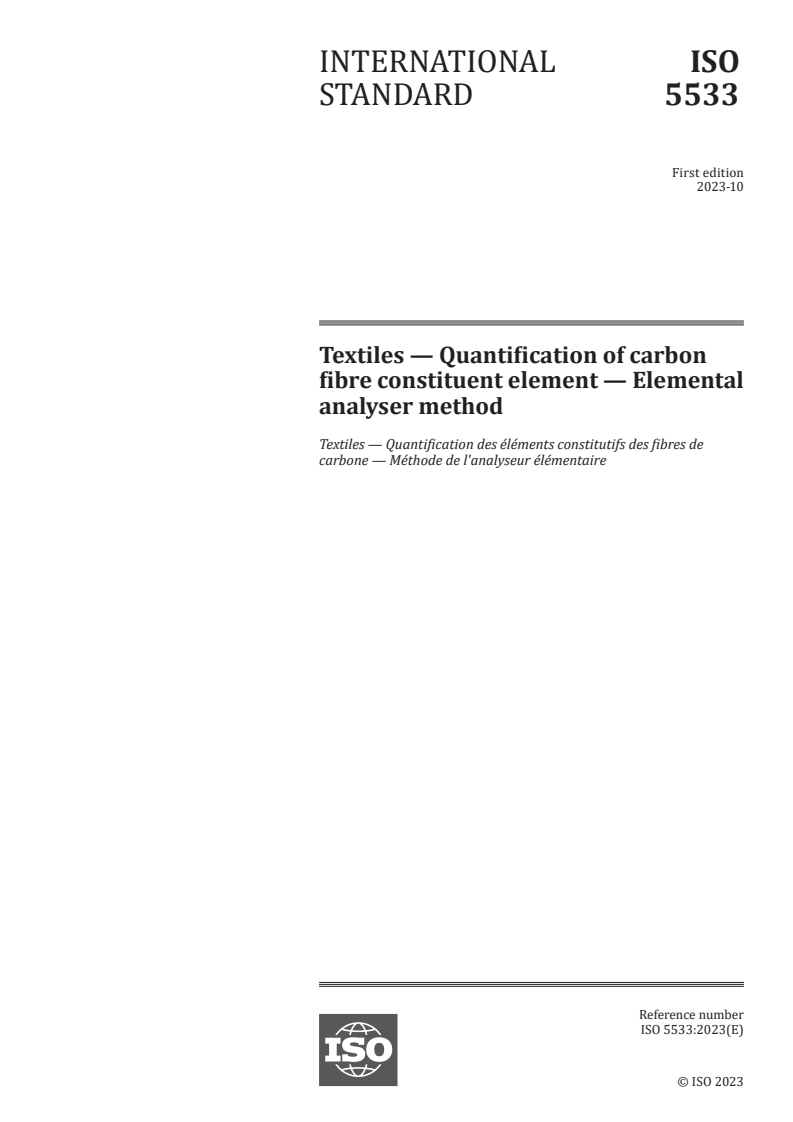
INTERNATIONAL ISO
STANDARD 5533
First edition
2023-10
Textiles — Quantification of carbon
fibre constituent element — Elemental
analyser method
Textiles — Quantification des éléments constitutifs des fibres de
carbone — Méthode de l'analyseur élémentaire
Reference number
ISO 5533:2023(E)
COPYRIGHT PROTECTED DOCUMENT
© ISO 2023
All rights reserved. Unless otherwise specified, or required in the context of its implementation, no part of this publication may
be reproduced or utilized otherwise in any form or by any means, electronic or mechanical, including photocopying, or posting on
the internet or an intranet, without prior written permission. Permission can be requested from either ISO at the address below
or ISO’s member body in the country of the requester.
ISO copyright office
CP 401 • Ch. de Blandonnet 8
CH-1214 Vernier, Geneva
Phone: +41 22 749 01 11
Email: copyright@iso.org
Website: www.iso.org
Published in Switzerland
ii
ISO 5533:2023(E)
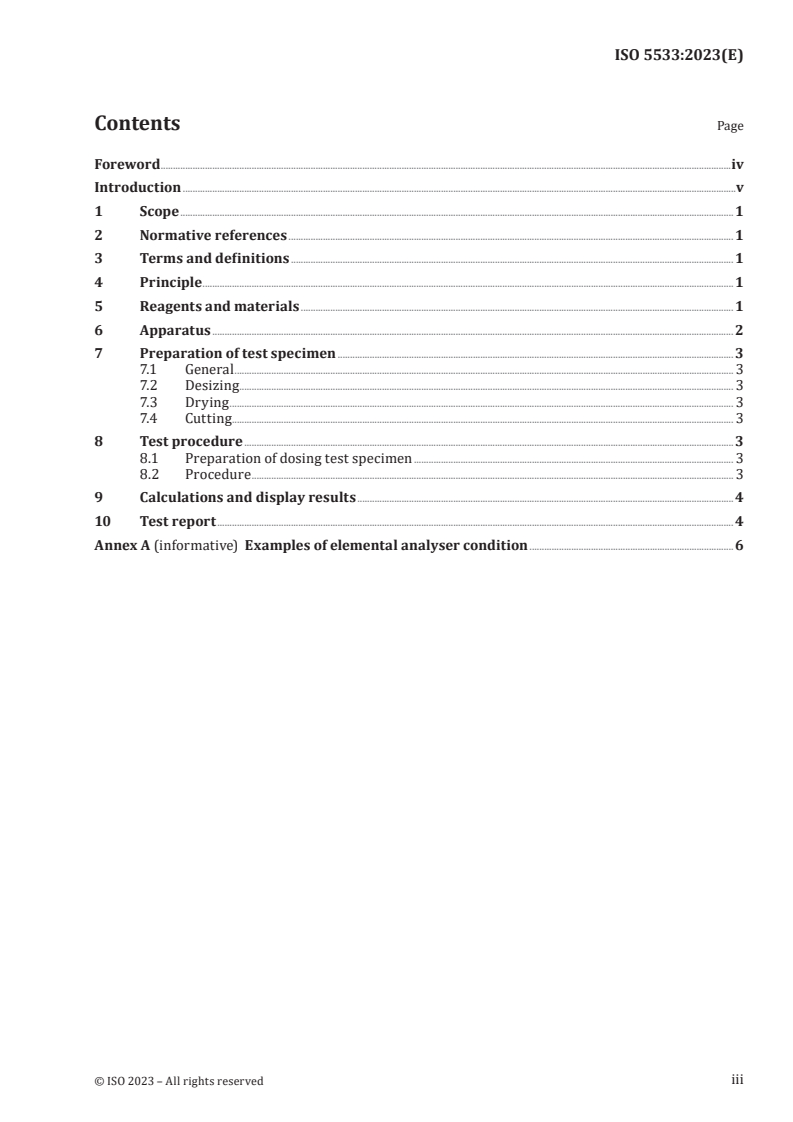
Contents Page
Foreword .iv
Introduction .v
1 Scope . 1
2 Normative references . 1
3 Terms and definitions . 1
4 Principle . 1
5 Reagents and materials . 1
6 Apparatus . 2
7 Preparation of test specimen . 3
7.1 General . 3
7.2 Desizing . 3
7.3 Drying . 3
7.4 Cutting . . 3
8 Test procedure .3
8.1 Preparation of dosing test specimen . 3
8.2 Procedure . 3
9 Calculations and display results .4
10 Test report . 4
Annex A (informative) Examples of elemental analyser condition . 6
iii
ISO 5533:2023(E)
Foreword
ISO (the International Organization for Standardization) is a worldwide federation of national standards
bodies (ISO member bodies). The work of preparing International Standards is normally carried out
through ISO technical committees. Each member body interested in a subject for which a technical
committee has been established has the right to be represented on that committee. International
organizations, governmental and non-governmental, in liaison with ISO, also take part in the work.
ISO collaborates closely with the International Electrotechnical Commission (IEC) on all matters of
electrotechnical standardization.
The procedures used to develop this document and those intended for its further maintenance are
described in the ISO/IEC Directives, Part 1. In particular, the different approval criteria needed for the
different types of ISO document should be noted. This document was drafted in accordance with the
editorial rules of the ISO/IEC Directives, Part 2 (see www.iso.org/directives).
ISO draws attention to the possibility that the implementation of this document may involve the use
of (a) patent(s). ISO takes no position concerning the evidence, validity or applicability of any claimed
patent rights in respect thereof. As of the date of publication of this document, ISO had not received
notice of (a) patent(s) which may be required to implement this document. However, implementers are
cautioned that this may not represent the latest information, which may be obtained from the patent
database available at www.iso.org/patents. ISO shall not be held responsible for identifying any or all
such patent rights.
Any trade name used in this document is information given for the convenience of users and does not
constitute an endorsement.
For an explanation of the voluntary nature of standards, the meaning of ISO specific terms and
expressions related to conformity assessment, as well as information about ISO's adherence to
the World Trade Organization (WTO) principles in the Technical Barriers to Trade (TBT), see
www.iso.org/iso/foreword.html.
This document was prepared by Technical Committee ISO/TC 38, Textiles.
Any feedback or questions on this document should be directed to the user’s national standards body. A
complete listing of these bodies can be found at www.iso.org/members.html.
iv
ISO 5533:2023(E)
Introduction
Carbon fibre has drawn much attraction in various industries due to its high stiffness, specific strength
and anti-corrosion. These outstanding properties of carbon fibre enable the expansion of its application
from textile usage to mechanical parts used in automobile and aircraft industry, if carbon fibre is used
as a reinforced component in polymer matrix.
In order to accelerate the trend of productization using carbon fibre, there is a prerequisite that the
carbon content in the fibre should be evaluated quantitatively. In addition, it is difficult to issue a test
report because even an accredited test organization cannot provide a clear method of quantification.
X-ray photoelectron spectroscopy is one of the measurement method suitable for analysis of chemical
components with quality and quantity. However, its detecting area is too small to cover the entire fibre.
This document aims to quantifz carbon content in textiles and textile products including PAN-based
carbon fibre using elemental analyser (EA) and gas chromatography (GC), successively. Furthermore,
this method can also analyse the contents of H and N, simultaneously.
v
INTERNATIONAL STANDARD ISO 5533:2023(E)
Textiles — Quantification of carbon fibre constituent
element — Elemental analyser method
1 Scope
This document specifies a quantitative measurement of chemical constituent element on carbon fibre
and its textile by an elemental analyser.
2 Normative references
There are no normative references in this document.
3 Terms and definitions
For the purposes of this document, the following terms and definitions apply.
...